
Writer. Director. Ex Financial Regulator.
Joined March 2009
- Tweets 10,736
- Following 1,047
- Followers 2,027
- Likes 110,295
371 Photos and videos

احسان Ehsan retweeted

The Iranian navy, which has been destroyed eight times, has apparently closed the Strait of Hormuz again, because the United States, for the seventh time, won the war that wasn’t a war, so now the United States has to open the Strait of Hormuz that was already open before the not-war began.
The not-war began because Iran had uranium that was totally, completely, beautifully obliterated, so they can’t build the nuclear bomb they weren’t building, which is why the United States had to start the not-war it definitely didn’t start.
Now the United States, which has nuclear weapons, is threatening to use nuclear weapons to stop Iran from getting nuclear weapons, because nuclear weapons are far too dangerous for countries with nuclear weapons to allow other countries to have.
If the United States saw the United States doing what the United States does in other countries, the United States would invade the United States to liberate the United States from the tyranny of the United States.
2,705
34,517
103,425
3,522,416
احسان Ehsan retweeted

May 29
The oil is the money.
Even more so if Tehran can repatriate the funds.
The Qatari frozen money is nice-to-have, but at, say, $75 a barrel, Iran makes ~$175 million a DAY in oil export revenue. That's >$5 billion in just one month. That's the real money. Check for oil waivers.
25
108
654
74,423

May 29
Ali’s rarely wrong. #IranWar
May 29

A well-informed source told me that Trump’s Truth Social post about lifting the blockade was, in fact, the first condition before moving to the next steps of the understanding.
According to the source, the Iranian side insisted on a formal public announcement first. Trump appears to have framed it as a secondary issue, while Tehran sees it as a key confidence-building measure before entering the more sensitive files.
So far, there has been no direct discussion of the nuclear file itself. The process is expected to move gradually through an MOU, where every step will be matched by a reciprocal step.
The same sources say a ceasefire announcement between Hezbollah and Israel is also expected as part of the broader framework currently taking shape.
205
احسان Ehsan retweeted

May 29
I respect those who are maintaining a healthy dose of skepticism, but fwiw, if the US is saying there's a deal and the Iranians are acting as though there's a deal, the odds are pretty good there's a deal.
108
47
380
79,009
احسان Ehsan retweeted
May 29
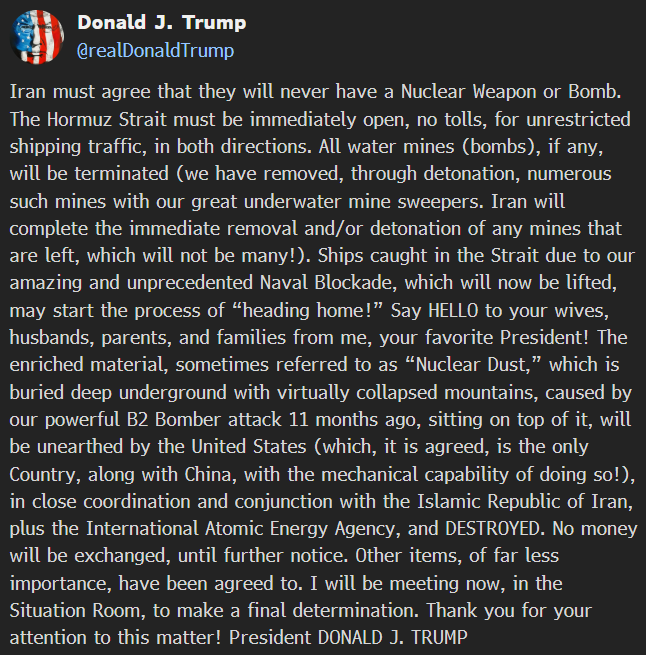
President Trump says he's "meeting now, in the Situation Room, to make a final determination" on a deal with Iran.
59
38
262
49,796
May 29
Good article. In a few short years, the UAE will advance dramatically in terms of missile and drone capabilities. Defensive capabilities already one of the best in the region. Offensive capabilities will get there quickly after studying this conflict.
May 28

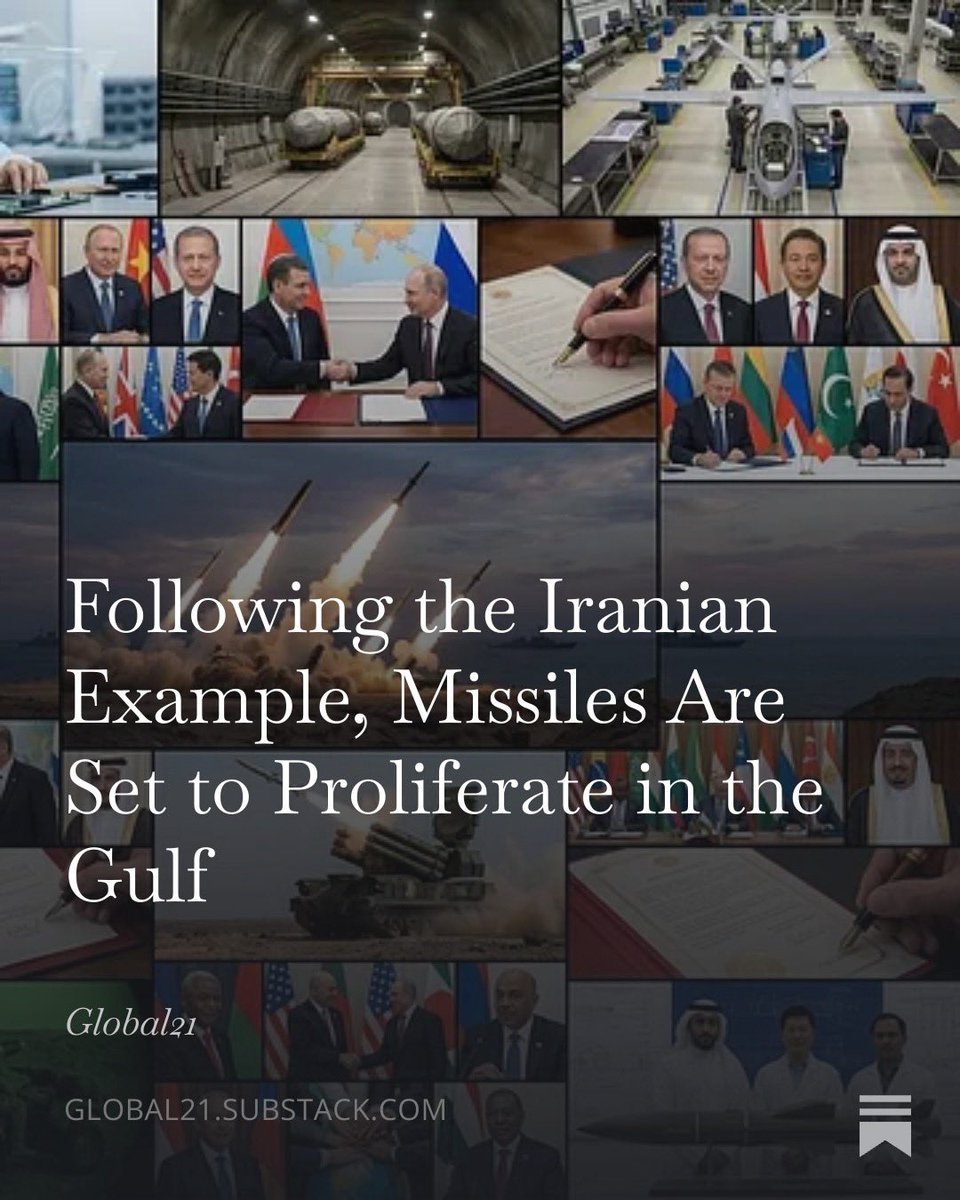
Following the Iranian example Missiles are set to proliferate in the Gulf
Never, not even the most optimistic Gulf analyst, would have said that any country in the region would be capable of facing two nuclear powers and remaining standing.
The Iranian military model, almost entirely based on asymmetric warfare, has sparked a broad debate in the Gulf regarding massive investment in missiles and drones to generate deterrence capabilities. Could the conventional warfare model, which has already cost the region’s countries hundreds of billions of dollars, have been the right choice?
The Iranian model is certainly flawed in terms of air defenses, but what system would be effective against 500 modern aircraft and more than 1,000 cruise missiles launched from ships
?
Hardly any system would maintain efficiency in such a scenario, especially within the Iranian geography. Having secure facilities that sustain a robust response capability is essential, no matter how much has been invested in air defenses.
Rains of missiles and drones have become a real deterrent force and will serve as an example for the entire region, starting with the Saudis, who have significantly accelerated their missile program.
The Vision 2030 program is moving at a fast pace, involving Chinese technology transfer, the construction of underground bases, and accelerated local production. In the last few months alone, approximately $11 billion in contracts were signed with non-American partners in the missile sector.
Saudi Arabia purchases Chinese missiles and also produces its own version, already utilizing a model of underground fortresses very similar to what the Iranians do.
In the case of the Emirates, they are already producing precision-guided missiles based on South African technology and attack drones based on Chinese technology.
The EDGE Group has acquired several companies around the world and is absorbing technology, working to soon introduce cruise missiles with the help of the French company Safran.
In May 2026, India and the United Arab Emirates elevated their partnership to include the joint industrial production of precision missiles and drones, with a projected investment of $5 billion. And the largest deal quietly moving forward would be the sale of the Indian BrahMos-NG missile to the UAE and Saudi Arabia.
Full article:
open.substack.com/pub/global…
105
May 28
How is this news? Of course the two leaders have to approve the deal after their staff puts it together. #IranWar
May 28

IRAN–U.S. DEAL REPORTEDLY BLOCKED AT TOP LEVELS
A source cited by i24NEWS claims that while an agreement was reached between Iranian negotiator Araghchi and the U.S. team led by Witkoff, it has not been approved by Iran’s senior leadership.
According to the report, Mojtaba Khamenei did not give approval, which may also be a factor in why President Trump has not given final consent.
66
احسان Ehsan retweeted

May 28
My latest oped on how the market is trading the peace talk headlines: agbi.com/opinion/oil-and-gas… #OOTT
5
13
55
8,801

Hormuz LNG flows resume
Another Adnoc-linked LNG tanker has crossed the Strait of Hormuz, with Umm Al Ashtan now signalling arrival in India on 31 May after loading at Das Island. Its voyage adds to a growing number of confirmed LNG transits through the route, following recent QatarEnergy-linked crossings toward Pakistan and China. For #LNG markets, the data point suggests Gulf exports are still moving, although exposure remains material given Hormuz handles about 20% of Gulf LNG flows.
Stay ahead of the market with #Kpler Insight: okt.to/iz8NUd
2
9
11
4,968
احسان Ehsan retweeted

May 28
May 28 (Reuters) - Pakistani Foreign Minister Ishaq Dar will visit Washington on Friday where he will meet with U.S. Secretary of State Marco Rubio, Pakistan's foreign ministry said on Thursday.
The visit comes as Islamabad is attempting to negotiate a peace pact to permanently end the U.S.-Israeli war with Iran.
1
14
49
10,227
May 27
This is true, however after settling it would climb back upwards at a steady pace. Market reactions to psychological wins tend to be short-lived. Reality kicks in afterwards.
May 27

Given how sharply oil futures have reacted to even the possibility of an Iran deal, I increasingly doubt the predictions of structurally high oil prices for the rest of the year.
Markets are beginning to realise that once geopolitical risk starts easing and Hormuz flows gradually normalise, the world could quickly move back toward an oversupplied market.
My sense is that if a deal materialises and escalation is avoided, we may well see oil settling back into the high $70 to low $80 range later this year.
1
61
احسان Ehsan retweeted
May 27
Once the strait opens we’ll find out the true extent of the damage caused by the war on the Gulf’s energy infrastructure. I’m expecting a fast recovery in production from Saudi Arabia and the UAE (within 3-4 weeks), other countries will take months to recover. #GCC #OOTT
31
44
226
41,650
احسان Ehsan retweeted

May 27
IRAN-US DRAFT FRAMEWORK LINKS HORMUZ ACCESS TO SECURITY DEAL
Iran’s state TV reports a draft, unofficial framework for a MoU with the U.S. outlining a potential deal on the Strait of Hormuz.
The draft says U.S. forces would withdraw from areas near Iran and lift a naval blockade, while Iran would restore commercial shipping through Hormuz to pre-war levels within one month. Military vessels are excluded.
Iran would manage shipping routes in coordination with Oman. If a final agreement is reached within 60 days, it could be turned into a binding UN Security Council resolution.
Iran also stressed the framework is not finalized and that no steps will be taken without “tangible verification.”
83
125
800
217,971
May 27
What’s Iran’s “vicinity”?
May 27

May 27 (Reuters) - Iran's state TV said Tehran had obtained a draft of an initial unofficial framework for a memorandum of understanding with the U.S.
Under the framework, Iran would restore commercial shipping through the Strait of Hormuz to pre-war levels within a month, while the U.S would withdraw military forces from Iran's vicinity and lift a naval blockade
24
احسان Ehsan retweeted

May 27
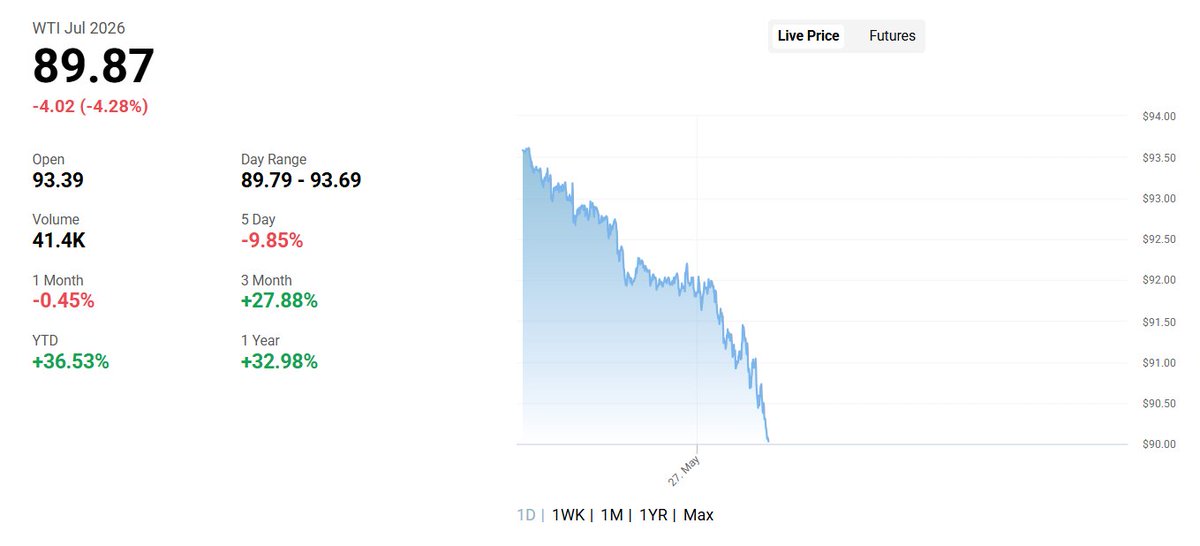
WTI now below $90 as traders bet on peace deal breakthrough 👀
oilprice.com/futures/wti/
8
15
95
8,729
May 27
Take with a grain of salt, but interesting nonetheless.

بدأت الإمارات خطوات حذرة ومدروسة لخفض التصعيد مع إيران
64
May 27
I don’t recall them ever saying chances are low.
May 27

BREAKING: IRGC Navy official Mohammad Akbarzadeh says renewed war with the US is unlikely but warns Iran’s forces are lying in wait and will turn the coast into a “graveyard for aggressors”, Iran’s semi-official Tasnim News reports.
🔴 More on Aljazeera.com
61