
10 years of proprietary index futures research → on-chart structure for prop firm traders. Session levels, real-time context. On TradingView.
Joined May 2024
- Tweets 140
- Following 253
- Followers 16
- Likes 8
62 Photos and videos
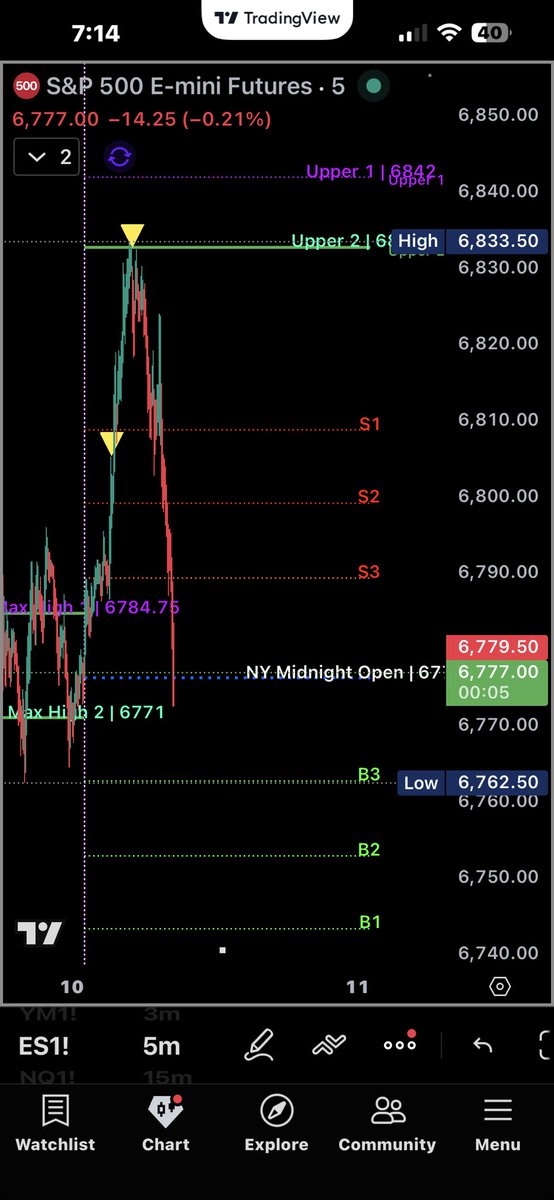
















Most traders fail evaluations not because their strategy was wrong.
They fail because they did not have a process. Or they had one and abandoned it on Wednesday when things got hard.
Structure is not optional. It is the product.
#TradingStrategy
2
Trailing drawdown is the rule that kills more funded accounts than bad trades.
Not because it is complex. Because it is not static. And most traders treat it like it is.
Here is a trade-by-trade walkthrough of how it actually works.
#FuturesTrading
1
8
EOD trailing drawdown: the floor only moves at end of day. If you make 500 dollars intraday then give it all back, your floor does not change.
Intraday trailing: the floor moves on every tick of unrealized P&L. Much harder.
Know which one your firm uses. It changes everything.
7
80% of funded traders fail. Not from bad trades. From unmanaged drawdown.
Most traders do not have a drawdown management framework. They have a vague intention to be careful.
Here is the quantitative approach.
#FuturesTrading
2
1
6
Step 1: Calculate your daily risk budget.
Step 2: Size to survive 5 consecutive losers.
Step 3: Use MAE data to set stops (78.1% of winners need less than 1 point).
Step 4: Three losses in a day means stop trading.
Simple. Specific. Survivable.
1
5
Before you trust any backtest result, ask:
Was entry on the signal bar or the next bar?
Were duplicates removed?
Were roll boundaries checked?
Were outcomes independently verified?
If the vendor does not understand these questions, run.
#TradingView
16
16 validation tests.
6 phases.
3 independent implementations.
10 random trades reconstructed bar-by-bar against raw data.
All verified. All documented. All published.
That is the work most indicator vendors skip entirely.
#Backtesting
9
Before any result was published, every indicator in the Algorithmic Suite passed through a 16-point validation suite.
Signal pagination. Duplicate detection. Lookahead bias. Trade reconstruction. Supabase cross-reference.
15 pass. 1 review. 0 fail.
#FuturesTrading
1
11
We caught a bug that inflated a key risk metric by 9x.
The backtest still ran. The numbers still looked plausible. Nothing crashed.
The results were just wrong. That is why validation suites exist.
1
7
Three independent implementations — TradingView, Python, Database — must produce identical outputs.
If they disagree, something is wrong and it must be found before anything is published.
algorithmic.io/blog
13
45 target/stop combinations tested.
Bonferroni-corrected threshold: 0.0011.
34 of 45 passed.
More than three quarters of the parameter space produces a genuine, statistically verified edge.
That is not one lucky combination. That is a structural result.
#Backtesting
6
We tested 45 target/stop combinations. That creates a multiple comparisons problem.
Bonferroni correction divides the significance threshold by 45. Only results that survive alpha = 0.0011 count.
34 of 45 passed.
#QuantTrading
1
5
Most retail backtests test dozens of parameter combinations and present the best one.
Without multiple testing correction, that is statistical fraud — even if unintentional.
1
6
The framework also checks for lookahead bias (none found), same-bar tie-breaks (negligible impact), and entry timing integrity (100% clean forward-walk).
Every integrity check passed.
algorithmic.io/blog
5
14 levels tested independently.
14 out of 14 profitable.
Barely 5 percentage points separating the strongest from the weakest.
The edge is distributed across the entire structure. Not one lucky line surrounded by noise.
#AlgorithmicTrading
2
There is a failure mode hiding inside almost every multi-level indicator suite.
One or two levels carry the entire result. The rest are noise.
We tested all 14 levels independently. All 14 are profitable.
#FuturesTrading
1
3
The spread across all 14 levels: barely 5 percentage points from strongest to weakest.
No level dominates. No level is dead weight. The edge is distributed, not concentrated.
1
1
Signal decay test: later visits to the same level are slightly stronger than first visits.
Bull/bear balance: 50.4% vs 49.6%. Perfectly neutral. No directional bias.
algorithmic.io/blog
1
If your equity curve looks great but you have never run a stationarity test on it, you do not know if the edge is real or if you got lucky in one stretch.
The ADF test takes five minutes. Run it.
#TradingStrategy
9
Most traders look at an equity curve and think up is good.
That is true but incomplete. The statistical properties of the curve tell you whether the edge is real or decaying.
Stationarity test. Autocorrelation test. Regression analysis. All passed.
#Backtesting
12