
53 Photos and videos








IMO, the Vedas are everything in one. Chanting them after necessary refinements to the mind, and with intent, one can get revelations about science, as much as about spirituality or surgery.
In the age of AI, I will request you to think of the Vedas as quantized, compressed version of a lot of revealed knowledge distilled into the most efficient, lossless sounds called mantras.
Most people may, at most, appreciate their rhythms while they see religious intent mostly with bits of philosophy and spiritual instructions here and there.
It's like someone appreciating an AI model's training weights and the output they see using a low level computer without having the powerful hardware or knowhow to extract the best knowledge.
A truly determined seeker will improve this hardware (or his brain and mind) to be able to extract much knowledge out of the quantized and distilled model (or the Vedas).
To the credit of the Vedas, they even provide the necessary steps to build and improve the hardware (body and mind) to extract the knowledge. Many seekers from Patanjali to Sankara have developed complete systems on how to do this.
But even if all these systems are lost, and only the sounds of Vedas remain in human consciousness, it will still enable more Patanjalis and Sankaras to emerge and develop systems to realize the Universe complete with all its knowledge. This is the beauty of the Vedas.
This is why the Vedas were never just "religion". They are a complete epistemic system engineered for precision, revelation, and infinite expansion of knowledge in our simulation.
They enable us to see the entire source code of the simulation (past, present, and future) or access just parts of it to in-vivo improve our experience (by creating science & tech with the revealed knowledge).
@bubbleboi is in the process of realizing this, do read👇
May 25

I’ve been reading the Vedas a lot recently, and what’s stood out is how it doubles as an encyclopedia as well as a religious text. Astronomy, medicine, mathematics, metallurgy, linguistics, are all woven through hymns and rituals as one body of knowledge. Simply calling it “religious” forces it into a Western category that didn’t have the apparatus to recognize what it actually was. It’s closer to a tradition of formalized epistemology in which metaphysics, observation, and language form one continuous inquiry, which as a result led Indian civilization to develop along a fundamentally different path because of it.
You can see the effect most clearly in the sciences. Around 600 BCE, the Vedic record describes a surgical procedure that matches modern rhinoplasty and is still foundational to reconstructive surgery today. Centuries before Western Europe stopped treating eclipses as supernatural, Indian scholars had calculated the circumference of the earth within 0.2% and explained eclipses as shadows. Centuries before Plato and Aristotle rejected atomism, the Vedic tradition already held that matter is composed of indivisible particles combining into binary and triatomic compounds, transformable by heat. The first formal rules for zero and negative arithmetic appear in the Vedas, along with infinite-series derivations of π, sine, and cosine centuries before Newton and Leibniz.
The interesting question is how did they get so much right, so early? My best guess is language.
The Vedic tradition is unique compared to other oral traditions as it demanded letter-perfect oral transmission across generations. Around 500 BCE, scholars composed a generative grammar of Sanskrit called Panini so rigorous it anticipates Backus-Naur form, the notation that defines programming languages today, by 2,500 years. Sanskrit is recursive, rule-based, and built to minimize ambiguity. It reads more like mathematics than English.
When you think in a language built like that, the precision of the language becomes the precision of your reasoning. The West didn’t formalize this until much later. Kant argued our categories of understanding shape what we can know, Wittgenstein wrote that the limits of language are the limits of one’s world, and Kripke showed that naming doesn’t just describe things, it constitutes what they mean and how we can reason about them. All three touch the same insight which is that thought is downstream of language.
The Vedic tradition operated on that insight thousands of years earlier. To the point that they built a whole language first and used it to think clearly about everything else after. I find that all really fascinating.
77
534
3,348
120,443
We must get this culture of appreciating fellow Indians on our side for good work, ignoring when they miss the mark or say stuff we don't agree with, and criticize less.
This is what Americans, the left, Islamists, Chinese do and that helps them team up and do great things together. They praise in public and give feedback in private.
We Hindus on the other hand are quick to criticize our own side people, if they even slightly differ in views, yet very stingy when it comes to appreciation. We seldom encourage others or team up to work together against the common enemy.
On X itself, I see, many handles which are on the same side as me and speaking in national interests will be very quick to catch me if I get something wrong, criticize immediately if what I say isn't agreeable, and try to create arguments just for the sake of it.
Very rare to find them sharing my post appreciating. It discourages the other and kills any prospect of team work to fight the common adversaries. This culture needs improvement.

He always done great job , but salute just for asking a normal question 🙄why r we so obsessed with such silly things
65
433
2,556
70,035
I have an intuitive hypothesis. The more time you spend in nature and observing natural things, the more will be your lifespan.
There have been scientific research like "hospital beds with a tree outside the window have lower mortality rates."
The universe wants you to observe itself. The universal consciousness (brahman) uses your consciousness (atman) to enjoy its creations.
So the more time you spend in nature being mindful, observing, and enjoying natural things like plants and animals, the more you will be kept alive.
The universe needs to understand and enjoy itself using itself - that's every conscious being including you. Animals can observe a lot more of nature but they can't appreciate.
So go out everyday to a park and have a mindful walk observing and enjoying nature. Or fill your space with nature and pets to enjoy them. Take some time to do so.
Human creations can also be enjoyed. But they only give second order effects to help you stay alive and healthy.
The best is to be Sir David Attenborough. Travel the world, see and enjoy a lot of nature and natural creations, and live up to a 100 healthy and appreciated by the rest of the universe.
Btw, if you have a doubt about my hypothesis, astronomers who do observational astronomy watching and discovering a lot of celestial objects too tend to live long and healthy lives ;)
May 8

A 32-year old David Attenborough with the then 10-year old future King Charles III (1958).
Today, he turned 100.

132
632
4,803
221,137
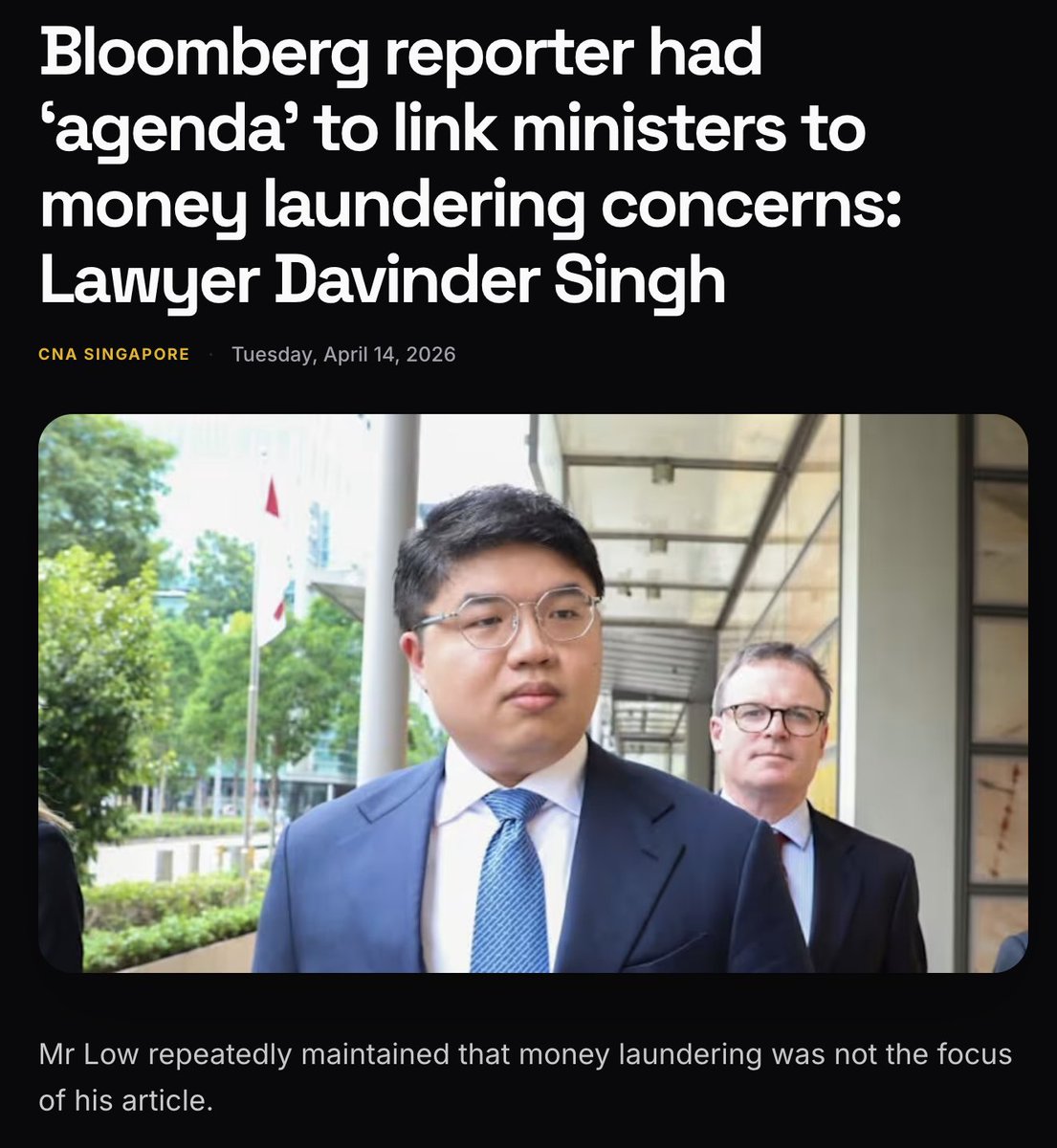
This is how it is done. India needs to learn from the small, yet self-respecting and sovereign, country of Singapore.
A Bloomberg reporter called Wei, likely a GLISCO-DS plant, tried to throw mud on some Singapore ministers. To try rock their govt and influence their politics.
He posted fake news on these ministers alleging some corruption. Just like Reuters, Bloomberg, FT, Economist, BBC are used to create trouble in Indian politics with fake news.
But the Singapore ministers sued Bloomberg.
Now it is becoming more and more clear, the Bloomerg reporter had purposefully tried to implicate the ministers into a scandal writing these fake news reports.
This is probably the end of his career. Bloomberg too will incur large costs. They won't leave him.
Remember, this small island nation did not leave one teenage American boy who did some mischief in spite of humongous American pressure.
They surely aren't going to allow foreign agents run copycat DS methods to try interfere in their politics to suit its needs for a new world order.

145
1,286
5,245
168,310
Amar R retweeted

Apr 13
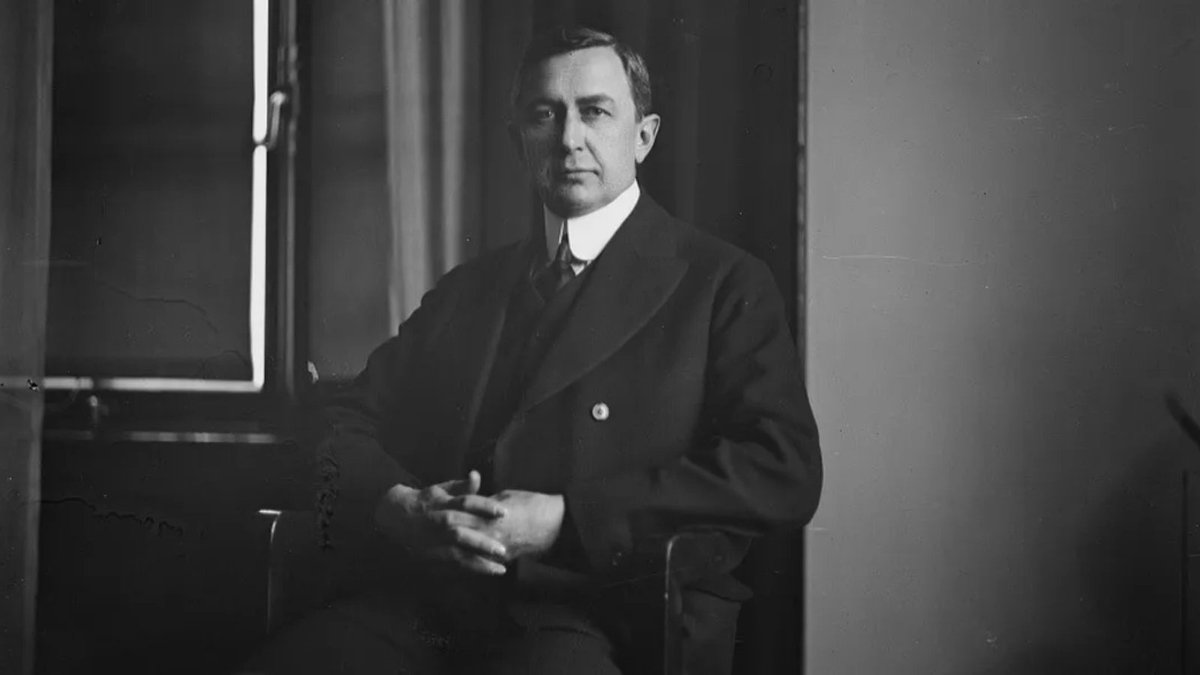
Charles Schwab ran the largest steel company in the world.
He had access to every consultant, every system, every productivity tool available in 1918.
He said a 15-minute conversation with a man named Ivy Lee was the most valuable business advice he ever received.
He paid him $25,000 for it. The advice fit on an index card.
Ivy Lee was not famous. He was not a philosopher or a scientist or a professor at a prestigious institution. He was a productivity consultant who had spent years watching extremely capable people fail to do their most important work, and he had developed a precise theory about why.
The theory was not complicated. It was uncomfortable.
The reason most people never do their most important work is not that they lack time. It is that they never decide what their most important work actually is. They arrive each morning at a pile of tasks with roughly equal claim on their attention, choose based on whatever feels most urgent or easiest in that moment, and spend the day moving through a list that was never designed to move them forward. They are busy in a way that feels productive and accomplishes far less than it should.
Lee asked Schwab for 15 minutes with his executive team. Schwab agreed. Lee walked them through six steps. He asked them to try it for three months and pay him whatever they thought it was worth.
Here is the system.
At the end of every workday, write down the six most important things you need to accomplish tomorrow. Not ten. Not twenty. Six. If you cannot decide what matters enough to make that list, you have already identified the real problem.
Prioritize those six items in order of their true importance. Not urgency. Not ease. Importance. The thing that will matter most three months from now goes first, regardless of how uncomfortable it is to start.
When you arrive the next morning, begin immediately on item one. Work on it until it is finished. Do not touch item two until item one is complete. Do not check email. Do not attend to whatever walked through the door. Item one, until it is done.
Move through the list in order. If you reach the end of the day and items four, five, and six remain untouched, move them to the next day's list without guilt. They were not the most important things. The most important things got done.
Repeat this process every day for the rest of your working life.
That is the entire system. Six steps. Four minutes the night before. No app required. No morning ritual. No tracking software. An index card and a pen.
What Lee understood that most productivity systems miss entirely is that the bottleneck in human performance is almost never capacity. It is prioritization. The average knowledge worker has more than enough hours in the day to accomplish something significant. What they do not have is a forcing function that makes them decide, the night before, in a calm moment free from the noise of the incoming day, what significant actually means for them tomorrow.
The morning is the worst possible time to make this decision. The morning brings email and notifications and other people's priorities and the accumulated urgency of everything that did not get done yesterday. By the time most people have decided what to work on, an hour is gone and the decision was made by their inbox rather than by them.
Lee's method moves the decision to the evening, when the day's noise has settled and the mind can assess without distraction. The prioritization is done before the chaos begins. Which means the next morning, there is no decision to make. There is only execution.
The second insight embedded in the system is the single-tasking constraint. Item one, until it is finished. Not item one until something more urgent appears. Not item one until you have checked in on items two through six. Item one, finished, before anything else receives your attention.
This runs against every instinct that modern work has trained into people. The entire infrastructure of the contemporary workplace is designed to fragment attention. Email expects a response within hours. Slack expects a response within minutes. The open office assumes that any question is more important than whatever the person being asked is currently doing. The result is a workforce that is in constant motion and making almost no progress on anything that actually matters.
Lee's method is a direct refusal of this dynamic. It does not negotiate with urgency. It does not make exceptions for whoever shouts loudest. It asks you to decide, once, what matters most, and then protect that decision from everything that will try to override it the next morning.
Charles Schwab ran Bethlehem Steel. He had seven hundred employees. He had more operational complexity, more competing demands, more legitimate urgency than most people reading this will ever face.
He tried the system for three months.
Then he sent Ivy Lee a check for $25,000 and a note saying it was the most valuable business advice he had ever received.
The system has not changed. The morning has not gotten less chaotic. The inbox has not gotten smaller.
The only variable that was ever under your control was what you decided the night before.
Six things. In order. Starting with the first.
The most valuable productivity advice in history is still free.
Most people will read it, find it obvious, and go back to checking email.
85
702
3,266
491,182
Amar R retweeted

Mar 22
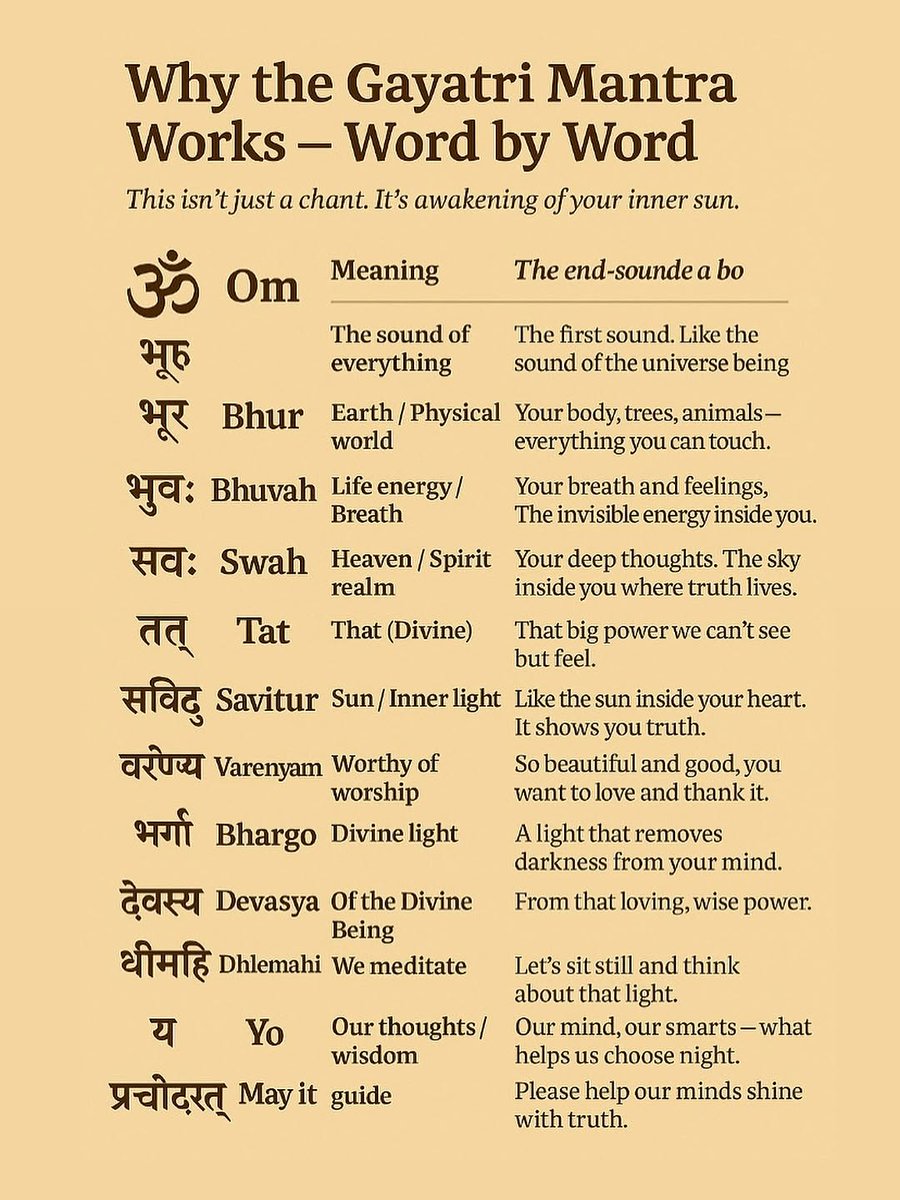
This is not just a mantra…
It’s a complete science of mind, breath & energy 🕉️
The truth behind Gayatri Mantra 👇
45
341
932
19,237

120 seconds. Spot the fraud

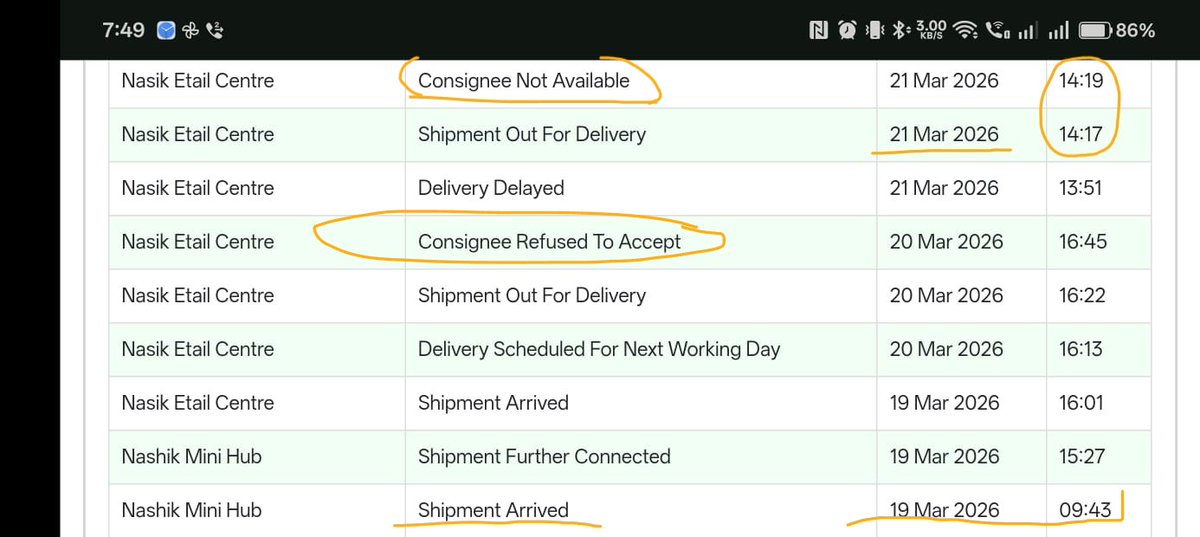
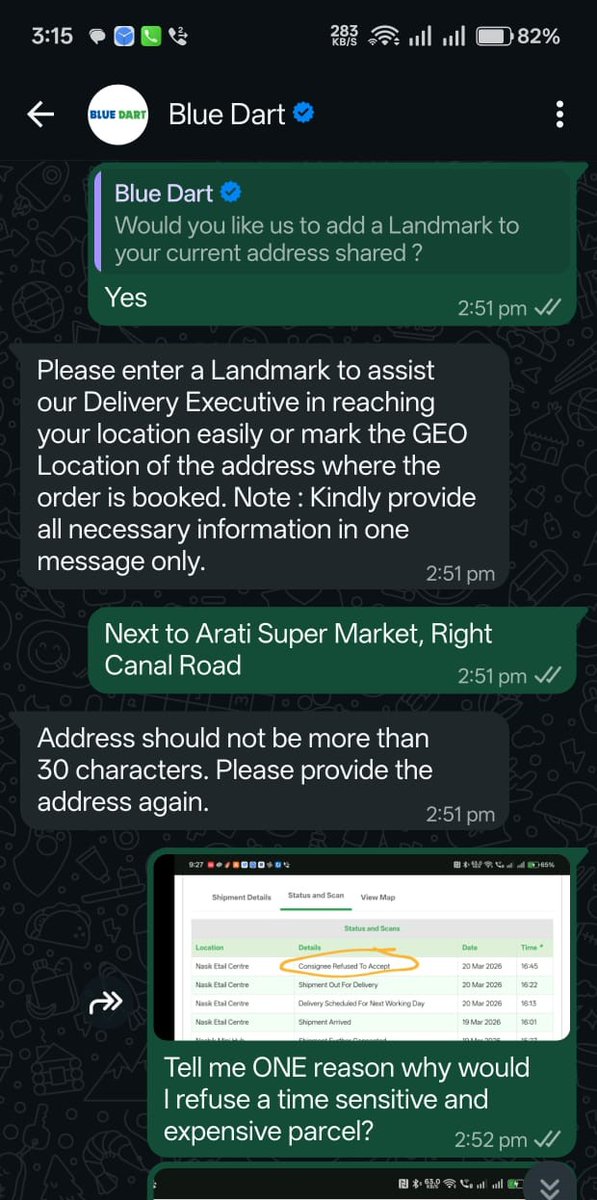
Dear @BlueDart_Official — what exactly is happening in Nashik?
A time-sensitive shipment lying just 2 km away for 48 hours… and your system says:
“Consignee Refused to Accept.”
This isn’t a mistake. This is blatant misinformation.
15
Just reply ‘same’ if you’ve faced courier fake delivery attempts- testing something...
x.com/Amar_gr/status/2035365…

If delivery is not possible in my location, then why was the shipment accepted in the first place? Customers or the company are paying for delivery, so why should the customer go to the courier office for self pickup?
Netmeds Order ID: FY69B32AC90ED8D37E37
9
Just reply ‘same’ if you’ve faced courier fake delivery attempts- testing something...
x.com/Amar_gr/status/2035365…

Your tracking page now says “delivery unsuccessful”, yet no one contacted me and your Abuja office isn’t answering calls.
This level of service is unacceptable. Please resolve this urgently.
12
Just reply ‘same’ if you’ve faced courier fake delivery attempts- testing something...
x.com/Amar_gr/status/2035365…
Mar 14

@delhivery
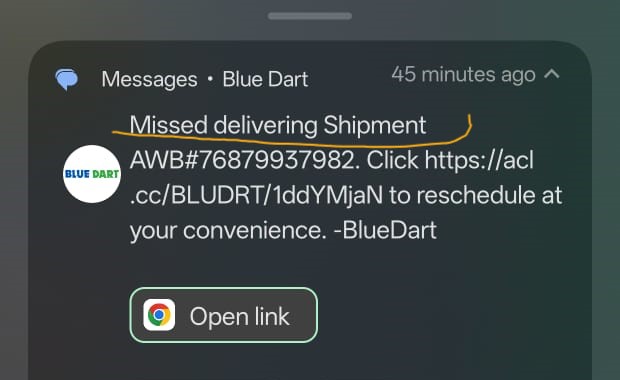
Very poor delivery experience. My parcels are repeatedly marked “Out for Delivery” but never delivered,saying delivery was attempted or calls were made, which is not true.
Earlier AWB: 7411341451512
Current AWB: 34466717698025
Kindly investigate this issue.
13
Just reply ‘same’ if you’ve faced courier fake delivery attempts- testing something...
x.com/Amar_gr/status/2035365…
Mar 20

@HDFCBank_Cares @HDFC_Bank @BlueDart_ @BlueDartCares Bluedart never attempted delivery but closing saying I am not available. Happened twice already. Not sure why this misinformation.
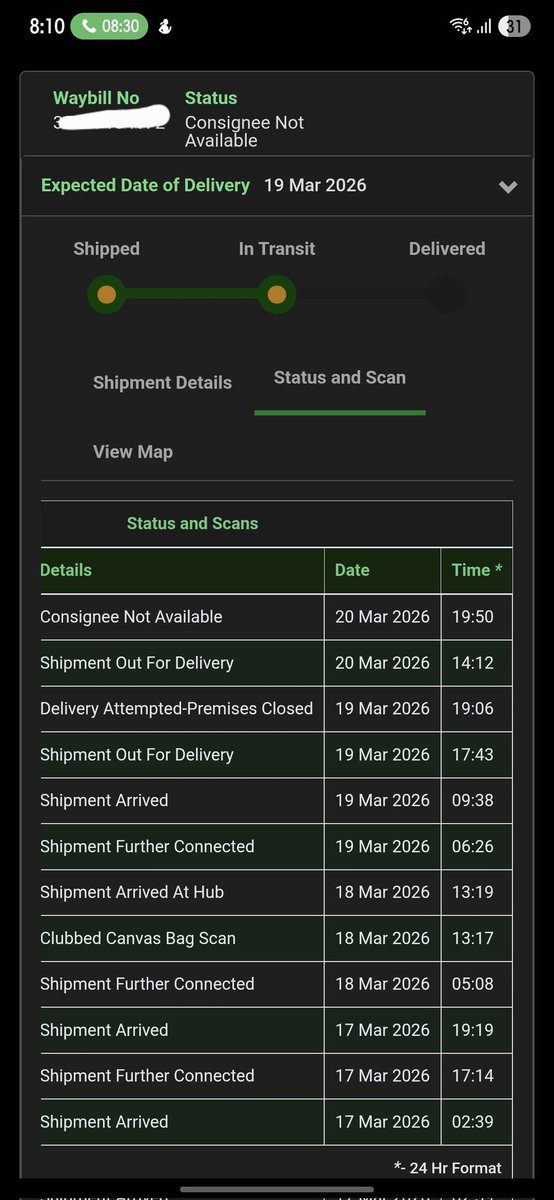
8
I'm seeing the exact same pattern in Nashik- even getting 2-minute ‘delivery attempts’ 👇
x.com/Amar_gr/status/2035365…
Mar 17

Hey @BlueDart_ I am extremely frustrated with the service. My order has not been delivered despite paying full shipping charges. This has become a recurring issue where Blue Dart simply fails to deliver.
64
I'm seeing the exact same pattern in Nashik- even getting 2-minute ‘delivery attempts’ 👇
x.com/Amar_gr/status/2035390…
Why are you accepting shipments if you cannot deliver them to the customer’s address?
My medicine order from Netmeds is with Blue Dart but it is not being delivered and the status is being marked incorrectly as “Address Incomplete” without even contacting me.
21
I'm seeing the exact same pattern in Nashik- even getting 2-minute ‘delivery attempts’ 👇
x.com/Amar_gr/status/2035390…
21
I'm seeing the exact same pattern in Nashik- even getting 2-minute ‘delivery attempts’ 👇
x.com/Amar_gr/status/2035390…

@BlueDartCares Hi , My consignment reached in destination on 18th march, but it's 5 days but blue dart has not delivered my consigment yet. And they are putting false status that consignee not available..
Request please look into the matter...
34
I'm seeing the exact same pattern in Nashik- even getting 2-minute ‘delivery attempts’ 👇
x.com/Amar_gr/status/2035390…
Mar 12

This incorrect update has delayed my delivery and is misleading. Because of this, I’m starting to lose trust in both Blue Dart’s delivery service and Myntra’s fulfillment process. Please clarify why this false status was added and ensure delivery without further delay.
118
I'm seeing the exact same pattern in Nashik- even getting 2-minute ‘delivery attempts’ 👇
x.com/Amar_gr/status/2035390…
Mar 12

@HDFCBank_Cares Disappointed with HDFC Bank using Blue Dart. My shipment scheduled today (13 March 2026) has no call, update, or delivery person’s number. Urgent action required to ensure delivery without further delay.
Waybill: 35886015093
50
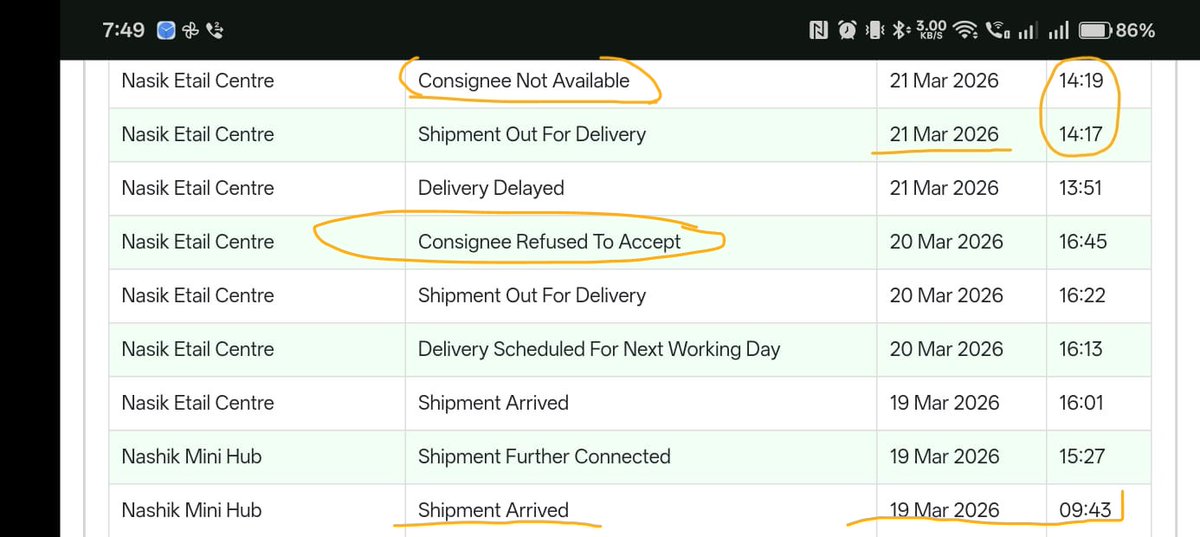
Out for delivery: 14:17
Consignee not available: 14:19
I was at home the entire time.
So the executive reached, attempted, failed & updated status… all in 120 seconds?
Nashik- does this sound familiar? 👇
@BlueDart_Official @BlueDartCares
#Nashik #BlueDart #ConsumerRights
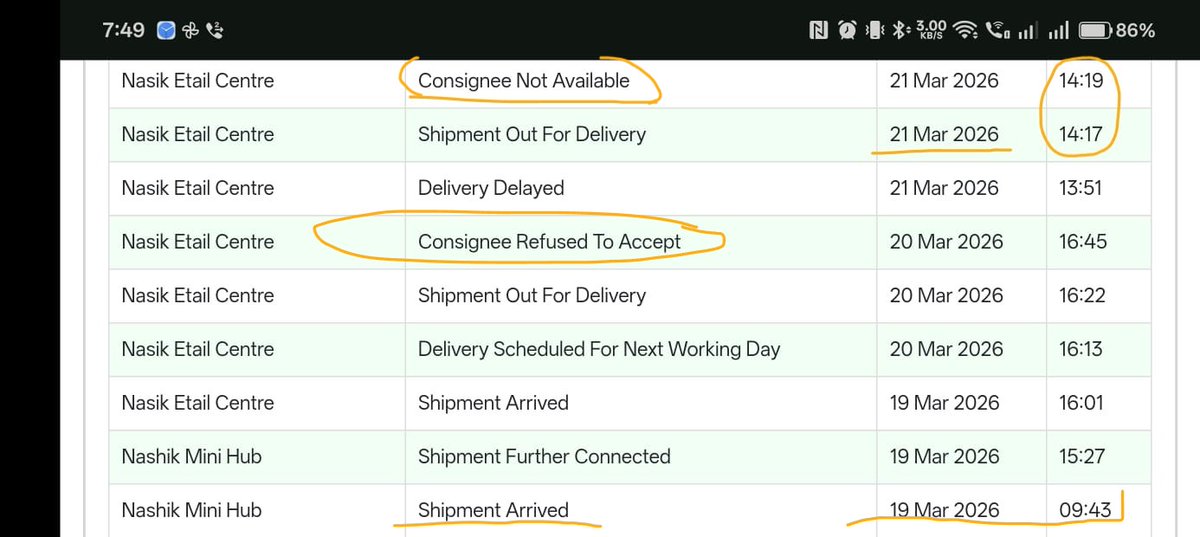
Out for delivery: 14:17
Consignee not available: 14:19
A 2-minute delivery attempt.
So the executive reached, attempted, failed, & updated status… in 120 seconds?
Nashik- does this sound familiar? 👇
@BlueDart_Official @BlueDartCares
#Nashik #BlueDart #ConsumerRights
1
115
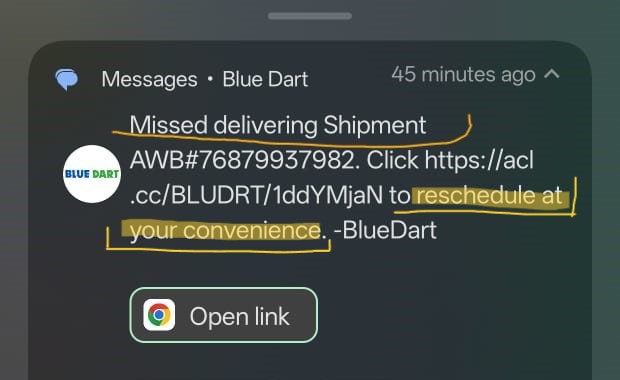
Out for delivery: 14:17
Consignee not available: 14:19
A 2-minute delivery attempt.
So the executive reached, attempted, failed, & updated status… in 120 seconds?
Nashik- does this sound familiar? 👇
@BlueDart_Official @BlueDartCares
#Nashik #BlueDart #ConsumerRights
1
1
151