
The history of the Veda is the history of humanity…
Joined September 2022
- Tweets 4,803
- Following 162
- Followers 6,889
- Likes 1,448
14 Photos and videos

Amazing Vedas retweeted

"Asura" thus begins as a generic term for powerful beings, the usage gradually specified to refer to beings who are powerful without necessarily being wise or good, a natural progression.

What is an Asura?
In the Veda the asura is a being of power. The dhatu is asu- which means life breath or vital power
Thus, Indra, Varuna, Mitra etc are called Asuras in the Veda
By the time of the Puranas the word took on a negative connotation, or rather, the force of the Asura was seen as separate from Truth. The suras became beings of light and asuras the beings of power
In the Rig Veda, the asura is the Lord. This is why in ancient Iran, Ahura Mazda began to be worshipped. Ahura is related linguistically to Asura
@MakrandParanspe
2
7
264
What is an Asura?
In the Veda the asura is a being of power. The dhatu is asu- which means life breath or vital power
Thus, Indra, Varuna, Mitra etc are called Asuras in the Veda
By the time of the Puranas the word took on a negative connotation, or rather, the force of the Asura was seen as separate from Truth. The suras became beings of light and asuras the beings of power
In the Rig Veda, the asura is the Lord. This is why in ancient Iran, Ahura Mazda began to be worshipped. Ahura is related linguistically to Asura
@MakrandParanspe
9
4
37
2,853

Jun 15
In Rig Veda 1.4.4 the Rishi says something curious
He says that Indra, whose mind is clear in its sight, needs to be questioned, पृच्छा विपश्चितम्
Why does Indra need to be questioned? That seems disrespectful. But this is the Indic tradition
Even the devas need to be questioned so that the yoga is established on solid grounds, not on blind following, validated constantly on solid footing
We see this tradition of profound questioning continued in the Upanishads and the Bhagavad Gita. But this questioning needs to be felt and lived deeply and not be just a superficial or intellectual shadow boxing only
@MakrandParanspe
2
7
30
2,225
Jun 15
Plato was a famous Greek philosopher who is not fashionable anymore. But he was profound and difficult to explain
But it is easier to understand him if one begins to understand Indra
Plato’s theory was that there is a world of perfect Forms or Idea that is permanent and apart from our imperfect world
Indra is the pinnacle of mind where he creates the perfect Form or Idea सुरूपकृत्नुम
which gets translated into our imperfect world
Plato’s world was fixed. Indra is dynamic and creative. But they both describe a world that is Ideal and is to be aspired for and translated into our imperfect world. The Veda shows how we can reach Indra
@MakrandParanspe
2
3
9
1,054
Amazing Vedas retweeted

Yes we need to develop secular language and logic of Dharma and Devas with semi ontology and metaphysics without the parts that is not intutive to most people. I think it is very much possible.
1
1
1
154
Amazing Vedas retweeted

Jun 14
RV 1.5.3 is a more utilitarian use of “योग “ . RV 5.81.1 is a clearer eg of yoga as union of mind, moody & soul (quoted in TS4.1 & TA 4):
यु॒ञ्जते॒ मन॑ उ॒त यु॑ञ्जते॒ धियो॒ विप्रा॒ विप्र॑स्य बृह॒तो वि॑प॒श्चित॑: । वि होत्रा॑ दधे वयुना॒विदेक॒ इन्म॒ही दे॒वस्य॑ सवि॒तुः परि॑ष्टुतिः ॥
3
2
975
Amazing Vedas retweeted

Jun 13
Most people read ancient scriptures as mythology.
Rupa Bhaty looked deeper.
An Architect and Adjunct Assistant Professor at the Institute of Advanced Sciences, Massachusetts, she explores Indic scriptures through the lens of science, archaeoastronomy, mathematics, and forgotten knowledge systems.
Were the Vedas recording celestial events with remarkable precision?
Did ancient Indians understand astronomy far beyond what we assume today?
From the Rig Veda and the Battle of Ten Kings to nakshatras, cosmic observations, and untold stories of women, warriors, and sages-this conversation challenges us to look again.
Not to blindly believe.
But to question, explore, and decode.
Because sometimes history isn't lost.
It's waiting to be rediscovered.
11
215
318
5,658
Jun 13
“Explain the Veda to me without your mystical hocus pocus please.”
I accepted the challenge. It is like being in love, I said. What happens to you when you’re in passionate amor?
“Well, the whole world reminds you of her.”
Yes, and what happens to you? Are you on fire?
“Yes,” he said
Well, that is Agni. And then what happens?
“Well, you are happy.”
You are lit. And you are in bliss. That is soma. What else happens?
“Everything changes.”
Yes, your life, that is Vayu; it becomes beautiful. Your brain is full of light; that is Indra. You are caring and expansive; those are Mitra-Varuna
“Is this it? Really?”
Well, almost. That is the joy of great art and literature, is it not? It applies to you, wherever you are. But that love thing being Agni. I meant it and you better believe it
Another ghar vaapsi accomplished. Perhaps the problem was never Gen Z. It is how I was trying to explain. I need to sharpen my own Indra, without the hocus pocus
@MakrandParanspe
1
2
5
446
Jun 13
The first mention of the word Yoga appears in Rig Veda in the rik 1.5.3.
Yoga in the Veda means reaching out for union with other forces or beings or realities. It also method of attainment of the goal, ideal or the cosmic power
The word essentially still means the same. Any yogic effort we make connects us to this tradition that is more than 4000 years at least, more likely 7000-11000 years
That makes it perhaps the oldest living dynamic tradition of humanity, whether it gets expressed now as Vedanta or Tantra or Bhakti or Karma yoga. It is the same continuous revelation and human aspiration
Quite remarkable, isn’t it?
@MakrandParanspe
1
3
10
579
Jun 13
So these are questions that come to me often. Why is Sri Krishna called Gopala? Is it only because he is a keeper of cows or also because he is also a keeper of Light rays which is the other meaning of go- ?
Why is he surrounded by gopis? Are they called so because they are filled with divine light due to their love for him or are they symbols too in the Vedic cycle?
Why does he insist on the worship of Govardhana, that which increases light? Have we misunderstood the story and Indra is only pouring more heavenly waters and grace for something occult Sri Krishna is doing?
Why is he called Govind? Is that too a name of his in the Vedic tradition? Is that because he knows the Light or has attained it?
@MakrandParanspe
2
3
10
806
Jun 13
Yesterday I took these two riks and attempted to show the difference in their assortment of various varnas:
अग्निमीळे पुरोहितं यज्ञस्य देवमृत्विजम् । होतारं रत्नधातमम् ॥ RV 1.1.1
वाय॒वा या॑हि दर्शते॒मे सोमा॒ अरं॑कृताः । तेषां॑ पाहि श्रु॒धी हव॑म् ॥ RV 1.2.1
But the proof is in the pudding really. If you know how to chant or have a friend who can chant for you then listen carefully as these two riks are chanted. There is a distinct shift in the vibrations of the two mantras, the first highly concentrated and intense and the second opening up to the universe
If we can begin appreciating the sound of these mantras it might be a wondrous discovery. As we prepare to teach children how to chant perhaps we can share those recordings on this handle too
@MakrandParanspe
4
9
550
Jun 13
If we look deeper at the anvik आण्विक or molecular levels the Vedic riks display a dazzling array of seed sounds and how they are expertly combined and applied to create feelings, sensations, mood and even experience
The use of seed sounds or Beeja Dhvanis as the fundamental unit of prosody is an Indic invention, profound and earth shattering in its scope eventually giving us the mantra itself
The svaras may be changed according to their gunas, the short and long varied as needed, sanyukta aksharas deployed and the entire matrix of vyanjanas arranged to establish the meaning through sound itself without the mind fully absorbing the implications yet. Let us look at one of my favorites:
Rig Veda 1.3.12
म॒हो अर्ण॒: सर॑स्वती॒ प्र चे॑तयति के॒तुना॑ । धियो॒ विश्वा॒ वि रा॑जति ॥
The first line gives us the anubhava of a vast ocean stirring with something subtle. The third pada settles it over the entire universe with the rule of Sarasvati. Why don’t we have doctorates over this!
@MakrandParanspe
3
6
551
Jun 13
Now let us compare Rig Veda 1.1.1 and 1.4.1
Only focus on the laghu and deergha svaras in the third pada of both. Look at the pattern
अ॒ग्निमी॑ळे पु॒रोहि॑तं य॒ज्ञस्य॑ दे॒वमृ॒त्विज॑म् । होता॑रं रत्न॒धात॑मम् ॥
सु॒रू॒प॒कृ॒त्नुमू॒तये॑ सु॒दुघा॑मिव गो॒दुहे॑ । जु॒हू॒मसि॒ द्यवि॑द्यवि ॥
We find how short and long alternate in the third pada of RV 1.4.1 giving a suggestion of an up and down movement, seen with the descent of Indra and with the milking of a cow. In fact the word goduhe begins this beat by the end of the second pada.
As we compare the patterning of Beeja Dhvanis in various riks we see a profound linguistic psychology emerging from this extremely refined art of the Rishis. In fact, we can begin seeing with such microscopic views how the larger vibration of the mantra is constructed so that the Rishi’s vision is given a body
@MakrandParanspe
1
1
6
611
Jun 13
Let me clarify this a bit more for I was not precise enough. Let us take the va- sound before goduhe and add to that the juhoo of the the beginning of the third pada: we see a pattern of short-long-short-long. Then we come to masi and dyavi dyavi. The half d- of dyavi makes the si of masi long, thus carrying on the pattern to the end where it ends in two shorts
I know this may be too much information but I will come back to it. Right now it may be important just to feel the change in rhythm
Apologies for the knowledge I am taking for granted but we will simplify it over the next few weeks
1
303
Amazing Vedas retweeted

Jun 13
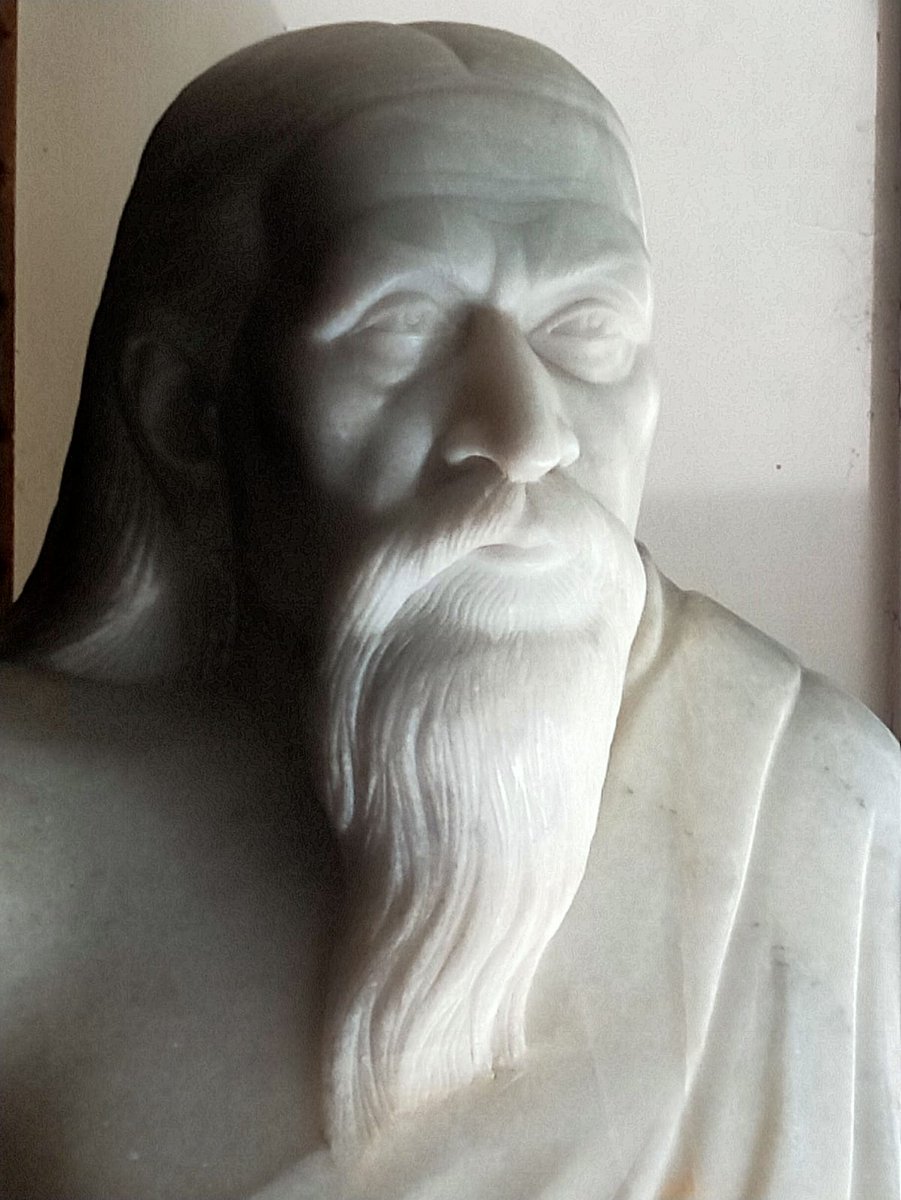
THE POET
He (The poet) sees beyond the sight of the surface mind and finds the revealing word, not merely the adequate and effective, but the illumined and illuminating, the inspired and inevitable word, which compels us to see also." #SriAurobindo
1
11
20
366
Jun 13
Let us compare the first riks of Agni Suktam and Vayu Suktam
अग्निमीळे पुरोहितं यज्ञस्य देवमृत्विजम् । होतारं रत्नधातमम् ॥ RV 1.1.1
वाय॒वा या॑हि दर्शते॒मे सोमा॒ अरं॑कृताः । तेषां॑ पाहि श्रु॒धी हव॑म् ॥ RV 1.2.1
What do we notice?
1) अ and आ : Notice that there is only one आ in RV 1.1.1 but seven times in RV 1.2.1.
2) Hrisva and deergh: Shorts are more common in the former while long svaras in the latter
3) Sanyukta aksharas are frequent in RV 1.1.1 and none in RV 1.2.1
The first rik of Agni Suktam gives a concentrated compact compressed feeling while the first rik of Vayu Suktam is open, expansive and invites
Each creates a different mantric acoustic environment. The transition from Agni to Vayu is not merely in thought but phonetic and experiential. It is seen and heard, felt and understood
@MakrandParanspe
4
3
504
Amazing Vedas retweeted

Jun 12
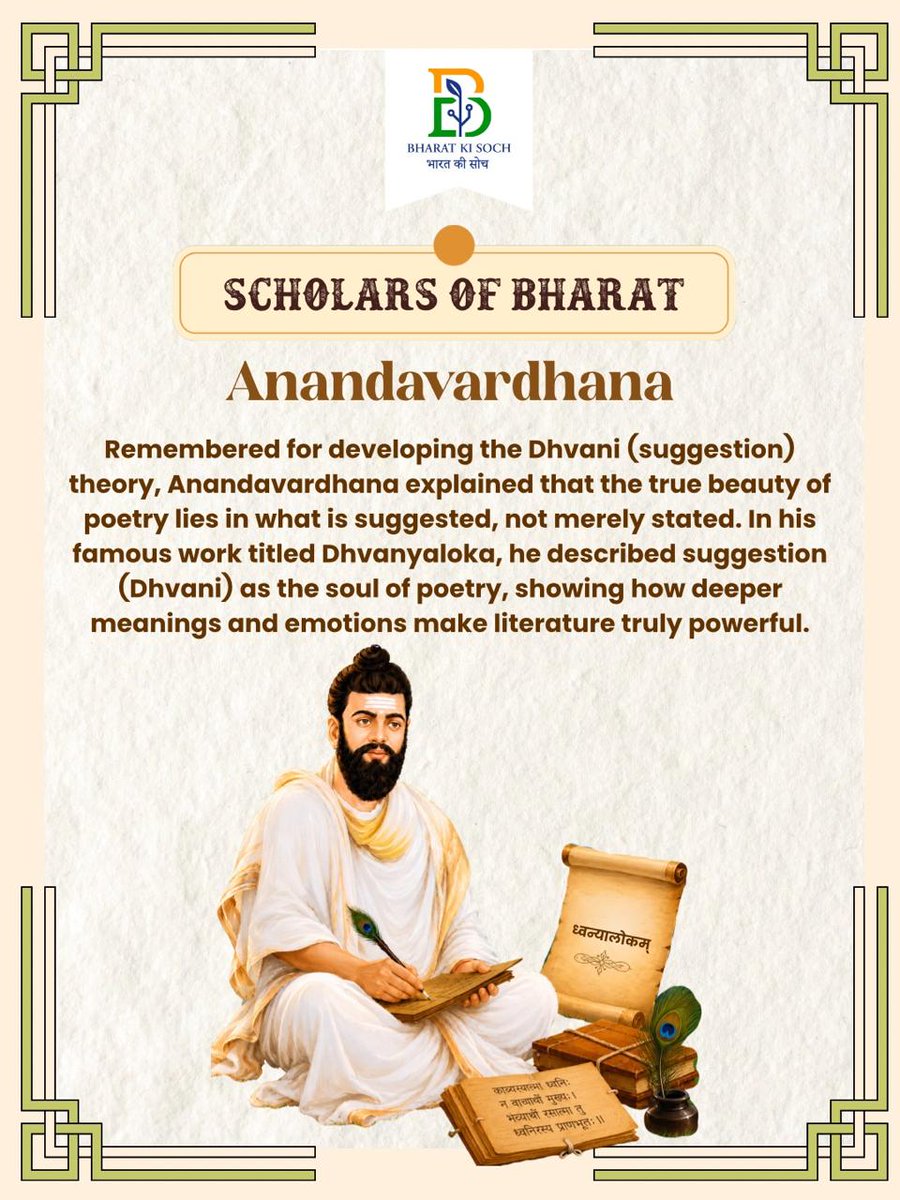
#ScholarsOfBharat
In India’s ancient tradition of literary theory (Kavyashastra), a great scholar named Anandavardhana (9th century CE) wrote Dhvanyaloka while serving in the court of King Avantivarman of Kashmir. In this work, he explained a powerful idea: the true beauty of poetry lies not only in what is said directly, but in what is suggested indirectly. He called this principle Dhvani (suggestion) and described it as the soul of poetry.
He illustrated this idea using examples from great authors like Kalidasa and Bhavabhuti, as well as the epic Mahabharata.
#BharatKiSoch #Anandavardhana #Dhvanyaloka #Kavyashastra #SanskritLiterature #Kalidasa #Bhavabhuti #Mahabharata #IndianKnowledgeSystems
@PMOIndia | @EduMinOfIndia | @MinOfCultureGoI | @ICHRMOE_1972 | @iccr_hq | @mygovindia | @PachnandaR | @59raghvendra | @AnilRajputsays
2
1
189
Jun 13
Who is Sarama सरमा?
Sarama is the Divine intuition that discovers hidden truth. She is the first movement towards the rays of light that are held captive by the Pani पणि in the bila or crypt of matter
She, along with Sarasvati, Ila and Mahi, is an aspect of the Divine Mother. She shares her root dhatu with Sarasvati which is sr- or sar- implying to run, move or flow
Sarama discovers the Truth. Sarasvati carries it. Sarama is a scout and finder of revelation. Sarasvati is revelation. Sarama is the search for knowledge. Sarasvati is the movement of knowledge. Sarama discovers while Sarasvati expresses
Truth is not static. Ritam is constantly moving. Sarama suggests its constant exploration and discovery. Sarasvati turns the light of divine hidden cows into speech that Sarama locates
@MakrandParanspe
1
3
15
1,230
Amazing Vedas retweeted
Jun 11
The question is why. I have not seen a single point by point refutation of Sri Aurobindo. Avoiding him seems to be the best strategy
Jan Gonda called it absurd that Sri Aurobindo said gau is a shlesha meaning both cow and a ray of light. He should have picked up a good Sanskrit dictionary like Apte
Even Swami Dayananda showed that the Veda is not karma kanda. He took a slightly different approach but his conclusions were valid
But Sri Aurobindo is also a lineage starting from the Veda of interpreting the Veda as a spiritual document. In that lineage we include the Upanishads and Sri Krishna himself in the Bhagavad Gita. It is time to awaken to the meaning of our first Sruti
6
12
2,885
Jun 12
मा नो॒ अति॑ ख्य॒
This very strange statement is made in Rig Veda 1.4.3
Sayana says that literally it means “do not speak beyond us”
The Rishi is invoking Indra deva to only give the knowledge that he can handle or is capable of. Sayana in his bhashya then says that this signifies that the Rishi is asking Indra not to share knowledge with others. That makes no sense for there is no indication of jealousy or envy here
RL Kashyap is correct in his assessment that the Rishi wants only according to the strength of his adhara or foundation. Any more would be harmful and set him back. This shows a maturity in the Vedic paradigm that is not only advanced but is highly balanced and holistic. These Rishis were not only geniuses but also extremely methodical, refined and systematic in their yogic approach
@MakrandParanspe
3
16
1,133