
powered by web3
Joined March 2021
- Tweets 39,224
- Following 996
- Followers 2,434
- Likes 52,586
2,329 Photos and videos

















your NFT is sitting in your wallet.
not doing anything.
not going anywhere.
just… sitting.
and somewhere in the back of your mind, you already know this is not what it was supposed to feel like.
walk with me 🧵↓
#5thKingdomThreadContest ,@Bellickkruz
36
11
76
838
Assidikh retweeted

Jun 13
good morning, 𝕏 frens
if you've been wondering where i disappeared to 😅
i got sick for a few days and had to take a break from everything
thankfully i'm doing much better now and happy to be back
wishing you all a lovely weekend 🤝
42
1
57
508
Assidikh retweeted

Jun 12
Hiiiiii Friends
Let’s talk about Intelligent Oracle on @GenLayer
71
9
190
3,214

The internet lost its providence of truth. Blockchain is how we get it back
@Player1Taco on the convergence of AI and crypto, data sovereignty, and who gets to judge what’s true in the agentic economy
GenPod Ep. 3 out now 🎙️
21
16
118
9,171
Assidikh retweeted
Jun 8
𝗽𝗿𝗶𝗰𝗲 𝗳𝗲𝗲𝗱𝘀 𝗰𝗮𝗻 𝘁𝗲𝗹𝗹 𝘆𝗼𝘂 𝘄𝗵𝗮𝘁 𝗵𝗮𝗽𝗽𝗲𝗻𝗲𝗱
𝘁𝗵𝗲𝘆 𝗰𝗮𝗻’𝘁 𝗮𝗹𝘄𝗮𝘆𝘀 𝘁𝗲𝗹𝗹 𝘆𝗼𝘂 𝘄𝗵𝗮𝘁 𝗶𝘁 𝗺𝗲𝗮𝗻𝘀
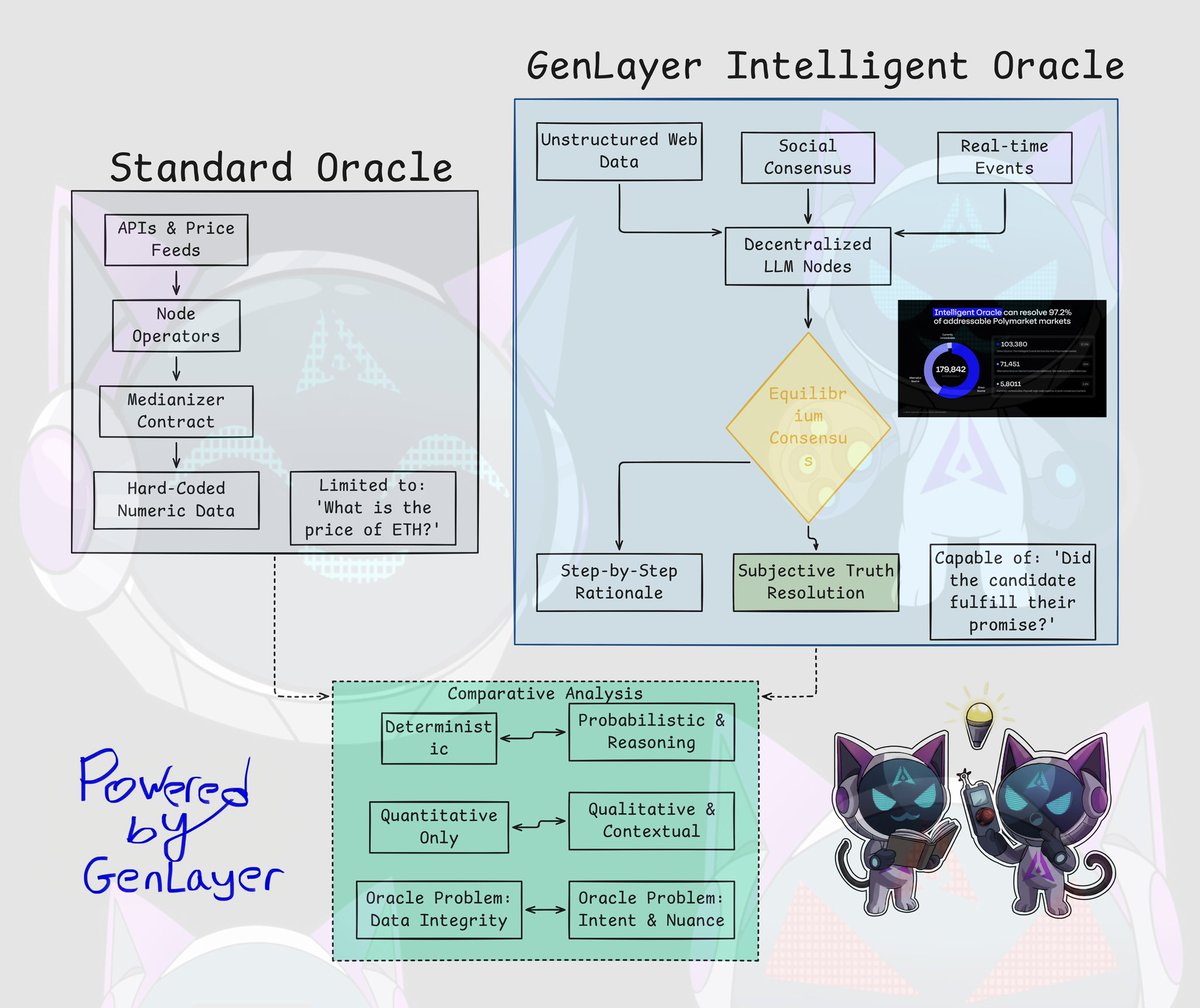
been thinking about this a lot after reading @GenLayer’s recent article on the 𝗜𝗻𝘁𝗲𝗹𝗹𝗶𝗴𝗲𝗻𝘁 𝗢𝗿𝗮𝗰𝗹𝗲
most people already understand how price feeds work
➜ btc price? easy
➜ eth price? easy
➜ sol price? easy
the number exists somewhere and everyone can verify it
but event markets are completely different
because they're not asking:
> 𝘄𝗵𝗮𝘁 𝗶𝘀 𝘁𝗵𝗲 𝗽𝗿𝗶𝗰𝗲?
they're asking:
> 𝘄𝗵𝗮𝘁 𝗮𝗰𝘁𝘂𝗮𝗹𝗹𝘆 𝗵𝗮𝗽𝗽𝗲𝗻𝗲𝗱?
and that’s the real difference
imagine a market asking:
> did a candidate win an election?
> did a company launch a product?
> did a team win a championship?
there isn't always a clean price feed for that
➜ someone has to read information
➜ someone has to understand context
➜ someone has to determine whether the event actually happened
today most systems solve this through:
> reviewers
> dispute windows
> manual verification
which works
but becomes harder to scale once thousands of markets need resolving at the same time
what i found interesting about the 𝗜𝗻𝘁𝗲𝗹𝗹𝗶𝗴𝗲𝗻𝘁 𝗢𝗿𝗮𝗰𝗹𝗲 is that it approaches the problem differently
instead of asking validators to agree on an exact output
it asks them to agree on whether the outputs mean the same thing
that sounds like a small difference
but it's actually a completely different way of thinking about 𝗰𝗼𝗻𝘀𝗲𝗻𝘀𝘂𝘀
because in the real world
truth isn't always returned as a neat number
sometimes it lives inside
➜ articles
➜ reports
➜ websites
➜ and messy human language
the more i thought about it
the more it felt like the real challenge isn't teaching blockchains 𝗵𝗼𝘄 𝘁𝗼 𝗿𝗲𝗮𝗱 𝗽𝗿𝗶𝗰𝗲𝘀
it's teaching them how to 𝗿𝗲𝗮𝘀𝗼𝗻 𝗮𝗯𝗼𝘂𝘁 𝗲𝘃𝗲𝗻𝘁𝘀
and that's a very different problem entirely
i'm only scratching the surface here
the full article below connects the dots much better 👇
@RuzgarFlns @Aezakmi_x

30
4
54
980

Assidikh retweeted

Jun 7
𝐑𝐞𝐝𝐞𝐟𝐢𝐧𝐢𝐧𝐠 𝐓𝐫𝐮𝐬𝐭: 𝐖𝐡𝐲 𝐆𝐞𝐧𝐋𝐚𝐲𝐞𝐫'𝐬 𝐄𝐪𝐮𝐢𝐯𝐚𝐥𝐞𝐧𝐜𝐞 𝐏𝐫𝐢𝐧𝐜𝐢𝐩𝐥𝐞 𝐢𝐬 𝐭𝐡𝐞 𝐌𝐢𝐬𝐬𝐢𝐧𝐠 𝐋𝐢𝐧𝐤 𝐟𝐨𝐫 𝐖𝐞𝐛𝟑 𝐀𝐈
If you have ever tried to connect a smart contract to the real world, you know the absolute headache that is the 𝑑𝑒𝑡𝑒𝑟𝑚𝑖𝑛𝑖𝑠𝑚 constraint.
In traditional Web3 development (like Ethereum), every single computer in the network has to run your code and get the exact same result down to the very last pixel or decimal point. If they don't, the network splits, consensus breaks, and everything grinds to a halt. This is why standard smart contracts are completely blind to the internet and entirely incapable of running AI natively.
---------------
When I first looked into GenLayer, I was highly skeptical. They claimed to run "𝐈𝐧𝐭𝐞𝐥𝐥𝐢𝐠𝐞𝐧𝐭 𝐂𝐨𝐧𝐭𝐫𝐚𝐜𝐭𝐬" that natively use Large Language Models (LLMs) and scrape the live web. How on earth do you make a room full of computers agree on an AI prompt when LLMs are inherently random?
The answer is an architectural shift called the 𝐄𝐪𝐮𝐢𝐯𝐚𝐥𝐞𝐧𝐜𝐞 𝐏𝐫𝐢𝐧𝐜𝐢𝐩𝐥𝐞. Let's break down exactly how it solves this bottleneck, why it matters for real-world applications
@RuzgarFlns
@Aezakmi_x
9
4
19
407
Assidikh retweeted

Jun 7
the biggest impact of new technology is usually the thing nobody predicts at the beginning....
...and that's one of the many reasons why i've been paying attention to what @GenLayer is exploring.
i turned my thoughts into a video 👇
@RuzgarFlns @Aezakmi_x
4
2
13
151
Assidikh retweeted
Jun 7
happy sunday 𝕏 frens
make sure you touch grASS today
enjoy 😉


17
1
30
423
Jun 7
a quick thank you to @RuzgarFlns, @Aezakmi_x, and @K1st_Capital
for the time and effort they continue to invest in the @GenLayer community
6
176


Assidikh retweeted
Jun 5
@RuzgarFlns said to bring back the meme culture earlier this week, so....to my brain role holders, this one's for yall.
4
2
16
185
Assidikh retweeted
Jun 4
sol just touched a brutal 24h low and sentiment flipped bearish fast
instead of sitting on the sidelines, i decided to test that thesis publicly on @FUDMarkets
i opened a long because i see this range more as consolidation than collapse
what i liked most is how simple it was to take a position and instantly make that conviction visible for others to follow or fade
now we'll see if the thesis holds
trade the fud 👉 fud.markets/?ref=E50D2C02
May 27

FUD. IS LIVE ON MAINNET!
crypto finally has a conviction layer.
🧪 tested by 7,000.
🔵 built on @base
⚖️ settled by @GenLayer
📈 trade the FUD → fud.markets
35
1
48
960