
Diplomatic Correspondent for BBC News
Joined July 2010
- Tweets 6,723
- Following 1,690
- Followers 78,480
- Likes 1,481
458 Photos and videos


James Landale retweeted

Jun 12
UK defence plans in disarray. A failure of leadership and politics, by successive governments? Or just a Whitehall spending row that went monumentally wrong?
bbc.co.uk/news/articles/c8d2…
1
1
4
1,646
James Landale retweeted

Jun 8
Within hours of being announced as the nominee to be the U.S. Director of the CIA, I received a hand-delivered message on MI6 stationery congratulating me on my nomination. It was signed simply "C" in green ink. Legendary. I shared it with my son and even he thought I was now cool!
More than that, this note, from Sir Alex Younger, Chief of the Secret Intelligence Service of the United Kingdom, confirmed what I already believed: the work that the CIA and MI6 did together mattered, that the partnership was critical, and that two leaders focused on the mission could save lives and provide tools for our nations to deter our adversaries.
Alex's passing this week brought back so many memories of our time in service together. He flew to Langley to see me the day I was confirmed. We brought our two senior teams together in the UK to plan and coordinate and build in the first several weeks of my time on duty: making clear to them all that this relationship was more than special - it was critical for the security of our two countries.
Alex was a remarkable intelligence partner. When we needed help, it wasn't "let me see;" it was "this matters to you and America we'll get it done." And he and his team always did. I think he knew we would do the same for him and his team and his nation. Many Americans are alive today because of his leadership of MI6, I never knew how to thank him enough.
Alex became a friend as well. In the years since we both left office we would see each other from time to time. He was always so kind, so thoughtful, so smart. His deep love of his country was surpassed only by his deep commitment and love of his family. Decent and proper - and funny as hell - Alex was "C." As espionage requires, he was quiet, not attention seeking. He knew what evil was and he was ruthless in his efforts to crush it with every legal tool at his command. And he knew who his friends were and committed himself to supporting them.
I miss Sir Alex Younger. He was a role model for me and a man with whom every minute I spent was valued and savored. Blessings to you Alex. Praying for you and for your family. Well done and may you rest in peace in His hands.
466
1,120
11,031
1,719,234
Just to be clear: is the US State Department really claiming the UK is suffering from “civilisational decline”?

Ideological conditioning and two-tiered policing are glaring symptoms of civilizational decline. They must be rejected across the West.
The United States sends our condolences to the family of Henry Nowak and the people of the United Kingdom at this troubling time.
3
3
8
2,718

James Landale retweeted

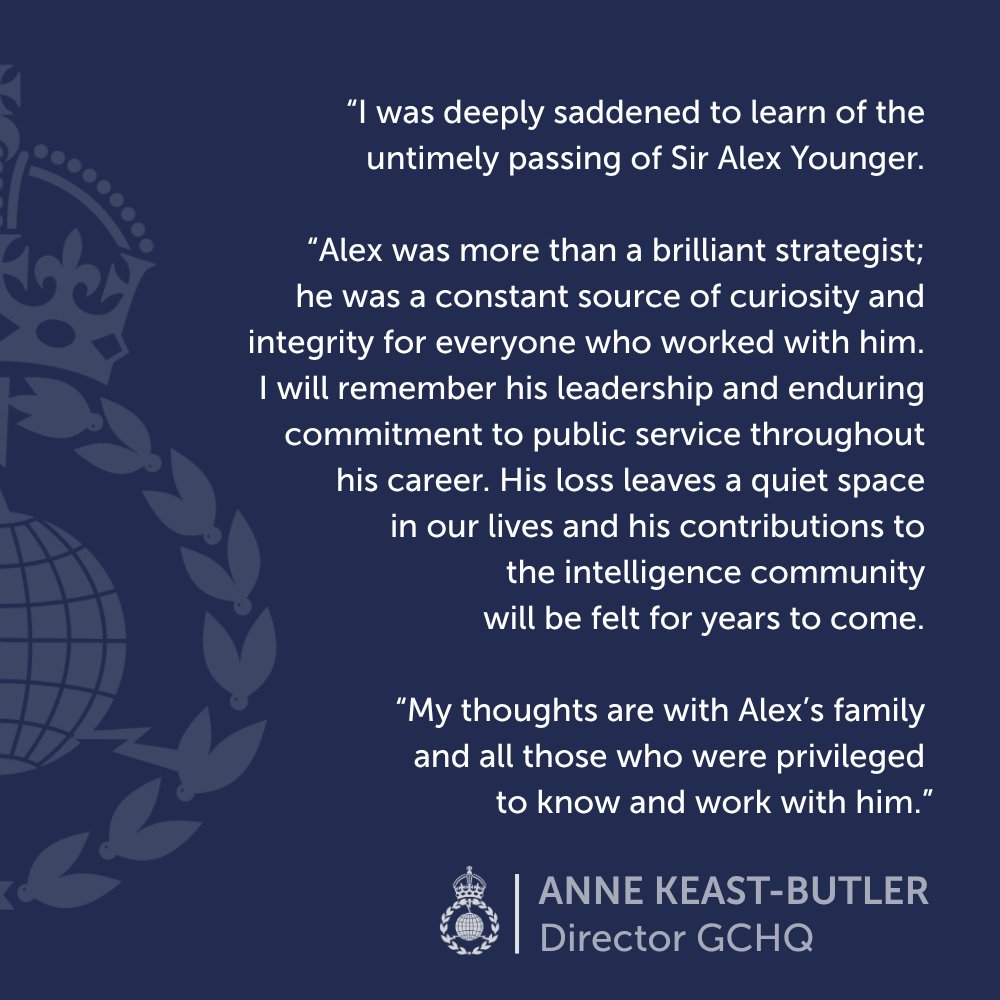
In these globally turbulent times one man has regularly acted as a wise, thoughtful and witty guide for listeners of @BBCr4today. The former Head of MI6 Sir Alex Younger has analysed, explained and contextualised the actions of Trump, Putin, Xi and the Ayatollahs. After he first appeared in the programme I was lucky enough to get to know Alex and call him my friend. I’m desperately sad to hear the news I’ve long feared was coming. Alex has died after months trying to cheat the
prognosis he was given whe. They discovered the tumour he nicknamed “Putin”.
We’re always told not to speak of a fight with cancer because it risks implying that only those strong enough survive. I understand that. I really do but sod it. Alex fought so hard to find a treatment to give him a little longer to be with Sarah and their lovely children. And he used every last minute of the short time he did have to be with family and friends and to do what he spent a lifetime in the shadows doing - using his intelligence to understand the world, to explain it but, above all, to keep us all safe.
61
252
2,126
248,389
James Landale retweeted

May 28
It is fair to say that neither Ukraine nor Russia is winning the war.
For Zelenskyy, this is good news: only yesterday, many were predicting his defeat. For Putin, it is bad news: no one seriously believes anymore that he is winning.
Yet Putin does not want to end the war. He seems to have five basic choices, but after four years of full-scale war, his core problem is clear: none of them gives him a guaranteed result.
A technological breakthrough? It takes time and offers no guarantee of a success.
A tactical breakthrough? Ukraine may adapt faster than Russia can turn it into strategic gain.
Mobilization? The Kremlin’s cheapest instrument, but one that raises the domestic cost of war.
A new theater of war? It may shift attention, but it does not guarantee a quick victory.
Nuclear weapons? Shock effect, but with uncontrollable consequences for Moscow itself.
So he will most likely do what he does best: buy time. He will move, in fragments, along the first four tracks and keep threatening the fifth.
Ukraine’s options remain unchanged: strike deeper, defend the sky, and strengthen resilience at home — politically, financially, and militarily. This has worked so far. It can keep working.
108
282
2,072
187,541
May 19
"It is the politics of decency that is our greatest protection against a slide into the politics of despair, out of whose dark crevices authoritarianism can slink."
Lord Hennessy as inspiring & insightful as ever in his last speech to their Lordships.
hansard.parliament.uk/lords/…
1
3
8
1,457
James Landale retweeted

May 18
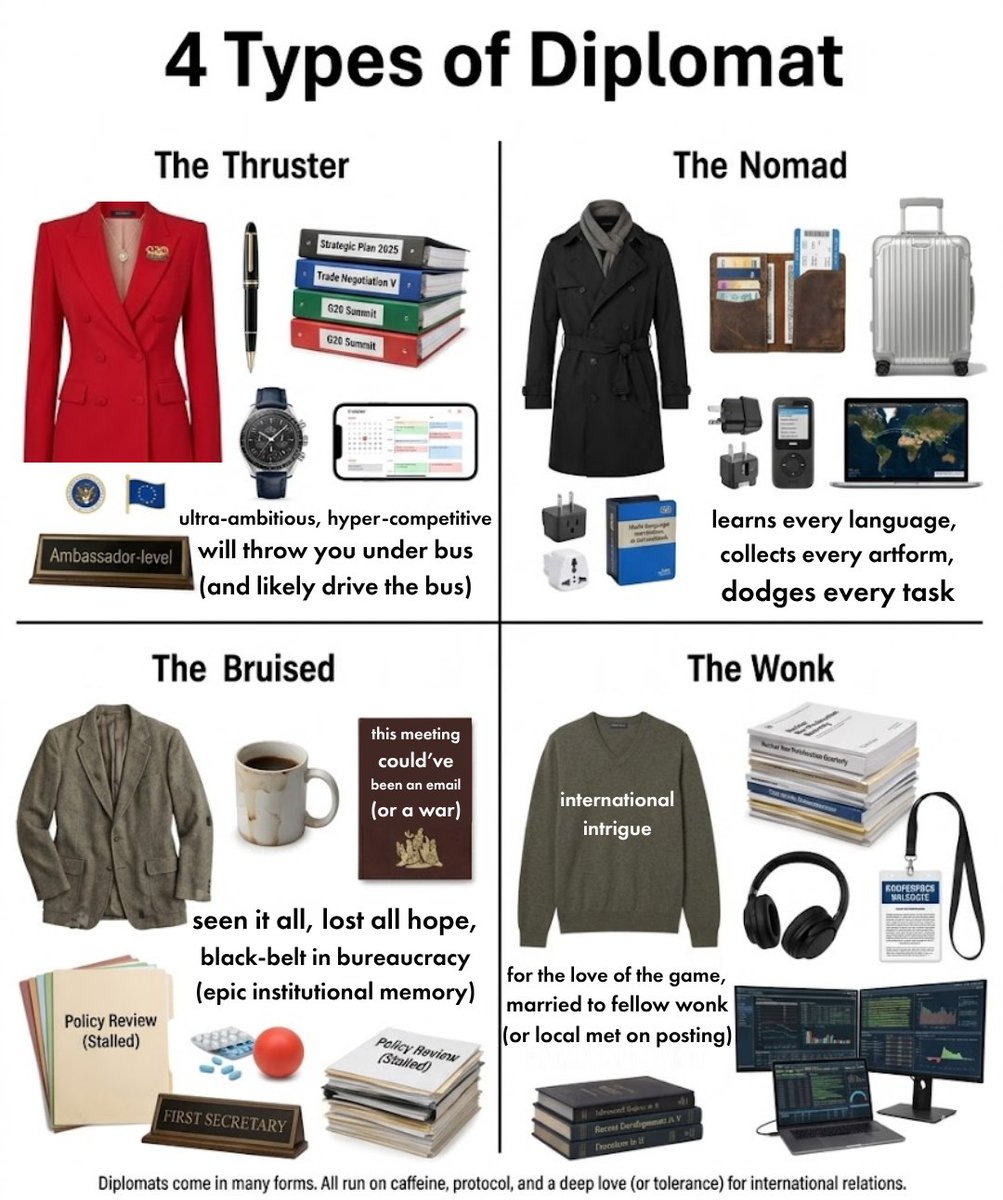
started out as a turbo-thruster until i hit cruising altitude, then enjoyed some delightful years as a nomad and a brief stint as a wonk before exiting pre-bruise. you?
6
39
426
42,916
James Landale retweeted
May 17
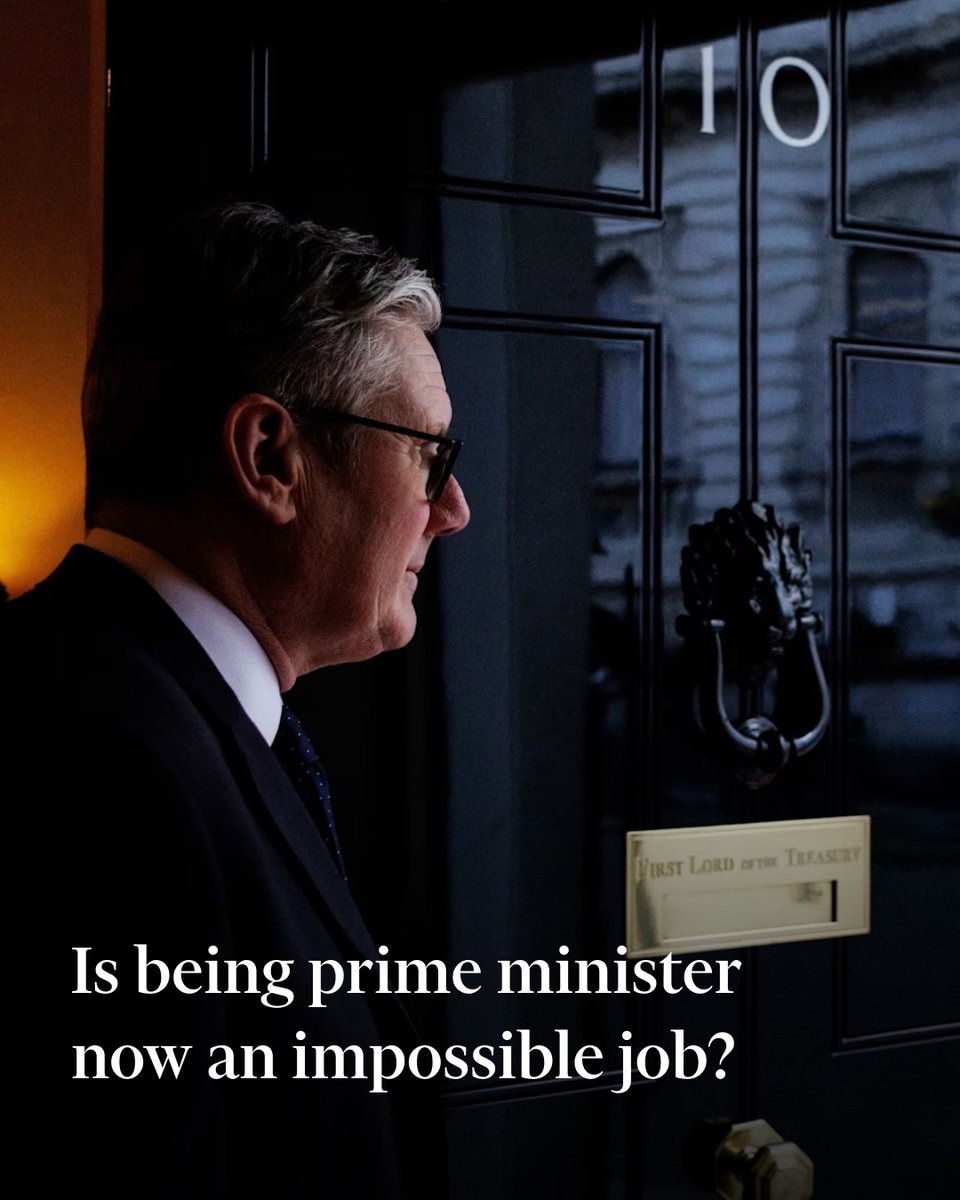
Why is the UK churning through its leaders almost as quickly as Italy once did? Why do voters and MPs bequeath and remove their support with seemingly such casual ease? In short, is Britain becoming ungovernable?
bbc.co.uk/news/articles/cqjp…
6
6
9
4,576
James Landale retweeted

I've been asking this question myself 4 many long years as I've watched prime ministers & cabinet ministers come & go as if they're visiting a supermarket! ➡️ In an In-Depth piece, @BBCJLandale opines on whether/why the UK seems less governable today? > bbc.co.uk/news/articles/cqjp…
1
1,391
May 17
Fascinating stuff from @AnthonySeldon. He & I have been ploughing a similar furrow. His, of course, is far more elegant & erudite bbc.com/news/articles/cqjpe7…
May 17

Once the model of stable government, Britain has had six PMs in the past 10 years — and is in the grip of yet another leadership crisis. Anthony Seldon asks what went wrong.
Read The Weekend Essay in full here: ft.trib.al/ZskSLQk
2
6
20
12,001
James Landale retweeted
May 17
Five PMs in seven years. A 6th may be on the way. What’s going on in UK politics? Why such instability? Turbulent times? Poor leadership? Or systemic challenges the British polity is failing to address?
bbc.com/news/articles/cqjpe7…
5
4
10
2,873
James Landale retweeted

May 15
The last remaining person in Parliament who served in the Armed Forces in the Second World War retired on Wednesday.
Labour peer Lord Christopher, aged 101, bowed out, 81 years after WWII ended.
12
392
3,110
167,541
May 13
Absolutely. Fabulous film. And here’s three blokes discussing why: x.com/warmovietheatre/status… @WarMovieTheatre
May 13

An absolutely brilliant, sensational film. Scott's first I think after having been an ad man. Carradine and Keitel seem to have really come to hate each other - but Keitel was terrified of the horseback rides he had to do - and the horses knew it!
1
4
4,773
May 11
This is interesting. Not what it says narrowly about Labour's leadership. But a rare argument from the left about the need to spend more on defence. Not all will support the idea - borrow more, protect welfare. But the question of how to build a resilient society is intriguing.
May 10

Westminster may finally be about to have the argument it has spent 40 years avoiding.
If Andy Burnham returns to Parliament, the political class will know how to cover it. A leadership drama. Who is up, who is down, whether Keir Starmer can survive, whether Labour is once again turning inward. The familiar machinery of Westminster psychodrama will whirr into life.
That framing misses the larger point. Burnham’s possible return matters not because of what it says about Labour’s leadership, but because of what it reveals about the British state: what it can still do, what it has forgotten how to do, and what kind of country it must become if it is serious about resilience.
Britain is finally having a more serious conversation about national security. The Strategic Defence Review, the pivot back towards Europe, the recognition that hybrid warfare turns citizens, infrastructure and civic institutions into part of the front line: all of it marks a real shift in how the state thinks about its own survival.
But at the centre of that conversation lies a question that the defence establishment, and most of Westminster, still does not want to answer. What kind of society do you need to be before resilience is possible?
Finland is now the model everyone cites. Comprehensive security. Whole-of-society defence. Civilian preparedness woven into military planning. British strategists admire the Finnish system and ask how it might be copied. But the admiration stops short of the uncomfortable question: why does it work there?
The answer is not geography or history or some mysterious quality of Finnish national character. It is structural. Nearly 80% of Finns say they would defend their country if attacked. In Britain, the figure is closer to 33%. That gap is not an accident. It exists because Finland has spent decades building a society in which people have a genuine stake in what they are being asked to defend. Energy is affordable. Housing is available. Public services function. Institutions command trust. The Nordic welfare state is not a sentimental add-on to Finnish security policy. It is the foundation of it. You cannot ask people to defend a country that does not work for them.
Britain has spent 40 years building the opposite. The privatisation of essentials – energy, water, transport, housing – transferred wealth upwards from households to shareholders while making the basics of everyday life more expensive. The state, stripped of the tools to control costs at source, has been reduced to compensating after the fact.
Out of every pound the Government spends on housing, 88p goes to subsidising private rents. Just 12p goes to building homes. When energy prices spiked in 2022, the Government spent £40bn in a single winter cushioning the blow, not because it had a resilient energy system but because it lacked one. Debt interest now consumes more than £100bn a year. Britain has the highest debt servicing costs in the G7: the compounding price of financing failure rather than eliminating it at source.
This is what bond market dependency actually looks like. It is not an abstract fiscal condition. It is the consequence of a state that has been stripped of the supply-side tools that would let it cure the problems it now pays, indefinitely, to manage. And here is the paradox the Treasury refuses to confront. The countries that borrow most cheaply are often those that have retained the public investment model Britain abandoned. The spread between UK and Dutch borrowing costs has widened sharply not because markets fear public investment, but because they have lost confidence in a model that borrows to subsidise private failure while never addressing its causes.
This is the connection Britain’s defence debate is missing. The familiar framing, that social spending is what must be sacrificed to meet the NATO target, is not merely politically toxic. It is strategically illiterate. Cutting the foundations of social cohesion to fund the hardware of national defence is self-defeating. You end up with planes and no pilots, submarines and no crew, an army that cannot recruit because the society it is meant to protect has stopped believing in itself.
I think Burnham understands this. That is why his programme is more interesting than the leadership gossip suggests. What he has been building in Greater Manchester – public control of transport, expanded social housing, investment in the productive foundations of the city economy – is not a nostalgic rerun of postwar nationalisation. It is a proof of concept for a different kind of state.
The Bee Network is the most visible example, but the argument behind it travels. A state that can shape markets is not condemned to subsidise their failures. A state that produces affordable energy through public generation does not need to spend tens of billions cushioning every price shock. A state with a serious public housebuilding programme does not need housing benefit to rise endlessly in line with private rents. A state that builds institutions people can see, use and trust begins to restore the civic confidence on which resilience depends.
The real constraint on Britain is not money. It is capacity: the workers, institutions, supply chains and public purpose needed to turn national will into national renewal. Britain’s tragedy is not that it has run out of money. It is that after 40 years of hollowing out the state, it has made itself less able to act.
Burnham’s critics will reach for the familiar warning. Borrow more, spend more, spook the gilt markets, repeat the Truss disaster. But this misunderstands both the problem and the opportunity.
Bond markets do not have ideological preferences. They have functional ones. They prefer clarity, credible revenue streams, productive investment, and a state with a plan. What they punish is not public ambition but incoherence. A properly designed productive state programme would not be a leap into fiscal fantasy. It would be an attempt to end the much costlier fantasy that Britain can keep borrowing to compensate for broken markets while refusing to repair them.
The defence conversation and the economic conversation need to become the same conversation. Finland did not build national resilience by choosing between welfare and security. It built resilience by understanding that they are inseparable: that a country in which the basics work, where people trust one another and the institutions around them, is one that can face danger with something more than anxiety.
That is the deeper argument Burnham represents. Westminster will be tempted to treat him as a leadership story. It should resist the temptation. The question is not whether Burnham can return to parliament. It is whether Britain can return to the idea that the state should make life work. Because a country that cannot command the confidence of its people cannot truly defend itself.
1
2
11
6,604
James Landale retweeted

Yet again, whatever the result, I love the process of voting: the other voters doing their democratic duty, the pleasant poll workers, the little secret ritual, the pencil and the ballot paper. No shouting, no demonstrations, just people making their individual decisions
31
60
605
30,965
James Landale retweeted

📷
I've written many #Ukraine articles. This is one of the most extraordinary: the story of Vadym Lietunov, who shared a dugout with a Russian soldier. Vadym fled after his own shelter was bombed and saw a fortified position. From inside came a rustling... theguardian.com/news/ng-inte…
15
147
494
106,721