
Girls' dad, Husband, Science Fiction Fan, Fitness and Cooking Enthusiast, Economics Professor 🇺🇸🇮🇱🇺🇦
Joined April 2020
- Tweets 654
- Following 462
- Followers 451
- Likes 1,287
90 Photos and videos

Pinned Tweet

9 Dec 2023
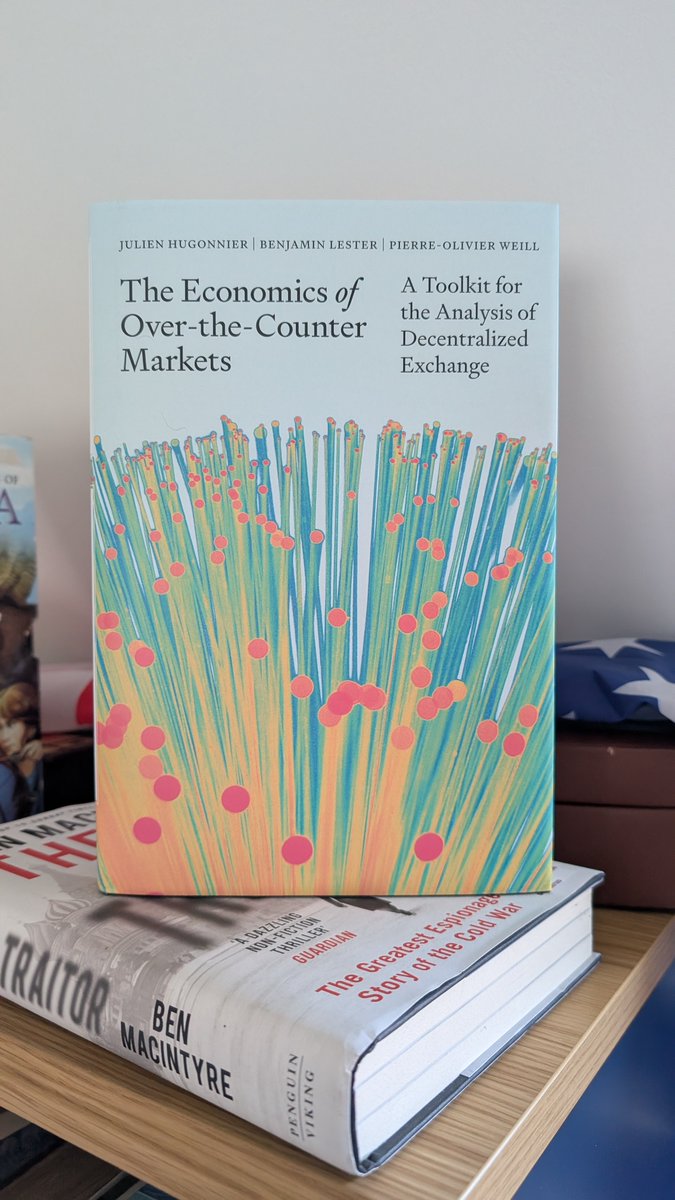
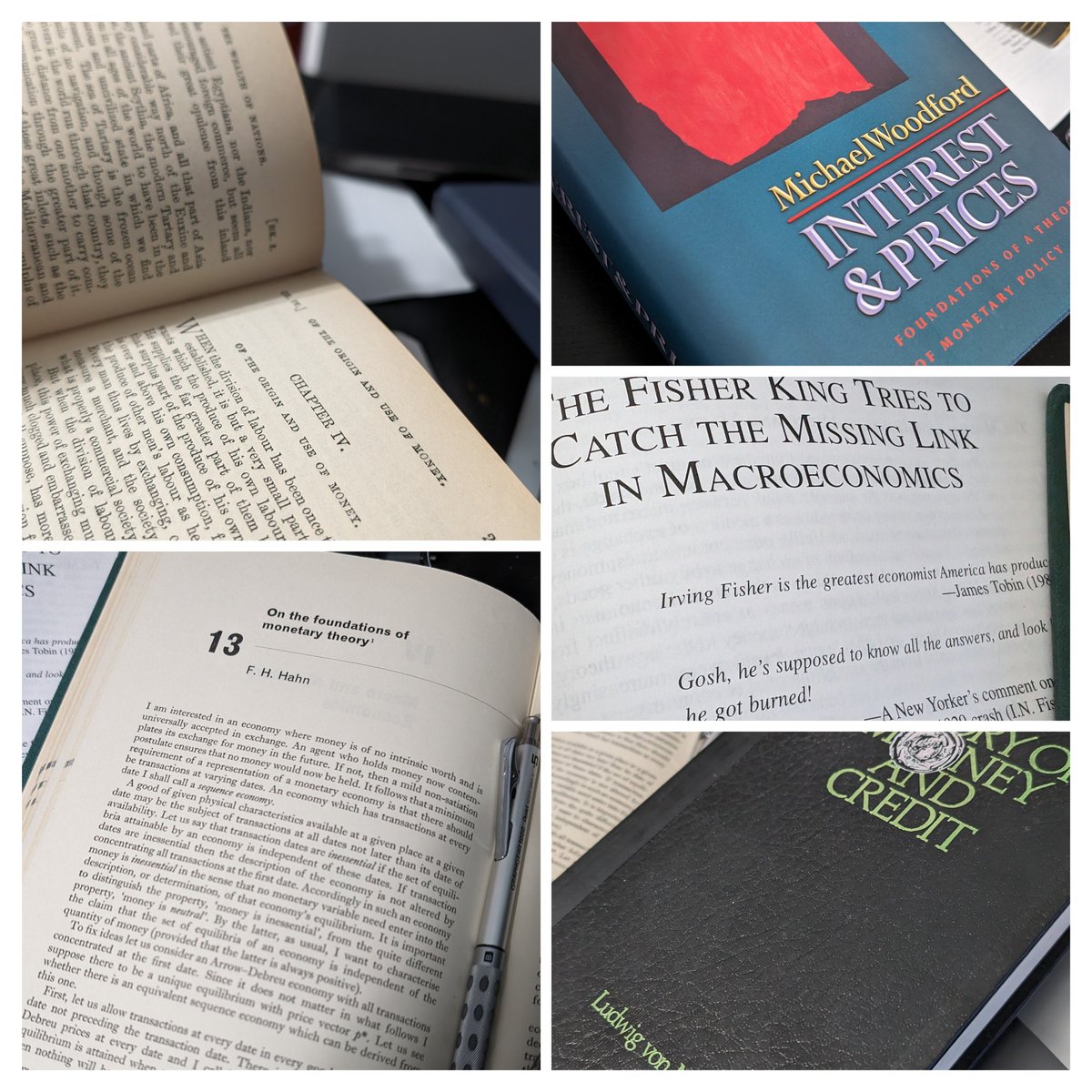
Money is the most fascinating topic in economics. This is a sample of the books I've been checking this week as I work on an article 😊
6
9
77
25,719
Jan 14
In the 1820s, several Latin American nations defaulted—Peru, Mexico, Argentina. Brazil didn't. Why?
Nathan Rothschild was trapped. He held so much Brazilian debt that he couldn't let Brazil fail. So in 1829, while the continent burned, he issued a new loan to Brazil just to pay off the old ones.
We call it a Dynamic Hold-up Problem.
Grey Gordon (@RichFedResearch) presents our theory with @gaston_chaumont (@UofR) on why this mechanism keeps self-fulfilling crises alive at @_SaMMF_ on Feb 9 at 12PM. Register now!
essex-university.zoom.us/web…
@UoE_Economics
1
2
7
601
23 Dec 2025
Picture of my dog made to @_SaMMF_ inflation workshop. 😆
youtu.be/CmbJiwATPNg?si=YeF9…
22 Dec 2025

Ok, pictures of my dogs made it to my MBA Competitive Strategy slides
Don't ask me how 🙃
3
186
17 Dec 2025
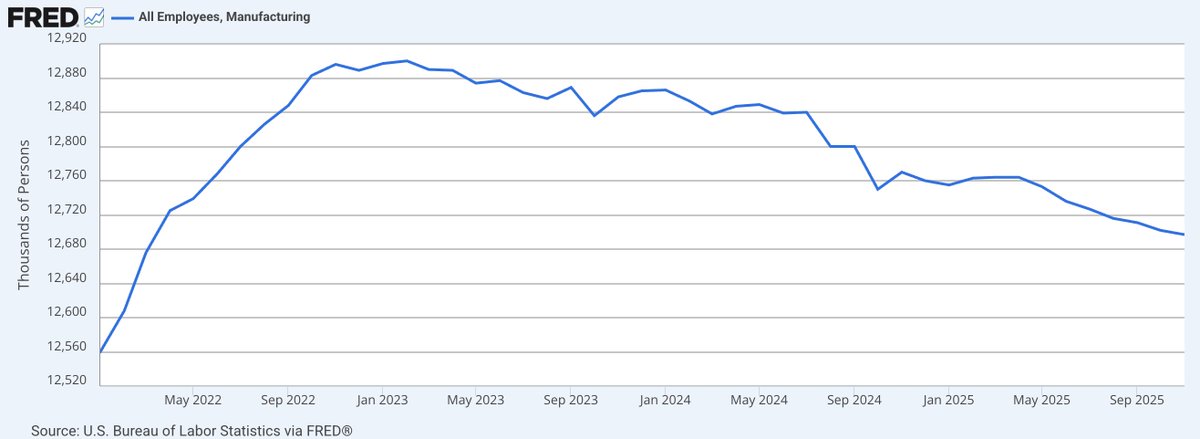
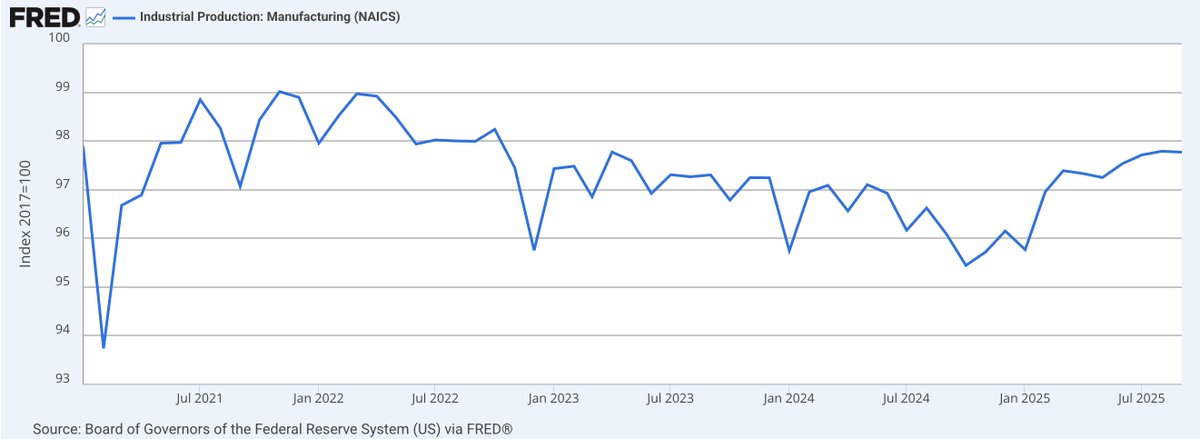
1. It is going down since 2022 and have stayed within trend.
2. Industrial production was also going down and did reverse course. We are having an AI boom, we don't know how that will affect labor allocation accross industries.
16 Dec 2025

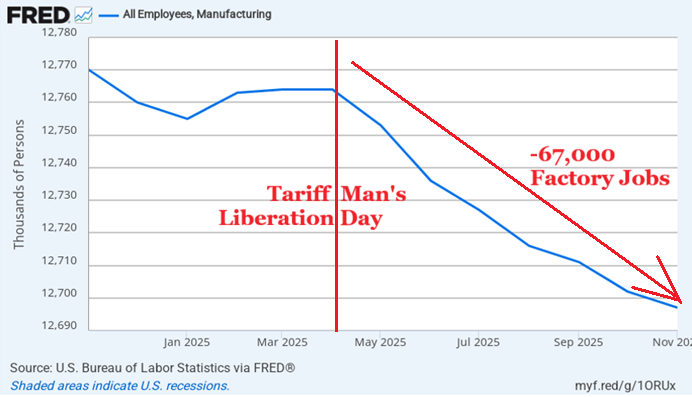
Since Tariff Man's "Liberation Day" Tariffs in April, the US has lost 67,000 factory jobs. Weren't those tariffs supposed to revive US manufacturing?
@StephenMoore @scottlincicome @JustinWolfers @FreeTradeBryan @FoxNews @VanceGinn @PhilWMagness
1
166
17 Dec 2025
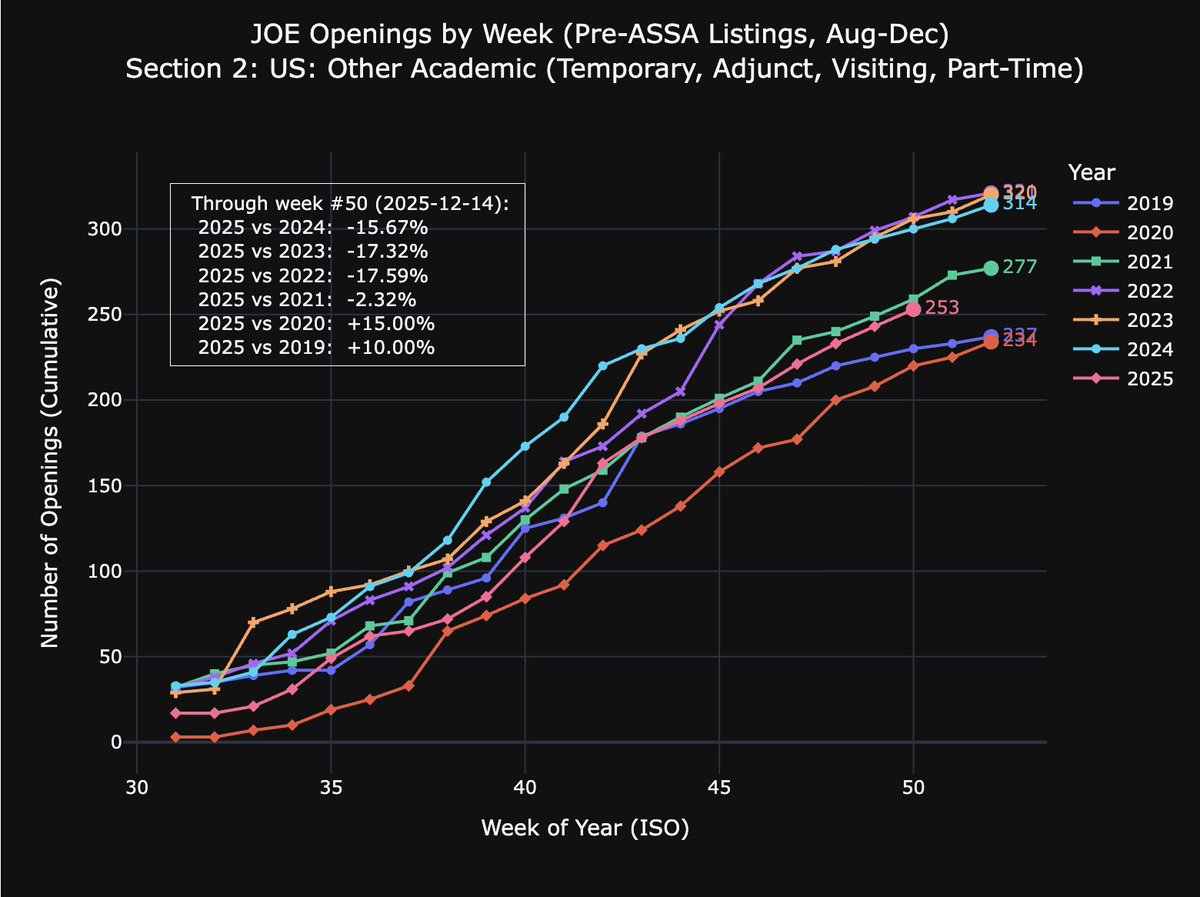
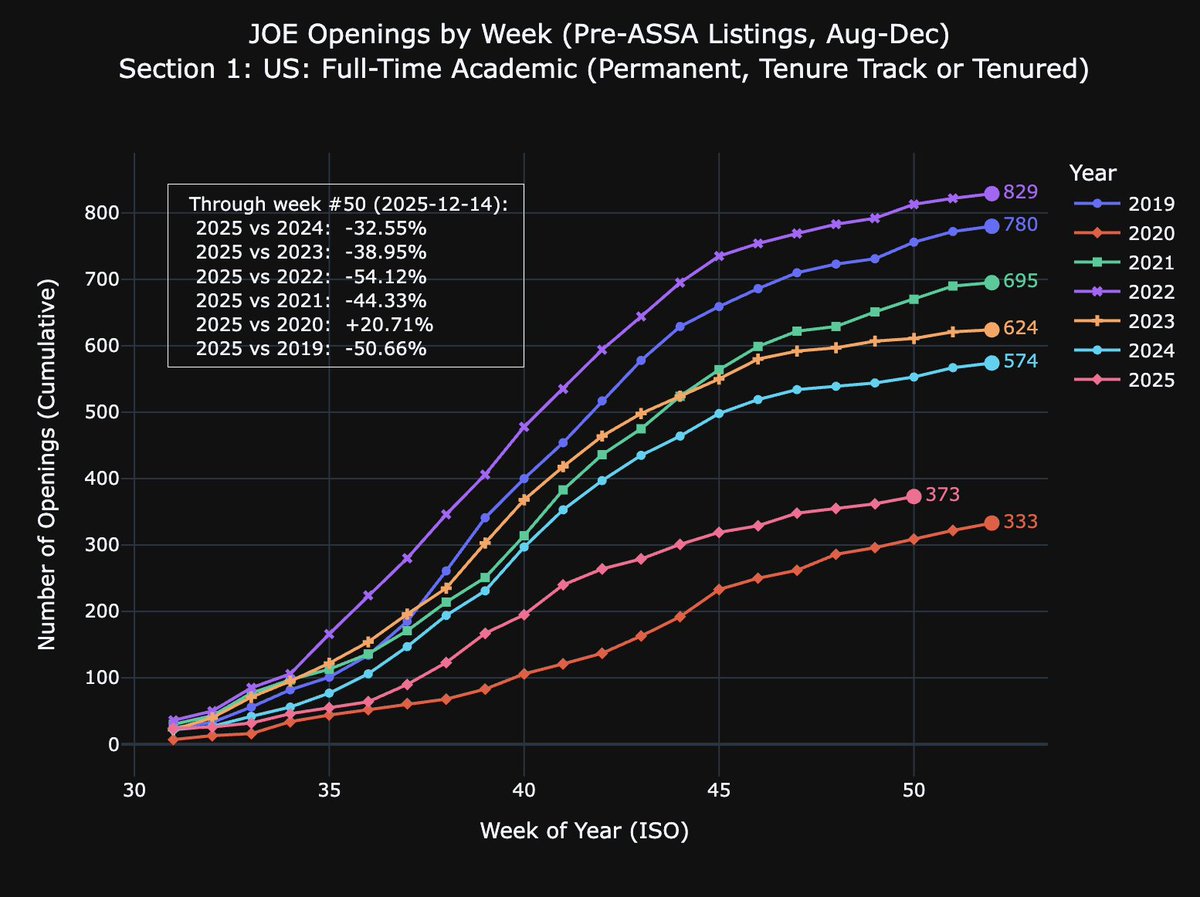
The numbers, while accurate, lack nuance and aggregate data often conceal specifics. The PhD market is not the same as the US academic market. The US academic market numbers exceed the pandemic lows.
Of course, this context does not reassure anyone facing the market today.
17 Dec 2025

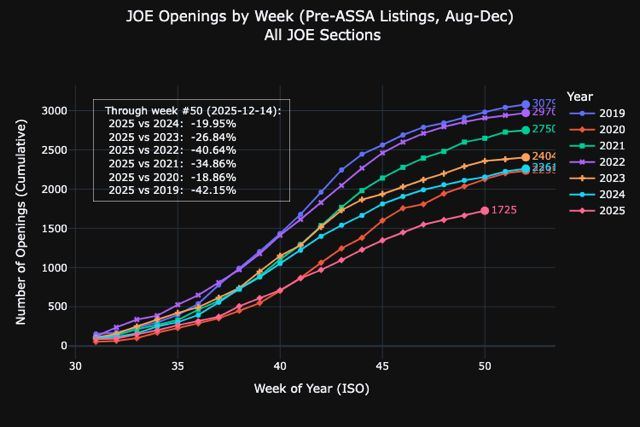
AEA job market update. The numbers don't lie, as this is the toughest market for PhD economists in recent memory.
JOE listings are down 20% from last year. Worse: they are 19% below COVID levels. Let that sink in.
The academic market took the biggest hit. Full-time US positions dropped 33% year-over-year. Liberal arts colleges and PhD-granting universities? Both down about a third. International academic postings fell 13% from last year, 25% from COVID.
Nonacademic isn't much better: down 27% from last year, 45% below COVID. And federal government hiring? That's where it gets ugly. Down 71% year-over-year, 79% below COVID. DOGE cuts plus the shutdown created a perfect storm.
One bright spot: private sector jobs in consulting, research, banking, and finance are holding steady at recent-year levels.
Bottom line for candidates: the data confirm what you're feeling. It's brutal out there. Universities facing their own financial pressures should still find ways to bridge unmatched candidates for another year. The talent is there—the opportunities aren't.
H/T John Cawley
1
215
14 Dec 2025
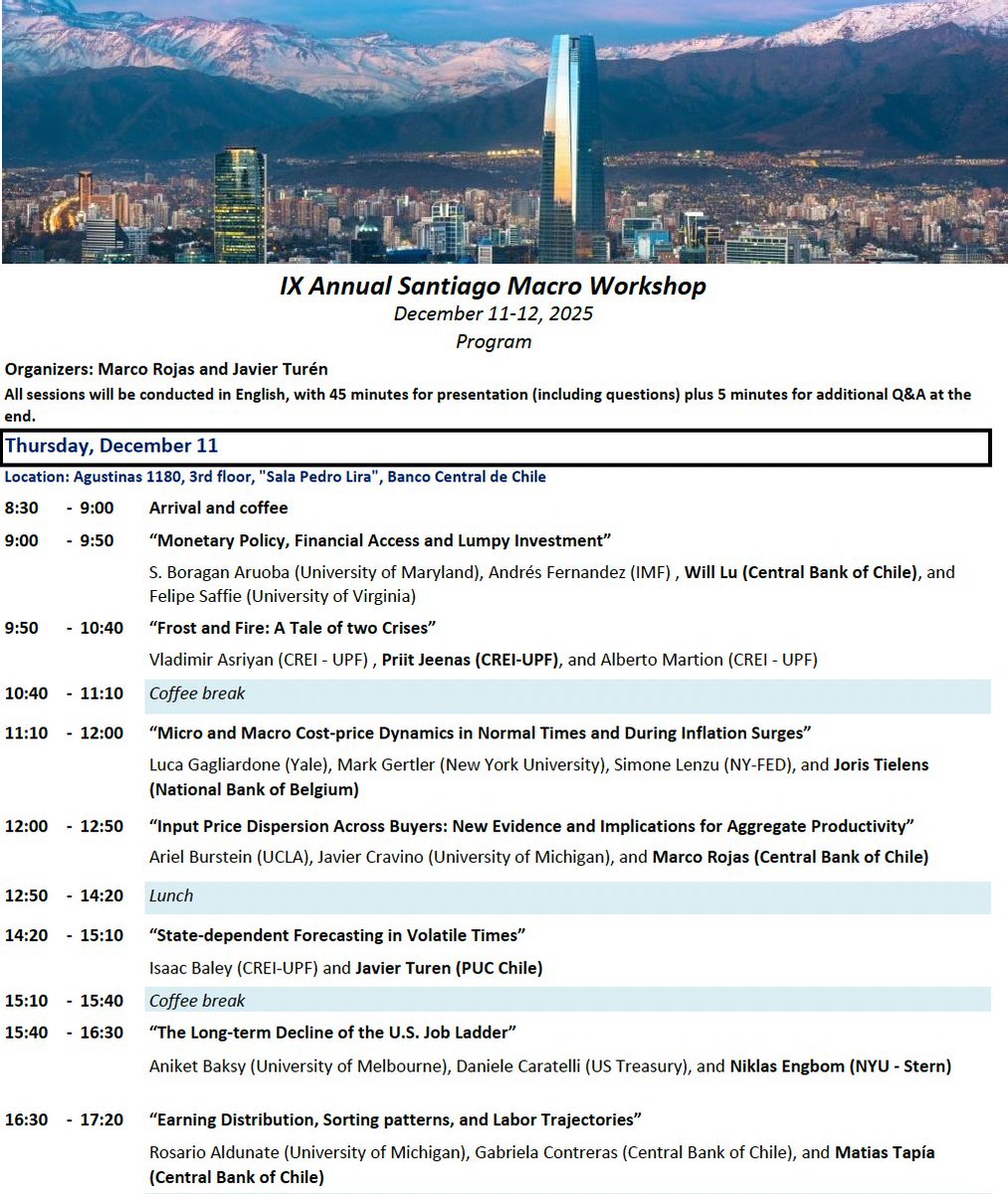
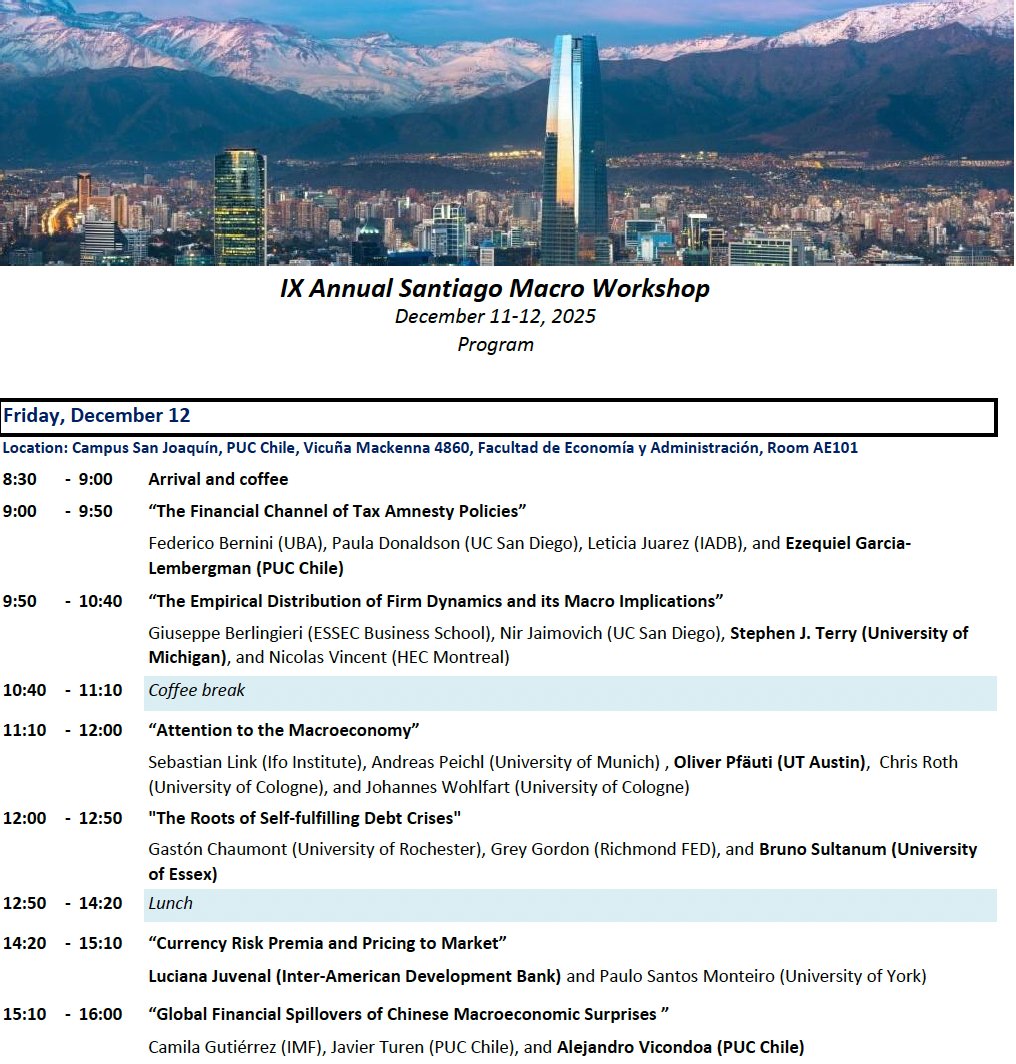
Just returned from an outstanding IX Santiago Macro Workshop. @marcorojas89 and @javier_turen did an amazing job organizing it. A special thanks to @caiohm for the invitation and to all participants for the great talks and discussions. Check the attached program!
@CBChileresearch @IE_UC
3
1
12
971
28 Oct 2025
Just got my copy! What are you waiting for? Order now and check this awesome interview with @poweill
@benjamminlester and Julien Hugonnier at
@_SaMMF_ in the link below!
youtu.be/pBznHs8PVxA?si=4Lu2…
27 Mar 2025

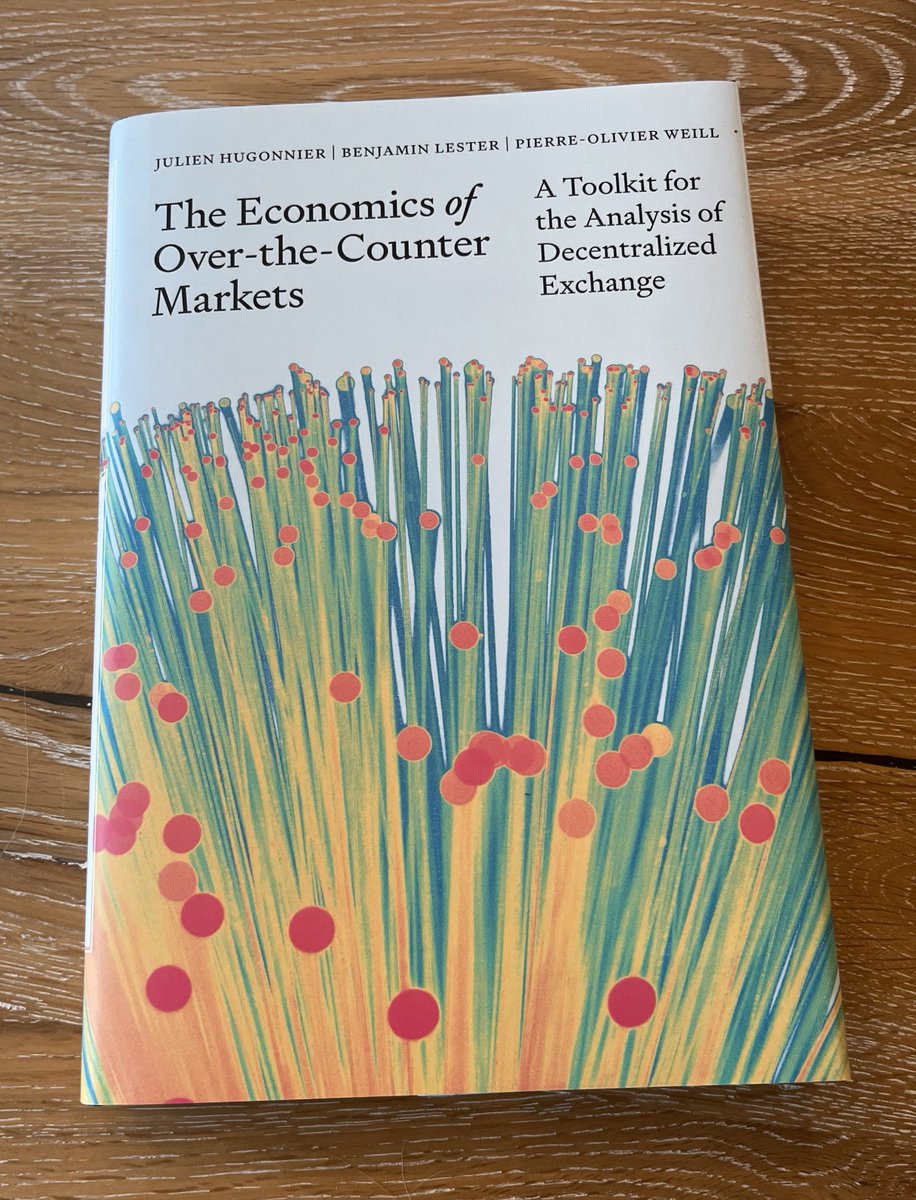
Advance copy of our book, The Economics of Over-the-Counter Markets has arrived! So thankful for my co-authors @poweill and Julien Hugonnier, and for our publisher @PrincetonUPress. Order your copy! Discount code in thread below. #econtwitter (1/4)
4
8
1,315
Bruno Sultanum retweeted

31 Jul 2025
Join us this fall for these exciting virtual seminars!
31 Jul 2025

🔖 The @_SaMMF_ Fall 2025 schedule is LIVE!
I'm thrilled to announce our lineup of virtual speakers in Macro and Finance.
📅 Sep 8: Randall Wright
📅 Oct 6: Brendan Daley
📅 Nov 10: Guillaume Rocheteau
📅 Nov 24: @SakiBigio
All seminars are at 12pm ET on Zoom. Register on the our website below!
sammf.com/
1
4
391
Bruno Sultanum retweeted

31 Jul 2025
We are up and running for Fall 2025!
31 Jul 2025
🔖 The @_SaMMF_ Fall 2025 schedule is LIVE!
I'm thrilled to announce our lineup of virtual speakers in Macro and Finance.
📅 Sep 8: Randall Wright
📅 Oct 6: Brendan Daley
📅 Nov 10: Guillaume Rocheteau
📅 Nov 24: @SakiBigio
All seminars are at 12pm ET on Zoom. Register on the our website below!
sammf.com/
1
3
321
31 Jul 2025
🔖 The @_SaMMF_ Fall 2025 schedule is LIVE!
I'm thrilled to announce our lineup of virtual speakers in Macro and Finance.
📅 Sep 8: Randall Wright
📅 Oct 6: Brendan Daley
📅 Nov 10: Guillaume Rocheteau
📅 Nov 24: @SakiBigio
All seminars are at 12pm ET on Zoom. Register on the our website below!
sammf.com/
7
30
2,133
Bruno Sultanum retweeted

28 Jul 2025
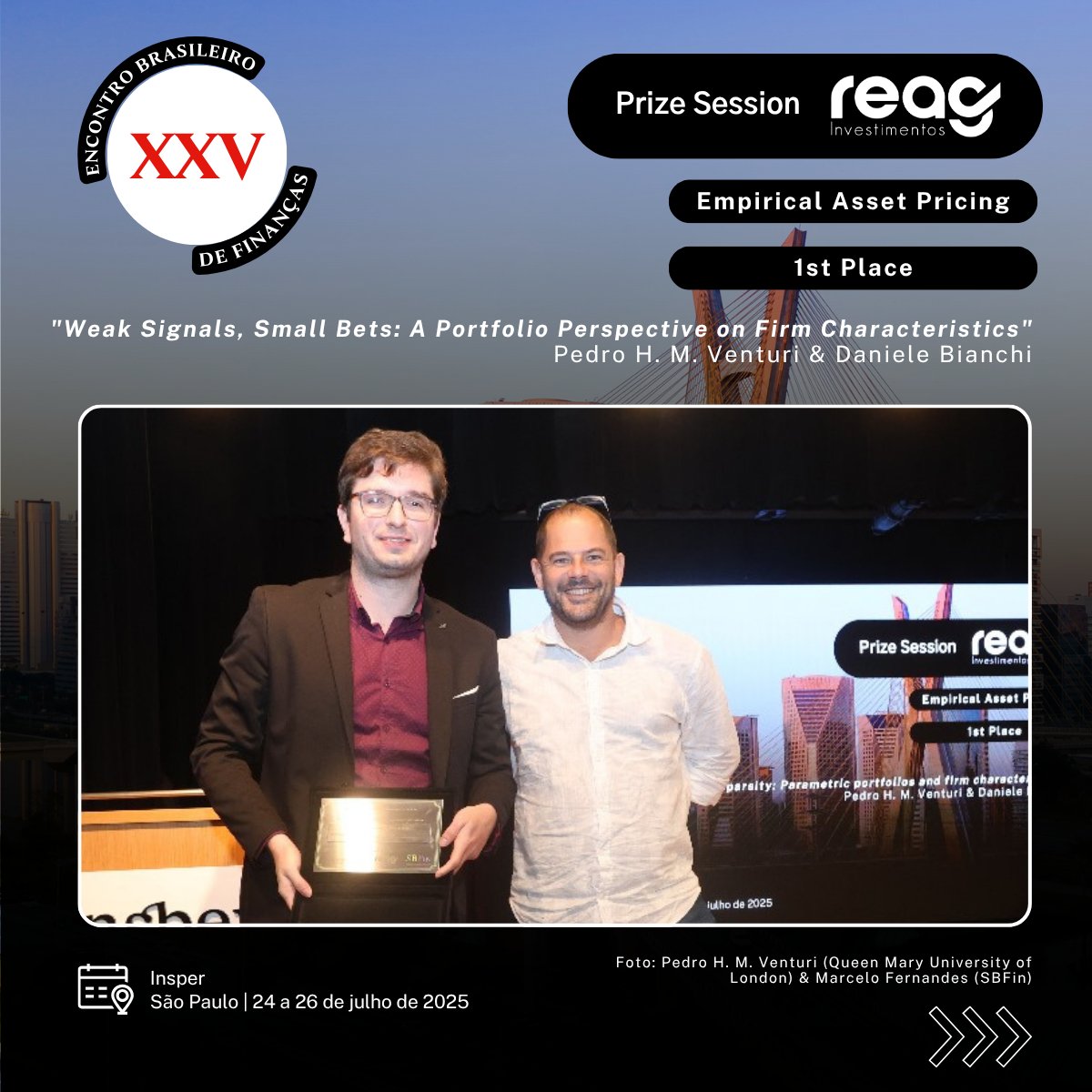
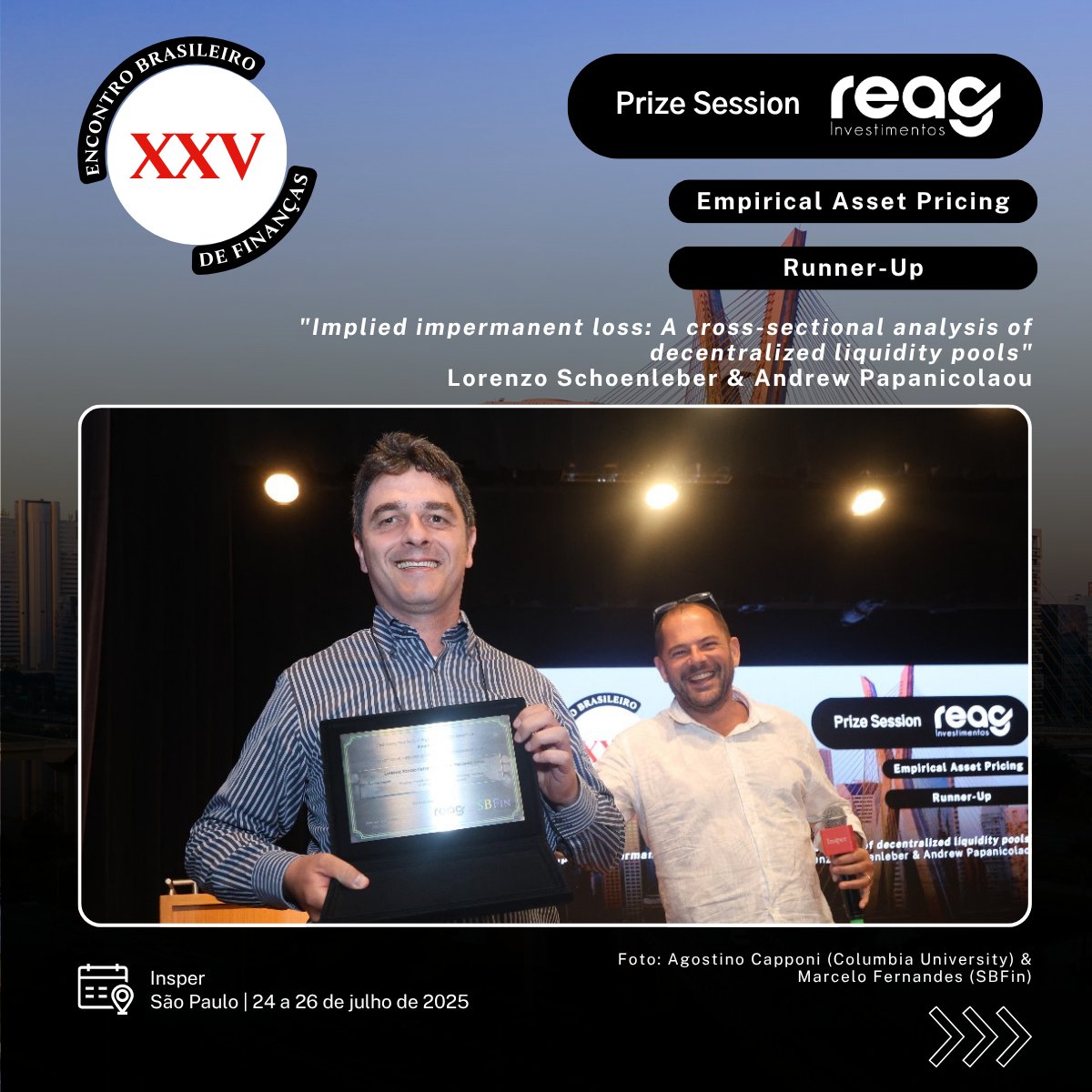
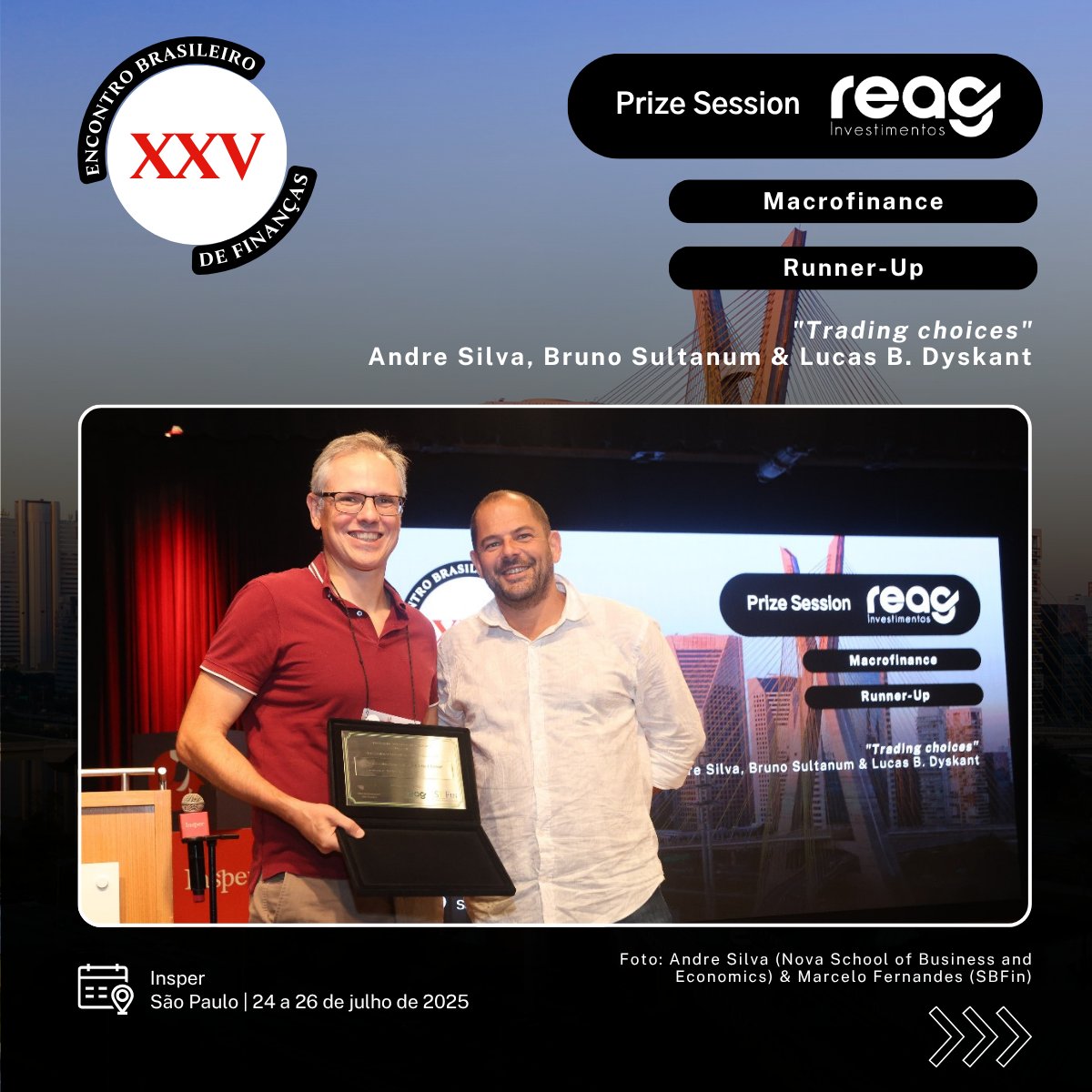
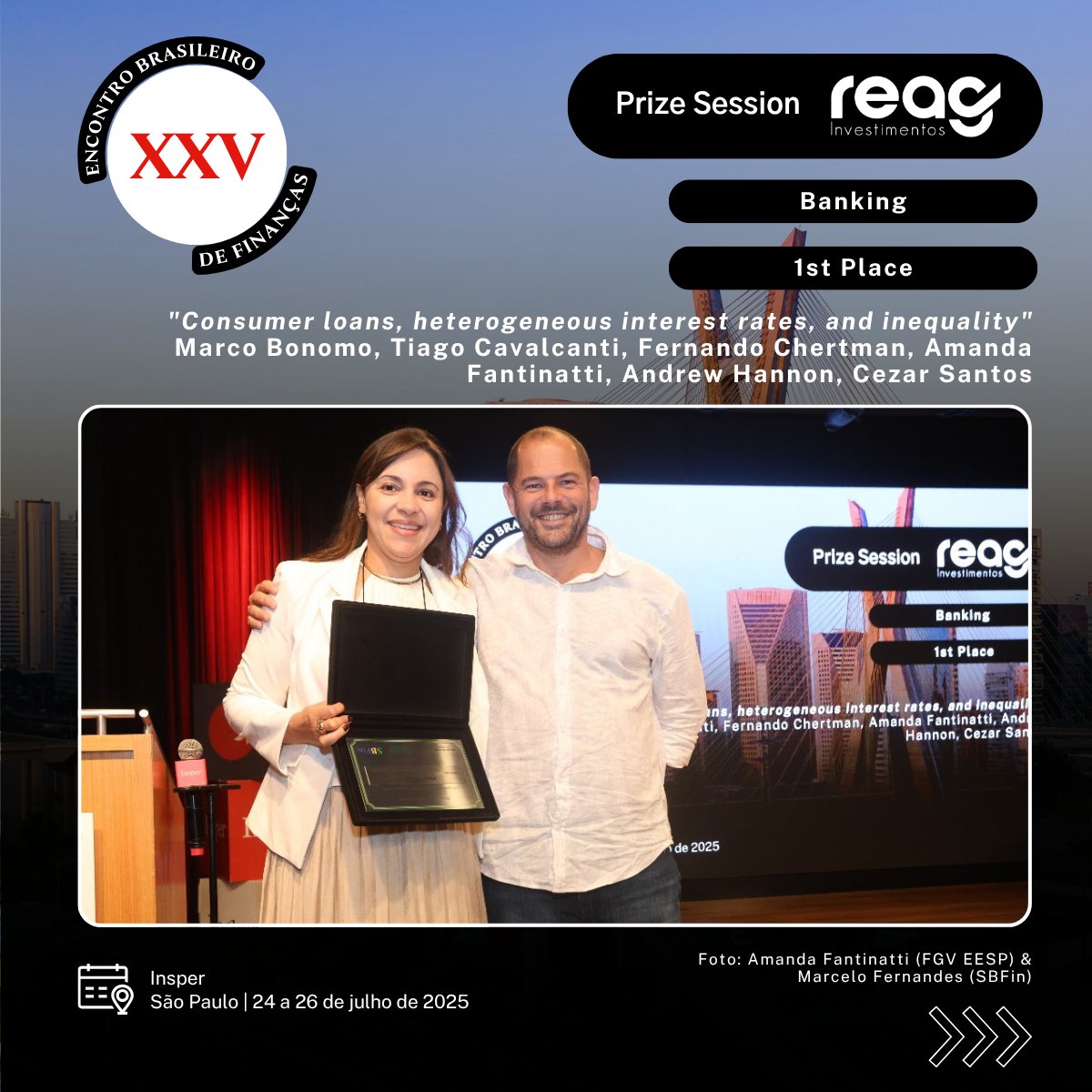
🏆 Prize Session – REAG Investimentos | EBFin 2025
Durante a cerimônia de encerramento do XXV Encontro Brasileiro de Finanças (#EBFin 2025), foram anunciados os vencedores dos Prêmios REAG Investimentos de Melhores Artigos, nas categorias Empirical Asset Pricing, Macrofinance e Banking.
Os prêmios, que levaram o nome da patrocinadora REAG Investimentos, foram entregues pelo Professor Marcelo Fernandes, Presidente da Sociedade Brasileira de Finanças (SBFin).
📍Local do evento: Insper, São Paulo
📅 Data: 24 a 26 de julho de 2025
📌 Auditório Steffi e Max Perlman – Térreo
Categoria: Empirical Asset Pricing
🟩 1º lugar: "Weak Signals, Small Bets: A Portfolio Perspective on Firm Characteristics"
Autores: Pedro H. M. Venturi (Queen Mary University of London) & Daniele Bianchi (Queen Mary University of London)
🟦 2º lugar: "Implied impermanent loss: A cross-sectional analysis of decentralized liquidity pools"
Autores: Lorenzo Schoenleber (Collegio Carlo Alberto) & Andrew Papanicolaou (North Carolina State University)
Categoria: Macrofinance
🟩 1º lugar: "Heterogeneous beliefs, asset prices, and business cycles"
Autores: Dejanir Silva (Purdue University), Saki Bigio (University of California) & Eduardo Zilberman (PUC-Rio)
🟦 2º lugar: "Trading choices"
Autores: Andre Silva (Nova School of Business and Economics), Bruno Sultanum (University of Essex) & Lucas B. Dyskant (Barclays Corporate & Investment Bank)
Categoria: Banking
🟩 1º lugar: "Consumer loans, heterogeneous interest rates, and inequality"
Autores: Marco Bonomo (Insper), Tiago Cavalcanti (University of Cambridge), Fernando Chertman (Banco Central do Brasil), Amanda Fantinatti (FGV EESP), Andrew Hannon (Banco Central Europeu) & Cezar Santos (BID)
🟦 2º lugar: "Bank liquidity mismatch in the reserve cycle"
Autores: Rafael Matta (SKEMA Business School), Enrico Perotti (University of Amsterdam) & Spyros Terovitis (University of Amsterdam)
1
4
12
756
3 Jun 2025
📢 Don't miss @_SaMMF_ next seminar! Prof. @GuidoMenzio (@NYUFASEcon) will present "Markups: A Search-Theoretic Perspective."
🗓️ Date: Monday June 9, 2025
⏰ Time: 12:00 PM ET (US and Canada)
🔗 Registration: essex-university.zoom.us/web…
#EconTwitter #Economics #Finance
4
17
1,074
Bruno Sultanum retweeted
20 May 2025
Check out this great seminar by Quentin!
20 May 2025
Check out the latest video from @_SaMMF_! @QuentinVandewe2 discusses “The Fiscal Cost of Quantitative Easing” with @AdriendAvernas @hubert2fraisse and Liming Ning.
Thanks @AltermattLukas for hosting it!
#QuantitativeEasing #FiscalPolicy #Economics
youtube.com/watch?v=avpy-6cZ…
1
2
353
20 May 2025
Check out the latest video from @_SaMMF_! @QuentinVandewe2 discusses “The Fiscal Cost of Quantitative Easing” with @AdriendAvernas @hubert2fraisse and Liming Ning.
Thanks @AltermattLukas for hosting it!
#QuantitativeEasing #FiscalPolicy #Economics
youtube.com/watch?v=avpy-6cZ…
1
13
1,457
20 May 2025
5/6 Key finding: US QE programs likely made a positive net present contribution to welfare. The cumulative risk-neutral cost is estimated at 0.25% of GDP, with an upper bound of 0.69% of GDP. This is compared to estimated output gains of 1.19% to 3.36% of GDP.
1
104
20 May 2025
6/6 Interestingly, the paper suggests that financing QE with zero-interest reserves (as some propose to avoid central bank losses) would render QE ineffective for boosting aggregate demand, as it wouldn't change bondholders' interest rate risk exposure.
97
Bruno Sultanum retweeted
13 Apr 2025
youtube.com/watch?v=6lpCSFi7…
📢 Don't miss this @_SaMMF_ seminar by Katka Borovickova on “Assortative Matching and Wages: The Role of Selection". Thanks again for a great seminar and kudos to our panelists for the great atmosphere!
2
4
889
Bruno Sultanum retweeted

10 Apr 2025
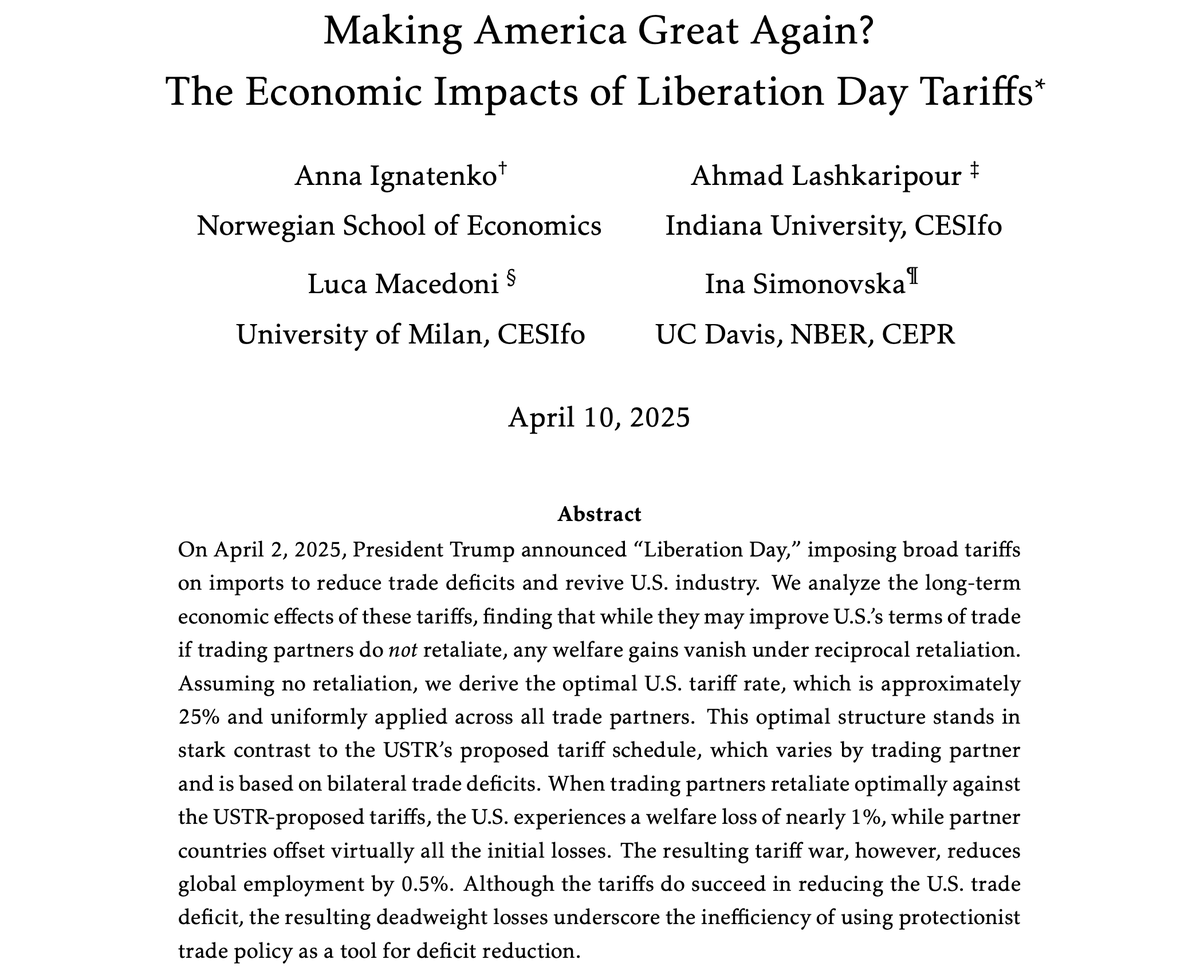
🚨We just released a paper examining the long-terms economic impacts of "Liberation Day" tariffs.
In summary: while these tariffs may help reduce the trade deficit, they will impose significant costs on the U.S. economy after retaliation by trade partners.
44
184
694
207,571