Joined November 2019
- Tweets 12,614
- Following 1,115
- Followers 4,164
- Likes 11,292
2,405 Photos and videos










Pinned Tweet

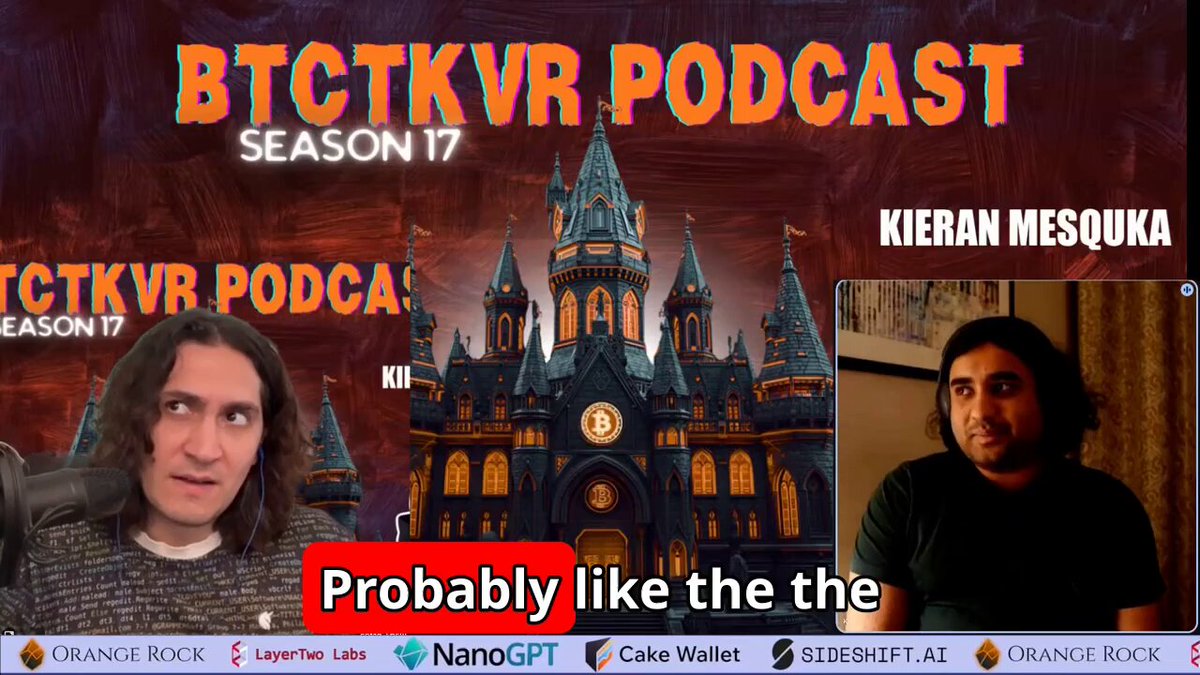
Another Quality Episode if here to bring Knowledge and Entertainment to your Sunday!
The guest is @mesquka/ Kieran Mesquka.
He is a contributor developing protocol designs for the @RAILGUN_Project,
He is a well known advocate for freedom-maximizing technologies and a connoisseur of Zero Knowledge privacy.
"Oh you're a people pleaser? Name 3 people who are pleased with you." - Kieran Mesquka
Some of the topics covered include
🧩Kieran shares his Bitcoin origin story
🧩Differences between Tornado Cash and Railgun
🧩Railgun's tech stack is very similar to Zcash
🧩The issues with transparent blockchains
🧩Praise for @naomibrockwell's work
🧩His shift from mining to building on Ethereum
youtube.com/live/rDgwqKQFjls…


Railgun & Building Privacy with @mesquka (Bitcoin Takeover Podcast S17 E27) x.com/i/broadcasts/1pJkOORQL…
3
6
15
23,103
Bitcoin Takeover (BTCTKVR.com) retweeted
Hard Truth with @Vladcostea
Vlad's argument about why Bitcoin is no longer honestly a cypherpunk project:
If the Lightning Network has been used to normalize custodians, if developers cannot get basic opcodes activated to build interesting things, and if the project is now primarily an institutional asset held by ETFs and treasury companies... you cannot describe it with a straight face as something Satoshi Nakamoto built for individual financial sovereignty.
He says people should accept that we live in a multi-coin world where different things serve different purposes, rather than pretending that one network serves all use cases it was originally promised to cover.
Bitcoin Takeover S17E20.


Privacy is the Last Battleground!
A new episode aired, with three champions of privacy.
@harryhalpin/ Harry Halpin CEO and co-founder
@nym, while building privacy tools, he is also one of the most prominent privacy advocates in academia.
@cialoneCodes/ Christopher Cialone is a big privacy advocate whose current focus is to free the Tornado Cash devs (especially @rstormsf ) and the Samourai Wallet devs.
@lunardragon420/ Amir Taaki is the cofounder @DarkFiSquad, a crypto anarchist, guerilla fighter and someone you want along for the ride when burning down the establishment.
With this great guest list, you cannot miss this episode if you are about self sovereignty and privacy.
A taste of topics discussed
⚓️Authoritarian control systems
⚓️Hypocrisy of prosecuting privacy tool developers
⚓️Early, freer days of the internet
⚓️AI, controlled by the Superpowers
⚓️The significance of zero-knowledge proofs
youtube.com/live/rzsJDOBA4NM…
5
9
18
2,777
Bitcoin Takeover (BTCTKVR.com) retweeted
Clarity on CLARITY
Poison for True Decentralization.... Putting the Lock in Blockchain!
In the last few days (as of early June 2026), the Digital Asset Market Clarity Act has hit the Senate legislative calendar and is advancing with negotiations resuming.
Proponents call it a win for crypto.... splitting oversight between SEC (securities) and CFTC (commodities), creating paths for stablecoins, and giving banks more custody roles.
This is classic government overreach dressed up as progress.
Here's why it hurts decentralization:
The bill formalizes heavy compliance, disclosures, AML requirements, and registration frameworks. True decentralization thrives in gray areas where code and networks run without constant permission from D.C. bureaucrats. This turns innovation into another regulated industry, forcing projects to lawyer up and centralize operations to meet federal standards.
Replacing Banks was the plan....
By carving out roles for banks in custody/trading and pushing "mature" network definitions, it tilts the field toward big finance and away from permissionless, borderless DeFi and peer-to-peer systems.
Smaller, truly decentralized projects get squeezed by compliance costs that only large players can afford.
Even with some anti-CBDC language, the overall structure expands federal reach into digital assets. History shows regulators don't stop at "clarity", they expand.
This risks turning crypto from a tool for financial sovereignty into a surveilled, taxed, and gatekept extension of the traditional system.
Decentralization isn't about getting a nicer regulatory sandbox from Congress. It's about reducing reliance on centralized authorities altogether. Bills like this often accelerate the capture of emerging tech by the state and entrenched interests, slowing the very innovation that made Bitcoin and Ethereum powerful in the first place.

Clarity on CLARITY!
Who controls the data?
The Clarity Act expands regulatory tracking and recordkeeping requirements.
More reporting, means more data in government databases, which means even more surveillance.
They're building infrastructure to monitor every transaction, every trade.
Individual sovereignty means your financial activity stays YOUR business, not theirs.
4
4
6
370
Bitcoin Takeover (BTCTKVR.com) retweeted

The funniest part of being early is that it doesn’t feel like being early.
It feels like being insane, alone, and right, in that order, for about a decade.
40
51
921
22,312
Bitcoin Takeover (BTCTKVR.com) retweeted
Conservatism Constricting Creation
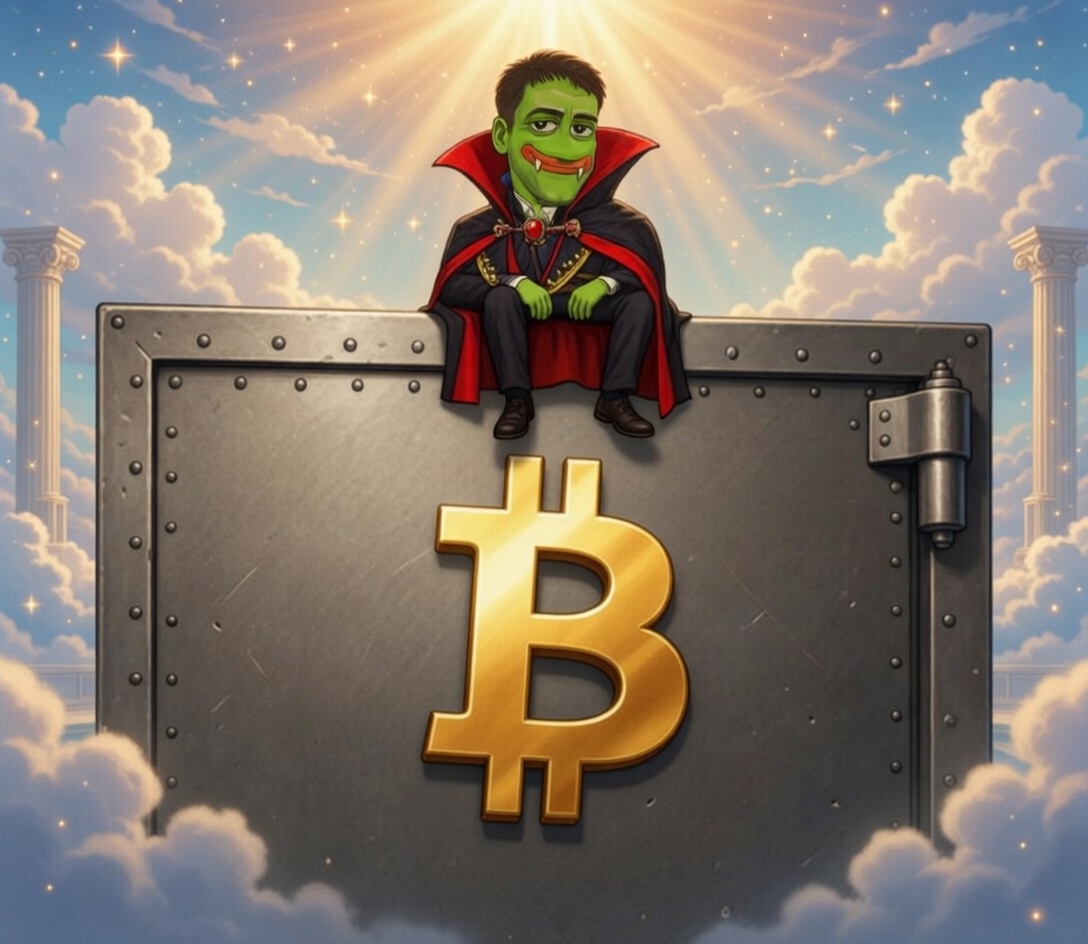
Tether left Bitcoin because Bitcoin was incompatible with Tether's use case.
The original Tether token was issued on Omni Layer, which runs on Bitcoin.
Tether moved to Ethereum, then Tron, then other chains, because Bitcoin's scripting language could not support the token functionality Tether needed.
John Carvalho uses this as evidence that Bitcoin's conservatism has actively driven away some of its most valuable use cases, not because those use cases were bad, but because Bitcoin refused to accommodate them.
Bitcoin Takeover S17E11 with @BitcoinErrorLog
A new episode was released, S17E11, featuring @BitcoinErrorLog in an episode about Bitcoin Depression, Bitkit and Pubky.
John Carvalho has been on the show before. He is the CEO of @Synonym_to which has developed self-custodial mobile wallet @bitkitwallet and @getpubky a social tagging protocol aimed at trying to give data sovereignty back to users.
This interview deals with
🍀The origins of Tether on Bitcoin
🍀Concerns about Bitcoin’s long-term sustainability🍀Synonym’s vision
🍀John's fashion brand
🍀The limitations of trustless systems
youtube.com/live/l58nYpu7zks…
3
3
219
Bitcoin Takeover (BTCTKVR.com) retweeted
Zcash Pool History
Josh Swihart's explanation of Zcash's shielded pool history!
The first pool was Sprout🌱, using slow cryptography that took minutes to generate a proof and could not run on mobile devices.
It was upgraded to Sapling 🌳, which was significantly faster, and then to Orchard 🎄, the current shielded pool.
Each upgrade represents a new cryptographic standard.
A vulnerability discovered in Orchard by security researcher Taylor Hornby was patched, with the next pool, Ironwood 🪵, planned to launch with formal verification of its underlying circuits rather than relying purely on manual auditing.
Bitcoin Takeover S17E28 with @jswihart from @zodl_app
Conviction is Rewarded
Our latest Episode features the guest Josh Swihart/ @jswihart founder of @zodl_app!
Zcash is in a very different position to the last time Josh was on as a guest. November 2024 S15E62, zcash:native was a struggling privacy project with very little support... fast forward to 2026 and zcash:native is the rising star of the cryptocurrency market, with plans to scale to billions of users and ever-improving shielding technology.
This is a glimpse of what was discussed
⚡️Orchard Pool Vulnerability and Ironwood Upgrade
⚡️Reasons for forking from Electric Coin Company
⚡️Zcash Turnaround Strategy
⚡️Long-Term Network Sustainability
⚡️Decentralization Efforts
youtube.com/live/t9gYDG6jDSg…
4
2
121
Bitcoin Takeover (BTCTKVR.com) retweeted
Another Quality Episode if here to bring Knowledge and Entertainment to your Sunday!
The guest is @mesquka/ Kieran Mesquka.
He is a contributor developing protocol designs for the @RAILGUN_Project,
He is a well known advocate for freedom-maximizing technologies and a connoisseur of Zero Knowledge privacy.
"Oh you're a people pleaser? Name 3 people who are pleased with you." - Kieran Mesquka
Some of the topics covered include
🧩Kieran shares his Bitcoin origin story
🧩Differences between Tornado Cash and Railgun
🧩Railgun's tech stack is very similar to Zcash
🧩The issues with transparent blockchains
🧩Praise for @naomibrockwell's work
🧩His shift from mining to building on Ethereum
youtube.com/live/rDgwqKQFjls…
Railgun & Building Privacy with @mesquka (Bitcoin Takeover Podcast S17 E27) x.com/i/broadcasts/1pJkOORQL…
3
6
15
23,103
Bitcoin Takeover (BTCTKVR.com) retweeted
Hard Questions on Bitcoin's Future
Chad and Danny's answer to the security budget question: Satoshi's white paper assumed that transaction fees would eventually replace the mining subsidy.
So far this has not been tested because Bitcoin's price has roughly kept pace with each halving. But the price cannot go up forever.
The common answers Chad has heard governments will subsidize mining, energy will become free.
he describes as betting Bitcoin's entire long-term viability on a maybe.
OP Net's answer is to create enough on-chain activity that fees become a meaningful and self-sustaining source of miner revenue without relying on anyone to volunteer a subsidy.
Bitcoin Takeover S17E15 with @chadmasterxbt and Danny from @opnetbtc.
Our newest episode is live.
Vlad talking to Danny Plainview and Chad Master/@chadmasterxbt , the masterminds behind @opnetbtc.
Their mission, bringing Ethereum smart contracts to Bitcoin's layer one.
🍀Defining OP NET and Consensus Protocols
🍀Layer Two Limitations and Liquidity Issues
🍀Criticism from Bitcoin Maximalists
🍀Decentralization, Node Operation, and Team Size
🍀Bitcoin: Peer-to-Peer Cash or Financial Layer?
youtube.com/live/WLm9wPw8b5U…
3
3
171
Bitcoin Takeover (BTCTKVR.com) retweeted
The Clownfest that is Stopping Mass Adoption!
@mesquka
Another Quality Episode if here to bring Knowledge and Entertainment to your Sunday!
The guest is @mesquka/ Kieran Mesquka.
He is a contributor developing protocol designs for the @RAILGUN_Project,
He is a well known advocate for freedom-maximizing technologies and a connoisseur of Zero Knowledge privacy.
"Oh you're a people pleaser? Name 3 people who are pleased with you." - Kieran Mesquka
Some of the topics covered include
🧩Kieran shares his Bitcoin origin story
🧩Differences between Tornado Cash and Railgun
🧩Railgun's tech stack is very similar to Zcash
🧩The issues with transparent blockchains
🧩Praise for @naomibrockwell's work
🧩His shift from mining to building on Ethereum
youtube.com/live/rDgwqKQFjls…
1
4
4
236
Bitcoin Takeover (BTCTKVR.com) retweeted
Probabilistic Economics
Bitcoin's six-block confirmation rule is an economic approximation, not a cryptographic certainty.
The probability that a block will be reorged decreases exponentially with each subsequent block, and six was chosen as a practical threshold where the cost of a reorg attack exceeds any plausible benefit.
Dr. K uses this to argue that finality in bitcoin:native is probabilistic and economic rather than absolute, and that treating it as absolute creates false confidence about transaction irreversibility.
Bitcoin Takeover S17E18 with @mechanikalk
In case you missed it.
Our latest episode is here.
"To not have existence, you must have existence. The reason we exist, is because we can't exist without existing."
Karl Kreder aka. Dr.K/@mechanikalk is back on the show!
He is is the architect of the @QuaiNetwork : a layered blockchain stack which maximizes the power of proof of work to enable high transaction throughput.
They discuss scaling Proof of Work, True economic Finality and AI Models.
If you want your mind blown, listen and maybe like and subscribe🤯
youtube.com/live/M67oEW2zKkI…
3
5
174
Bitcoin Takeover (BTCTKVR.com) retweeted
Conviction is Rewarded
Our latest Episode features the guest Josh Swihart/ @jswihart founder of @zodl_app!
Zcash is in a very different position to the last time Josh was on as a guest. November 2024 S15E62, zcash:native was a struggling privacy project with very little support... fast forward to 2026 and zcash:native is the rising star of the cryptocurrency market, with plans to scale to billions of users and ever-improving shielding technology.
This is a glimpse of what was discussed
⚡️Orchard Pool Vulnerability and Ironwood Upgrade
⚡️Reasons for forking from Electric Coin Company
⚡️Zcash Turnaround Strategy
⚡️Long-Term Network Sustainability
⚡️Decentralization Efforts
youtube.com/live/t9gYDG6jDSg…
What's going on with Zcash? feat @jswihart (Bitcoin Takeover Podcast S17 E28) x.com/i/broadcasts/1rxmqqAoA…
1
9
15
1,095
Bitcoin Takeover (BTCTKVR.com) retweeted
Are You Not Entertained!
3
2
117
Bitcoin Takeover (BTCTKVR.com) retweeted
It is what it is!
André/ @_cryptozoidberg believes Bitcoin will switch to proof of stake within ten years.
He said he would put his life on it.
His argument is not ideological.
He says proof of stake simply offers better confirmation times, better economics for network security, and removes the attack vector where a well-funded actor buys up enough existing mining hardware to attempt a 51% attack without needing to manufacture a single new chip.
He says Bitcoin Maxis will disagree, but the technical argument is what it is.
Bitcoin Takeover S17E03 @zano_project

Season 17 Episode 3 was recorded yesterday and if you missed it, we caught up with the @zano_project
team members @_cryptozoidberg @crypto_sowle
and @Mr_Kwibs popped in as well to field some questions.
The interview had discussions around exchange listings and the options of defi because of the strength of the privacy narrative, marketing challenges and as always privacy features.
The @zano team is always approachable and ready to answer questions which makes for a great interview.
youtube.com/live/H0p2qwm_dMw…

5
3
180
Bitcoin Takeover (BTCTKVR.com) retweeted
Technical Clarity
Calin Culianu's explanation of why $BCH node runners do not actually verify every transaction from block zero even on a full node: Bitcoin Core and Bitcoin Cash node both implement a feature called assume-valid, which skips signature verification for blocks before a certain checkpoint.
What a full node actually verifies is chain of custody, not every individual signature.
He argues this makes the claim that you must verify from genesis to be truly trustless technically false for almost every node on both networks, and that UTXO commitments, which BCH is implementing, provide the same security guarantee with a fraction of the overhead.
Bitcoin Takeover S17E2 with @cculianu
Our latest episode is here. Forks and Reunions.
As always, there is no time limit and this is another epic installment. Grab some snacks and get stuck in.
The guests are none other than
@cculianu is the creator of Fulcrum, an efficient privacy-preserving SPV client and a pro science carnivore.
@stevethurmond is the most ardent advocate for Cash Stamps and believes Bitcoin was designed as a peer-to-peer electronic cash system and actively promotes Bitcoin Cash as fulfilling that vision
There are also a host of other guests that drop in during this marathon.
They discuss
👑The Evolution of Bitcoin Cash bitcoin-cash:native
👑The Problem with IOU Systems like Lightning
👑The Changing Culture of Bitcoin Cash
👑The Difficulty of Recreating bitcoin:native's Genesis
👑The End of Crypto-Friendly Spaces in Europe
youtube.com/live/SJkwCaQLRuc…
2
7
18
2,936
Bitcoin Takeover (BTCTKVR.com) retweeted

19 Jan 2015
Yes, there's a problem. Yes, the government could fix it. But I'm willing to bet that if they try, they'll make it worse.
4
10
76