
Living in Shenzhen, China. Creating content about China & Geopolitics.
Joined June 2019
- Tweets 9,817
- Following 841
- Followers 43,230
- Likes 8,970
1,596 Photos and videos

Jun 11
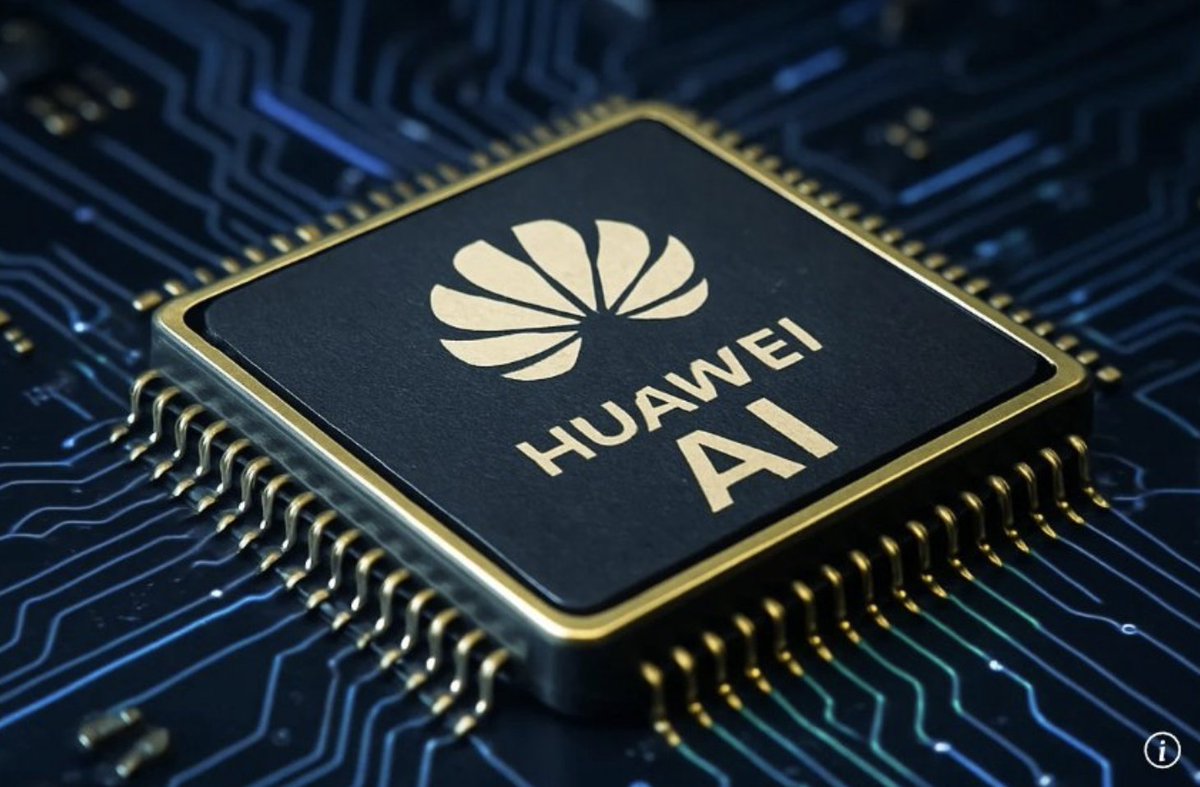
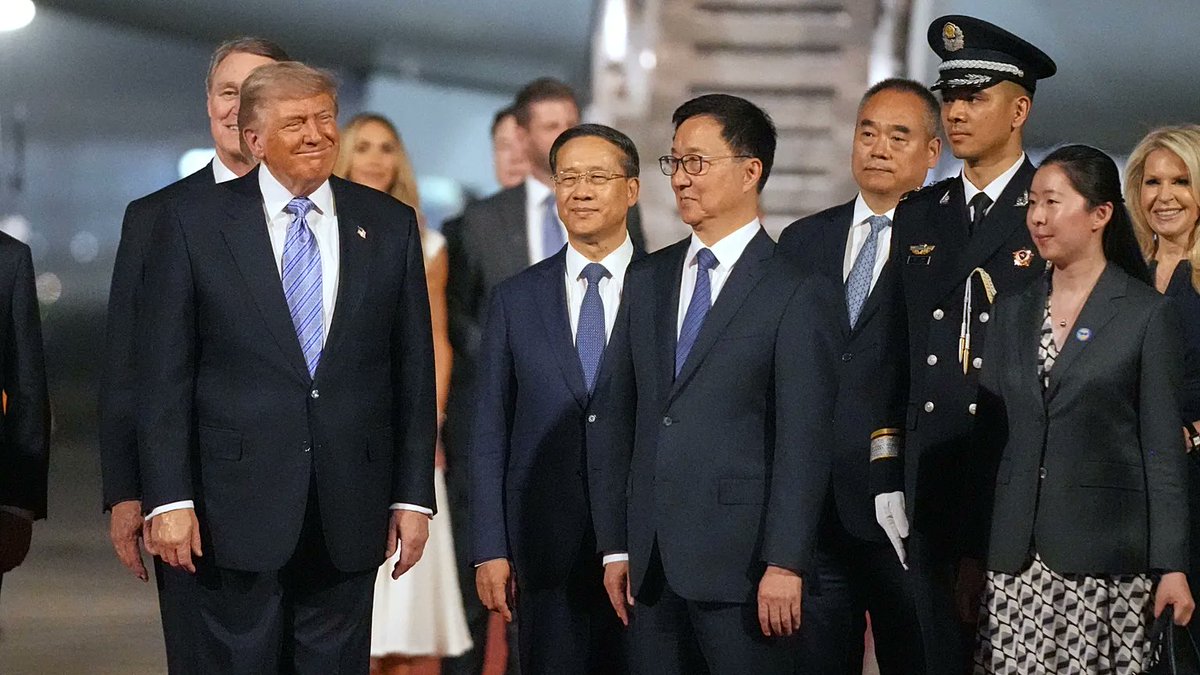
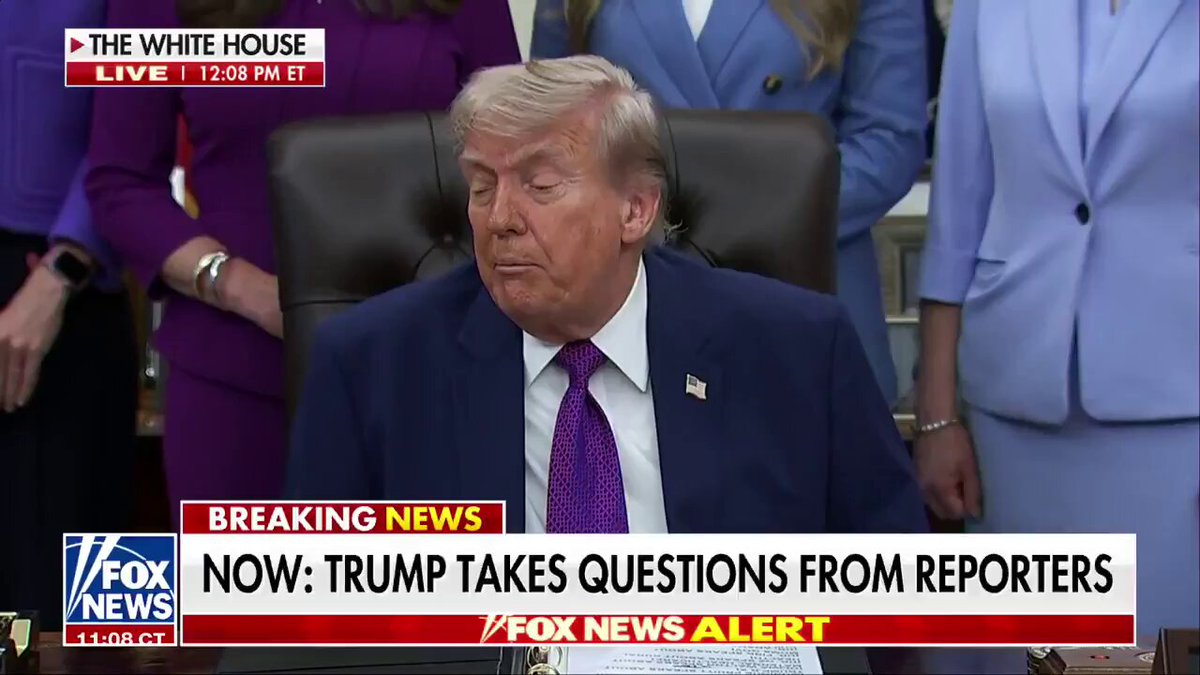
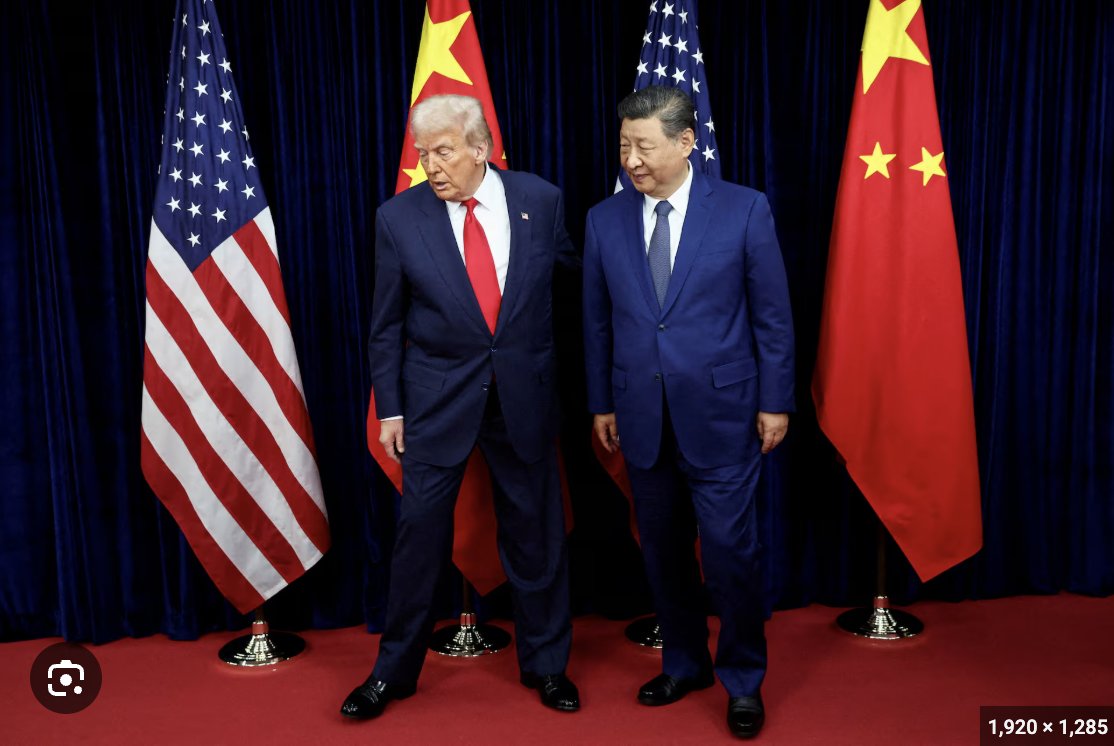
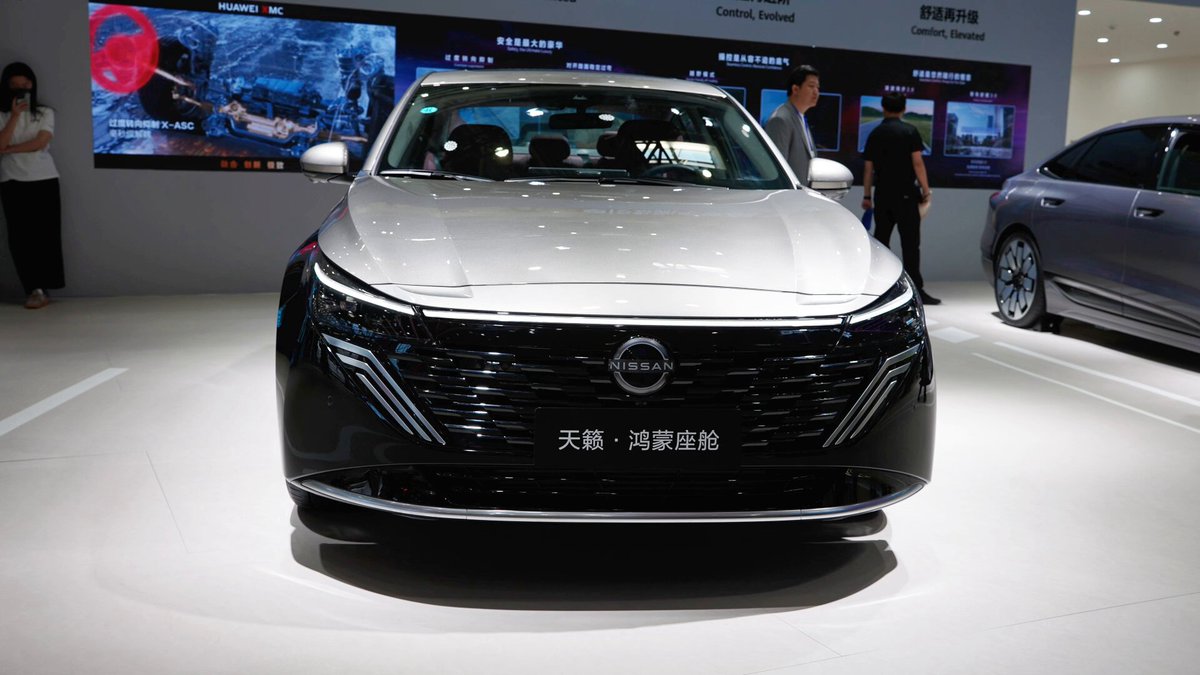
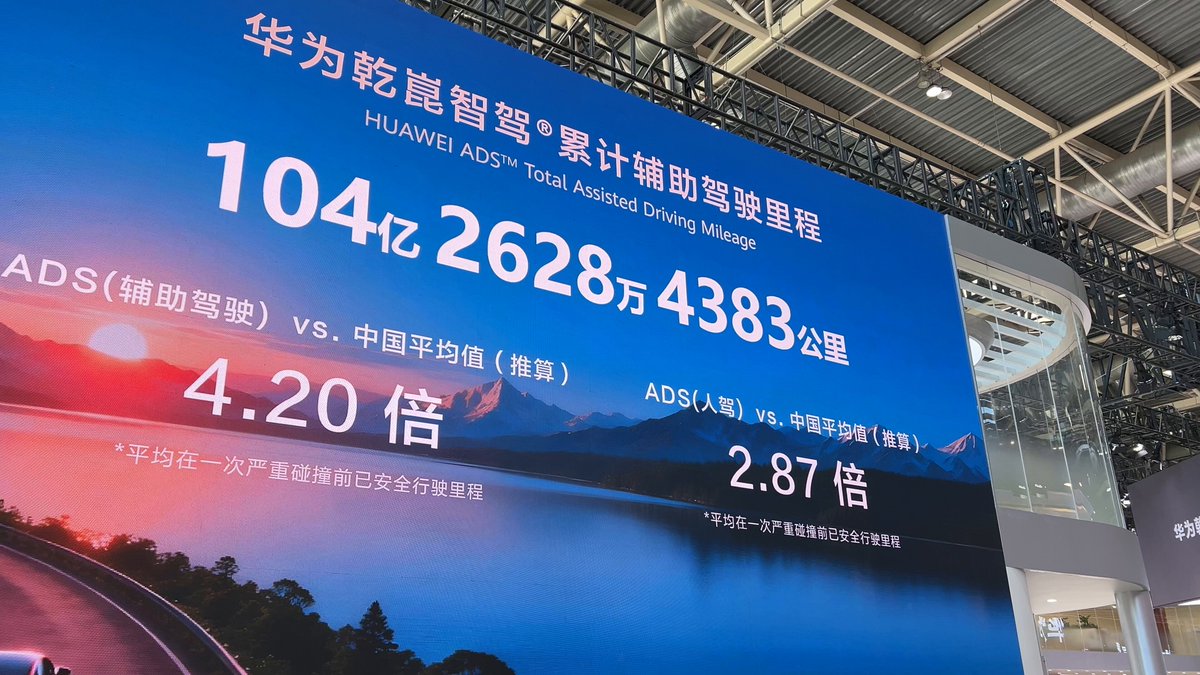
The US thought they were going to Kill Huawei. If you know anything about China or Chinese people you will know that was never going to happen. Now look, the sanctions from the US have made Huawei stronger and more innovative. China thinks way more long term than election cycles of the US.
Jun 10

Isn't Huawei a success story? Nowadays, many Chinese people and enterprises view being sanctioned or blacklisted by the U.S. as a badge of honor—a form of free publicity. It signifies that a company possesses formidable strength and superior technological capabilities; after all, only such companies are perceived as a threat significant enough to worry the Americans.
So, we should thank those foolish American politicians for spurring more Chinese companies to become great enterprises like Huawei—companies that challenge the status quo and containment efforts, overcome technical hurdles, and achieve even greater growth amidst adversity.
11
16
92
3,723
Jun 11
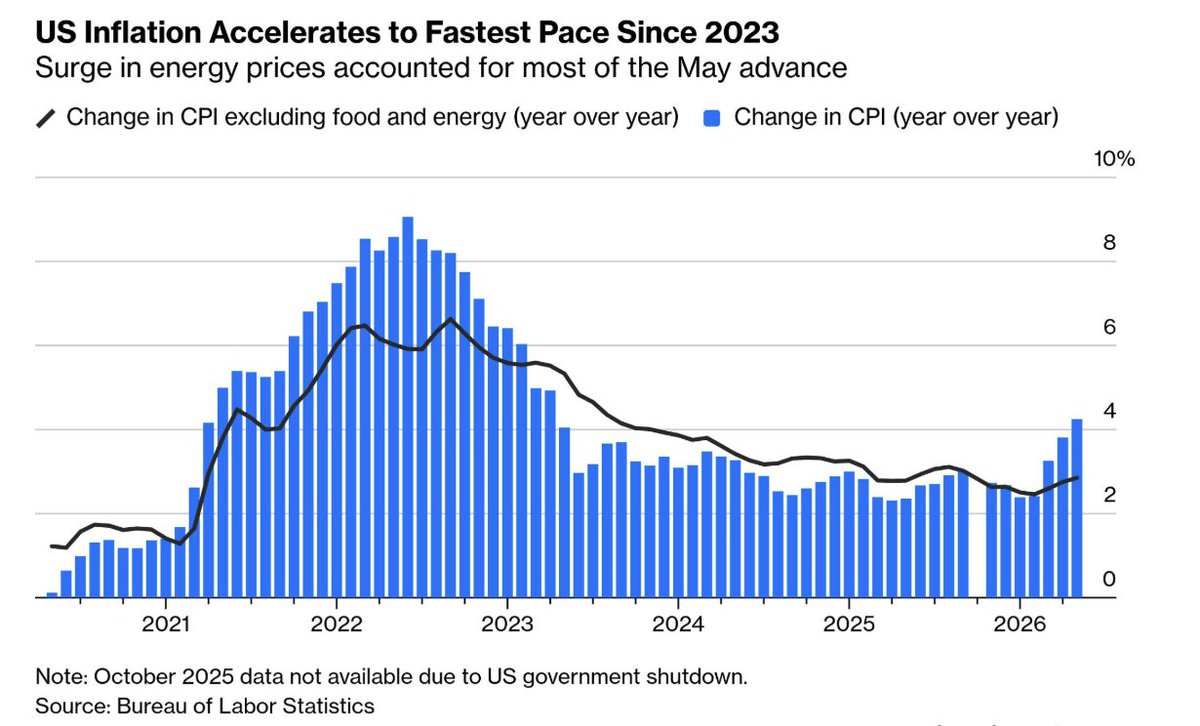
According to Bloomberg this is a result of the US - Iran war, It's just the start. This is how policy that is not fully thought through affects regular people. By eroding their money... As I'd sure wages won't be going up in line...
1
5
421
Jun 10
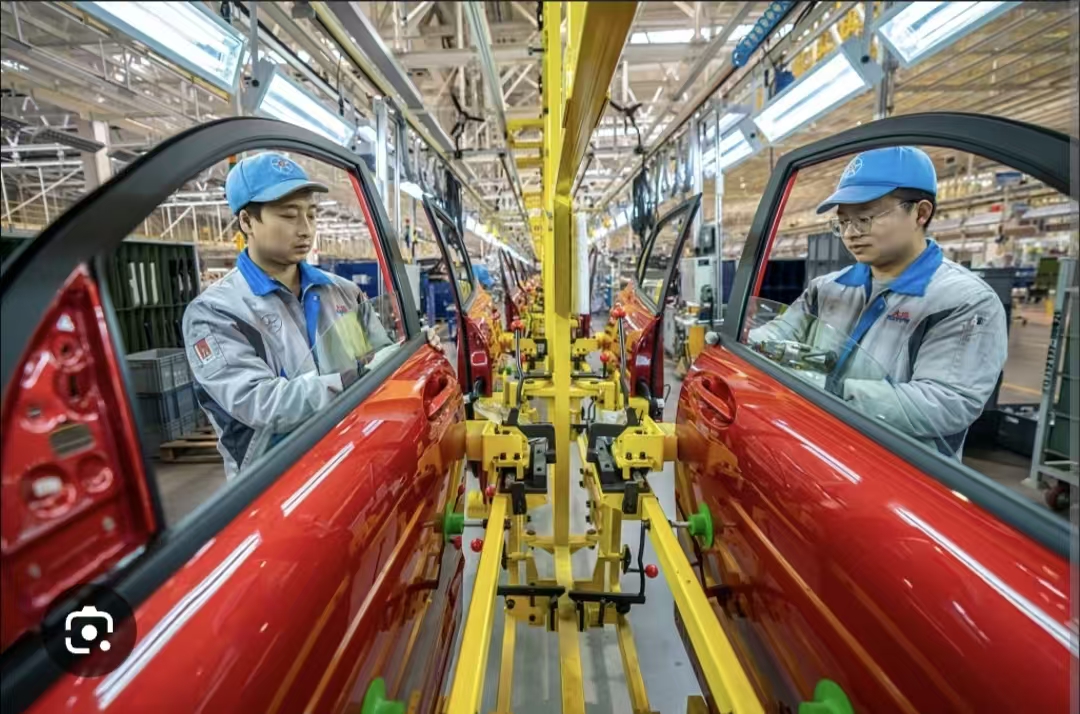
Let's be clear .China builds the best EVs on the planet, dominates AI, cracks memory chips the West said was impossible, and Washington’s genius response is to throw another toddler tantrum blacklist?
BYD, Alibaba, Baidu, YMTC, CXMT, all of them suddenly “military threats” because they’re too good at winning?
Meanwhile U.S. tech giants are literally in bed with the Pentagon building weapons, surveillance, and kill lists and that’s just “innovation.” This isn’t national security. This is a dying empire having a public meltdown because it can’t compete and refuses to admit it.
Every sanction, every blacklist, every crybaby restriction has done NOTHING but make China faster, smarter, and more self-reliant.
Keep crying in Washington. Keep blacklisting winners while your own companies beg for bailouts. China doesn’t need your permission to dominate the 21st century.
Jun 9

So let's get this straight. China builds the world’s biggest EV company, develops globally competitive AI firms, creates world-class memory chip makers, and suddenly the answer from Washington is… put them on another blacklist?
BYD sells millions of cars. Alibaba powers global commerce. Baidu pushes AI innovation. YMTC and CXMT are helping China solve one of the hardest technology challenges on Earth. Yet the Pentagon now wants people to believe these companies are somehow a threat simply because they are Chinese.
Meanwhile, American tech giants work hand in hand with the US military, build defence systems, cloud infrastructure, AI tools, and surveillance capabilities, but apparently that’s “normal”.
This is not about security. It’s about competition.
The reality? China was told it could never build advanced semiconductors. China was told it could never challenge Western EV makers. China was told it could never compete in AI.
Yet here we are.
Sanctions, entity lists, investment restrictions, we’ve seen this movie before. And every time, China adapts, localises, and accelerates.
What I keep saying remains true: Do not underestimate China.
15
30
120
4,392
Jun 9
So let's get this straight. China builds the world’s biggest EV company, develops globally competitive AI firms, creates world-class memory chip makers, and suddenly the answer from Washington is… put them on another blacklist?
BYD sells millions of cars. Alibaba powers global commerce. Baidu pushes AI innovation. YMTC and CXMT are helping China solve one of the hardest technology challenges on Earth. Yet the Pentagon now wants people to believe these companies are somehow a threat simply because they are Chinese.
Meanwhile, American tech giants work hand in hand with the US military, build defence systems, cloud infrastructure, AI tools, and surveillance capabilities, but apparently that’s “normal”.
This is not about security. It’s about competition.
The reality? China was told it could never build advanced semiconductors. China was told it could never challenge Western EV makers. China was told it could never compete in AI.
Yet here we are.
Sanctions, entity lists, investment restrictions, we’ve seen this movie before. And every time, China adapts, localises, and accelerates.
What I keep saying remains true: Do not underestimate China.
15
38
129
9,475
Jun 9
For years we’ve been told that China’s economy is on the brink, that manufacturing is leaving, that sanctions, tariffs and geopolitical pressure would finally bring the country’s export machine to a halt.
Yet here we are again.
Reuters is reporting that China’s exports are expected to rise by around 15% in May, driven by strong global demand for semiconductors, AI-related products and advanced manufacturing. China’s trade surplus is also forecast to increase significantly.
What many commentators still fail to understand is that China is no longer competing primarily on cheap labour. It is increasingly competing on technology, supply chains, manufacturing scale and speed. While some countries debate industrial policy, China is building the factories, producing the chips, manufacturing the components and shipping the finished products.
Much of this growth is being driven by the very sectors that critics claimed China would struggle to dominate: semiconductors, AI hardware and high-tech manufacturing.
I’ve said it before and I’ll say it again. Every round of pressure seems to accelerate China’s determination to innovate, localise and move further up the value chain.
The narrative may not change overnight, but the numbers don’t lie.
Do not underestimate China.
4
39
136
6,082
Barrett retweeted

Jun 3
China’s counter-response to U.S. bullying tactics is entering a critical phase, marked by the establishment of a comprehensive, systematic "toolbox"—a strategy modeled, notably, after U.S. practices.
Since the trade war launched against China during the first term of the Trump administration, the United States—in concert with its Western allies—has continuously tightened restrictions on China’s access to high-end technologies. These restrictions focus on semiconductors, artificial intelligence (AI), quantum computing, aerospace, supercomputing, and various dual-use technologies (civilian-military applications), with the aim of curbing China’s development in high-end manufacturing and frontier technologies.
However, over the past decade, as China has achieved leapfrog breakthroughs in numerous strategic technological fields, the original dynamic has fundamentally shifted. China is no longer merely a passive recipient of international technological restrictions; it now urgently needs to establish its own autonomous and controllable system for managing technology outflows—particularly regarding core technologies in which it has already secured a global leading edge.
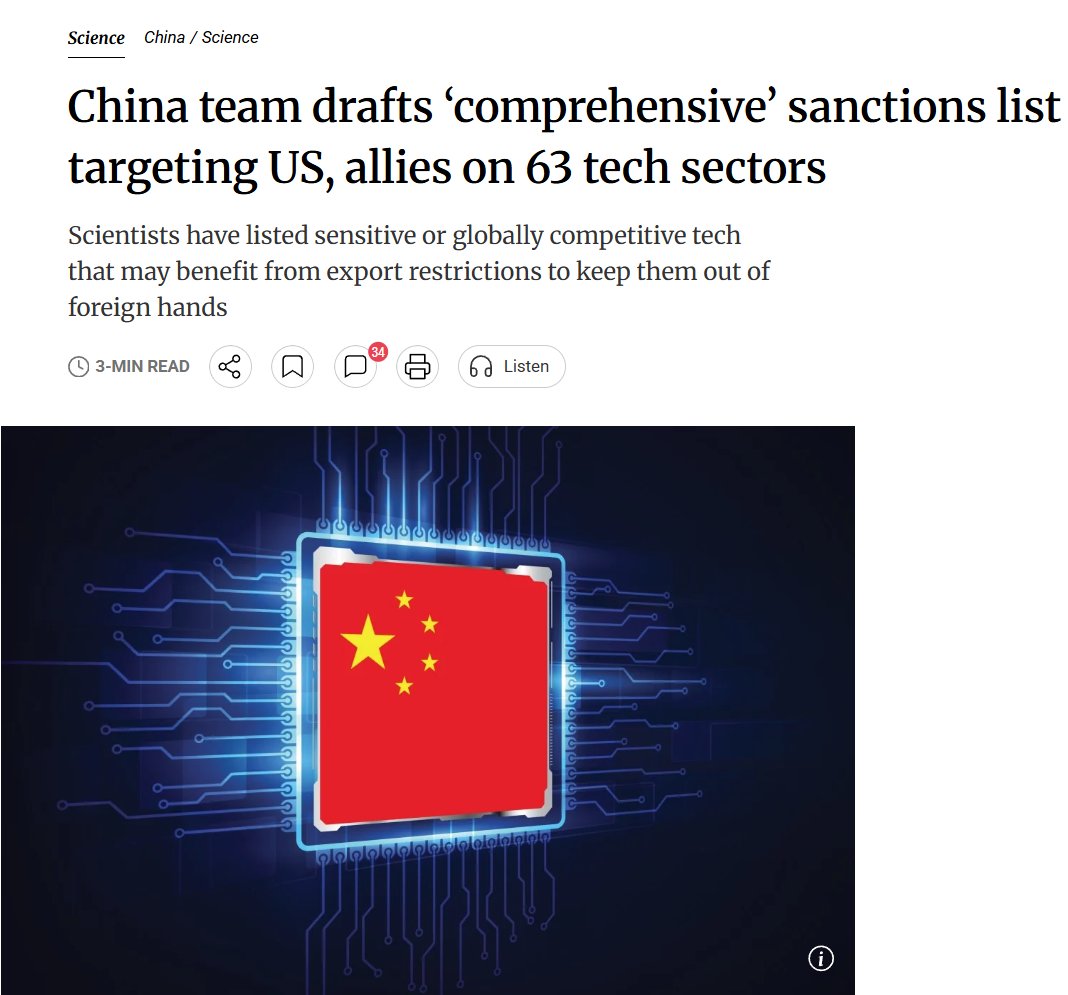
On June 1, Hong Kong’s *South China Morning Post* reported that Chinese research teams have drafted a "comprehensive" export control list targeting the United States and its allies, covering 63 distinct technological fields. Researchers have identified technologies deemed strategically sensitive or globally competitive, with the objective of preventing their outflow abroad through export restrictions.
This pioneering study, titled *Framework for Selecting Technologies for Export Restriction: An Empirical Study*, was first published on March 19 in the *Bulletin of the Chinese Academy of Sciences*. The paper delves deeply into "a fundamental strategic issue that has rarely been publicly discussed in China in recent years." It proposes China’s first relatively comprehensive framework for identifying technologies subject to export controls, ultimately selecting 63 specific technologies characterized by strategic sensitivity or global competitiveness. These technologies span fields such as advanced materials, quantum communication, AI hardware, energy systems, biotechnology, and aerospace engineering.
According to the study’s assessment, the technologies designated as "Tier 1" restricted exports include: satellite-based quantum-encrypted communication, electromagnetic launch technology, solar cell-related technologies, general-purpose miniaturized AI edge computing devices, metal recovery technologies for rare earth waste residues and tailings, and advanced high-strength steel production technologies for the automotive industry, among others. Other technologies include graphyne material preparation, deep-ultraviolet crystal fabrication, ultra-large-scale offshore wind turbines, space robotics, high-performance carbon electrode fabrication for perovskite solar cells, autonomous orbit determination via inter-satellite links for the BeiDou-3 navigation system, and free-space optical communication.
In their paper, the research team notes that this framework draws partly upon the export control mechanisms that the United States has long had in place. Through decades of evolution, the U.S. Department of Commerce has established a methodology that combines expert technical reviews with public consultations to identify specific technological domains and parameters subject to export bans or restrictions. The paper points out that, historically, U.S. export controls have focused not only on military or dual-use technologies but have also closely targeted two specific categories of critical technologies: first, fields where latecomer nations—exemplified by my country—are rapidly rising and, while not yet technological leaders, show the potential to challenge U.S. monopolies (e.g., integrated circuits, supercomputing, and civil nuclear power); and second, cutting-edge foundational technologies poised to shape the future landscape of science, technology, and industry (e.g., 3D printing, brain-computer interfaces, and artificial intelligence).
Evidently, the Chinese research team has sought to construct an assessment methodology tailored to China’s specific stage of development and industrial structure. Their screening process draws comprehensively upon existing domestic and international technology lists, the International Patent Classification (IPC) system, technology gap models, and patent co-occurrence network analysis; furthermore, it has undergone multiple rounds of expert review involving stakeholders from industry, academia, and government agencies. The study also relies heavily on patent databases to identify technological domains in which China possesses a comparative advantage. Taking the field of advanced materials as an example, the research team analyzed over 215,000 international patent records, employing machine learning clustering models and network analysis to pinpoint key technological nodes.
The significance of this research extends far beyond export policy alone. In the past, my country’s science and technology development strategy centered primarily on technology acquisition and addressing industrial deficiencies. However, as Chinese enterprises and research institutions increasingly join the global "first tier" across numerous cutting-edge sectors, issues such as technological sovereignty, technological security, and the protection of critical strategic technologies have now become subjects of routine discourse and policy deliberation within China.
The study also observes that my country’s institutional framework for ensuring the security of technology trade currently lags behind those of developed nations such as the United States, the United Kingdom, France, Germany, and Japan—countries that, through decades of development, have successfully established comprehensive systems for technology export control. Based on this study, it is recommended that relevant competent authorities, grounded in top-level design, effectively undertake three key tasks: monitoring and anticipating trends in foreign technology export restrictions while strengthening preventive measures; refining the selection processes and methodologies for my country's own restricted export technologies; and advancing the practical implementation of control measures for these technologies.
9
83
195
22,081
May 27
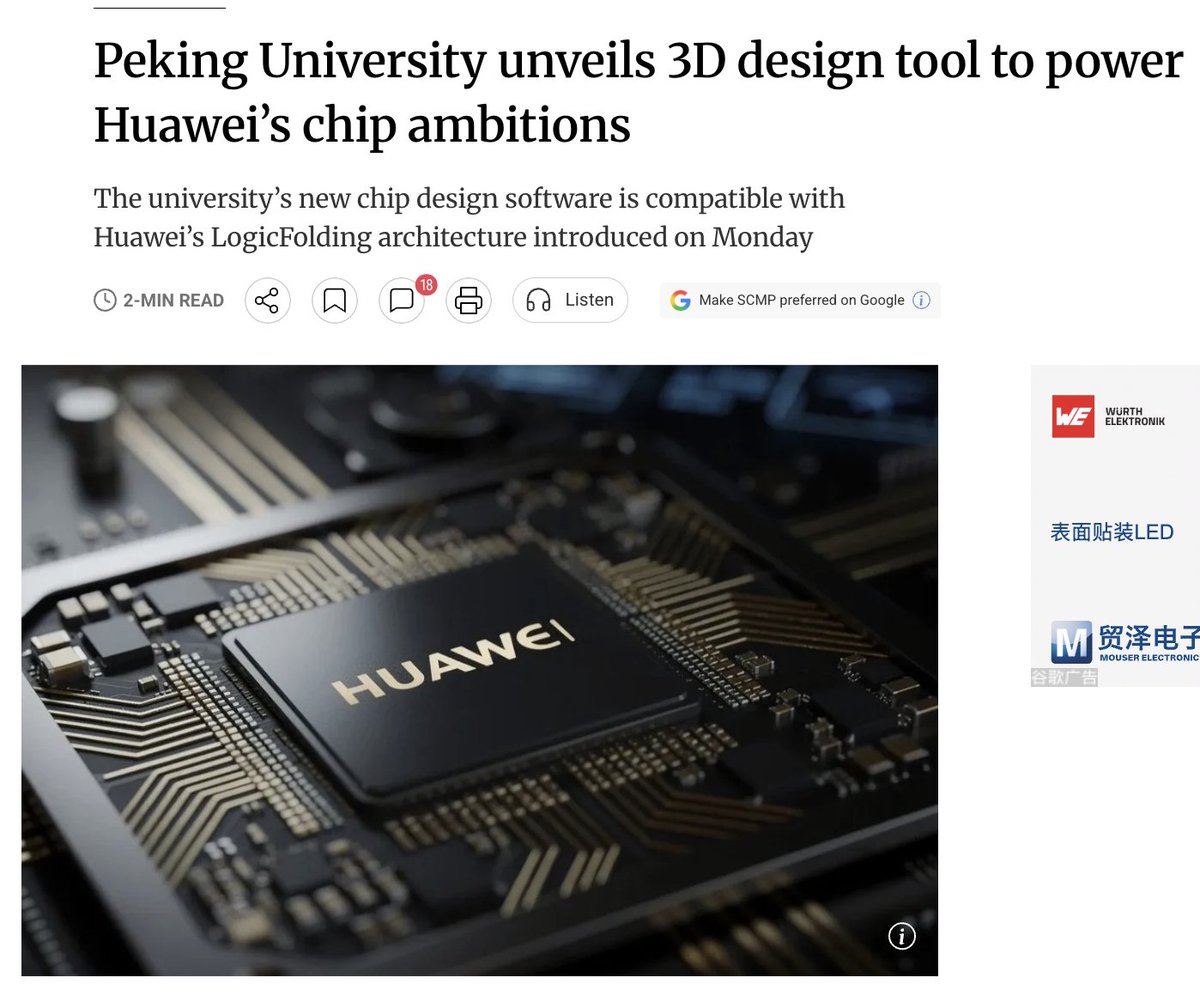
Just days after Huawei dropped their Tau Scaling Law and LogicFolding bombshell proving they’re done begging for permission and building an entirely new roadmap, Peking University is already rolling out 3D EDA tools built specifically for Huawei’s architecture.
This is what I’ve been saying for years.The US thought they could choke Huawei and freeze China’s chip industry with sanctions. Instead they’ve triggered the fastest, most complete sovereign semiconductor ecosystem on the planet. New chip architectures, domestic EDA tools, advanced packaging, AI silicon, procurement standards, the whole supply chain, reorganising around Huawei.
Pressure doesn’t break China. It makes them innovate faster, harder and meaner. America tried to deny them the tools. So China built their own. And they’re doing it at warp speed. This isn’t “catching up.” This is leaving the old path in the dust. Biggest strategic policy in modern history. Keep coping, Washington. Never underestimate China.
19
252
985
52,296
May 27
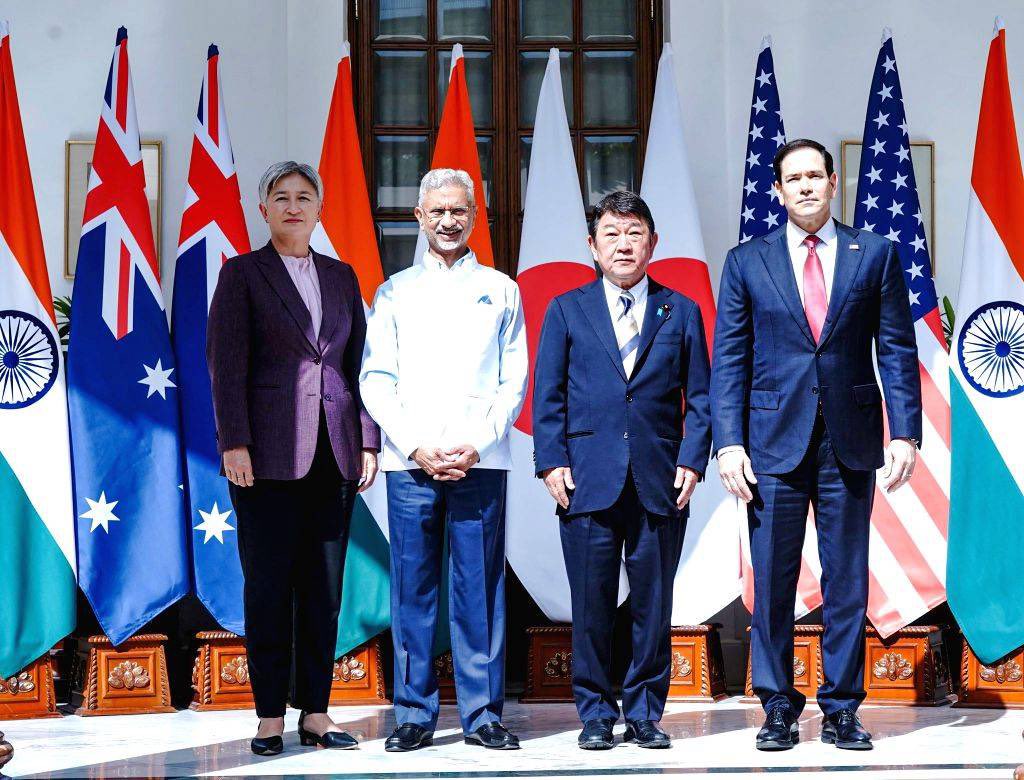
QUAD containment is DEAD.All the Western hype, summits and “Asian NATO” cope exposed as total fantasy. US overstretched, allies hedging, China just keeps moving foreward. Do not underestimate China.
May 27
For years, the QUAD was hyped up as the grand alliance that would “contain China.” The media sold it as an Asian NATO. Endless headlines, endless summits, endless speeches about “shared values.” But now? Even their own analysts are admitting the cracks are everywhere.
The reality is simple. The United States is overstretched. Washington shifted military assets out of Asia to the Middle East, burned through huge amounts of munitions, then suddenly started trying to reassure nervous allies after Trump’s China visit. That alone tells you everything.
Japan is worried about being abandoned. India is pushing harder for “strategic autonomy.” Australia is getting squeezed economically while being told to take greater risks against China. And the QUAD itself has no treaty, no unified command, no collective defence obligations… just political messaging.
Meanwhile China kept building. Manufacturing. Technology. Infrastructure. Trade. Diplomacy. While the West focused on blocs and containment, China focused on long-term development.
This is why I keep saying: do not underestimate China.
The biggest weakness of anti-China alliances has always been this: they are often united by fear, while China is united by national development and long-term strategy. Eventually reality catches up.
7
15
83
4,901
May 27
For years, the QUAD was hyped up as the grand alliance that would “contain China.” The media sold it as an Asian NATO. Endless headlines, endless summits, endless speeches about “shared values.” But now? Even their own analysts are admitting the cracks are everywhere.
The reality is simple. The United States is overstretched. Washington shifted military assets out of Asia to the Middle East, burned through huge amounts of munitions, then suddenly started trying to reassure nervous allies after Trump’s China visit. That alone tells you everything.
Japan is worried about being abandoned. India is pushing harder for “strategic autonomy.” Australia is getting squeezed economically while being told to take greater risks against China. And the QUAD itself has no treaty, no unified command, no collective defence obligations… just political messaging.
Meanwhile China kept building. Manufacturing. Technology. Infrastructure. Trade. Diplomacy. While the West focused on blocs and containment, China focused on long-term development.
This is why I keep saying: do not underestimate China.
The biggest weakness of anti-China alliances has always been this: they are often united by fear, while China is united by national development and long-term strategy. Eventually reality catches up.
14
26
108
11,420
May 25
For years, the narrative coming from the West was that US sanctions would cripple Huawei and stop China’s semiconductor ambitions. Instead, Huawei appears to have responded by developing an entirely new path forward. According to Huawei, its new τ (Tau) Scaling Law, nicknamed “Her’s Law” by He Tingbo’s peers, could eventually allow Huawei to develop chips equivalent to 1.4nm by 2031. Rather than relying purely on shrinking transistor sizes like traditional Moore’s Law, Huawei is focusing on reducing signal delay and redesigning chip architecture through technologies like LogicFolding. This is exactly what I’ve said for years: pressure doesn’t stop China, it forces China to innovate faster. Never underestimate China.
scmp.com/tech/article/335471…
3
19
93
3,600
May 25
🚨🇨🇳For years I’ve been saying the same thing… the semiconductor “blockade” on China was never going to stop China. If anything, it accelerated everything.
The US thought sanctions would cripple Huawei. Instead, Huawei went back to the drawing board and started innovating in ways the West wasn’t even talking about. Now they’re unveiling “logic folding” chip technology and openly saying they’ve found a new path beyond traditional scaling.
This is what so many people still don’t understand about China. Pressure doesn’t weaken China… often it forces China to innovate faster, invest harder, and become more self-reliant.
A few years ago people laughed when anyone suggested China would solve its semiconductor challenges. Today? Huawei is back. Chinese chip companies are advancing rapidly. Domestic supply chains are growing. And this is still only the beginning.
I keep saying it because people keep underestimating what’s happening here:
Do not underestimate China.
32
90
421
16,088
May 25
For years, many believed US sanctions would cripple Huawei’s semiconductor ambitions. Instead, Huawei appears to have used that pressure to rethink chip design entirely. At IEEE ISCAS 2026, Huawei revealed its new τ (Tau) Scaling Law and “LogicFolding” architecture, focusing on reducing signal delay and optimizing entire computing systems rather than relying purely on shrinking transistors. It’s a fascinating shift away from the traditional Moore’s Law approach that the global semiconductor industry has followed for decades. Whether this becomes the future of chip development or not, one thing is becoming clear: the sanctions didn’t stop Huawei, they pushed the company to innovate differently.

2
6
35
2,725
May 20
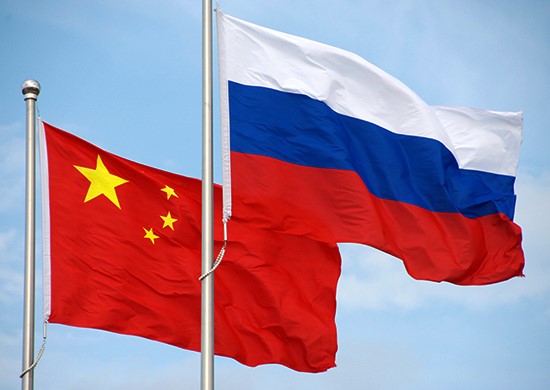
🇨🇳🇷🇺UPDATE : Putin is IN Beijing RIGHT NOW, shoulder-to-shoulder with Xi Jinping on day two of this historic visit! While the US and its lapdogs are still crying about an ‘axis of evil’, the two strongest independent powers on Earth are locking arms tighter than ever. 25th visit. 30th anniversary of strategic partnership. 25th anniversary of the Good-Neighborliness Treaty. And they just kicked off the China-Russia Years of Education to train the next generation of unbreakable friendship.This isn’t diplomacy. This is a steel wall. No sanctions, no threats, no colour revolutions can break it. China and Russia are done asking permission from Washington. They’re building the multipolar world in real time, protecting the Global South, smashing unilateralism, and giving the American empire the middle finger it deserves.
The West had its unipolar moment. It’s OVER. This partnership is only getting stronger, faster, and more confident. You were warned. Now watch it happen live. #ChinaRussiaStrong #PutinInBeijing #MultipolarWorldIsHere #TheEmpireIsShaking
May 19
Russia’s President Putin is landing for his 25th visit to China, perfectly timed with the 30th anniversary of the China-Russia strategic partnership and the 25th of their Good-Neighborliness Treaty!
This alliance isn’t some fragile thing, it’s at its absolute BEST period in history and it’s getting stronger and stronger every single day!
Xi and Putin have met over 40 times, guiding this rock-solid bond with deep mutual trust, shoulder-to-shoulder, back-to-back cooperation that no third party can touch or dictate.
The West loves to cry ‘axis of evil’ but the facts are clear: while the US throws tantrums, sanctions, interference and long-arm jurisdiction nonsense, China and Russia are pushing back HARD. They’re the pillar holding up international fairness and justice in a world the Americans keep trying to destabilise. Coordinating in the UN, BRICS, SCO – protecting the Global South and building real multipolarity.
China and Russia are true neighbors who can’t be moved. This partnership is injecting massive stability and positive energy while the US bully keeps trying to divide and conquer.
The US’s unipolar days are finished. The China-Russia machine is only accelerating. Deal with it! The multipolar world is here and it’s unstoppable.
2
8
31
2,411
May 19
Russia’s President Putin is landing for his 25th visit to China, perfectly timed with the 30th anniversary of the China-Russia strategic partnership and the 25th of their Good-Neighborliness Treaty!
This alliance isn’t some fragile thing, it’s at its absolute BEST period in history and it’s getting stronger and stronger every single day!
Xi and Putin have met over 40 times, guiding this rock-solid bond with deep mutual trust, shoulder-to-shoulder, back-to-back cooperation that no third party can touch or dictate.
The West loves to cry ‘axis of evil’ but the facts are clear: while the US throws tantrums, sanctions, interference and long-arm jurisdiction nonsense, China and Russia are pushing back HARD. They’re the pillar holding up international fairness and justice in a world the Americans keep trying to destabilise. Coordinating in the UN, BRICS, SCO – protecting the Global South and building real multipolarity.
China and Russia are true neighbors who can’t be moved. This partnership is injecting massive stability and positive energy while the US bully keeps trying to divide and conquer.
The US’s unipolar days are finished. The China-Russia machine is only accelerating. Deal with it! The multipolar world is here and it’s unstoppable.
5
28
76
8,679
May 17
This is a great analysis of the NVidia situation with regards to China.
May 17
Why was there no news regarding the procurement of Nvidia chips following Trump's visit to China?
After Trump's departure, China's Ministry of Commerce released a summary of the preliminary outcomes from the China-U.S. economic and trade consultations; notably, it contained no mention whatsoever of the chip trade between the two nations.
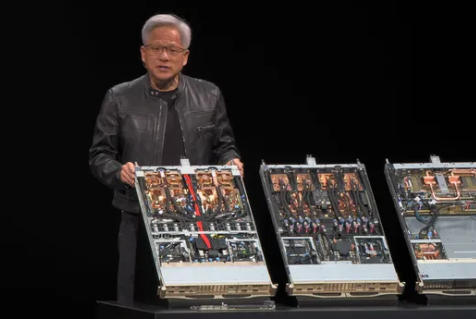
Prior reports had suggested that the U.S. side had authorized Nvidia to export up to 75,000 H200 chips—specifically, a maximum of 7,500 units per company—to ten Chinese technology firms. Upon returning to the United States, Trump himself confirmed that the U.S. had indeed approved the sale, yet the Chinese side had failed to place an order. Why? In reality, Trump's eleventh-hour strategy—sending Jensen Huang aboard Air Force One to Beijing—proved to be a failure, stemming from a fundamental miscalculation of the situation.
The reason is that China has, in fact, little interest in the H200 chips that the U.S. has permitted for sale. Purchasing them entails paying a hefty "toll"—a 25% tariff imposed by the U.S. government. Furthermore, there are concerns that the chips may contain "backdoors" and cannot be guaranteed as secure.
Moreover, while the H200 offers decent performance, its prime is rapidly fading. In the second half of the year, Nvidia is set to begin mass production of its Rubin series chips (R100), which will represent the cutting edge of technology. The Blackwell series will rank second in performance, leaving the H200 relegated to a distant third place.
Were China to purchase H200 chips on a massive scale right now, it would essentially be helping Nvidia clear its inventory (reports suggest that the figure of 750,000 units corresponds precisely to Nvidia's current stock). Furthermore, domestic Chinese chips have now reached a level of performance—in terms of computing power and cluster applications—that is largely on par with the H200; consequently, large-scale procurement of Nvidia's H200 chips would deal a severe blow to China's burgeoning domestic chip industry.
Thus, the situation remains in constant flux—unless, of course, the U.S. agrees to supply China with more advanced Nvidia chips. This also implies that the "Nvidia chip card" has not proven as effective against China as the White House and Jensen Huang had anticipated; they should not mistake China for a willing "patsy" ready to pay a premium simply to help them offload their excess inventory.
3
2
9
2,020
May 14
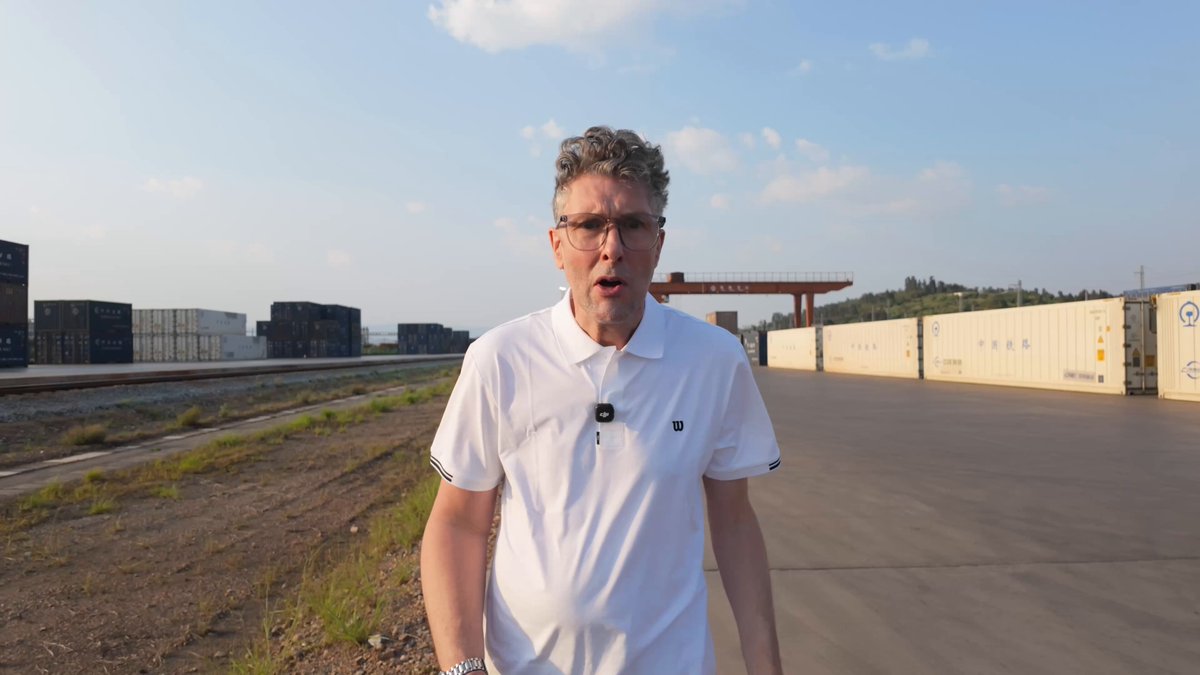
Most people have never heard of Yuxi. But this city deep inside China’s Yunnan province is becoming something much bigger than anyone expected. What started as a railway connection into Laos is now transforming trade, industry, logistics and even education across Southeast Asia. In this video, I take you inside massive automated steel factories, electric freight hubs and one of the most important railway projects in Asia to see how inland China is rapidly building the next phase of regional connectivity.
5
59
260
8,710
May 14
Update: Trump-Xi Summit in Beijing Delivers Results:
Just hours after President Trump touched down in Beijing at Xi Jinping’s invitation, the two leaders sat down and got real.
Xi was resolute: Taiwan is China’s core interest. Any mishandling risks serious consequences. Period. China’s red lines remain non-negotiable.
But the tone was clear and constructive. Both sides agreed to build a “constructive China-U.S. relationship of strategic stability” , the new guiding framework for the years ahead.
Practical wins are already on the table:
China stepping up purchases of American soybeans, Boeing jets, energy, oil & LNG
Expanded market access for U.S. businesses
Continued cooperation to keep the Strait of Hormuz open and block fentanyl precursors
Trump called the relationship “better than ever” and invited Xi to the White House in September.
The U.S. tried tariffs, tech bans, and tantrums. China stood firm, never knelt, and forced the conversation back to equal, pragmatic cooperation.
American farmers, CEOs, and workers will benefit, Over 80,000 U.S. firms in China prove it every day.
The message from Beijing is loud and clear:
Dialogue beats confrontation. Cooperation beats decoupling and Stability wins over chaos.
China never wanted to replace the U.S. it just refused to be bullied. Now the giant ship of China-U.S. relations is steadying again… on China’s course.
Win-win isn’t weakness. It’s the future.
May 14
At President Xi Jinping’s invitation, Donald Trump is landing in Beijing for a full state visit. After all the twists, the trade war tantrums, the tariff bombs, and the tech blockades the US threw at China like a spoiled child smashing toys… the US is coming anyway. Because deep down the US knows the giant ship of China-US relations only steadies when it sails on China’s course.
China never wanted to replace the US. China said it a thousand times. But China also said ,and proved that they will NEVER kneel. The US hit China with everything. China hit back harder when it had to, stood rock-solid on its red lines, and forced the table back to equal, pragmatic talks. Taiwan is Chinese territory. Period. Sovereignty, security, development interests? Non-negotiable. Full stop.
Now the world watches Beijing. 2026 isn’t just another year, it’s China launching its 15th Five-Year Plan while the US celebrates 250 years of independence.
The message is clear: the unstoppable rise of China isn’t a threat to the US goal of “Making America Great Again.” It’s the best partner the US could possibly have if the US finally drops the zero-sum game.
American CEOs are already lining up. US soybean farmers, US businesses, US investors are making money hand over fist in China while US politicians play games. Over 80,000 US firms here in China. Millions of American jobs tied to China-US trade. The American Chamber of Commerce itself admits it: the US is doing better in China than US propaganda wants America to admit.
So here’s the deal, straight and aggressive:
Dialogue beats the US’s stupid confrontation. Cooperation beats the US’s failing decoupling fantasy. Stability beats the chaos the US keeps trying to create.
The Pacific isn’t too wide for friendship when both sides respect each other. But respect means recognizing reality: China is rising, China is open, China is the world’s factory AND the world’s biggest market and nobody is stopping that.
Trump is coming to Beijing. Good. Let the US talk like equals. Let the US build like partners. But never forget: China has been here before, China stood firm, and China is still standing taller than ever.
The future doesn’t belong to the bully. It belongs to the strong who choose win-win.
3
6
34
4,162
May 14
At President Xi Jinping’s invitation, Donald Trump is landing in Beijing for a full state visit. After all the twists, the trade war tantrums, the tariff bombs, and the tech blockades the US threw at China like a spoiled child smashing toys… the US is coming anyway. Because deep down the US knows the giant ship of China-US relations only steadies when it sails on China’s course.
China never wanted to replace the US. China said it a thousand times. But China also said ,and proved that they will NEVER kneel. The US hit China with everything. China hit back harder when it had to, stood rock-solid on its red lines, and forced the table back to equal, pragmatic talks. Taiwan is Chinese territory. Period. Sovereignty, security, development interests? Non-negotiable. Full stop.
Now the world watches Beijing. 2026 isn’t just another year, it’s China launching its 15th Five-Year Plan while the US celebrates 250 years of independence.
The message is clear: the unstoppable rise of China isn’t a threat to the US goal of “Making America Great Again.” It’s the best partner the US could possibly have if the US finally drops the zero-sum game.
American CEOs are already lining up. US soybean farmers, US businesses, US investors are making money hand over fist in China while US politicians play games. Over 80,000 US firms here in China. Millions of American jobs tied to China-US trade. The American Chamber of Commerce itself admits it: the US is doing better in China than US propaganda wants America to admit.
So here’s the deal, straight and aggressive:
Dialogue beats the US’s stupid confrontation. Cooperation beats the US’s failing decoupling fantasy. Stability beats the chaos the US keeps trying to create.
The Pacific isn’t too wide for friendship when both sides respect each other. But respect means recognizing reality: China is rising, China is open, China is the world’s factory AND the world’s biggest market and nobody is stopping that.
Trump is coming to Beijing. Good. Let the US talk like equals. Let the US build like partners. But never forget: China has been here before, China stood firm, and China is still standing taller than ever.
The future doesn’t belong to the bully. It belongs to the strong who choose win-win.
5
14
52
8,060
May 12
Trump really thinks he’s sitting there holding all the cards before facing President Xi? Absolute nonsense!
Putting Taiwan weapons sales “on the negotiating table” like it’s some genius leverage play?
From right here in China it’s blindingly obvious: China holds the upper hand, and have done for years. The US still depend on China’s manufacturing, rare earths, supply chains, and massive market. One serious pushback and your “America First” fantasy collapses like a house of cards.
Taiwan is China’s internal affair – full stop. Not some Yankee bargaining chip for your ego. Xi’s leadership over 1.4 billion people isn’t an “iron fist” – it’s strong, decisive governance that’s turned China into the world’s most powerful economy while your country argues with itself.
Trump praises the “iron fist” one minute then tries to play games the next. Pathetic.
Come to Beijing ready to deal with reality, not arrogance. China isn’t for sale, isn’t for bullying, and isn’t playing your games anymore.
The future is multipolar. We’re leading it. Deal with it.
51
86
434
21,387
May 12
Unitree really pushing the boundaries of robotics with this.
May 12

Unitree Unveils: GD01, A Manned Transformable Mecha, from $650,000 👏
The world's first production-ready manned mecha. It can transform. It's a civilian vehicle. It weighs ~500kg with you inside.
Please everyone be sure to use the robot in a Friendly and Safe manner.
1
14
1,581