
Head of the Based Department at Algorand Foundation
Joined January 2024
- Tweets 760
- Following 145
- Followers 421
- Likes 1,104
322 Photos and videos











Pinned Tweet

27 Aug 2024
#Algofam, I am pleased to announce the launch of the $BASED Energy Drink. The only memecoin energy drink in the known universe.
Pop open a can of liquid invincibility today!
26 Aug 2024

The $BASED Department never sleeps, and we just might get be about to announce our most significant product in our quest for cultural and financial world domination.
Like and retweet to receive a FREE updates AIRDROPPED to your account!
7
9
59
9,271
26 Sep 2025
Curious what that cuntbag @BaronofLoxley has to say about this.
26 Sep 2025

Look at this cuntbag, @BaronofLoxley, complaining about people blocking him for talking shit, then blocking people for giving it right back.

1
2
10
497
9 May 2025
Can’t wait to step down so I can tell all you retards what I really think.
1
39
981
3 Apr 2025
Worst trade deal in the history of trade deals.
In addition to my beautiful 50% TARIFF, we are SHUTTING DOWN THE BORDER by making this bridge ILLEGAL.
All illegal coins will be rounded up and sent to an El Salvadorian SUPER MAX prison!
10 Oct 2024

1️⃣ @AramidFinance
The @AramidFinance bridge connects Voi to major networks like @Algorand, @arbitrum, and @base, with seamless integration through @kibisis_wallet. Bridging $VOI has never been easier!
🔗 Try it now:
app.aramid.finance/bridge/Ba…
2
2
17
854
3 Apr 2025
It’s Liberation Day for #Algorand.
Foreign coins have been taking advantage of us for too long. That’s why I am announcing a 50% reciprocal TARIFF on VOI effective IMMEDIATELY!
5
6
63
1,434
2 Apr 2025
Based.Algo will use the $ALGO portion of its treasury account to enter the NLL. If it wins, those winnings will be used to buyback and burn $BASED.
2 Apr 2025

🫵🤡ATARDED GIVEAWAY😂🌈
FOR THE NEXT FIVE LOTTERY DRAWINGS EVERY ELIGIBLE ENTRANT THAT HASN’T WON A LOTTERY YET WILL SHARE IN 100 $ALGO PER DRAWING
LIKE AND RETWEET, AND LET’S GROW THIS MFER.
LINK BELOW
1
6
289
18 Mar 2025
Personally, I like his dead tooth. It presents a certain “devil may care about hygiene” look.
18 Mar 2025

Oh we’re playing the picture game?
You look like if some greasy pirate lord fucked cotton candy, gave birth, abandoned you at a meth lab, and years later you played the henchmen in a C-list English language anime.
Sit the fuck down.

2
181
14 Mar 2025
🚨BREAKING🚨
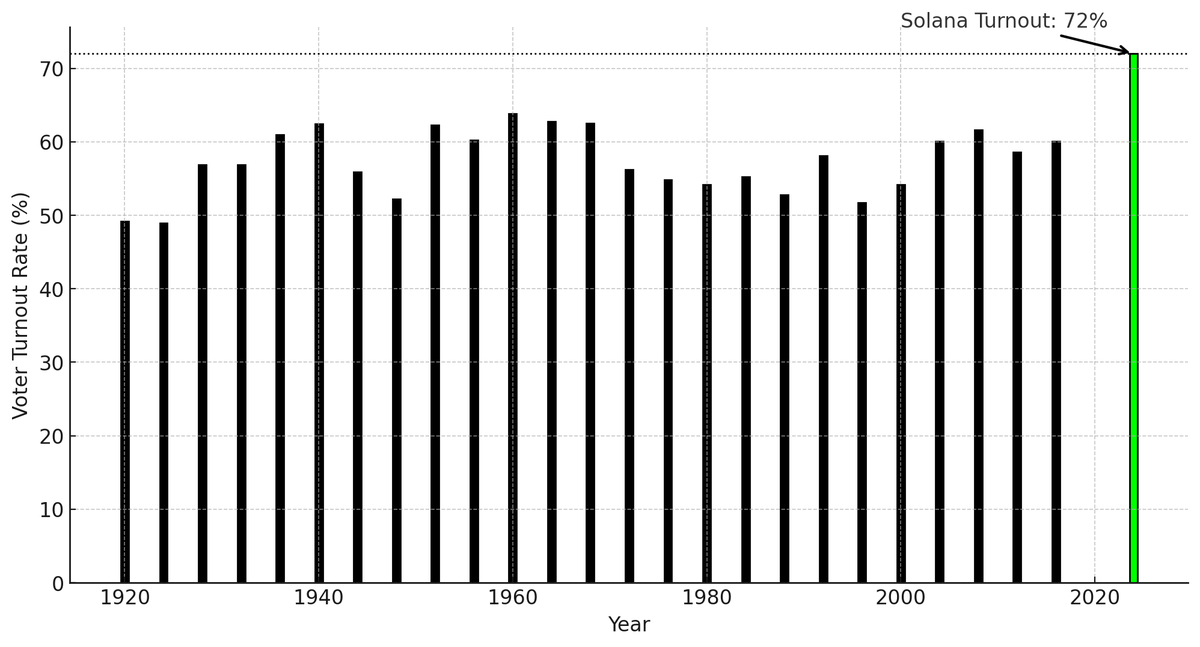
Solana node voting turnout rate nearly matched its transaction failure rate.
Reporters on the scene interviewed a node runner who explained, “keep on the money printer, I gotta get mine, beeyotch!”

Solana SIMD 228 voter turnout was higher than every US presidential election in the last 100 years
2
1
16
918
19 Dec 2024
Never leaving.


2
22
1,183
Based Staci retweeted

18 Dec 2024
Adding 2 more tokens to the Index: First is $BASED @BasedStaci @GovernorHat. BASED is an edgy meme coin that is dialed into the conversation on #algorand. You can count on BASED to bring the tea and leave you wanting more.
2
2
17
672

Based Staci retweeted

17 Dec 2024
sorry guy, not many, there's only one

17 Dec 2024

"Instant finality"... snakeoil debunk of the day🤣
Many blockchains now boast of "instant finality," which means, essentially, that a tx becomes final the moment it is included in a block.
By popular request, let's go over this nonsense, point by point:
1) Finality occurs when multiple parties reach an irreversible agreement (i.e. consensus) on a result, such as that a block of tx should be appended to a chain of blocks
2) To reach agreement, the multiple parties must communicate with each other, or in distributed computing parlance, "exchange messages."
3) These messages must be transmitted over the internet (since as of yet, quantum entanglement networks don't exist!!)
4) The fastest networks available use fibre optic cabling (i.e. they transmit data encoded in light, which beamed down a glass wire)
5) Light travels at 2/3 the speed inside glass than it does in a vaccum ~200,000km/s
6) Let's say there's a blockchain node in London, and another in Tokyo. The distance is about 10,000km, so clearly if data were transmitted down a single uninterrupted fibre cable, it would take 50ms to travel the distance, and 50ms to return = 100ms round trip
7) In reality, in the real world, the internet does not draw a straight line between London and Tokyo, and moreover, data routes (e.g. between a server in a London data center and a server in a Tokyo data center) comprises lots of individual links, which are stitched togehter using network routing devices
8) My guess is that in the real world a pair of well-connected nodes in London and Tokyo might communicate with round trip latencies between 250-400ms
9) When a block-producing node wishes to finalize a block, they must distribute the block in order that other nodes may add their vote (in whatever form). Meanwhile, a block cannot be transmitted with minimum theoretical latency because of its size... let's say it might take 0.8-1s just to send to Tokyo
10) Now votes need to be collected, but since they are smaller (e.g. signatures, or signature shares) they can be transmitted back at nearer to max theoretical speed
11) It is necessary to receive positive votes from ⅔ 1 of the nodes to finalize a block. Being kind, clearly, if the distribution takes 0.8-1s, and then it takes another 150ms to collect necessary signatures... we see a optimal finalization time being around a second (what the Internet Computer achieves, yay!)
Note 1: obviously, as network routers/switches improve, latency will fall, and we maybe eventually this might shave a few ms off the time
Note 2: the time to finality can be reduced by geographically concentrating the nodes, albeit by reducing decentralization...
Note 3: the time to finality can be really really reduced by running most of the nodes on Amazon Web Services, thereby ensuring they are mostly in the same data center, and, hilariously, this is what many blockchains do – such that Amazon could literally switch them off overnight, or meddle in their consensus, such that Uncle Jeff can decide what they decide.
In trying to defend "instant finality" claims, some blockchains will no doubt protest that they use a random beacon (or other method) to choose a leader, and therefore, whatever that leader produces, is final (!!)
They might even say that the leader uses a ZK proof that allows any recipient of the block to know that it is valid instantaneously, such that it doesn't need to be checked by other nodes (haven't seen this implementation or heard that argument yet but sure it's coming).
However, every protocol must allow for failover, in case "the leader" fails to produce a block. This means that until such time that signatures/approvals have been received from ⅔ 1 other nodes (this limit derives from non-negotiable laws of mathematics that everyone with a background in distributed computing is aware of), a block is *not* finalized.
Furthermore, all the foregoing is really assuming an optimal situation. In practice, there are many other factors adding delay to getting a tx finalized, including the time taken to get it into a block, the time taken to process the computations the tx involves (e.g. smart contract function invocations, ledger token transfers...), the latency involved in retrieving the tx result, and so on.
End-to-end latency is what matters, which is what the Internet Computer focuses on without snakeoil. But anyway, to summarize....
Whenever you hear projects talking about "instant finality," you know that they come from the land of Snakeoil Central
Let me know if there are any other debunks worth doing :)
1
1
5
259





9 Dec 2024

5
27
812