
Betweenity monitors all competition law & policy developments in Africa across 11 languages on a daily basis. Used by global brands & regulators.
Joined November 2020
- Tweets 314
- Following 570
- Followers 263
- Likes 195
171 Photos and videos


Betweenity - News for the Connected retweeted

17 Aug 2025
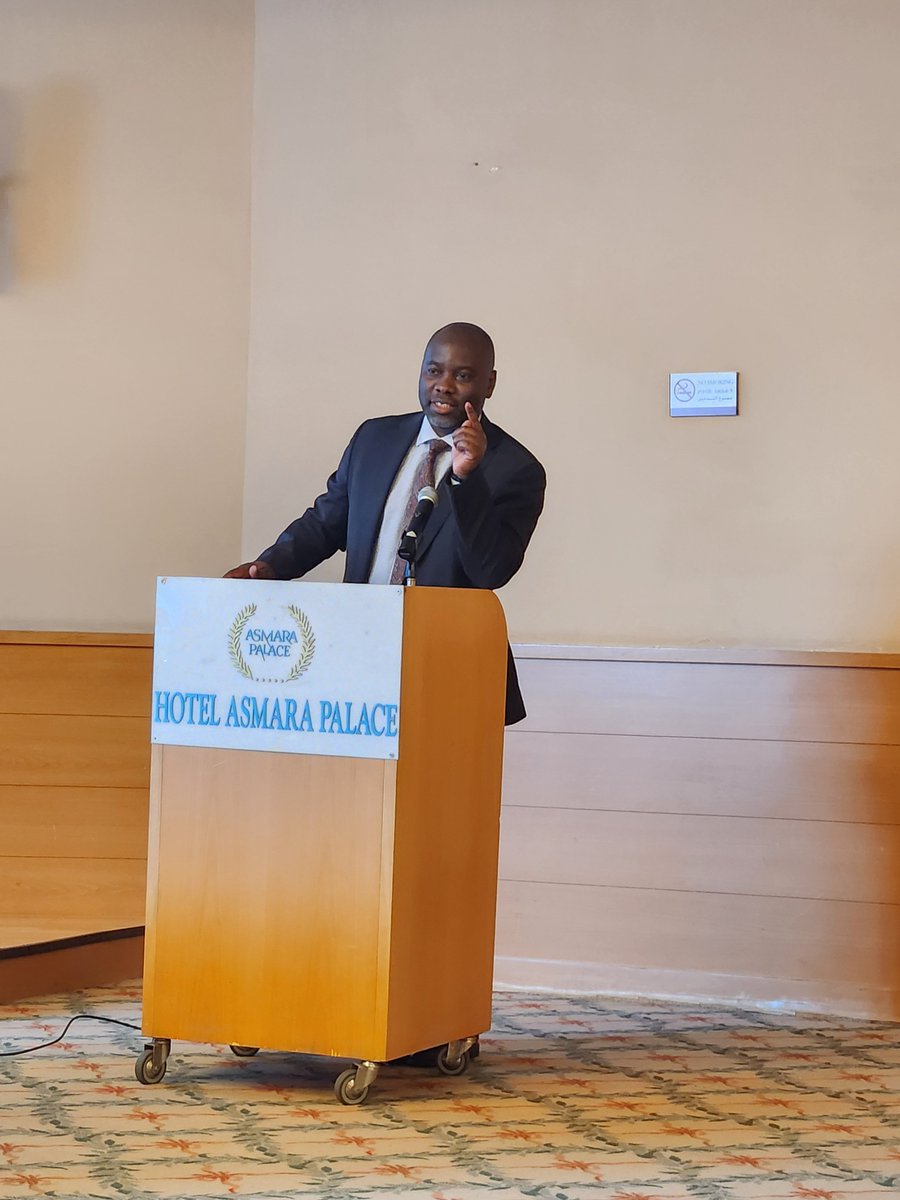
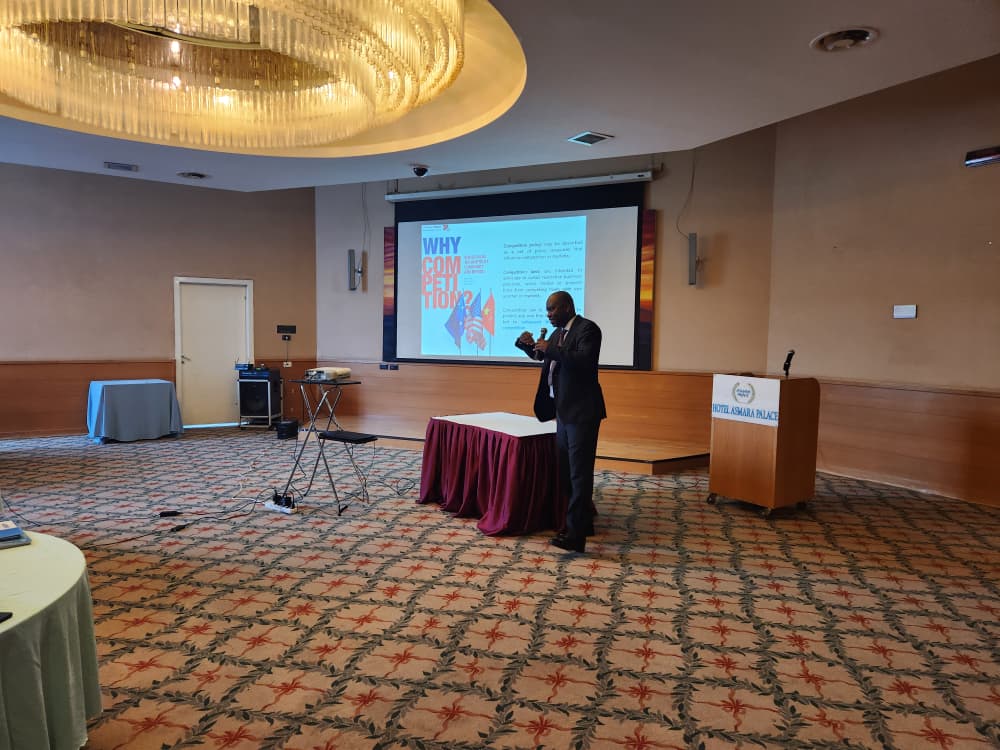
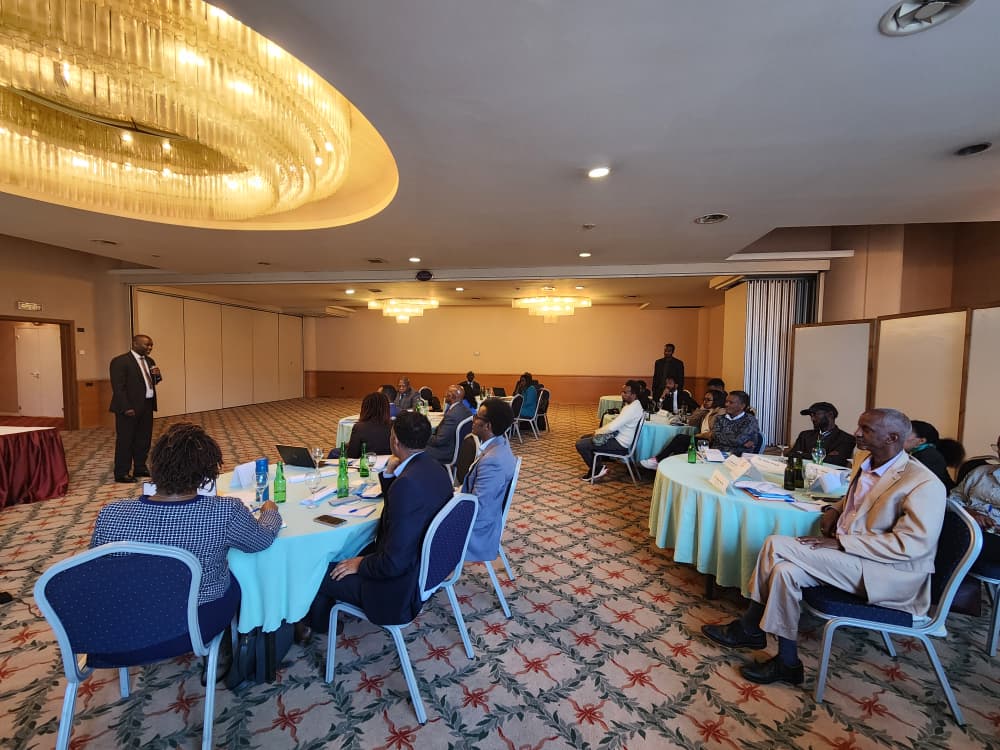
#13August2025-#14August2025-Inaugural Eritrea sensitisation workshop on competition and consumer protection #Asmara, #Eritrea
In his presentation on, "Essentials of Competition Law", the CEO-CCC Dr Willard Mwemba stated that if Eritrea was to adopt a [competition] law, it would not be starting from scratch as there are existing provisions on unfair trade practices and unfair competition though spread out in different laws of Eritrea. He also observed that Eritrea has a trade policy that expressly provides for prohibition of anti-competitive conduct and this is important as trade policy and competition policy are inseparable.
#AfricaCompetition #COMESAMemberStates #COMESARegion #competition #consumerprotection #workshop
1
1
247
Betweenity - News for the Connected retweeted

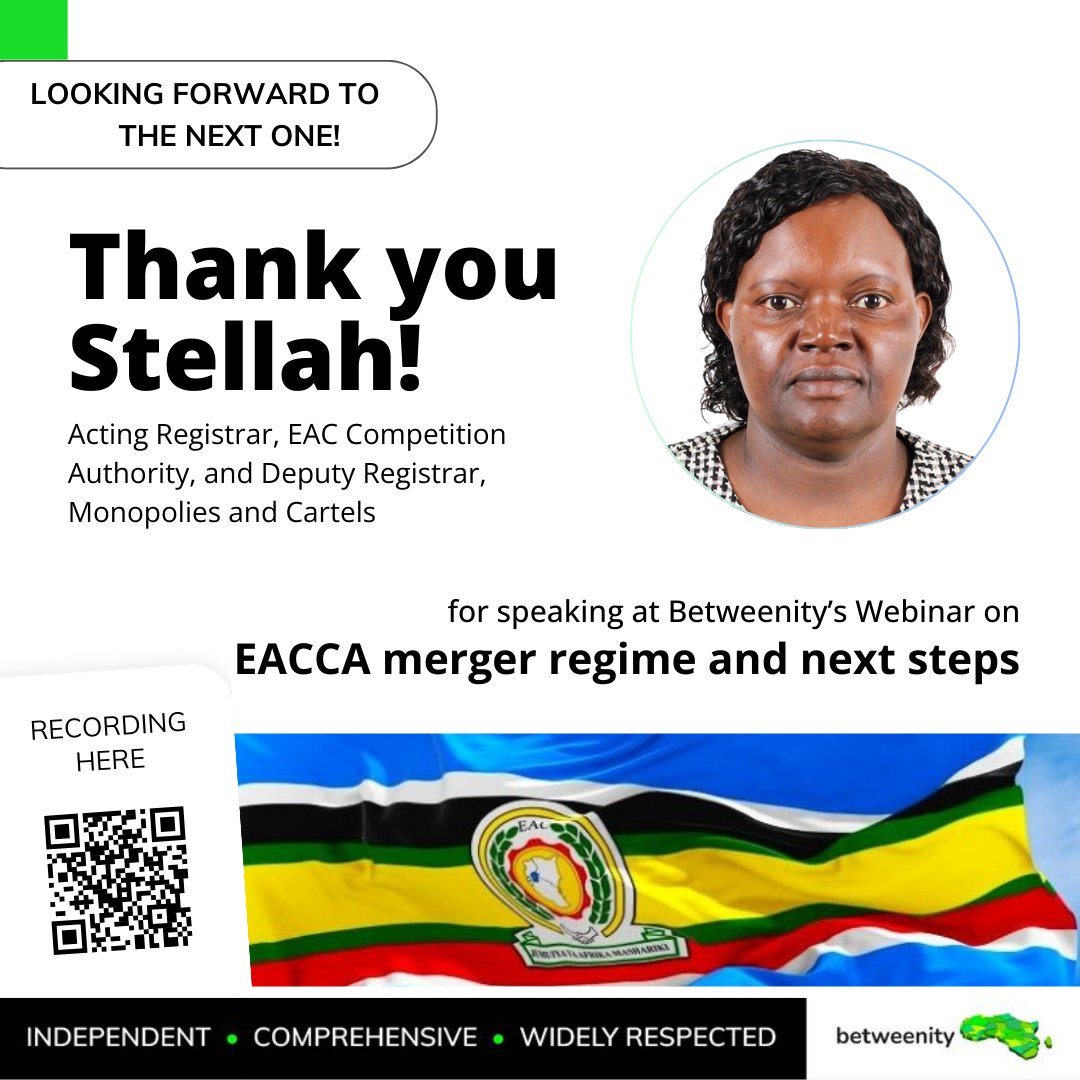
🎧🇧🇮🇰🇪🇹🇿🇨🇩🇸🇸🇸🇴🇷🇼🇺🇬 RECORDING AVAILABLE - Thank you for attending @BetweenityNews' webinar on the new EAC Competition Authority's merger regime and other priorities!
Herewith the links to the:
💡 recording: youtu.be/lTNDwLFlF0A
💡 presentation: tinyurl.com/8hynynbb
💡 mailer signup: tinyurl.com/y7bwwvmd
Our next webinar will be announced soon!
2
32

10 Aug 2025
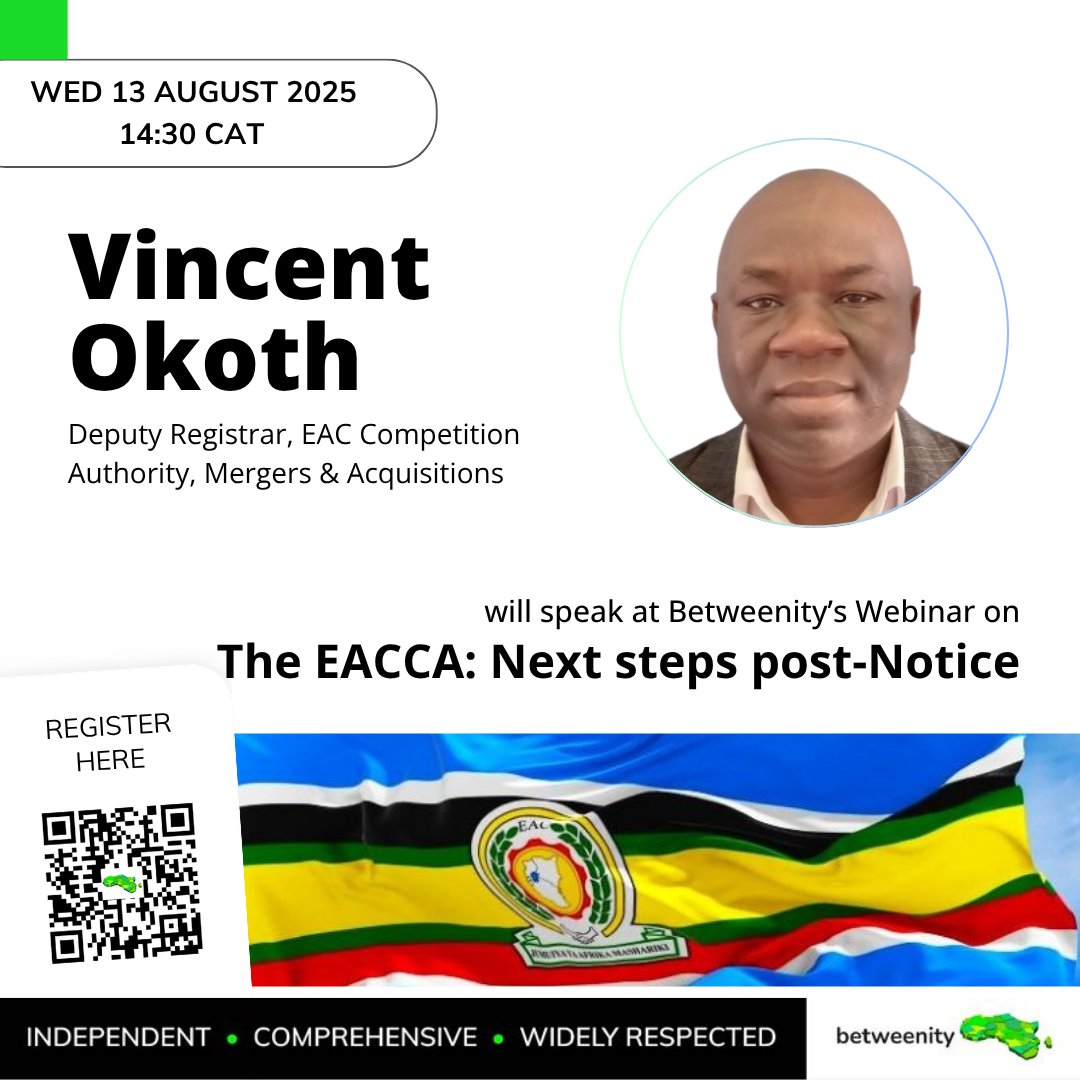
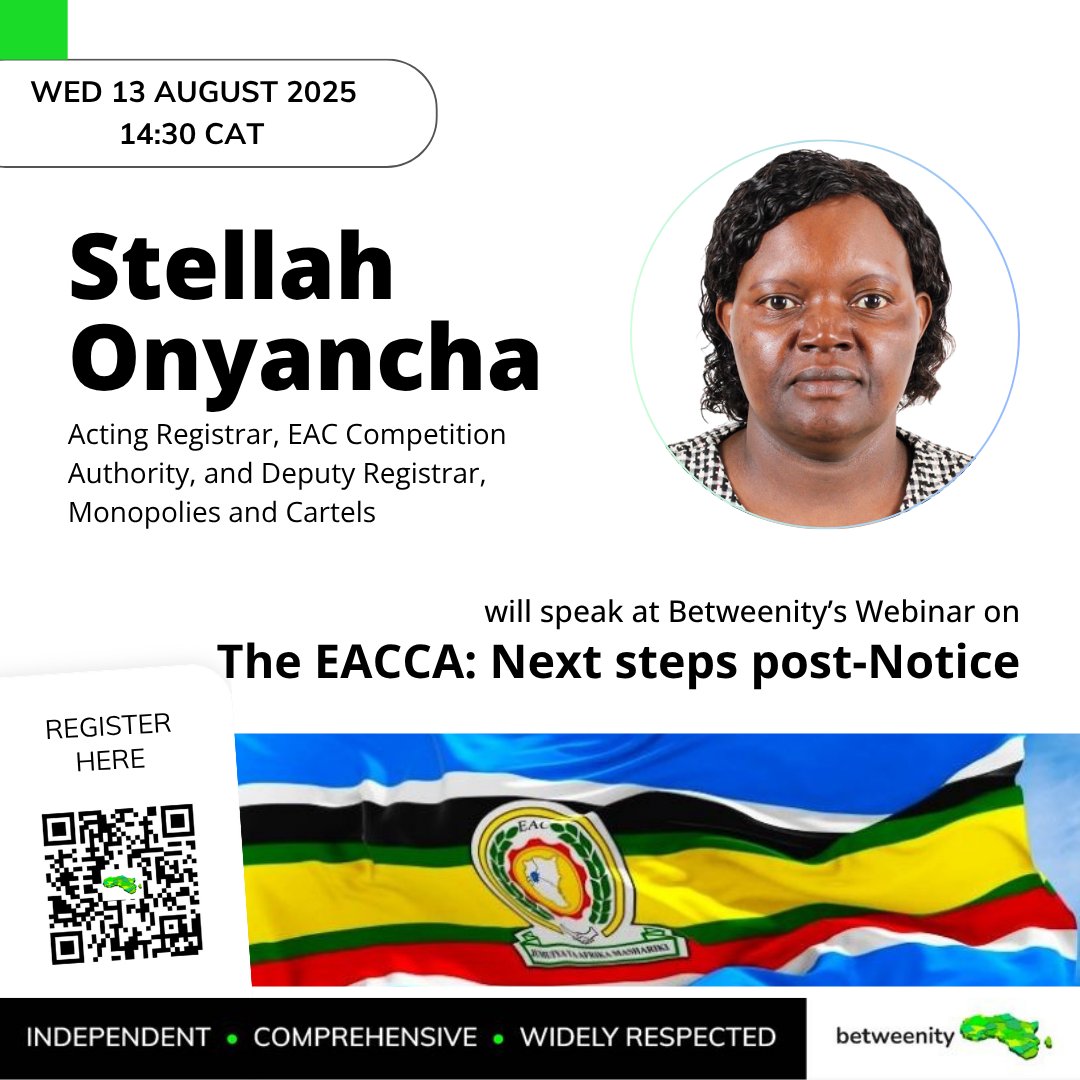
🇸🇸🇺🇬🇷🇼🇹🇿🇸🇴🇰🇪🇨🇩🇧🇮 WEBINAR - Join us for a webinar on the imminent commencement of the EACCA merger regime. We will also discuss priorities pursuant to the signing of the MoU with the COMESA Competition Commission (@CCC_COMESA).
We are proud to host:
● Stellah Onyancha, Acting Registrar and Deputy Registrar of the EACCA, Monopolies and Cartels;
● Vincent Okoth, Deputy Registrar of the EACCA, Mergers and Acquisitions; and
● Denis I Kabbale, Competition expert at the EACCA.
The moderator will be Odie Strydom, Managing Director of Betweenity.
● Date: Wednesday, 13 August 2025
● Time: 14:30 CAT
● Registration link: lnkd.in/d6rBmPkh
The EAC consists of 8 Partner States: Burundi, the DRC, Somalia, Kenya, Rwanda, South Sudan, Uganda, and Tanzania.
47
10 Aug 2025
🇧🇮🇨🇩🇰🇪🇸🇴🇹🇿🇷🇼🇺🇬🇸🇸 WEBINAR - Join us for a webinar on the imminent commencement of the EACCA merger regime.
We will also discuss priorities pursuant to the signing of the MoU with the @CCC_COMESA.
We are proud to host:
● Stellah Onyancha, Acting Registrar and Deputy Registrar of the EACCA, Monopolies and Cartels;
● Vincent Okoth, Deputy Registrar of the EACCA, Mergers and Acquisitions; and
● Denis I Kabbale, Competition expert at the EACCA.
The moderator will be Odie Strydom, Managing Director of Betweenity.
● Date: Wednesday, 13 August 2025
● Time: 14:30 CAT
● Registration link: lnkd.in/d6rBmPkh
The EAC consists of 8 Partner States: Burundi, DRC, Somalia, Kenya, Rwanda, South Sudan, Uganda, and Tanzania.
38
10 Jun 2025
A significant event in Africa!
10 Jun 2025

#10June2025
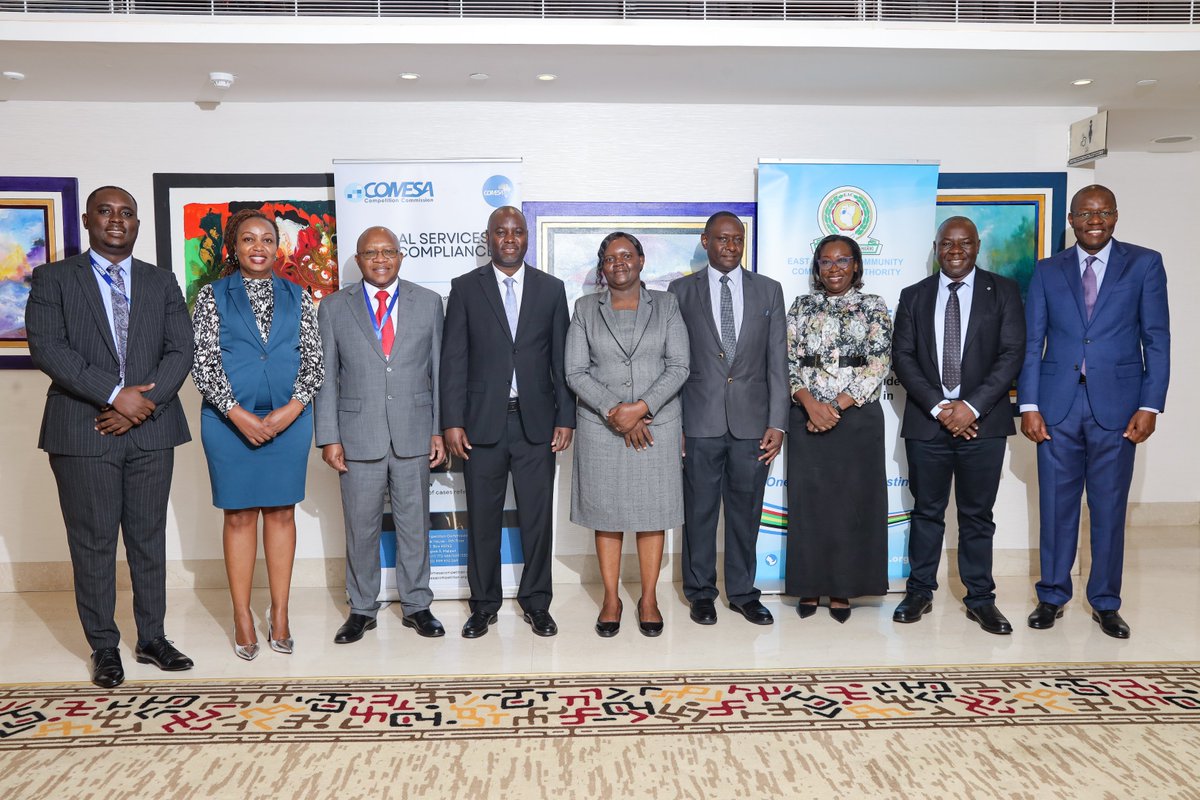
#MOU signing ceremony, Nairobi, Kenya
#CCC and the East African Community (EAC) Competition Authority @eac_Competition
signed a Memorandum of Understanding regarding cooperation in enforcement of their respective competition and consumer protection laws.
#AfricaCompetition #COMESA #EAC #COMESARegion #EACRegion #COMESAMemberStates #EACPartnerStates #competition #consumerprotection
1
51
4 Jun 2025
💡 Looking forward to hosting Magatte Wade (@magattew) as a special guest at Betweenity's 3-Day Virtual Conference on Africa Competition Regulation between 18-20 June 2025.
At the Conference, Magatte and Odie Strydom, Managing Director of Betweenity (@BetweenityA) will engage on the following question:
"What does Africa's approach to merger remedies reveal about our commitment to historically disadvantaged persons?"
We are deeply humbled by your presence, Magatte.
Conference page: tinyurl.com/yfpzn24y
Agenda: tinyurl.com/24zxzpdk
Contact us: odie@betweenity.co.za
48
4 Jun 2025
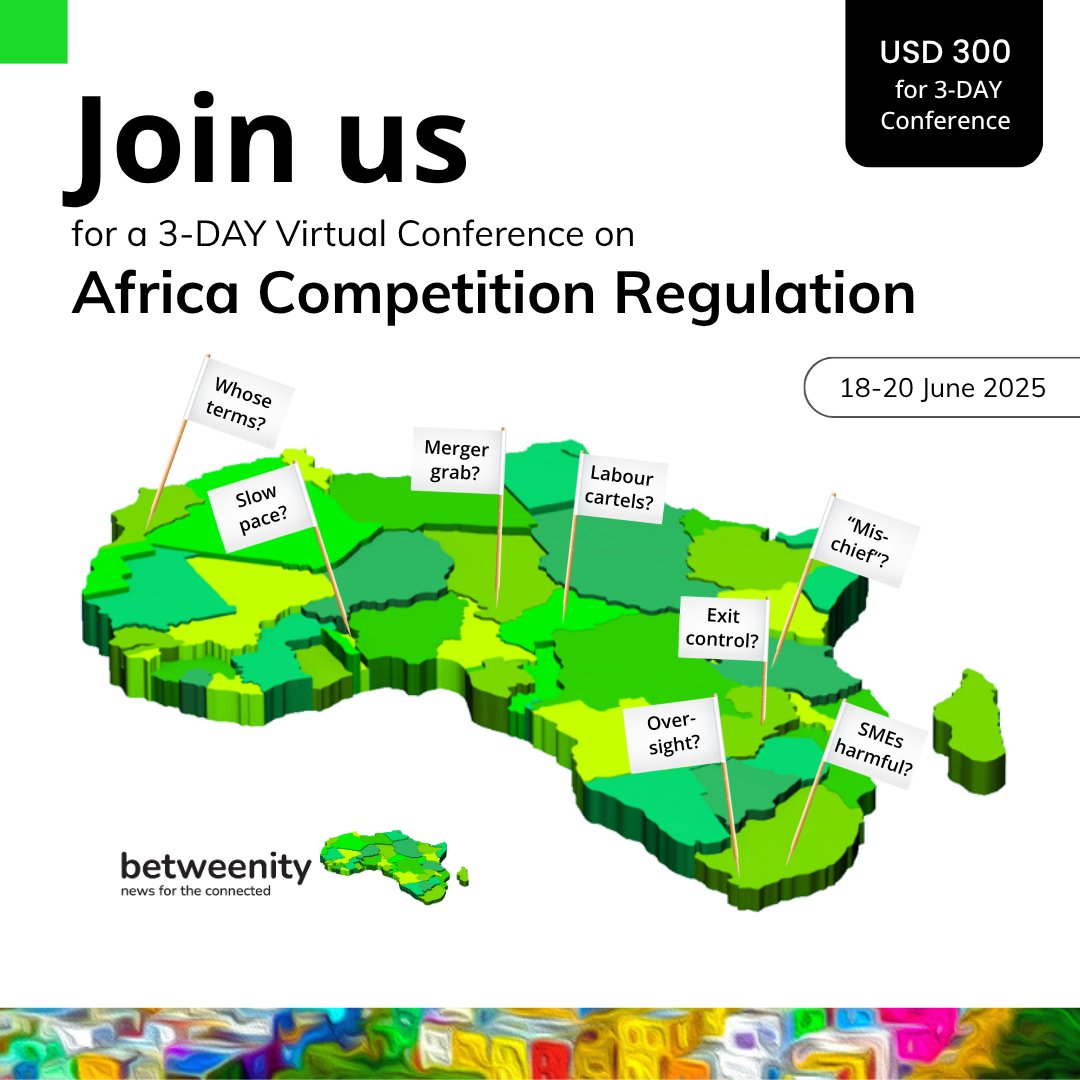
🌍 Only 2 weeks left to register for our 3-Day Online Virtual Conference on Africa Competition Regulation to be held on 18-20 June 2025!
More than 50 high profile speakers will share insights. Discussion points include:
💡 Who has the power in settlement negotiations? Are there limits to authorities bending backwards?
💡 Does the South African Competition Tribunal bring sufficient oversight to the work of the Commission?
💡 The elements of a “forward-looking” merger analysis – Are current methodologies forward-looking?
💡 Are current SME policies contributing to large industry collapse (e.g. steel)?
💡 Excessive pricing's new confusion – Are firms more exposed under competition laws or consumer protection laws?
💡 Labour market cartels in Africa – Why the perceived regulatory disinterest?
💡 Post-merger asset expropriation – Does the crime fit the punishment?
💡 Asset exit requiring competition approval?
💡 The Tanzanian cement merger – Regulatory “mischief” or valid boundary testing?
💡 Public interest analyses in Africa – Critical Africa cases and concepts
💡 New African competition authorities – Why the slow operationalisation?
💡 The protection of intrabrand competition in Africa – Is this the way to go?
💡 What is the structure and policy of the CEMAC Competition Authority?
See the agenda: tinyurl.com/24zxzpdk
✅ Format: Online
✅ Date: 18-20 June 2025
✅ Time: to CAT / to EST
✅ Language: English
✅ Fee: USD 300 per person
💡 Get tickets on Conference page: tinyurl.com/yfpzn24y
@magattew @CCABotswana @CIC_Burundi @concorrencia_cv @com_cemac @CCC_COMESA @ERCA_ARCC_ @Egy_Competition @EswatiniCompCo @official_gccpc @CAK_Kenya @CFTCMalawi @fccpcnigeria @ccptng @FTC_Seychelles @CompComSA @comptrib @FCC_Tanzania @FairFct @UEMOA_Officiel @CompComZambia @CTCZimbabwe
1
2
4
179
15 Apr 2025
🌍🎧 REGISTRATION OPEN! Join us for our Flagship Online Conference on Africa Competition Regulation!
💡 It is a virtual Conference – we bring Africa to you!
💡 Registration page: tinyurl.com/yfpzn24y
💡 Early bird discounts of 20% are available until 30 April 2025.
💡Group discounts of a further 20% and 40% are available.
💡 We use a well-known conference platform that is web and app-based.
💡 Nearly 40 distinguished speakers share their insights on critical, unventilated topics.
💡 Topics have been identified based on deep, daily scanning of Africa competition law and policy developments over many years in 11 languages.
💡 Live interpretation services in Arabic, French and Portuguese are available.
💡 Registered attendees have access to recordings.
💡 No flights, no accommodation, no transport, no inconvenience.
💡 Sponsorship opportunities are available – feel free to reach out at sponsor@betweenity.co.za.
Any questions? Contact us at conference@betweenity.co.za.
We look forward to seeing you there!
65
8 Apr 2025
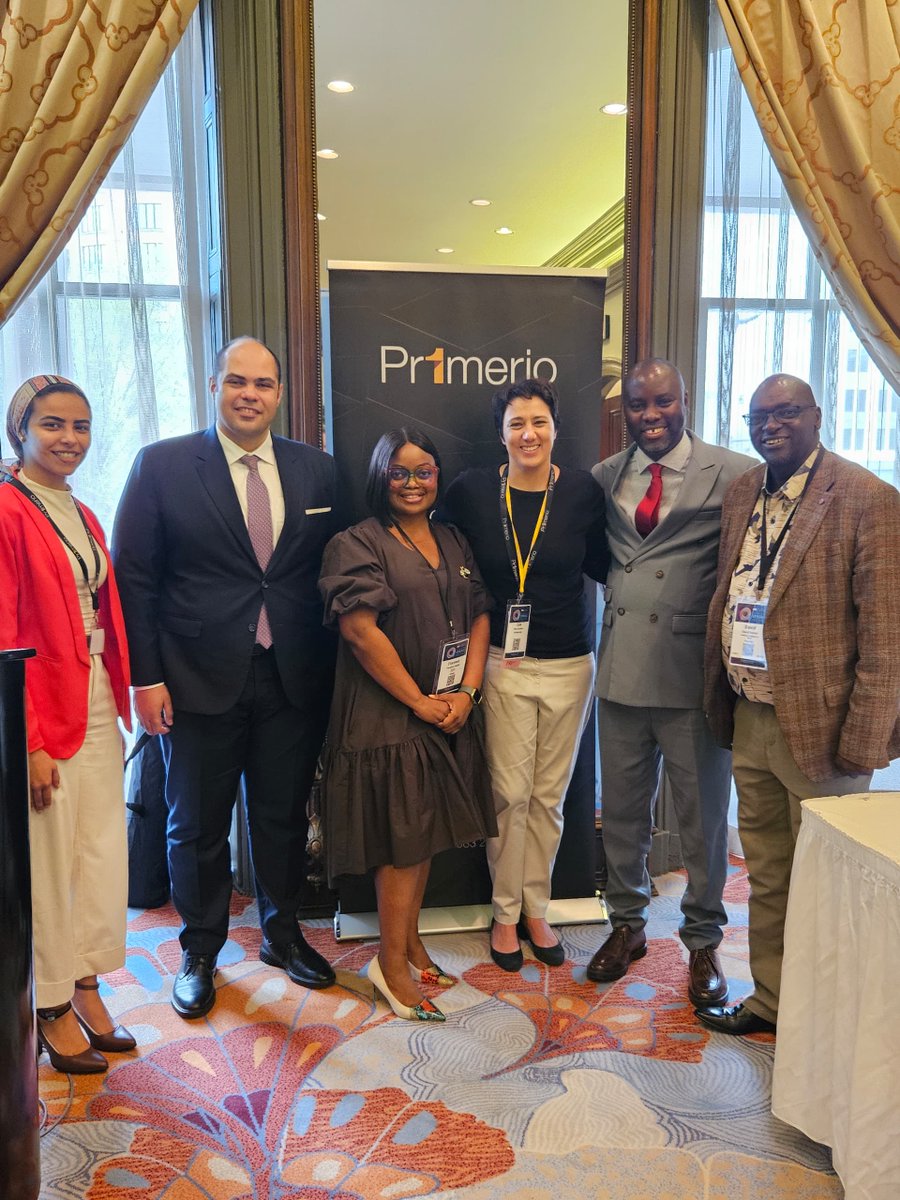
Wonderful event, thank you Primerio!
4 Apr 2025

At the meeting, the competition law experts discussed the evolving and increasing role of African agencies in shaping enforcement milestones across the continent, with enhanced consumer welfare being the shared objective.
1
226
6 Mar 2025
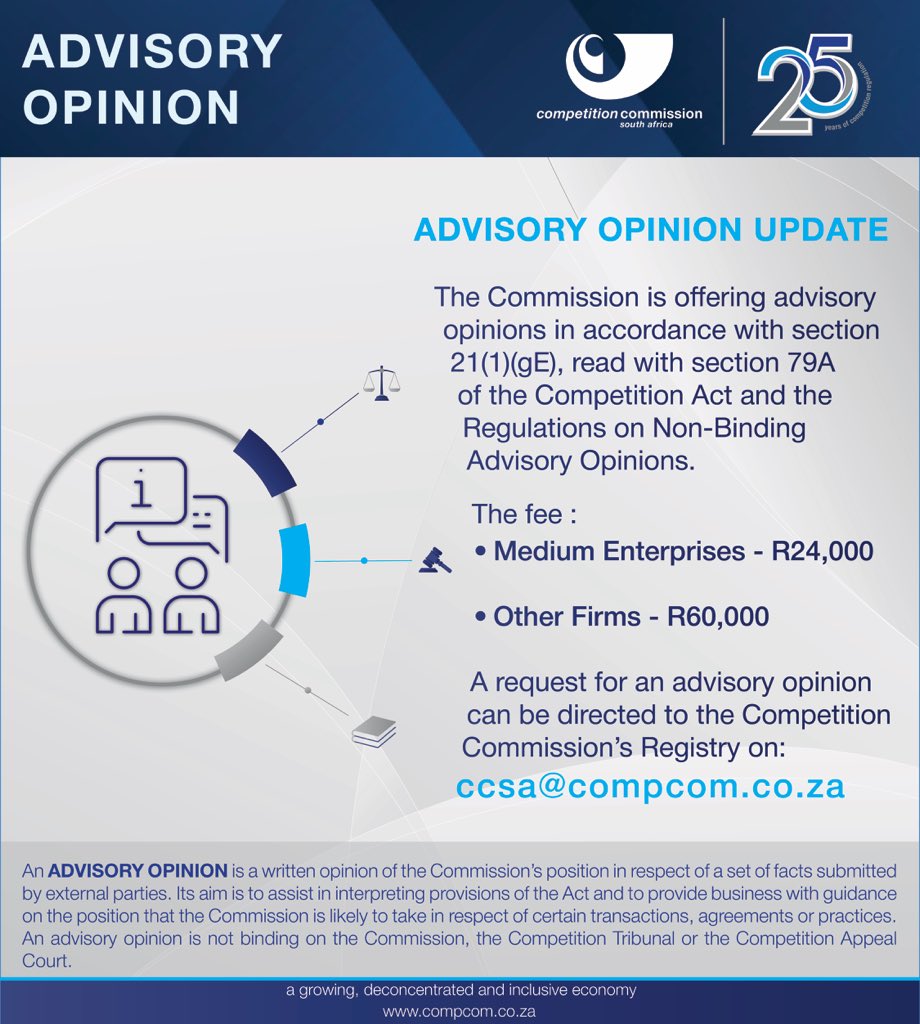
🇿🇦 Thank you, @CompComSA! Has the Commission received any applications for advisory opinions since the publication of the Advisory Opinion Regulations (link: shorturl.at/faeCL) on 6 December 2024?
6 Mar 2025

Advisory Opinion update
The Commission is offering advisory opinions in accordance with section 21 (1)(gE), read with section 79A of the Competition Act and the Regulations of Non-binding Advisory Opinions.
92
8 Feb 2025
🇿🇦 I am not entirely convinced by the authorities’ approach to the matter involving Global Roofing Solutions (GRS), a supplier of roofing products.
The Competition Commission South Africa established (and the Competition Tribunal of South Africa confirmed) that GRS is not a dominant firm, and had not contravened the Competition Act, 1998. Despite this, a non-exclusivity remedy was imposed.
Before the remedy was imposed, GRS customers had to use GRS clamps for their roofing products (solar panels) because the competitors' clamps did not meet GRS's quality standards, and using them would void the warranty.
Despite GRS’ non-dominance and adherence to the Act, the Commission imposed (and the Tribunal confirmed) the following remedies:
● for GRS to provide a warranty on roofing products even if 3rd party solar clamps had been used; and
● for GRS to retain the right to deny warranty claims if any deterioration or failure of products supplied by GRS had been caused by 3rd party clamps that do not meet its technical and material standards or installation methods.
Comment:
● The authorities appear to both acknowledge and disregard the importance of quality products in the market by (i) finding GRS innocent but (ii) imposing remedies aiming to promote the use of low quality products.
● The use of quality clamps is a critical competitive factor in the market due to the high price of solar panels, which are paid for by end consumers.
● Moreover, a quality-based regime is critical in the residential built environment where structural failures could be fatal. We have seen this in George in the Western Cape 6 months ago.
● The complainant, Metal Roof Innovations (MRI) does not require GRS as a “route to market” because GRS is not dominant. Moreover, MRI is a USA subsidiary which is presumed to be well-resourced (in any event, sufficiently so as to improve clamp quality).
● As in Sekunjalo, the authorities are again insisting that “high risk” players be entertained by other players in the market in the name of “competition” with no regard to the extent (or the bearers) of the actual risk.
● One of the goals of an exclusivity warranty is to “prevent rather than cure”. The authorities' remedy encourages structural failure over prevention. Worse still, it leaves the consumer without recourse, because the warranty now excludes the very failure that it contributes to.
● Who are GRS' competitors, and must they also entertain low quality clamps as part of their warranty programs? If not, GRS will be worse off.
● Why not simply requiring the use of a SABS approved clamp?
94
8 Feb 2025
The SA Competition Tribunal’s granting of interim relief to GovChat shows how far the competition authorities in South Africa will go to question the internal rules of large digital companies if they affect competitive conduct in the country.
This is according to Jerome Wilson SC during the ‘Antitrust Across Africa’ Conference presented by the American Bar Association Antitrust Law Section in Cape Town in September 2024.
WhatsApp threatened to offboard GovChat because GovChat tried to list different government departments under its own business account, which was not allowed in terms of WhatsApp’s internal rules.
“The Tribunal decided that the offboarding attempt was prima facie anti-competitive because GovChat provided a very important service in South Africa during the Covid-19 pandemic.
“The We Buy Cars prohibition years ago was based on conglomerate effects, and the impact of data on the entrenchment of these effects.
“At that time, it came as quite a surprise that the authorities were so aggressive to protect competition in these kind of markets – historically, the authorities were hesitant to involve themselves in these cases unless there was a very good basis for it.
“Today however, the bar to intervention in digital markets reduced significantly. The competition authorities are watching this space very carefully and one can't move as freely as perhaps one could historically.”
Regarding the value of a separate law for the digital space, Jerome says that the debate ought to be had as to whether an ex ante instrument may be useful in South Africa.
“The Digital Markets Act (and the Digital Markets, Competition and Consumers Act of the UK) set consistent standards and obligations for digital markets players. This is great for consistency and transparency.
The dilemma with South Africa’s approach to market studies is that the Competition Commission assumes the role of both investigator and adjudicator.
“The division of powers is largely done away with.”
Photo: Betweenity
1
54
8 Feb 2025
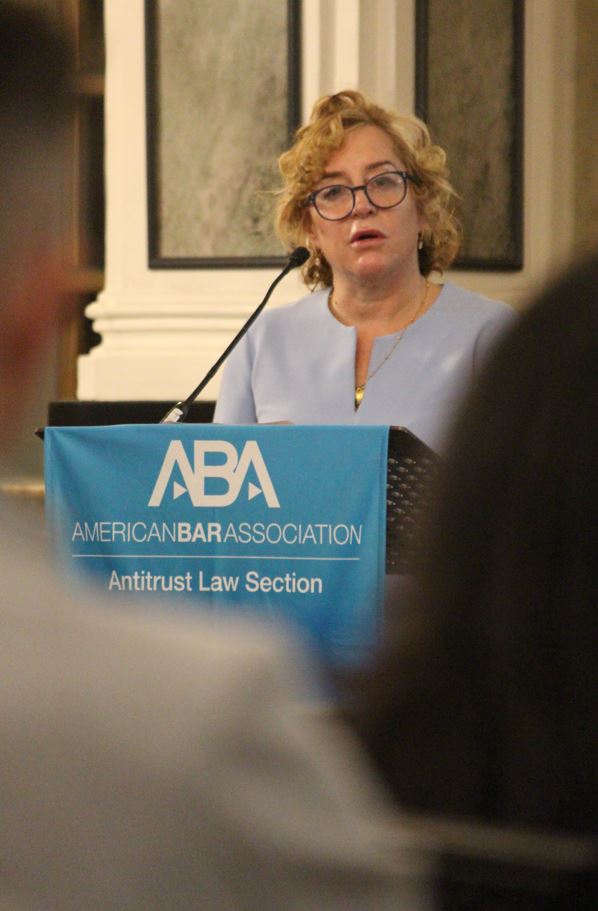
“While the US antitrust laws have been on the books for a little longer – since 1890 – you [in Africa] have shown us how competition law enforcement is dynamically evolving to meet the needs of communities in newer and emerging economies.”
This is according to Fiona Schaeffer, Partner at Milbank and the International Officer of the American Bar Association Section of Antitrust Law, during the American Bar Association Antitrust Law Section Conference in Cape Town in September 2024.
“You have focused on the importance of promoting a sustainable economy for future generations. These are topics that we are currently navigating in the US. The lessons that we are learning here will inspire and inform our work in the US and beyond.
“Together, we can build a global framework of competition that champions opportunity for all.
“In the words of the great Nelson Mandela, ‘Our struggle is not merely for ourselves, but for future generations that will inherit the world that we shape today’.
“Let’s remember that the true measure of a person’s life is not in the accolades that they collect, but in the impact they leave on others.
Photo: Betweenity
45