
Building...
Joined July 2024
- Tweets 292
- Following 421
- Followers 275
- Likes 10,256
11 Photos and videos







Pinned Tweet

Jun 5
Wrapped up my new Agentic AI project
It uses Gemini function calling to:
- inspect directories and files
- read and write code
- execute Python scripts in a sandboxed workspace
- loop through tool calls until a task is completed
Mostly built it to understand how tool-calling agents, context management, and agent loops work under the hood.
Check it out:
github.com/binaryCoder-101/a…
#AgenticAI #LLM #BuildInPublic #100DaysOfCode
2
12
2,496
Jun 12
Hey @X
My timeline needs more builders.
If you're into:
• Backend
• AI
• DevOps
• Cloud
• Startups
• Open source
Reply with what you're working on and I'll check out your profile.
Let's #connect 🚀
#TechTwitter #BuildInPublic #IndieHackers #AI #DevOps #MachineLearning #OpenSource #Startups #SaaS #Programming #100DaysOfCode
56
41
2,011
Misaq retweeted
Jun 11
Hey @X,
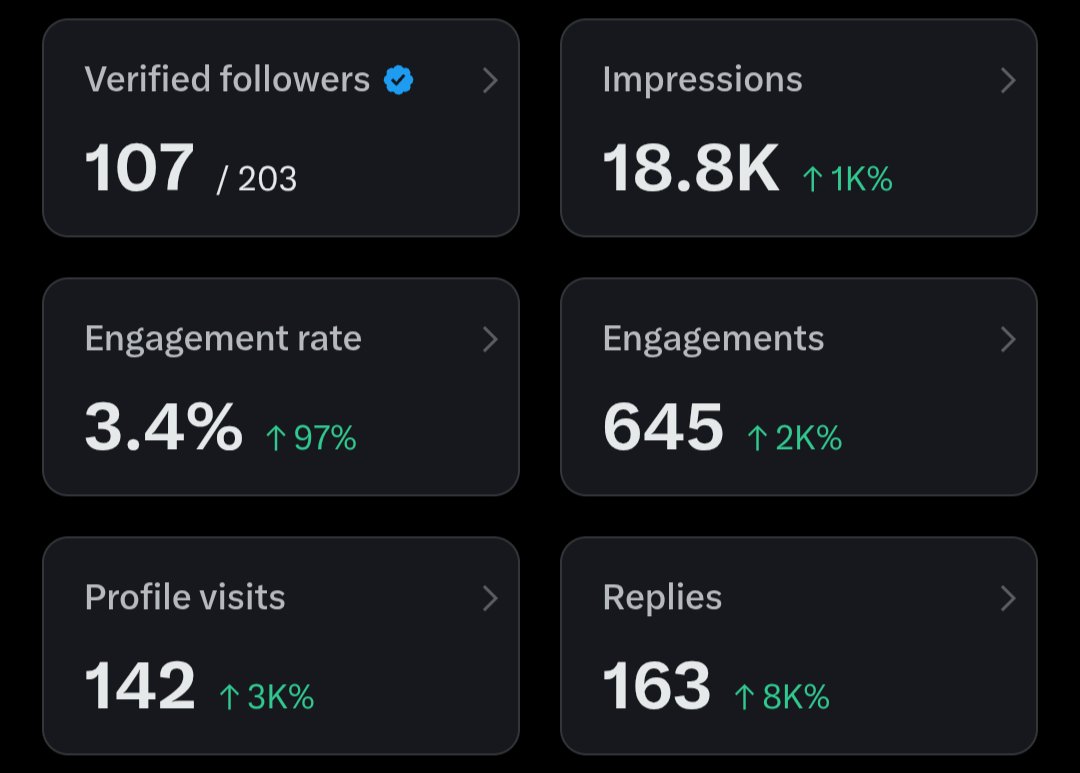
I just crossed 200 followers! 🚀
The best thing about Tech Twitter so far has been discovering builders who are actually shipping.
So let's do it again 👇
If you're into:
• Backend
• AI
• DevOps
• Cloud
• Startups
• Open Source
Reply with:
What you're building
Your tech stack
One challenge you're currently facing
I'll check out profiles and #connect with fellow builders.
Let's grow our corner of Tech Twitter together 🤝
#TechTwitter #BuildInPublic #IndieHackers #AI #DevOps #OpenSource #Startups #Programming
12
1
9
613
Jun 11
Engineers who've shipped AI agents:
At what point did you realize "it's not just a wrapper around an LLM"?
What problem forced that realization?
In other words, what system level skill actually sets you apart from the rest of the "LLM wrapper making enthusiast" crowd?
#TechTwitter #BuildInPublic #Programming #100DaysOfCode #AgenticAI #LLM
1
1
3
184
Jun 10
Hey @X
My timeline needs more builders.
If you're into:
• Backend
• AI
• DevOps
• Cloud
• Startups
• Open source
Reply with what you're working on and I'll check out your profile.
Let's #connect 🚀
#TechTwitter #BuildInPublic #IndieHackers #AI #DevOps #MachineLearning #OpenSource #Startups #SaaS #Programming #100DaysOfCode
84
1
61
2,766
Jun 8
Agentic AI refers to an autonomous AI system designed to execute multi-step tasks independently without human intervention.
One of the core ideas behind AI agents is the agent loop.
A normal LLM interaction looks like:
Input → LLM → Output
One prompt. One response.
Whereas an agent adds a loop:
Reason
↓
Act
↓
Observe
↓
Reason Again
Suppose you instruct this to your AI agent:
"Add JWT authentication to this codebase."
A normal LLM might generate some code and stop.
An agent does something different:
1. Explores the repository
2. Finds the auth-related modules
3. Identifies the framework being used
4. Writes the implementation
5. Runs the tests
6. Sees failures
7. Reads the error messages
8. Modifies the code
9. Runs the tests again
10. Updates affected files
11. Repeats until everything passes
After every action, it observes the result and decides what to do next.
while not task_complete:
think()
act()
observe()
The difference sounds subtle, but it's the difference between:
"Here's how I would add JWT authentication."
and
"I added JWT authentication."
Note:
The LLM isn't usually given direct access to the computer.
Instead, it's provided with a set of tools such as:
* Read file
* Edit file
* Run tests
* Search codebase
* Execute command
At each step, the model decides which tool to call, what arguments to pass, and how to proceed based on the result.
The "agent" is often just:
LLM Tools Agent Loop
The intelligence comes from the model's ability to choose the next action. It is the brain.
The capabilities come from the tools. They are the limbs through which the brain accomplishes the task.
#TechTwitter #BuildInPublic #Programming #100DaysOfCode #AgenticAI #LLM
1
6
383
Misaq retweeted
Jun 7
One of the most important ideas in modern AI powered search engines is the inverted index.
A naive approach would store:
Document → Words
Eg:
doc1 → [golang, backend, docker]
doc2 → [python, ai, backend]
doc3 → [golang, kubernetes]
To find all documents containing "golang", you'd have to scan every document.
An inverted index flips the relationship:
Eg:
golang → [doc1, doc3]
backend → [doc1, doc2]
docker → [doc1]
python → [doc2]
ai → [doc2]
kubernetes → [doc3]
Now a search for "golang" is just a lookup.
Searching for:
"golang AND backend"
becomes an intersection of posting lists:
golang → [doc1, doc3]
backend → [doc1, doc2]
Result → [doc1]
No full scan.
No brute force.
Just efficient data structures.
This simple idea powers search engines, log analytics platforms, document databases, code search tools, and many modern RAG systems.
Sometimes a massive performance gain doesn't come from adding more compute.
It comes from organizing data differently.
#TechTwitter #BuildInPublic #Programming #100DaysOfCode #AgenticAI #LLM
1
1
5
472
Misaq retweeted

Jun 6
Remember the times when devs utilised each byte of the RAM?
Pfft, today Slack alone eats 2GB. VSCode takes 4GB & don't get me started on Claude Code & it's hunger for memory.
We replaced optimization with "just add more RAM & CPU." The irony is that 2026 is shipping the most resource-hungry software while hardware prices keep climbing.
Hardware got better but software got lazy faster.
13
3
45
2,480
Misaq retweeted

Jun 6
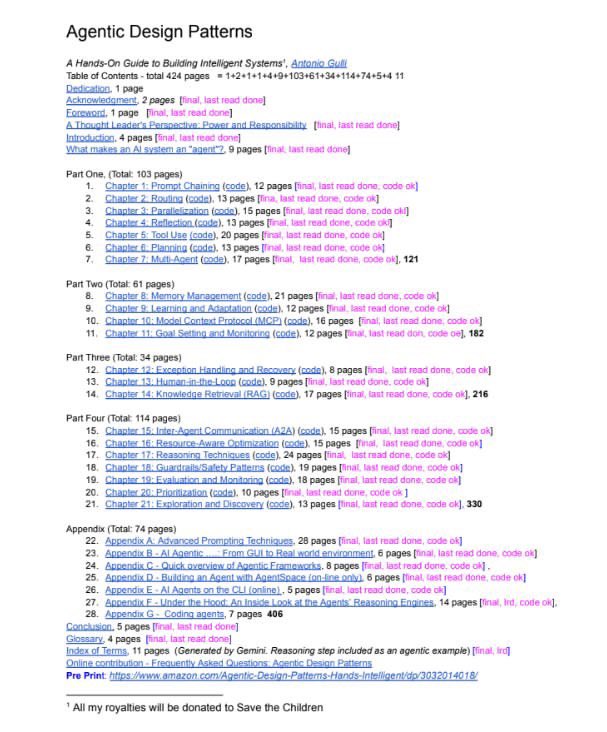
A senior Google engineer quietly dropped a 400 page guide on AI systems free.
It’s called Agentic Design Patterns.
Most paid AI courses suddenly feel unnecessary.
4
11
112
6,572
Misaq retweeted

Jun 6
Wait. Google is paying SpaceX $920 million per month for GPUs?
Google. The company that builds its own TPUs. That runs one of the largest cloud infrastructures on earth. Is renting 110,000 Nvidia GPUs from a rocket company.
I'm honestly not sure what to make of this. Either Google's AI compute needs have gotten so massive that even they can't build fast enough. Or SpaceX has built something in AI infrastructure that nobody was paying attention to. Or both.
$920M a month. $30B over the contract.
Whatever is happening behind the scenes at these companies is moving way faster than what we see publicly.
Jun 5

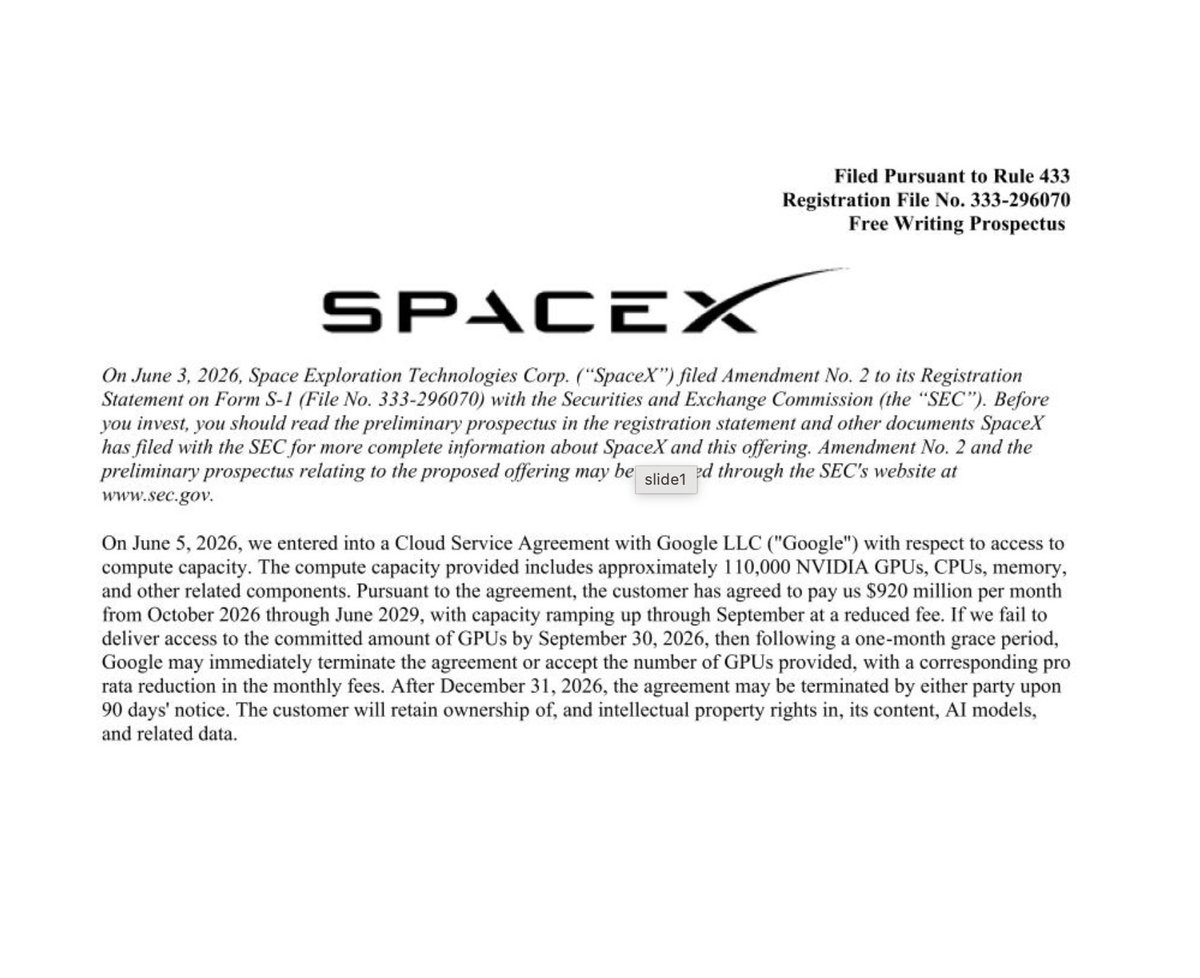
SpaceX has just announced that they have entered into a $920 million per month agreement with Google to provide compute capacity, according to a new filing.
"On June 5, 2026, we entered into a Cloud Service Agreement with Google with respect to access to compute capacity. The customer has agreed to pay us $920 million per month from October 2026 through June 2029, with capacity ramping up through September at a reduced fee. The compute capacity provided includes approximately 110,000 NVIDIA GPUs, CPUs, memory, and other related components.
After December 31, 2026, the agreement may be terminated by either party upon 90 days' notice. The customer will retain ownership of, and intellectual property rights in, its content, Al models, and related data."
779
735
7,972
1,459,770
Misaq retweeted
Jun 6
Hey @X
My timeline needs more builders.
If you're into:
• Backend
• AI
• DevOps
• Cloud
• Startups
• Open source
Reply with what you're working on and I'll check out your profile.
Let's #connect 🚀
#TechTwitter #BuildInPublic #IndieHackers #AI #DevOps #MachineLearning #OpenSource #Startups #SaaS #Programming #100DaysOfCode
35
1
19
1,066
Misaq retweeted

Hot take the infra stuff around ai is way cooler than model training
58
73
1,510
154,944

Misaq retweeted

Jun 5
The way to become a top 1% AI Engineer in 2026 is to just FAFO
Have sheer will power to just try out everything and incorporate it in your context window.
6
12
288
9,306


Misaq retweeted

Jun 4
As an AI Engineer. Please learn
>Harness engineering, not just prompt engineering
>Context engineering, not just long prompts
>Prompt caching vs. semantic caching tradeoffs
>KV cache management, eviction, reuse, and memory pressure at scale
>Prefill vs. decode latency and why they optimize differently
>Continuous batching, paged attention, and throughput optimization
>Speculative decoding vs. quantization vs. distillation tradeoffs
>INT8, INT4, FP8, AWQ, GPTQ, and when quantization hurts quality
>Structured output failures, schema validation, repair loops, and fallback chains
>Function calling reliability, tool contracts, argument validation, and idempotency
>Agent guardrails, loop budgets, tool budgets, and termination conditions
>Model routing, graceful fallback logic, and degraded-mode UX
>RAG architecture: chunking, embeddings, hybrid search, reranking, and freshness
>Retrieval evals: recall, precision, grounding, attribution, and citation quality
>Evals: golden sets, regression tests, adversarial tests, LLM-as-judge, and human evals
>LLM observability as a first-class discipline: traces, spans, tokens, latency, errors, and drift
>Cost attribution per feature, workflow, tenant, and user journey not just per model
>Safety engineering: prompt injection defense, data leakage prevention, and permission boundaries
>Multi-tenant isolation, cache safety, and cross-user context contamination prevention
>Fine-tuning vs. in-context learning vs. RAG vs. distillation and when each is the wrong tool
>Latency, quality, cost, and reliability tradeoffs across the full inference stack
>Production failure modes: hallucinated tool calls, malformed JSON, stale retrieval, runaway agents, and silent eval regressions
103
491
4,283
239,093

GITHUB JUST CREATED AN OFFICIAL CERTIFICATION FOR THE MOST IN-DEMAND DEVELOPER ROLE OF 2026.
It is called Agentic AI Developer.
GH-600.
And it is the first formal signal that running AI agent teams is now a recognized engineering discipline with a credential behind it.
Not a prompt engineer.
Not a vibe coder.
An Agentic AI Developer.
The person who operates, supervises, and integrates AI agents across the entire software development lifecycle.
The person who knows where agents fail in production.
The person who understands how to build autonomous workflows that do not introduce catastrophic failure modes into CI/CD pipelines.
The person every engineering team is going to need and almost none of them have right now.
GitHub certifying this role changes the hiring conversation permanently.
Before GH-600: "Do you work with AI agents?" is an interview question with no standard answer.
After GH-600: the credential tells the hiring manager exactly what you know and what you can do before the interview starts.
The engineers who get certified in the first wave of GH-600 will have a credential for a role that has more demand than supply for the next 3 to 5 years.
The engineers who wait until it is mainstream will be competing with everyone who moved first.
If you are already working with GitHub Copilot or building agent-driven workflows you are already doing this job.
GH-600 is how you prove it.
Bookmark this.
Follow @cyrilXBT for every AI certification worth your time the moment it drops.
May 14

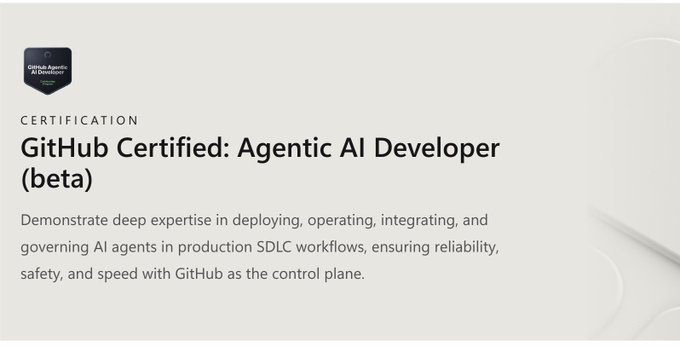
We’re introducing a new GitHub Certified: Agentic AI Developer (GH-600).
As AI agents become part of modern development workflows, this role-based certification focuses on how developers and teams operate, supervise, and integrate agents across the SDLC.
If you’re already working with tools like GitHub Copilot or exploring agent-driven workflows, we’d love your input.
Learn more and get involved. msft.it/6013vRHHZ

ALT A dark blue gradient banner announces “GitHub Certified: Agentic AI Developer — New Exam GH‑600 (beta)” on the left. On the right is a badge featuring the GitHub logo above the text “GitHub Agentic AI Developer — Certification Program.”
44
107
1,095
212,856
