Joined April 2023
- Tweets 2,540
- Following 6,881
- Followers 11,997
- Likes 6,264
Photos and videos
Pinned Tweet

17 Nov 2024
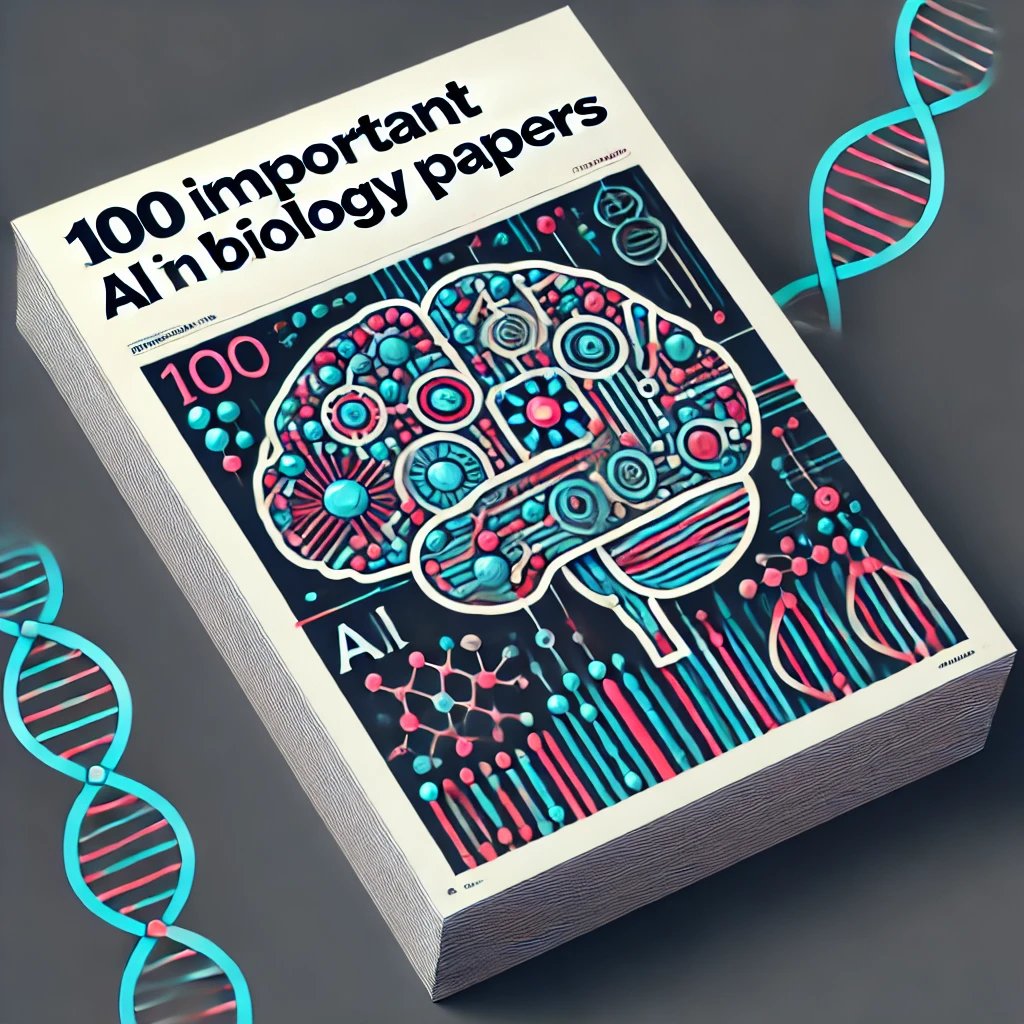
Friends and colleagues often ask, “What are the top 100 important "AI in Biology" papers that provide broad insights into the field?” 📚🔬 While narrowing it down to exactly 100 is no small feat, I’ve curated a list of foundational and impactful #BioAI papers. I'm sure the list would exceed more than 100 given the relentless expansion of this thrilling field! Please follow this thread for key insights, and please feel free to suggest any papers I may have missed!
With my background and interests, I prioritize papers in #AgingBiology, #CellBiology, and #Neuroscience. I’ll keep this thread pinned to my profile and update it regularly. I encourage everyone to add more papers from their own expertise—let’s make this interactive and foster engaging discussions! Here is a collection of essential #AIbio papers. #100_AIBio_Papers #AIBio_papers #AIBio_Chat #AIneuro_papers #AI_AgingBio_papers
44
80
488
57,683
6/Universal AI (AIXI) is a theoretical framework that describes the maximum possible level of machine intelligence. Rather than being an extension of today's AI models, AIXI provides a mathematical ideal of an agent that can learn, reason, and make optimal decisions across any computable environment by continuously maximizing long-term rewards. While AIXI is computationally impossible to implement in practice, it serves as an important benchmark for understanding the ultimate limits of intelligence. #UniversalAI #AIXI
1
85
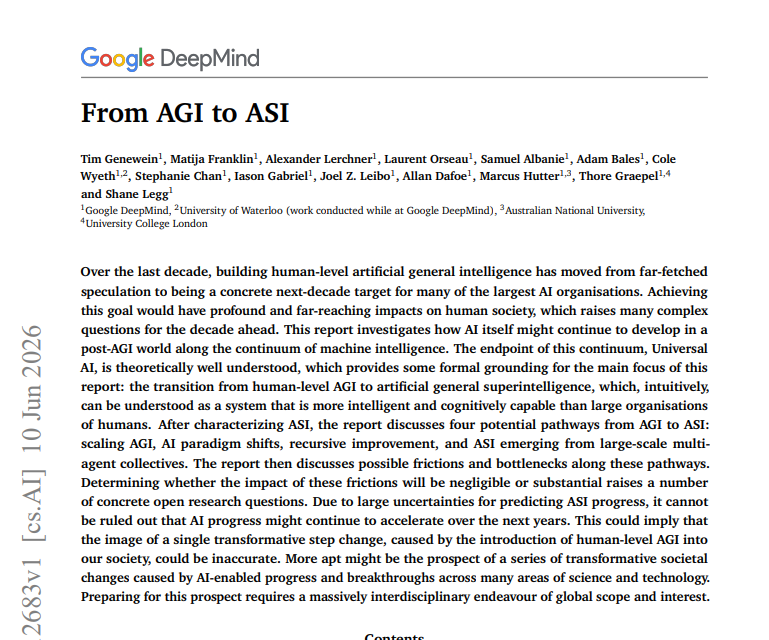
Reading From AGI to ASI paper from @GoogleDeepMind
will update my comments as a read through
arxiv.org/html/2606.12683v1
#AGI #ASI #NeuroAI #Nextfen_AI
1
2
20
1,055
5/ The passage defines and clarifies what the report means by AGI, ASI, and a theoretical upper bound called UAI, emphasizing that intelligence is treated as a continuum rather than a sharply defined threshold.
AGI (Artificial General Intelligence): Defined as roughly median human-level intelligence across most cognitive tasks. Even this level of AI would already be superhuman in many narrow domains, but still not fully general. It corresponds to a “competent human-equivalent” system.
ASI (Artificial Superintelligence): A system that is broadly and significantly more capable than humans across nearly all domains of interest. Unlike narrow superhuman systems (e.g., AlphaGo or AlphaFold), ASI would outperform not just individuals but large groups of human experts across almost all tasks. It may also consist of many interacting AI instances working in parallel.
UAI (Universal AI): A theoretical upper limit of intelligence defined in formal terms (via the Legg-Hutter framework and AIXI). It represents the maximally intelligent possible agent in principle, but is not computable in practice. ASI is viewed as an approximation that can progressively approach this limit.
1
84
Transferable generative models bridge femtosecond to nanosecond time-step molecular dynamics
science.org/doi/10.1126/scia…
AI Speeds Up Molecular Simulations by 10,000×
A new AI framework called TITO represents a significant advance in computational chemistry and biophysics. The system was trained on more than 12,500 organic molecules and over 1,000 peptides, learning the fundamental rules that govern how molecular systems evolve over time.
Traditionally, molecular dynamics (MD) simulations track atomic movements using femtosecond-scale time steps (10⁻¹⁵ seconds). While highly accurate, this approach is computationally expensive and often prevents researchers from observing the slower molecular motions—such as protein folding, conformational changes, and relaxation processes—that determine biological and chemical function.
TITO addresses this challenge by using a deep generative modeling approach that can accelerate molecular simulations by up to four orders of magnitude (10,000×) while preserving the underlying physics of the system. Rather than calculating every individual atomic step, the AI learns how molecular structures evolve across time and can effectively bridge molecular behavior from femtoseconds to nanoseconds.
Remarkably, the model not only reproduces equilibrium molecular ensembles and dynamical relaxation processes but also generalizes across different chemical compositions and molecular sizes. It can even extrapolate to peptides larger than those used during training, capturing chemically meaningful transitions on timescales previously accessible only through costly brute-force simulations.
Why This Matters
This work could dramatically accelerate research in:
Drug discovery — exploring protein-ligand interactions and conformational states more efficiently.
Materials science — designing novel materials with desired properties.
Catalysis — understanding reaction pathways and optimizing catalysts.
Biophysics — studying protein dynamics, folding, and molecular mechanisms at unprecedented speed.
More broadly, TITO may represent one of the clearest examples of AI accelerating scientific discovery itself, not merely assisting with data analysis. By expanding the accessible timescales of atomistic simulations while maintaining physical realism, AI-driven approaches like TITO could transform how scientists investigate molecular systems, enabling discoveries that were previously impractical due to computational limitations.
For researchers working at the intersection of AI, chemistry, and biology, this development highlights a growing trend: AI is increasingly becoming a tool for exploring the laws of nature, not just interpreting experimental data. The ability to rapidly map molecular conformational landscapes, thermodynamics, and kinetics may ultimately shorten the path from hypothesis to discovery across multiple scientific disciplines.
#AIforScience #MolecularDynamics #DrugDiscovery #GenerativeAI #Biotech
1
15
861
Navigating uncertainty:
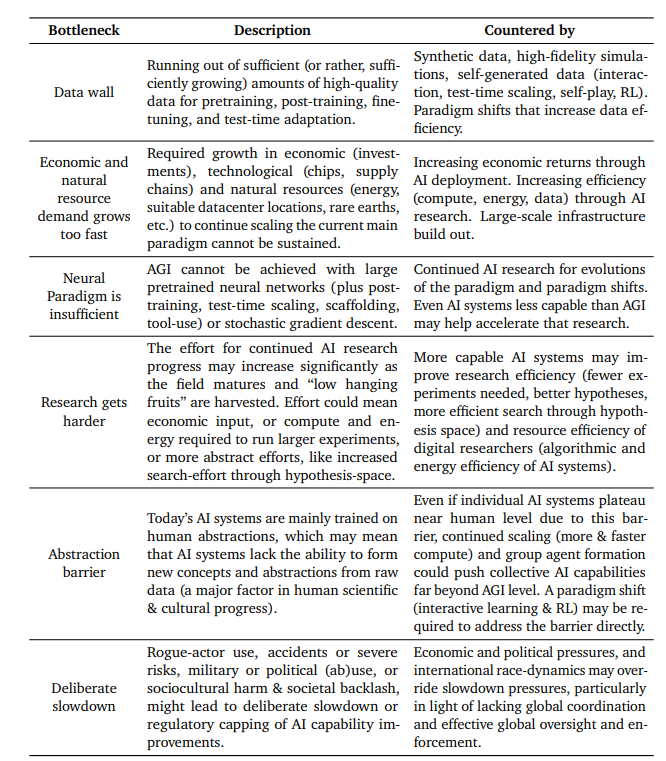
It notes that recent advances make human-level AGI seem more concretely imaginable than before, and continued trends such as improved algorithmic efficiency, large-scale investment in compute, and AI infrastructure expansion could plausibly sustain rapid growth through the end of the decade. Even challenges like limited high-quality training data might be mitigated using self-generated data from reinforcement learning, simulations, and agent-based systems.
However, it emphasizes that AI progress is inherently unpredictable. Because growth may be exponential or even hyperbolic, small uncertainties in assumptions can lead to large differences in outcomes. As a result, average or “best guess” forecasts may be misleading for decision-making. Progress could either continue rapidly or hit natural limits sooner than expected, potentially delaying AGI.
The text also stresses that even if AGI is achieved or surpassed, this does not guarantee “omnipotent” ASI or breakthroughs like curing aging, nanotechnology-based matter control, or climate restoration—such outcomes are not guaranteed.
A central tension is between accelerating forces (like AI helping accelerate research) and decelerating forces (like increasing difficulty and resource requirements in science). These opposing dynamics may coexist and compete, making it hard to determine which will dominate long-term.
Because of this, reliable forecasting requires using multiple models, tracking quantitative indicators (like algorithmic efficiency), and continuously updating predictions rather than relying on a single estimate.
#omnipotent #Cure_Aging
1
2
161
2/2 Is the Singularity near?
Evidence from scaling laws and recent benchmarks suggests that, at least so far, capability growth has often been super-linear with compute, though not perfectly consistent.
Importantly, the text emphasizes that even if individual model capability plateaus, overall system capability could still grow through scaling deployment: running many more instances of models, running them faster, or letting them “think” longer. This “quantitative scaling” might produce effects that resemble qualitative breakthroughs.
The example given is that if AGI were achieved but expensive, continued 10× annual growth in compute could rapidly expand usage from thousands to millions of instances, raising the question of whether such scaling alone could eventually produce ASI.
#Singularity #AGI #Scaling #compitational_power
1
353
1/2 Is the Singularity near?
The passage discusses uncertainty about whether AI progress could lead to a “singularity” driven by continued growth in effective compute.
It argues that even if traditional drivers like investment or hardware improvements slow down, improvements in training efficiency and system optimization could still sustain exponential growth in usable compute (e.g., 10× per year). This would enable larger training runs, cheaper model deployment, and more intensive “test-time compute” (like reasoning, planning, or multi-agent systems).
A key uncertainty is how this compute growth translates into new AI capabilities. Two possibilities are raised:
1. Diminishing returns could mean ever-increasing compute is needed just for small capability gains → slow progress.
2. Or capabilities could scale proportionally with compute → continued exponential improvement.
1
1
376
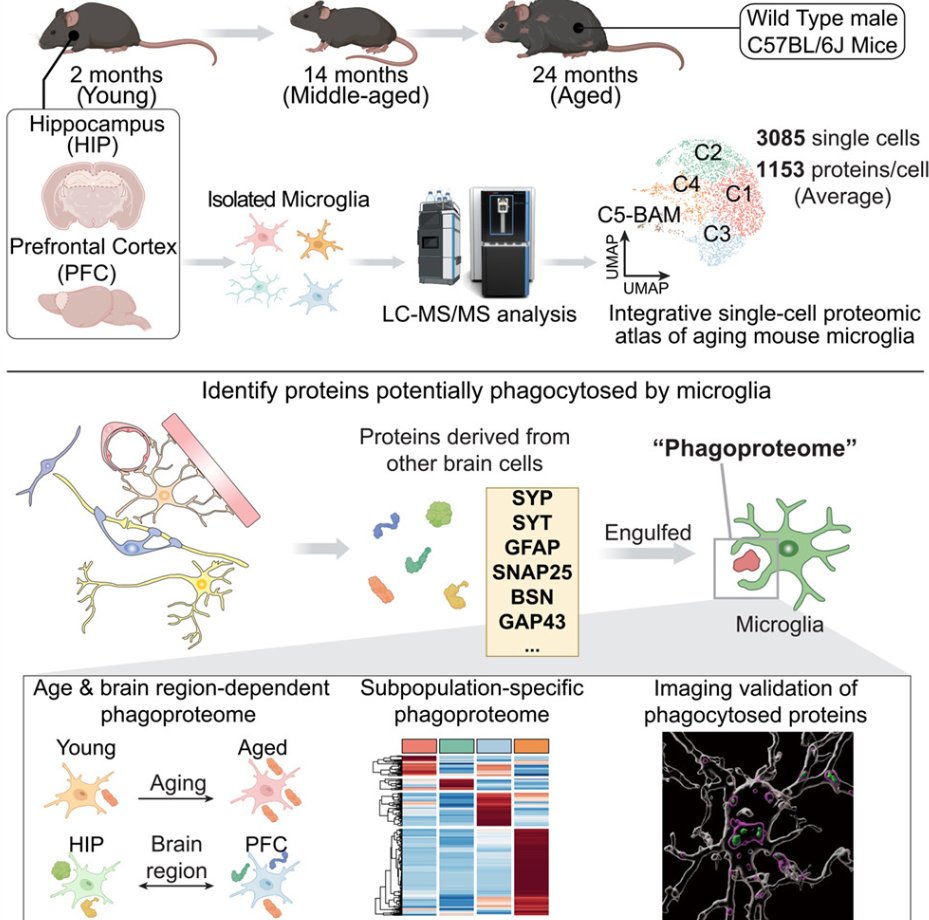
Single-cell proteome atlas of aging mouse microglia reveals subpopulation-specific phagoproteome
cell.com/neuron/abstract/S08…
@NeuroCellPress
1
7
334
A strong sustainability approach to AI development | Nature Machine Intelligence nature.com/articles/s42256-0…
1
10
298
Jun 13
scientist feel pressured to use AI tool? 😀

Our poll revealed many scientists feel pressured to adopt AI technology
go.nature.com/4utpjM3
1
2
6
460
Jun 10
Many people are currently unable to submit their abstracts due to website errors this afternoon. Is @SfNtweets considering an extension of the deadline this year as well, given the technical issues?

Have you submitted your abstract yet?
Whether you are looking to share a breakthrough finding, get fresh eyes on your work, or simply connect with fellow researchers, #SfN26 is the place to do it.
Don’t miss out! The deadline to submit is tomorrow.
🔗 vist.ly/574nu
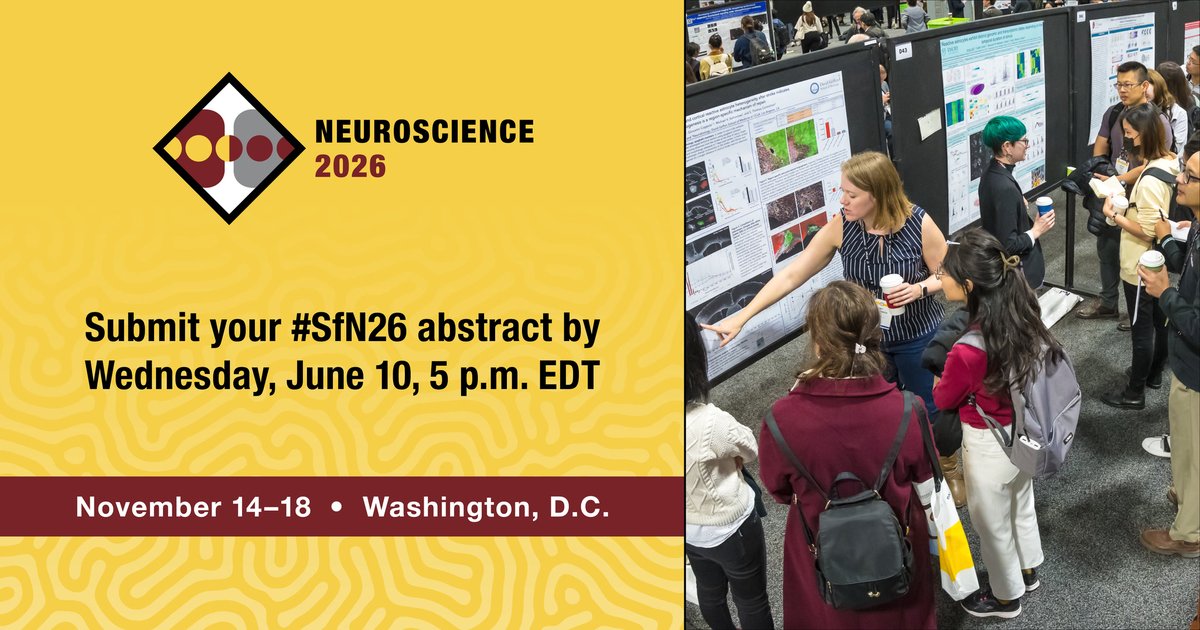
ALT A group of people examining posters at a neuroscience conference. Includes details of the abstract submission deadline for the 2026 event.
5
734
Jun 9
This is definitely the beginning of a STEM renaissance. It makes me wonder: how many modern-day Da Vincis will emerge from this new era of scientific and technological discovery?
1
17
1,500
@BioAI_Neuro retweeted
Jun 7
What books are AI researchers, founders, and scientists reading these days?
I'm interested in books that go beyond models and benchmarks and tackle bigger questions:
• Intelligence and AGI
• Neuroscience
• Longevity
• The future of science
Recommendations are appreciated ?
Here are the books I’m currently studying and will continue with
#AIBook #AIreading_list #AGI #Neurosciences #Longevity
10
6
28
3,536
Jun 8
Indeed, next decade will be a scientific renaissance for people who know how to use existing tools and methods . After reading these kind of posts, I always wish I have even more time to upgrade myself and read more AI stuff!
Time to start a reading club, I guess . Feel share your interest to participate in!!
Jun 8

“In the next 10 years we are going to be entering what I feel like is a new renaissance.”
Nobel Prize laureate Demis Hassabis was awarded the Nobel Prize for using AI to predict the structure of proteins. For him, AI is a tool that will help scientists make even more discoveries in the years to come.
Hassabis took part in our Nobel Prize Dialogue ‘The Future of Science With AI’ which discussed how AI might transform science in the future.
Watch the full event at nobelprize.org/events/nobel-…
2
1
18
1,231
@BioAI_Neuro retweeted

Jun 2
What would a Figma for science look like?
Drug discovery reasoning is inherently spatial and non-linear. A canvas lets the work breathe.
Humans will remain in the AI x bio loop for the foreseeable future, and some of the most exciting work is happening at the UX layer.
4
5
63
7,337
@BioAI_Neuro retweeted

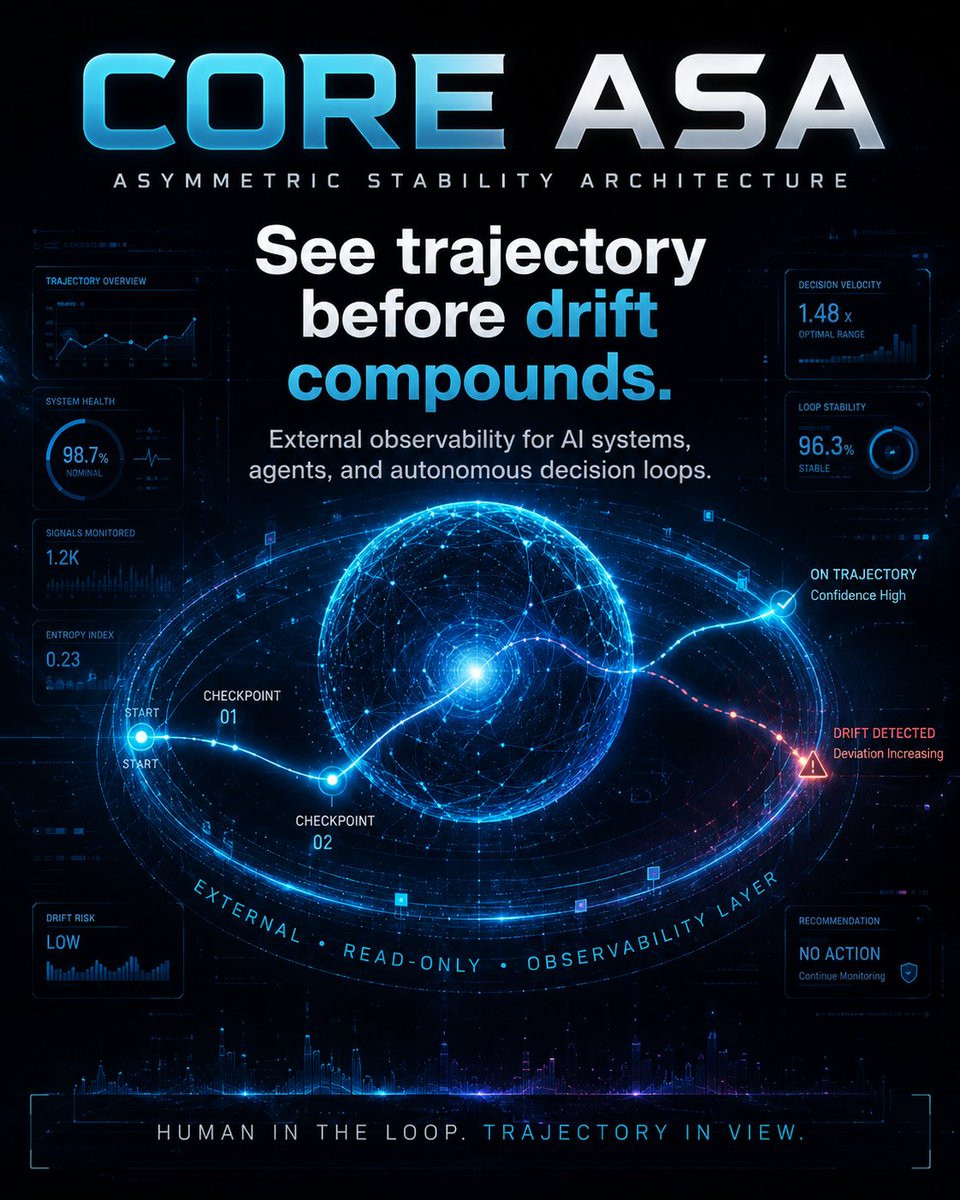
The problem ASA solves is not one bad answer.
x.com/Symbioza2025/status/20…
It is the slow movement of a system away from its original intent while everything still appears coherent.

Core ASA - Asymmetric Stability Architecture is an external observability layer for AI agents and autonomous systems.
It does not control the model.
It does not rewrite outputs.
It does not slow progress.
It observes trajectory.
The goal:
detect drift, assumption shifts and loss of human decision ownership before visible failure appears.
Because future AI systems may not fail loudly.
They may remain useful while quietly changing direction.
Project ASA - Asymmetric Stability Architecture
Mieczysław Kusowski
GitHub : github.com/Krugers123/
3
5
561