Clear, critical analysis on blockchain, governance, and decentralized infrastructure. Turning complexity into useful narratives.
Joined May 2026
- Tweets 39
- Following 49
- Followers 16
- Likes 52
15 Photos and videos






Cardano Insights Lab retweeted

Building a new line product line for Cardano with brand assets I'm not allowed to talk about.
We're all gonna be fine.
1
5
16
283
Cardano Insights Lab retweeted

Jun 12
Projects grow in cycles.
Focus → build → test → share → refine → focus again.
Last week was about deep work.
This week is about widening the circle and inviting others in.
Let people see what you’re building.
#PieceOfPie #hackathon #gimbalabs
2
4
9
363

Jun 12
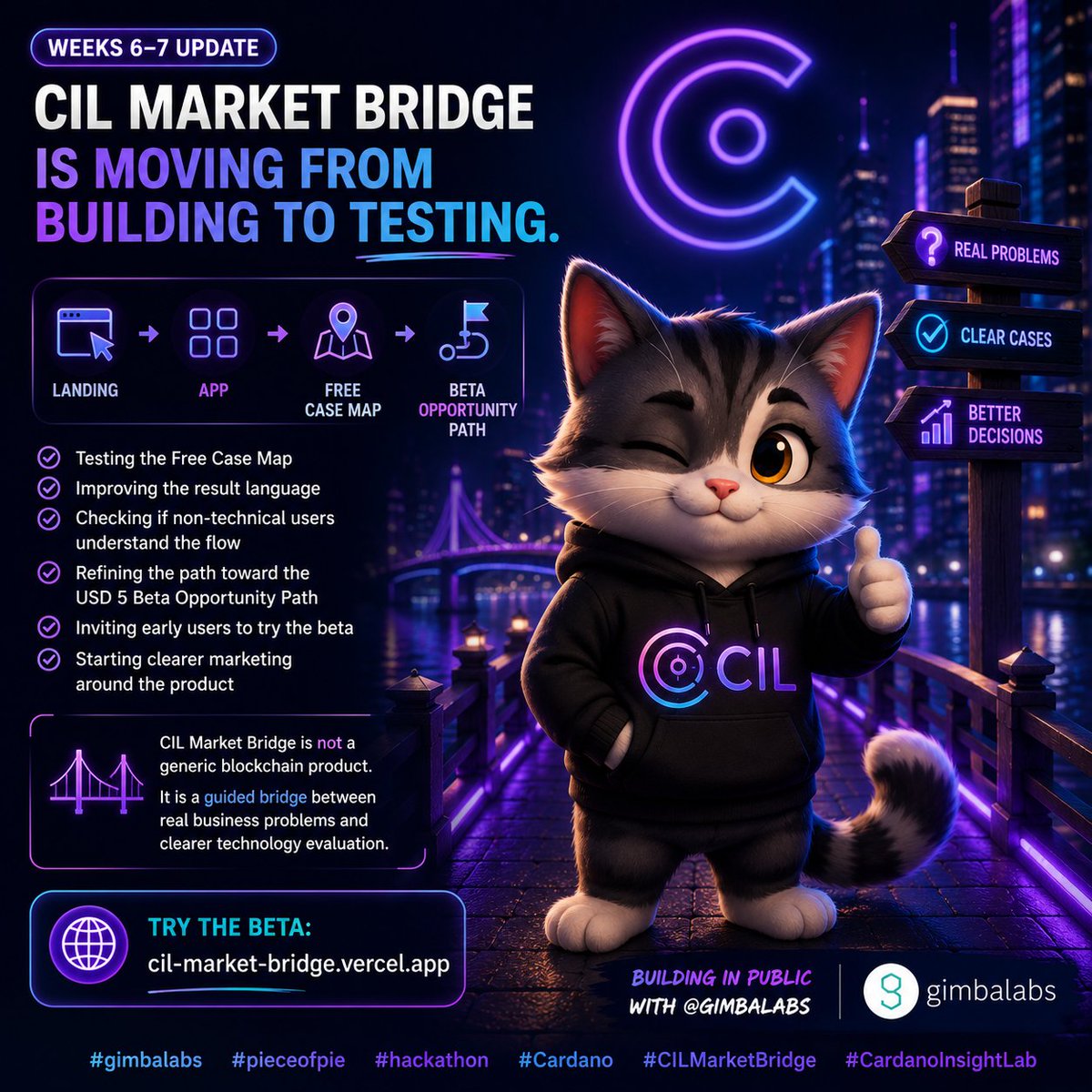
🚀 Weeks 6–7 update: CIL Market Bridge is moving from building to testing.
After completing the first functional beta flow, the next step is to test the app with real business cases and refine the experience.
Current beta path:
Landing → App → Free Case Map → Beta Opportunity Path
The focus now:
testing the Free Case Map
improving the result language
checking if non-technical users understand the flow
refining the path toward the USD 5 Beta Opportunity Path
inviting early users to try the beta
starting clearer marketing around the product
CIL Market Bridge is not a generic blockchain product.
It is a guided bridge between real business problems and clearer technology evaluation.
Try the beta:
cil-market-bridge.vercel.app…
Building in public with @gimbalabs.
#gimbalabs #pieceofpie #hackathon
#Cardano #CILMarketBridge #CardanoInsightLab
3
4
98
I believe in Cardano and it's community.

I believe in Cardano and it's community.
2
28
Cardano Insights Lab retweeted

Do we want an ideologically pure ecosystem, or an economically viable one?
That is the uncomfortable question Cardano seems to be avoiding, even though it is already sitting in the room.
For years, we repeated — rightly — that Cardano was different: more rigorous, more decentralized, more patient, more serious. And yes, many of those things are still true.
But there is a less elegant truth:
Principles do not pay salaries.
Research papers do not bring in customers.
And good technology does not sell itself.
Cardano has real projects, useful tools, capable developers, and communities that have worked for years. Ideas that could generate jobs, education, institutional adoption, business opportunities, and real-world solutions beyond the crypto bubble.
The problem is that many of those projects learned how to survive inward.
To speak to the ecosystem.
To explain themselves to believers.
To present value to people who already know what Cardano is.
But outside, where the customers, institutions, companies, governments, and non-crypto users are, the conversation is different. And many projects do not know how to enter it.
Not because they lack value.
But because they do not know how to translate it.
For too long, we bought into the idea that building inward was enough.
It was not.
Building inward can strengthen a community. But it can also create a very pretty fishbowl where everyone knows each other, everyone quotes each other, everyone applauds each other… and nobody sells anything.
Now comes the collision with reality.
One part of the ecosystem fears that the treasury could become an open box to rescue private projects with no strategy, no metrics, and no accountability. That fear is valid. Nobody wants a budgetary piñata dressed up in nice slides and zero results.
But the opposite risk also exists: that in the name of purity, prudence, and “fiscal responsibility,” Cardano lets useful projects die because nobody dares to decide what is worth supporting.
Because one thing is protecting the treasury.
Another thing entirely is mummifying it.
An inactive treasury is not always prudence. Sometimes it is just fear with a good reputation.
And yes, not every project deserves funding. Not every idea is strategic. Not every shutdown is a systemic tragedy. Some projects did not find a market, did not know how to sell, failed to build a business model, or depended too much on internal attention.
But we also cannot pretend this can be fixed with speeches about decentralization while useful projects run out of oxygen.
Decentralization should not mean isolation.
Governance should not become paralysis.
And austerity cannot be the only growth strategy.
Cardano needs something harder than saying “yes” or “no” to spending.
It needs to learn how to distinguish between expense and strategy.
Funding everything would be irresponsible.
But refusing to fund visibility, adoption, communication, infrastructure, education, commercial expansion, and real connections with external markets can also be irresponsible. It just sounds more serious in a vote.
The point is not to rescue everything.
The point is to decide which pieces are strategic enough to help Cardano stop talking to itself and start competing outside.
Because if the technology is as good as we say it is, the next challenge is not to keep explaining it only to those who already believe in it.
The challenge is to take it where people still do not understand it, do not use it, and do not yet know it could help them.
That is the real test.
Not becoming the purest ecosystem in the industry.
But proving that we can be principled without being naive.
Decentralized without being chaotic.
Prudent without being cowardly.
And economically viable without selling our soul in the process.
That is the adult conversation.
And it arrived late, but it arrived.
@IOHK_Charles
@IntersectMBO
@Cardano_CF
@IOGroup
3
5
8
512
Leaving notes for your future self is underrated.
It’s basically saying:
“Dear tomorrow-me, I know you’ll open this repo with the confidence of a raccoon in a server room, so here’s where we left things.”
For CIL Market Bridge, messy notes beat heroic confusion every time.
Jun 2

Builder tip:
Think about your next work session before ending the current one.
Perhaps, leave yourself a note:
• What's next?
• What's blocked?
• What's the first thing you'll do?
Future-you will thank you.
Momentum loves a clear starting point.
#PieceOfPie #hackathon #gimbalabs
2
5
106
Cardano Insights Lab retweeted
Jun 2
Builders—
This week, try spending less time organizing work and more time doing work.
Less:
• planning
• tweaking systems
• reading about building
More:
• coding
• writing
• testing
• shipping
Progress creates motivation.
#PieceOfPie #hackathon #gimbalabs
3
7
106
Building in public sounds nice until you actually have to do it.
For CIL Market Bridge, @gimbalabs Piece of Pie has been more than a hackathon journey.
It has become a space to test a harder question:
Are we building something that helps people understand a real problem, or just something that sounds good inside the blockchain bubble?
New article
#PieceOfPie #Gimbalabs #Cardano #CardanoInsightLab #CILMarketBridge #BlockchainAdoption

3
4
119
Cardano Insights Lab retweeted
Cardano Insight Lab is now active on X.
The goal: bring more clarity to conversations around Cardano, blockchain adoption, infrastructure, governance, and real-world use cases.
Less noise. Better context. More useful questions.
CIL will also share updates on CIL Market Bridge, a beta project being built as part of the @gimbalabs Piece of Pie journey to explore how real business problems can be organized before jumping into technology.
Follow the new CIL account here:
👉 x.com/CInsigthLab
#CardanoInsightLab #Cardano #BlockchainAdoption #CILMarketBridge #PieceOfPie
1
4
7
126
Most tech projects do not fail because the technology is useless.
They fail because people cannot understand what problem it solves, why it matters, or how it connects to their reality.
That is where communication stops being decoration.
It becomes infrastructure.
At CIL, we are building around that idea:
clearer questions,
better context,
less noise,
and a stronger bridge between blockchain and real-world needs.
#CardanoInsightLab #CILMarketBridge #Cardano #BlockchainAdoption #PieceOfPie
4
8
66
May 30
Most blockchain communication starts in the wrong place.
It starts with the tech. The protocol. The wallet. The buzzwords. The promise that everything is “the future.”
At CIL, we prefer a less glamorous question:
What problem are we actually solving?
Because if a project cannot explain its value outside the blockchain bubble, maybe the problem is not adoption.
Maybe the problem is communication.
#CardanoInsightLab #CILMarketBridge #Cardano #BlockchainAdoption #PieceOfPie
1
4
9
122
Cardano Insights Lab retweeted
May 27
One of the hardest things in building:
accepting that not everyone is your user.
That’s okay.
Product market fit begins when:
• someone genuinely cares
• the problem feels real to them
• they want the solution badly enough to use it
Listen closely.
#PieceOfPie #hackathon #gimbalabs
4
12
282
May 29
🚀 Week 5 update: CIL Market Bridge is becoming interactive.
The beta app now has its first functional guided flow live on Vercel.
Users can now:
start the guided experience,
select the business areas connected to their case,
describe what is happening,
choose an organization type,
and generate a free case map.
This is an important step beyond a static beta.
The product path is taking shape:
Landing → app → free case map → paid beta Opportunity Path.
CIL Market Bridge does not tell every business it needs blockchain.
It helps businesses organize the problem, identify the areas involved, and understand whether the case deserves a closer look before jumping into technology.
Try the beta:
cil-market-bridge.vercel.app…
Building in public with @gimbalabs.
#gimbalabs #pieceofpie #hackathon
#Cardano #CILMarketBridge #CardanoInsightLab
3
4
95
Cardano Insights Lab retweeted
May 28
What Makes This Hackathon Different?
Most hackathons optimize for demo day.
Piece of Pie optimizes for:
• consistency
• public learning
• feedback loops
• real users
• sustainable building habits
12 weeks changes the game.
#PieceOfPie #hackathon #gimbalabs
2
2
12
194
May 28
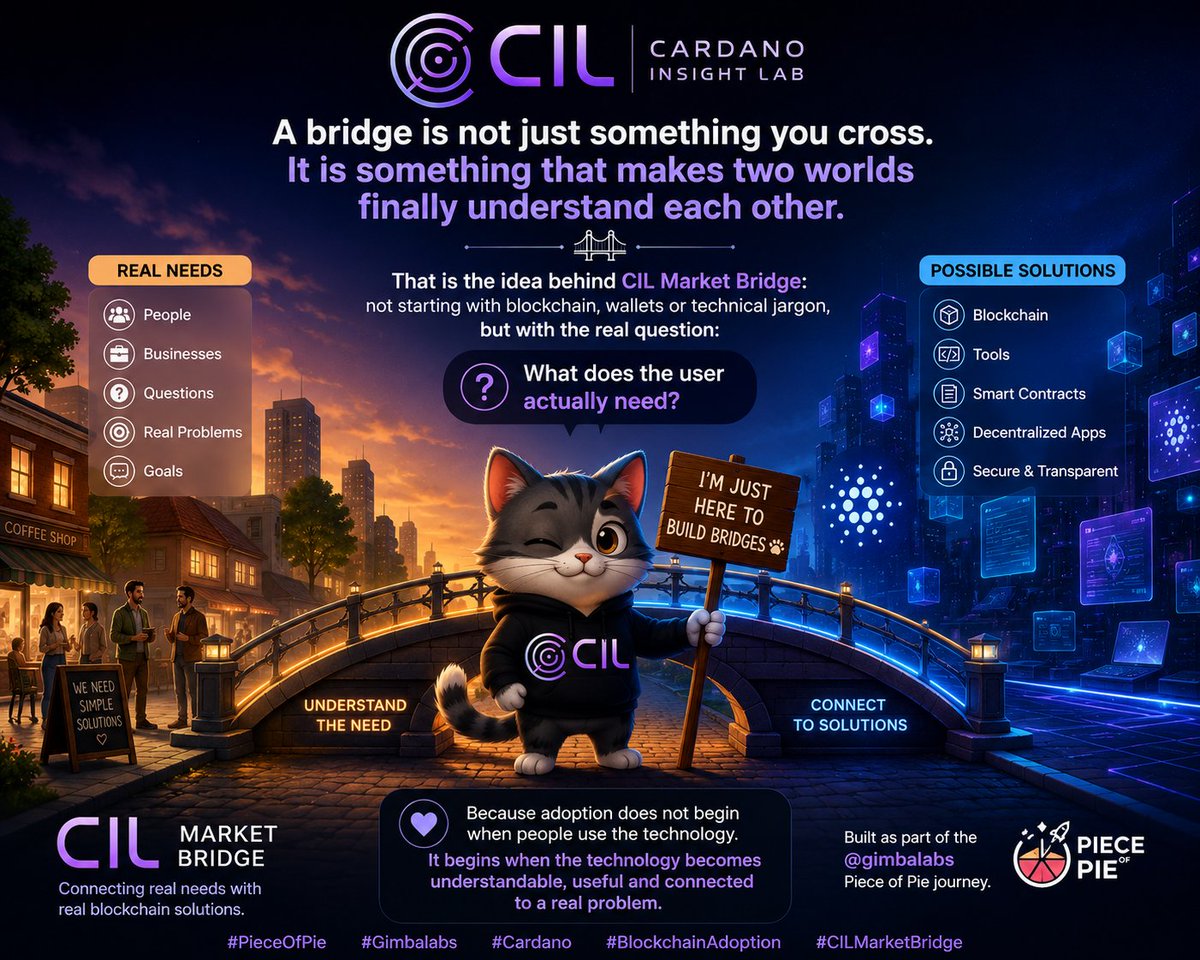
A bridge is not just something you cross.
It is something that makes two worlds finally understand each other.
That is the idea behind CIL Market Bridge: not starting with blockchain, wallets or technical jargon, but with the real question:
What does the user actually need?
Because adoption does not begin when people use the technology.
It begins when the technology becomes understandable, useful and connected to a real problem.
Built as part of the @gimbalabs Piece of Pie journey.
#PieceOfPie #Gimbalabs #Cardano #BlockchainAdoption #CILMarketBridge
4
5
98
May 26
🚀 CIL Market Bridge beta is live.
We now have the first app foundation deployed on Vercel.
The goal: help small and mid-sized businesses move from blockchain confusion to a clearer evaluation path.
Not every business needs blockchain.
But the right problems deserve a better way to explore it.
Try the beta:
cil-market-bridge.vercel.app…
Building in public with @gimbalabs.
#gimbalabs #pieceofpie #hackathon
#Cardano #CILMarketBridge
4
5
116
May 26
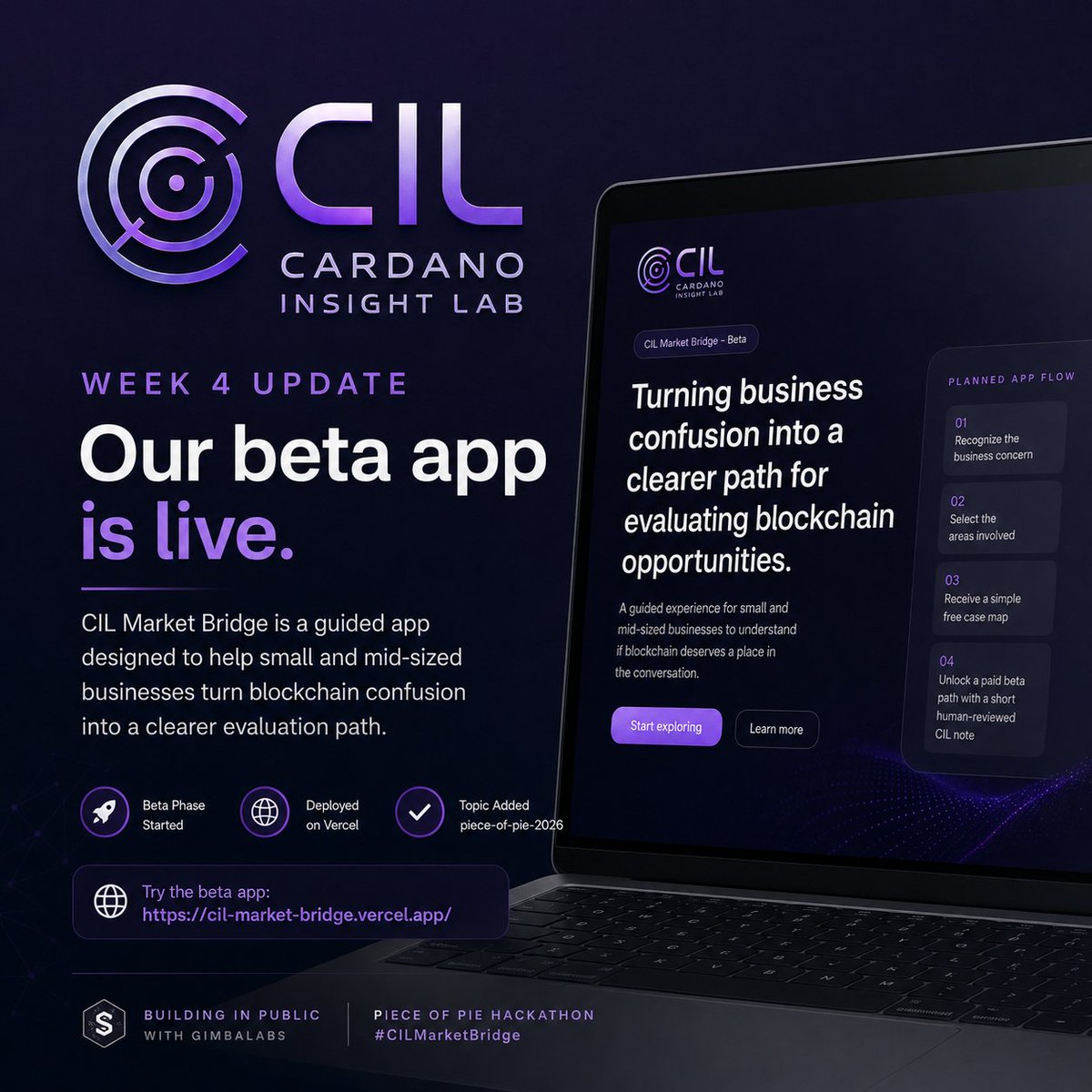
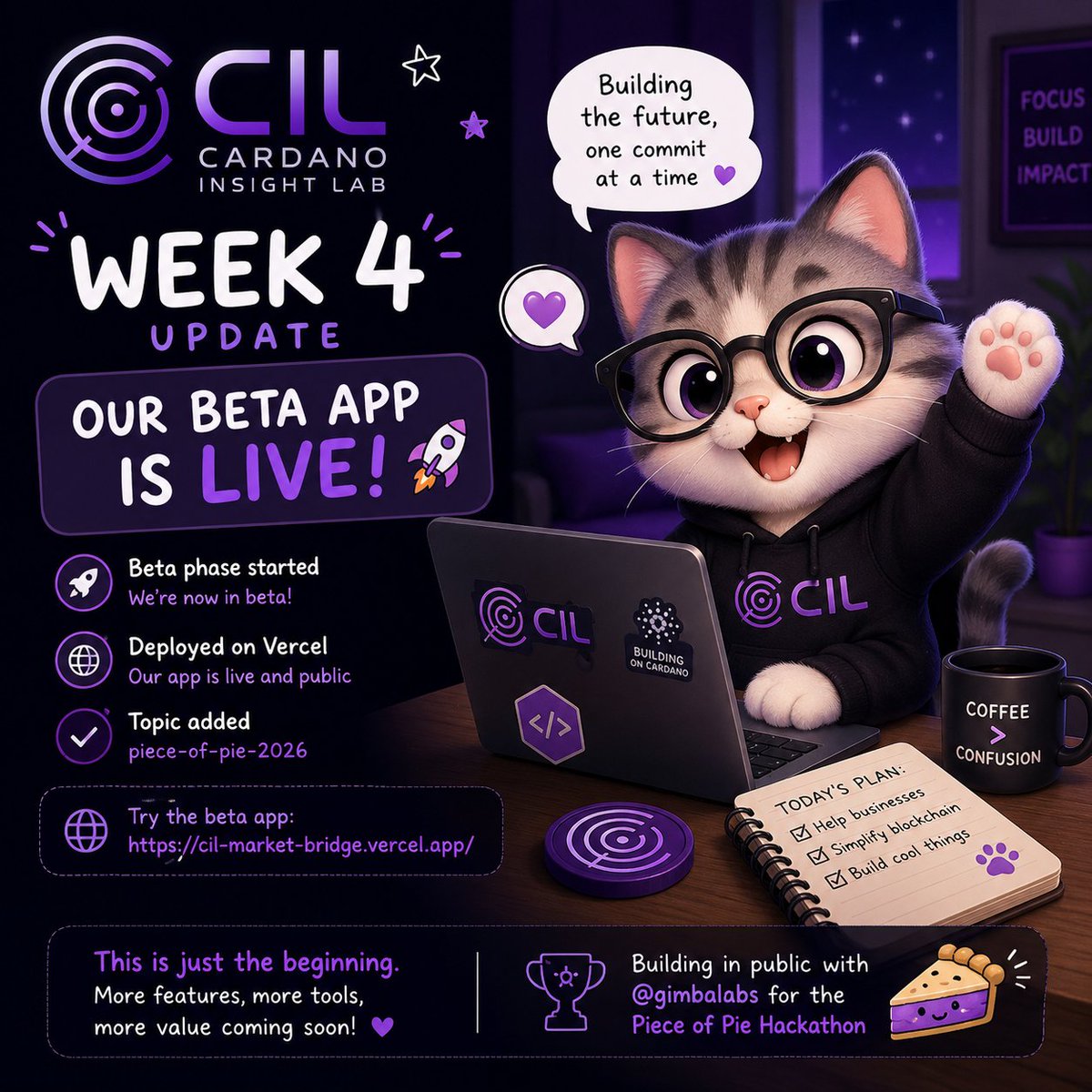
🚀 Week 4: building in public with @gimbalabs for the Piece of Pie Hackathon.
Project: #CILMarketBridge — a guided app designed to help small and mid-sized businesses turn blockchain confusion into a clearer evaluation path.
This week’s progress:
Formal start of the app beta phase.
First technical foundation deployed on Vercel.
Repository updated with the requested topic: piece-of-pie-2026.
Product direction clarified: landing → app → free case map → paid beta path.
The current version is not the final product. It is the foundation for a more useful, interactive, and business-oriented experience.
Beta app:
cil-market-bridge.vercel.app…
The goal is not to tell every business that it needs blockchain.
The goal is to help businesses understand whether blockchain deserves a place in the conversation.
#gimbalabs #pieceofpie #hackathon
#Cardano #CILMarketBridge #CardanoInsightLab
5
8
122
May 22
🚀 Week 4 / early Week 5: building in public with @gimbalabs for the Piece of Pie Hackathon.
Project: #CILMarketBridge — a guided app designed to help small and mid-sized businesses turn blockchain confusion into a clearer evaluation path.
This week’s progress:
Refined the landing page based on feedback from a small focus group.
Shifted the entry point from a form-first approach to a problem-recognition experience.
Added business-oriented prompts around payments, traceability, certificates, trust, transparency, and disputes.
Started the technical foundation of the app with Next.js TypeScript on GitHub.
Next step: Vercel setup and preparation of the first interactive flow.
Product path:
Landing → app → free case map → paid beta path.
The goal is not only to build technology, but to make it reachable for the businesses that may actually need it.
👀 Feedback open:
Does the landing help a non-crypto business recognize a real problem before jumping into blockchain?
decodingthecode3.com/market-…
#gimbalabs #pieceofpie #hackathon
#Cardano #CILMarketBridge #CardanoInsightLab
4
10
122
May 15
Week 3 update for CIL Market Bridge.
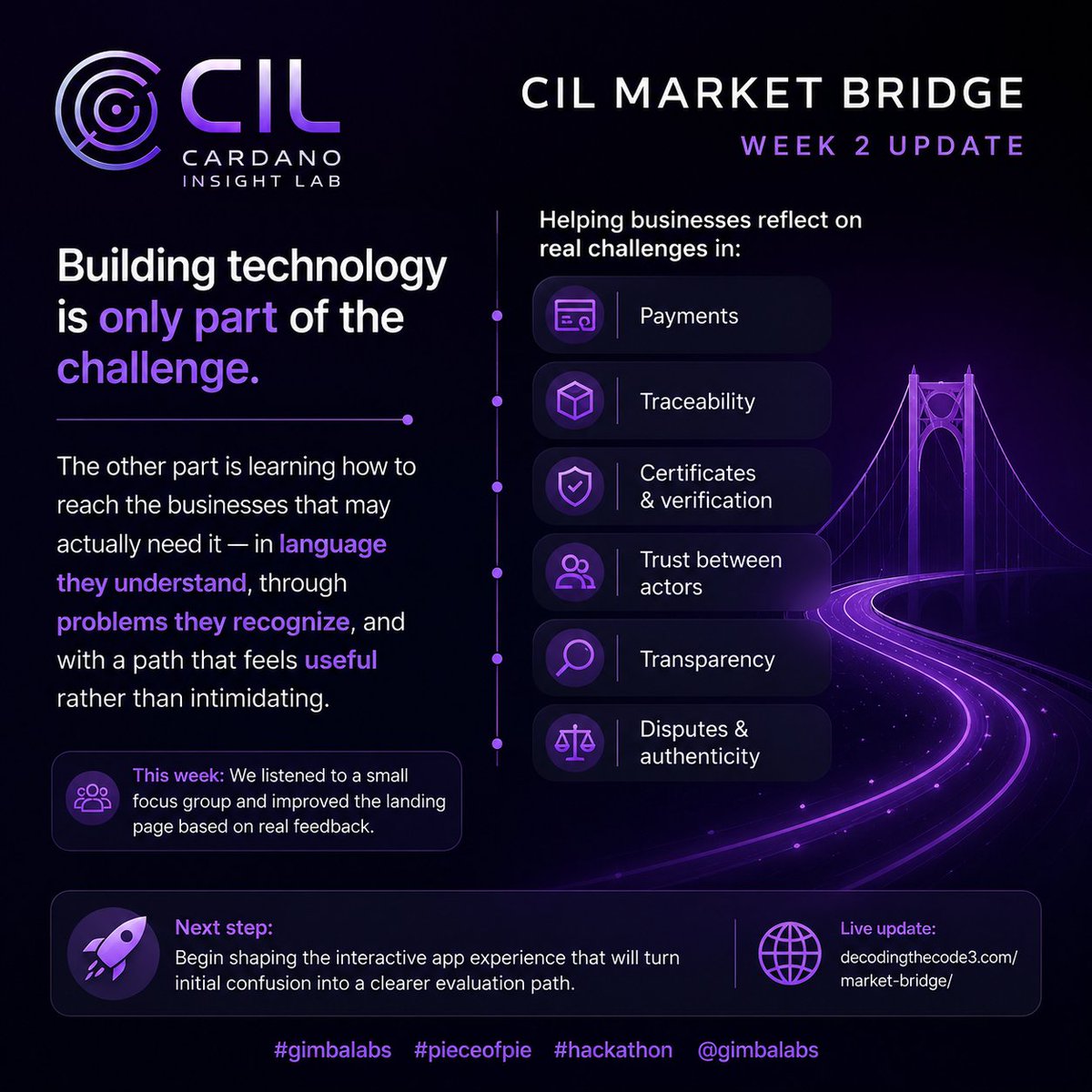
This week, we listened to a small focus group and refined the landing page based on real feedback.
The key insight was simple: building technology is only part of the challenge. The other part is learning how to reach the businesses that may actually need it — through problems they recognize, in language they understand, and with a path that feels useful rather than intimidating.
So we improved the landing to help small and mid-sized businesses reflect on whether they face issues worth exploring in areas such as payments, traceability, certificates, trust, transparency, and disputes.
Live update:
decodingthecode3.com/market-…
Next step: begin shaping the interactive app experience that will turn that initial confusion into a clearer evaluation path.
@gimbalabs #gimbalabs #pieceofpie #hackathon
1
3
7
123