Joined November 2019
- Tweets 936
- Following 566
- Followers 941
- Likes 964
28 Photos and videos


We start 2026 strong with a publication in ChemSystemsChem. Luis and coworkers wanted to determine whether globular protein vesicles could be formed using ELP bolaamphiphiles, i.e., ELPs flanked by soluble globular proteins at both ends. lnkd.in/eBmBgWxY
1
2
75
He developed cloning methods to produce different architectures of these protein fusions. He then showed these GPV containing ELP bolaamphiphiles had different biophysical properties. This paper lays the foundation for generating GPVs with transmembrane-like signal transductions.
1
64
These GPVs would be a significant advance in synthetic cellular mimetics. This work comes from our ongoing collaboration with Yeongseon Jang.
1
57

23 Sep 2025
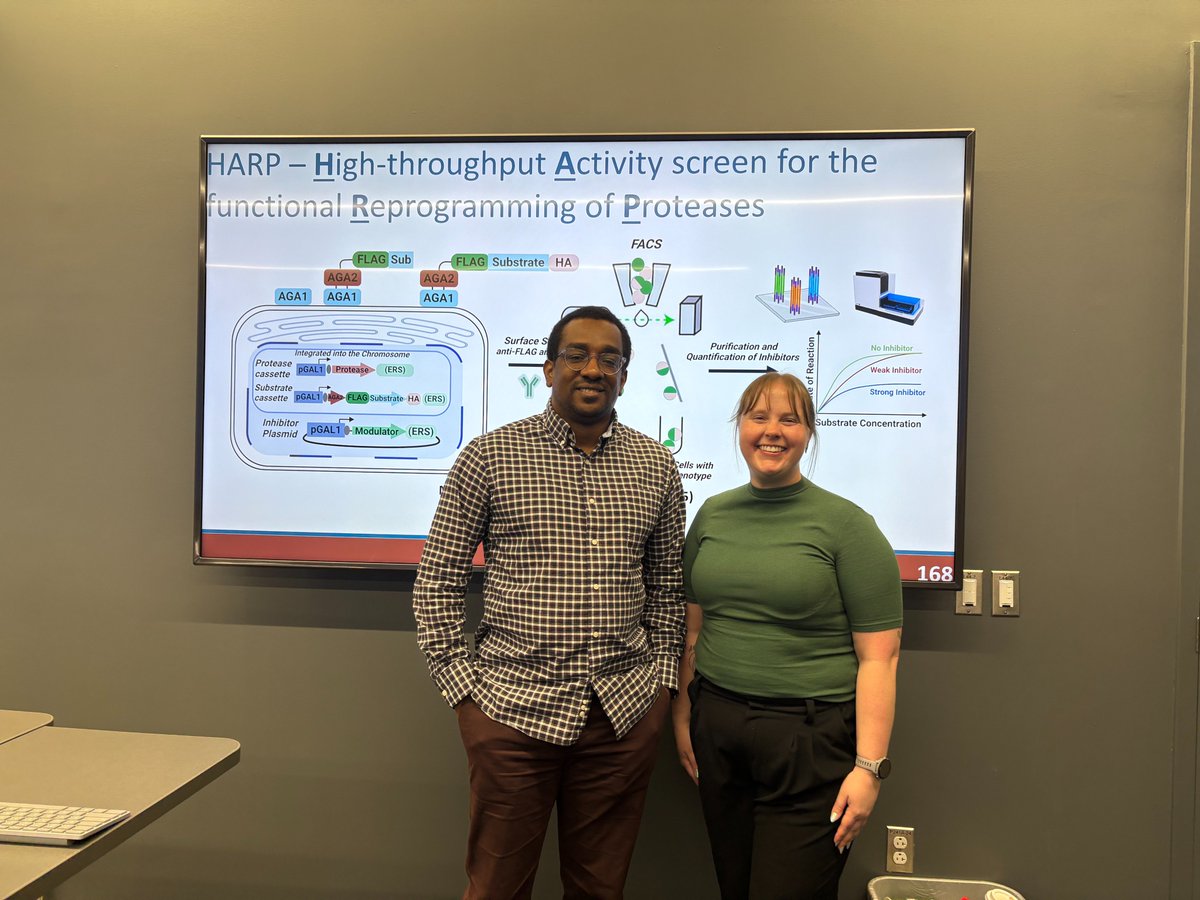
After a few months in review, HARP is finally out! Congrats to Samantha Martinusen, Ph.D., Ethan Slaton, and Nima Ajayebi for leading experimental and computational arms. Special thanks to Amit Dutta and Steven Bruner for the structural analysis.
1
1
88
23 Sep 2025
HARP enables the discovery of protease-inhibitory nanobodies from large synthetic libraries, bypassing the more numerous non-inhibitory binders. pubs.acs.org/doi/10.1021/acs…
44
29 Aug 2025
Congratulations to Sage Nelson for being one of the four graduate students who received the Excellence in Research Award from the UF Department of Chemical Engineering. Sage is now a fourth year graduate student, has already authored several papers. Amazing scientist!
181
20 Aug 2025
Hello Xverse, if anyone has a plasmid to express and purify IdeS from E. coli, please send me a DM.
125
DenardResearchGroup retweeted

11 Jul 2025
Online now @ Cell is the yeast multicellular engineering paper from @DrFankangMeng - the fruits of his productive PhD. He developed modular synthetic biology tools to bring multicellular behaviours to yeast - adhesion, juxtacrine signalling and more. cell.com/cell/fulltext/S0092…
5
37
135
8,779
8 Jul 2025
TwitterWorld, my lab wants to get into some optogenetics work (bacteria, yeast, in vitro). Are there good protocols to build cheap systems out there?
2
2
224
DenardResearchGroup retweeted

4 Jul 2025
2
5
47
4,196
DenardResearchGroup retweeted

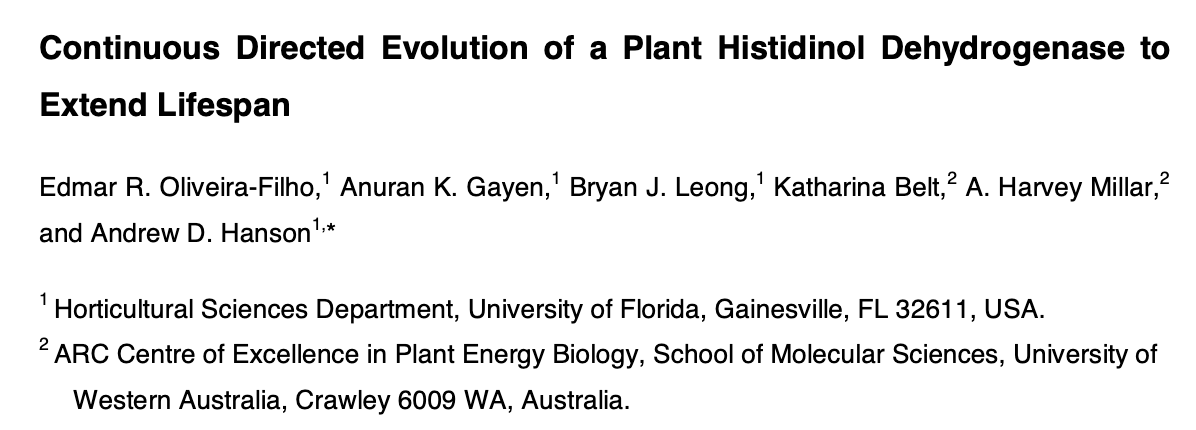
Excited to share the Hanson Lab’s @ADHansonLab new preprint! We used OrthoRep to evolve Arabidopsis HDH, a short-lived enzyme, selecting variants with up to 20× higher abundance. Mutations boosted lifespan, catalytic efficiency, or inhibitor resistance.
🔗doi.org/10.1101/2025.07.01.6…
2
10
19
1,441
3 Jul 2025
Has anyone made RNA-triggered toehold switches that work in S. cerevisiae? If you know of some good papers, let me know.
1
169
24 Jun 2025
New PrePrint from Denard Lab: biorxiv.org/content/10.1101/…
In this collaboration with the Jang lab, we designed recombinant ELP bolaamphiphiles to construct multifunctional globular protein vesicles.
1
1
85
24 Jun 2025
This work lays the foundation for the bottom-up construction of GPVs with transmembrane signal transduction capabilities. Go Team!
58
5 Jun 2025
"New" Paper Alert from a collab with Jang Lab. We designed and characterized globular protein vesicles with ability to sense small molecules in their surroundings. Congrats to her awesome students. pubs.acs.org/doi/abs/10.1021…
5
143
19 May 2025
pubs.acs.org/doi/10.1021/acs…
PERRC is now out. Last month, we presented this work on manipulating ER retention signals to modulate counterselection to selection substrate ratios in the yeast ER and how we used it for protease engineering.
1
3
180
19 May 2025
Sage Nelson is the driver of this work, with tremendous help from Jokent Gaza, Ron Masse, and others. Alberto Perez and Amor Menezes collaborators on this work.
62
15 May 2025
Happy to share an authoritative, topical, and detailed review paper on cover all the latest efforts to engineer proteases, out now in Biotech Avdances. sciencedirect.com/science/ar…
Led by @sammartinusen, with considerable efforts from many lab members.
1
7
246
16 Apr 2025
Streptavidin beads, two years expired from Mitenyi Biotech. Should we still use for MACS?
1
167
29 Mar 2025
HARP is on Biorxiv! biorxiv.org/content/10.1101/…. We developed a high-throughput functional screening platform for protease inhibitory nanobody discovery via yeast ER sequestration and screening. We used to HARP to isolate low nM inhibitors against TEVp and KLK6 for the first time.
1
2
8
769
29 Mar 2025
We found active site and allosteric inhibitors for TEVp, including an uncompetitive inhibitor with a 7 nM Ki. Before HARP, the best TEVp inhibitor to date had an IC50 of 700 nM.
1
1
101
29 Mar 2025
HARP is @sammartinusen's labor of love. HARP is very powerful for inhibitor discovery because of its high resolution. Moreover, in-yeast inhibition correlates almost perfectly with NGS enrichment. We also showed how HARP navigated the inhibitor space through sequence embedding.
1
98