
Market Strategist at AG Capital. Translator of global macro trends into actionable investment insights. Always asking "what if" to manage risk and cut noise.
Joined December 2025
- Tweets 221
- Following 196
- Followers 276
- Likes 209
32 Photos and videos





Pinned Tweet

May 3
Data is everywhere, but clarity is rare.
I keep a close eye on what’s happening in the global economy and financial markets, and focus on explaining what it means in practical terms for portfolios and our clients.
Everyone has an opinion on the market, but very few understand what’s actually driving it.
I track the signals, not the noise - rates, liquidity, global flows, turning complex market developments into clear, useful insights that support better investment decisions and client conversations.
2
371
Casey Sprake retweeted

Jun 14
this year’s Comrades Marathon broke the record for novice runners 🔥 🔥
across the country Hyrox events sell out, Pilates studios are full, cycling clubs are thriving & padel courts are booked
massively inspiring to see the investment into health & wellness!! 🦾🦾
25
339
1,827
61,354
Casey Sprake retweeted

What timeline are we on man.
There’s a $60 million UFC cage on the White House lawn for the president’s 80th birthday. 125,000 guests. 494 port-a-potties. He compared it to the Eiffel Tower and said maybe they’ll never take it down.
The world’s first trillionaire was minted yesterday. SpaceX IPO. One person now holds more wealth than the GDP of most countries.
The government is negotiating to own a piece of OpenAI. The CEO walked into the White House and pitched it himself. They’re calling it a Public Wealth Fund.
That same government killed OpenAI’s biggest competitor’s models on a Friday night. The reason? A verbal jailbreak claim from an unnamed company. The same jailbreak works on OpenAI’s models. Nobody touched them.
The competitor got blacklisted by the Pentagon four months ago. Their crime? Refusing to let the military use their AI for mass surveillance of American citizens. A judge called it retaliation. The Pentagon did it anyway.
Both AI companies filed to go public in the same two-week window. Both targeting trillion-dollar valuations. One has a government equity deal in progress. The other can’t keep its products online.
The engineers who built the banned models can’t use them anymore. Because of their passports.
And an AI company that spent thousands of hours cooperating with government safety testing got punished harder than any company that didn’t bother.
UFC on the White House lawn. A trillionaire. Government-owned AI. Export controls based on phone calls. Cage fights and trillion-dollar IPOs in the same news cycle.
Watch the film titled Idiocracy. That’s the timeline we’re on.
Jun 13

The US government, citing national security authorities, has issued an export control directive to suspend all access to Fable 5 and Mythos 5 by any foreign national, whether inside or outside the United States, including foreign national Anthropic employees.
The net effect of this order is that we must abruptly disable Fable 5 and Mythos 5 for all our customers to ensure compliance.
Access to all other Claude models is not affected.
We apologize for this disruption to our customers. We believe this is a misunderstanding and are working to restore access as soon as possible.
Read our full statement: anthropic.com/news/fable-myt…
120
813
4,672
763,264
Jun 11
South Africans are feeling the squeeze, and the pressure isn't over yet.
In this Africa Live interview, I unpack why rising fuel prices and inflation continue to drive up the cost of living, and why there may still be more pain ahead for consumers.
Watch the full video for my insights on what this means for households and the economy.
32
Jun 9
Weird, weird day to be on X. Europe feels ring-fenced by social unrest and the threat of political violence, SA agri Twitter is busy doing Olympic-level politicking over foot-and-mouth, the Soccer World Cup timeline is a rolling crisis meeting and America is somehow still the loudest thing in the room. Feasible market content? Not a chance.
1
59

Barbell strategy for killing it in an age of superhuman AI:
Simultaneously get as close to AND stay as far away from AI as humanly possible.
1. Get close — play with AI models, use them to help you think, ask them to teach you about the world, get them to help you create, work with them to write code, understand what makes them tick, embed them into your everyday life, have fun.
2. Stay far away — learn to tell stories, make eye contact, build a team, lead with courage, connect far-flung ideas, build lifelong friendships, debate persuasively, think forbidden thoughts, handwrite ideas, confess your fears, fall in love.
Spend less time trying to master mental transformations that are purely mechanical — building spreadsheets, analyzing trades, balancing accounts, writing code by hand, following playbooks, searching for needles in haystacks. These are the emerging no-man's land, squarely the domain of AI.
Venture to the extremes. That’s where all the fun is anyway.
148
415
3,584
553,953
Jun 9
Fitch's latest credit rating upgrade for South Africa will be priced in, traded, and quickly forgotten. What matters is whether the debt stabilisation behind it is durable, or riding a commodity cycle in a water-stressed, infrastructure-fragile economy that can reverse faster than any rating decision.
On 5 June 2026, Fitch lifted South Africa's sovereign rating for the first time in almost 21 years, taking the country one notch higher on the back of a clearer path to debt stabilisation. That follows Moody's changing its outlook from stable to positive, breaking a decade-long pattern in which ratings news almost always meant cuts, downgrades, or warnings. For the first time in a long time, two of the three major agencies are leaning in the same, more optimistic direction.
The current story looks neat and tidy. A gentler debt trajectory means lower perceived risk, a lower sovereign risk premium, and slightly cheaper funding for the state. In a world where many emerging markets are still wrestling with post-pandemic debt hangovers, that alone makes South Africa look cleaner on comparative screens. For global allocators operating inside models and index rules, it becomes a bit harder to justify being structurally underweight.
The upgrade is a signal. Whether it reflects a structural turning point or a temporary alignment of favourable conditions is the question serious investors are asking.
Read the full article below.

2
1
5
342
Jun 8
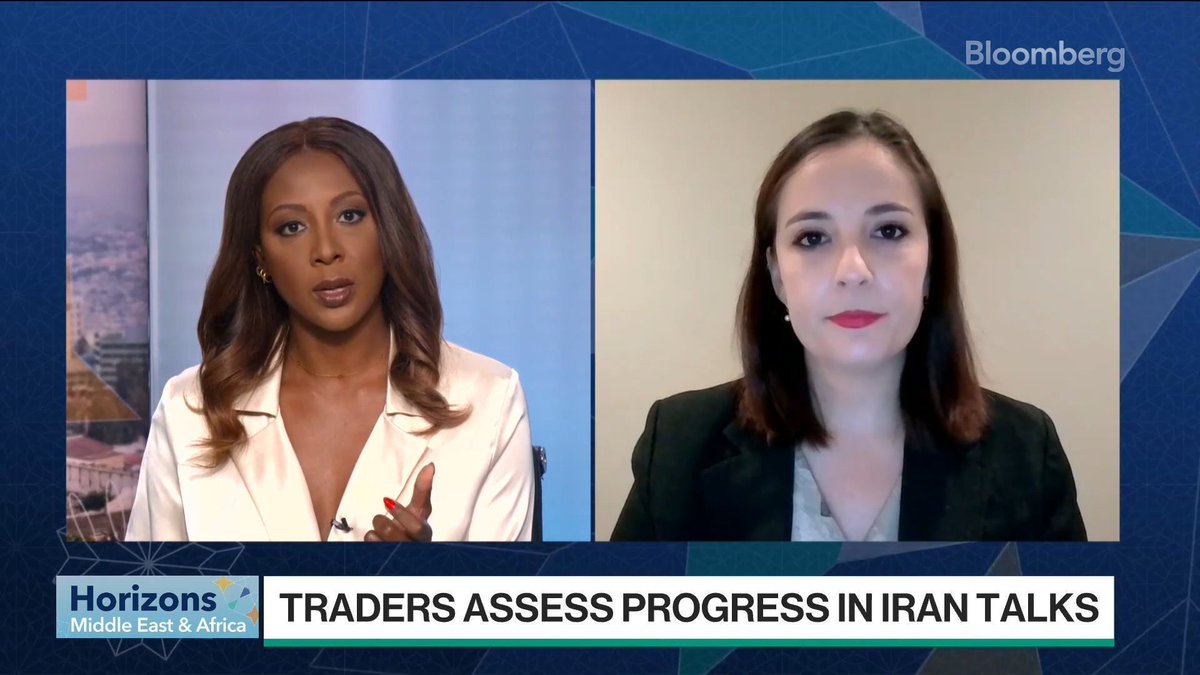
Markets are holding their breath...
I joined Bloomberg to unpack what a potential US-Iran peace deal could mean for global markets, oil prices, and investor sentiment.
Watch the full interview below to hear my insights on the market reaction and what investors should be watching next.
bloomberg.com/news/videos/20…
46
Jun 4
This is a pretty big signal that India wants to deepen its bond market by competing on tax rather than just yield or inclusion in global indices.
If they also follow through on cutting the 20% withholding tax on interest, you’re suddenly looking at Indian government bonds priced much more like a “developed market carry trade” than a classic EM risk premium story.
63
Casey Sprake retweeted

The 12.5% tariffs the U.S. intends to levy on South African goods will be challenging. Still, it is far better than where we are coming from, where South Africa had to face a 30% tariff. In agriculture, some of our competitors, like Australia and New Zealand, will face a similar tariff level. The U.S. remains an important market for South Africa’s agriculture, accounting for around 4% of exports valued at US$15.1 billion in 2025. Citrus, raisins, table grapes, and wine are amongst the most exposed industries. Again, oranges, juices and nuts still have exemption from these tariffs, which helps a bit.
4
14
42
3,220
Jun 4
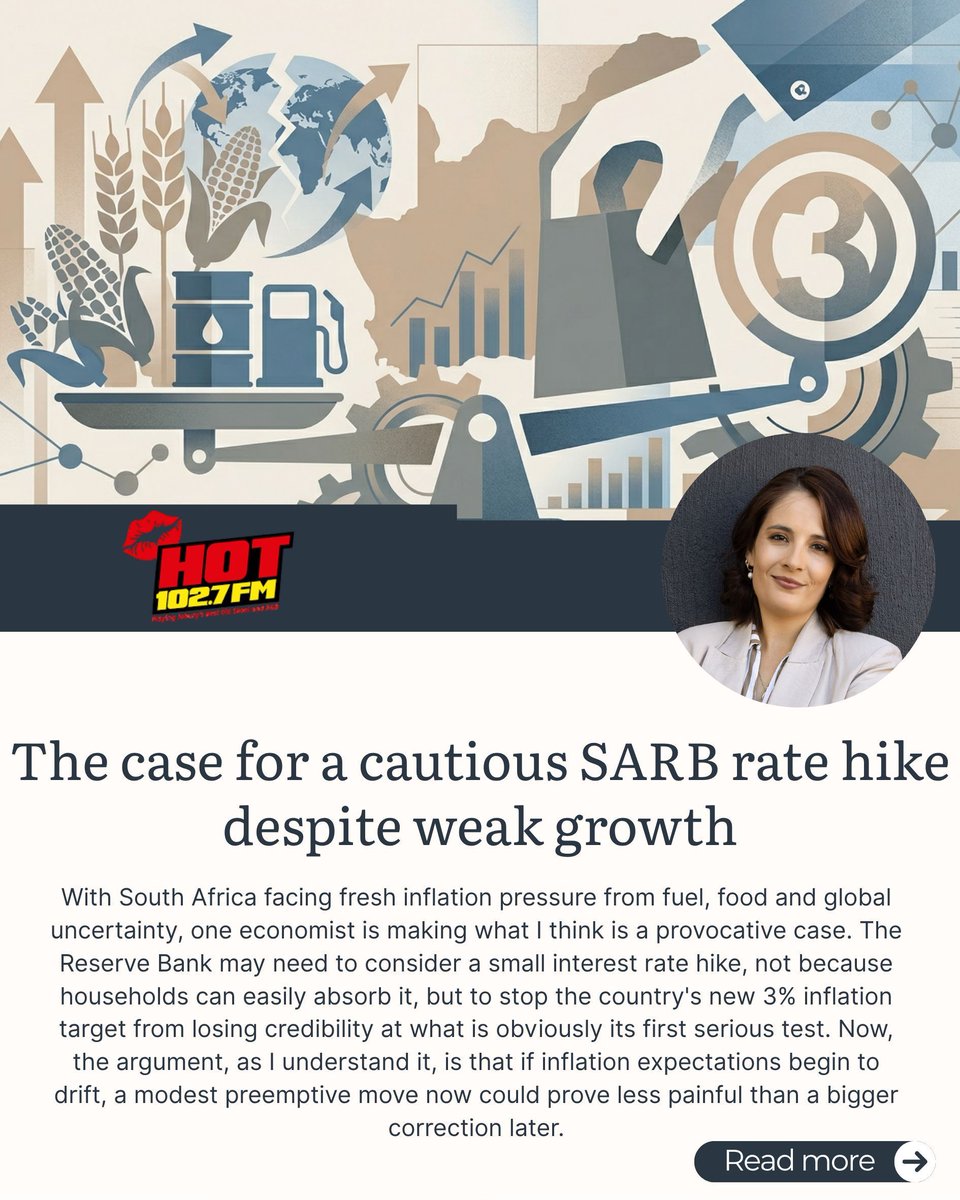
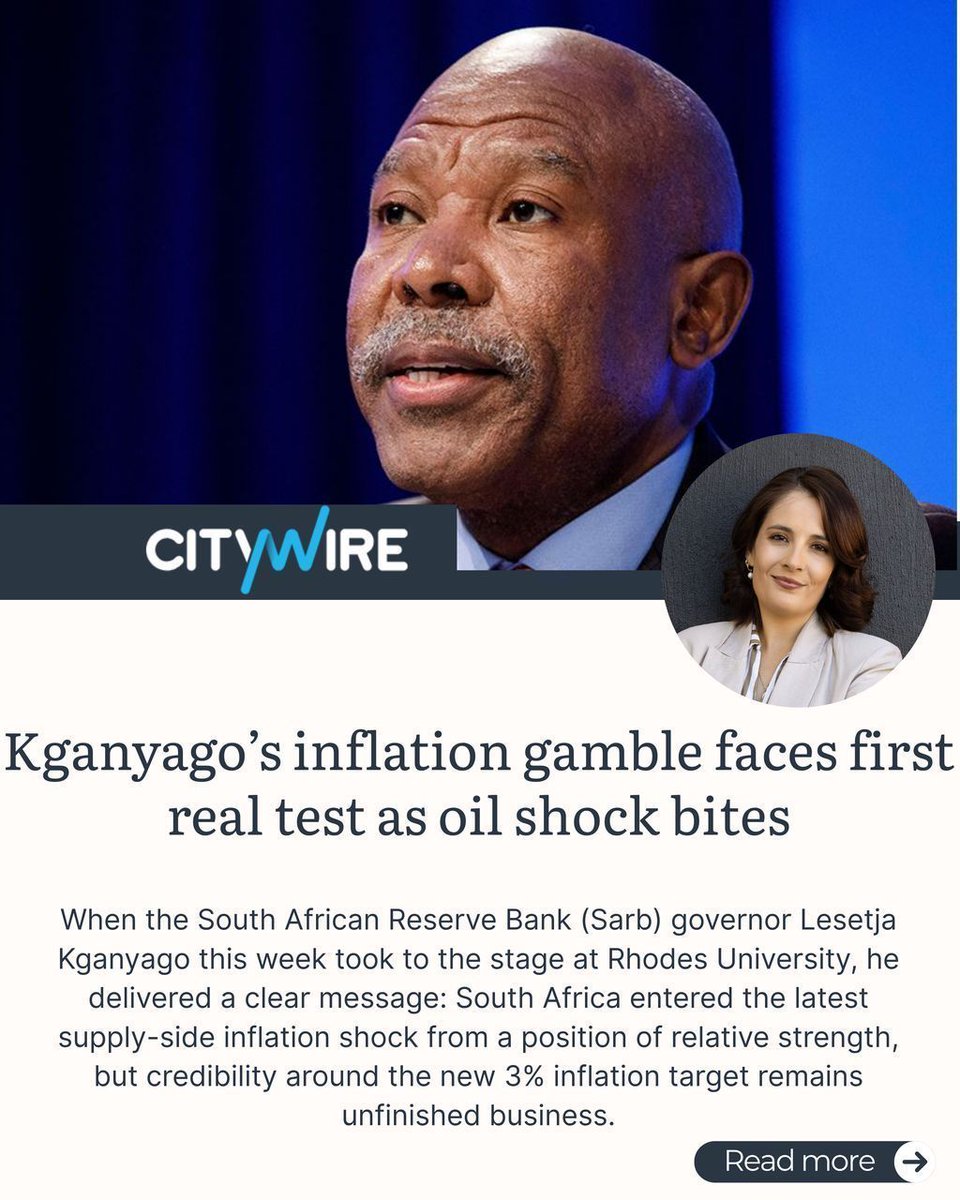
Inflation, interest rates, and credibility. Not exactly light breakfast radio topics, but incredibly important for every South African right now.
I joined Hot Business with Jeremy Maggs to unpack why a small, pre-emptive interest rate hike could actually prevent a far bigger inflation problem down the line. We discussed the Reserve Bank’s new 3% inflation target, rising fuel and food pressures, and why inflation expectations matter just as much as inflation itself.
It’s a difficult balancing act between protecting households already under pressure and maintaining long-term economic stability.
Catch the full interview below to hear why I believe the SARB’s credibility is facing its first real test:
iono.fm/e/1677435
63
Jun 2
What happens when the world’s economic wiring starts to fray?
Adam Smith’s invisible hand was never meant to wear a Stars and Stripes glove, yet for decades, it effectively did.
American power hard-wired the global economy, and the Hormuz shock has reminded investors just how fragile that wiring has become. In a world where the hegemon is less willing or able to underwrite stability, South African investors, in particular, need to rethink how they manage risk, inflation, and diversification.
The accompanying graph from BCA Research traces the rise and fall of global economic powers from the 1800s through to the projected 2040s, revealing how successive empires shaped the global economy before the United States emerged as the dominant hegemon.
As global power shifts and old assumptions are challenged, what does this mean for investors and the future of markets?
Read the full article below.
1
2
99
Jun 1
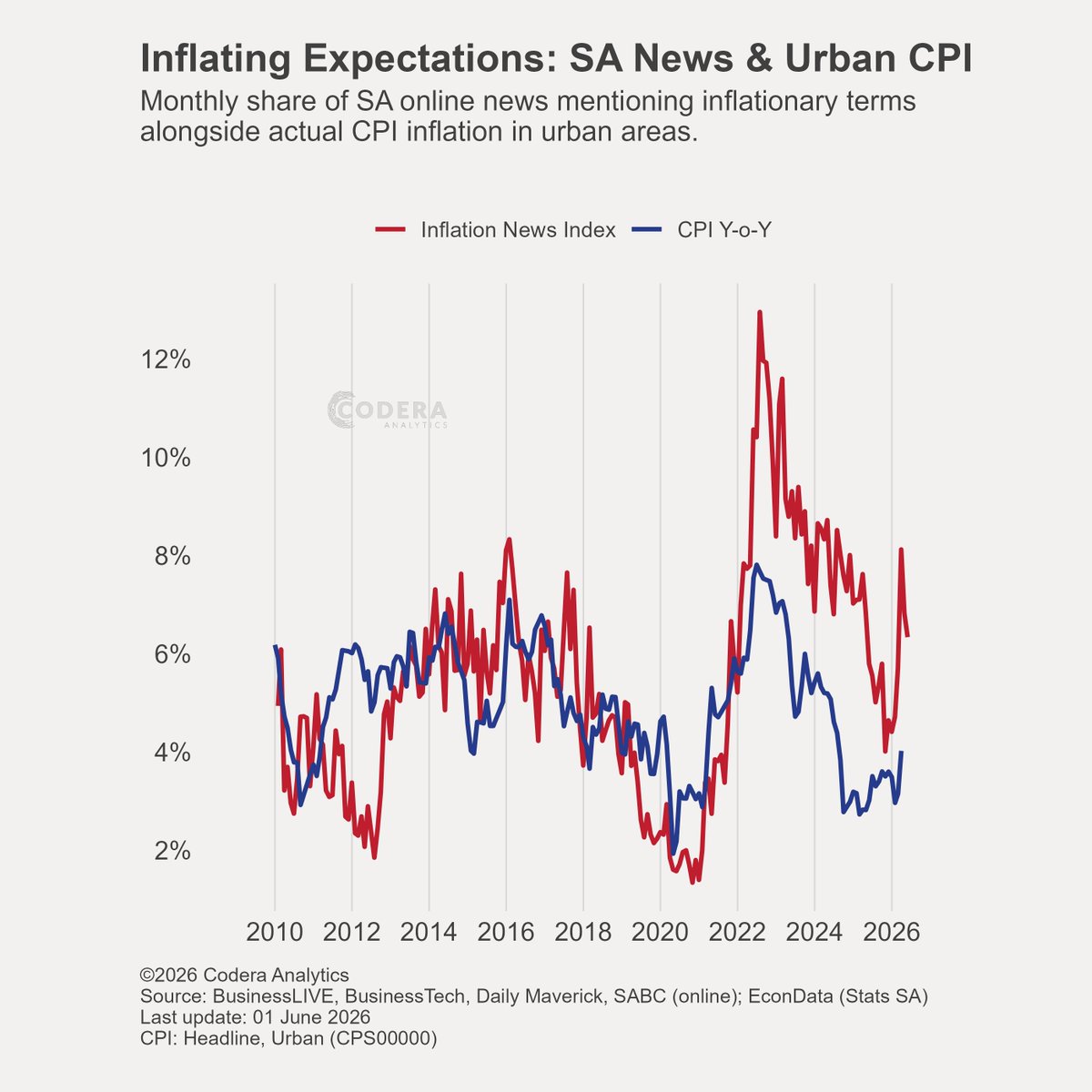
Fascinating work from @CoderaAnalytics tracking “inflation news” alongside CPI gives us a real-time window into how households and firms might be updating their inflation expectations, beyond what traditional surveys can capture. As SA consumers become ever more sensitive to price headlines in this high-inflation environment, measure like this become increasingly more interesting.

Today’s @CoderaAnalytics post by Jacques Quass De Vos measures public inflation attention, counting the frequency of the word ‘inflation’ in South African newspapers. As we show in the post, inflation-related news coverage correlates with inflation expectations.
76
Jun 1
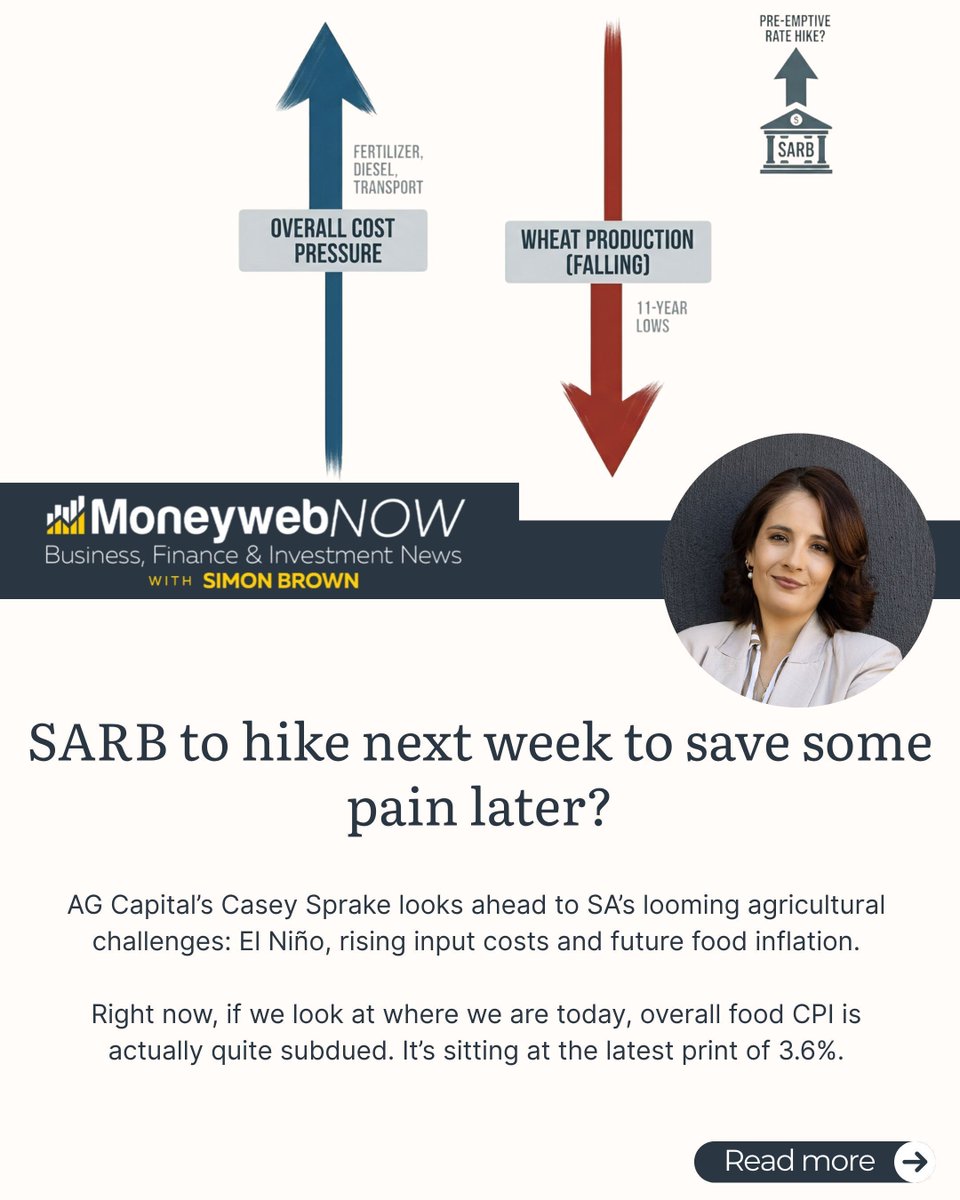
There’s a growing risk on the horizon that South Africans cannot afford to ignore.
In my conversation with Simon Brown, I unpack why the possible return of El Niño by late 2026 could place major pressure on food production, inflation, and ultimately, consumers’ pockets.
From wheat plantings hitting 11-year lows to rising fertiliser, diesel, and transport costs, the agricultural sector is facing mounting challenges that could ripple through the entire economy.
If you want to understand what these global and local risks could mean for farmers, food prices, inflation, and the broader economy, listen to the full interview below:
moneyweb.co.za/moneyweb-podc…
2
70
Casey Sprake retweeted

May 28
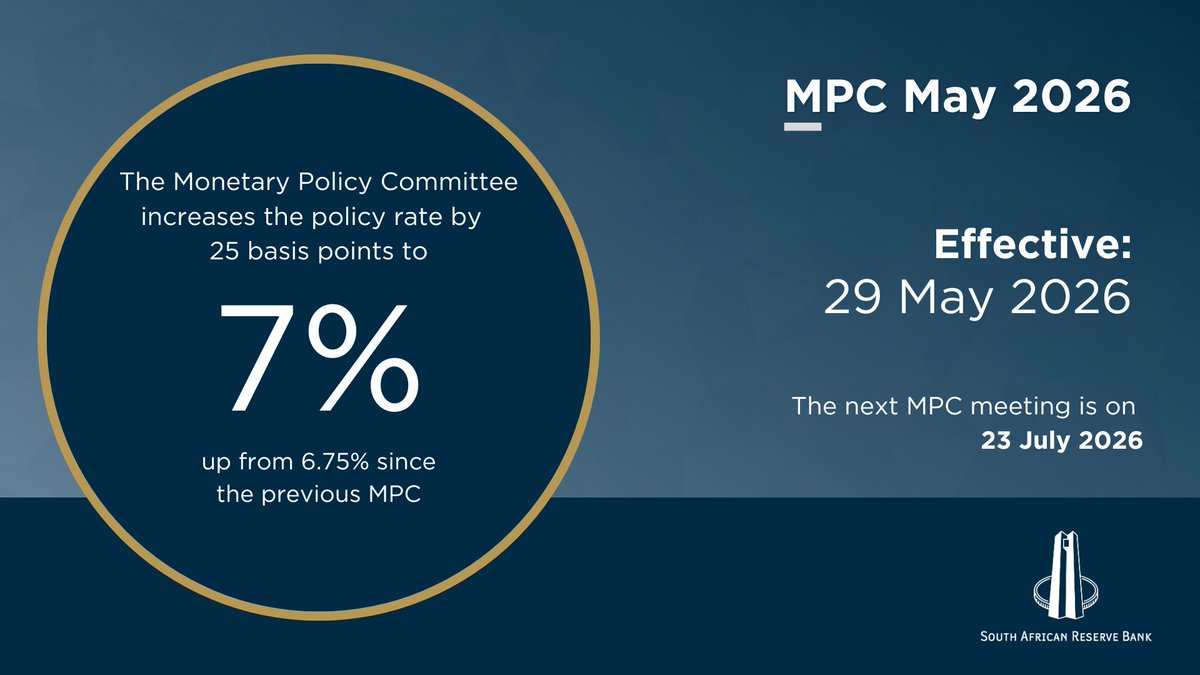
The MPC decided to increase the policy rate by 25 basis points, to 7%, effective from 29 May. #SARBMPCMay26
39
123
100
49,981
May 28
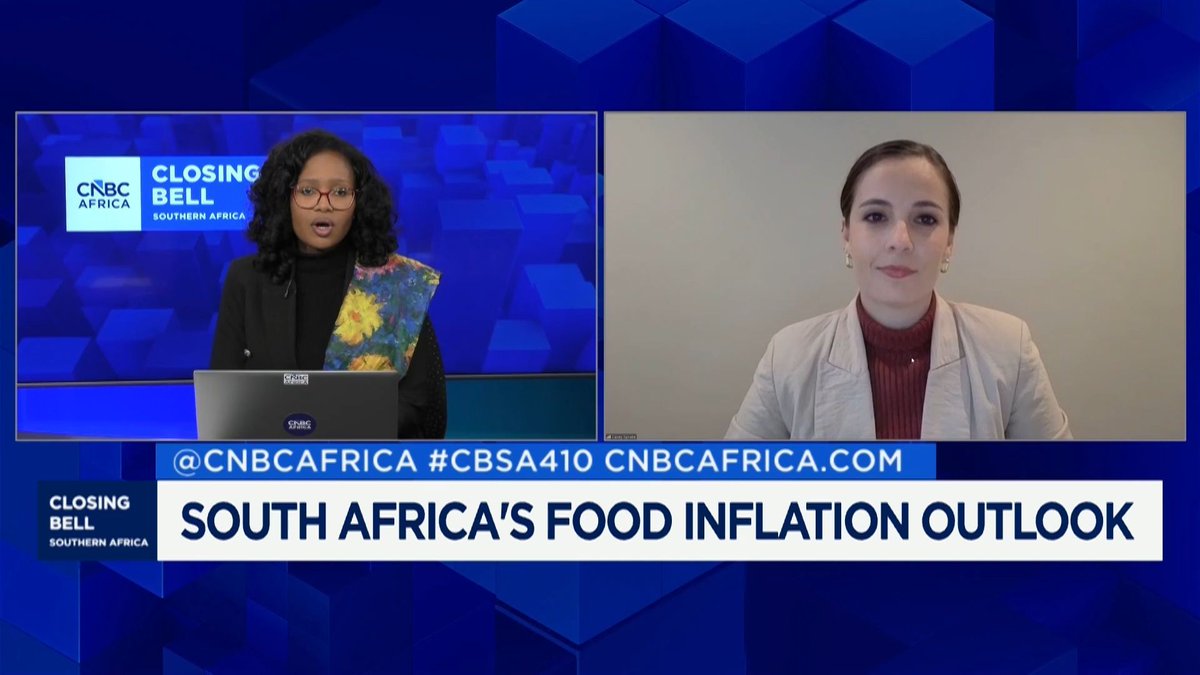
Weather patterns are changing, and South Africa’s agricultural sector is preparing for what could be a challenging season ahead.
As the cycle moves from El Niño conditions toward the drier realities of El Niño, concerns are growing around crop production, food security, and the possible impact on inflation in the 2026–27 summer crop season.
In this insightful CNBC Africa interview, I unpack what these climate shifts could mean for farmers, consumers, and the broader economy.
From production risks to inflationary pressures and market outlooks, this conversation offers a valuable perspective for anyone watching South Africa’s agricultural and economic landscape.
Watch the full interview for the complete insight:
cnbcafrica.com/media/7778613…
2
69
May 26
South Korea’s equity market has gone from overlooked to borderline overheated in record time.
What was once a relatively inaccessible and under-owned market is now drawing serious global attention, and when access improves, capital tends to follow quickly.
With Interactive Brokers expanding into South Korean equities, we’re already seeing the familiar pattern emerge: access, inflows, momentum, and the narrative that follows.
What’s particularly interesting to me is that the opportunity may not only sit with the well-known semiconductor giants. There’s growing interest in more traditional cyclical businesses that still trade on mid-single-digit earnings multiples, which is attracting value-focused investors.
The full article unpacks why South Korea is suddenly back on the radar and what investors should be watching next.
1
80
May 25
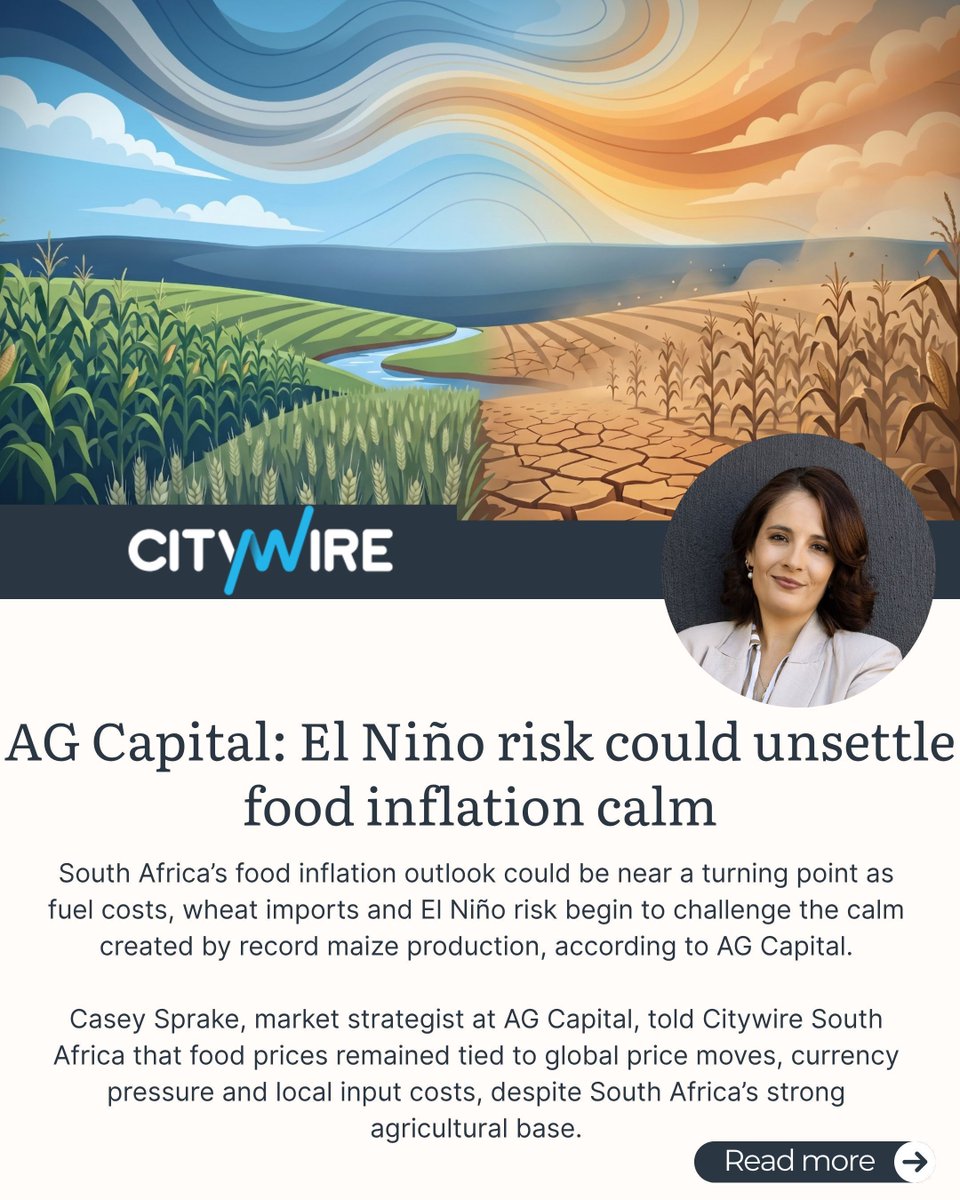
I’ve been watching South Africa’s food inflation picture closely, and while record maize production has helped keep prices relatively calm for now, I think we may be approaching a turning point.
Rising fuel costs, pressure from wheat imports and the growing possibility of an El Niño event all have the potential to change the inflation outlook later this year and into 2027.
One of the biggest misconceptions is that South Africa is fully insulated because of our strong agricultural sector. The reality is that we still import a significant portion of our food, which means global prices, currency moves and input costs continue to matter.
Add higher fertiliser and diesel costs into the mix, and those pressures eventually filter through the entire food value chain.
For now, the maize surplus is acting as an important buffer, but weather risk remains the wildcard. Markets are not fully pricing in what a drought cycle or supply-side shock could mean for inflation and interest rates down the line.
Follow the link below to read the full article:
citywire.com/za/news/ag-capi…
2
3
138