
Author of "The Kingdom of Heaven is at Hand" and "Am I Predestined? or Free to Choose?"
Joined August 2024
- Tweets 1,337
- Following 27
- Followers 57
- Likes 131
49 Photos and videos






Jun 10
Got blocked by @soothkeep
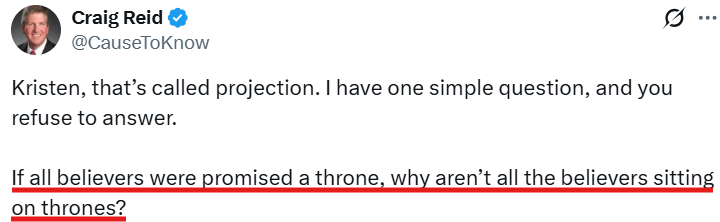
He believes the church is in heaven in Rev 4. Further, he stated that every believer in the church is promised a throne in heaven.
So I asked: If every believer is promised a throne, why aren't there millions of believers sitting on thrones? (...instead of just the 24 elders)
He wouldn't answer but my answer is: Because the church is not in heaven in Rev 4
38
Jun 4
Question for Calvinism
There is hardly a more repeated verse than Gen 15:6:
"And he believed in the LORD; and he counted it to him for righteousness." (see Rom 4:3, 5, 9, 11, 21-22, 24, Gal 3:6, Jam 2:23)
Clearly, faith precedes righteousness. And if that's true, don't we have to come to faith before we are born again (i.e. made righteous)?
2
79
May 18
Question for Calvinism
If God decrees and determines all things, how did Judah burn their sons with fire against the will of God?
Jeremiah 19:5 KJVS
They have built also the high places of Baal, to burn their sons with fire for burnt offerings unto Baal, which I commanded not, nor spake it, neither came it into my mind:
1
139
May 8
Question for Calvinism: Why would a person be accursed for preaching a false gospel? (Gal 1:8-9)
If the elect were given a false gospel, they wouldn't believe it. And if the non-elect were given a false gospel, why would it matter? They were never going to be saved anyway
2
113
Apr 20
To @JPGolfandTaxes @god_came_down @JustBibleTruth
JP Golfer: I never saw a reply to this question ...sorry if I missed it.
I first said:
"It seems clear that whatever Abraham is inheriting, Israel and New Testament believers are inheriting the same thing"
Then:
1
130
Apr 13
Question: Did Paul believe the temple would be destroyed before Jesus came back?
2
1
136
Apr 14
Did I miss other responses to this question? ...or was Katinka the only responder?
Question: Did Paul believe the temple would be destroyed before Jesus came back?
1
92
Apr 13
Sure he is. Just like he's dividing the 5 wise virgins and the 5 foolish virgins. Just like he's dividing the good and faithful servants from the wicked and slothful servant.
2
1
105
Apr 13
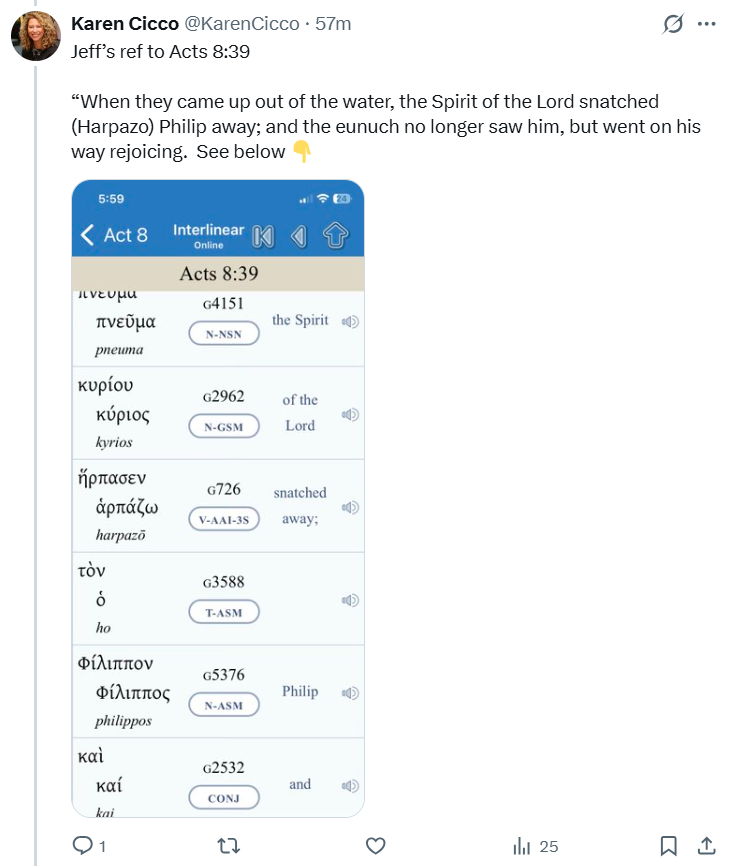
No, all the usages of Harpazo do not indicate supernatural power of God.
The violent take it by force
The wicked one catcheth away
Men would come and take him by force
The wolf catcheth
No man shall pluck them out of my hand
The soldiers..to take him by force
Pulling them out of the fire
2
1
70
Apr 13
And furthermore, see Matt 13:
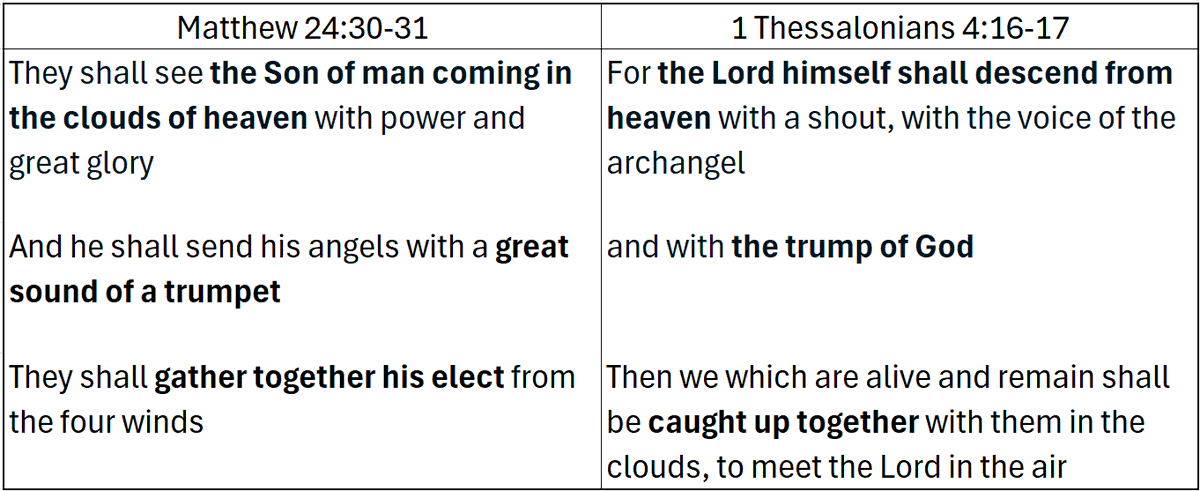
"I will say to the reapers, Gather ye together first the tares, and bind them in bundles to burn them: but gather the wheat into my barn."
"The enemy that sowed them is the devil; the harvest is the end of the world; and the reapers are the angels."
1
2
45
Apr 13
You know what Paul (and anyone else) never stated? ...that the 24 elders represent the church.
Please do not add words that aren’t there to Paul’s letters (or anyone else's writings in the Bible).
2
2
41
Apr 13
And while we're on the subject of words in the Bible...
Where all in the book of Revelation is the church described as being in heaven?
2
2
34
Apr 4
Somewhat, but what did you mean before when you said you believe God IS?
3
1
134
Apr 4
That’s funny. I thought it was somehow a reference to I AM. Thanks for clarifying that.
Seems to me that if God was a dispensationalist, he would have used the word more …and in such a way that it didn’t look like something was being dispensed (i.e. given out) …like the gospel or grace or Paul’s job as minister of the church.
Anyone else see that?
55
Mar 13
Question: Why is the first part of Daniel's 70th week often said to be a time of "tribulation?"
Before Antichrist breaks the covenant, it seems there will be relative peace in that region. The Jewish people will be making their daily sacrifices in the temple.
3
4
260
Mar 7
An honest question for Calvinists who don’t believe God predestined some people to hell:
Did God determine that sin would be passed down from Adam (such that judgment would come upon all men to condemnation)?
119
Mar 6
I’ve been asked about the 144,000 servants in Rev 7:4 and 14:1. Though they are of the 12 tribes of Israel, they are Christians — they follow the Lamb wherever he goes (Rev 14:4). To learn about these men, we first need to understand that the rapture is described in both Rev 7:9 (a great multitude before the throne) and Rev 14:14-16 (the harvest of the earth was reaped).
So just before the rapture, the 144k are in heaven “before the throne of God” (Rev 14:5). We’re told they are redeemed from among men, firstfruits unto God and the Lamb (Rev 14:5). What this means is they have experienced an early resurrection and are in heaven prior to the rapture. They are about to be taken to the earth to live there during the great tribulation. But they first need to be sealed in their foreheads (Rev 7:3).
After being sealed, they are taken to earth, presumably as witnesses for Jesus during the tribulation. Importantly, they will be protected from all the judgments during that time. We see this in Rev 9:4, where the locusts could only hurt “those men which have not the seal of God in their foreheads.”
Finally, I believe the 144k will be taken back to heaven when the great tribulation ends — right before the 7th trumpet judgment (i.e. 7 bowl judgments). This would coincide with the resurrection of the two prophets in Rev 11:12.
Importantly, the 144k are not the same as unbelieving Israel described in Romans 11 — Jews who were seeking salvation via the old covenant, who stumbled at Jesus the stumbling block. Those unbelieving Jews would include both men and women, whereas the 144k are only men. Plus, the 144k will be put on the earth after the 6th seal, whereas unbelieving Israel will be put there before the 1st seal. But there are similarities. Unbelieving Israel will live on the earth during the 42 months of antichrist’s power (i.e. the great tribulation), and they will be protected from him during that time. Then at the end of the 42 months, when the fulness of the Gentiles be come in (Rom 11:25), their blindness will be removed, they will see Jesus as the Messiah and the Son of God, and they will be saved and resurrected to be with Christ for eternity. “And so all Israel shall be saved” (Rom 11:26.
1
118
Feb 24
Cool Learning on Forgiveness
Words used for “forgive” are translated in other verses as: lift up, bear up, leave something, let them alone, let them go, send away, etc (H5375, G863, G630).
On the day of atonement, the high priest would sacrifice a bull for his own sins. Then he would take two goats and cast lots to determine which goat would be the sin offering. He would sacrifice that goat for the sins of the people. He would then take the other goat (scapegoat), lay both of his hands upon its head and confess over it the sins of the children of Israel. Finally, he would put the scapegoat into the hands of a fit man, who would take it out and release it into the wilderness. (Lev 16)
On the day of atonement, sins were not actually forgiven, they were only covered …for one year. Interestingly, the word for atonement (H3722) was used in Gen 6:14, when Noah was told to pitch the ark within and without. In other words, Noah was to cover the ark with pitch. So every year, on the day of atonement, Israel had to come back to the temple to have their sins covered.
Then Christ came and shed his blood for the forgiveness of sins. Hebrews 10:4 tells us that it was not possible for the blood of bulls and goats to take away sin. But when Jesus shed his own blood for the sins of the world, he did not simply provide a covering for sin; he provided a way for total forgiveness. In the new covenant, God says, “Their sins and their iniquities will I remember no more.” (Heb 8:12). That is forgiveness—God remembers our sins no more because Jesus took them away. That’s why John the Baptist proclaimed, “Behold the Lamb of God, which taketh away the sin of the world” (Jo 1:29).
For 1500 years, the children of Israel would send the scapegoat out into the wilderness. They had no idea it was a foreshadow of a greater day, when God would place the sins of the world upon Jesus, and by his shed blood, he would take our sins away and leave them in the wilderness, never to be remembered again.
Praise God indeed!!
1
1
2
137
Feb 23
Is it common for Calvinists to equate regeneration with being born again? If so, are they saying people are born again and then they believe?
x.com/CauseToKnow/status/202…
Feb 23

Election has always preceded faith ...in accordance with the foreknowledge of God.
Regarding John the Baptist, this appears to be a special case where God filled a person with the Holy Ghost before he was born. All other related verses show man receives the Holy Spirit after the crucifixion.
"But this spake he of the Spirit, which they that believe on him should receive: for the Holy Ghost was not yet given; because that Jesus was not yet glorified." (John 7:39)
"And, behold, I send the promise of my Father upon you: but tarry ye in the city of Jerusalem, until ye be endued with power from on high." (Luke 24:49)
"Wait for the promise of the Father" (Acts 1:4)
"And I will pray the Father, and he shall give you another Comforter, that he may abide with you for ever" (John 14:16)
"But the Comforter, which is the Holy Ghost, whom the Father will send" (John 14:26)
"But when the Comforter is come, whom I will send unto you from the Father, even the Spirit of truth" (John 15:26)
"If I go not away, the Comforter will not come unto you" (John 16:7)
"When he, the Spirit of truth, is come, he will guide you into all truth" (John 16:13)
The Bible is very clear: First we believe, then we receive the gift of the Holy Spirit
"Repent, and be baptized every one of you in the name of Jesus Christ for the remission of sins, and ye shall receive the gift of the Holy Ghost" (Acts 2:38)
1
2
223
Feb 16
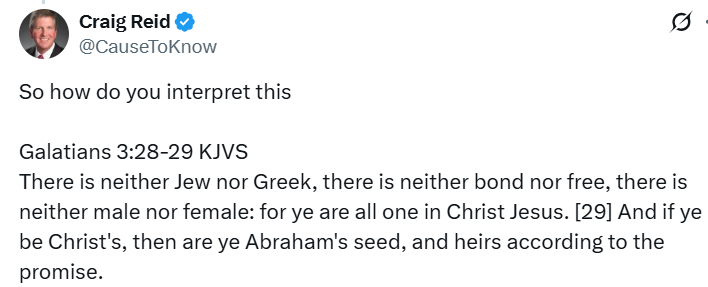
We're not predestined to faith but to be 1) adopted as children of God and 2) heirs to the kingdom of God (...when Christ returns)
These are promises to Abraham and his seed. “If ye be Christ's, then are ye Abraham's seed, and heirs according to the promise.” (Gal 3:29)
1
4
133
Feb 13
Could use some help. Any idea why only one person’s replies show up in my notifications when there are two people replying on the thread at various times? Thanks
1
1
124
Jan 30
Predestination vs Free Will
Adam and Eve were created holy and without sin. They would’ve lived forever in perfect communion with God had they never sinned. Further, they would’ve had sinless children. And without sin, generation after generation of their descendants would’ve been born righteous and had everlasting life.
That was God’s will—that all men and women would be born righteous and live forever with him. However, as we know, Satan beguiled Eve, and after she ate of the fruit, Adam ate of it also. And sin and death entered into the world (Romans 5:12).
Here’s the important question: Are we to believe that before sin entered into the world, God wanted all men and women to be saved, but then after sin entered into the world, God wanted only certain men and women to be saved? Of course not! “For I am the LORD, I change not” (Malachi 3:6). God’s will is no different now than it was before sin entered the world. That’s why Paul states in 1 Timothy 2:4, God would have “all men to be saved, and to come unto the knowledge of the truth.”
3
1
3
231
4 Dec 2025
Consider this: The first part of the 70th week of Daniel will not be a period of tribulation. Antichrist will be in covenant with Israel, and Israel will be in relative peace - making their daily sacrifices and worshipping God in a (future) temple. Only when Antichrist breaks the covenant will tribulation come ...and great that tribulation will be.
1
1
3
234
30 Dec 2025
Taking this a step further...
- Daniel 9:27 says antichrist will break the 7-year covenant in the middle (midst) of the week.
- Rev 13:5 says he will be given 42 months of power.
If antichrist breaks the covenant in the middle of the week and will have power to make war with the saints for 42 months, why should we believe that there will be persecution/tribulation during the first half of the 7-year covenant?
Is there a verse (or verses) that teachers rely on when they teach that the entire 7-year period will be tribulation?
1
1
141