
living in China | cosmopolitan patriot | progressive traditionalist | secular spiritualist | Harvard | investment banker | geopolitics analyst | China voice
Joined October 2016
- Tweets 2,305
- Following 423
- Followers 12,944
- Likes 23
1,223 Photos and videos












Pinned Tweet

May 11
Dear readers: this is my latest platform for publishing Chinese articles. Readers who follow China-related news, please follow me. "tuzhuxi新平台" , at wechat.
3
16
2,827
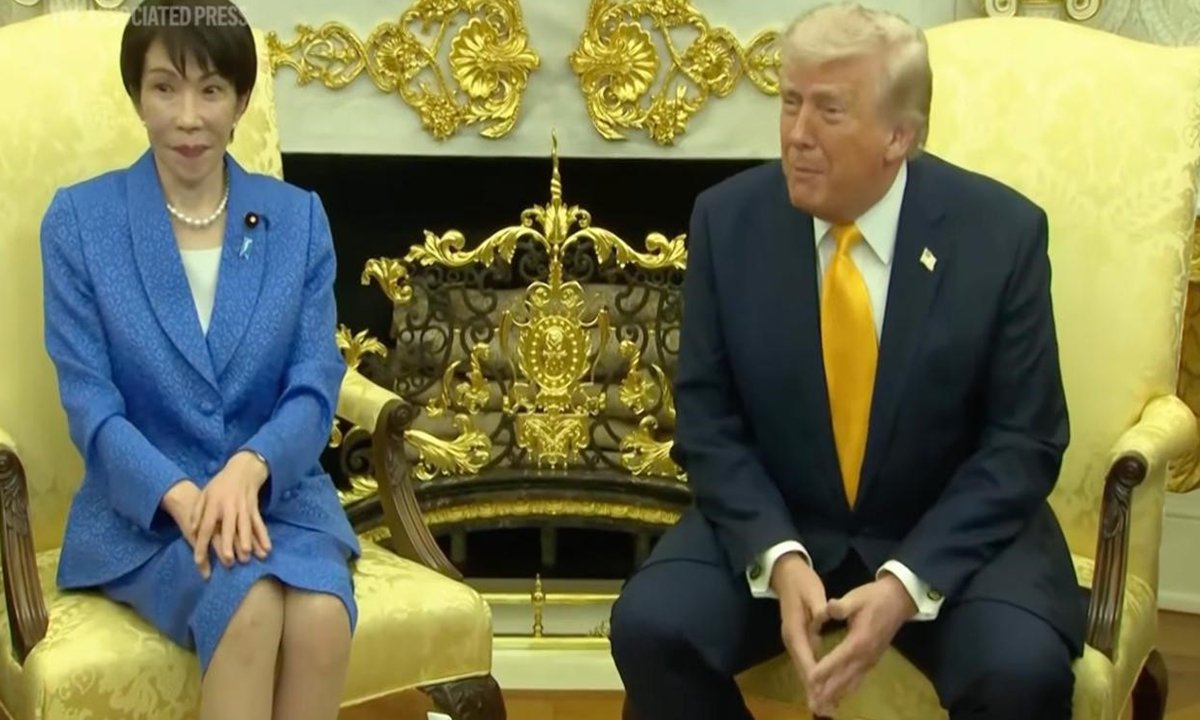
People with experiences can immediately tell, from body language, that if a man and a woman have intimate relations before - through their interaction at very subtle level. and this is a classic sample.

3
1,980
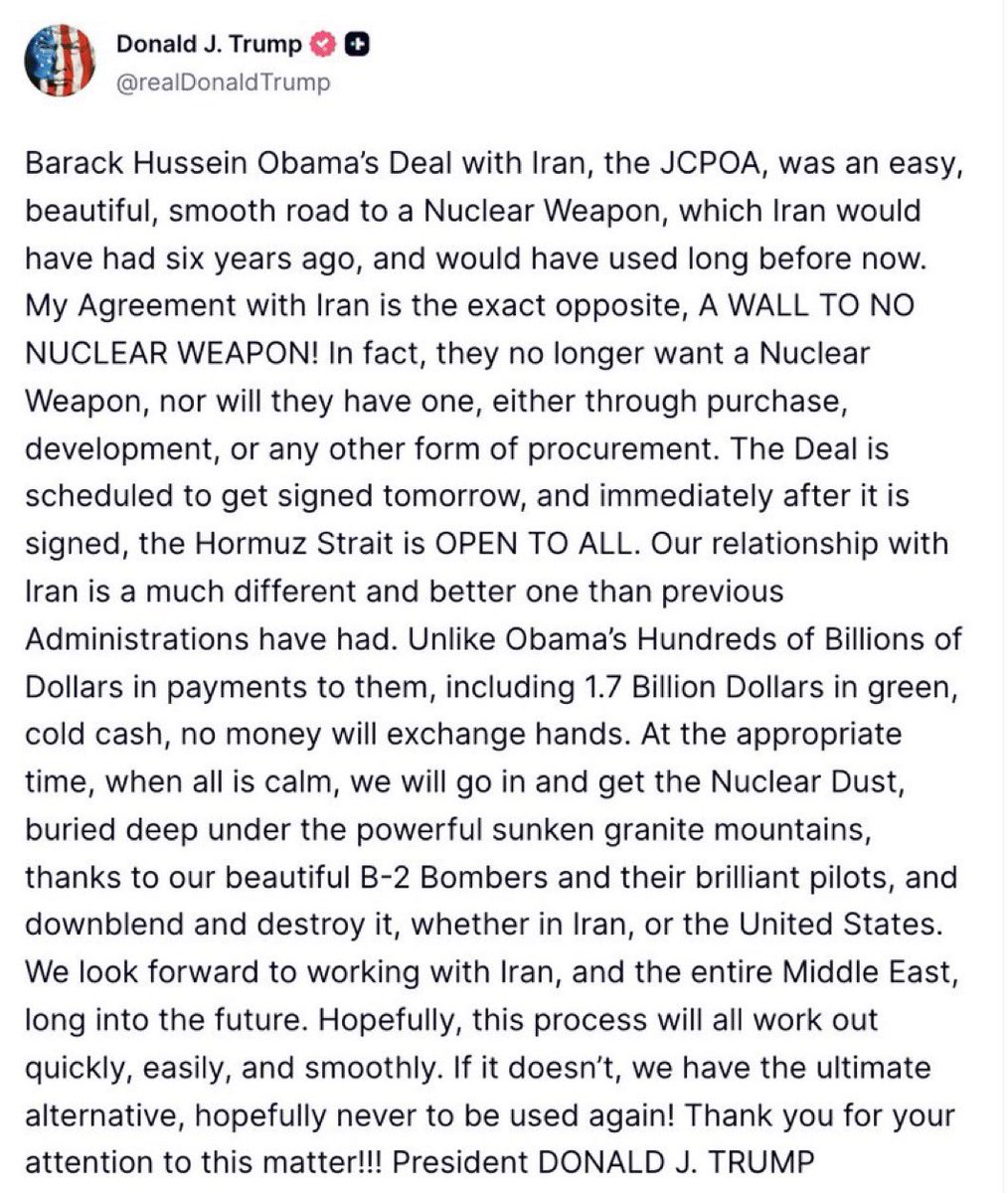
Trump is pressuring Iran, but mostly addressing domestic audience. But this doest work with the Persians. It will only backfire. You never rush into deals.
Jun 13

No approval yet from Iran, but Trump claims deal to be signed tomorrow, and threatens Iran with nuclear annihilation if talks don’t lead to desired results.
4
812
Jun 12
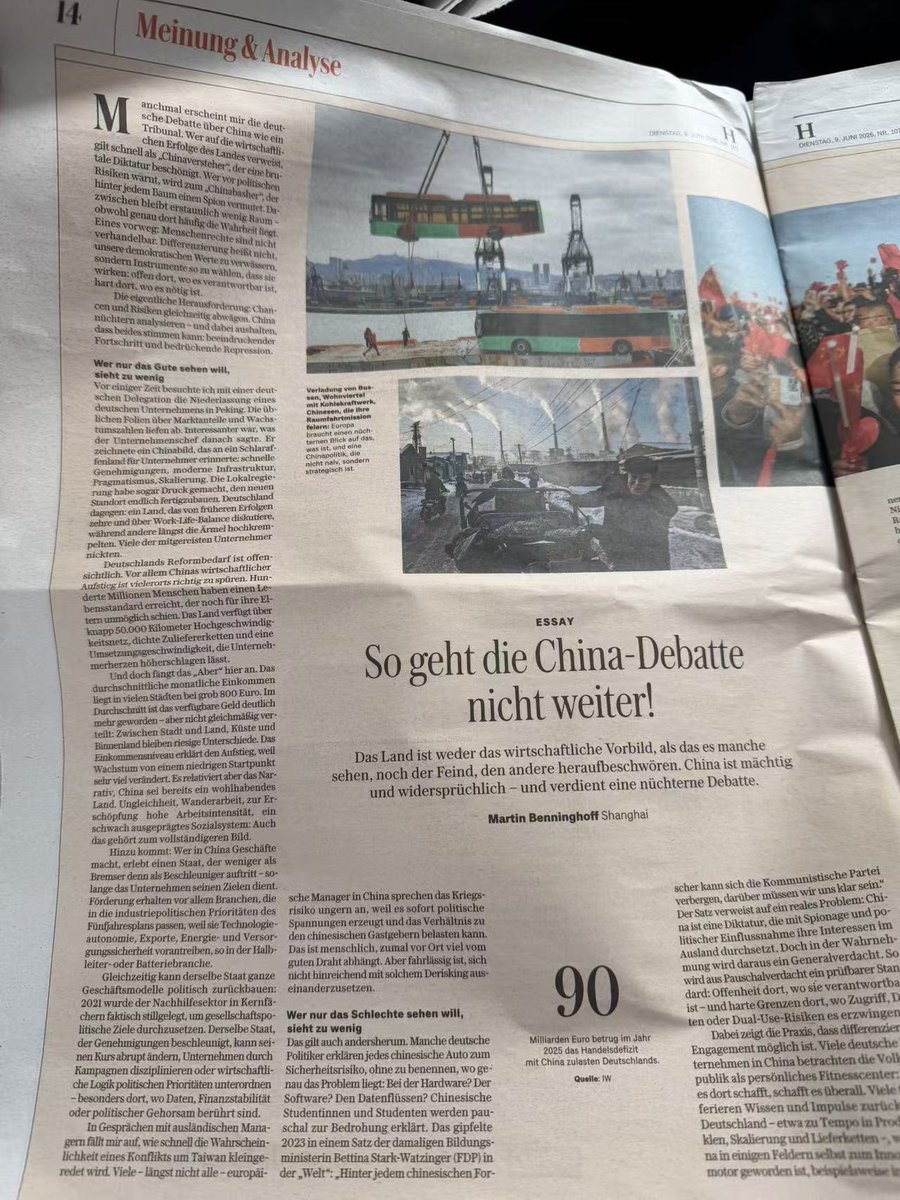
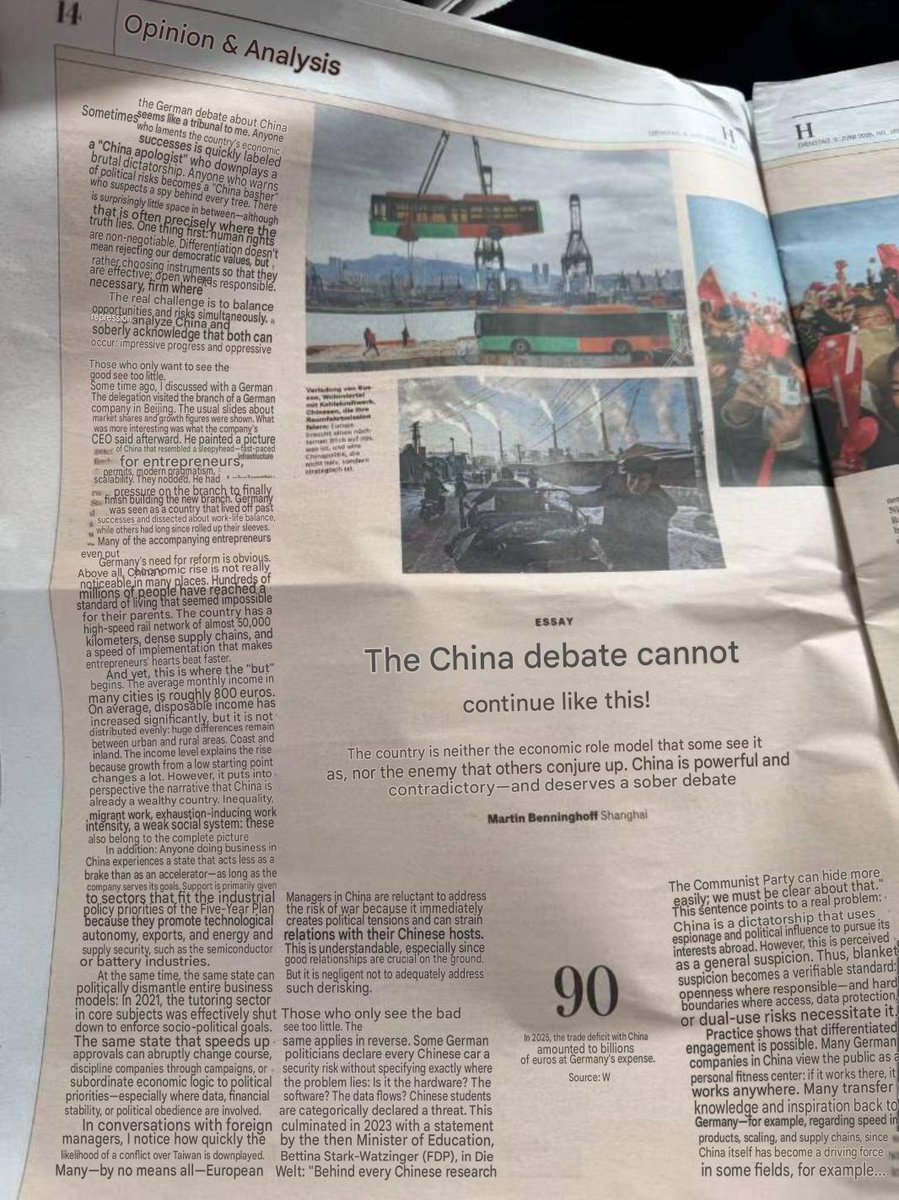
Perhaps this German journalist tailored his writing to align with the sharply critical stance of Germany’s media toward China, too critical indeed,resulting in an article rife with rpolitical accusations against China.
In fact , he is repeating all these anti-China political propaganda himself. And this matters because he is sitting in China, so people are supposed to believe he is fair.
To be honesty I’m a bit shocked to see this negative. It really has been a while since the last time I come across content and rhetoric like this in Bloomberg, The Wall Street Journal or the Financial Times. Not even The Economist.
So good luck Germany.
Jun 10

This is extraordinarily rare.
In fact, according to a key figure in the German business community (who is a dear friend of mine), it's unprecedented.
An op-ed, two pages, centerpiece, in Germany’s most important economic newspaper (the Handelsblatt) that begs the German establishment to stop looking at China via the prism of propaganda. And it's by their Shanghai bureau chief - not some outside contributor.
The title is "The China debate cannot continue like this!" and the article makes the case that it's suicidal, from a German and European standpoint, to keep reducing China to false caricatures rather than facts.
In effect it's rubbish in, rubbish out: if you tell people lies about China - whichever direction they go (anti or pro) - then obviously the policies that come out will be rubbish, designed for a mirage of a country that exists only in people's imagination.
Needless to say, this is absolutely music to my ears because it's literally the main point I've been making in my advocacy around China for now almost 10 years. Some are finally seeing the light...
I also believe, as I argued in my article "Are Western media turning China-friendly?" last year (arnaudbertrand.substack.com/…) that this type of coverage was bound to happen, and there will be more and more of it.
Why? For a very simple structural reason: China is now too powerful to coerce. The West, and Europe in particular, just don't have the leverage anymore. Which means that if you tell China to do something and they don't want to, they just won't do it. Period.
In this situation, incapable of coercing, your only remaining choice is... convincing. And what do you need if you want to convince someone? Well, you need to understand them: understand how they think, how they behave, what drives them, what they actually want.
In other words: the moment coercion stops being an option, not only does propaganda stop being useful, it begins to be actively harmful as genuine understand becomes a strategic necessity. Reality is finally becoming profitable again.
Which means, if you're a journalist reading this and you're peddling some of your usual lies, describing China as some sort of cartoonish dictatorial dystopia that's simultaneously on the verge of collapse yet a "threat" to the whole world (in short, if you write on China for The Economist or the FT), be on notice: the real threat to your country isn't China. It's you.
1
2
42
11,489
Well, now is the time to visit DPRK.
Jun 8

Smartphones, EVs and brick-oven pizza. North Korea is the world’s most unlikely economic growth story. on.wsj.com/49MdyZO
3
1,117
Why do these people, who spare no resources to fuel the explosive growth of silicon-based civilization, still care about carbon-based life?

Humanity is disappearing 😔 wsj.com/health/wellness/us-f…
2
1
6
1,074
Commentary: As a tech revolution, AI possesses an unprecedented feature - it will destroy or replace a vast number of other industries. Meanwhile, the substitution of human labor by AI, or its relegation to the lower end of the production value chain, will also exert long-term negative impacts on the labor market and the economy. The expansion of silicon-based demand results in the compression of carbon-based demand.
Now, investors already find it challenging to assess AI’s impact across various sectors, and witnessing the frenzied surge in AI and chip stocks only fuels further pursuit. This leads to an excessive concentration of liquidity and valuations in the AI-chip sector, creating a peculiar market phenomenon where AI overwhelmingly dominates. This anomaly is not confined to the United States but will also spill over to other countries and regions, e.g. East Asia.
Ultimately, the result is a significant amplification of both the AI investment bubble and the subsequent risk of market correction.
Fears of rising interest rates collided with worries about artificial-intelligence spending on Wall Street, bringing an abrupt and painful end to weeks of gains wsj.com/finance/stocks/carna… via @WSJ
1
4
824
This article is extraordinary, and greatly deepens our understanding of present-day and future Iran. A must read.

“The war’s initial aim—to deliver a death blow to the Islamic Republic—has proved unattainable,” write Narges Bajoghli and @vali_nasr. “Rather than breaking Iran, the crucible of war has transformed it in unanticipated ways.”
foreignaffairs.com/iran/iran…
9
2,233
Totally wrong. China is a socialist country with this as its fundamental political system. Ultimately, the excess value generated by tech enterprises and tech capital will be redistributed by the government to all people in an equitable manner. Institutionally, China has laid solid groundwork for the future AI-driven economy. Widening wealth disparity stemming from technological advancement is largely an American predicament inherent to the United States’ unique ideology and politics.
In the end, we will have tech-socialism in China in one hand, and tech-feudalism in the US on the other hand. One is utopia , the other dystopia. One a commonwealth futuristic society, the other a world of cyber punk.
Jun 2

That could make a starkly unequal country even more so economist.com/china/2026/06/…
6
11
99
28,925
how many times The Economist has posted this article on X? 20 times ? 30 times ? why ?
Jun 1
Xi Jinping will have to choose carefully when it comes to handling of his right-hand man’s future. Aides and advisers can easily be replaced. Trust cannot. Want our take on it? Read on by registering for free economist.com/china/2026/04/…
6
1,676
Naturally. With Monday just around the corner, he’s bound to release good news. He’s pulled this same trick for how many times alteady ?
Jun 1

BREAKING: US president Donald Trump has released a new statement on the situation with Iran, claiming Tehran “really wants to make a deal” and that whatever deal is reached will “be a good one for the U.S.A. and those that are with us”.
🔴LIVE updates: aje.news/rwlju7
1
3
1,038
May 30
Sun Tzu said: "If you know yourself and your enemy, you will never be defeated in a hundred battles." If you know nothing about your rivals, you are bound to lose every competition. For China, the West’s sheer ignorance of China creates a massive information asymmetry that works overwhelmingly in China’s favor. And the level of information asymmetry is growing by the day.
May 29
This is genuinely incredible and says SO SO MUCH about the perception of China in the West.
This is the #1 news show in France, and the host - David Pujadas - asks the pundits around the table (a sample of the top media figures in France) if they can name 3 living Chinese people.
That's it: they just need to say the names of 3 living Chinese people, anyone. This should be extremely easy.
Yet not of a single one of them can name a single Chinese beyond Xi Jinping. They do not know a single living Chinese person beyond the president.
That's the level of ignorance of China we're dealing with in the West today, in 2026.
This is the source for the video: tf1info.fr/replay-lci/videos… Aired live yesterday 28th of May 2026.
6
7
58
5,439

May 28
Still , Mr Bessent comes across as the most innocuous member of Trump’s Cabinet.

.@SecScottBessent destroys the @washingtonpost in the White House briefing room:
"Who here is from the Post? Yeah, terribly written, terribly edited."
"Basically what it says is that Treasury is following the law?"
1
1
1
833
May 28
Everything he lost in the Iran war, he will recoup elsewhere.

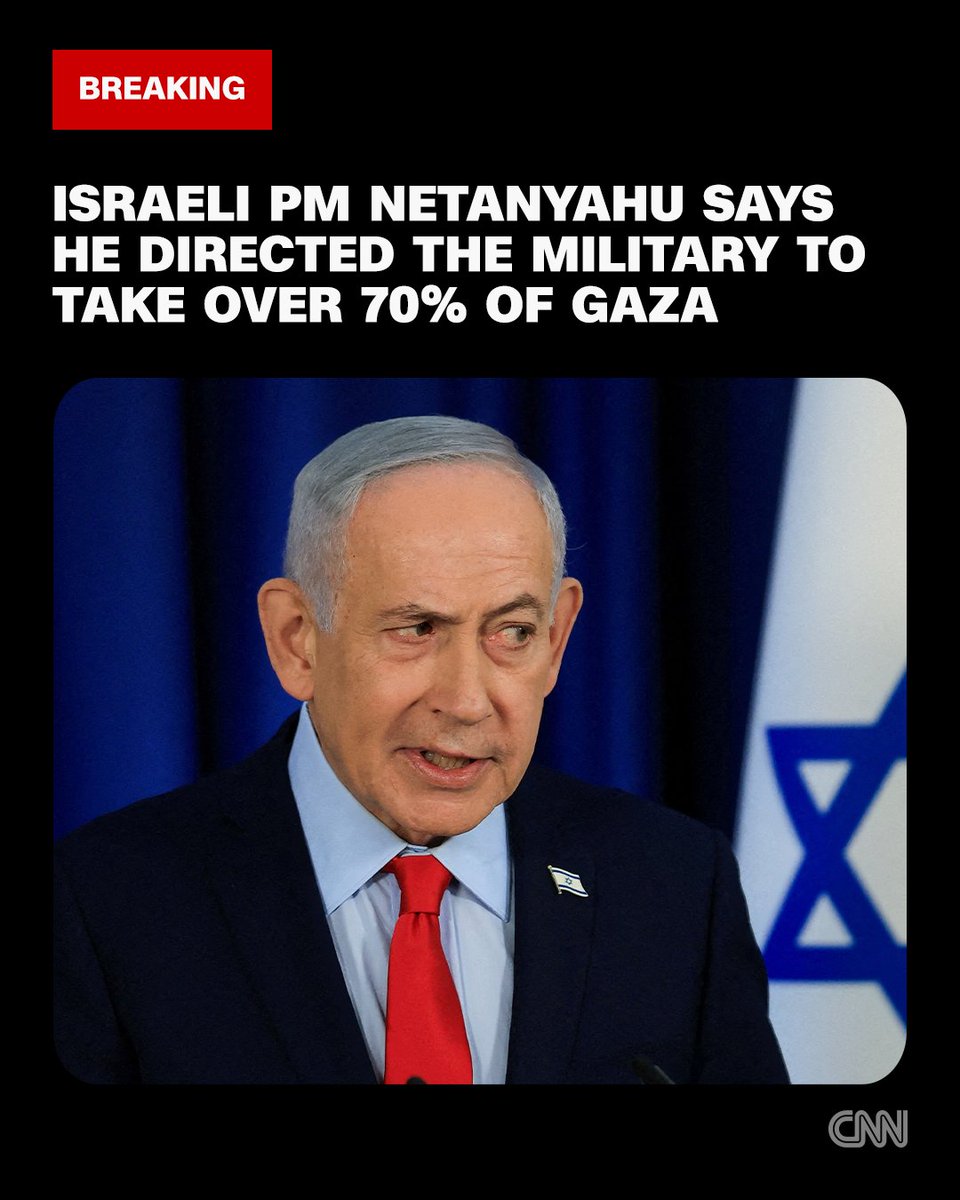
Israeli Prime Minister Netanyahu says he has directed the military to take over 70% of Gaza, adding that it's "tightening" its grip on Hamas cnn.it/4vcLFCa
1
2
631
May 28
Some are genuine critics, but a large portion of these so-called commentators are neoconservatives and the Israel lobby. They hope to pressure Trump in this way into abandoning peace and restarting the war.
May 28

Donald Trump is frustrated with his inability to get Iran to capitulate—and angry at commentators who say the stalemate makes him look weak, @JonLemire and @nancyayoussef report: theatlantic.com/national-sec…
2
3
9
876
May 28
JD Vance is the biggest casualty of the Iran war. Buried alongside him is the MAGA coalition.
1
23
1,122
May 28
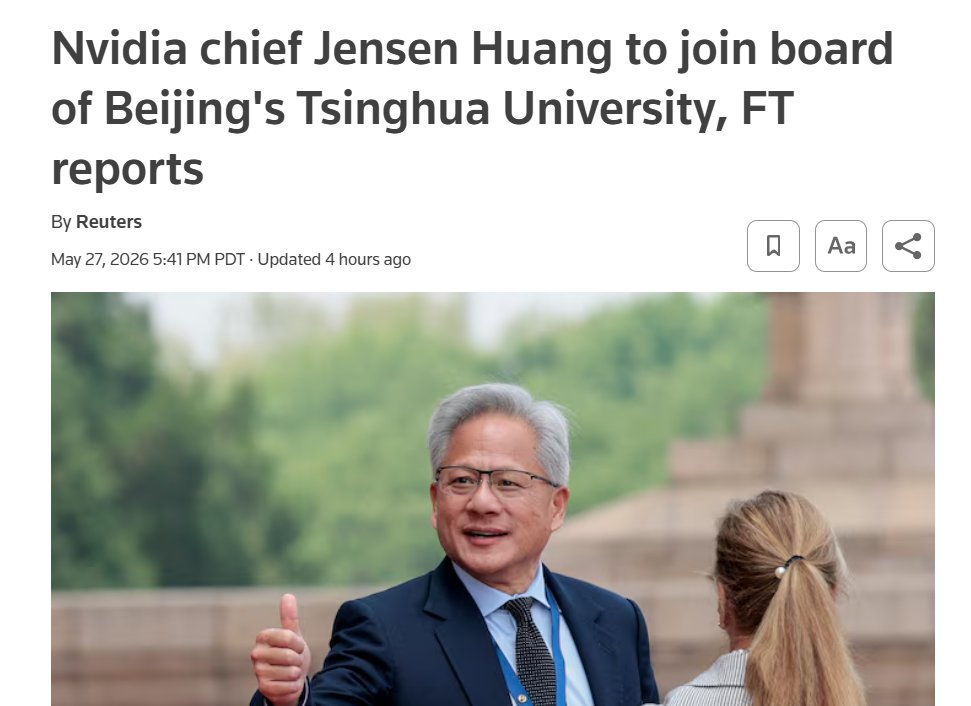
Jensen Huang feels his ever at home in China,because, guess what - he's (ethnically) Chinese. Digest this information.

1
4
1,125
May 28
Unfortunately, average American voters today won’t buy any of this. For one thing, they distrust all professors and intellectual elites, as well as and in particular elite univerisities like Harvard. For another, they cannot bring themselves to trust an interview framed in such a setting: an ethnic Chinese conducting the interview, with another Chinese intellectual being jointly interviewed. And they all know each other. The audience see all of this as a setup, and what they promote as a narrative,a propaganda myth, crafted by intellectual elites and global capital.
Here I'm not talking about whether these professors have to say are right or wrong, at all. What I want to address instead is how prevalent this line of thinking is in today’s American political landscape.
And these academics, too, live confined within their own bubbles and echo chambers.
May 28
This is absolutely fascinating: Jason Furman, one of the foremost economists in the U.S. and former chair of the Council of Economic Advisers, explains why the so-called "China shock" is a myth.
According to him, "85 to 95% of Americans benefited" from trade with China, and "China has been part of helping [the US economy] work, not hurting it work."
In other words, the narrative that China "stole" American jobs and wages is the exact opposite of reality.
Furman's logic is pretty ironclad:
1) He points out, which is factual, that "the slowdown of wage growth and the rise of inequality began in the 1970s, when there basically was no trade with China." It then accelerated in the 1980s-90s when China trade was small, and **slowed down** after 2000. And "since about 2013," when trade with China was at its highest, "we've had pretty fast real wage growth," with "the fastest real wage growth for moderate income households."
In other words, the timing doesn't fit: if China was the cause, the problem should have gotten worse as trade with China increased. Instead, it got better.
2) A common narrative one hears about China is "who cares about affordable goods, we need well-paying jobs." But Furman points out it's actually one and the same thing: "the way we measure jobs is how much your wages can buy. If you improve purchasing power, you are making every single job in the economy better."
In very concrete terms, if salaries stay flat but Chinese imports make goods 10% cheaper, your purchasing power just went up 10%, as if you got a 10% wage hike. This makes every single job in the economy better.
In effect "jobs vs. cheap goods" is a false dichotomy: cheap goods ARE better jobs.
3) Furman also points out, rightly, that the majority of what U.S. imports from China isn't consumer goods: "more than half of what we import is actually inputs into the manufacturing process itself."
In other words, Chinese imports make U.S. manufacturing MORE competitive as it decreases their input costs. If you were to cut all Chinese imports, you'd cripple U.S. manufacturing as it would no longer be able to compete on price with anyone. And, as per point 2 above, you'd also destroy Americans' purchasing power, making every single U.S. worker worse off.
4) Last but not least, Furman says that the "China shock" literature is fundamentally flawed, as it "doesn't answer the most important question, which is what the net effect was." It "doesn't consider other causes for the job losses, doesn't look at all the places that gained jobs and wages, and doesn't integrate the consumer side."
All in all, he believes that if one were to actually calculate the net effect of trade with China on the U.S. economy, it'd show that "85 to 95% of Americans benefited." And even for the 5-15% who lost out, Furman says these people were failed by "our labor policies, our social safety net" - not by China.
What Furman is saying is more relevant than ever because, both in the U.S. and in Europe, this notion that China is somehow "stealing" Western jobs and prosperity has become the unquestioned premise of so many of today's policies.
Nobody even debates it anymore, it's almost universally assumed correct.
In my own country France, Macron keeps repeating it all the time, leading the charge in Europe to slap tariffs on Chinese imports, warning that China is "killing its own customers" and that it's a question of life or death for European industry (reuters.com/world/china/fran…). He literally called last week for the EU to build its own version of America's Section 301 - the same protectionist tool Trump uses (politico.eu/article/emmanuel…).
BUT, if Furman is right, and the data strongly suggests he is, France and Europe are about to inflict economic self-harm in the name of a problem that doesn't exist.
Much more affordable cars, for instance, would literally give every single European a big wage hike. It's Furman's argument on "85 to 95% benefiting" vs 5% to 15% losing out: the vast majority of Europeans would see their money go further, while a small number of jobs in legacy automakers would be disrupted. Instead of helping those workers transition, Europe wants to prevent making everyone better off.
Anyhow, please do watch the whole podcast, which has many other fascinating insights because Furman also debates with Justin Yifu Lin, the former Chief Economist of the World Bank and State Council Counsellor of China.
They're both interviewed by my friend @Hansong_Li - also a professor and an immensely smart man - in his excellent new podcast "worldviews" (imho one of the best new podcasts our there). The video is here: youtube.com/watch?v=TAj2FBbc…
3
2
25
8,363
May 28
Hong Kong is PART OF China and functions as China's own offshore financial center. Its purpose is to give foreign / global more options and flexibilities in investing in China , where capital control is still in place for broader reasons.
May 28
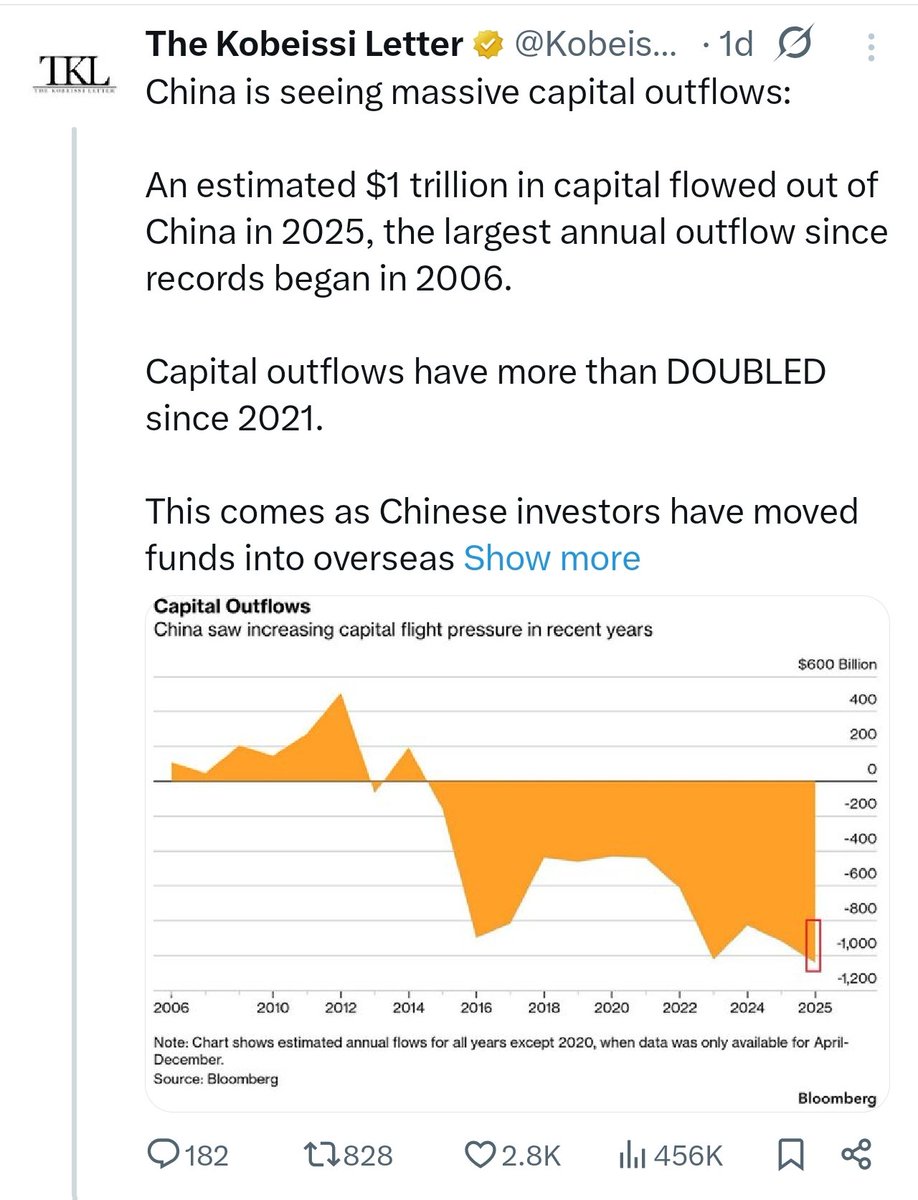
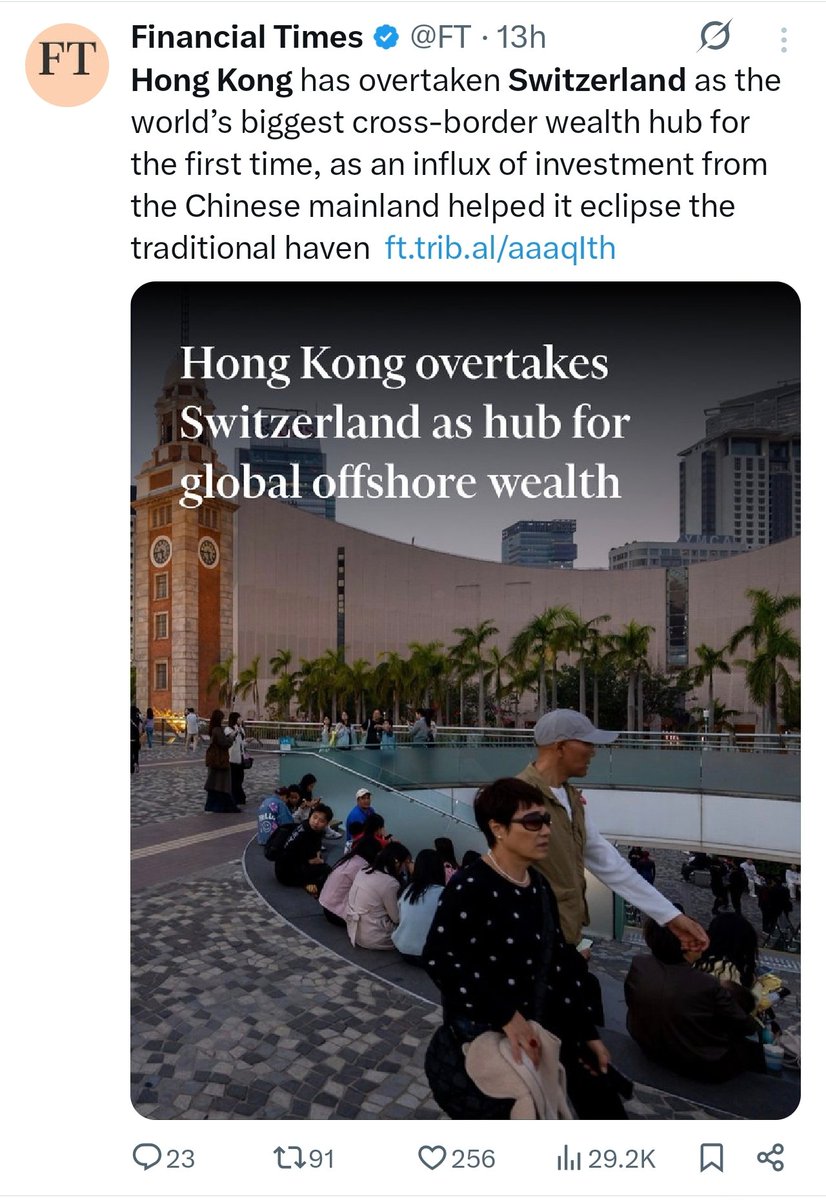
This is quite funny. There were these two stories over the past 24 hours:
1) "China is seeing massive capital outflows"
2) "Hong Kong overtakes Switzerland as hub for global offshore wealth"
But it's actually one and the same story: China is seeing massive capital outflows BUT this capital largely lands in bank and brokerage accounts in... China, in Hong Kong.
It's actually the whole point of Hong Kong: it is China's own offshore center with a separate legal system, free capital flows, low taxes, and convertible currency.
So even when capital "leaves" China, most of it lands in China 🤷♂️
10
87
14,057