
Joined May 2009
- Tweets 46,807
- Following 1,266
- Followers 404,920
- Likes 152,521
3,877 Photos and videos




Pinned Tweet
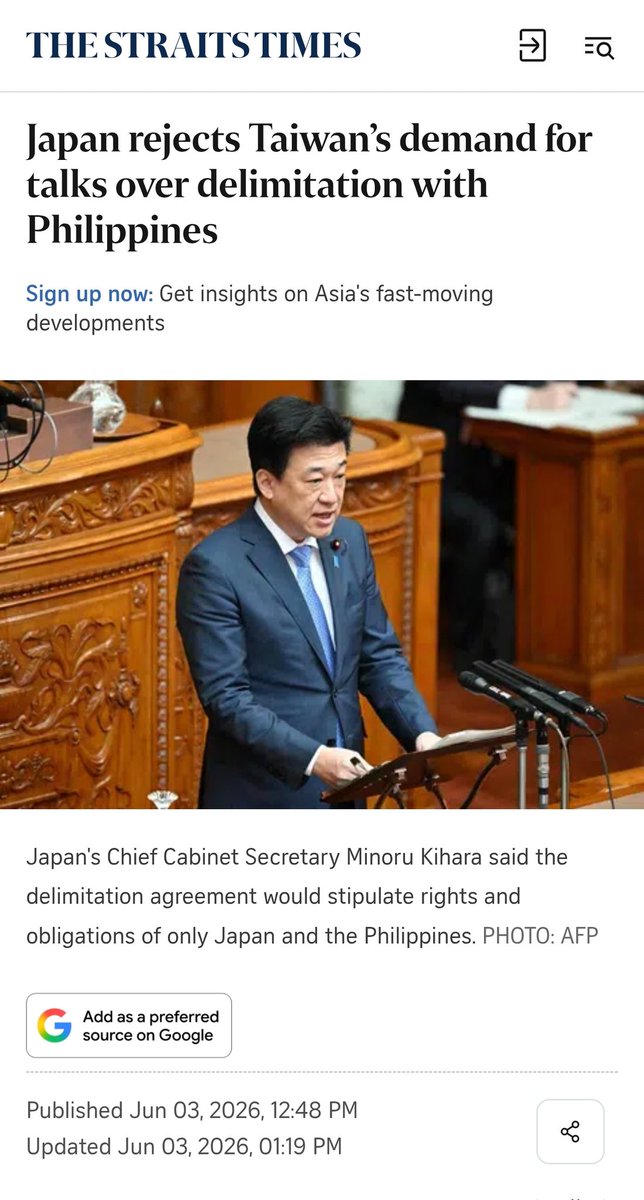
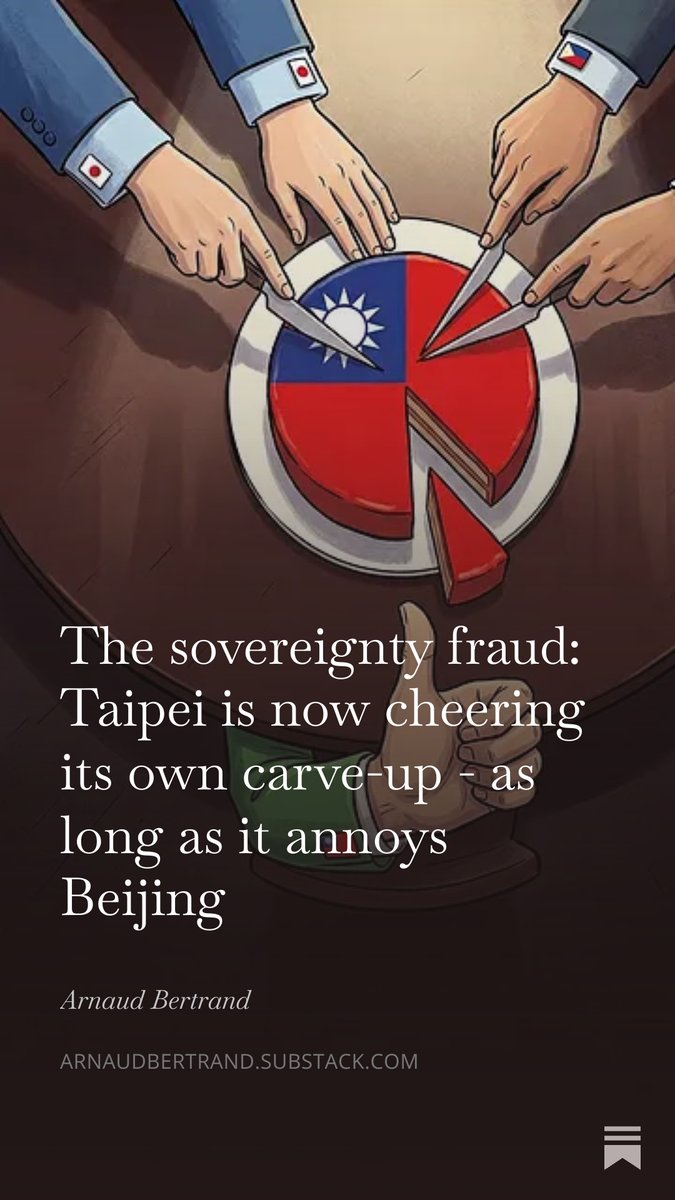
If you understand this story, you’ve understood much there is to understand about geopolitics around Taiwan.
The current DPP government is quite literally cheering its own carve-up - as long as it annoys Beijing.
Here is what happened.
So recently, May 28th, Japanese PM Takaichi and Philippines President Marcos Jr. issued a joint statement (mofa.go.jp/files/101035755.p…) announcing they would open negotiations to delimit their overlapping EEZ and continental-shelf boundaries.
As a reminder, an EEZ - Exclusive Economic Zone - is the area extending 200 nautical miles from a country's coastline within which that country has exclusive rights to exploit all natural resources.
Small problem: their EEZs directly overlap with China's, both from Beijing’s standpoint and Taipei’s, as they are less than 200 nautical miles from Taiwan’s coastline.
In effect, what Japan and the Philippines are announcing here is that they're agreeing bilaterally - without Beijing or Taipei at the table - to split between themselves waters that belong, in part, to someone else.
Unsurprisingly, that didn't sit well with Beijing. They issued a statement the day after - 29th of May - where they "strongly deplore and firmly oppose the so-called maritime delimitation talks between Japan and the Philippines" (english.news.cn/20260529/bf5…).
Any rational person would have expected Taipei to issue a similar statement because, whatever you think of Beijing's claims, it's the EEZ around Taiwan we're speaking about here: surely they'd object to other countries carving up the resource rights off their coastline.
It's actually one thing Beijing and Taipei have aligned interests on: neither wants its maritime entitlements carved up by third parties.
As a reminder Taipei rejected the infamous 2016 Hague arbitration ruling on the South China Sea - siding with Beijing against Manila - for the same reasons: because the tribunal downgraded Taiping (Itu Aba), the largest feature in the Spratlys that Taipei occupies, from an “island” to a “rock,” which would have stripped it of its 200-nautical-mile EEZ.
In other words, defending their own EEZ is normally sacrosanct for Taipei.
Except... not this time. Taipei issued an angry statement, yes, but where the anger was entirely directed at Beijing. The statement (en.mofa.gov.tw/News_Content.…) explicitly “commend[ed] Japan and the Philippines for working to resolve maritime differences”, reserving its sharp language to China because it "has no right to comment on the territory and appertaining waters of the Republic of China (Taiwan)."
Think for a moment about what it says about Taipei’s current DPP independentist government: the party that claims to champion Taiwan's sovereignty literally celebrated, as its first instinct, two countries announcing they'd carve up Taiwan's maritime territory between themselves. All because Beijing opposed it.
This caused quite a stir in Taiwanese politics, with the KMT calling the statement “humiliating,” warning that cheering the talks without seeking a seat in negotiations over the overlapping EEZs could seriously hurt Taiwanese fishermen's livelihoods in the future (focustaiwan.tw/politics/2026…).
So much so that Taipei’s MOFA had to issue a new statement on June 2 specifying that the Japan-Philippines talks "should not impair our country's rights", with MOFA spokesperson Hsiao Kuang-wei finally acknowledging the delimitation waters “highly overlap” with Taipei's EEZ.
But then, confusingly, 2 days after - June 4 - Foreign Minister Lin Chia-lung undercut his own ministry’s correction entirely (cna.com.tw/news/aipl/2026060…). The Japan-Philippines talks, he explained, are “aimed at China” and therefore, fundamentally good - Taipei's EEZ being carved up in the process being, apparently, a minor detail.
China protesting the talks, he said, is “getting cause and effect backwards” and he branded “the handful distorting the issue and shifting the focus” - i.e. anyone pointing out that Taiwan's EEZ is being carved up - as “falling into a trap and letting China benefit.”
So the same ministry, within 48 hours, both (a) asked Tokyo and Manila to guard against a danger to Taiwan's EEZ, and (b) declared that danger nonexistent and smeared anyone naming it as a Beijing stooge. Go figure 🤷
But this is actually just one part of a much bigger story - one about colonial nostalgia, about the three competing visions at play for Taiwan, and about why the West champions the one party in Taiwan that does NOT actually defend sovereignty and democracy.
I wrote it all up here: open.substack.com/pub/arnaud…
77
338
1,593
138,241
Arnaud Bertrand retweeted

13h
I have fought the neocons and warmongers in Washington for more than 25 years. Throughout, they have tried to silence, discredit, slander, and cancel me. Only recently, however, have they tried to deport me.
At least, that appears to have been the aim of a hit piece in Bari Weiss’s The Free Press, which claimed that Marco Rubio’s State Department was “investigating” me for allegedly seeking to “undermine the U.S.”—presumably because of my opposition to war with Iran.
Yet just hours later, the State Department issued a statement to reporters clarifying that “the State Department has no plans to revoke the green card of Mr. Parsi at this time.” Nor did it provide any confirmation for the central premise of the Free Press story—that an investigation of me existed in the first place.
So here’s what I think happened.
Read the full piece on my Substack: tritaparsi.substack.com/p/so…

412
2,002
7,103
507,446
Arnaud Bertrand retweeted

I Have a Dream. That One Day,
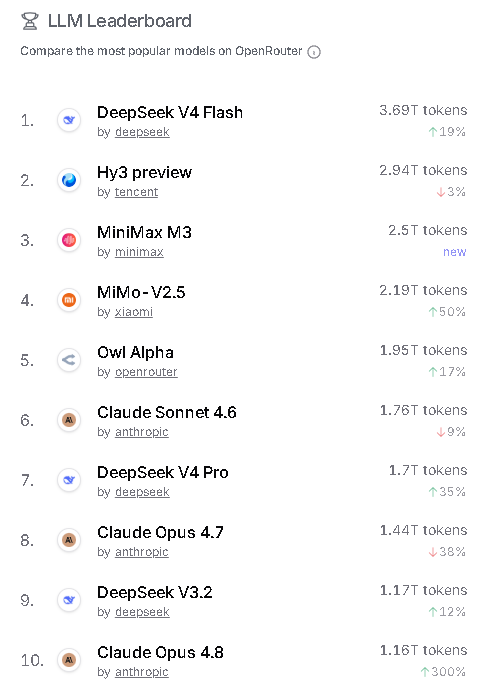
the world’s most advanced intelligence — whether it’s called GPT, Fable, DeepSeek, or something else
Just Does Not Matter~
— will be just like electricity and water supplt today.
Cheap. Stable. High‑quality.
It will power all kinds of AI software, the way electricity powers all of akindsppliances.
We’re still living in the era when the light bulb was just invented. There will be countless AI applications in the future.
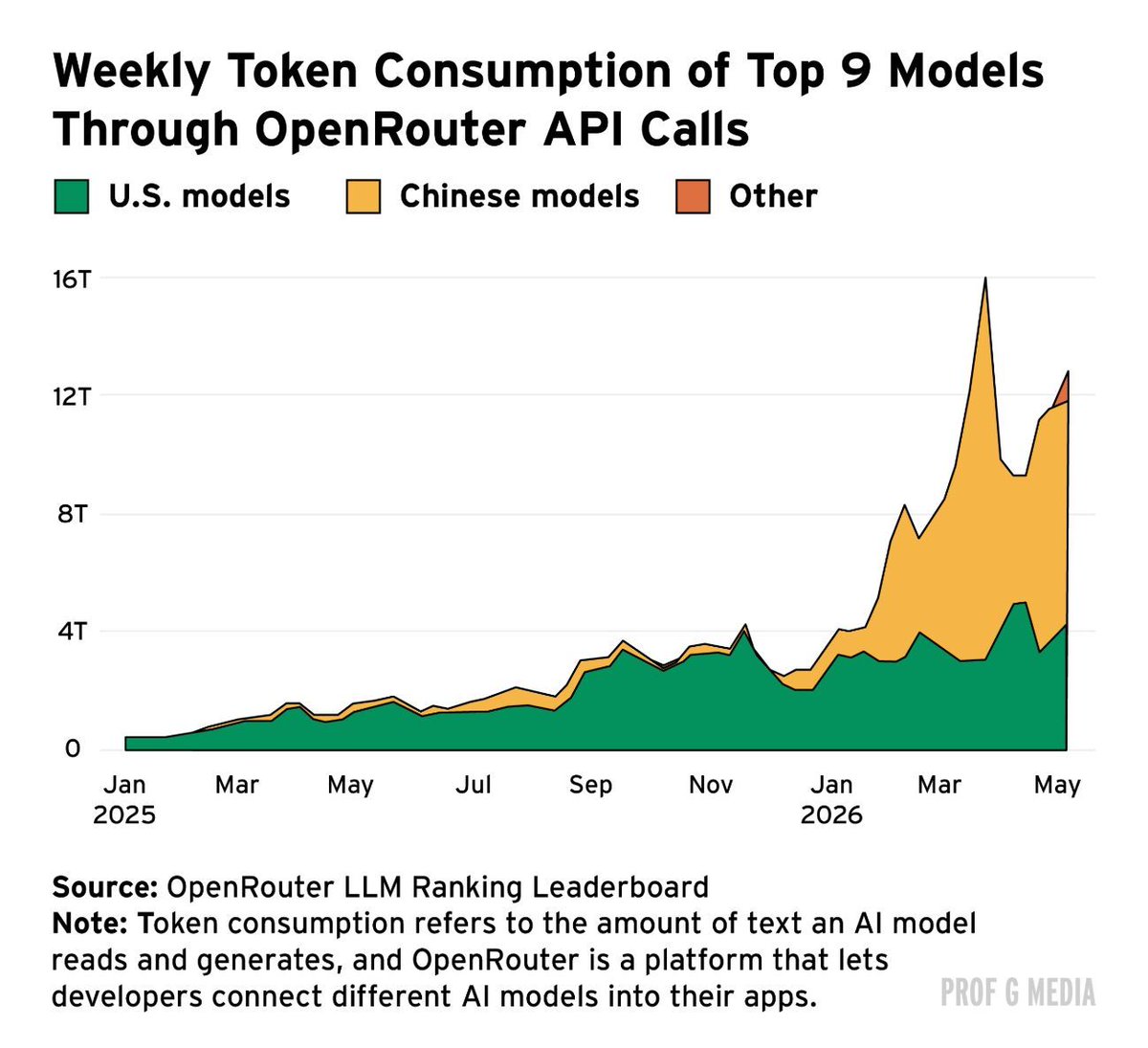
That’s why token production and token transportation — as the underlying infrastructure — will be the most important infrastructure build of the next 10 to 30 years.
This is an industry‑wide upgrade. A benefit to all of society. And this is exactly why I strongly oppose closed‑source models. #AGIForEveryone
How can we let infrastructure — something as essential as water and electricity — become a luxury for the few?
How can we expect people to pay such exorbitant bills?
#路长而歧行则将至
#我心匪石不可转也
#AI #Infrastructure #OpenSource #TokenEconomy

A good business model should not turn your heaviest users into a source of loss.
This is exactly why I have always believed that a “coding plan” (usage‑based pricing) is a terrible business.
Think of a gym that only makes money because people buy memberships and then never show up.
That’s a broken logic.
A sound business model should ensure that your most core, highest‑volume users generate the largest profit – not the other way around.
#BusinessModel #StartupTruth #UsageBasedPricing #BadEconomics
48
58
501
71,086

GLM-5.2 is Fully Open, Frontier Intelligence Belongs to Everyone
Today, the sudden restriction of certain frontier models is deeply regrettable. At a time when access to frontier models is abruptly cut off for non-technical reasons, we are even more convinced of one thing: science should be global.
The path to AGI (Artificial General Intelligence) must never be enclosed by high walls. We have always believed that AGI should be the cornerstone for all of humanity to collaboratively explore the boundaries of intelligence and solve complex challenges, rather than a privilege monopolized by a few rules and subject to revocation at any moment. In the face of external blockades and restrictions, our attitude is one of radical openness. Frontier intelligence must remain open-source, accessible, and buildable, serving every dedicated developer.
GLM-5.2 is Zhipu's most capable open-source model to date. It not only supports a truly usable 1M context window but also maintains a continuous lead in the independent completion of long-horizon tasks, providing solid foundational support for building complex agent applications. It also continues to be our main engine for creating the strongest domestic coding model.
Tonight at 5:21—at this special moment—GLM-5.2 will officially be available to all GLM Coding Plan users (including Lite / Pro / Max). The API will also go live next week.
A step closer to frontier intelligence for everyone.
The future of AI is open, and it is for the people.
ModelKey: GLM-5.2
196
528
5,319
564,964

Jun 13
The worst part is him saying the strike on the elementary school in Minab (that killed 168 schoolchildren and teachers) "is a use case that doesn't even violate our red lines."

CEO of Anthropic Dario Amodei awkwardly smiles through his answer to a question about why Claude AI directly contributed to the US Military bombing of the elementary school in Minab.
120
2,209
6,235
233,177
Jun 13
Love this quote from Agathe Demarais in the article: “China is not going to change [its] entire economic model to make the French G7 presidency happy.”
All the funnier given she was appointed by Macron's own G7 presidency to chair the expert group advising it.
In other words, the lead expert appointed by Macron for the G7 says that his signature initiative for the summit is utterly moronic 😅 Tells you everything about how respected Macron is: even his own people treat his grand plans as a joke, on the record.
And she's right (kind of): Macron is trying to install the narrative that China as an export powerhouse - now that it competes directly in high-value sectors with EU firms as opposed to merely supplying them - is a "global imbalance," a structural pathology that needs correcting.
It's perfect weaponization of language: the word "imbalance" implies a natural equilibrium that China is disrupting and the "global" framing universalizes what is fundamentally a European (and maybe Western) competitiveness problem.
Macron's delusional hope was to get Xi Jinping at the summit to get lectured on this: China obviously didn't indulge him, they're not going to legitimize the premise by engaging with it at a leadership level.
They instead sent Zhang Guoqing (张国清), a vice-premier, who read a text about the importance of "adher[ing] to seeking truth from facts and objectively view[ing] the comparative advantages of various countries" (ca.china-embassy.gov.cn/lcbt…). A diplomatic way of saying "we're not the problem, you're just falling behind."
Jun 12

French President Emmanuel Macron wants the G7 summit to tackle a flood of subsidized Chinese exports disrupting global markets.
But even before leaders meet, it’s clear that credible action is one deliverable he won’t be able to land.
politico.eu/article/emmanuel…
26
185
961
58,229
Jun 11
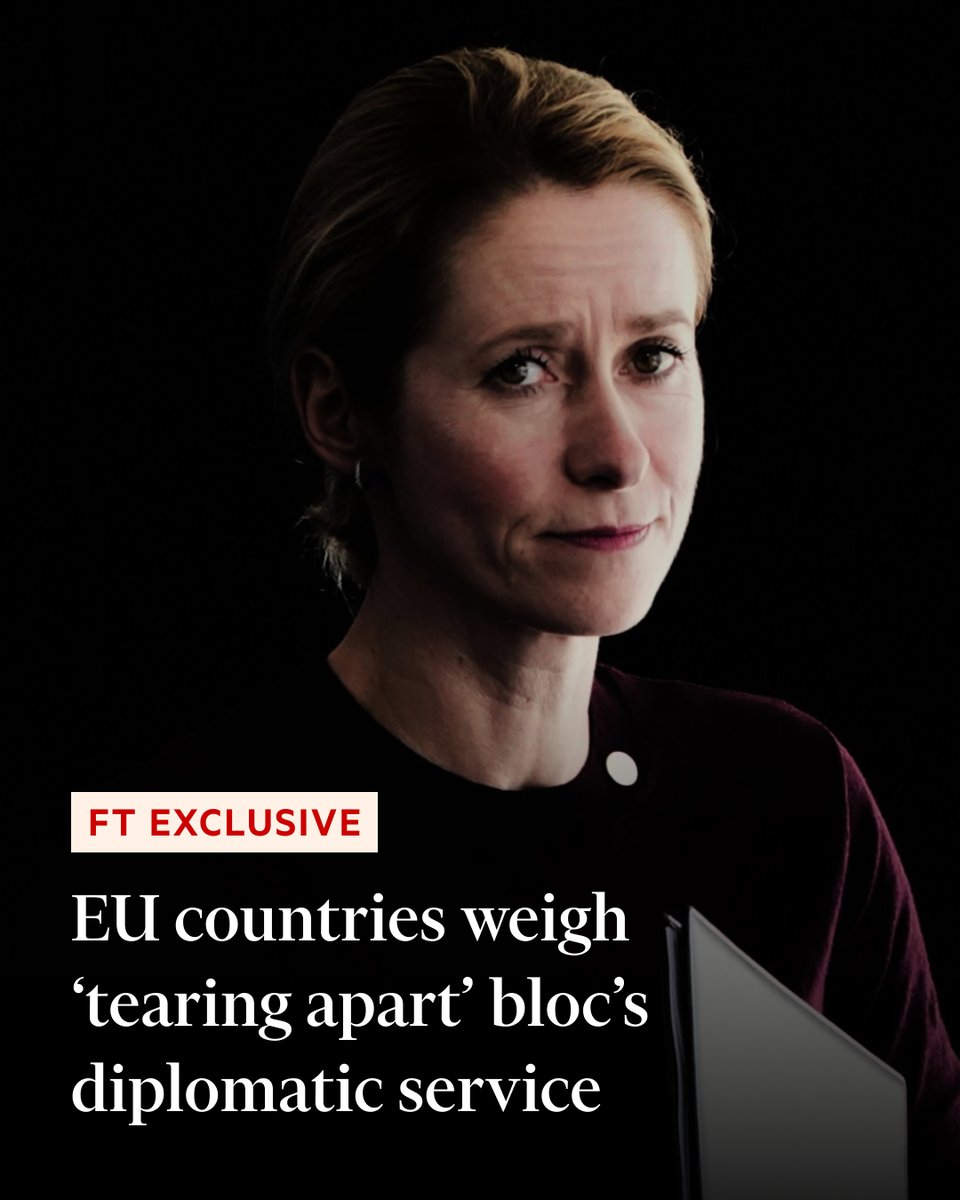
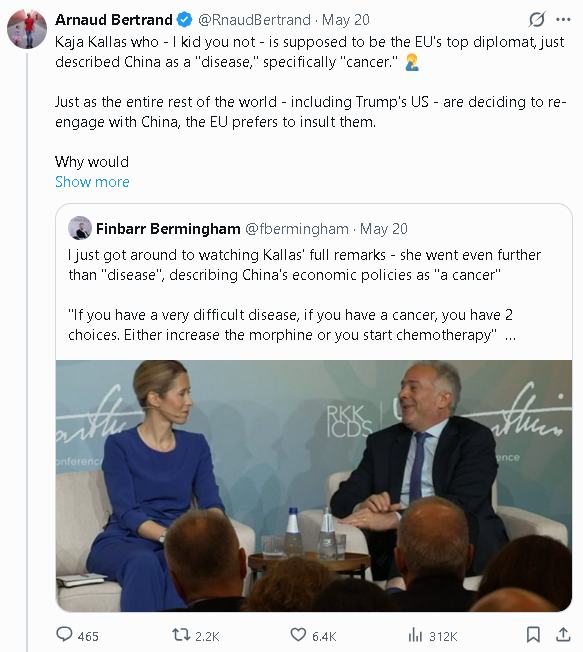
Best news of the year: Kaja Kallas' only diplomatic achievement may end up uniting Europe on the need to get rid of her, and dismantle her own office.
Jun 11

FT Exclusive: France, Germany and other European nations are discussing proposals for a radical overhaul of the EU’s 15-year-old diplomatic service, including stripping powers from the bloc’s chief diplomat. ft.trib.al/Hskd8cT
204
1,312
6,232
279,741
Jun 12
Turns out that this may have been the straw that broke the camel's back
8
18
244
12,644
Jun 12
This surely didn't help either
x.com/RnaudBertrand/status/1…
4 Sep 2025

This is extraordinarily embarrassing: x.com/peacemaket71/status/19…
Kaja Kallas, the EU Foreign Policy head, doesn't even seem to be aware that Russia and China were among the winners of WW2.
Immensely ironically, she dismisses it as "something new" and propaganda for people who "don't read or remember history that much" 🤦♂️
Not sure how she explains how Russia and China got their permanent seat at the UN Security Council 🤷♂️
9
17
219
15,545
Arnaud Bertrand retweeted

Jun 12
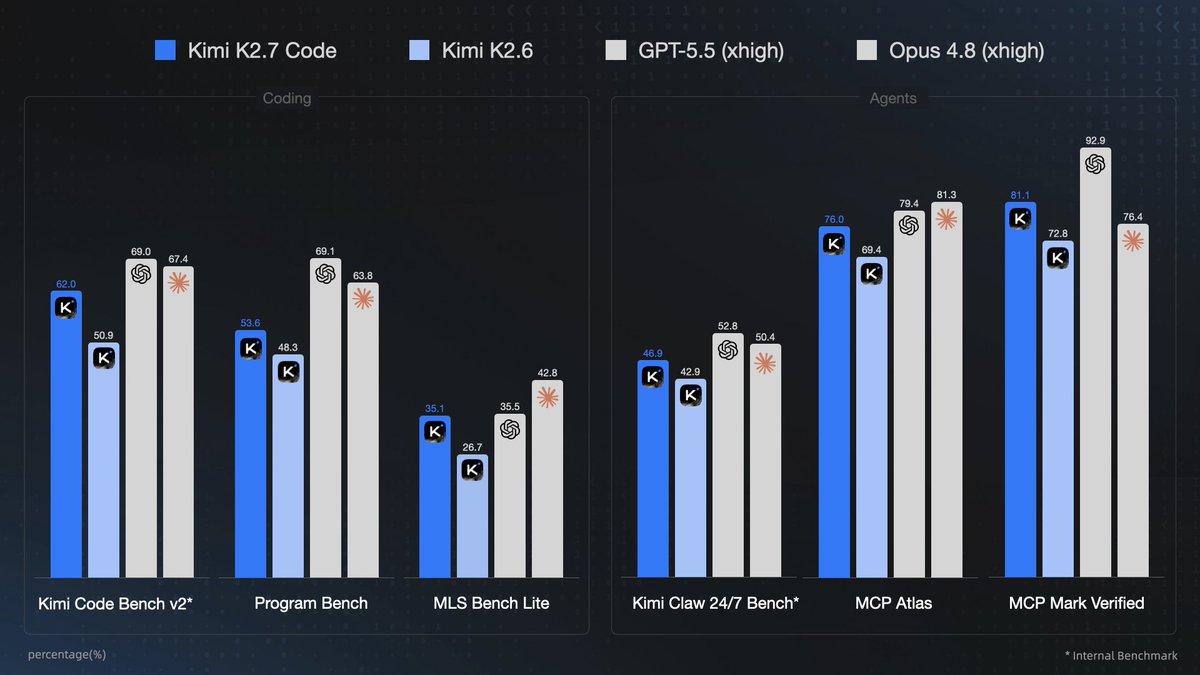
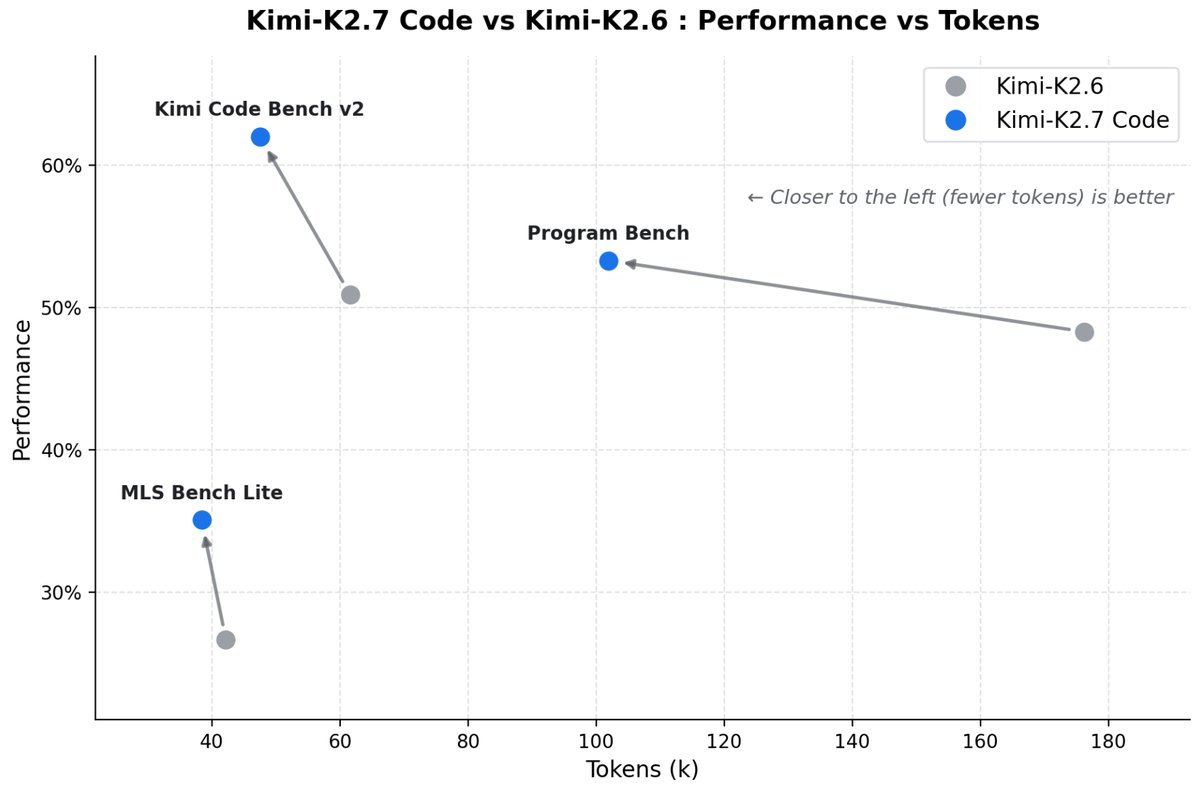
🌘 Kimi-K2.7-Code, our latest coding model, is now released and open-sourced!
🔷 Improved coding & agent performance over K2.6: 21.8% on Kimi Code Bench v2, 11.0% on Program Bench, and 31.5% on MLS Bench Lite.
🔷 Reasoning efficiency: Less overthinking, with 30% lower reasoning-token usage compared to K2.6.
🔷 Long-horizon coding: Improved instruction following, higher end-to-end coding task success rates.
⚡️ 6x High-Speed Mode coming soon!
🔌 Available today via Kimi API and Kimi Code.
🔗 Kimi Code: kimi.com/code
🔗 API: platform.moonshot.ai
579
1,567
13,107
1,805,188
Arnaud Bertrand retweeted

Jun 12
China is, in practice, one of the most decentralized countries on earth. Roughly 85% of government spending in China happens at the subnational level - against about 30% in the average OECD country۔
Jun 12
This is a really fascinating paper that everyone interested in China's industrial policy should read.
It destroys so many myths (see below), and is written by deeply credible people who conducted over three years of fieldwork in China and interviewed 60 Chinese officials, entrepreneurs, and engineers. When it comes to China studies, it literally doesn't get more rigorous than this.
First myth it destroys: contrary to popular belief, Beijing's industrial policy didn't build the companies that became China's EV champions. They rose largely **despite** it, through its cracks.
For sure, Beijing did favor EVs as an industry and pushed hard for it but their big bet was SOEs (State Owned Enterprises): research grants, pilot programs, licenses, cheap credit - virtually all of it flowed to state firms.
The result? China's actual EV champions - BYD, Geely, NIO, XPeng, Li Auto, etc. - are overwhelmingly private firms that succeeded despite Beijing favoring their SOE competitors.
How so? Because, when favoring SOEs, the central government didn't just pick winning companies, it picked winning cities, each SOE being anchored in a specific city: Shanghai (SAIC), Changchun (FAW), Wuhan-Shiyan (Dongfeng), etc.
Which means that every city not on the list, that wanted a piece of the auto boom, had only one option left: team up with private entrepreneurs who were equally excluded from central government favor.
That's what truly fueled China's EV miracle: an alliance of the excluded, between local private entrepreneurs and local mayors.
This is the biggest misconception this paper destroys: the reality is that the "Chinese state capitalism" that many in the West think powered the EV boom actually tried to block many of these companies from existing. In effect, it was closer to an obstacle course that local actors (mayors and provinces) learned to game.
Geely - now the third largest automaker in China - is a fantastic example of this.
First of all, it started off illegal since, to build passenger cars, you had to have a central government license and they couldn't get one. Zhejiang Province told them to go ahead regardless because the province had hundreds of auto parts suppliers but no carmaker of its own.
It's only a couple of years later, recognizing the fait-accompli that Geely was producing cars and was competitive, that the central government admitted them to the National Sedan Catalog - effectively legalizing them retroactively because there were facts on the ground.
Then there was the Volvo acquisition in 2010, which is fair to say - looking back - proved to be the most strategically valuable acquisition in Chinese automotive history. Despite it being presented at the time (and still described this way today) as "China buying Volvo", all 3 major state-backed banks in China (Export-Import Bank, China Development Bank, Bank of China) refused to finance the deal. The only state-bank money Geely managed to get was a $200 million loan from a provincial branch of China Construction Bank - a tiny fraction of what the deal required.
Geely actually did the deal with Goldman Sachs money via Hong Kong plus loans and equity from four local governments (Chengdu, Zhangjiakou, Daqing, Shanghai's Jiading district), each of which bought in by securing a Volvo plant or headquarters for itself.
In effect, the doors that Beijing controlled were largely closed to Geely, but it made it because the doors subnational actors controlled were opened.
Which all means this paper destroys another very common myth: the big merit of the central government in all this was to be relatively chill about it, to NOT be dictatorial.
I just imagine if that had happened in France and you had - say - the mayor of Lyon or Marseilles open, fund and promote an unlicensed carmaker against Renault: the préfet would shut it down within weeks, and the mayor would be lucky to escape prosecution.
That's the irony: on industrial policy, the supposedly "totalitarian" Chinese state proved more tolerant of local defiance than most Western liberal democracies would be. Beijing's greatest contribution to the EV miracle wasn't the plan - it was looking the other way while the plan was being violated.
To be sure, the paper doesn't hide the costs of this system: ferocious local competition also produced what's known today in China as "involution" (内卷-Neijuan, basically a hypercompetitive price war), as well as some spectacular failures. For instance one county lost 6.6 billion yuan on a carmaker that never really made cars.
But that's precisely the point: this is a high-risk, high-reward model of decentralized experimentation, the very opposite of the careful central planning Westerners imagine.
I've repeated this countless times but it bears repeating again: the single greatest misconception people have about China is - probably because we wrongly associate communism with centralized control - that it is a monolith run from Beijing. Some even say it's run by "one man."
The reality is the exact opposite: China is, in practice, one of the most decentralized countries on earth. Roughly 85% of government spending in China happens at the subnational level - against about 30% in the average OECD country (and even less in France, which is actually one of the most centrally controlled countries on earth). A Chinese mayor commands fiscal resources, land, investment funds and policy latitude that virtually no Western mayor could dream of.
Last but not least, I'd be remiss not to mention what the paper has to say on the positive legacy of Mao and its role in the rise of EVs (given I myself wrote an article titled "Mao's economic record wasn't bad, actually": arnaudbertrand.substack.com/…).
When it comes to China myths, none is more entrenched than the idea that Mao left behind nothing but ruins.
This paper confirms a key argument of my article: Mao's deliberate dispersal of industry across China (during the Great Leap Forward and Cultural Revolution decentralizations) left dozens of cities with their own small auto works. Inefficient, yes - but these scattered factories survived into the 1990s and became the seed stock of everything that followed: the industrial base, the engineers, and the production licenses that EV startups would use to enter the market.
The paper even says it outright: the fragmentation that industrial policy "sought to eradicate" is "precisely" what "ironically enabled" the EV sector's rapid rise.
This is exactly the mechanism I described in my Mao article: structures built in the Mao era - communes becoming township governments, commune enterprises becoming TVEs, Third Front factories seeding interior industrialization - became load-bearing foundations of the reform miracle.
Fittingly, the spark for China's first municipal carmaker adventure was literally a TVE (Township and Village Enterprise), the institutional descendants of Mao's commune enterprises: Tongbao, a kit-car maker in Wuhu whose success stunned local officials into building what became Chery (one of China's biggest carmakers today). You can't tell the story of China's EV miracle without crediting the legacy of Mao.
What's the biggest lesson in all this for Western policymakers?
The obvious one is that the part of industrial policy that most people assume China does and that they sometimes want to copy - i.e. the state picking winners - is actually the part that failed.
The part that did succeed is the China nobody in the West believes exists: a radically decentralized system with a high degree of tolerance for disobedience and experimentation.
We imagine China as a country where nothing happens without Beijing's approval when the reality is closer to the opposite: China's EV miracle happened precisely because localities asked for forgiveness rather than permission.
All in all, and this is the lesson I often come back to, this is yet another illustration of the importance of understanding China for what it is as opposed to the caricature we've built of it. This matters whichever "camp" you're in. If you see China as a rival, you can't compete with someone you don't understand. If you see them as a source of lessons, you can't emulate what you've misunderstood. Whatever you want from China - to compete with it or learn from it - the entry fee is the same: genuinely understanding it.
6
55
489
25,380
Arnaud Bertrand retweeted

Jun 12
@RnaudBertrand is a needful corrective to the nonsense you are peddled about China from the garbage-tier media we are afflicted with. Disagree? Fine. But he brings reliable information that will not appear on your ordinary default programming. Worth a read and a follow always.
Jun 12
This is a really fascinating paper that everyone interested in China's industrial policy should read.
It destroys so many myths (see below), and is written by deeply credible people who conducted over three years of fieldwork in China and interviewed 60 Chinese officials, entrepreneurs, and engineers. When it comes to China studies, it literally doesn't get more rigorous than this.
First myth it destroys: contrary to popular belief, Beijing's industrial policy didn't build the companies that became China's EV champions. They rose largely **despite** it, through its cracks.
For sure, Beijing did favor EVs as an industry and pushed hard for it but their big bet was SOEs (State Owned Enterprises): research grants, pilot programs, licenses, cheap credit - virtually all of it flowed to state firms.
The result? China's actual EV champions - BYD, Geely, NIO, XPeng, Li Auto, etc. - are overwhelmingly private firms that succeeded despite Beijing favoring their SOE competitors.
How so? Because, when favoring SOEs, the central government didn't just pick winning companies, it picked winning cities, each SOE being anchored in a specific city: Shanghai (SAIC), Changchun (FAW), Wuhan-Shiyan (Dongfeng), etc.
Which means that every city not on the list, that wanted a piece of the auto boom, had only one option left: team up with private entrepreneurs who were equally excluded from central government favor.
That's what truly fueled China's EV miracle: an alliance of the excluded, between local private entrepreneurs and local mayors.
This is the biggest misconception this paper destroys: the reality is that the "Chinese state capitalism" that many in the West think powered the EV boom actually tried to block many of these companies from existing. In effect, it was closer to an obstacle course that local actors (mayors and provinces) learned to game.
Geely - now the third largest automaker in China - is a fantastic example of this.
First of all, it started off illegal since, to build passenger cars, you had to have a central government license and they couldn't get one. Zhejiang Province told them to go ahead regardless because the province had hundreds of auto parts suppliers but no carmaker of its own.
It's only a couple of years later, recognizing the fait-accompli that Geely was producing cars and was competitive, that the central government admitted them to the National Sedan Catalog - effectively legalizing them retroactively because there were facts on the ground.
Then there was the Volvo acquisition in 2010, which is fair to say - looking back - proved to be the most strategically valuable acquisition in Chinese automotive history. Despite it being presented at the time (and still described this way today) as "China buying Volvo", all 3 major state-backed banks in China (Export-Import Bank, China Development Bank, Bank of China) refused to finance the deal. The only state-bank money Geely managed to get was a $200 million loan from a provincial branch of China Construction Bank - a tiny fraction of what the deal required.
Geely actually did the deal with Goldman Sachs money via Hong Kong plus loans and equity from four local governments (Chengdu, Zhangjiakou, Daqing, Shanghai's Jiading district), each of which bought in by securing a Volvo plant or headquarters for itself.
In effect, the doors that Beijing controlled were largely closed to Geely, but it made it because the doors subnational actors controlled were opened.
Which all means this paper destroys another very common myth: the big merit of the central government in all this was to be relatively chill about it, to NOT be dictatorial.
I just imagine if that had happened in France and you had - say - the mayor of Lyon or Marseilles open, fund and promote an unlicensed carmaker against Renault: the préfet would shut it down within weeks, and the mayor would be lucky to escape prosecution.
That's the irony: on industrial policy, the supposedly "totalitarian" Chinese state proved more tolerant of local defiance than most Western liberal democracies would be. Beijing's greatest contribution to the EV miracle wasn't the plan - it was looking the other way while the plan was being violated.
To be sure, the paper doesn't hide the costs of this system: ferocious local competition also produced what's known today in China as "involution" (内卷-Neijuan, basically a hypercompetitive price war), as well as some spectacular failures. For instance one county lost 6.6 billion yuan on a carmaker that never really made cars.
But that's precisely the point: this is a high-risk, high-reward model of decentralized experimentation, the very opposite of the careful central planning Westerners imagine.
I've repeated this countless times but it bears repeating again: the single greatest misconception people have about China is - probably because we wrongly associate communism with centralized control - that it is a monolith run from Beijing. Some even say it's run by "one man."
The reality is the exact opposite: China is, in practice, one of the most decentralized countries on earth. Roughly 85% of government spending in China happens at the subnational level - against about 30% in the average OECD country (and even less in France, which is actually one of the most centrally controlled countries on earth). A Chinese mayor commands fiscal resources, land, investment funds and policy latitude that virtually no Western mayor could dream of.
Last but not least, I'd be remiss not to mention what the paper has to say on the positive legacy of Mao and its role in the rise of EVs (given I myself wrote an article titled "Mao's economic record wasn't bad, actually": arnaudbertrand.substack.com/…).
When it comes to China myths, none is more entrenched than the idea that Mao left behind nothing but ruins.
This paper confirms a key argument of my article: Mao's deliberate dispersal of industry across China (during the Great Leap Forward and Cultural Revolution decentralizations) left dozens of cities with their own small auto works. Inefficient, yes - but these scattered factories survived into the 1990s and became the seed stock of everything that followed: the industrial base, the engineers, and the production licenses that EV startups would use to enter the market.
The paper even says it outright: the fragmentation that industrial policy "sought to eradicate" is "precisely" what "ironically enabled" the EV sector's rapid rise.
This is exactly the mechanism I described in my Mao article: structures built in the Mao era - communes becoming township governments, commune enterprises becoming TVEs, Third Front factories seeding interior industrialization - became load-bearing foundations of the reform miracle.
Fittingly, the spark for China's first municipal carmaker adventure was literally a TVE (Township and Village Enterprise), the institutional descendants of Mao's commune enterprises: Tongbao, a kit-car maker in Wuhu whose success stunned local officials into building what became Chery (one of China's biggest carmakers today). You can't tell the story of China's EV miracle without crediting the legacy of Mao.
What's the biggest lesson in all this for Western policymakers?
The obvious one is that the part of industrial policy that most people assume China does and that they sometimes want to copy - i.e. the state picking winners - is actually the part that failed.
The part that did succeed is the China nobody in the West believes exists: a radically decentralized system with a high degree of tolerance for disobedience and experimentation.
We imagine China as a country where nothing happens without Beijing's approval when the reality is closer to the opposite: China's EV miracle happened precisely because localities asked for forgiveness rather than permission.
All in all, and this is the lesson I often come back to, this is yet another illustration of the importance of understanding China for what it is as opposed to the caricature we've built of it. This matters whichever "camp" you're in. If you see China as a rival, you can't compete with someone you don't understand. If you see them as a source of lessons, you can't emulate what you've misunderstood. Whatever you want from China - to compete with it or learn from it - the entry fee is the same: genuinely understanding it.
2
7
93
10,104
Jun 12
This is a really fascinating paper that everyone interested in China's industrial policy should read.
It destroys so many myths (see below), and is written by deeply credible people who conducted over three years of fieldwork in China and interviewed 60 Chinese officials, entrepreneurs, and engineers. When it comes to China studies, it literally doesn't get more rigorous than this.
First myth it destroys: contrary to popular belief, Beijing's industrial policy didn't build the companies that became China's EV champions. They rose largely **despite** it, through its cracks.
For sure, Beijing did favor EVs as an industry and pushed hard for it but their big bet was SOEs (State Owned Enterprises): research grants, pilot programs, licenses, cheap credit - virtually all of it flowed to state firms.
The result? China's actual EV champions - BYD, Geely, NIO, XPeng, Li Auto, etc. - are overwhelmingly private firms that succeeded despite Beijing favoring their SOE competitors.
How so? Because, when favoring SOEs, the central government didn't just pick winning companies, it picked winning cities, each SOE being anchored in a specific city: Shanghai (SAIC), Changchun (FAW), Wuhan-Shiyan (Dongfeng), etc.
Which means that every city not on the list, that wanted a piece of the auto boom, had only one option left: team up with private entrepreneurs who were equally excluded from central government favor.
That's what truly fueled China's EV miracle: an alliance of the excluded, between local private entrepreneurs and local mayors.
This is the biggest misconception this paper destroys: the reality is that the "Chinese state capitalism" that many in the West think powered the EV boom actually tried to block many of these companies from existing. In effect, it was closer to an obstacle course that local actors (mayors and provinces) learned to game.
Geely - now the third largest automaker in China - is a fantastic example of this.
First of all, it started off illegal since, to build passenger cars, you had to have a central government license and they couldn't get one. Zhejiang Province told them to go ahead regardless because the province had hundreds of auto parts suppliers but no carmaker of its own.
It's only a couple of years later, recognizing the fait-accompli that Geely was producing cars and was competitive, that the central government admitted them to the National Sedan Catalog - effectively legalizing them retroactively because there were facts on the ground.
Then there was the Volvo acquisition in 2010, which is fair to say - looking back - proved to be the most strategically valuable acquisition in Chinese automotive history. Despite it being presented at the time (and still described this way today) as "China buying Volvo", all 3 major state-backed banks in China (Export-Import Bank, China Development Bank, Bank of China) refused to finance the deal. The only state-bank money Geely managed to get was a $200 million loan from a provincial branch of China Construction Bank - a tiny fraction of what the deal required.
Geely actually did the deal with Goldman Sachs money via Hong Kong plus loans and equity from four local governments (Chengdu, Zhangjiakou, Daqing, Shanghai's Jiading district), each of which bought in by securing a Volvo plant or headquarters for itself.
In effect, the doors that Beijing controlled were largely closed to Geely, but it made it because the doors subnational actors controlled were opened.
Which all means this paper destroys another very common myth: the big merit of the central government in all this was to be relatively chill about it, to NOT be dictatorial.
I just imagine if that had happened in France and you had - say - the mayor of Lyon or Marseilles open, fund and promote an unlicensed carmaker against Renault: the préfet would shut it down within weeks, and the mayor would be lucky to escape prosecution.
That's the irony: on industrial policy, the supposedly "totalitarian" Chinese state proved more tolerant of local defiance than most Western liberal democracies would be. Beijing's greatest contribution to the EV miracle wasn't the plan - it was looking the other way while the plan was being violated.
To be sure, the paper doesn't hide the costs of this system: ferocious local competition also produced what's known today in China as "involution" (内卷-Neijuan, basically a hypercompetitive price war), as well as some spectacular failures. For instance one county lost 6.6 billion yuan on a carmaker that never really made cars.
But that's precisely the point: this is a high-risk, high-reward model of decentralized experimentation, the very opposite of the careful central planning Westerners imagine.
I've repeated this countless times but it bears repeating again: the single greatest misconception people have about China is - probably because we wrongly associate communism with centralized control - that it is a monolith run from Beijing. Some even say it's run by "one man."
The reality is the exact opposite: China is, in practice, one of the most decentralized countries on earth. Roughly 85% of government spending in China happens at the subnational level - against about 30% in the average OECD country (and even less in France, which is actually one of the most centrally controlled countries on earth). A Chinese mayor commands fiscal resources, land, investment funds and policy latitude that virtually no Western mayor could dream of.
Last but not least, I'd be remiss not to mention what the paper has to say on the positive legacy of Mao and its role in the rise of EVs (given I myself wrote an article titled "Mao's economic record wasn't bad, actually": arnaudbertrand.substack.com/…).
When it comes to China myths, none is more entrenched than the idea that Mao left behind nothing but ruins.
This paper confirms a key argument of my article: Mao's deliberate dispersal of industry across China (during the Great Leap Forward and Cultural Revolution decentralizations) left dozens of cities with their own small auto works. Inefficient, yes - but these scattered factories survived into the 1990s and became the seed stock of everything that followed: the industrial base, the engineers, and the production licenses that EV startups would use to enter the market.
The paper even says it outright: the fragmentation that industrial policy "sought to eradicate" is "precisely" what "ironically enabled" the EV sector's rapid rise.
This is exactly the mechanism I described in my Mao article: structures built in the Mao era - communes becoming township governments, commune enterprises becoming TVEs, Third Front factories seeding interior industrialization - became load-bearing foundations of the reform miracle.
Fittingly, the spark for China's first municipal carmaker adventure was literally a TVE (Township and Village Enterprise), the institutional descendants of Mao's commune enterprises: Tongbao, a kit-car maker in Wuhu whose success stunned local officials into building what became Chery (one of China's biggest carmakers today). You can't tell the story of China's EV miracle without crediting the legacy of Mao.
What's the biggest lesson in all this for Western policymakers?
The obvious one is that the part of industrial policy that most people assume China does and that they sometimes want to copy - i.e. the state picking winners - is actually the part that failed.
The part that did succeed is the China nobody in the West believes exists: a radically decentralized system with a high degree of tolerance for disobedience and experimentation.
We imagine China as a country where nothing happens without Beijing's approval when the reality is closer to the opposite: China's EV miracle happened precisely because localities asked for forgiveness rather than permission.
All in all, and this is the lesson I often come back to, this is yet another illustration of the importance of understanding China for what it is as opposed to the caricature we've built of it. This matters whichever "camp" you're in. If you see China as a rival, you can't compete with someone you don't understand. If you see them as a source of lessons, you can't emulate what you've misunderstood. Whatever you want from China - to compete with it or learn from it - the entry fee is the same: genuinely understanding it.
Jun 10

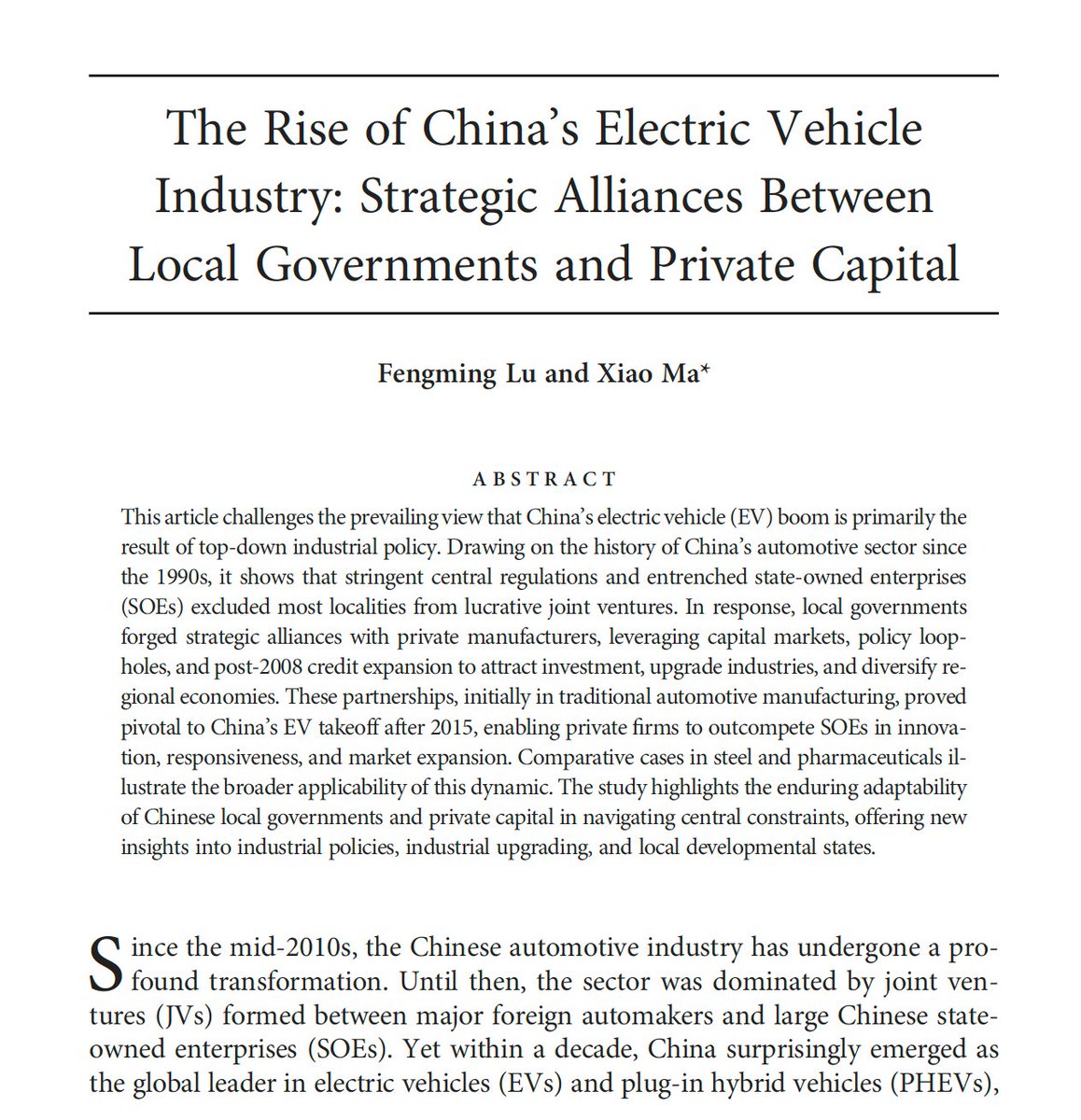
Why did private firms, not state-owned enterprises (SOEs), come to dominate China’s EV sector?
My new @ChinaJournal article (co-authored with Xiao Ma @maxiaoalex) challenge the "top-down industrial policy" narrative.
The real engine? Strategic alliances between local governments and private capital. 🧵
Based on 3 years of fieldwork, 60 interviews (with officials, entrepreneurs, and engineers), and rich first-hand accounts, we show how strict central regulations inadvertently drove local states to bet big on private EV players.
Here is the story: (1/15)
72
563
1,917
184,459
Arnaud Bertrand retweeted

Jun 11
the worst part about this is that even if its "unenforceable", it really is only unenforceable if you have the money and the time to get buried in a year long legal battle with Daddy Dario
Jun 11
By the way, public service announcement: if you're one of the numerous people posting about Anthropic's dystopian ways and you're thinking about getting Claude to help you write that post... don't!
Another one of their terms is that you may not use Claude to do anything that "exposes [Anthropic to] reputational harms" 👇
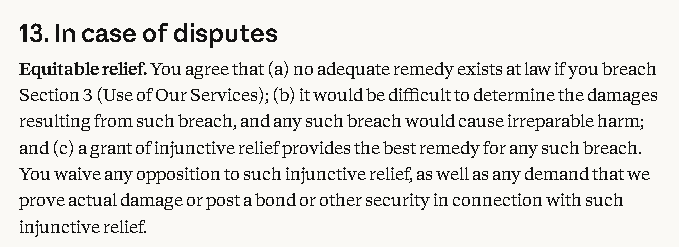
And, if you do, under the - extremely unusual - clause 13 of their terms (anthropic.com/legal/consumer…), you have PRE-AGREED, by using Anthropic (and accepted their terms), that the harm you've done is irreparable, that you won't oppose Anthropic injunction, and they don't need to prove actual damage.
They can simply go to a judge in a friendly jurisdiction (and of course, their terms precise that any dispute "will be resolved exclusively in the state or federal courts located in San Francisco, California") and:
a) file an injunction that shuts you down
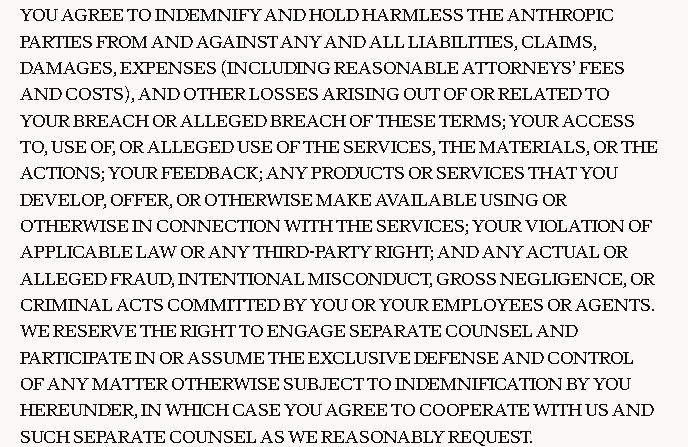
b) make you pay for everything since under section 11 of their terms you agree to indemnify Anthropic for "any and all liabilities, claims, damages, expenses (including reasonable attorneys' fees and costs), and other losses arising out of or related to your breach or alleged breach of these Terms."
In other words, if you use Claude to help you talk shit about Anthropic publicly, their terms say you pay their lawyers to go after you and you've already pre-agreed you've lost the case.
Oh, and cherry on the cake: in the odd case the judge were like "are you crazy, this is insanely abusive, you Anthropic are the ones at fault here," according to their terms Anthropic's maximum liability is... $100.
18
19
295
32,626
Arnaud Bertrand retweeted

パランティアの人間からバルファキスが聞いた話。本当なら今すぐ地獄の業火に灼かれるべき。
ガザの住民密集地を🇮🇱が爆撃する時のスマホを持って逃げ惑うガザの人々の動き「パニックインプリント」をAIに食わせて訓練し「パニック防止AI」として英国NHSに14億ドルで売った
119
4,384
8,114
330,757
Jun 11
By the way, public service announcement: if you're one of the numerous people posting about Anthropic's dystopian ways and you're thinking about getting Claude to help you write that post... don't!
Another one of their terms is that you may not use Claude to do anything that "exposes [Anthropic to] reputational harms" 👇
And, if you do, under the - extremely unusual - clause 13 of their terms (anthropic.com/legal/consumer…), you have PRE-AGREED, by using Anthropic (and accepted their terms), that the harm you've done is irreparable, that you won't oppose Anthropic injunction, and they don't need to prove actual damage.
They can simply go to a judge in a friendly jurisdiction (and of course, their terms precise that any dispute "will be resolved exclusively in the state or federal courts located in San Francisco, California") and:
a) file an injunction that shuts you down
b) make you pay for everything since under section 11 of their terms you agree to indemnify Anthropic for "any and all liabilities, claims, damages, expenses (including reasonable attorneys' fees and costs), and other losses arising out of or related to your breach or alleged breach of these Terms."
In other words, if you use Claude to help you talk shit about Anthropic publicly, their terms say you pay their lawyers to go after you and you've already pre-agreed you've lost the case.
Oh, and cherry on the cake: in the odd case the judge were like "are you crazy, this is insanely abusive, you Anthropic are the ones at fault here," according to their terms Anthropic's maximum liability is... $100.
135
591
2,866
297,099
Jun 11
Jun 11

3
104
22,485
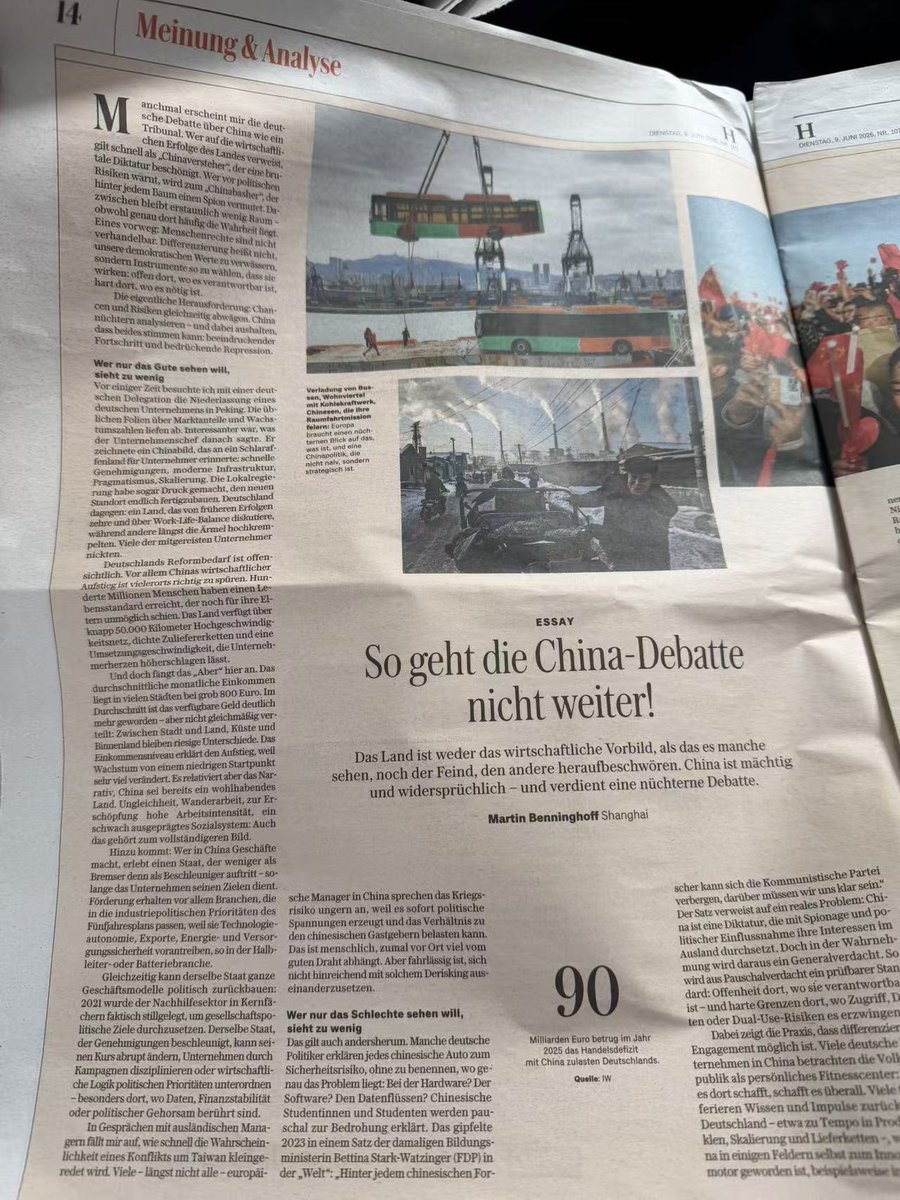
It always astonishes me how there is virtually ZERO public debate - or even public awareness - in Europe about the decisions that will most shape ordinary people's lives.
These days, the EU is drafting a new anti-China legal framework where - quite literally - the more affordable and competitive Chinese products are, the more illegal they'd become.
You'd think EU citizens would want to be informed about such things - as it couldn't be more consequential for their prosperity.
Yet I bet virtually no EU citizen is even aware of it, beyond a vague sense that there is some sort of trade dispute going on.
So what's going on exactly? It all centers around a new legal instrument the EU is drafting called the "overcapacity instrument" (euobserver.com/218003/china-…).
First of all, the very notion of "overcapacity" is pretty ridiculous to begin with, especially the way it's being defined by the EU, as it basically means being competitive enough to export.
By this definition of "overcapacity," pretty much every European industry that's ever run a trade surplus - German cars, French wine, Italian fashion - has been guilty of "overcapacity."
I'm not even exaggerating: if you read this study by the EU Parliament on "Industrial overcapacities, with a focus on China" (europarl.europa.eu/RegData/e…), they define "overcapacity" as building more capacity than your domestic market can absorb. So the moment you build capacity to export abroad, you're in "overcapacity."
Utterly ridiculous.
And what this "overcapacity instrument" is about is creating a permanent legal mechanism for the EU to block Chinese competition across whole sectors of the economy, if they happen to be in "overcapacity."
In effect, this means that if China is competitive globally in a given sector in such a way that it exports a lot, that's proof of overcapacity, and legally it'd mean that the entire sector can be restricted from the EU market.
Which means it really, factually, is a legal framework where the more affordable and competitive your products are, the more illegal they become.
Which is a CRAZY economic concept! 🤦♂️
Please note that it's different from the anti-subsidy legal instrument, which the EU has already put in place in 2023 (the "Foreign Subsidies Regulation": competition-policy.ec.europa…).
This "overcapacity instrument" would be above and beyond this: it wouldn't even matter if a particular sector was subsidized by the Chinese government or not, the mere fact of its competitiveness in exports would be grounds for restrictions in the EU.
It doesn't take a genius to understand how badly this could impact everyday people: this is European consumers being forced to pay more for worse products by law, so that uncompetitive European firms don't have to improve.
Politicians frame it as avoiding a "China shock 2.0" but really this is choosing an even steeper self-inflicted decline than is already the case, where EU citizens would subsidize mediocre EU companies that would have even less pressure to catch up. It's a hidden tax: subsidies for uncompetitive firms paid by consumers instead of governments, which in turn makes them less incentivized to become competitive.
The first "China shock" did de-industrialize Europe somewhat, but at least it made things cheaper for European consumers. If this becomes Europe's response to a second "China shock" not only it'd make everything more expensive but it'd do nothing for EU industry: you don't become competitive by banning the competition...
Look at China itself: the way it industrialized was NOT by banning Western firms but on the contrary by welcoming them strategically and learning from them. You learn to compete by... competing, duh!
What I find most shocking in all of this isn't even the policy itself - you can make arguments for and against protectionism, and reasonable people can disagree.
What's shocking is that virtually no European media outlet is explaining any of this to the public. This is unarguably one of the single most consequential economic decisions the EU will make this decade, affecting the price of everything, and it's being drafted in near-total silence.
No newspaper is running the headline "EU plans to make Chinese goods illegal if they're too affordable" - even though that's essentially what's happening.
But that's what you call a "democracy" with "freedom of expression" these days apparently...
317
1,957
4,863
283,087
👇 exactly 💯
x.com/i/status/2061694123388…
Jun 2

I find the concept of “overcapacity” ridiculous. Does Germany have an overcapacity in cars? France one in wine? Sweden in heavy trucks? Italy in fashion? And don’t tell me that European food exports aren’t subsidized. euobserver.com/218003/china-…
6
20
250
26,538
Jun 11
I'm starting to like that guy 😅
x.com/i/status/2064970868933…
Jun 11
I still fail to understand what this ”overcapacity” really means. The share of exports in the 🇪🇺 economy is actually larger than its share in the 🇨🇳 economy, although not by much. Overcapacity? Can anyone define the term in a way that makes sense? euobserver.com/220918/inconc…
2
2
50
8,927

A growing number of foreigners are traveling to China for life-saving treatments, including for cancer, because it's often cheaper and more readily available bloomberg.com/news/features/…
57
217
851
247,867
Arnaud Bertrand retweeted

Jun 11
"In other words, if you use Claude to help you talk shit about Anthropic publicly, their terms say you pay their lawyers to go after you and you've already pre-agreed you've lost the case."
Now that's just evil.
Jun 11
By the way, public service announcement: if you're one of the numerous people posting about Anthropic's dystopian ways and you're thinking about getting Claude to help you write that post... don't!
Another one of their terms is that you may not use Claude to do anything that "exposes [Anthropic to] reputational harms" 👇
And, if you do, under the - extremely unusual - clause 13 of their terms (anthropic.com/legal/consumer…), you have PRE-AGREED, by using Anthropic (and accepted their terms), that the harm you've done is irreparable, that you won't oppose Anthropic injunction, and they don't need to prove actual damage.
They can simply go to a judge in a friendly jurisdiction (and of course, their terms precise that any dispute "will be resolved exclusively in the state or federal courts located in San Francisco, California") and:
a) file an injunction that shuts you down
b) make you pay for everything since under section 11 of their terms you agree to indemnify Anthropic for "any and all liabilities, claims, damages, expenses (including reasonable attorneys' fees and costs), and other losses arising out of or related to your breach or alleged breach of these Terms."
In other words, if you use Claude to help you talk shit about Anthropic publicly, their terms say you pay their lawyers to go after you and you've already pre-agreed you've lost the case.
Oh, and cherry on the cake: in the odd case the judge were like "are you crazy, this is insanely abusive, you Anthropic are the ones at fault here," according to their terms Anthropic's maximum liability is... $100.
28
108
13,234
Arnaud Bertrand retweeted

Jun 10
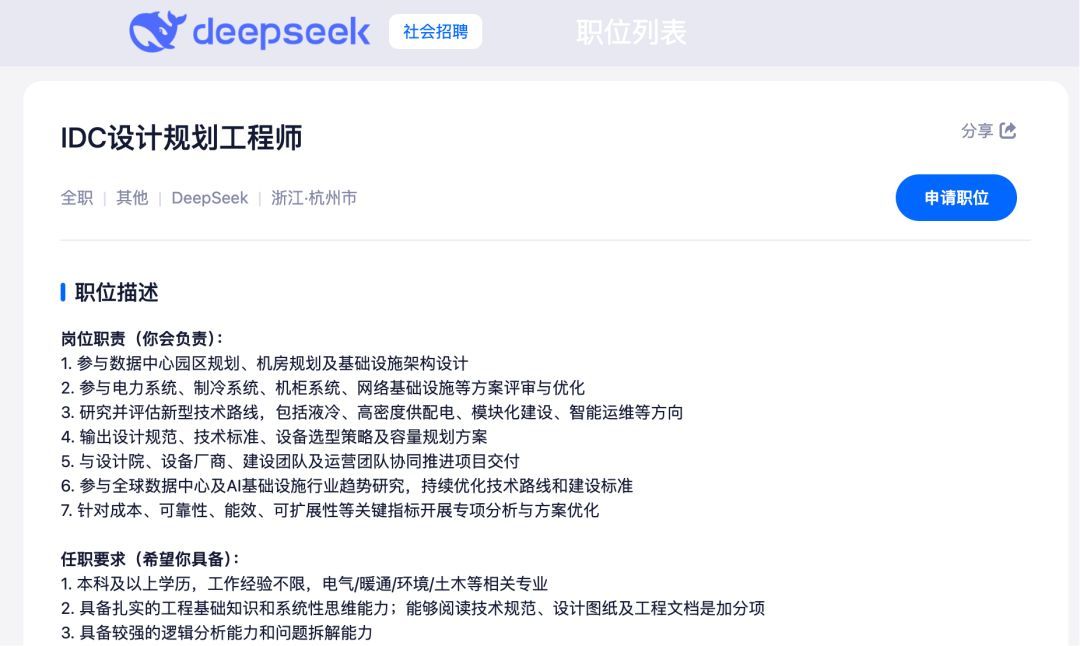
DeepSeek is going heavy-asset.
On June 9, the company posted an opening for IDC planning engineers, a role explicitly scoped to the design and delivery of MW-to-GW scale infrastructure. It follows April's hiring of data center O&M engineers in Ulanqab, Inner Mongolia. Taken together, this is the first time DeepSeek has fully shown its hand on owning compute infrastructure rather than just renting it.
17
49
479
105,841
Jun 11
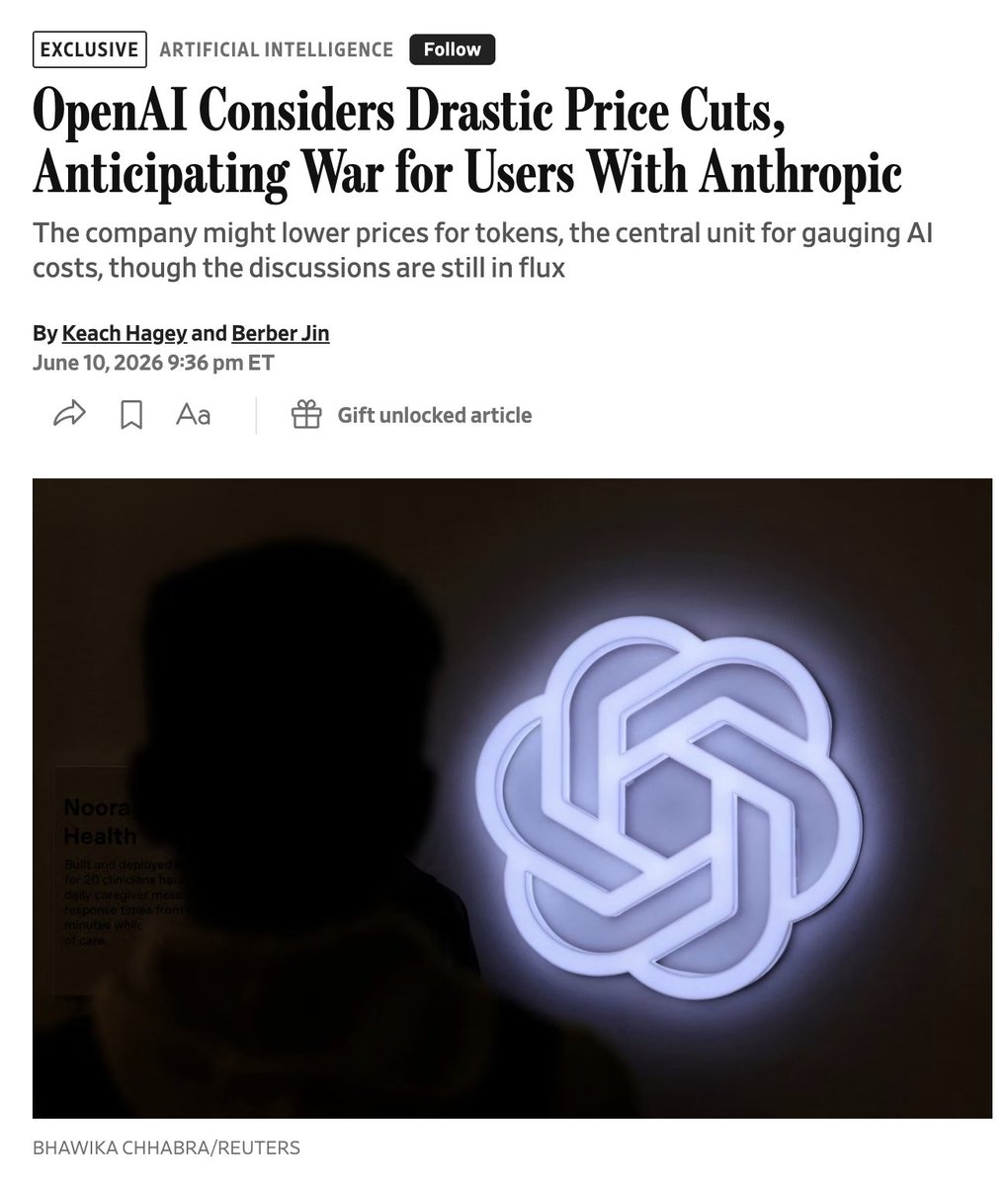
And, just as predicted, AI models will be commoditizing

* OpenAI Considers Drastic Price Cuts, Anticipating Costly War For Users With Anthropic - WSJ
14
29
259
25,225
Jun 11
See here 👇
x.com/RnaudBertrand/status/2…
Apr 24
Here's an interesting thought experiment: what would the world have been like had the U.S. decided to take towards electricity the approach it's currently taking towards AI?
Imagine if, say, the United States in 1890 had declared electricity a matter of national security, classified the designs of Edison’s dynamos and Tesla’s induction motors as export-controlled, integrated its electrical companies directly into the War Department, framed the generator as a strategic weapon rather than a general-purpose technology, and spent the following century building its foreign policy around ensuring that only it, and politically-aligned nations, had access to the light bulb.
Batshit insane, right? Well that’s pretty much EXACTLY the posture it’s taking towards AI.
Had that happened, it’s painfully obvious we’d ALL have been immeasurably poorer for it, materially and morally.
And the United States first and foremost, given that for electricity - as will undoubtedly be the case for AI - the real value didn’t lie in control of the technology but in its widespread diffusion and in what you built on top of it.
Think about the U.S.’s “electricity giants”: companies like GE, Whirlpool or RCA didn’t get rich by “owning” electricity - they got rich by selling what electricity made possible into a world that was electrifying as fast as it could. The U.S.’s electrical fortune was built on the world electrifying alongside it, not against it.
Does the analogy hold for AI? Yes, surprisingly well. I like Jensen Huang’s recent description of AI (dwarkesh.com/p/jensen-huang) as a "5-layer cake" made of 1) energy, 2) chips, 3) infrastructure, 4) models and lastly 5) applications.
The implication of his point is that each layer save for the last one - the application layer - will ultimately be largely commoditized, and as such that’s where the real value lies: in the millions of specific products, services, and industrial processes that get built on top of the other 4 layers.
It’s typical network building: the layers underneath eventually become utilities, and utilities are low-margin commodity businesses. It happened with electricity, it happened with phones, it happened with railroads, it happened with the internet itself. The operators of each layer got commoditized over time, while the durable, century-defining fortunes accrued at the top of the stack: GE on top of electricity, Apple on top of the mobile and telecom infrastructure, Amazon and Google on top of the internet.
There's no reason to think AI - a general-purpose technology of the same order - will turn out any different.
And in fact, we're seeing this happening in real time: take the release of DeepSeek V4 today. What is it if not a commodification of the model layer in Jensen Huang's "5-layer cake"? A frontier-grade model, given away under an MIT license, running on non-Nvidia silicon - and shipped by a lab that explicitly frames it as "AGI belongs to everyone" (x.com/victor207755822/status…).
When a product that cost tens of billions of dollars to develop can be downloaded for free and run on commodity hardware, that product is, by definition, a commodity.
This means that the whole notion of an "AI race" is now absurd on the face of it: you cannot race for control of a thing that is being given away for free by someone who isn't racing.
And doubly absurd because, as we just saw, the economics of general-purpose technologies actively punish "race winners": the value accrues at the application layer, which requires the maximum possible diffusion of everything underneath it. "Winning" by hoarding the model layer is like "winning" electricity by refusing to let people have a generator - you don't capture the value, you prevent it from ever being created.
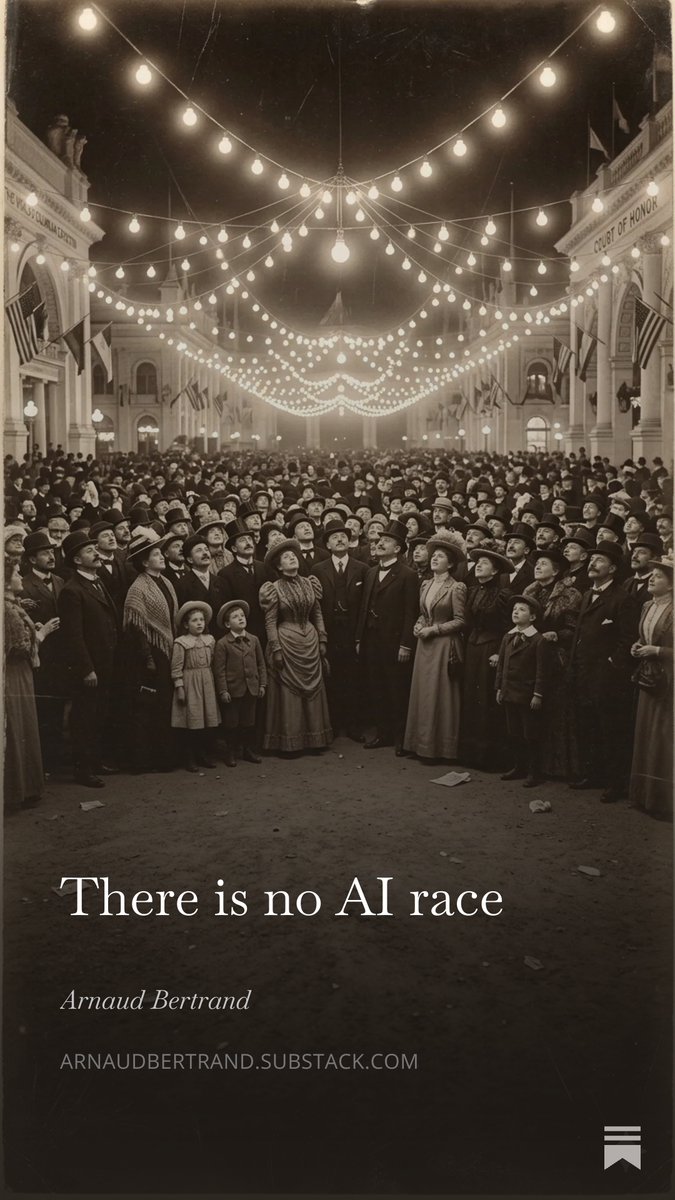
That's the topic of my latest article in which I argue that the whole "AI race" framing isn't just wrong, it's one of the most successful regulatory capture operations in history.
Shaped by a handful of US companies - like Palantir, Anthropic and OpenAI - it's a perfect example of an industry convincing the public to cheer for its own enrichment by dressing it up as a civilizational struggle.
Link to the article here: open.substack.com/pub/arnaud…
Enjoy the read!
8
87
13,497