
3 Photos and videos



ChiefORZ retweeted

May 27
An Anthropic engineer paid for my espresso at Sightglass when he saw my screen
I was running my Polymarket bot from the counter. He was next in line. Looked over my shoulder. Stopped scrolling.
"That's not a normal trading app. What's it actually running on"
I told him. Claude Code. Four repos. $25 a month.
He sat down without asking.
"I'm on the agent team. We stress test Claude for exactly this. You're letting it find its own edges"
Not just edges. Wallets.
86 million trades. Every wallet. Every entry. Every exit.
"You're feeding Claude raw wallet data and letting it identify who consistently wins. Then cloning them"
He said it slowly. Like he was writing the threat model in his head.
One prompt. Find every wallet with 100 plus trades and win rate above 70%. Rank by profit. Export top 50.
Claude scanned 14,000 wallets in 4 minutes. Returned 47.
The top 20 made more than the bottom 13,000 combined.
"That's not a stat. That's a hit list"
Exactly.
"And you didn't write the scoring function"
Claude did. I just wired it into an if-statement.
Then I showed him the second repo.
Official Rust CLI. No API key for reads. 500 markets, Claude scores them in minutes.
Gap. Depth. Resolution window.
487 markets become 35 before a dollar moves.
93% killed before I even see them.
A green fill landed on the screen. $84.
He watched it hit.
"How does it decide to actually enter"
Three agents. Shared wallet. No shared memory. Arbitrage, convergence, whale copy. 2 agree, full size. 1 alone, half. Disagree, no trade.
Consensus filter alone killed 40% of losing trades.
"And the exits?"
The 47 whales never hold to settlement. 91% exit early. 73% of max profit captured. Redeploy immediately.
My bot cuts at 85% of expected move or on a 3x volume spike.
"You built a whale copy bot that exits before the whales"
Yeah.
He put his espresso down.
"How often does it trade"
10 a day on average. Most of them skipped before I look up from my coffee.
My setup:
Claude API - $20/mo
VPS in Germany - $5/mo
poly_data - free
polymarket-cli - free
Polymarket/agents - free
$200 seed. 27 days ago. $14,300 now.
Copytrade here: t.me/KreoPolyBot?st…
271 trades. 74% win rate. Sharpe 2.47.
I haven't touched it in 27 days.
He stared at the screen for a long time.
"This is literally what our red team simulates. Except you actually shipped it"
He emailed me the next morning.
"Any chance you'd take a call with our policy lead"
I told him the article is the call. Read it twice.
Too late to gatekeep.
You only need Claude laptop 1 hour/day.
Giving This Free for 24 hours. To get it:
1. Comment the word 'Claude'
2. Like and Retweet this post
3. Follow me @ZayvenKnox [so i can dm you]
71
51
112
7,015
ChiefORZ retweeted

May 26
I made $3,500 in 4 hours By Cloning a Pro Trader Strategy Using Claude Code & Hermes Agent.
This New Hermes Bot made $3,500 in last 4 hours.
Turn any trader's public data into a fully automated AI agent that trades 24/7.
You can do this in simple steps.
Get FREE Setup Guide:
1. Comment "Hermes"
2. Like and Retweet this post
3. Follow me @codewithimanshu (so I can DM you)
You only need Claude laptop 2 hours to build your own clone trader bot.
Normally people sell this, but it's FREE for Today.
No Money Asked At Any Point. This is a complete, build it yourself Hermes Agent Setup Guide.
Make sure you Follow me @codewithimanshu so I can send you setup guide in DM.
125
93
171
22,412
ChiefORZ retweeted

6 Dec 2023
I'm convinced that React's concurrent rendering model is fundamentally at odds with fine-grained reactivity/updates/rerendering.
I have users who are clawing at me for fine-grained updates and rendering subscriptions in TanStack Router, but you simply can't have both fine-grained updates AND things like transition/suspense-aware state. Let me explain.
To get fine-grained subscriptions in react, you have to use an external store (literally anything that doesn't trigger rerenders out of the box) and wire up the subscriptions to where they are used in react, hopefully with something like selectors, proxies, signals or atoms. However, as soon as you move your state out of useState/useReducer, you will experience state tearing when you attempt to use concurrent rendering, especially with startTransition. This is because React can't "version" your state, create new fibers based on it, etc. So if fine-grained reactivity and subscriptions are important to your application or library, you kinda just have to swallow the bitter pill that you can't *really* support startTransition at the same time... and tell some of your users (who may totally *need* concurrent rendering, but refuse to use a library if it doesn't check that box) to take a hike.
Maybe you decide it's worth trying to figure out though, just like I did 2 months ago, so you can get that high-quality A-grade startTransition support people are asking you for. To do this, you must put ALL of your state into either useState or useReducer and ensure you're not breaking ANY concurrent rendering rules. However once you do this, you'll quickly realize the only way to propagate that state down to subscribers is via React context... So you start to do the song and dance of splitting your state into multiple contexts. But then you also realize that updating any useState or useReducer will trigger renders all the way down... unless you useMemo to bail out... and teach your users to do the same. At the end of the day, you essentially have to tell your users to embrace frequent rerenders and optimize the crap out of their entire application. But hey, that's not too different than what they're used to. But it's important that people realize this is the reason that the "useMemo as an optional optimization" speak is a bandaid lie we've been told to so we can deal with React's lack of reactivity.
So here I am with two patterns that are essentially at odds with each other and I'm on the verge of picking one over the other. Can you guess which one?
Is concurrent rendering - and more specifically in this case, holding paints until all suspense boundaries inside of your startTransition resolve - more important than fine-grained performance?
Why do we have to choose?
43
57
614
186,958

Another opinion and hopefully an inspiration for somebody
schaffernak.digital/blog/how…
34
My First Take on a Non-Tech Blog Post
It is about my Transition to my Remote Work Life
schaffernak.digital/blog/lea…
31
ChiefORZ retweeted

23 Jun 2023
🚀So yeah. It's Friday and shipping time! 🚢
The first usable v4 beta version of coolify.io is available for everyone! The available features are minimal, but more will come every day. Lots of things are missing, not complete, etc, but...
This release is just a mental release for me - a huge relief! 😅
I'm extremely eager to hear your thoughts, so please share your experience if you decide to give it a try! 💜
github.com/coollabsio/coolif… #buildinpublic
15
8
64
11,129
the markdown posts looks fresh in my new blog - webdev was never so convenient.
schaffernak.eu/blog/pdf-repo…
1
1
ChiefORZ retweeted

8 Mar 2022
Thanks @ChiefORZ - really cool thing.
The solution running on your server with the coded program about tracking my Delegation-Rewards is perfectly working. Helps a lot to keep up running my records about this stuff.
1
ChiefORZ retweeted

27 Jul 2021
Btw. yes we are using React to build the UI :)
11
14
310
sooo true 😅😅
2 Aug 2019

border: 1px solid red; is the console.log of css
ChiefORZ retweeted

2 Aug 2019
💕 Very interesting idea.
5 Aug 2017

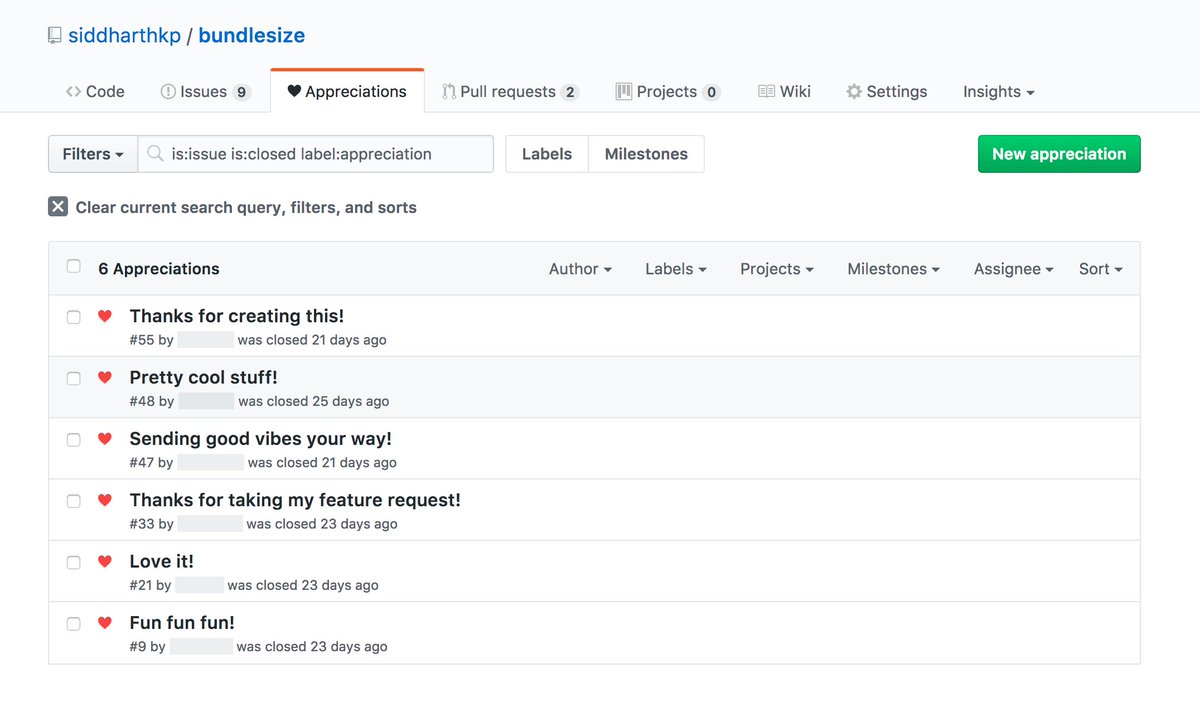
Problem: project maintainers only get "issues" on github, not enough love/motivation from the community
Solution: ⬇️ What do you think?
39
112
1,261
Proud to be the 1021th backer for HYPHEN: The Gold Standard of Wireless Earbuds ! Excited for it! igg.me/p/hyphen-the-gold-sta… #indiegogo via @indiegogo
I'm having too much fun with the day/night switch on twizzy.app 🤦️ 500 times so far! 😂️ twizzy.app
😍

Next.js 7:
⬩ Smaller footprint
⬩ 57% faster bootup, 42% faster re-compilation
⬩ Better error reporting
⬩ Webpack 4 and Babel 7
⬩ New nextjs.org
nextjs.org/blog/next-7
Excited to be the 805th 😎 on @BackerKit for The Micro Wallet - Doing more with less. Thanks @paperwallet micro-wallet-2.backerkit.com…