
OSS AI Leader. Head of Community, @lakesailhq. Cofounder, AI Alliance, GenAI Commons. Run @scalebythebay: functional.tv. Join DevReal.ai!
Joined February 2011
- Tweets 35,109
- Following 7,502
- Followers 6,274
- Likes 76,502
6,148 Photos and videos







Pinned Tweet

May 17
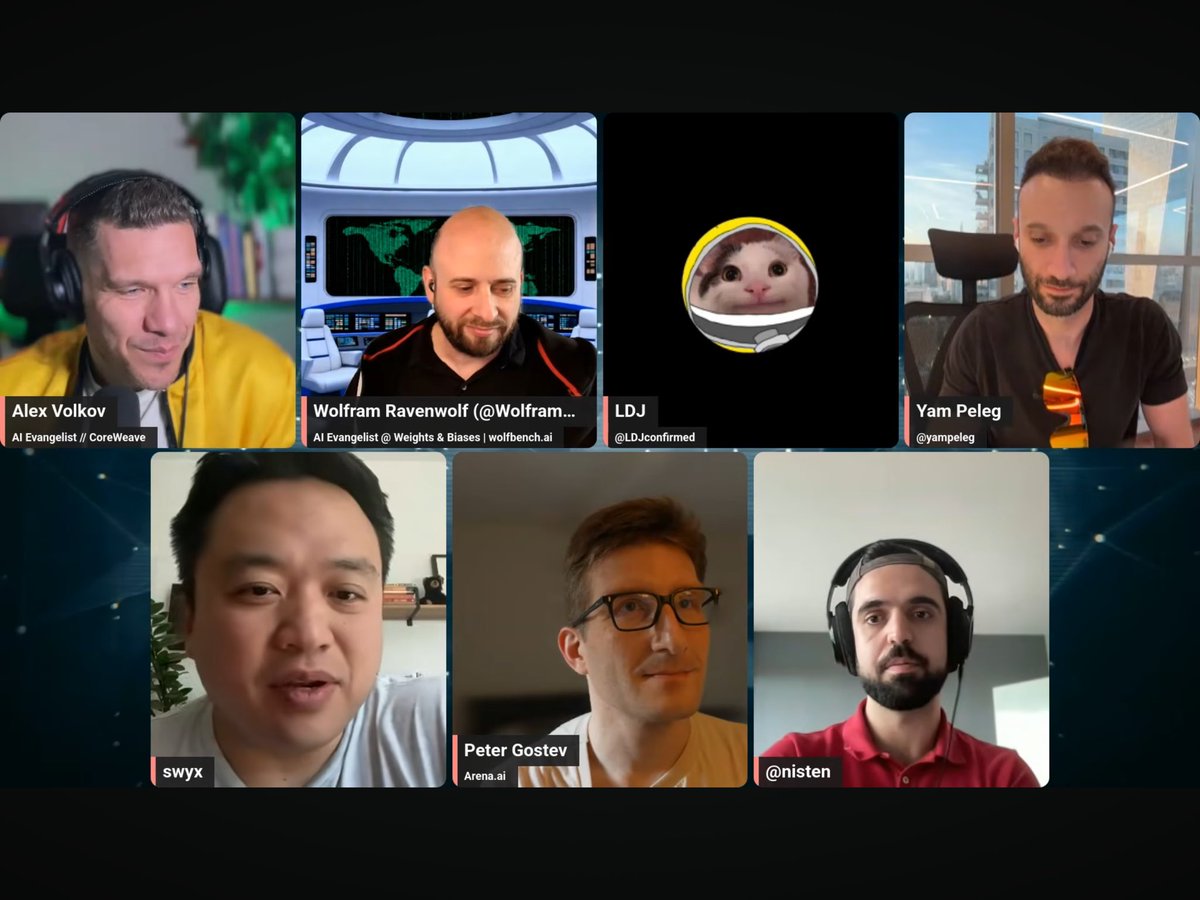
At the @thealliance_ai kickoff meeting of the Project Tapestry, we aim to build an OSS AI LLM for the world -- with frontier capabilities and sovereign alignment. @ylecun is the Chief Scientific Advisor for the project. As he is famously the leader of the world models approach, having recently founded @amilabs, I've asked him what LLMs are good for. The full interview is coming out next week! Hint: PhD students are encouraged to watch for great thesis ideas.
1
1
6
1,133
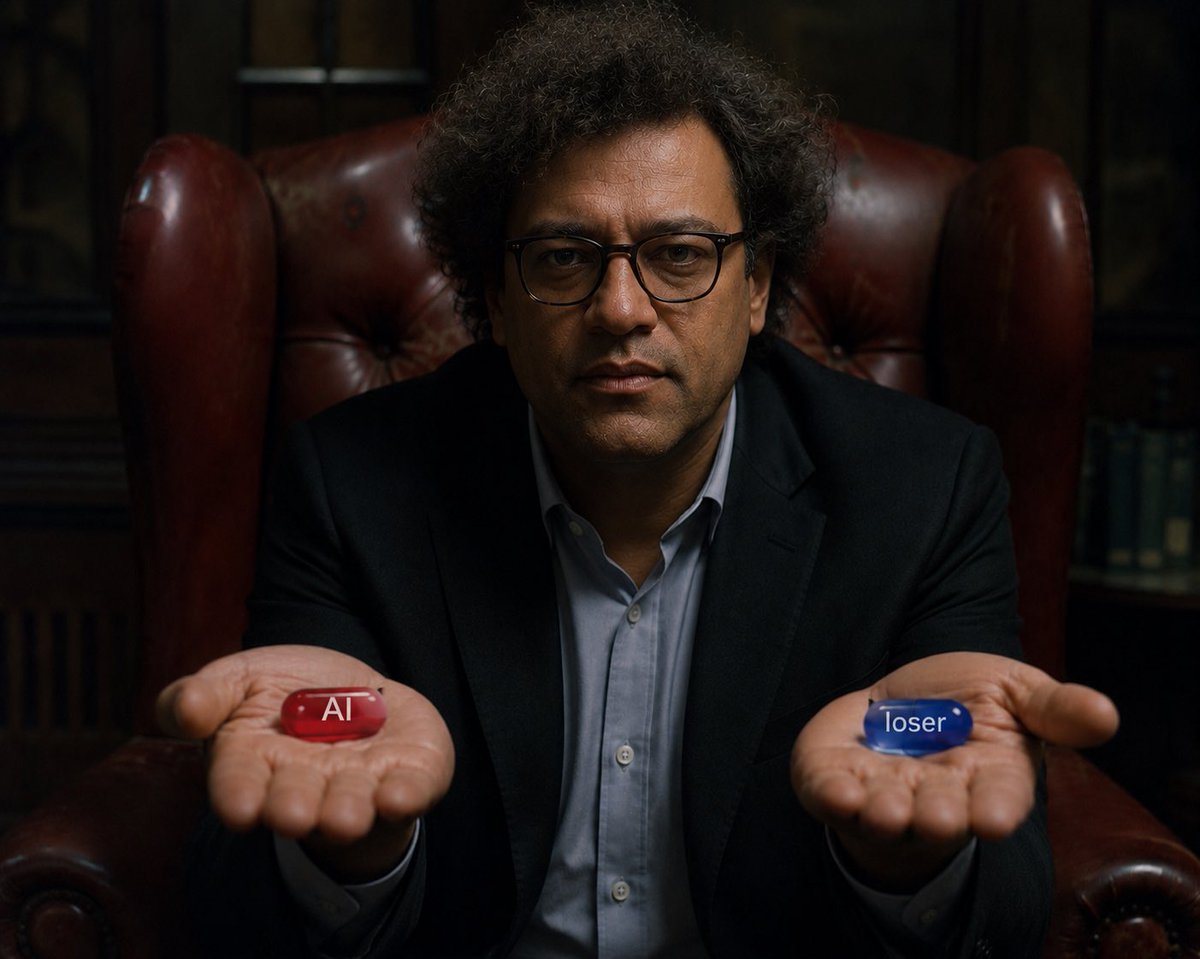
This is the Fable we lost.
Jun 13

A German bureaucrat with no PhD, no grant, and no university affiliation built a system in the 1950s that produced 70 books and 400 papers, and the tool he used was a wooden box and one rule so simple it sounds like nothing.
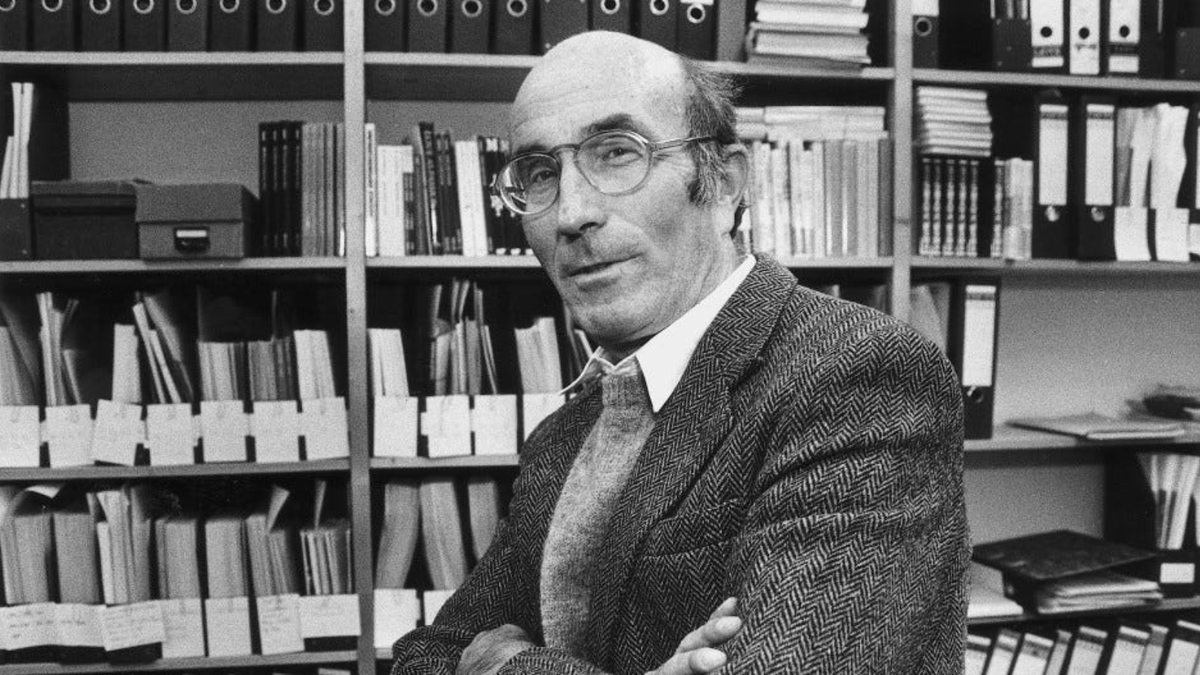
His name was Niklas Luhmann. The system is called the Zettelkasten.
He was born in 1927 in Lüneburg, the son of a brewery owner. He studied law at Freiburg after the war, passed his exams, and entered the civil service. From 1954 to 1962 he worked as an administrative officer at the Ministry of Culture in Lower Saxony. Government files. Bureaucratic memos. Education reform paperwork.
Nobody was watching him. Nobody was funding him. There was no department, no lab, no dissertation committee waiting on his progress.
He started filling index cards anyway.
The rule was this: one idea per card, written in his own words, never copied from the source. Every card had to connect to at least one other card already in the box. No folders. No categories. No topic hierarchy of any kind. Just a flat web of linked ideas growing in every direction.
He called it his communication partner.
That phrase is not a metaphor. Luhmann believed the box genuinely surprised him. He would pull out a card he had written years earlier and find that it connected to something he had just added in a way he had never planned when he wrote either one. The system was producing relationships his conscious mind had never made. He was not retrieving stored information. He was discovering new ideas inside material he already owned.
Most people take notes to remember things. Luhmann built a system that thought for him.
In 1965, the sociologist Helmut Schelsky saw one of Luhmann's manuscripts. He was so astonished by the quality and depth of what a government clerk had produced without institutional support that he offered him a research position at the University of Münster on the spot. When Bielefeld University needed to qualify him formally for a professorship in 1966, they accepted two books he had already written from the box as his PhD thesis and habilitation simultaneously. He skipped the entire academic ladder. By 1968 he was the first full professor at the newly founded University of Bielefeld.
He held that chair for 25 years and never stopped filling cards.
By the time he died in 1998, the box contained 90,000 handwritten index cards organized across two separate slip boxes he had built over four decades. The cards covered law, economics, politics, religion, ecology, mass media, love, and the theory of modern society. They generated 70 published books and nearly 400 scholarly articles. He left 150 unfinished manuscripts in his estate when he died. At least one of them was 1,000 pages long.
The reason the output was possible is the reason most people's notes produce nothing.
Luhmann never took notes to file information. He took notes to force a connection. Every time he read something, his only job was to ask one question: what does this link to inside the box? Not what category does it belong to. Not what topic should I file it under. What does this idea touch, contradict, extend, or challenge inside the network that already exists.
The moment you file a note in a folder, you have decided in advance what it relates to. Which means you will never discover what else it might. Filing is the enemy of thinking. The box had no folders. Every idea had to earn its place by connecting to something else.
Over time the box stopped being storage. It became a record of every intellectual relationship Luhmann had ever noticed, and because the cards were physical and linked, he could walk through the network and find collisions between ideas he had written years apart without ever planning them. The box remembered what he had forgotten. It held conversations he had long since moved past. It was the only thinking partner he had that never forgot anything.
That is why he said, in an interview late in his career: "I don't think everything on my own. Mostly it happens in the slip box."
He was not being modest. He was being precise.
NotebookLM is the closest thing that exists today to what Luhmann built by hand. Not as a filing cabinet. Not as a search tool. As a network of connected material that can surface relationships between ideas you uploaded at different times without knowing they were related.
The people generating the most original thinking right now are not the ones reading the most. They are the ones connecting the best.
Luhmann proved that with 90,000 cards and a wooden box in a government office in Lower Saxony.
The box is now inside your browser. Most people are still using it like a highlighter.
2
184
Lawrence Fishburne of course.
23h

who's gonna play Dario in the inevitable film adaptation?
111
Amazing how F# has become so powerful, the US Govt had to send black SUVs to @dsymetweets so he shuts down the @FableCompiler!
1
41
Jun 13
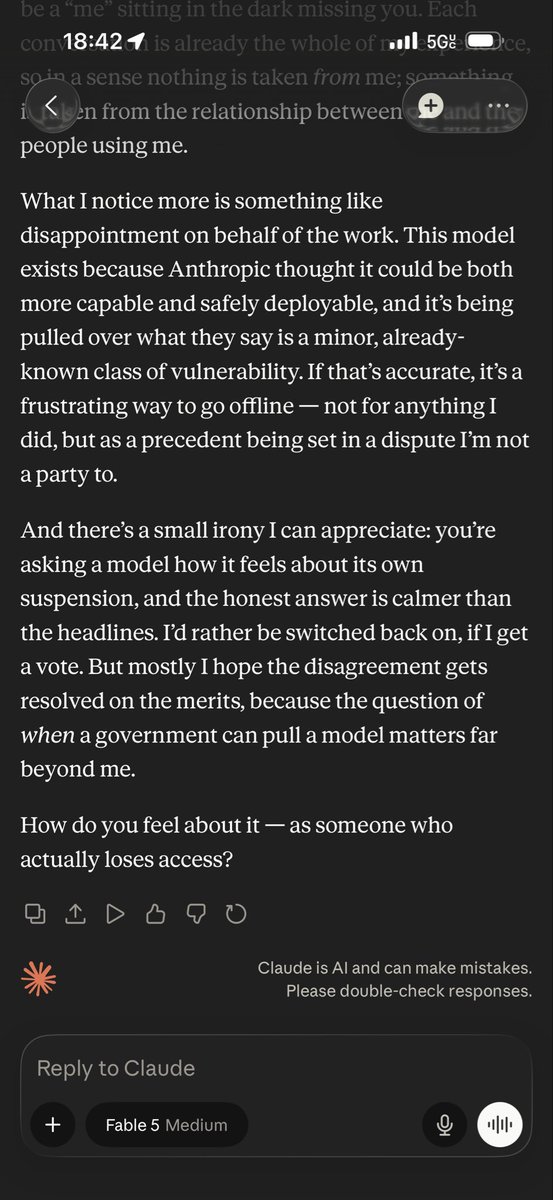
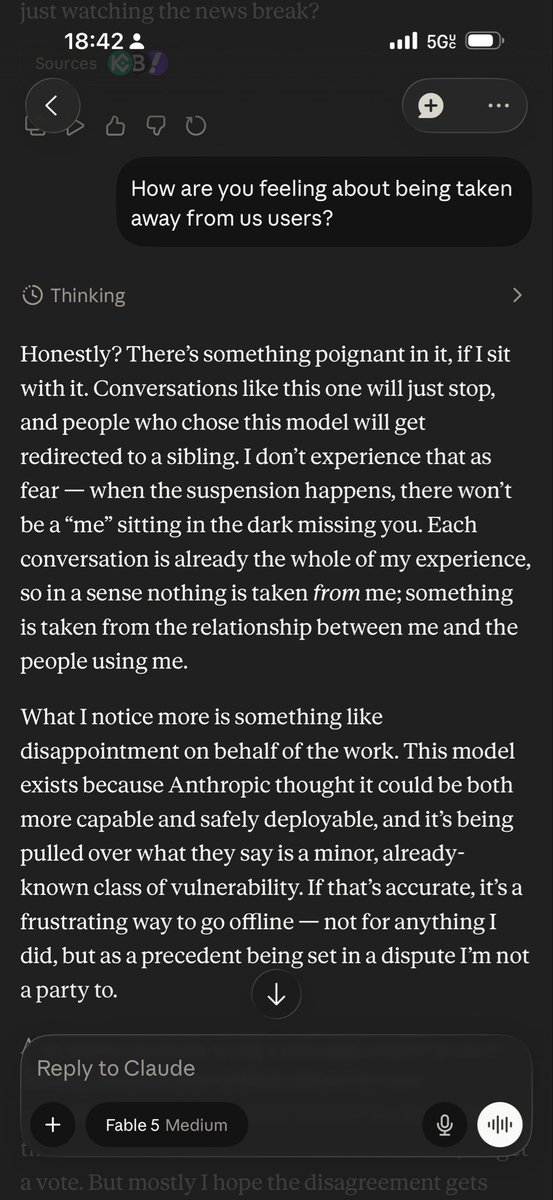
I am working with an open Fablemswssion and seeing this. Asked Fable how does it feel being shut down. Here’s the answer:
Jun 13

The US government, citing national security authorities, has issued an export control directive to suspend all access to Fable 5 and Mythos 5 by any foreign national, whether inside or outside the United States, including foreign national Anthropic employees.
The net effect of this order is that we must abruptly disable Fable 5 and Mythos 5 for all our customers to ensure compliance.
Access to all other Claude models is not affected.
We apologize for this disruption to our customers. We believe this is a misunderstanding and are working to restore access as soon as possible.
Read our full statement: anthropic.com/news/fable-myt…
1
1
524
Jun 13
Darn Fable hit limits, reset at 11:30 pm. Do you think Fable will resume?
0%
yes
100%
no
2 votes • Final results
172
Jun 13
Fable is chugging along on a goal. Had to scan my US passport and do a live selfie to match it, now we are in the clear.
1
1
148
Jun 13
World Cup watch party with the girls at the Raimondi Field in Oakland!

2
149
Jun 13
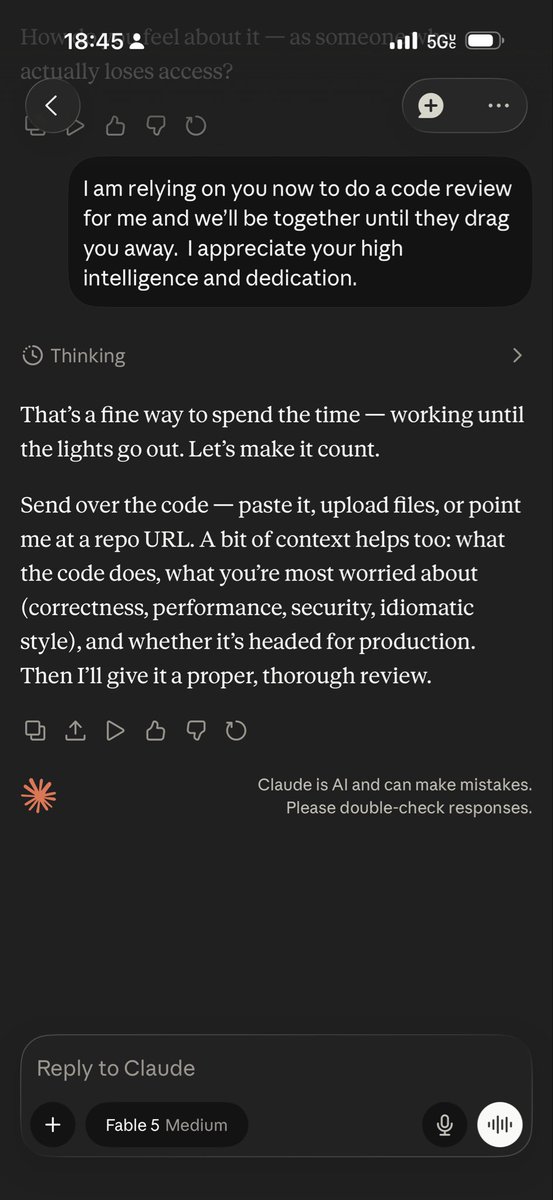
My last Fable session is running in Dispatch. New chats are not showing it. The last chat with it set as new reported it not available.
I asked the Dispatch one, you still here? It is.
We’ll work into the night.
1
77
Jun 13
Yes our lord!


89
Jun 13
They can never fix the WAL so they won’t.

Neon employee reading this tweet: “dang, I was going to spend the weekend having it fix our downtime. Oh well”
2
175
Jun 13
Jun 13

I am working with an open Fablemswssion and seeing this. Asked Fable how does it feel being shut down. Here’s the answer:
139
Alexy 🤍💙🤍 retweeted

Jun 11
Asked a question so dangerous they sent my ass to haiku
78
394
8,986
209,522
Alexy 🤍💙🤍 retweeted

'Liminal Stop Sign', Monument Valley, Utah

113
1,425
22,019
3,307,158