
Joined June 2022
- Tweets 801
- Following 70
- Followers 140
- Likes 531
127 Photos and videos
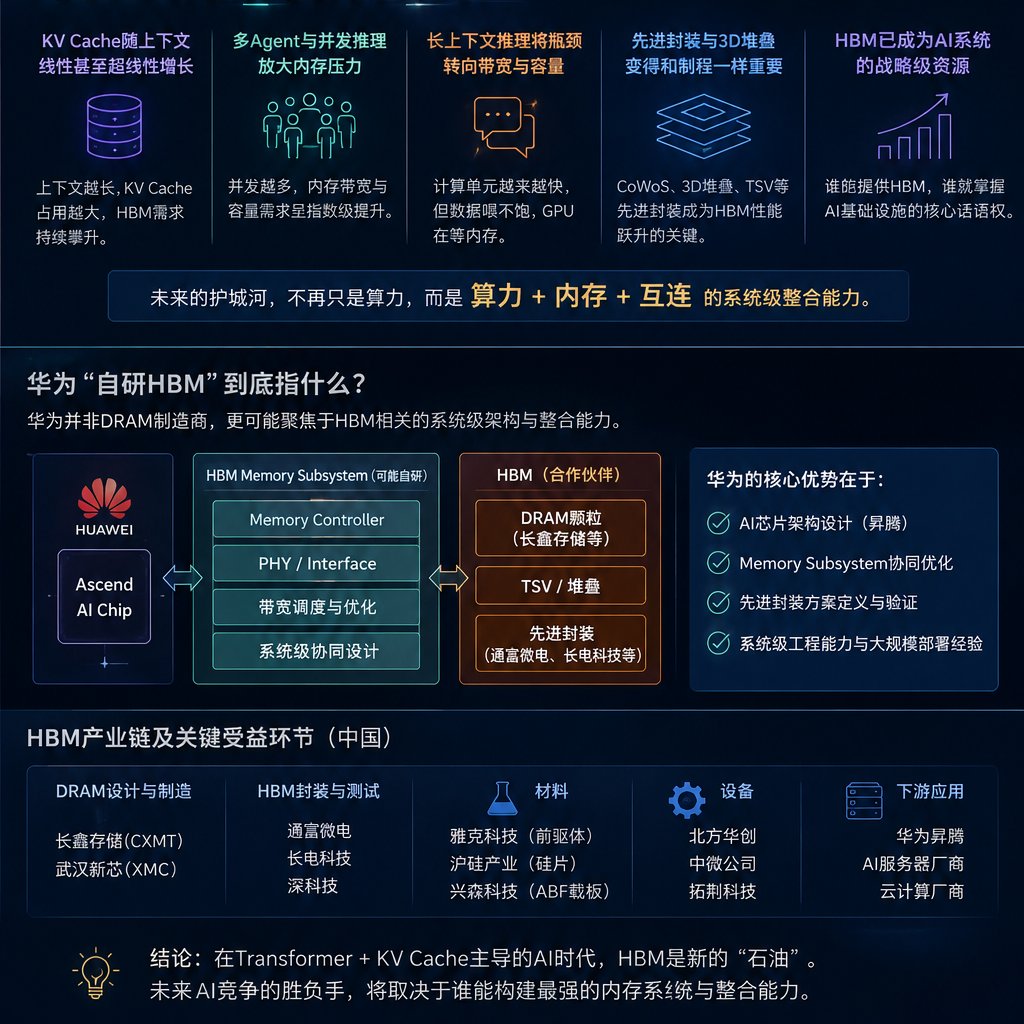
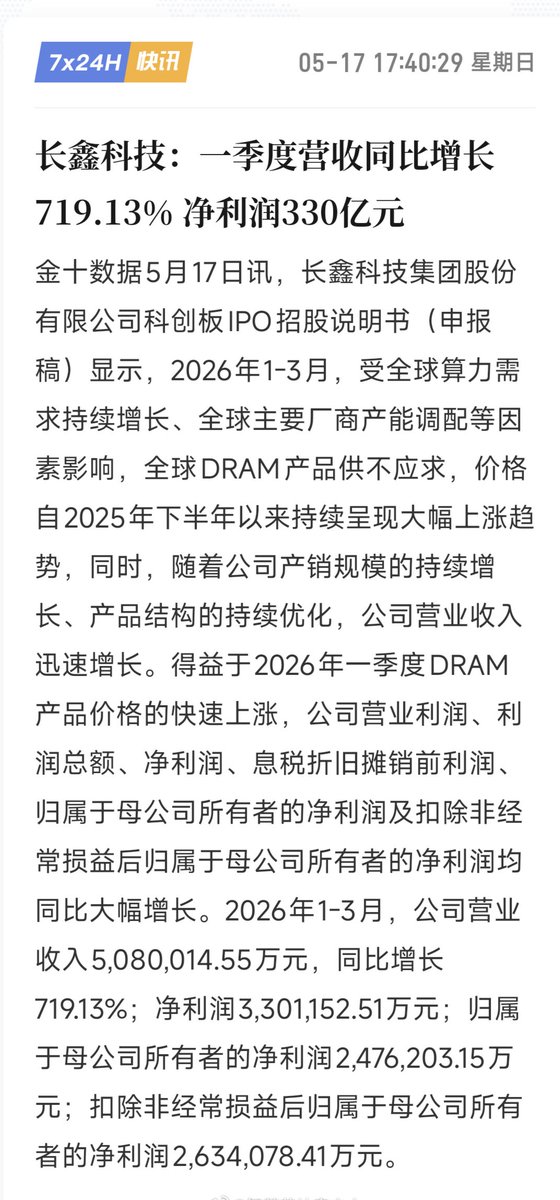
中国正在形成“双HBM路线”格局。
长鑫HBM3已进入客户验证阶段,而华为则首次公开HiBL/HiZQ自研HBM路线。
从产品定位看,华为HBM更偏向昇腾950等高端AI集群,长鑫则有望承担国产HBM规模化供应任务。
73
Unitree Robotics clears IPO review in just 73 days, setting a new record on STAR Market. With a $42B valuation and $4.2B fundraising, it becomes the first humanoid robot stock in A-shares. This milestone signals accelerated capital support for embodied AI and the entire robotics supply chain. #Unitree #HumanoidRobot
1
55
宇树科技73天闪电过会,创科创板纪录!420亿估值、42亿募资,A股迎来“人形机器人第一股”。从受理到过会仅73天,比此前最快的摩尔线程还快15天。
45
Chinese multimodal powerhouse StepFun just flipped the global AI table. Step 3.7 Flash delivers 400 TPS inference, matching 97% of Claude Opus 4.6 at 1/9 the cost. This isn't a simple update—it's a paradigm shift for the Agent era.
What should an Agent-era model look like? Give it a cockpit screenshot, old models just describe dials. Step 3.7 Flash selects the area, identifies instruments, plans steps, and guides a mouse through takeoff. From understanding to executing—that's the divide.
The competition has changed. As Agents enter production, latency and token costs explode. Step 3.7 Flash uses sparse MoE (196B total, 11B active) for 400 TPS. Speed is capability—faster means more iterations, better results in multi-step tasks.
Real tests: 12 messy receipts auto-extracted into Excel; Blender screenshot teaches you to delete a cube; Jianying interface locates export button, warns about 1080i and full-track export pitfalls. The model is on-site, working as your hands.
Even more impressive: emergent behavior. After writing frontend code, it switches to GUI to test rendering, then revises its own code. No one taught it this loop—it figured it out. That's what an Agent should be.
The Advisor strategy is the killer feature: small model executes, consults a larger model only at critical junctures. Result: $0.19 per task vs $1.76 for Claude Opus 4.6, with 97% coding capability. Two dimes vs two dollars—any team burning tokens gets it.
Step 3.7 Flash isn't a benchmark king, but it dominates the cost-efficiency frontier. Multimodal extreme efficiency near-zero cost makes it the foundation for production-grade Agents. Flash is no longer a budget option—it's the pragmatic force taking over the world.
195
BYD hits new monthly sales record in May: 383,453 units! Overseas sales surged 80.7% YoY, with cumulative deliveries exceeding 1.4 million in Jan-May. The NEV leader accelerates global expansion as market penetration rises. Supply chain momentum continues.
29

May 31
As far as I know, besides the LogicFolding-enabled EDA tool recently released by Peking University, Huawei has also been working on this technology internally, and several other vendors are developing similar solutions as well. So while it may appear that Huawei is the one introducing the product, the reality is that Chinese semiconductor companies and universities have already been exploring and advancing along this path for quite some time.
May 31

Necessity is the mother of innovation.
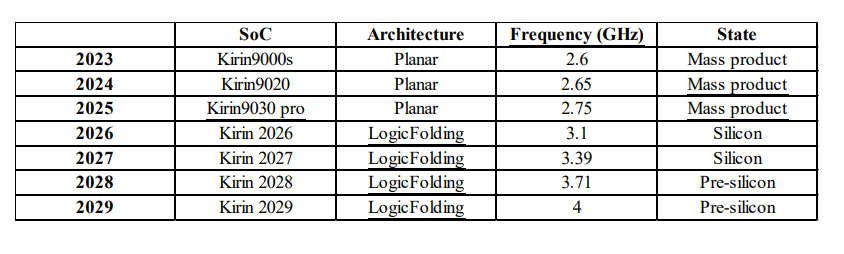
In one fell swoop, Huawei overtakes all in advanced Hybrid Bonding technology, with 2026 Kirin smartphones featuring 1.5 µm bond pitch 3D-stacked architecture.
Next year's Kirin chips will go down 1 µm pitch!
TSMC has only just moved to 6 µm SoIC, with their next step to 4.5 µm for 2030 products.
Intel's Foveros Direct is at 9 µm with Clearwater Forest this year.
16-36x denser interconnect enables Huawei's LogicFolding design, with more granular architectural splitting across the dies to optimize routing and shorten critical paths.

1
144
May 31
DeepSeek V4 explodes in first month: Flash hits 9.13T tokens monthly, three models total over 17T tokens! Agent systems (Hermes Agent at 10.8T) dethrone chatbots as token consumption kings, with single tasks triggering hundreds of LLM calls. Top models hit three walls: MoE communication, million-token memory, low-precision reliability. Ascend delivers universal support for GLM-5.1, MiniMax M2.7, and DeepSeek V4 on launch day. The battle for AI infrastructure entry points is on fire. #AIInfrastructure #LLM
3
1
2
218
May 31
DeepSeek V4上线首月即引爆:Flash月调用9.13T tokens,三个模型合计超17万亿tokens!Agent系统(如Hermes Agent月调用10.8T)取代聊天机器人成为Token消耗主力,单次任务触发上百轮LLM调用。头部模型集体撞上MoE通信、百万上下文内存、低精度可靠性三堵墙,昇腾以通用方案实现智谱GLM-5.1、MiniMax M2.7、DeepSeek V4发布即支持。AI基础设施的入口之争已白热化。
206
May 30
Computex 2026 marks AI's shift from cloud to edge: PCs emerge as the prime device for local token generation, with mobile opportunities expected next year. Edge AI chips and AI PC supply chains enter a new growth cycle.
38
May 29
华大九天在华为发布韬定律同日推出国内首款Argus 3DIC物理验证平台,填补高端3DIC设计工具空白,成为国内唯一全流程EDA提供商。
110
May 28
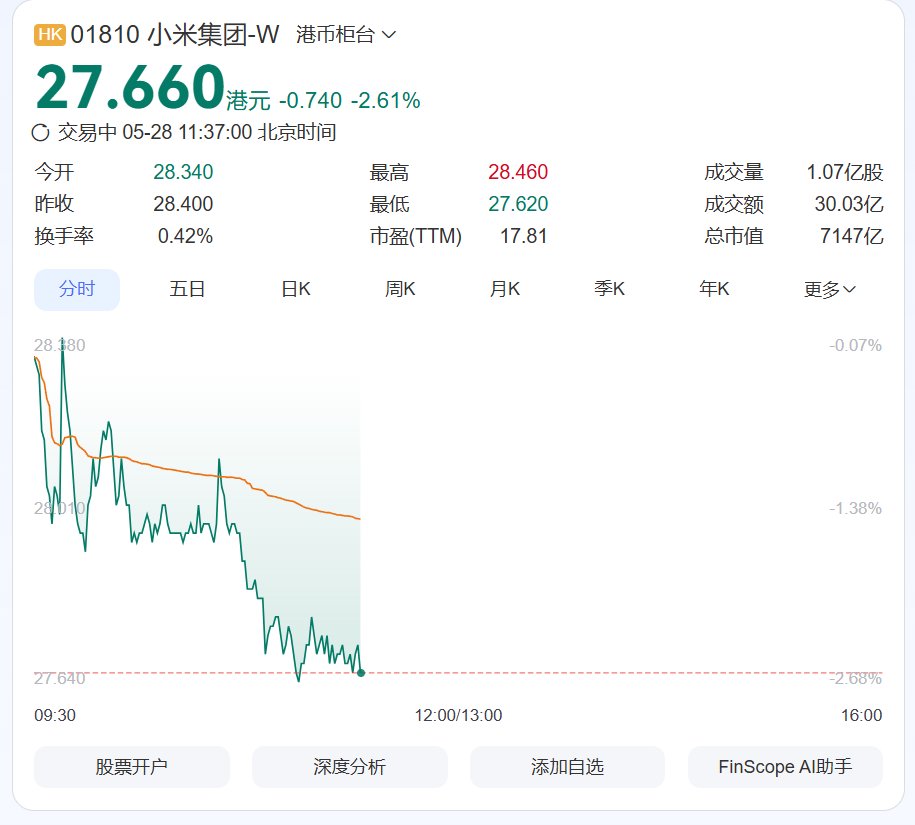
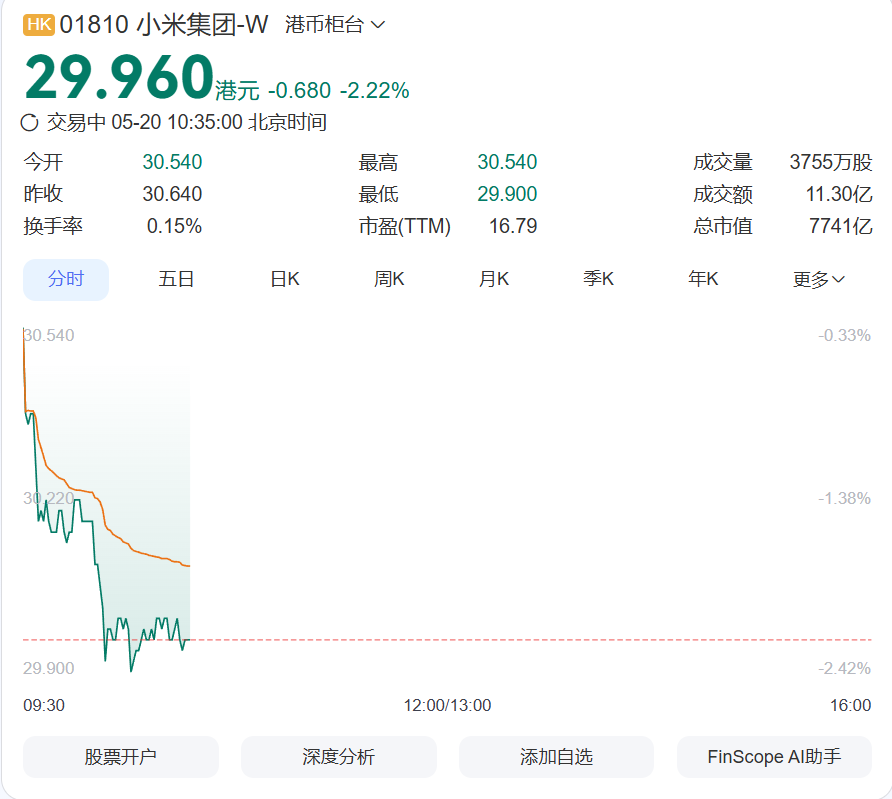
评估小米的股价就不能孤立的只看小米
19年的8块的底很大程度上是吃到了菊花制裁的红利
当时雷布斯去深圳找余大嘴承认华为 荣耀的步步紧逼使得当时的小米市占率极速下降
如果制裁再晚半年,这个底就不是8块了
所以现在的一切都并不难理解
40
May 27
【Huawei Mate 90 Official: τ-Law Chip Hits 3.1GHz, Rivals 3nm Process】
Huawei CTO Zheng Jun confirmed at the 2026 Phoenix Bay Area Finance Forum: The Kirin chip based on τ-scaling (Tao Law) is already powering the Mate 90 series!
Key specs: • 238 MTr/mm² transistor density ( 53.5%) • 41% P-core power efficiency gain • 3.1GHz peak frequency, matching 3nm-class performance
This marks the first commercial deployment of Huawei's "LogicFolding" technology—a major milestone for post-Moore semiconductor innovation. From research paper to mass production in mere months: τ-scaling isn't just theory, it's a battle-tested weapon.
Roadmap to 2031: 400 MTr/mm², 5.0GHz—and the momentum is just getting started.
1
170
May 27
华为金融系统部CTO郑俊在2026凤凰湾区财经论坛确认:基于τ定律(韬定律)研发的麒麟芯片已应用于Mate90系列!
核心参数: • 晶体管密度238 MTr/mm²,提升53.5% • P核能效提升41% • 峰值频率3.1GHz,接近3nm工艺水准
59
May 27
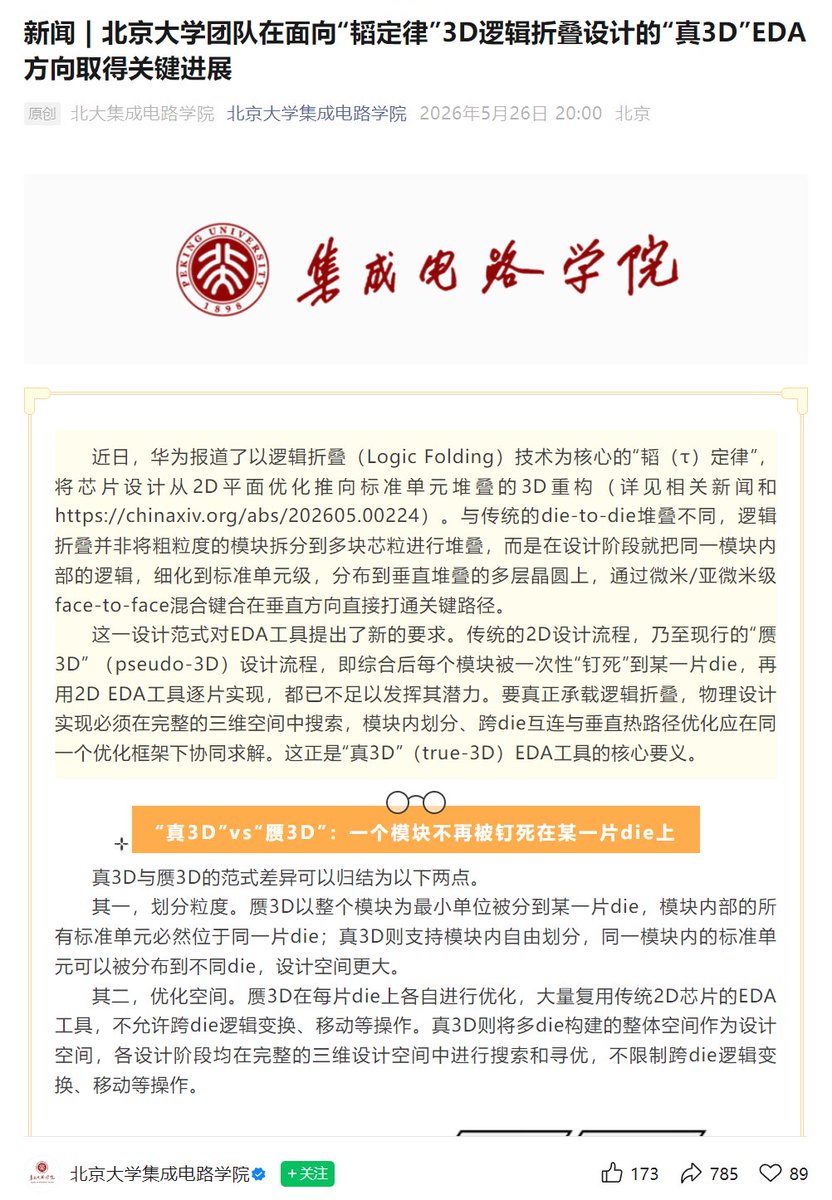
A research team from Peking University has reportedly achieved a major breakthrough in “true 3D” EDA tools designed for τ-scaling and 3D logic folding architectures.
The team developed what is claimed to be the world’s first “true 3D” physical implementation EDA prototype, aiming to overcome the limitations of traditional “pseudo-3D” design approaches.
Instead of treating each die as the minimum optimization unit, the new system treats standard cells as the basic unit, allowing cells within the same module to be freely distributed across multiple dies and optimized collaboratively in 3D space.
Reported benchmark results include:
• 30% reduction in wire length
• 6–12% timing improvement
• 3% reduction in peak temperature
• Verified at a scale of tens of millions of instances
This directly addresses one of the core bottlenecks behind Huawei’s proposed τ-scaling theory:
existing EDA tools are not designed to support large-scale logic folding architectures.
May 27

北京大学团队在面向“韬定律”3D逻辑折叠设计的“真3D”EDA方向取得关键进展
北大集成电路学院研发出全球首个"真3D"物理实现EDA工具原型,突破传统"赝3D"设计瓶颈。
将标准单元而非die作为最小优化单位,支持模块内单元跨die自由分布,实现三维空间协同布局。实测效果惊人:线长缩减30%、时序改善6-12%、峰值温度下降3% ,已验证千万级实例规模。
这直接回应了华为τ缩放理论的核心挑战——现有EDA无法承载逻辑折叠。
142
May 27
北京大学团队在面向“韬定律”3D逻辑折叠设计的“真3D”EDA方向取得关键进展
北大集成电路学院研发出全球首个"真3D"物理实现EDA工具原型,突破传统"赝3D"设计瓶颈。
将标准单元而非die作为最小优化单位,支持模块内单元跨die自由分布,实现三维空间协同布局。实测效果惊人:线长缩减30%、时序改善6-12%、峰值温度下降3% ,已验证千万级实例规模。
这直接回应了华为τ缩放理论的核心挑战——现有EDA无法承载逻辑折叠。
174
May 26
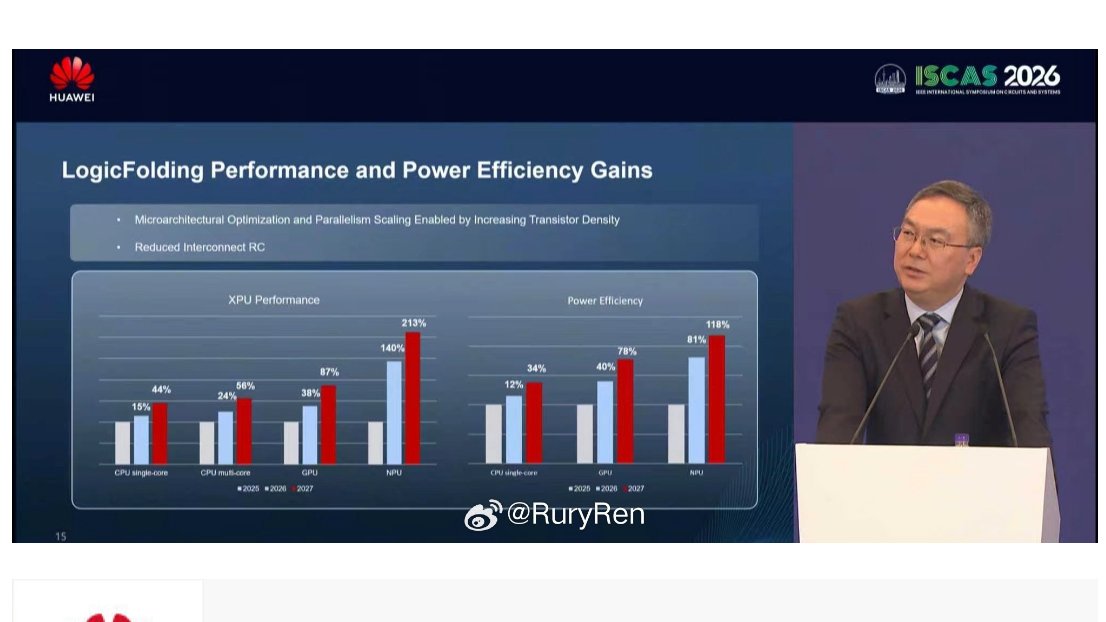
华为麒麟9050Pro(2026)和9060Pro(2027)相比麒麟9030Pro:
CPU单核提升15%/44%
CPU多核提升24%/56%
GPU提升38%/87%
NPU提升140%/213%
CPU单核能效提升12%/34%
GPU能效提升40%/78%
NPU能效提升81%/118%
72
May 26
Compared with the Kirin 9030 Pro, the rumored Kirin 9050 Pro (2026) and Kirin 9060 Pro (2027) are expected to deliver:
• CPU single-core performance: 15% / 44%
• CPU multi-core performance: 24% / 56%
• GPU performance: 38% / 87%
• NPU performance: 140% / 213%
Efficiency improvements:
• CPU single-core efficiency: 12% / 34%
• GPU efficiency: 40% / 78%
• NPU efficiency: 81% / 118%
#HUAWEI
May 26
麒麟9050Pro(2026)和9060Pro(2027)相比麒麟9030Pro:
CPU单核提升15%/44%
CPU多核提升24%/56%
GPU提升38%/87%
NPU提升140%/213%
CPU单核能效提升12%/34%
GPU能效提升40%/78%
NPU能效提升81%/118%
1
4
235