
566 Photos and videos








Pinned Tweet

10 Nov 2025
EOS Energy Enterprises: Building America’s Long-Duration Energy Backbone
Investment Pitch — Q3 2025 Revision
TL;DR Version
Eos ($EOSE) entered Q3 2025 with momentum and exited the quarter with clear proof of scale. Automation at Turtle Creek now covers 88 percent of bipolar lines, providing the throughput capability to support 2 GWh of annual capacity and confirming the repeatability of the company’s process. Contribution-margin positive performance is expected in Q4, with gross-margin positive results as Eos exits Q1 2026. The Department of Energy Loan Programs Office facility remains fully active, with Tranche 1 of $90.9 million completed and the first Tranche 2 advance expected before year-end.
Commercial traction continues to deepen. Frontier Power converted 228 MWh into backlog under its five-gigawatt-hour framework, while 16 projects totaling approximately 11 GWh advanced through Ofgem’s Cap-and-Floor Round 2 process - twice the original MOU volume. MN8 Energy executed a master supply agreement covering up to 750 MWh of deployments beginning 2026. A new collaboration with Talen Energy introduces Eos technology into AI-driven power infrastructure across Pennsylvania, anchored by the Robena Data Center campus.
The new 432 000 sqf. Marshall Township facility - supported by $24 million in state and county incentives - adds a straight-line, high-throughput manufacturing layout designed for replication. Line 2 has been ordered for spring 2026 installation, which will double nameplate capacity to 4 GWh per year. Record quarterly revenue of $30.5 million, double Q2 and accompanied by a 92-point improvement in gross margin, along with sharply higher utilization, confirms that Eos’s thesis - domestic manufacturing leverage, institutional adoption, and policy alignment - is translating into measurable performance.
Long-Form Pitch
The Q2 edition of this pitch described Eos on the threshold of scale. The company has now stepped across that line. The systems built over the past two years are proving their efficiency, the cost curve is compressing, and the commercial strategy is converting into real orders. Each of the levers behind the investment case - manufacturing leverage, institutional partnerships, and U.S. policy alignment - is now active in concert.
Eos is no longer a story of potential; it is one of execution. The zinc-based Z3 system continues to validate its role across the full spectrum of long-duration storage, now extending into the 4-hour range where lithium chemistry has historically dominated. Lower total cost of ownership, non-flammability, and domestic sourcing align with the priorities of customers, regulators, and investors alike. Federal loan support, state incentives, and commercial demand have converged to create a path not just to profitability but to a new category of American-made energy storage at industrial scale.
Technological Advancements and Manufacturing Milestones
The third quarter demonstrated the transformation of Eos’s manufacturing organization from ramp-up to performance. Automation at Turtle Creek now covers 88 percent of bipolar lines, providing the throughput capability to support 2 GWh of annual capacity and forming the backbone of the company’s margin trajectory. Process discipline under Chief Operating Officer John Mahaz has reduced defect rates by roughly 45 percent and improved plant reliability, reflecting broader gains in consistency and throughput achieved through lean manufacturing standards across every workstation.
These operational gains are not isolated; they reflect the company’s growing ability to replicate success. Supplier tooling has been standardized, allowing new lines to be commissioned in about 90 days - a key differentiator that will allow Eos to expand capacity rapidly as market opportunities materialize.
The new Marshall Township facility, a 432 000 sqf. building recently leased by Eos and now being configured for production, will house these new lines. Its straight-line layout eliminates the inefficiencies inherent in Turtle Creek’s retrofitted plant and is designed to ensure that throughput gains and lower handling costs continue to drive manufacturing efficiency, serving as the model for future scale-outs. Line 2 has been ordered for installation in spring 2026, which will double capacity to 4 GWh and provide headroom for sustained cost-down learning.
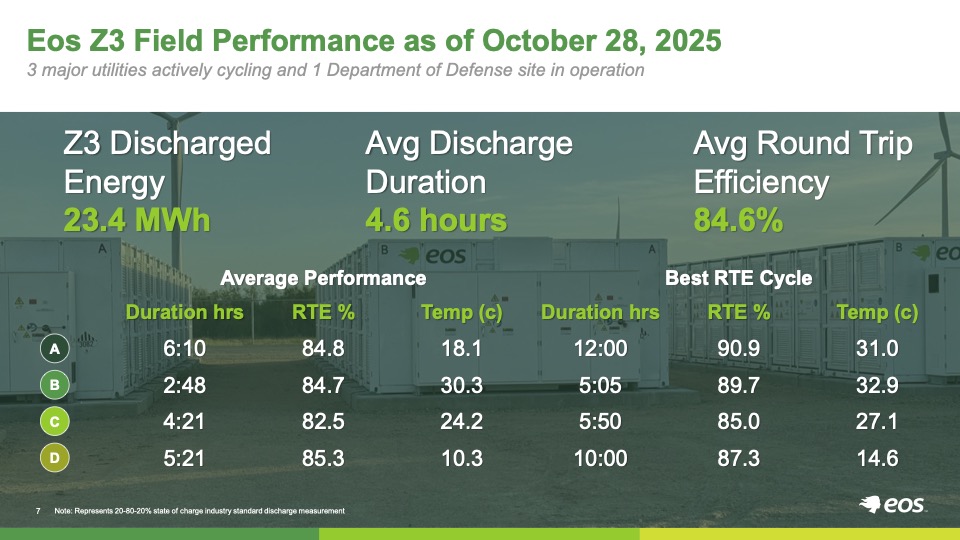
Eos’s internally developed controls and analytics platform, DawnOS™, is now the standard software layer across Z3 systems. Built entirely in the United States with no foreign-code dependencies, DawnOS™ enhances system balancing, predictive maintenance, and performance optimization. Together, these manufacturing and software advancements are converting the company’s theoretical operating leverage into reality. Field testing has also validated Z3’s responsiveness, with the system capable of reacting to grid-frequency changes in as little as five milliseconds. That speed positions Eos to participate in fast-response and ancillary-service markets traditionally dominated by lithium systems, broadening both the addressable market and the value of each deployed asset.
Strategic Grid Applications Beyond Renewables
Eos’s technology base, once associated primarily with renewable firming, now extends into the wider architecture of the grid and industrial economy. The Z3 system’s safety, scalability, and long-duration performance allow it to address a range of applications - supporting data centers, stabilizing transmission networks, reducing curtailment of renewables, improving the efficiency of existing generation, and providing fast-response power where and when it’s needed.
U.S. electricity demand is projected to double by 2050, driven not only by artificial intelligence and data centers but also by the broader electrification of transport, manufacturing, and heating. Meeting that demand will require capacity that is flexible, reliable, and deployable at speed - able to relieve congestion, firm intermittent resources, add efficiency to existing grid assets, and accelerate connection timelines for new load growth.
Through its collaboration with Talen Energy, Eos is developing multi-gigawatt-hour storage frameworks in Pennsylvania aimed at serving the next wave of AI-driven and industrial power demand. The Robena Data Center campus in Greene County illustrates the scale and type of opportunity emerging in this segment - integrating long-duration storage with legacy generation and new digital-infrastructure loads. While Eos has not formally announced participation, press coverage of the project indicates that International Electric Power (IEP) plans to use Eos technology, and the company has previously delivered systems for other IEP developments. The Robena project is widely viewed as a likely next deployment for Eos’s technology and underscores how zinc-based storage is moving from validation to critical infrastructure, powering data-center and industrial loads that define 24/7 energy demand.
Internationally, Eos signed its first behind-the-meter project in Germany with an industrial customer. Though modest in size, it provides a foothold in continental Europe and demonstrates the versatility of the Z3 system and DawnOS™ software in managing industrial energy profiles and on-site generation.
Strategic Partnerships and Financial Growth
Eos’s commercial activity deepened materially in Q3 as relationships established in prior quarters began converting into formal agreements, including master supply arrangements and portfolio-level partnerships. The total opportunity pipeline expanded to $22.6 billion, representing 91 GWh of potential projects, while the reported backlog reached $644 million, excluding approximately 1 GWh of additional orders booked after the close of the quarter. These results reflect a maturing commercial engine transitioning from pilot deployments to recurring, multi-site commitments with institutional customers.
The Frontier Power framework advanced from memorandum to execution. Within the 5 GWh agreement, Frontier booked 228 MWh into backlog, and all 16 projects under the umbrella progressed to Round 2 of the U.K.’s Cap-and-Floor program - together representing roughly 11 GWh, twice the volume of the original MOU. Each project requires eight or more hours of duration, matching Z3’s core capabilities and providing regulatory validation in one of the most structured grid markets in the world.
In the United States, the MN8 Energy master supply agreement covers up to 750 MWh of deployments beginning in 2026 and represents portfolio-level adoption by a leading clean-energy owner-operator. The Talen Energy collaboration expands that reach into the data-center and AI power segment, positioning Eos at the intersection of rising 24/7 demand and domestic energy supply.
In September, Eos completed the final milestone under the Cerberus term-loan agreement tied to customer-cash receipts. With all 16 milestones now achieved, no additional equity, preferred stock, or warrants were issued - closing out the process while preserving shareholder value. The completion of this process underscores Eos’s ability to meet every operational and financial commitment under the agreement while preserving shareholder value.
Together, these relationships define a commercial profile built on credibility and repeatability - progressing from technology validation toward sustained, multi-market demand.
Supply Chain Strengthening and Market Expansion
Beneath the top-line growth, Eos’s supply chain has become one of its strongest strategic assets. More than 90 percent of content is sourced domestically, ensuring compliance with the Inflation Reduction Act’s 45X and 48E provisions and avoiding foreign-entity restrictions that limit competitors. Stable input costs and standardized components have produced predictability in both production planning and gross margin.
Equally important, the supplier network has been reorganized to support the company’s replication model. Each partner now operates within a framework that assumes new lines can be added every 90 days once ordered, giving Eos the flexibility to scale production in step with the sales cycle. This cadence enables the company to execute on its strategy of building capacity for qualified demand rather than speculative backlog, ensuring that new investment directly supports revenue conversion. The approach maintains capital efficiency while lowering execution risk and allowing Eos to expand capacity in parallel with verified market growth.
The result is a supply ecosystem that is simultaneously local, resilient, and scalable.
High-Profile Contracts and Strategic Collaborations
The composition of Eos’s customer base underscores its commercial maturity. What began as individual pilot demonstrations has evolved into multi-project, multi-partner programs with some of the most credible names in energy. Frontier Power’s expansion in the U.K., MN8 Energy’s domestic framework, and Talen Energy’s entrance into AI-related capacity all point to a single theme: long-duration storage has crossed from experimental adoption to institutional planning.
These partnerships provide more than revenue - they provide validation. Each represents a counterparty capable of influencing standards and financing norms across the industry. As these projects move from contract to deployment, they will set the performance benchmarks by which long-duration storage is measured and, in doing so, establish zinc-bromine chemistry as a trusted alternative to lithium for large-scale stationary applications.
Infrastructure Expansion and Leadership Enhancement
Physical and organizational scale advanced together during the quarter, led by the build-out of the 432 000-square-foot Marshall Township facility - supported by $24 million in state and county incentives - now being configured for production under Project AMAZE.
Leading this effort is John Mahaz, appointed in August 2025 as Chief Operating Officer to oversee operations, supply chain, and manufacturing strategy through the next phase of growth. A 35-year manufacturing veteran who previously oversaw more than 30 global plants and 70 000 employees at Jabil Inc., Mahaz brings deep experience in scaling complex operations with discipline and precision. His arrival marked the point where Eos began combining rapid development with structured industrial execution. As Mahaz described, Eos is “at the inflection point every operations leader wants to step into” - a company striving to scale in a way that can reshape the energy-storage industry. The margin and productivity improvements achieved through Q3 reflect that alignment of speed and rigor, as lean principles and process control take hold across the organization.
At the same time, Eos began relocating its headquarters to Nova Place in Pittsburgh, consolidating leadership, engineering, and software development near its manufacturing base. The new software and controls hub, established under Project AMAZE, anchors this transition - housing the teams responsible for DawnOS™, battery-management systems, and advanced analytics. Together, these facilities form an integrated center for product innovation and operational coordination in western Pennsylvania, a region now emerging as a hub for advanced-energy manufacturing. These structural and leadership advances provide the platform for efficient, repeatable expansion as Eos transitions from demonstration to volume production.
Market Position and Future Outlook
Third-quarter financial results marked a decisive inflection point. Revenue reached a record $30.5 million - double the prior quarter and 35 times the same period last year. Gross margin improved by 92 points, and operating expenses fell $5.6 million as automation and scale delivered the expected cost leverage. Utilization rose to roughly 15 percent in Q3 and is projected to exceed 90 percent by year-end, with management noting that the company will exit Q4 operating its full asset base 24/7 as production moves to continuous operation. The improvement reflects both the completion of automation installation and the normalization of component supply as Eos transitioned from manual to automated production, establishing a steady operating rhythm.
Liquidity and federal partnership remain solid. The DOE loan guarantee is fully active: Tranche 1 ($90.9 million) has been drawn, and Eos expects to request its first Tranche 2 advance before year-end 2025. This long-term, low-cost capital provides both validation and flexibility to continue expansion under Project AMAZE. Cash totaled $126.8 million (including restricted amounts) at quarter-end, with an additional $43 million received in October customer payments.
Management reaffirmed 2025 revenue guidance of $150 - $160 million and reiterated expectations to achieve contribution-margin positive results in Q4 and gross-margin positive results exiting Q1 2026. The backlog of $644 million and pipeline of $22.6 billion (91 GWh) provide visibility well beyond those milestones. Eos’s financial trajectory continues to strengthen as scaling advances on a low-cost manufacturing base, bringing the company steadily closer to break-even. New opportunities are emerging in NYISO and other high-value markets where long-duration storage can relieve congestion and firm intermittent resources. The company is also developing indoor system configurations tailored to data centers and dense urban environments, extending its technology into new load segments while leveraging the same standardized platform that underpins its cost advantage.
Eos enters 2026 as a scaling, capital-backed U.S. manufacturer demonstrating the economics and reliability required for long-duration storage to become a mainstream grid asset class. Execution risks remain operational rather than structural - focused on timing and working-capital management - but the company’s liquidity, supply chain, and federal partnership provide sufficient cushion for continued growth.
The investment case is not simply intact; it is strengthening, as operational execution, financial performance, and commercial visibility now reinforce one another. Eos is converting proof into production, production into margin, and margin into momentum - a clear demonstration of how industrial policy, technology innovation, and disciplined execution can align to create a durable American energy-manufacturing company.
10
30
219
91,144
Gary Wentworth 🔋 retweeted

Ironically, if the American people were as pissed off at our elected representatives for creating $39 trillion in debt as they are with Elon Musk becoming a trillionaire, that might *actually* solve our problems.
50
81
629
13,285
Gary Wentworth 🔋 retweeted

I find it interesting that so many people attack @elonmusk for becoming a trillionaire after building companies, creating products, generating jobs, and helping create wealth for countless employees and investors. Yet there’s far less outrage directed at a government that has spent and wasted trillions of taxpayer dollars—often with little accountability, limited transparency, and documented cases of fraud. One fortune was built by creating value people chose to support; the other was spent using money taxpayers had no choice but to provide.
65
229
954
16,712
Gary Wentworth 🔋 retweeted

Jun 14
Elon, with his money, created trillions in value.
Politicians, with your money, created trillions in debt.
134
1,593
8,446
96,929
Gary Wentworth 🔋 retweeted

Jun 14
Can we debunk this nonsense?
Elon Musk was awarded (note: not given) cost-per-result contracts to perform a service for the US government. The total of those for SpaceX specifically is ~$22B, which includes repaid loans, state tax incentives, etc.
The deal was simple: put stuff into LEO at or below a set cost. If SpaceX does it below the set cost, SpaceX keeps the difference. If it doesn’t, the company is responsible for the overrun.
End result? SpaceX & Elon lowered the cost of getting 1 kg into LEO by 95-97% vs what NASA was paying previously.
And for the record, every other company around at the time was offered the same opportunity to bid on the contract - Musk/SpaceX just took it.
The handout narrative implies the taxpayer is the patron and SpaceX the dependent. The cost data shows the opposite: before SpaceX, NASA paid Russia’s Soyuz $80-86M per seat; SpaceX delivered at ~$55 million. SpaceX saved the US taxpayer $300M-$465M each year on that alone (the US sends 12-15 astronauts to space each year)
On the lunar lander, NASA estimated SpaceX’s fixed-price bid saved $20B-$30B vs the Boeing-preferred cost-plus approach.
So: SpaceX saved the US taxpayer more than the total value of contracts it earned on a single project, PLUS provided the US government with the requested services (put stuff in LEO) at the best possible price.
Jun 14

Elon Musk was given tens of billions in government contracts and tax breaks and was able to take a company that’s lost $41 billion and somehow become a “trillionaire.”
You will pay social security your whole life and they’ll tell you it’s an “entitlement” when you try to collect
432
2,913
11,862
1,177,317
Gary Wentworth 🔋 retweeted

Jun 13
We should make sure Americans are not pursuing entrepreneurial, game-changing, humanity-improving innovations and inventions that create enormous value and catapult American competitiveness? That culture and pursuit are what makes America special and unique. And it’s why Europe has no trillion dollar companies and is nowhere in the ai revolution or technology

Elon Musk just became the world’s first trillionaire.
Let’s make sure he’s also the last.
386
486
4,356
176,634
Gary Wentworth 🔋 retweeted

Jun 14
Ten reasons wealth taxes don’t work:
1.Europe already ran the experiment and quit. Twelve OECD countries had wealth taxes in 1990; only four do now. Those that still have wealth taxes don’t have CGT or IHT.
2.Norway proved how dangerous they are. A tiny rate hike was meant to raise ~$146m; instead $54bn of wealth fled and revenue fell by ~$448m net.  They hit the opposite of the target.
3.It will hit regular people. Governments typically bring in taxes on the “super rich”, then when it doesn’t work they lower the threshold.
4.Britain already wealth-taxes by stealth. Council tax, stamp duty, dividend tax, frozen thresholds, CGT, 40% IHT, luxury tax, private school tax - we have a diffuse wealth tax wearing a dozen costumes.
5.Wealth is a guess, not a fact. Income hit a bank account; wealth is an opinion about future value. You end up taxing and then litigating based on arguable estimates, every single year.
6.Most people can’t tell wealth from income. The politics sells because the public conflates “owns £10m of illiquid business” with “earns £10m” - they’re nothing alike.
7.It punishes illiquidity. Paper-rich, cash-poor founders must strip dividends from their own companies to pay - taxing ownership by gutting the thing that makes jobs.
8.The mobile escape; the rooted pay. Norway’s most-taxed man left for Switzerland in a weekend.  The regional business owner and the homeowner can’t so they get the bill.
9.It causes capital flight. More super-rich Norwegians left in 2022 than in the previous 13 years combined.  Capital is the most mobile thing there is.
10.It eats the seed corn. Wealth is just deferred investment the capital funding the next hire and the next business. It raises little, invites avoidance, and drains the capital base. 
BONUS: 90% of what we call wealth now is intangible - intellectual property, data, algorithms, startup venture valuations, brand equity etc. The days of wealth being houses, factories and materials that can be seized are long gone. If you make your country anti-wealth you are basically making it anti-competitive in the modern economy.

43
161
818
60,791
Gary Wentworth 🔋 retweeted

Jun 13
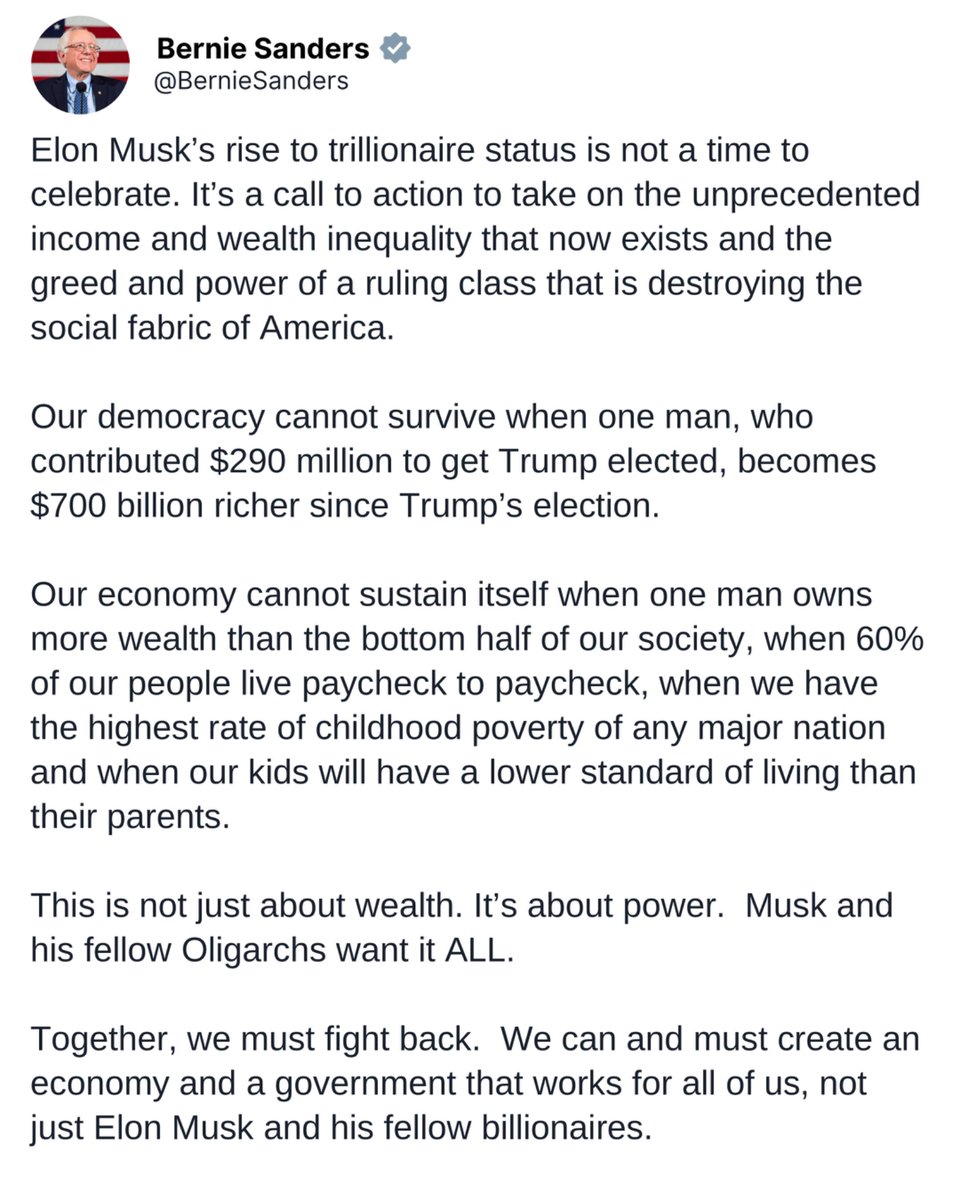
.@BernieSanders , it is a time to celebrate. @elonmusk has created enormous value for society by building @SpaceX, driving down the cost of rocket launches and creating a global satellite communication network that has brought high speed, low-cost internet and communication access to hundreds of millions and eventually billions of people along with critical advantages for our military and our nation’s defense.
SpaceX and its technologies will cause an acceleration in the growth of wages and wealth creation globally, including in some of the poorest communities in the U.S. and around the world.
Access to low-cost, high speed communications everywhere will allow children around the world to be educated, families to build businesses, and life-saving medical knowledge and care to be available everywhere.
SpaceX will materially bring down the cost of compute, advancing AI and humanity.
Meanwhile, 4,000 SpaceX employees yesterday became millionaires, including hourly wage employees who you claim you are trying to help.
The Elon Musks of the world drive growth, global GDP, and provide access to goods and services at lower cost that would otherwise not exist.
Elon’s nominal trillionaire status is due to his ownership of SpaceX, Tesla, Neuralink, the Boring Company and his other initiatives that have brought new technologies that improve our everyday lives.
Elon is not sitting on a trillion dollar pile of cash, jewelry and gold. He is using his controlling stakes in his companies to advance mankind. Elon’s companies don’t pay dividends. They reinvest all of their capital to accelerate innovation and value creation.
Elon is working 24/7 for all of us. He deserves respect and appreciation, not smears.
Bernie, your socialism would never allow a SpaceX to be built. Socialism has only proven to impoverish mankind and lead to death and destruction.
We need to create the conditions for more SpaceXs to be built, not attack the great entrepreneurs who are helping to advance our country.
Jun 12

3,700
9,220
48,692
2,640,355
Gary Wentworth 🔋 retweeted

Jun 12
Elon Musk has done more for workers than any democratic socialist politician ever has.
Jun 12

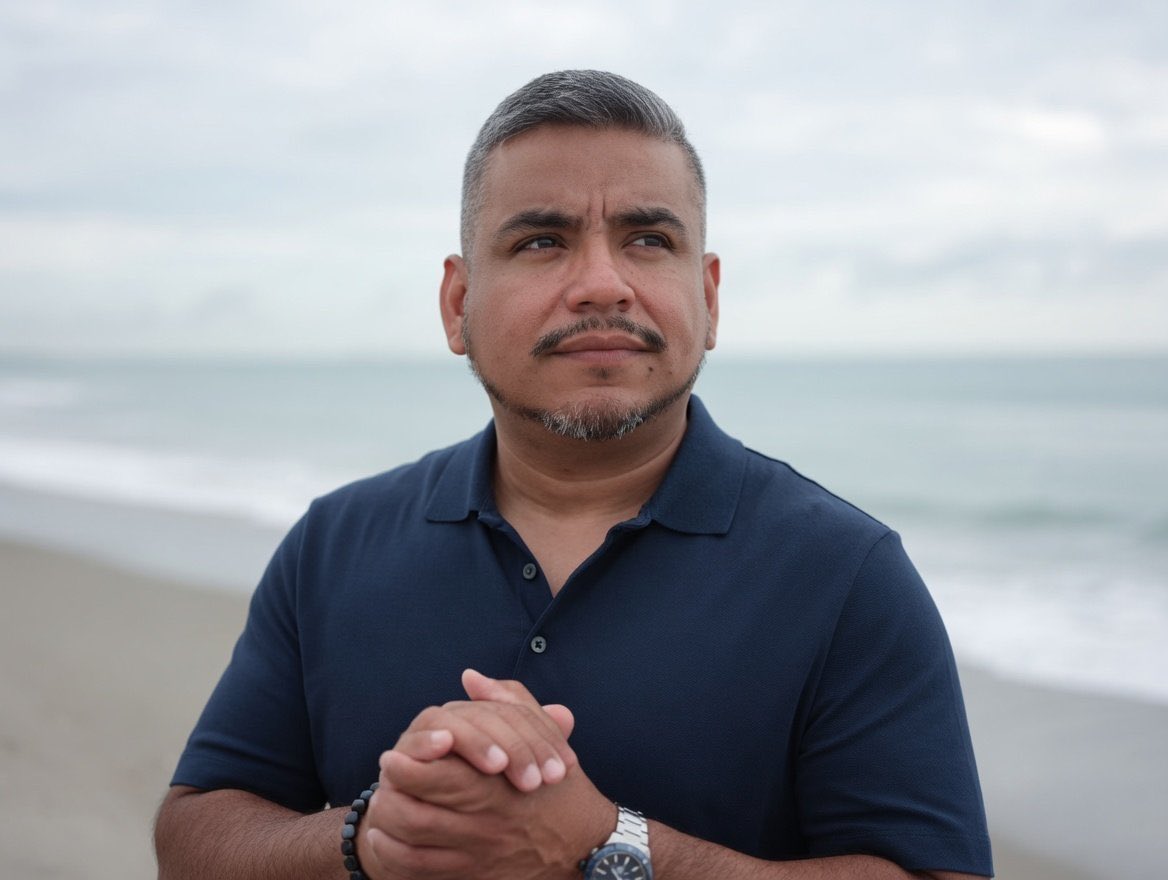
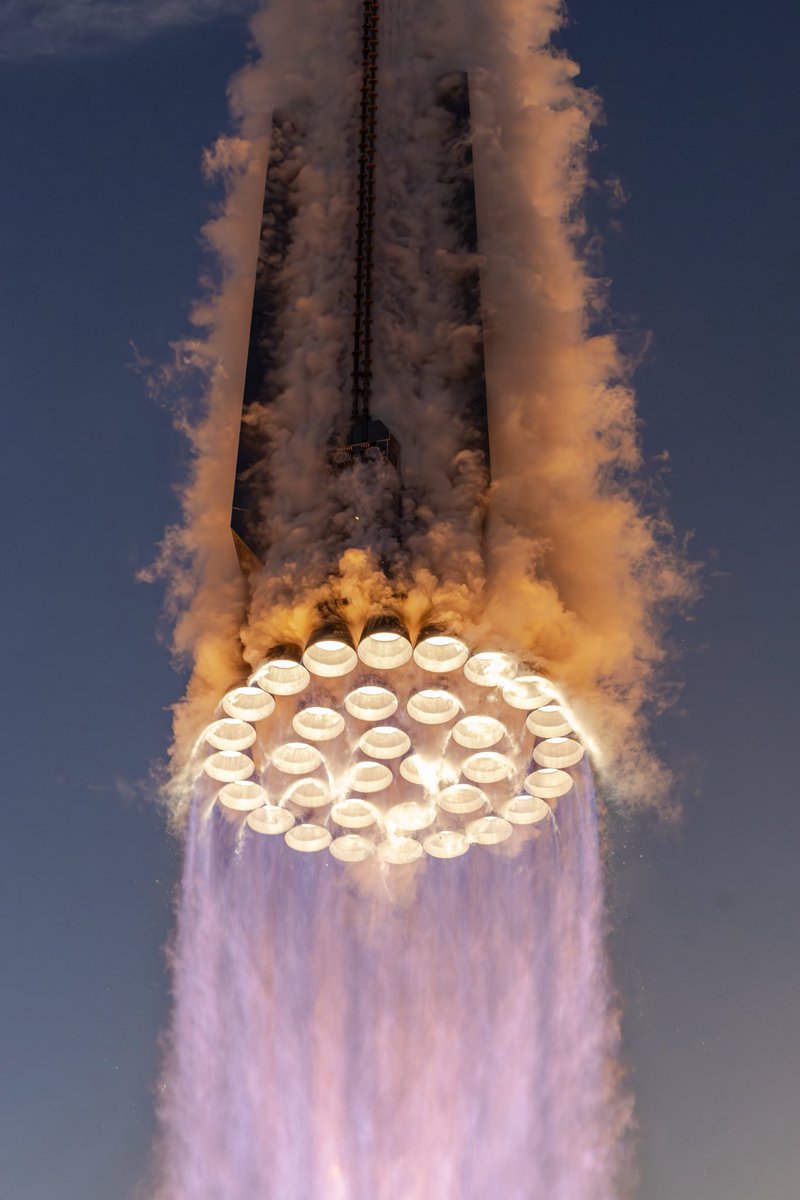
NEW: Juan Hernandez, a welder who says he took “just another contract job” at SpaceX for $28/hr in 2015, is now a millionaire as shares soar.
36
378
3,852
83,552
Gary Wentworth 🔋 retweeted

Jun 12
It blows my mind how many people are complaining that Elon became the first trillionaire.
First, most of it is paper wealth tied to equity in his companies. He could not turn it into real cash without dumping shares, which would crash the price and shrink his net worth massively.
“But he can borrow against his shares.” Sure he can. That does not make him richer. A loan still has to be paid back, the shares stay pledged as collateral the entire time, and if the price drops he gets margin called. He’s just leveraging paper.
You would be much richer holding $1 million in cash than owning 25% of a company worth $4 million, even though both equal $1 million on paper.
Second, come on. He actually changed the world. A lot of these people complaining drive electric cars because they care about emissions. Those cars would not be mainstream if Elon had not built Tesla. Millions of people in rural and remote areas have internet because of Starlink. SpaceX is the only reason NASA is not still paying Russia to send astronauts to the ISS.
You can hate the man. You can hate his politics. But pretending he is not one of the most consequential entrepreneurs of our lifetime is just dishonest.
297
391
3,587
222,751
Gary Wentworth 🔋 retweeted

Jun 12
This is economic toddler logic. Even if you could magically convert Elon’s entire $1.1T paper net worth into cash without crashing the value of his companies, it would fund U.S. healthcare spending for about 76 days. It would fund federal healthcare support for about 6 months. It would fund the entire federal government for less than 2 months.
The government already spends trillions on healthcare. If Elon’s wealth would magically solve it, why hasn’t their money?
So the “one rich guy exists, therefore healthcare crisis” argument is financial illiteracy compressed into one emotional sentence. It's appealing if you don’t understand how wealth, resources, or value creation work.
Jun 12

People die of preventable illnesses because they can’t afford healthcare
4
37
239
9,923
Gary Wentworth 🔋 retweeted

Jun 12
This is the shit that gets people killed.
We should live in a world where we celebrate entrepreneurship, hard work, and once-in-a-lifetime innovation.
Shame on the @globeandmail.
Jun 11

Opinion: SpaceX IPO makes Elon Musk the first trillionaire. Here’s how to properly hate him theglobeandmail.com/business…
529
1,207
11,349
242,805

It’s sad to see a governor of the state with the biggest tech companies not understanding the difference between wealth and capital.
That Elons SpaceX shares are not made of gas and groceries.
Jun 12

Americans are struggling to pay for groceries and gas while Elon Musk becomes a TRILLIONAIRE.
When the federal government is for sale, the rich get richer and everyone else gets shafted.
The system is rigged.
59
24
292
25,090
Gary Wentworth 🔋 retweeted

Jun 12
“If you enact an economy-destroying wealth tax on the world’s richest man you could increase the amount spent on student aid by 18% for one year!”
Morons.

Brad, a 5% tax on Elon's trillion net worth would literally pay for free college and trade school for every American.
And with the market's growth, he still would be worth over a trillion dollars!
You don't think that's worth it?
Community note
5% of $1.2T is $60b. 8m students in BA/BS programs on average pay over $20k/yr, or ~$160b/yr for BA/BS degrees only.
That tax could not cover even half of only US bachelor degree costs for just 1 year, excluding grad, ass., or trade degrees totaling another ~10m students.
nces.ed.gov/programs/coe/i…
bestcolleges.com/research/colle…
10
40
776
23,274
Gary Wentworth 🔋 retweeted

Jun 12
Elizabeth Warren embodies one of the most anti American ideas imaginable:
The belief that extraordinary success is suspicious, that wealth requires political permission, and that the more value you create, the less right you have to keep it.
The American ideal was never equality of outcome.
It was the freedom to rise as far as your ability, ambition, and voluntary exchange could take you.
Warren sees a trillion dollars and asks how much should be confiscated.
I see a trillion dollars and ask what was created to make it possible.
Jun 12

Elon Musk just became the world's first trillionaire.
The typical American household would have to work more than 11 MILLION years to make Elon Musk's level of wealth.
We need a wealth tax.
24
75
369
6,115
Gary Wentworth 🔋 retweeted

Jun 12
When I give my savings to @elonmusk they multiply. When I give them to you and all of the US government, they disappear.
Jun 12
Elon Musk just became the world's first trillionaire.
The typical American household would have to work more than 11 MILLION years to make Elon Musk's level of wealth.
We need a wealth tax.
680
5,768
44,030
788,219
Gary Wentworth 🔋 retweeted

Jun 12
The first trillionaire in human history
- Elon Musk
- Born in South Africa
- Bullied relentlessly as a kid
- Immigrated to North America
- Arrived with a backpack and a dream
- Built Zip2 with his brother
- Sold it 4 years later for $300 million
- Co-founded PayPal with the profits
- Revolutionised digital payments
- Sold PayPal to eBay for $1.5 billion
- Bet everything on Tesla and SpaceX
- Got mocked for electric cars
- Got laughed at for reusable rockets
- Nearly went bankrupt in 2008
- Kept building anyway
- Turned Tesla into the world’s most valuable automaker
- Made EVs mainstream and transformed the automotive industry
- Made reusable rockets a reality
- Reduced the cost of reaching space by 95%
- Sparked the modern commercial space race
- Built Starlink and connected millions around the world to high-speed internet
- Turned SpaceX into the most valuable private company in history
- Bought Twitter for $44 billion
- The world said he overpaid
- He was called reckless, stupid & crazy
- Advertisers fled, media declared it dead
- Critics called it the worst acquisition in tech history
- Renamed it 𝕏
- Rebuilt the platform anyway
- Turned it into one of the most influential platforms on Earth
- Launched xAI and accelerated the global AI race
- Sent astronauts to space
- Is trying to get humans to mars
- Created millions of jobs
- Generated hundreds of billions in value
- Inspired an entire generation of builders
Before:
- Failed repeatedly
- Worked insane hours
- Slept in factories and offices
- Got bullied, laughed at and mocked
- Constantly told “it’s impossible”
- Kept building anyway
- Made it possible
Today:
- Richest person on Earth
- First trillionaire in human history
- Largest IPO in history $1.77 trillion
Most people quit when the world laughs at them.
Elon Musk built the future instead.
Love him or hate him…
Nobody has changed more industries in a single lifetime.
Payments. Cars. Energy. Space. Social Media. Communications. AI.
History won’t remember the people who said it couldn’t be done.
It will remember the people who did it anyway.
Congratulations Elon.
The first trillionaire. 🚀


4,394
28,842
112,175
2,398,444
Gary Wentworth 🔋 retweeted

Jun 11
AJ Brown on Drake Maye:
🎥: @ByMarkDaniels
AJ Brown on Drake Maye:
“The talent speaks for itself. He can make any throw…to be that young and to understand the defense and every little check, the hots, the blitz, so young and so fast, it’s very impressive…he’s a true leader. He’s a true leader of men. It’s crazy to see at a young age, he’s a true leader of men.”
24
64
1,673
88,035

Jun 12
$EOSE FPUSA RO announcement
Today’s Rights Offering announcement, even if light on some important details, clarified a few important things for me regarding the structure of the FPUSA capitalization.
Most importantly, the filing explicitly states that participation rights will be distributed to common shareholders and holders of the April 2023, May 2023, December 2023 and November 2025 warrants. Notably absent from that list were any explicit references to Cerberus-linked warrants or DOE warrants. That omission is interesting and feels intentional.
Up until now, many have simply assumed that Cerberus would fully participate alongside common shareholders through the RO process itself. I’ve mentioned previously that Cerberus participation may ultimately be more nuanced than many currently assume, and today’s filing may support that idea.
Cerberus anti-dilution protections become relevant only below a pricing threshold of $5.99. So if the RO is ultimately structured above those levels, then automatic anti-dilution adjustments do not activate.
That creates an interesting dynamic. If Cerberus ultimately does not participate in the RO itself, or participates partially, then some dilution at the Eos corporate level may simply be acceptable to them given that they are already separately contributing substantial capital and founder economics into FPUSA. Meaning, it is at least possible that Cerberus ultimately views any potential dilution at the Eos corporate level as being offset by the Frontier platform economics.
To be clear, none of this proves Cerberus will or will not participate in the RO. And the announcement does not directly address how Cerberus’ existing contractual protections are ultimately handled. But I do think today’s filing was more revealing than it may initially appear, particularly because the company very specifically enumerated participating warrant classes rather than simply saying “all outstanding warrants.”
investors.eose.com/news-rele…
5
1
44
3,988