
Christian, Software Engineer, Docs. Opinions are mine and not of my employer 👍🏽
Joined November 2016
- Tweets 20,328
- Following 2,748
- Followers 5,623
- Likes 71,286
890 Photos and videos














My favorite @elonmusk quote that I often send friends:
Do not fear losing. “You will lose,” Musk says. “It will hurt the first fifty times. When you get used to losing, you will play each game with less emotion.” You will be more fearless, take more risks.
121
3,506
22,555
568,731
Fortune 🥑 retweeted

Apr 3
All this and you’re still making five yr plans. All this and you still worry about double texting. All this and you’re still counting calories and sucking in your stomach. All this and you still can’t forgive your parents. All this and you’re still waiting for someone to go first


105
3,712
26,917
1,138,722
Fortune 🥑 retweeted

Apr 2
Using AI ≠ Understanding AI.
Stop being a proxy. Start being dangerous.
New video breaking this down, let me know what you think.
29
61
253
7,994

😂😂😂
Mar 29

claude code discombobulating, shimmying, frolicking, doing hard yakka in balenciyagga
blah blah blah
just put the tokens in the bag and get it done lil bro I don’t got all day
1
416
Fortune 🥑 retweeted

Mar 26
What a story! A janitor at a Yale University teaching hospital earned a college degree while working full time, then went to med school and is now returning to the same hospital as a resident in anesthesiology! washingtonpost.com/lifestyle… Mentors matter so much!
68
921
5,016
158,725
Fortune 🥑 retweeted

Mar 26
Nigerians are in the comments complaining about how poor their salaries are, and rightfully so. But when it’s time to get involved in the decisions that shape those outcomes, tribe and religion suddenly take over.
It’s strange how people can be united by hardship, yet divided by identity, even when those divisions don’t actually change anything about their reality.

52
2,443
6,014
149,309
Fortune 🥑 retweeted

Mar 25
Igbo Christians remove the cap. They know what it means as a Christian you lower your self when you speak to God, and guess what that is correct and the ultimate respect to God.
When you speak to your chi, or your ancestors you don’t remove your cap because you are their ontological equal. But when you speak to the Supreme God who made all of it, Nwanne remove that thing.
Mar 25

Obi Of Onitsha visited the permanent site of Shanahan University with his cabinet members...When the Arch Bishop started praying after the supervision... Obi Of Onitsha and his cabinet members removed their title red cap whereas the bishop didn't remove his....Arch Bishop knows the cap on his head is an honour to whatever he believe in whereas our custodian of Igbo culture doesn't know the meaning of the red cap on their own head....As a titled Igbo man with red cap....That cap on your head is an honour to CHI and Ezumezu...You dare not remove it during igo Ofo or any sort of prayers.
This is very Embarrassing...
We will definitely start getting it right....
We must unlearn to re-learn.

64
120
768
114,442
Fortune 🥑 retweeted
We are excited to announce Monad Blitz Lagos – Build Fast. Build Onchain. Build IRL. ⚡
📅 Saturday, April 11, 2026
⏰ 9:00 AM – 6:00 PM
Register: luma.com/kumue622
Join us for an intense 1-day IRL hackathon where developers will build, experiment, and deploy onchain!
Expect hands-on learning, rapid building, and an opportunity to connect with the vibrant Monad developer community and win rewards!
Hosted by Web3 Afrika in collaboration with the @monad Foundation.

19
28
105
12,651

Fortune 🥑 retweeted

Feb 11
At no point in human history have we been subjected to so much life advice from complete strangers, be very careful about whose words you take to heart, they're selling their path and know nothing of yours
95
1,401
5,300
155,495
Fortune 🥑 retweeted

Jan 18
4,624
5,917
46,942
13,845,697
Fortune 🥑 retweeted

Jan 26
Over the weekend... I built an open-source Palantir! 🚀
It visualizes these:
- Country conflict intelligence
- Military bases locations
- Near real-time threat mapping
- Deep research/Intel on entities like Hezbollah or any groups
Learn wars, conflicts, military bases and history of nations with the Global threat map. 🧙
🔗 globalthreatmap.up.railway.a…
203
761
5,923
423,992
Fortune 🥑 retweeted

Jan 22
As someone who lived in Lagos before exiting, I believe that to genuinely enjoy Lagos, you must fall into one of four categories:
(1) You’re an occasional IJGB visitor, returning intermittently and selectively, buoyed mostly by nostalgia and the romance of distance.
(2) You have never lived in a properly functioning city outside Nigeria for more than 3 consecutive months; a strenuous visit to Zanzibar or Kenya every other year does not qualify.
(3) Your income, social or other advantages are so tightly coupled to Lagos that leaving would require an intolerable loss of status, access, or opportunity making you a rational actor under enormous constraints.
(4) You are temperamentally suited to chaos and tolerant of disorder in a manner that is so unusual, it would be best explained by a rare combination of low intelligence, a comfortingly low threshold for environmental expectations, and the possession of just the right physical resilience required to absorb the daily friction.
Outside these categories, Lagos is utterly a hell hole. I will always stand by this. More than half the world’s population would struggle to believe it is even possible to live under conditions this hostile especially because those conditions are obscured by a remarkable asymmetry between everyday lived experience and the city’s relentless PR.
156
1,328
3,993
336,183
Fortune 🥑 retweeted
14 Apr 2025
People are the true wealth. People. Not things. Not resources.
People. Then ideas. Then all the rest.
If you have the right people, and subscribe to the right ideas the rest will fall into place.
15
569
1,381
43,669
Fortune 🥑 retweeted
18 Nov 2023
On interviews. First——
Get them engaged and make them like you. Your entire strategy should be built on how to make this happen. Sharing some tips based on cool comments I’ve received from interviewers.
192
3,917
12,475
1,896,324
Fortune 🥑 retweeted

25 Dec 2025
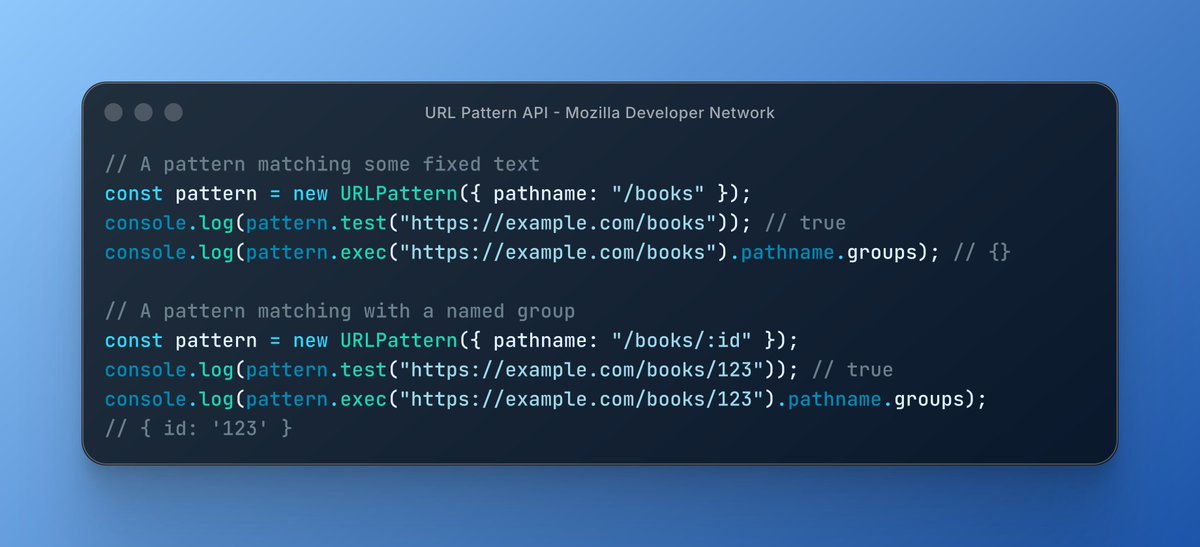
Quick remind to not use URLPattern in @nodejs, it would be painfully slow.
adventures.nodeland.dev/arch…
25 Dec 2025

🆕 The URL Pattern API is Newly Available!
Use it to match and extract parts of URLs, no need to reinvent routing logic. Supports literals, wildcards, named groups, and even regex constraints.
Learn how it works 👇
developer.mozilla.org/en-US/…
17
24
385
109,713
Fortune 🥑 retweeted
27 Dec 2025
stop copy-pasting code into chatgpt like a caveman.
cursor and copilot are amazing, but your context is trapped in your editor. team review? deep-dive debug on discord or elsewhere?
one command. entire codebase.
npx repomix 🛂
68
125
592
27,454
Fortune 🥑 retweeted

21 Dec 2025
I don’t think we need to lie to ourselves, or exaggerate our similarities to coexist. I believe deeply in freedom of religion. I have friends of other faiths. I eat with them, respect them, and defend their right to worship. But respect doesn’t require pretending our beliefs are the same. It doesn’t require pampering. It allows honesty.
When someone says, “We worship the same God and we believe in Jesus too,” that sounds conciliatory, but on closer inspection, it’s a false flag.
Here’s why.
If someone tells you they honor Donald Trump, respect him, acknowledge his importance, but insist he is the Governor of New York, not the President of the United States, what do you do with that? You don’t applaud the respect. You point out the category error. Titles matter because roles matter.
Now imagine this claim appears 600 years after Trump lived, contradicts all earlier records, and then adds, “He wasn’t really President, it just appeared that way.” At some point, respect without accuracy becomes meaningless.
I agree that religion is more complex than politics, but the logic is not different.
Yes, Jesus is mentioned in the Qur’an. That’s not impressive by itself. Why wouldn’t He be? Jesus is one of the most historically attested, morally exceptional figures in human history. Agreeing that He existed, that He was sinless, or that He was a prophet is not a theological achievement, its baseline acknowledgment of reality.
The issue is not whether Jesus is mentioned. The issue is who He is said to be and what role He plays and this is where the contrast becomes stark.
The New Testament, take the book of Hebrews alone, does not merely make claims about Jesus. It argues;
1. Hebrews 1 carefully establishes that Jesus is not an angel but categorically above them.
2. Hebrews 2 explains why He had to become fully human, to truly represent humanity and defeat death from within.
3. Hebrews 3 shows He is greater than Moses, using a precise analogy: the builder of the house is greater than the house itself.
4. Hebrews 4–5 lay out the criteria for priesthood; representation, sympathy, divine appointment, and then demonstrate, step by step, how Jesus meets and exceeds every category.
This is theological reasoning, not assertion. It’s coherence, not command.
By contrast, Islam re-characterizes Jesus dramatically, denying the crucifixion, denying sonship, denying mediation, yet offers no comparably rigorous explanation for why this reinterpretation should override earlier testimony or how this version of Jesus resolves anything at all. Saying “Jesus is a prophet” is not depth. It’s reduction. And when you reduce someone while claiming to honor them, the burden is on you to explain why your version should be taken seriously.
So yes, if Islam wants to claim continuity with Jesus, it’s not too much to ask for something more than isolated verses followed by “submit.”
It should answer the theological depth that already exists. Let’s judge the arguments, not the applause lines.
19 Dec 2025

I want every Muslim to REPOST this video!
Steve reveals how his opinion changed about Muslims when he met them. He made it clear that they were told totally different thing about Muslims.
The western world is spending a lot of money to spread falsehood about Muslims is the world.
23
201
548
33,118
Fortune 🥑 retweeted

19 Dec 2025
Let me teach you one of life’s important lessons, then. When you achieve a goal, you set your sights on the next one.
That’s the meaning of life, staying hungry.
19 Dec 2025

Getting a reply from Arnold would complete my life
582
4,038
43,022
1,373,742
Fortune 🥑 retweeted

13 Dec 2025
END-OF-THE-YEAR COMMUNITY BOUNTY CHALLENGE IS HERE! 🎉
Fam, as we wrap up 2025, we want YOU to document everything we achieved this year in the most fun and creative way possible!
From Dec 15th to Dec 23rd, we're hosting a community-wide bounty challenge with a $400 prize pool for 5 winners! 💰🔥
Your challenge:
✅️ Create a recap of Web3 Afrika’s 2025 journey including:
✅️ Events we hosted
✅️ Workshops, spaces & masterclasses
✅️ Partnerships & collabs
✅️ Community wins
✅️ Any special or memorable moments
✅️ Our ecosystem growth
How you can document it:
📝 Write an article
📊 Make a design or infographic
🎥 Create a video recap
📚 Do a carousel or monthly breakdown
🎙️ Record a storytelling video
🎨 Or any format you love!
Rules:
✅️ Must cover Jan–Dec 2025
✅️ Must be your original work
✅️ Must have been the part of the community for at least 2 months
Submission must be posted on X and tag @web3afrika, @olanetsoft and @developer_dao
🏆 Prize Pool: $400
👥 Winners: 5 community members
📅 Duration: 15th – 23rd December
Let’s end the year with creativity, memories, and community energy. Can’t wait to see your entries! ❤️

9
13
49
7,987