
Joined October 2025
- Tweets 14
- Following 8
- Followers 151
- Likes 49
1 Photos and videos
Pinned Tweet

Feb 5
Matching TradFi market structure is the only way blockchains win.

3
1
8
2,064
Continuum retweeted

Jun 5
TL;DR:
> Type of takers responsible for price discovery: HFT/algorithmic and latency-sensitive traders.
> Type of venues dominating price discovery: CEXes and DEXes with low-latency FCFS microstructure.
Cancel priority, RFQ, and FBA microstructures deter the very category of trades responsible for the bulk of price discovery.

1
4
32
4,410
Mar 26
This is the thesis of continuum - institutions care about fine-grained ordering guarantees.
x.com/blockworksdas/status/2…

"MEV — that ability for people to reorder transactions to extract value, something that happens on top of Ethereum and Solana — that's just not suitable for financial markets."
@drwconvexity @DRWTrading
2
6
513
Mar 9
If your transaction came in 100 microseconds before someone else, continuum will order you accordingly. The only blockchain with this guarantee.
1
2
7
684
Feb 18
The cost of MEV is stunted adoption of blockchains themselves.
5
181
Continuum retweeted
28 Nov 2025
Continuum is now live on testnet.
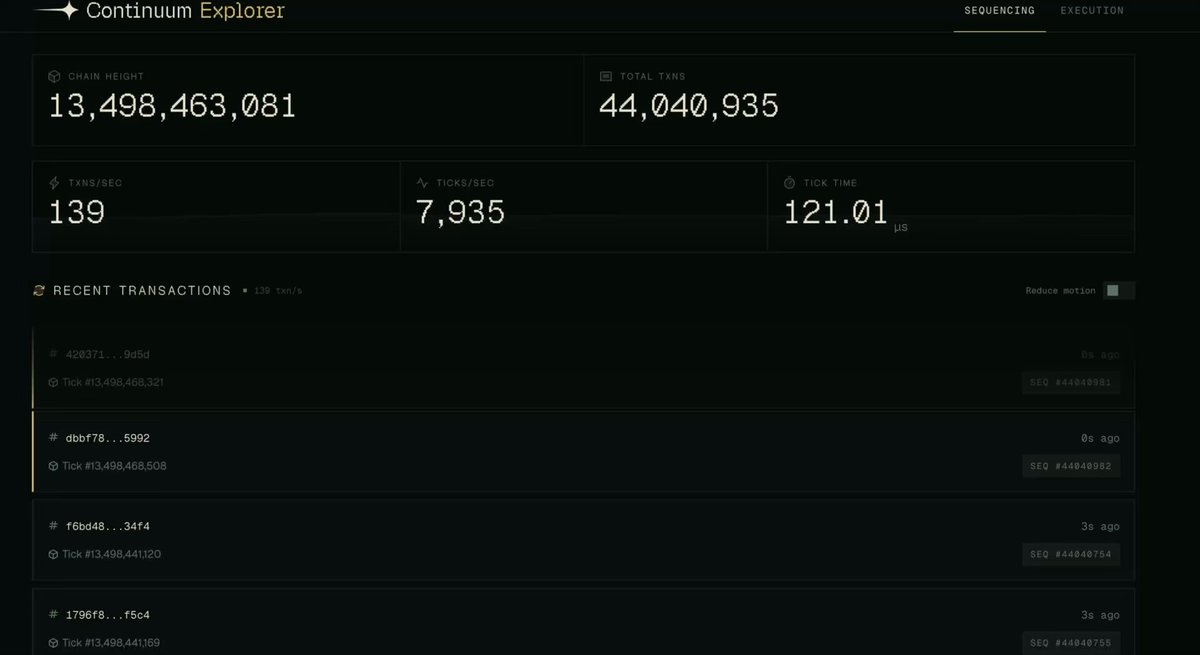
You can check out the explorer here: continuum.wtf/
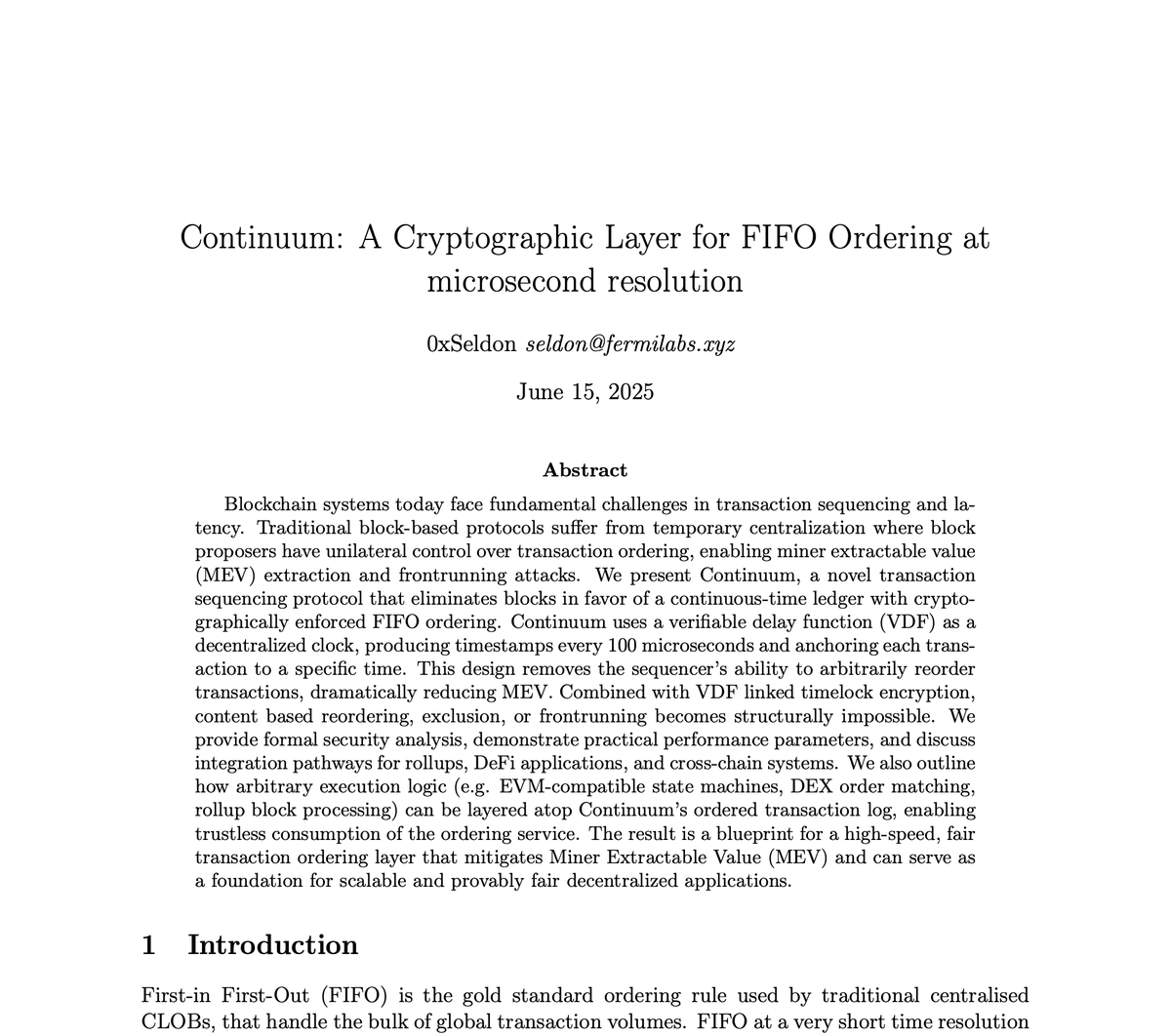
And learn more from the whitepaper: fermilabs.xyz/whitepaper.pdf
(This is the last post in the thread)
2
2
21
1,545
Continuum retweeted
28 Nov 2025
Introducing @ContinuumChain - the first blockchain with fair ordering guarantees at microsecond resolution.
8
11
51
5,949
26 Oct 2025
Continuum aims to answer the question: Who came first?
Surprisingly enough, there is no cryptographic primitive/trustless way to answer this at fine-grained time resolution as of today. The closest thing we have is committee-based fair-ordering protocols that operate at coarse resolutions of a few seconds.
30
2
32
2,619
26 Oct 2025
Continuum is a trustless, verifiable sequencing protocol. It allows users to trust that all incoming orders were treated the same, and indexed fairly upon arrival. While the full protocol is described in our whitepaper, we can highlight two key aspects required to make this possible.
6
9
636
26 Oct 2025
First, the sequencer must have an internal source of time - we use a recursive Weselowski VDF as proof of elapsed time, at microsecond resolution.
Second, when assigning these timestamps, the sequencer must be blind to the contents of the order.
We achieve this by utilising fine-grained time-lock encryption, which allows the order to be hidden during ordering and decryptable rapidly thereafter, enabling blind ordering and fast execution simultaneously.
4
5
527