CEO and Founder of @DRWTrading and @CumberlandSays
Joined November 2013
- Tweets 141
- Following 373
- Followers 5,172
- Likes 84
2 Photos and videos

Super proud to share @ComputeXchange has achieved SOC 2 Type II compliance. For a marketplace built on connecting buyers and sellers of compute, this milestone is more than a badge — it's third-party validation of the security and operational discipline that underpins every transaction on our platform. More info here: trust.compute.exchange/
1
2
5
2,049

May 27
As global regulators including the @SECGov, @CFTC and @bankofengland explore how best to enable markets to benefit from the efficiencies moving on-chain, blockchain selection is an underrated but critical choice. Some designs embed front-running and information leakage directly into execution. Others are designed to prevent it. My latest in the @FT on why these choices matter for investors and capital markets: ft.com/content/2fdbb11e-8c8d…
6
12
73
10,278
May 20
.@MessariCrypto's report on @CantonNetwork clearly frames the problem we’ve been focused on for years: financial markets need synchronized settlement and interoperability without sacrificing privacy and selective disclosure. Most systems force a tradeoff between the two. Canton does not, with intention. It's exciting to see institutions like @The_DTCC, @Broadridge, @jpmorgan and @FranklnTempletn using this architecture for real collateral and settlement workflows. messari.io/report/understand….
9
22
111
10,661
Don Wilson retweeted

May 19
Today, we announced a new investment round backed by leading trading firms as Eris SOFR adoption continues to rise.
Open interest has tripled in 16 months ahead of the June launch of Eris Options at CME Group.
Full release: businesswire.com/news/home/2…

1
4
7
860
Survived my first CNBC hit at 3am HK time. Lineup: @cerebras CFO @BobKomin on IPO day, @OctahedronCap, @SambaNovaAI CEO… and me, talking the first compute futures market with @CMEGroup
Thanks @dee_bosa for having me. m.youtube.com/live/w8DO0baoT…
May 14

We've got the biggest IPO of the year surrounded. LIVE at 3p ET /12 on youtube.com/watch?v=w8DO0bao…
Cerebras CFO @BobKomin on the company's first day as a public stock
Octahedron Capital’s @_ram_ on whether the trade works and what could break it
SambaNova CEO @RodrigoLiang on what a successful Cerebras IPO means for everyone still on the private side
And Silicon Data’s @carmenli on the first compute futures market with CME
1
1
13
3,124

JPMorgan and other big Wall Street firms are using crypto's underlying technology to transform a key corner of the financial market bloomberg.com/news/features/…
12
12
40
14,279
May 12
I've believed for years that compute would evolve into one of the world’s most important commodities — which is why I backed the creation of @Silicon_Data and @computeexchange two years ago.
Today’s announcement from @Silicon_Data and @CMEGroup is an important step in that direction. As AI scales, compute markets are developing the same kinds of supply, volatility and capital allocation dynamics we’ve seen in energy and other major commodity markets. Futures markets matter because they improve price discovery, reduce the cost of capital and support long-term infrastructure investment.
ft.com/content/3e6b81e3-954d…
1
3
47
7,195
Digital Asset Holdings, the company behind a blockchain used among several big banks and trading firms, is raising money from investors including a16z crypto at around a $2 billion valuation, people with knowledge of the matter said bloomberg.com/news/articles/…
18
25
149
95,315
May 1
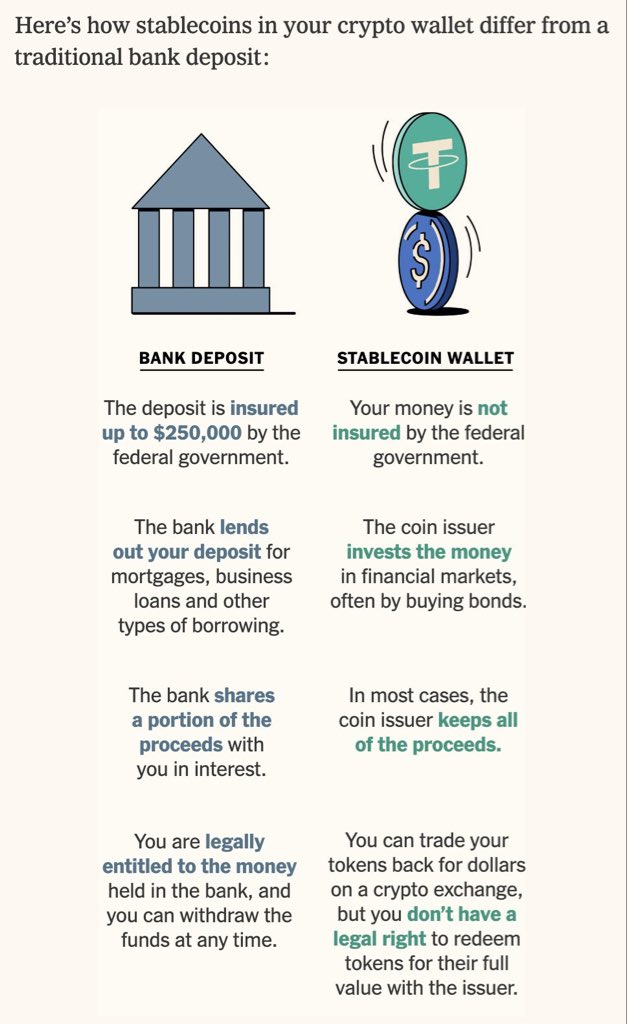
Tokenised repo only works if the “cash” leg is truly cash-equivalent. Some thoughts on how proposed US stablecoin rules could impact that, and why transparency in reserves will be critical for market confidence. Thank you to @ISDA for hosting an important conversation on how proposed stablecoin rules could shape liquidity and market structure.
May 1

As digital assets and traditional markets converge, market structure matters. Our CEO @drwconvexity highlights how proposed US stablecoin rules could impact liquidity and the viability of tokenised repo, reinforcing the importance of transparency, resilience, and true cash-equivalence in next-generation financial infrastructure. Read more: risk.net/regulation/7963449/…
8
7
57
10,986
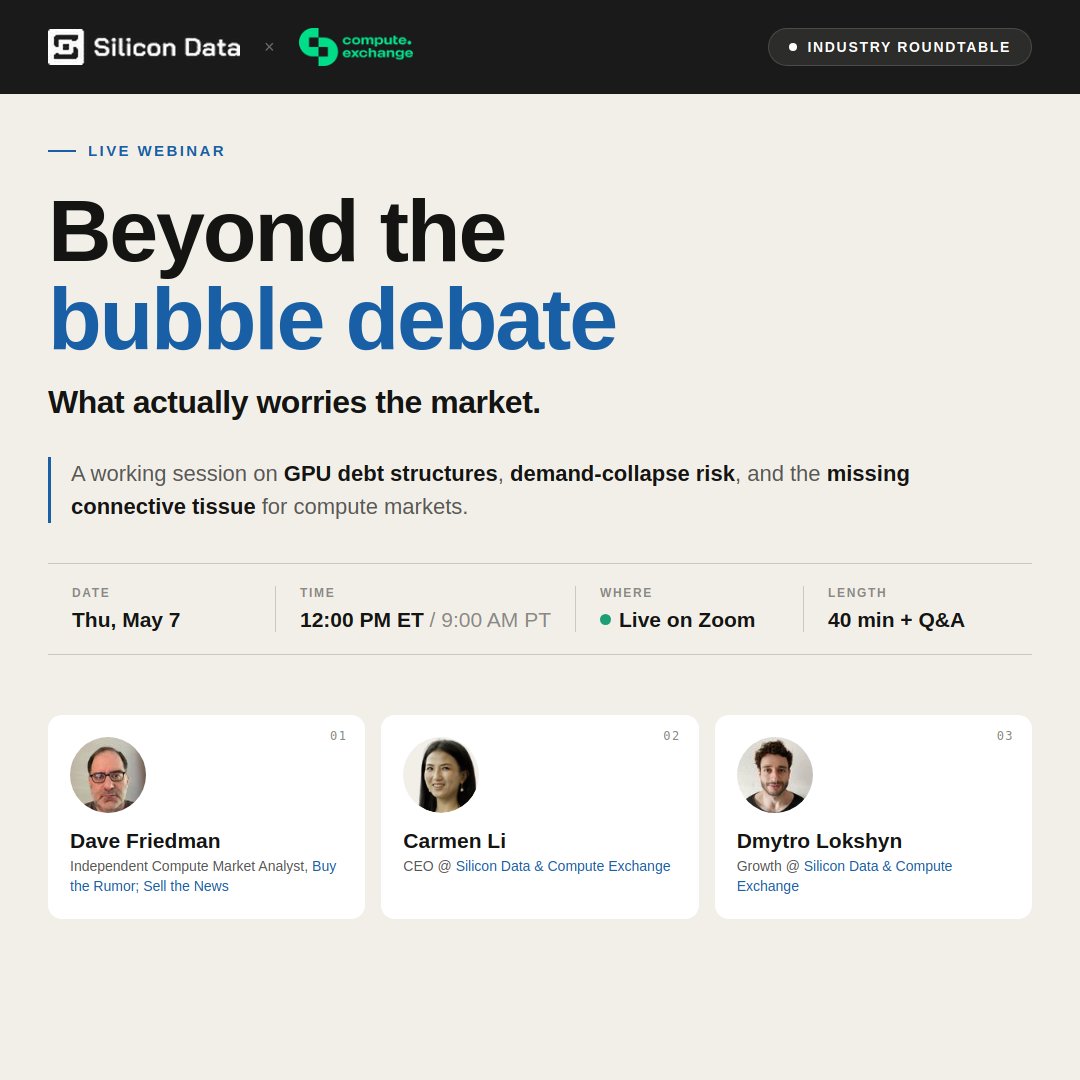
The bubble debate is a distraction.
Compute already has natural longs, natural shorts, speculators, a forward curve, and benchmarks.
What it doesn't have yet: standardized contracts and deep hedging venues. The connective tissue every other commodity figured out 50 years ago.
That gap is what's actually pricing risk in the market right now.
David Friedman, Dmytro Lokshyn and I are going deep on it next Thursday.
Thursday, May 7, 2026 — 12:00 PM ET (9:00 AM PT)
Live online via Zoom
Link: luma.com/kpro2g8x
1
2
7
1,580
Apr 16
I am excited about the launch of options on Eris swap futures on June 16! Congratulations @ErisFutures on the dramatic growth in volume and open interest of the futures, which has laid the groundwork for the launch of options. Thank you for the support from @CMEGroup!

🚨Eris SOFR Swap options are coming June 16 (pending regulatory review).
3
5
29
6,985
Apr 14
RT @CumberlandSays: @CMEGroup has announced plans to launch options on Eris SOFR Swap futures, expanding the toolkit available for managing…
1

Don Wilson retweeted

Mar 30
No, aggregate properties of private assets, such as total supply cap, cannot be verified by every user on Canton yet. If this is the main criticism of Canton, I wholeheartedly accept it!
All of the claims people are throwing on X about Canton not being decentralized, not being cryptographically verifiable, and requiring complete trust in institutions are red herrings. Your observation is the only correct critique of Canton I've seen yet.
I agree that publicly proving aggregate amounts is a desired property and that all transparent chains have it. zkSync Prividiums also have it, under the assumption that the entire ZKP stack works as advertised. Canton does not (yet) have this property.
Now that we've distilled it to the core property that Canton lacks, we can talk about why the importance of it is completely overblown, and why this hasn't been a concern in practice for any users:
(1) Many privacy assets on Canton have decentralized BFT issuers. You're not trusting any single institution; you're trusting a BFT consensus. A single honest Validator can report and cryptographically prove dishonest behavior.
(2) For asset-backed tokens, Canton has the same trust model as transparent public chains. You ALREADY rely completely on an independent auditor to review that the aggregate amount on-chain equals the off-chain amount. Those same auditors cryptographically and independently audit the on-chain amount in Canton. We're already trusting stablecoin providers their auditors to maintain the on- vs off- chain reserves, so the trust model on Canton is exactly the same! But Canton makes it much better - we're moving to a world where tokenized US Treasuries are on-chain, so the auditor gets cryptographic independent verification of the peg. If anything, Canton is the ONLY blockchain bringing on-chain cryptographic verifiability of RWA reserves! Repo transactions on Canton are the only repo transactions in the world where there's distributed cryptographic verification that your asset is fully backed!
(3) For fully dematerialized assets, the registrar is legally allowed to change the aggregate amount. The important thing is that it's auditable by the issuer, not that it's publicly auditable. If DTCC tells you that Tesla has 3.3b shares outstanding, even if you could verify that aggregate number on-chain, can you independently verify that that's the correct amount? Only Tesla can say whether that number is correct so they're the only voice that matters from a trust-model perspective.
All that said, I agree that publicly proving aggregate properties is a nice-to-have. But it's never been desirable enough to justify the trade-off of adding significant complexity to the software stack. Running a Canton Validator in a TEE would be dead simple and give you that property (with different trust assumptions), yet in practice, no one seems to think it's important enough to justify even that modest investment. This is actually one area where retrofitting ZKPs on top of Canton would not be very hard!
By relaxing this single requirement, Canton has been able to add many other security properties.
x.com/DejaRu22/status/192990…

View every decision as a trade-off. Because it is. Saying no to something is saying yes to something else. Saying yes to something is saying no to something else. Basic, yet most are not even capable of embodying a level of lucidity that clearly evaluates choices under this lens.
3
6
27
13,192
Don Wilson retweeted

Mar 29
I will say one thing:
in the past 24 hours, both @ShaulKfir and @gluk64 have shown us how to lead open discourse around privacy standards and design choices that actually educates everyone
as someone who works in ZK, it’s easy and frankly lazy for me to rely on my own biases and write off networks like Canton
but this thread has made me reconsider my own assumptions about the stated vs revealed preferences for institutions and has even helped me deepen my current understanding of both ZK and federated systems
tysm @ShaulKfir @gluk64 @lex_node and more for keeping this convo mostly to the facts/arguments vs personal jabs
we are maturing rapidly
Mar 28

Thank you @gluk64. A rebuttal that attacks the arguments, not the person, lets us have a mature conversation that will improve both Canton and zkSync. I hope others follow your lead. If you ever want to meet for a beer, I’m buying 🍻
4
10
72
11,515
Don Wilson retweeted

Mar 28
On Ethereum VS Canton:
Dude brags about Ethereum surviving adversarial stress testing. Yeah, because it's a public network with anonymous actors and no legal recourse. That's exactly the environment banks are trying to AVOID.
The "battle testing" Ethereum underwent = billions of dollars in hacks, exploits, and rug pulls. Institutions look at ecosystem risk as a whole. Try to sell that to a compliance officer.
When it comes to decentralization, I encourage all of you to visit kyc_rip or Dune and see the 1.7 BILLION in frozen stables on ETH. If it's decentralized, why can assets be frozen?
On the BUIDL comparison. Try transferring $BUIDL tokens to a random wallet without @Securitize approval. You can't. That's a permissioned app on a public chain.
BUIDL holds T-bills and cash. There's no competitive intelligence in knowing someone holds T-bills. It's a single-issuer, single-asset-class fund. There are no counterparties on the other side of a trade who need privacy from each other. For that type of asset a public ledger is fine, HOWEVER.
A bank pricing a structured note doesn't want competitors seeing the terms. A pension fund building a position doesn't want the market front-running it. Two dealers on opposite sides of a swap do not want each other seeing their full book. And private credit facility where knowing the borrower's terms gives you leverage in negotiation, certainly does NOT want that.
I like ZK proofs long-term, but it's still nascent with virtually no institutional legal precedent for disputes involving ZK-proven state.
What happens when a ZK proof says a trade settled and a counterparty disagrees? Who arbitrates? That question doesn't have a legal answer yet.
@CantonNetwork was built knowing that. $CC

Canton founders claim ZK proofs are too risky for institutional finance. They have been making this argument to buyers and regulators, publicly and behind closed doors. It deserves a public answer.
Let's see if the argument holds — and if Canton's infrastructure passes its own test.
The argument
Their case, stated fairly: ZKPs are complex. Bugs are inevitable in any sufficiently complex system. If a flaw exists in a proof system, it could go undetected because the underlying data is private. If it goes undetected, it spreads throughout the system. This creates systemic risk. Therefore, ZKPs cannot be used for critical financial infrastructure.
This is a real concern. Let's take it seriously and follow the logic.
The flaw in the logic
Strip away the ZKP-specific language, here's the story:
Technology X can have implementation flaws. Technology X serves a mission-critical function. If it fails, the consequences are catastrophic. Therefore, Technology X can never be used.
Read it again. There is a hidden assumption doing all the work: that Technology X is your only line of defense.
If this logic held, we would not have aviation. Fly-by-wire, engine controllers, autopilot — every one of these systems has bugs, is mission-critical, and can fail catastrophically.
Nuclear reactor control systems, robotic surgery, radiation therapy dosing, implantable cardiac devices, and many other systems all run on software that can fail catastrophically. But they are somehow still in use. How?
Redundancy and containment
The foundation for these mission-critical systems is the explicit assumption in their architectures that every component will eventually fail. They all rely on two things: redundancy and containment.
Redundancy = multiple independent systems, each capable of catching a failure in the others.
Containment = when failure occurs, limit the blast radius so it cannot become systemic.
This is the only question that matters for any mission-critical system: does your architecture have more than one line of defense?
Canton's architecture
Let's apply this test to Canton.
Canton's privacy and integrity model relies on a single mechanism: trusted operators segregating data between participants. There is no cryptographic verification layer and no independent check. If a few keys of the operators in a validation domain are compromised, manipulated state propagates silently inside opaque chains of UTXOs with nothing watching. This is a real systemic risk, accelerated by the rise of AI-assisted cyberattacks.
By Canton's own logic — a single point of failure with catastrophic consequences — this is the architecture that should concern regulators.
Prividium's architecture
Now look at how Prividium is built.
Redundancy. Prividium has three independent lines of defense. First, institutional partners operate Prividium nodes within their own security environments, the same infrastructure banks already trust and regulate. Second, zero-knowledge proofs provide cryptographic integrity verification as an independent layer on top, verifying operational security rather than replacing it. Third, as ZK proof systems standardize, multiple independent provers can verify the same computation. A flaw in one implementation gets caught by another.
Containment. Each Prividium instance is an individual chain operated by an individual institution. When institutions interact across chains, Prividium's interop layer implements inter-chain accounting mechanisms that are independently enforced by the participating institutions, asset issuers, or on-chain. Even an attacker who compromises a single institution's internal IT infrastructure and simultaneously finds a ZKP bug could only affect that one Prividium instance. The damage cannot propagate to the broader network.
The net balance: Canton has a single mechanism, no fallback, silent failure propagation across the network. Prividium has layered defenses, independent verification, blast radius contained by design.
Importance of open standards
Multiple lines of defense only matter if each line is itself strong. What makes a technology strong? The depth of adversarial testing it has survived. Shaul points to a compiler bug example in his post, and it actually illustrates this well.
ZKsync embraced full EVM equivalence over a year ago. This was shaped precisely by the understanding that the more you deviate from an open standard, the larger your attack surface becomes.
And Ethereum is not battle-tested in some polite, academic sense. For over a decade, its smart contract infrastructure has been completely open to scrutiny by the most sophisticated adversarial actors in the world, with hundreds of billions of dollars at stake. Vulnerabilities and exploits fed directly back into the ecosystem: new audit standards, formal verification tools, compiler safeguards, and hardened design patterns. The EVM that exists today is the product of a decade of continuous adversarial stress testing at a scale no other smart contract platform has experienced.
Canton went the opposite direction. DAML is a proprietary smart contract language with a closed ecosystem and a fraction of the developer and security community. Every growing pain that Ethereum went through over the last ten years still lies ahead for DAML, except DAML will face them with orders of magnitude fewer eyes watching. Every maturity concern Canton raises about ZKPs applies to their own technology stack with far less mitigation available.
The safest technology is the one that has survived the longest under the harshest conditions. For smart contract infrastructure, that is Ethereum. It's not close.
So to answer the question directly: everyone agrees bugs exist. The question is whether your architecture has redundancy to catch them and containment to limit the damage when they slip through.
Cryptographic verification provides both. Trust in operators provides neither.
21
15
99
19,157
Don Wilson retweeted

Mar 28
The only honest people about absolute permissionlessness are Bitcoiners. They wanted to solve a specific problem and stuck it through the test of time.
If you’re into RWAs (we are and always have been and are unashamed of it) and claim to be all about absolute permissionlessness, you’re just being dishonest to pump a bag and nothing else.
Once you want centralized issuers to operate in your ecosystem in a way that works for their business, you start to compromise.
Enjoy the coffee.
Mar 28

You know what’s dark? Your dishonesty. You don’t care about permissionless at all. For example, you retweeted the below… it’s about a centralized issuer issuing a centralized asset. Why did you do it? Because it’s on “your” chain. If you truly cared about permissionless all that much (aka “dark times”), you’d say the only asset that should exist on ETH is…. ETH or similar assets. No RWAs. Definitely no RWAs that have centralized control. But again, you’re not really honest.
You talk from a position. You try to push for your bags. And that’s ok btw, but “dark times”. lol, give me a break.
11
9
100
16,440
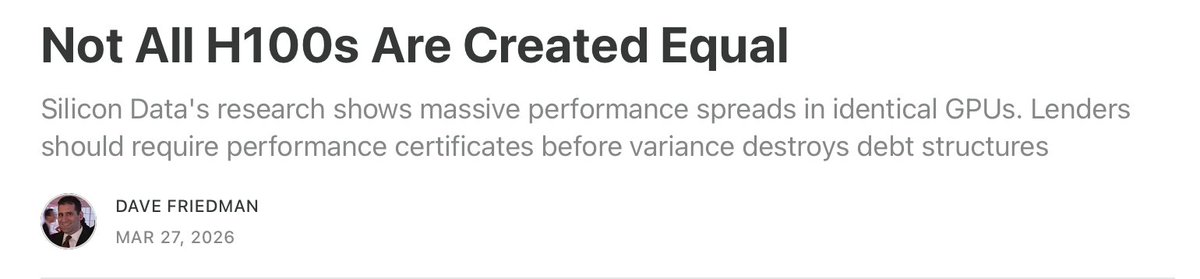
In the 1980s, banks lent against commercial real estate without checking for contamination. Then the losses came. Then Phase I environmental assessments became standard overnight.
David Friedman's latest piece makes the case that GPU-backed lending is at that same inflection point — and he builds the argument on research Yuhua Yu and I did at @Silicon_Data.
The finding that stuck with me most: individual chip identity explains 32–73% of performance variance. Not the provider. Not the config. The chip itself. Two identical #H100s can differ by up to 38% in real throughput.
If you're structuring debt against GPU pools, the spec sheet isn't your collateral. What that hardware actually does under load is.
Great working with Dave on this one.
1
1
10
1,389
Don Wilson retweeted

Rebecca, your thread defending Solana’s MEV setup and pushing back against the DRW Trading executive misses the current reality.
You argue that permissionless chains like Solana have already advanced to mitigate negative transaction ordering and MEV problems that institutions care about. That overstates where things actually stand.
The Constellation multi-proposer upgrade you highlight was only proposed two days ago. It is not deployed. Solana continues to run on the single-leader scheduler, with the vast majority of MEV still routed through Jito’s block engine and bundle auctions. Jito dominates around 70% of validator stake weight. That is not open permissionless competition. It is one company's infrastructure acting as the main gatekeeper for transaction ordering.
On the permissionless claim: anyone can spin up a validator in theory, but in practice, competitive participation requires expensive enterprise hardware, benefits from massive delegations, and almost always means running the Jito client to capture meaningful MEV revenue. This creates real economic and technical barriers that make the system far less permissionless than advertised.
Institutions prioritize predictable execution, regulatory clarity, and protection from reordering games. Permissioned networks like Canton are gaining traction exactly because they address those needs. Calling them outdated experiments ignores why TradFi players remain skeptical of public chains for sensitive financial activity.
Solana excels in retail DeFi and speed, but pretending the MEV and centralization issues are solved is premature.
3
3
37
3,426