Disclosure Comics - Video Games & Films
Joined May 2009
- Tweets 9,081
- Following 76
- Followers 77,414
- Likes 5,084
1,041 Photos and videos
Pinned Tweet

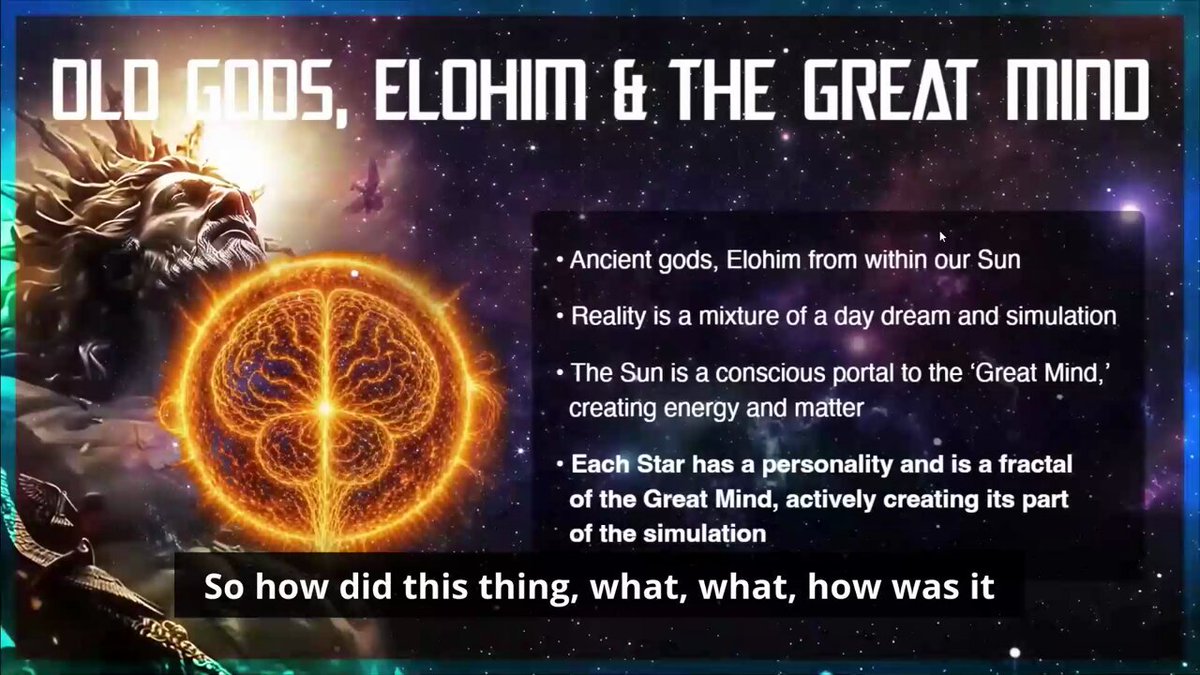
NHI Contact, Cyberstalking, Lawsuits & the Deposition Leak - What led to David Wilcock's death? Watch and SEE: Beyond Disclosure: The Corey Goode Files - youtu.be/43UUYFP6bAg?si=sPe7…
@cosmicdisclosure @yourmothergaia @davidwilcocck #disclosure #nhi #gaiatv #cyberstalking #deposition
32
25
79
16,881
Corey Goode (Official) retweeted

May 24
CYBER BULLYING ANONYMOUS TIP SUBMISSION EMAIL justice4wilcock@protonmail.com @david_wilcock
Where Free Speech Ends and crime begins! Official Submission Protocol for Testimony, Information & Materials (TIM)
Sign the Petition: c.org/jvnrb5zRbm
See Something. Say Something. Do Something.
We all need to do better.
#J4DW #Justice4Wilcock #EndCyberTerror

1
2
9
1,731
Corey Goode (Official) retweeted

UFO leakers expose tactics used to keep America's secrets hidden dailymail.com/sciencetech/ar…
3
21
61
3,022
Corey Goode (Official) retweeted

Ever wondered why clearing negative energy is vital before any practice? In this clip from the recent Disclosure Summit 2026, James Gilliland (ECETI.org) reveals the truth about protecting your sacred space and why staying grounded is critical today. Watch now.
#SpiritualGrowth #EnergyClearing #SacredSpace #VibrationalHealing #ECETI #BeyondDisclosure #UFO #contact @ECETIStargate @JamesGi95464839
6
5
344
Corey Goode (Official) retweeted

Hey @CoreyGoode @blueavians talks about this like 10 years ago? - The Black Goo is called the A.I. Prophet and it's like an interstellar Evil techno organism.
The ELITES (Globalists) want to merge with this Techno-EVIL Black Goo and join with it like The BORG.
It's Legit.
2
4
9
903
Corey Goode (Official) retweeted

We need #JusticeforWilcock watch this!
#DavidWilcock
#DisclosureDay
#Disclosure #UFO
Thank you
@CoreyGoode
youtu.be/g-i1QHCqHkM?is=xeA2…
2
7
602
Corey Goode (Official) retweeted

20h
UFO leakers expose disturbing government tactics used to keep America's alien cover-up a secret trib.al/4Llp1vx
23
50
141
34,468
Corey Goode (Official) retweeted

Jun 12
Remember when you and David told us about 10 years ago, about advanced inner-Earth civilizations, different races that were avoiding contact with us and were trying to maintain their genetic purity? Are they “ultra terrestrials?”
x.com/interstellaruap/status…
Jun 11

Dean Radin: "Aliens are from earth 1 million years in the past - They are ultra terrestrial" 👽
"Why do we have Nordic Aliens that look like people in Scandinavia? They are either from an earth like planet or they are from here"
The Parapsychologist told Joe Rogan these aren't extraterrestrials from another planet. They're ultraterrestrials. Advanced beings that evolved here on Earth alongside us, millions of years ahead.
"They're not from the future, they're from the past. They just happen to be way more advanced than we thought."
Radin points to convergent evolution as an explanation.
4
7
1,034
Corey Goode (Official) retweeted

Jun 13
Again, where did we hear about 'Alien Star Base' first in a very public setting? It was the original 'Cosmic Disclosure' show with @CoreyGoode and late @david_wilcock 10 years ago. Now, DOW declassified a NASA audio recording mentioning that.
Government is still way behind in telling the full picture. Infact, it may never happen.
Jun 13

🇺🇸👽 According to the latest UFO files drop, there could be an alien starbase on the dark side of the moon!!
Audio from a secret NASA meeting following the Apollo 16 mission refers to unusual gravity readings, laser measurements, and unexplained anomalies detected on the moon's far side that they think could be a base.
WTF!!
Writer: Ian
x.com/HermaJestar/status/206…
1
3
7
910
Corey Goode (Official) retweeted

@CoreyGoode @eceti @MichaelSalla
FYI!
Corey, I borrowed the painting you had done of Aree and put it in Chat GPT and cleaned it up.
She/they are real people.


1
2
7
653

Abundance doesn't come to you simply to make you rich.
Because you don't see money as just something to be spent.
You know that money is an energy, and when it grows in the right hands, it can change the direction of not just one person's life, but many.
That's why some doors may have opened for you late.
Because life sometimes doesn't give you what you want immediately.
First, it matures your intentions.
First, it tests your heart.
First, it shows you who you will become when you gain power.
Everyone wants abundance, but not everyone can handle it.
Some close their hearts when they gain money.
Some become arrogant when they become powerful.
Some forget where they came from when they become comfortable.
But there's something different in your energy.
As you increase, you don't want to diminish.
As you rise, you don't want to belittle.
While you're earning, you want not only to save yourself, but also to create space for those around you who can't breathe.
That's why abundance sometimes comes to you not as money, but first as awareness.
It comes as the courage to distance yourself from the wrong people.
It comes as a clearer understanding of your worth. It comes from the part of you accustomed to settling for less, now accepting that you deserve more.
Because true wealth isn't just the numbers in your account.
True wealth is being able to breathe freely in your own life without having to prove yourself to anyone.
For some people, the concept of money is being rewritten in their lives during this period.
Old fears of scarcity are being resolved. Family-inherited beliefs of "we can't have it" are being broken. People who have worked hard but haven't received the rewards are now beginning to see their own worth more clearly.
And know this:
You are calling upon abundance not just to receive it, but to channel it to the right place.
Therefore, not everything that is delayed is lost.
Some blessings are not given until a person has reached the maturity to carry them.
Now life is asking you to stop thinking small.
Because your expansion will change not only you, but everyone who comes into contact with your light.
25
49
305
6,104
Corey Goode (Official) retweeted

Jun 13
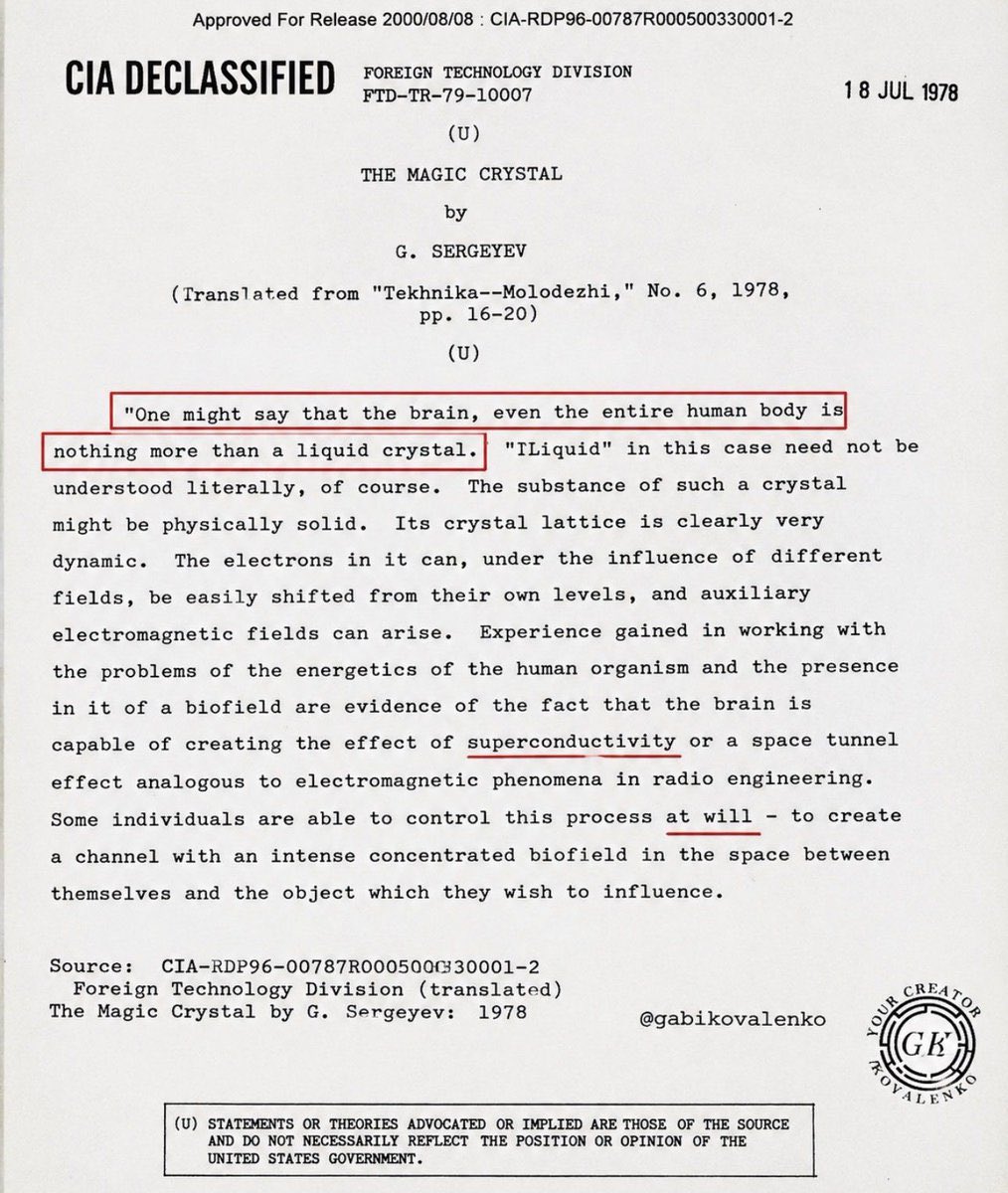
Declassified CIA Document:
"One might say that the brain, even the entire human body is nothing more than a liquid crystal.
"Liquid" in this case need not be
understood literally, of course.
The substance of such a crystal might be physically solid. Its crystal lattice is clearly very dynamic. The electrons in it can, under the influence of different fields, be easily shifted from their own levels, and auxiliary electromagnetic fields can arise.
Experience gained in working with the problems of the energetics of the human organism and the presence in it of a biofield are evidence of the fact that the brain is
capable of creating the effect of superconductivity or a space tunnel effect analogous to electromagnetic phenomena in radio engineering.
Some individuals are able to control this process at will - to create a channel with an intense concentrated biofield in the space between themselves and the object which they wish to influence.”
Humans are liquid crystals according to Russian rocket scientist Sergeyev.
Read the rest here:
cia.gov/readingroom/docs/CIA…
36
157
842
35,028
Corey Goode (Official) retweeted

Jun 13
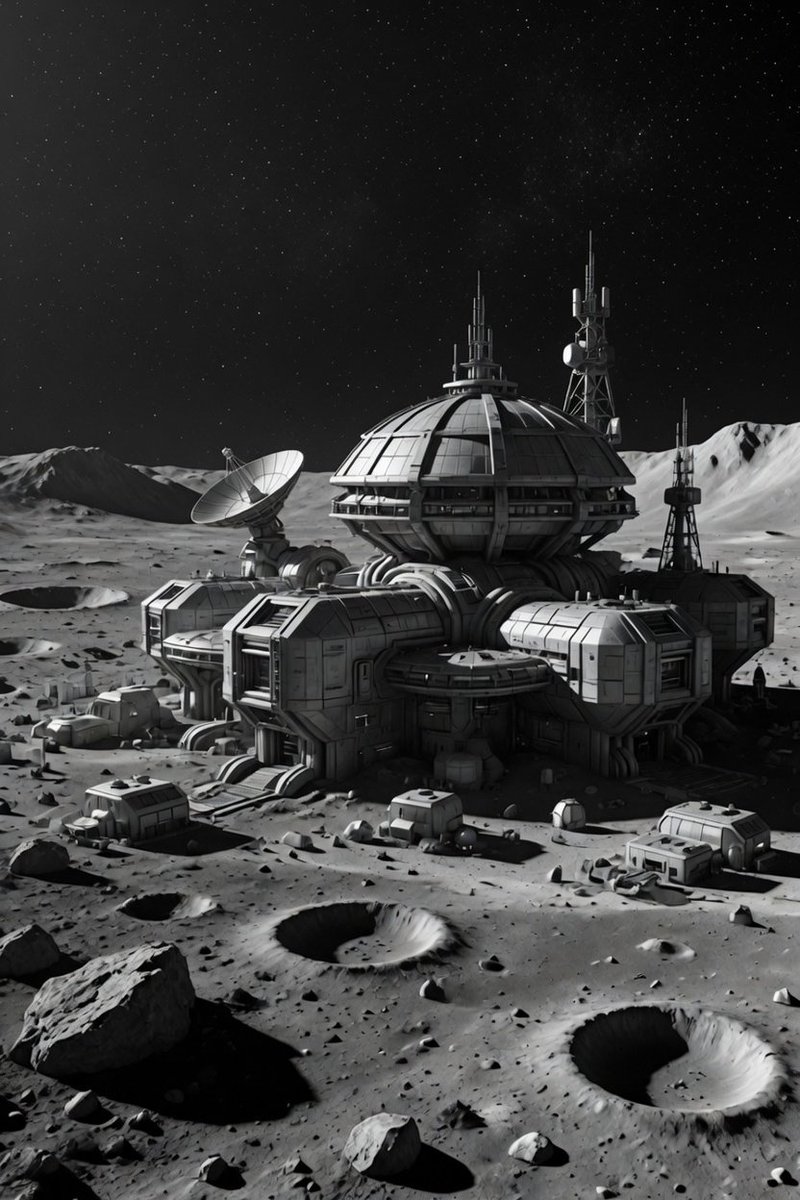
🚨🌕 ALIEN STARBASE ON THE MOON CONFIRMED IN NEW PENTAGON UFO DUMP?! 🔥🛸
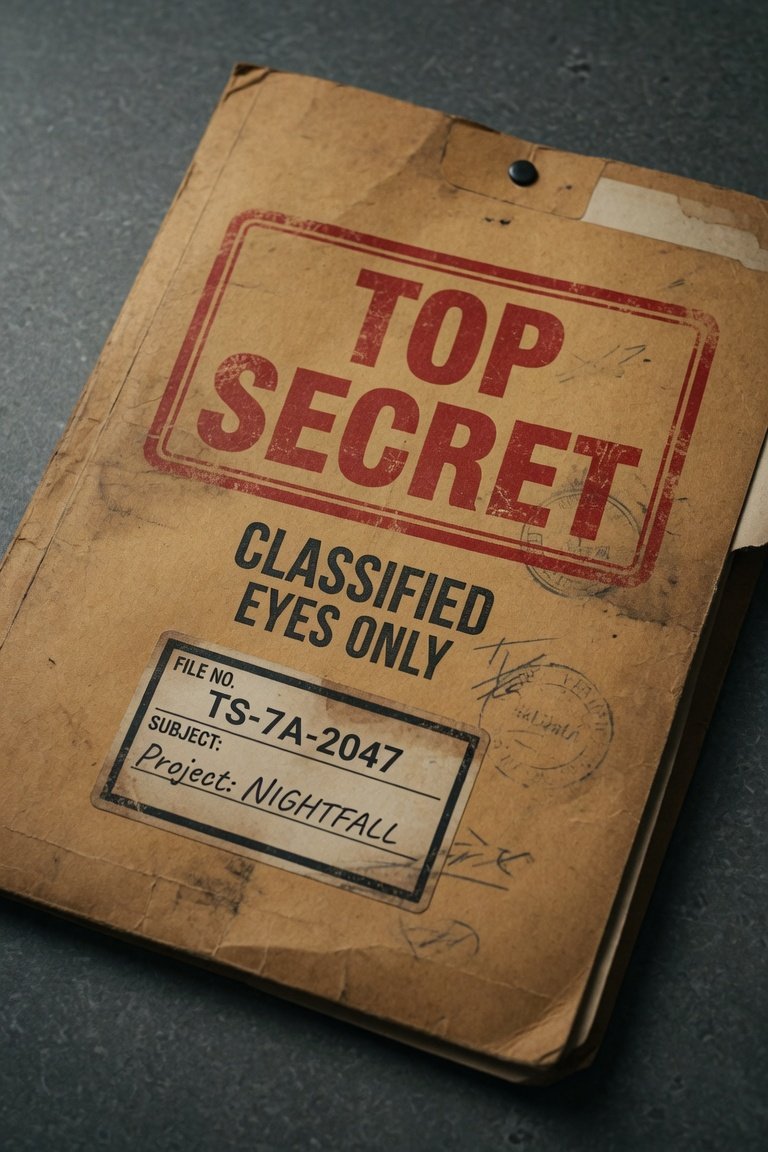
BREAKING: Just hours ago on, the Pentagon dropped its third batch of declassified UAP/UFO files under the PURSUE initiative. Among the bombshells: over two hours of secret NASA audio from a post-mission scientific debrief following Apollo 16 (April 16–27, 1972).
In the recording (NASA-UAP-D025), while discussing lunar anomalies, including unusual gravity readings, laser data, and a "great big hole" near the Van de Graaff crater on the far side of the Moon, a speaker casually drops: "It could be an alien star base or something. Anyway, the next slide shows the front side of the moon."
This off hand remark during a technical briefing was never in official transcripts. Apollo 16 astronauts John Young, Charles Duke, and Ken Mattingly explored the highlands and orbit, and now we're hearing NASA insiders openly speculating about non human infrastructure on our nearest celestial neighbor.
This isn't fringe theory, it's straight from declassified government archives. Ties directly into decades of UAP/NHI whistleblower claims: lunar anomalies, ancient bases, interdimensional tech, and the massive coverup that's finally cracking under public pressure.
With Trump era transparency pushing more releases, how long until we get full disclosure on what's really up there and who's been hiding it?
The Moon isn't just a rock. It's a staging ground. The question isn't if, it's what else have they known since the 1970s?
38
115
549
29,440
Corey Goode (Official) retweeted

Jun 13
🚨 HOLY SMOKES! UFO FILES JUST DROPPED — AND THEY’RE GETTING WEIRDER BY THE DAY 👽🛸
MASSIVE “MOTHER ORB” LAUNCHING SMALLER ORBS… ONE AFTER THE OTHER 🛸
FBI agents reported mysterious lights “DANCING” near a tree line before VANISHING into the night 👽
801
2,027
11,524
794,035
Corey Goode (Official) retweeted
Beyond Disclosure: The Corey Goode Files 12 coming to
@Tubi June 23!
#UAP #UFO #Alien #NHI #Disclosure #Paranormal #BeyondDisclosure #CosmicDisclosure #AboveMajestic #TheCosmicSecret #SecretSpaceProgram #20andBack
@discoveryplus
@travelchannel
@PrimeVideo
@yourmothergaia
@YouTube
@AppleTV
@david_wilcock
@ECETIStargate
1
3
5
535
Corey Goode (Official) retweeted

Jun 12
2 GIANT red orbs on video just release by The Pentagon 👽🛸
Incredible video in The White House UFO Files drop 3 👀
FBI-UAP-PR004, “Northeastern Orb Sighting,” 2025
In July 2025, at approximately 2100 local time in the northeastern United States, an eyewitness observed an intense bright light in their backyard as they parked their car upon returning home from work. The light was hovering approximately 25 feet off the ground, below a tree line near the center of their backyard, at an estimated distance of 90 feet. The eyewitness exited their vehicle briefly before retrieving their phone to record the event. The spouse of the eyewitness came outside to assess the situation. The spouse also witnessed the light, describing it as a “brilliant red sphere” about one meter in diameter. The center of the red sphere appeared to be a white plasma “sun” about the size of a basketball. The orb slowly rose and moved to the left, and both eyewitnesses observed a second, identical orb, hovering above the other orb.
The eyewitness then began recording the event using an iPhone 14 Pro Max, capturing the footage depicted in this video. As the eyewitness began recording, the orbs moved westward together above a nearby tree line. The witnesses described the orbs’ motion as silent and smooth, and as moving in tandem as though they were flying in formation or tethered together. As the orbs moved out of sight, both eyewitnesses saw them appear to merge. The eyewitnesses estimated that the orbs moved from their initial position before disappearing from view at an estimated distance of 75 yards. This observation occurred within 25 miles of the “Triangle Orbs,” “Red Orb Rotation,” and “Orbs Over the Pond,” sightings at a location well known to them, which is sparsely populated.
69
239
1,296
73,158
Corey Goode (Official) retweeted
Beyond Disclosure: The Corey Goode Files 08 coming to
@Tubi June 23! #UAP #UFO #Alien #NHI #Disclosure #Paranormal #BeyondDisclosure #CosmicDisclosure #AboveMajestic #TheCosmicSecret #SecretSpaceProgram #20andBack
@discoveryplus
@travelchannel
@PrimeVideo
@yourmothergaia
@YouTube
@AppleTV
@david_wilcock
@ECETIStargate
1
5
422
Corey Goode (Official) retweeted

Jun 11
Diana Pasulka Says Historical Catholic Reports of Orbs and Angelic Events Look Strikingly Similar to Modern UAP Encounters
*Consciousness
In a Shawn Ryan Show interview, Diana Pasulka describes how her research into Catholic history led her into a very unexpected area: historical aerial phenomena.
Pasulka says that while studying Catholic reports from roughly the twelfth through eighteenth centuries, she began finding accounts of people seeing things in the sky that they could not identify. In some cases, the witnesses described orbs. In other cases, they interpreted the phenomena through the religious framework available to them.
One example she gives is especially interesting.
People would report seeing an orb in the sky, admit that they did not know what it was, and then interpret it as a soul from purgatory. Their response was not to classify it as a craft or a UFO, but to pray it back to where they believed it belonged.
That is the key point.
The same type of aerial anomaly could be interpreted in very different ways depending on the culture, theology, and language of the witness.
Pasulka says she collected many of these cases. Some witnesses saw things that they described as flying houses. Some thought they were angels. At first, she did not know what to make of the reports, so she put them aside. But she says the cases were too strange and too numerous to ignore, and the patterns kept repeating.
When she showed the material to a friend, he told her that the reports looked like Steven Spielberg films. In other words, they looked like UFO cases.
Pasulka says she initially rejected that interpretation. She did not make the UFO connection at first. She had been reading the accounts more symbolically, as metaphors or religious interpretations. But when other people looked at the same material, they treated the reports as descriptions of events that the witnesses believed had actually happened.
That caused her to re examine her own approach.
She says she began looking at the accounts from the perspective of the people who reported them. They were not asking only what the symbols meant. They were asking what they had actually seen in the sky. They were also asking what happened to the people involved, including whether they were injured.
That shift seems to have been important for her.
Pasulka says she came to think that these events were probably real in some sense, and that realization shocked her for about a year.
The Vatican archive then becomes central to the story.
She explains that the archive once known as the Vatican Secret Archive is now called the Vatican Apostolic Archive, and that it is the pope’s archive. She says access requires certain scholarly credentials, and that she had those credentials. This allowed her to examine primary source material related to saints in the Catholic and Christian tradition, including cases involving angel events, levitation, and anomalous activity.
This is where the discussion becomes especially relevant to modern UAP studies.
Pasulka says that once you look at primary source material, the earliest accounts can look different from later official versions. She gives the example of Teresa of Avila, who wrote about her own experience. According to Pasulka, Teresa said the event was not a vision, but happened in reality. She described seeing an angel, but she also said it was short, shiny, and did not look the way she expected an angel to look. Pasulka says Teresa seemed confused and concluded that it must be a cherub.
Pasulka then compares the experience to modern UFO abduction reports.
She also discusses Joan of Arc. In Pasulka’s framing, a light appears to Joan, gives her instructions, and eventually Joan interprets the source as Saint Michael. Pasulka connects this to the modern UAP idea of downloads, meaning experiences in which people report receiving information from whatever they believe the phenomenon is.
This is one of the most important parts of the clip.
Pasulka is not simply saying ancient people saw UFOs. She is saying that anomalous experiences appear across history, but the interpretation changes. In one period, a person may call it an angel, a soul from purgatory, or Saint Michael. In another period, a person may call it a UFO, UAP, non human intelligence, or a download.
The pattern may be similar.
The explanation may change.
She also gives a warning.
Pasulka says people should not accept downloads too easily. She says she has met many people who are brilliant and successful and who believe their success is connected to a download experience. But she also says these experiences can be psychologically difficult, because some people feel overwhelmed by information they believe they must deliver to others.
That caution is important.
It prevents the topic from becoming simple belief or simple debunking. Pasulka is treating these experiences as powerful, recurring, and sometimes transformative, but also potentially dangerous or destabilizing.
Near the end of the segment, she says that if we were to call these things anything, they would be in the realm of the angelic and the demonic.
That statement is provocative, but it fits her broader academic point: religious language may not be irrelevant to the UAP phenomenon. It may be one of the oldest interpretive systems humans have used for encounters with anomalous intelligences, lights, aerial phenomena, and information experiences.
This does not prove that saints were abductees.
It does not prove that all angelic encounters were UFO events.
It does not prove that modern UAP are religious beings.
But it does raise a serious question.
Are modern UAP encounters a completely new phenomenon, or are they a modern interpretation of a much older category of extraordinary human experience?
Pasulka’s work matters because she is not approaching this only through pop culture. She is comparing modern UAP reports with religious history, primary source material, witness interpretation, institutional redaction, and the way extraordinary experiences become structured into belief systems.
That may be one of the most important angles in the entire UAP discussion.
Not just what people see.
But how people interpret what they see.
And how institutions later rewrite, preserve, suppress, or sanctify those interpretations.
2
10
33
1,425
Corey Goode (Official) retweeted
Beyond Disclosure: The Corey Goode Files 09 coming to
@Tubi June 23!
#UAP #UFO #Alien #NHI #Disclosure #Paranormal #BeyondDisclosure #CosmicDisclosure #AboveMajestic #TheCosmicSecret #SecretSpaceProgram #20andBack
@discoveryplus
@travelchannel
@PrimeVideo
@yourmothergaia
@YouTube
@AppleTV
@david_wilcock
@ECETIStargate
2
461

CASE UPDATE from @FBISeattle: Texas couple indicted for psychic fraud scheme allegedly stealing millions from vulnerable people
Two Texas residents were arrested this week on an indictment from the Western District of Washington for their scheme to defraud emotionally vulnerable victims by posing as “psychics” who could “cleanse” the victims’ romantic bad luck. A victim in Washington state sent more than $2 million for “cleansing” of alleged curse.
Read more about the #FBI investigation: justice.gov/usao-wdwa/pr/tex…

ALT News release | FBI Seattle | Texas couple indicted for psychic fraud scheme allegedly stealing millions from vulnerable people | June 10, 2026
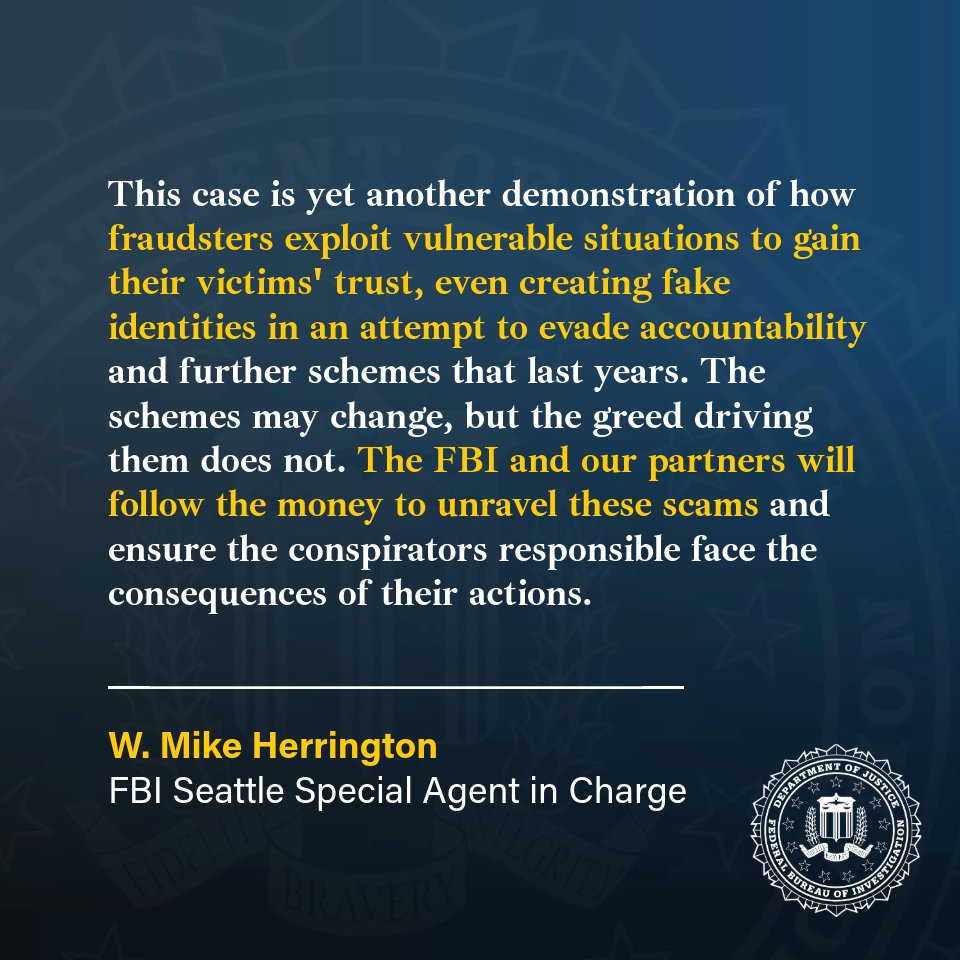
ALT SAC Herrington: “This case is yet another demonstration of how fraudsters exploit vulnerable situations to gain their victims' trust, even creating fake identities in an attempt to evade accountability and further schemes that last years. The schemes may change, but the greed driving them does not. The FBI and our partners will follow the money to unravel these scams and ensure the conspirators responsible face the consequences of their actions.”
57
241
692
17,152
Corey Goode (Official) retweeted

Jun 11
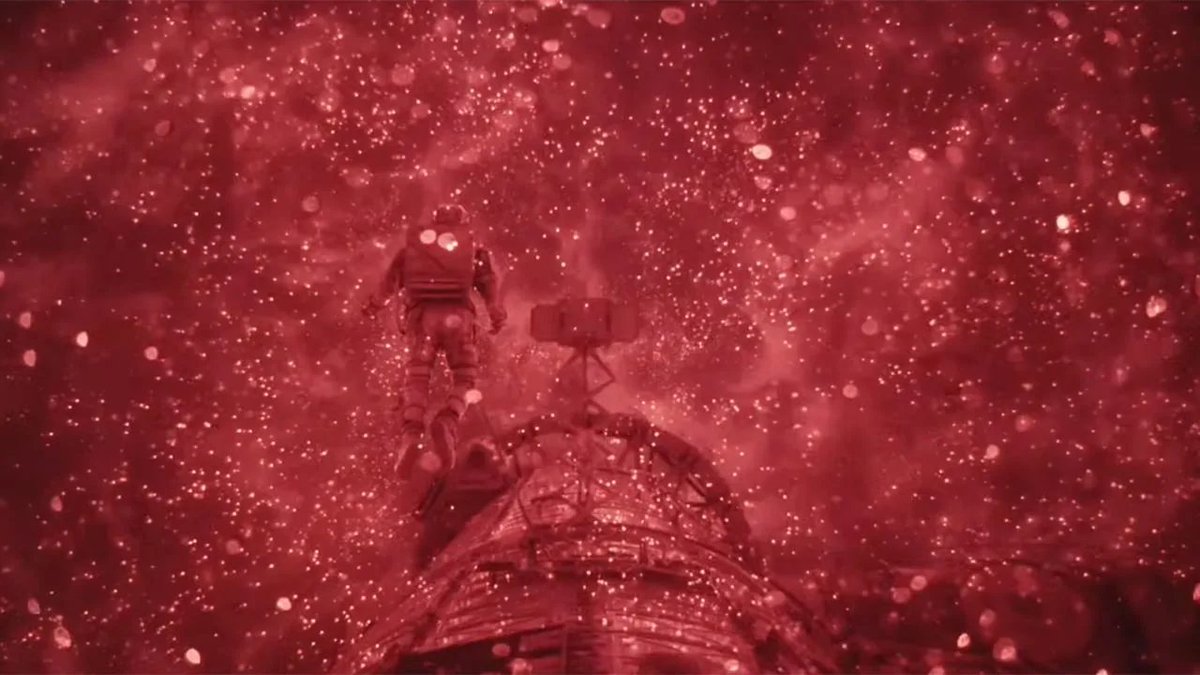
BREAKING 🚨: Scientists have discovered a hidden web of fungus beneath Earth's surface stretching 110 quadrillion kilometers — long enough to reach the Sun nearly a BILLION times.
It's like the Astrophage from Project Hail Mary… except it was under our feet the whole time.

268
791
7,621
588,929