
Trad Catholic. Father. Constitutional Conservative. Author. Retired Soldier. OIF/OEF Veteran. Hunter. #2A. Attorney. Descended from Norse-Gael Scots-Irish.
Joined March 2013
- Tweets 27,513
- Following 237
- Followers 790
- Likes 43,970
957 Photos and videos










Pinned Tweet

10 Jul 2024
Do not overlook the role of the state/fed Fusion Centers, and/or academic cyber security centers, in this mix. DHS manages the national Fusion Center network (with significant FBI interface). The academic cyber security facilities are openly partnered with NSA, FBI, DHS and DOD.
11
36
115
43,571
CJSebastian retweeted

Hey since I supposedly just voted in our runoff on a crooked machine (DS200) thought I'd share this tidbit on our fake elections.
uncoverdc.com/2021/08/03/vul…
2
38
60
1,053
CJSebastian retweeted

One of the darkest aspects of this is that these girls came from the lower classes, the north, the working class, the industrial towns and cities. Their grandparents and ancestors were coal miners, factory workers, soldiers, servants to the upper classes. To show their thanks to generations of loyal Brits who did backbreaking toil for their country and the crown, their daughters were given as sex slaves to foreign invaders. A genocide of native people. The crimes of the complicit modern UK government put it up there with Ceausescu’s Romania and Pol Pot.

250,000 girls raped by Muslim rape gangs. A quarter of a million of your young daughters. And then kept secret by those meant to protect them. Then arresting people for speaking out.
Why Brits aren’t violently overthrowing their government as we speak I’ll never know.
128
1,481
6,526
176,058

In 1945, as the horrors of the Holocaust were still raw, Frank Sinatra stepped up with a powerful short film called The House I Live In.
After a recording session, he steps outside for a smoke and witnesses a gang of boys bullying a Jewish kid. Sinatra doesn’t look away.
He intervenes, schools them on racism and discrimination, and calls it straight: un-American. He even tells them that hating Jews like that makes them no better than Nazis.
One of America’s greatest voices used his platform—not for silence, not for fashionable equivocation, but for moral clarity. He stood against bigotry when it mattered, earning an Honorary Oscar for shining a light on tolerance and the shared American house we all live in.
In a world full of Javier Bardems and Cynthia Nixons, be a Frank Sinatra.
Be the one who speaks up.
@NancySinatra
youtu.be/weaUOdCIBGQ

15
168
555
15,988
CJSebastian retweeted

Bob Odenkirk has returned as Saul Goodman in a new video celebrating 250 years of America.
722
16,545
154,494
6,998,433
CJSebastian retweeted

So good

Bob Odenkirk has returned as Saul Goodman in a new video celebrating 250 years of America.
41
322
2,428
192,461


CJSebastian retweeted

The Scots took over Boston and they belt out OUR anthem, word for word, in a pub!
The Europeans and Japanese at the World Cup have made the world appreciate America.
(Maybe they can teach the Democrats).
662
7,233
38,413
403,691
CJSebastian retweeted

Jun 12
“Only 13% of all American 8th graders can, with basic proficiency, say what the American timeline is.”
“Which is to say less than 15% can accurately say at 8th grade the American Revolution, the Civil War, the First and Second World Wars, etc.”
Timothy Goeglein says America’s education system is failing despite the billions of dollars poured into it every year.
“That to me is really stunning.”
“It’s a lower number than I would have thought.”
“In light of the billions of dollars that our country pours into education of all kinds.”
“I think it’s a real failure.”
54
247
945
48,246
CJSebastian retweeted

Jun 16
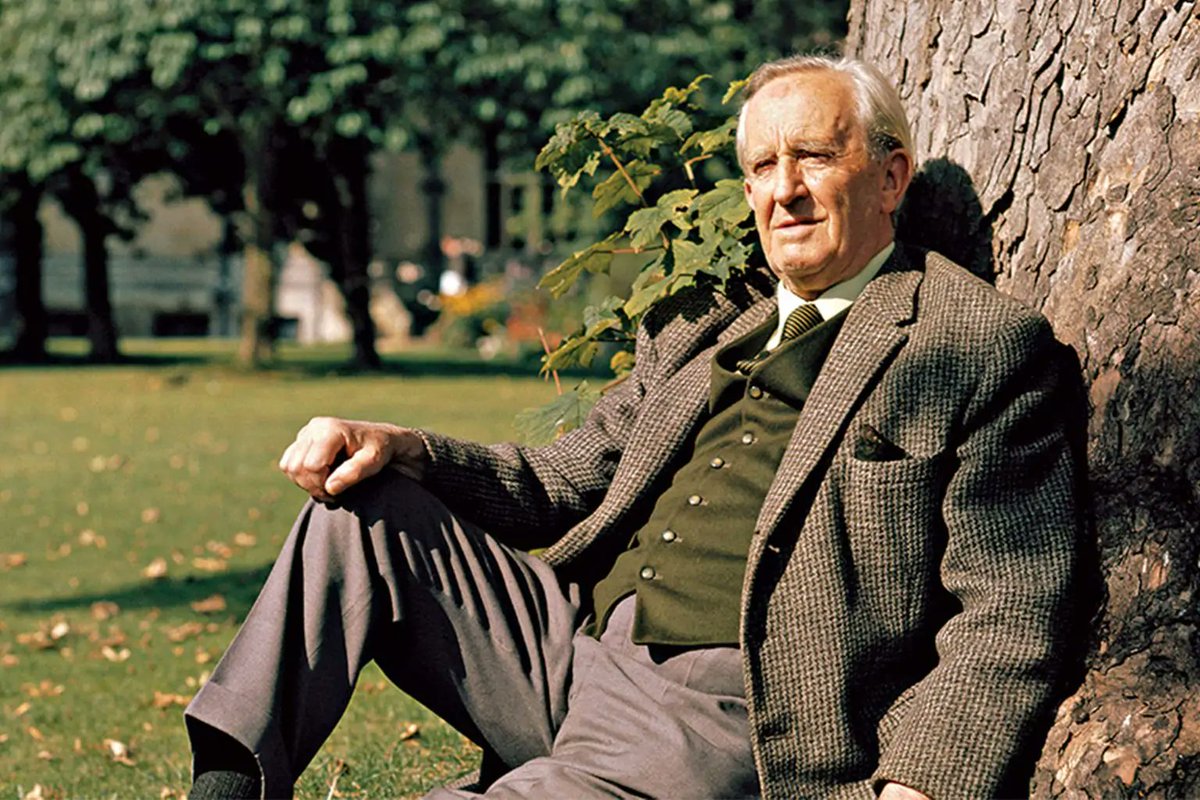
J.R.R. TOLKIEN ON THE DEAD END OF PROTESTANTISM
I read this letter in the years leading up to my conversion. As I discovered, not only was Tolkien right about the mistaken search for “primitive” purity in the Church (read Scripture—it never existed), but the primitive church—to the extent we have artifacts of it in documents, archaeology, etc.—was very Catholic in its beliefs and practices. What I had been told my whole life were “medieval accretions” were widespread in the ancient Church, and defended from both Scripture, and the constant practice of the Church since the Apostolic age. The protestant claim to have restored the ancient Faith was, I discovered, completely false.
To this day, I have not yet found anything uniquely protestant in the ancient Catholic Church, except (I am sad to say) the heresies. All of them—no matter how different their doctrines from one another (and virtually none of them resembled protestantism)—ultimately relied on a novel/erroneous interpretation of Scripture (including subtracting or adding to its canon), coupled with a rejection of the authority of the Church. In this, each of them resembled protestantism. It was very sobering to realize that the Church Fathers’ descriptions of how heresy and heretics operated was disturbingly similar to how my native protestantism had operated since the 16th century.
TOLKIEN’S LETTER
The 'protestant' search backwards for 'simplicity' and directness—which, of course, though it contains some good or at least intelligible motives, is mistaken and indeed vain. Because 'primitive Christianity' is now and in spite of all 'research' will ever remain largely unknown; because 'primitiveness' is no guarantee of value, and is, and was in great a reflection of ignorance. Grave abuses were as much an element in Christian liturgical behavior from the beginning as now. (St Paul's strictures on Eucharistic behavior are sufficient to show this!)
Still more because 'my church' was not intended by Our Lord to be static or remain in perpetual childhood; but to be a living organism (likened to a plant), which develops and changes in externals by the interaction of its bequeathed divine life and history—the particular circumstances of the world into which it is set.
There is no resemblance between the 'mustard-seed' and the full-grown tree. For those living in the days of its branching growth, the Tree is the thing, for the history of a living thing is part of its life, and the history of a divine thing is sacred.
The wise may know that it began with a seed, but it is vain to try and dig it up, for it no longer exists, and the virtue and powers that it had now reside in the Tree…But they will certainly do harm if they are obsessed with the desire of going back to the seed or even to the first youth when it was (as they imagine) pretty and unafflicted by evils.
J.R.R. Tolkien, Letter to his son Michael (August 25, 1967)
39
322
1,475
41,793
CJSebastian retweeted

Jun 16
Across every recorded near-death experience in the scientific literature, one detail never breaks.
The people waiting at the end of the tunnel are always dead.
"There's never been a report of somebody who's gone down the proverbial tunnel and seen a living person at the other end of the tunnel."
That's Dr. Michael Egnor, professor of neurosurgery at Stony Brook.
If these were hallucinations or wishful thinking, he argues, at least once in a while you'd see your living husband or wife. You never do.
What you do find?
Over a dozen cases of people greeting a relative on the other side they didn't yet know had died. Crash victims sent to separate hospitals, one seeing the other, before anyone in the room knew that person was gone.
A dying brain shouldn't have that information. Somehow it did…
19
149
606
43,680
CJSebastian retweeted

Jun 15
🔺Telegram founder Pavel Durov compares the lack of panic during the sinking of the Titanic with the current lack of awareness in Europe as citizens freedoms are stripped away: “I came here today to tell you-that we find ourselves in a similar predicament. In a similar situation. Our ship. Has already hit the iceberg. We have already started to sink. Without even realizing it. And I'm talking about the ship of our personal freedoms”
Continuing giving examples of his personal experiences of fraud and corruption with Russia, the EU and France. Before moving onto Keir Starmer’s UK clampdown on social media:
“Thousands of people are getting arrested every year in the United Kingdom for social media posts. You say somethingpolitically incorrect online, you may end up being fined or spend some time in prison in Germany”
244
6,145
17,316
431,902
CJSebastian retweeted

Jun 15
Everyone has been so impressed by Japanese fans cleaning up after themselves but most probably missed this beautiful moment at the post-game (🇳🇱2 - 2🇯🇵) press conference.
Toward the end after reporters were done asking questions, 🇯🇵head coach, Hajime Moriyasu, asked to speak one more time.
🗣️ “May I speak?”
He turned to the Dutch reporters in the room.
🗣️ “I think there are many Dutch reporters here as well, so I’d like to take this opportunity to express my gratitude to the people of the Netherlands once again.”
Moriyasu explained that when he became part of the Japan national team, Japanese football still had no professional league.
🗣️ “I was trained by a Dutch coach named Hans Ooft. It wasn’t just me. Japanese coaches in general were greatly influenced by him, which has led to the development of Japanese soccer today.”
He also mentioned another Dutch figure who shaped his career.
🗣️ “The legendary Dutch coach Wim Jansen served as the manager for J.League’s Sanfrecce Hiroshima and also as a coach for Urawa Reds, contributing to Japanese soccer.”
🗣️ “It’s not just those two. Many other coaches and players have contributed to raising the level of Japanese soccer, so I want to express my thanks. Thank you very much.”
What a masterclass in graciousness and gratitude. Imagine after a high-stakes match, instead of basking in glory and bravado (well-deserved in my opinion), the coach took to the microphone to... thank his opponents publicly and sincerely.
Japan's cultural operating system prizes harmony (wa), respect for precedent, and gratitude as a form of strength, not weakness. Japanese sports culture reflects its broader society where you'll see athletes bow to their opponents, thanking referees, and even crediting rivals or mentors.
Think of sumo wrestlers, Olympic athletes, or even bullet-train staff apologizing for a 30-second delay.
The Japanese have this concept of On (恩) - it is the sense of indebtedness to those who came before or helped you. It's what you'd expect from a culture that truly prizes continuity.
Moriyasu was acknowledging a real debt to Dutch coaches like Hans Ooft (who coached Japan in the early 90s and helped professionalize the game) and Wim Jansen. Japanese football openly credits foreign influences - Dutch "Total Football" philosophy, German organization, Brazilian flair - while building something distinctly their own. Few nations do this with such little ego.
Japan is pure class

148
2,733
15,869
508,234
CJSebastian retweeted

Bret Weinstein says we're in an Alice in Wonderland moment: the medical freedom movement finally has its strongest warrior running HHS, but there are even more powerful forces at work.
"So there's this tension between Bobby Kennedy. He knows this stuff as well as anybody. He's really encyclopedic in his understanding of science, the fraud that masquerades the science, the hidden hazards in the vaccines. He knows the COVID vaccine story backwards and forwards.
And yet in his position, he is presumably forced to work delicately. I assume knowing him that he's doing everything he can to move the ball in the right direction. But in a case like this, where you have the DOJ sandbagging it for pharma reasons, there's just a question of, well, what world are we in?"
@Attorney_Cox explains what RFK Jr. is up against in 2026 in her appearance on @BretWeinstein's DarkHorse Inside Rails.
44
394
2,391
91,557
CJSebastian retweeted

THE ELITES WON'T TELL YOU THIS—but the science is clear.
The University of Nebraska just proved raising MORE COWS & eating MORE BEEF saves the planet.
Cows are carbon negative—they produce more oxygen than the methane & carbon they emit.
788
20,328
51,924
450,306
CJSebastian retweeted

Jun 15
John Foster Dulles. John J. McCloy. Dean Rusk.
Is the revolving door between major foundations and the U.S. government a coincidence, or the normal operating pattern of the postwar establishment? Congress identified the network in 1954—and the paper trail is still there. 📜🔍
#TheMelKShow #AmericaBetrayed #Congress #Journalis

6
57
92
2,316
CJSebastian retweeted
Jun 15
Her body was cooled to 60 degrees. Her heart was stopped. The blood was drained out of her brain. Every monitor in the room said she was dead.
Then she woke up and described her own surgery.
Pam Reynolds had an aneurysm at the base of her brain that couldn't be operated on by ordinary means. So Dr. Robert Spetzler stopped her heart, drained her brain, and gave himself 30 minutes to rebuild the artery.
When she recovered, she told him she had watched the whole thing. He told her she couldn't have. She was under surgical drapes. She was brain dead.
So she described his custom-made instruments. The conversations between the doctors, word for word. The problems that came up mid-surgery.
"She described the music they were playing in the operating room while she was brain dead."
Spetzler's own response: "I can't explain it."
138
1,475
5,017
207,754
CJSebastian retweeted
Jun 15
Timothy Goeglein just delivered an urgent warning:
“We are definitively, with no debate, in a demographic winter.”
“We have never had a lower marriage rate.”
“And we’ve never had a lower fertility rate.”
He told me that young Americans have been raised to believe that family and children are bad things.
And it goes hand in hand with the vilification of religion.
“We need to tell a new generation that marriage is a really good thing.”
“Babies are really good things.”
“Intergenerational connections among families and communities of faith are really good things.”
“If someone were to ask me: what is the biggest single challenge facing America in its 250th year?”
“I would say that the biggest challenge facing us is a spiritual crisis of a pretty substantial order.”
“And I would say: show me a country with a strong spiritual and religious base, and I’ll show you a strong country.”
6
32
122
4,813
CJSebastian retweeted

Jun 14
🇺🇸 In a world that never slows down, Mission BBQ hits pause at noon — and suddenly, strangers become one heartbeat under the flag. Little hands over tiny hearts, eyes wide with wonder… this is how you plant roots of gratitude that grow into unbreakable pride. Teaching our kids that respect isn’t just taught — it’s felt in those quiet, powerful 90 seconds. ❤️🤍💙
138
1,649
9,619
80,103
CJSebastian retweeted

Jun 14
Freedom 250 is proud to announce Rodeo 250 — The Evolution of the American Cowboy, a signature attraction of the Great American State Fair on the National Mall in Washington, DC.
Visitors will journey through the evolution of the American cowboy. From Spanish vaquero traditions to cattle drives, Wild West performances, charros, trick riding, Roman riding, trick roping, and the emergence of modern professional rodeo. All brought to life by the legendary @CerviRodeo.
DATES: June 25–July 10, 2026
TIMES: Sun–Wed at 4 PM; Thu–Sat at 7 PM; special July 4 show at 3 PM
LOCATION: American Heartland Arena, National Mall, Washington, DC
🎟️ RSVP now for FREE tickets

334
4,378
21,064
1,072,479
CJSebastian retweeted

Jun 15
Joe Rogan watches in disbelief as a video reveals America’s “nonprofit” hospitals actually rake in $45,000,000,000 in profit every year.
ROGAN: “Motherf*ckers.”
One CEO at NYU Langone paid himself $15,300,000 a year.
Other CEOs paid themselves $4,500,000 while nurses made about $70,000 a year.
P. DAVIS JONES: “A congressman recently described some nonprofit hospitals as ‘hedge funds with hospital beds,’ and I was like, ‘I bet they are.’”
“The total revenues of nonprofit hospitals in America in 2023 was $1.3 trillion. Nonprofit hospitals were making $45 billion worth of profit.”
“A study that looked at almost 1,500 nonprofit hospitals found that 86% of them provided LITTLE TO NO charity.”
“It goes to executives, these CEOs getting paid about $4.5 million a year. Meanwhile, their nurses make about 70K.”
“Here’s a guy, Robert [Grossman], at a hospital in New York who paid himself $15.3 million a year. Nonprofit hospital.”
861
14,963
47,116
1,529,583