
Lab of Nicole Creanza, Department of Biological Sciences at Vanderbilt University
Joined April 2017
- Tweets 288
- Following 271
- Followers 529
- Likes 1,060
36 Photos and videos

20 Mar 2024
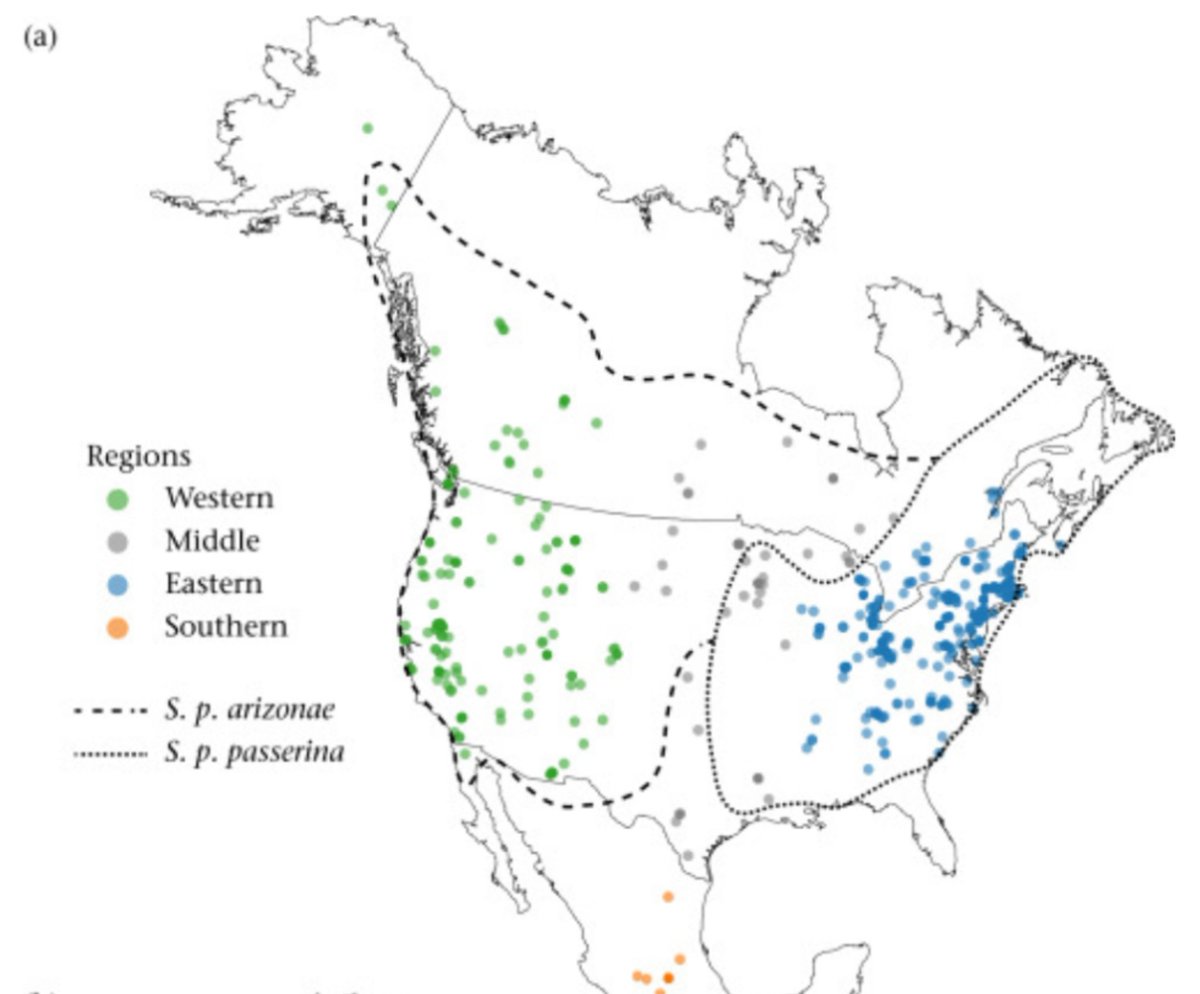
Excited to share a publicly accessible link to new work with @pichkary and @AbigailSearfoss -- detecting cultural evolution in songbirds (chipping sparrows!) using community science data and computational modeling authors.elsevier.com/a/1icLx…
1
6
11
1,333
20 Mar 2024
We simulate chipping sparrows learning from a random neighbor, the most common song, or the fastest song. When we compare our simulated results to real data, it seems like chipping sparrows might try to learn the best song around them!
1
1
4
461
20 Mar 2024
We also found that some chipping sparrow songs were sung by many individuals over a long time period (>50 years) and some were only observed once. The long-lasting songs were sung faster (they were made up of more, shorter syllables) 🐦
2
172
20 Mar 2024
Thank you so much, Mason! 🐦🥰
29 Feb 2024

New paper from @pichkary @AbigailSearfoss @CreanzaLab on cultural evolution in chipping sparrow song! Really creative application of agent-based modeling to community science data 🐦 sciencedirect.com/science/ar…
1
4
452
Creanza Lab retweeted

26 Jul 2023
Nicole Creanza on the interactions between socially learned song and speciation in songbirds #smbe23 #smbe2023 using data from @Team_eBird

2
9
34
6,638
30 Jun 2023
Genes and languages have worldwide signatures of human history – but does variation *within* a language correspond to genetic population structure? @pichkary examined pronunciation of English words and found greater genetic differences at dialect borders: onlinelibrary.wiley.com/doi/…
2
1
6
593
30 Jun 2023
We analyzed two separate datasets (library.leeds.ac.uk/special-… and peopleofthebritishisles.org/)–both sampled people with multigenerational ties to rural agricultural locations, so our data are linked to 19th century England, not to more recent movement and mixing
1
1
167
30 Jun 2023
Our results suggest that past populations might have mated assortatively with speakers of the same dialects or those who shared other other associated cultural features.
More here:
theconversation.com/english-…
And here:
news.vanderbilt.edu/2023/06/…
2
125
28 Jun 2023
Big congratulations to newly minted Dr. Kerri-Ann Anderson, who successfully defended her PhD and has a new paper out modeling the interactions between vaccine hesitancy and vaccination behaviors! sciencedirect.com/science/ar…
1
4
17
1,095
28 Apr 2023
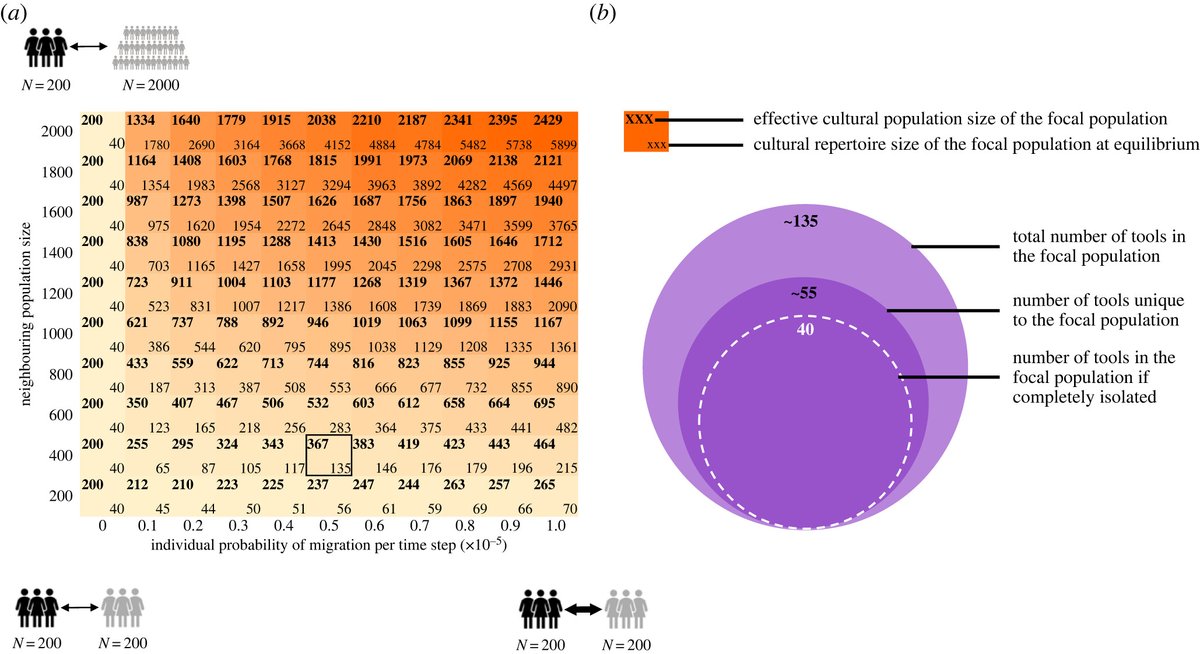
How might population contact affect the tools and technologies of a population? Happy to see this paper out, featuring the work of former undergrad Sarah Saxton Strassberg (now a PhD candidate at UChicago!) and wonderful collaborators @YotamBenOren @orenkolodny @ErellaEhovers
27 Apr 2023

#BiologyLetters authors @YotamBenOren @CreanzaLab @orenkolodny model the effects of inter-group contact on links between population size and cultural complexity ow.ly/iYgj50NQkSr #populationsize #evolutionarybiology
1
6
537
24 Jan 2023
What happens when some members of a population have specialized knowledge? Our model predicts that if the population is large enough, their cultural repertoire could expand, but if it is too small, the specialized knowledge could be lost.
royalsocietypublishing.org/d…
1
7
25
3,593
24 Jan 2023
New article with @orenkolodny and @YotamBenOren in a special issue of Phil Trans @RSocPublishing royalsocietypublishing.org/t…
1
250
24 Jan 2023
It was great fun to be a part of this @RSocPublishing special issue! Many thanks to the editors for organizing it!
23 Jan 2023

Happy announce our special issue of Proc Roy Soc B @RSocPublishing on
‘Human socio-cultural evolution in light of evolutionary transitions'
royalsocietypublishing.org/t…
Coedited by me, Eörs Szathmáry, Ayelet Shavit & Yohay Carmel.
Get it while it's hot!!!
#cultevo #philbio
2
256
Creanza Lab retweeted

23 Jan 2023
New paper out on cultural specialization!
We suggest that when different people in a population know different things it can increase the population's overall cultural repertoire, but also make it more susceptible to loss
royalsocietypublishing.org/d…
1
7
9
1,002
Creanza Lab retweeted

23 Jan 2023
Happy announce our special issue of Proc Roy Soc B @RSocPublishing on
‘Human socio-cultural evolution in light of evolutionary transitions'
royalsocietypublishing.org/t…
Coedited by me, Eörs Szathmáry, Ayelet Shavit & Yohay Carmel.
Get it while it's hot!!!
#cultevo #philbio
3
13
2,216
7 Dec 2022
Thank you so much for the kind words and the photos, Annie! 🐦
4
6 Dec 2022
So proud of Kate, and so excited for her defense!! 🐦🥳
5 Dec 2022

This is tomorrow!! Looking forward to telling the story of a subset of my PhD research 😊
Tune into the Zoom webinar at 3:15pm (Central) if you'd like to hear it!
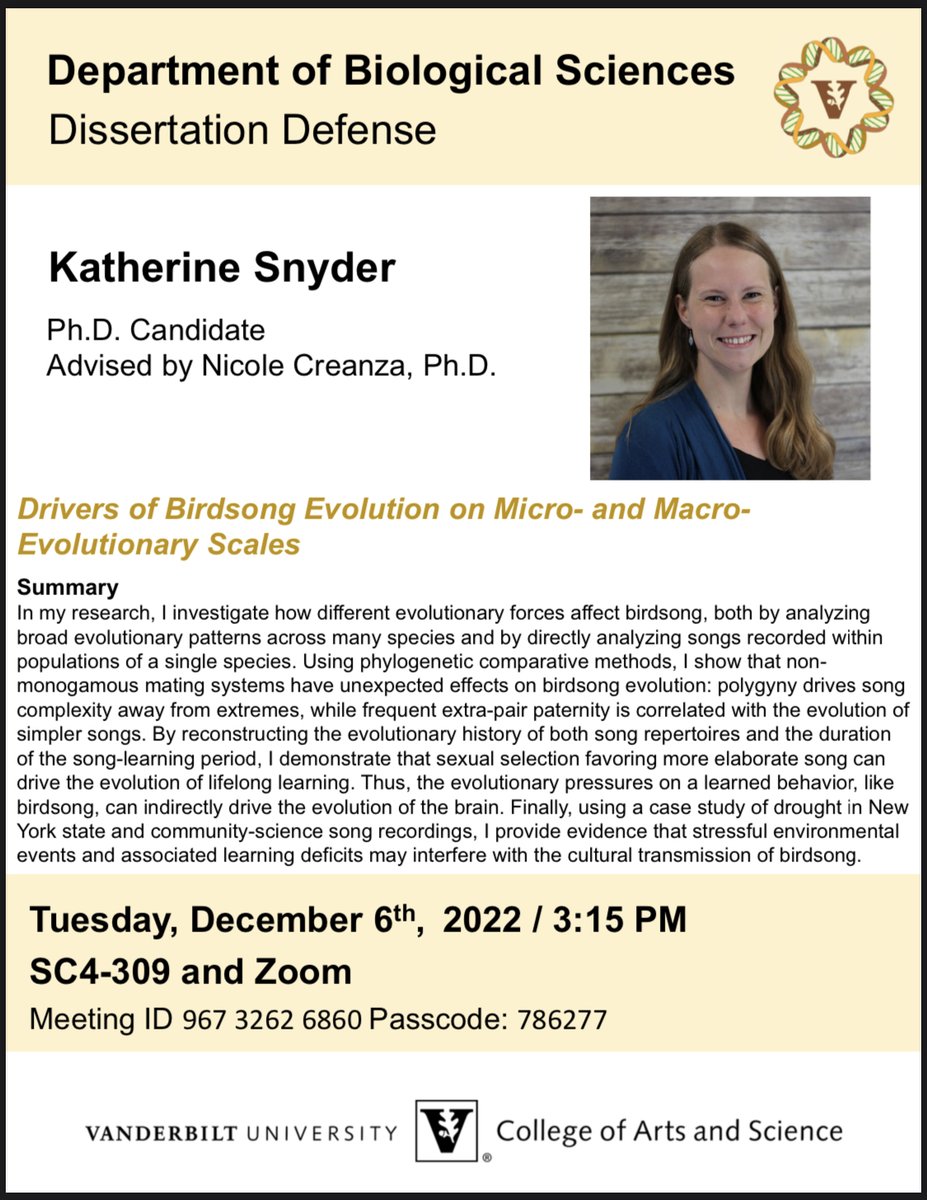
ALT A typed flyer with a Vanderbilt University logo and a headshot of me. The flyer has text reading: Department of Biological Sciences Dissertation Defense Katherine Snyder Ph.D. Candidate Advised by Nicole Creanza, Ph.D. Drivers of Birdsong Evolution on Micro- and Macro- Evolutionary Scales A summary of my projects that doesn't fit in alt text allocated space - my apologies. Tuesday December 6th 2022, 3:15 PM SC4309 and Zoom Meeting ID 967 3262 6860 Passcode: 786277
8
23 Sep 2022
I was so jazzed to read this paper a little early and talk to @buehlersciwri about it! Really fascinating work @PLOSBiology by @eric_schuppe @erichjarvis @fuxjagerlab et al. 🐦 Evidence for learning in the drumming of woodpeckers! plos.io/3DDOLaT
22 Sep 2022

Nice piece by @buehlersciwri in @newscientist about @fuxjagerlab's #woodpecker drumming paper in @PLOSBiology. Original paper: plos.io/3DDOLaT newscientist.com/article/233…
2
3
Creanza Lab retweeted

23 Sep 2022
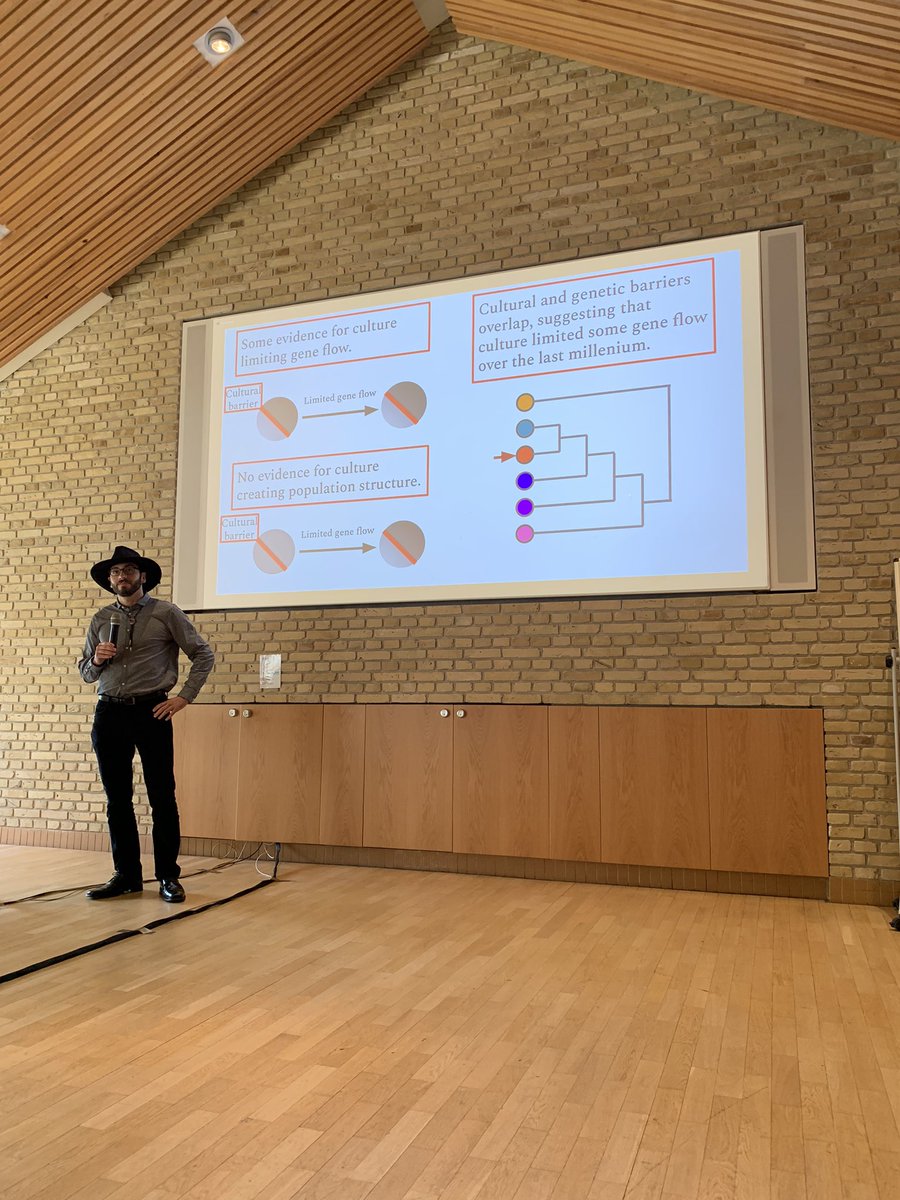
Fantastic talk by fellow @CreanzaLab member @pichkary on cultural barriers to gene flow in “homogeneous” England! Nailed the lightning talk format. Great to see this project out in the world. #CESConf2022 @CulturalEvolSoc
2
12