
Crypto Runner
Joined February 2026
- Tweets 661
- Following 261
- Followers 91
- Likes 738
24 Photos and videos











Runner retweeted

📊 Guess the Chart Challenge is LIVE!
A hidden chart is waiting… can you decode it? 📈
How to Participate:
• Comment your answer with your chart prediction
• Follow & RT this post
• Tag 3 friends to join the challenge
⏰ Deadline: 20th June, 12 PM PKT
Show your analysis skills and win! 🚀

117
121
141
6,656
Runner retweeted

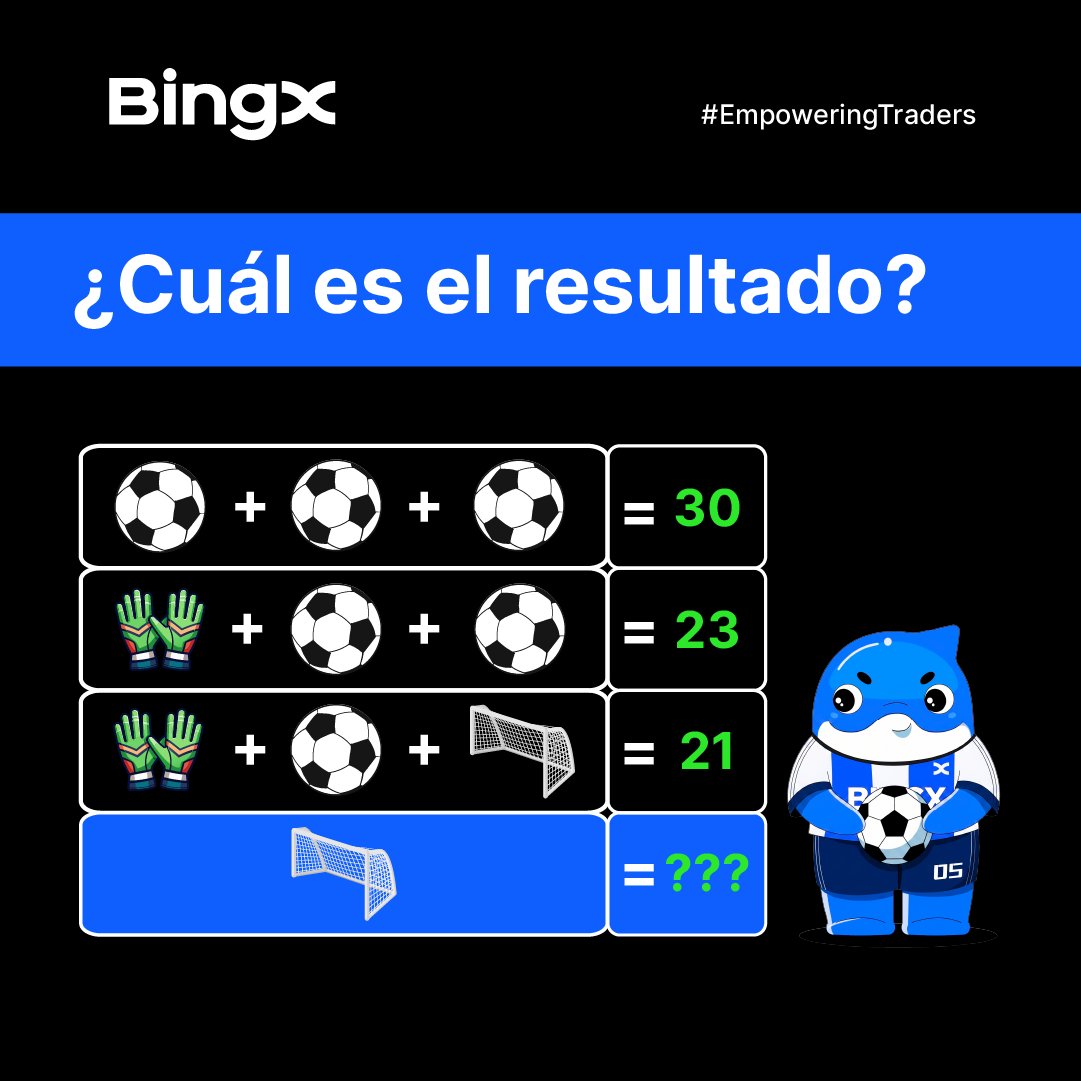
🤑 ¡Sorteamos 30 USDT para 3 ganadores! (10 c/u).
👉 Seguirnos Repost.
👉 Comenta tu respuesta.
🍀 Termina este viernes.
#Sorteo #BingX #CriptoLatam
66
60
70
667
Runner retweeted
1
3
8
Runner retweeted
1
2
10
Runner retweeted
1
2
5
Runner retweeted

🚀 SpaceX hit NASDAQ. Now it's your turn.
10 Winners share 500 USDT 💰
Biconomy.com x $SPCX GIVEAWAY 🎁
✅ Follow @BiconomyCom
✅ Like | Repost | Tag 3 frens
✅ Comment [Trade $SPCX on Biconomy] UID
📅 June 26, 12pm (UTC)
👉 Register: forms.gle/VD8i72an348G8JCK8
#BiconomyCom #SPCX #SPACEX

162
151
188
3,750

🏆 號外!我們正在尋找足球預測大神!
這次不用上場踢球,只要動動手指以下精選賽事結果,就有機會把 獎金帶回家
🇫🇷 法國 vs 伊拉克(6/23)
🇳🇴 挪威 vs 塞內加爾(6/23)
🏴 英格蘭 vs 迦納(6/24)
1️⃣ 追蹤 @MEXCZH 並轉發本篇貼文
2️⃣ 留言UID 你的每一場預測結果(每一場選國家或平局),共三個答案,一起Tag兩位好友來參加
📅活動時間:0615-0622
🎁 活動獎勵
🏆 猜中 3 場:3000 USDT 合約倉位 × 3 名
🏆 猜中任 2 場:1500 USDT 合約倉位 × 3 名
🏆活動參與獎: 500 USDT 合約倉位 x 3名

134
117
141
3,833
Runner retweeted

Jun 15
France vs Iraq
🇨🇵 = 🎉🔥
Norway vs Senegal
🇸🇳 🎉🔥
England vs Ghana
🏴🎉🔥
My MEXC UID = 65163735
@SmartAhmad01
@M00BAAH
1
3
66
Runner retweeted

Jun 15
👕 Every number tells a story! ⚽🔥
What’s your jersey number? Which country do you stand with? 🌍
Comment your favorite jersey number, country & MEXC UID below for a chance to win a $300 MU Airdrop Position! 🎁
⏰ Event Period: Jun 15 – Jun 17, 23:59 (UTC 8)
#WEARE26 #MEXCKickoffFest #MEXC

99
84
114
4,053
Runner retweeted

Jun 15
كل يوم إثنين سؤال جديد، وفرصتك تكسب USDC 🤩
جاوب صح، واتبع الخطوات، و7 منكم يشاركون في جائزة إجمالية قدرها 300 USDC هذا الأسبوع.
✅ متابعة @BinanceArabic
✅ لايك وريتويت
✅ تاغ صاحب في التعليقات
💬 ردّ بإجابتك
سؤال هذا الأسبوع: ما هي العملة الرقمية الأولى في العالم؟
A) Ethereum
B) Bitcoin
C) BNB
D) Solana
سيتم اختيار 7 فائزين بشكل عشوائي من الإجابات الصحيحة.
وإذا ما عندك حساب على بينانس حتى الآن، سجّل من هنا وابدأ معنا 👇
accounts.binance.com/ar/regi…

1,397
1,256
1,494
49,384
Runner retweeted

Jun 14
One Day, You Will Meet the Person You Could Have Become.
And that meeting will either be your greatest source of pride...
Or your deepest regret.
Think about it.
Years from now, there is a version of you that exists only as a possibility today.
A version that is wiser. Stronger. More successful. More respected. More financially secure.
A version of you that has achieved things you currently only dream about.
The question is not whether that version exists.
The question is whether you will become them.
Because the distance between who you are and who you could become is determined by the choices you make every single day.
Most people spend their lives believing their biggest enemy is lack of money.
It isn't.
Others believe their biggest enemy is lack of opportunities.
It isn't.
Some believe their biggest enemy is bad luck.
It isn't.
The greatest enemy of human potential is comfort.
Comfort convinces people that tomorrow is guaranteed.
Comfort whispers:
"You can start later."
"You still have time."
"One more day won't matter."
But life has a brutal way of exposing that lie.
Years pass.
Dreams remain dreams.
Goals become memories.
Potential becomes regret.
And people find themselves living far below what they were capable of becoming.
The saddest thing in life is not failure.
Failure teaches.
Failure develops.
Failure creates experience.
The saddest thing in life is unrealized potential.
Knowing you could have done more.
Could have learned more.
Could have become more.
But never did.
History is filled with people who changed their lives because of one decision:
The decision to stop postponing their future.
The day they decided to learn. The day they decided to build. The day they decided to take responsibility. The day they stopped making excuses.
Everything changed after that.
Not immediately.
But permanently.
The reality is that every action you take is writing a letter to your future self.
Every hour invested in growth is a gift.
Every excuse is a debt.
Every disciplined action is an investment.
Every wasted day carries a cost that cannot be refunded.
Time is the only currency that every billionaire, every king, every genius, and every ordinary person receives in exactly the same amount.
The difference is not who has more time.
The difference is who understands its value.
One day your life will become a story.
The question is:
Will it be a story about someone who spent years waiting for the perfect moment?
Or a story about someone who understood that the future is built by ordinary days repeated consistently?
Because whether you notice it or not...
You are becoming someone right now.
The habits you repeat. The books you read. The people you follow. The conversations you engage in. The standards you accept.
All of them are shaping the person you will eventually become.
So don't ask yourself where you'll be in five years.
Ask yourself:
"If I continue living exactly the way I am today, where will I end up?"
The answer to that question reveals your future.
And if you don't like the answer...
Today is the best day to start rewriting it.

8
4
20
193
Runner retweeted
Jun 5
One opportunity most people miss in Web3...
is documenting their journey publicly.
Many users spend months learning:
🔹new tools
🔹ecosystems
🔹airdrop strategies
🔹community building
🔹onchain concepts
But they keep everything to themselves.
Meanwhile, someone else learns the same thing and shares:
"Here's what I learned today."
"Here's a mistake I made."
"Here's what surprised me."
Over time, that person becomes discoverable.
Teams start recognizing their name.
Other users start trusting their insights.
Opportunities start finding them.
The lesson?
Don't just learn in Web3.
Learn publicly.
Your content can become proof of your knowledge long before you have a big audience.

3
6
16
137
Runner retweeted
Jun 5
I realized one thing many people don't realize about Web3 jobs...
some of the best opportunities never get posted publicly.
They get filled through reputation.
A founder needs a moderator.
A community manager is looking for support.
A project needs a content creator.
Instead of creating a public job post, they often ask:
"Do you know anyone reliable?"
That's why your goal shouldn't be to look for jobs every day.
Your goal should be to become the person people recommend.
Start building that reputation now:
🔹show up consistently
🔹communicate professionally
🔹help where you can
🔹deliver on small commitments
In Web3, many opportunities travel through people before they ever reach a job board.
Position yourself where your name comes up in those conversations.

1
6
12
96
Runner retweeted
Jun 5
The most sophisticated product in Web3 is not the one with the most complex architecture.
It is the one that makes complexity disappear for the user without hiding the value behind it.
This is a distinction the industry does not discuss enough.
Many teams treat complexity as evidence of innovation.
And to be fair, innovation often creates complexity.
New systems introduce new mechanisms. New mechanisms introduce new behaviors. New behaviors introduce new learning requirements.
Complexity itself is not the problem.
The problem begins when users are forced to carry that complexity themselves.
Because every product makes a choice.
Either:
The team absorbs complexity internally and delivers simplicity externally.
Or:
The user absorbs complexity externally and pays the cognitive cost personally.
The difference between those two choices is enormous.
In fact, it may be one of the most important competitive advantages in the entire Web3 ecosystem.
Most adoption conversations focus on:
• distribution • incentives • partnerships • growth loops • network effects
Yet beneath all of them exists a more fundamental variable:
Cognitive efficiency.
How much mental effort is required before a user can confidently act?
The answer to that question influences nearly everything.
Because human beings do not merely optimize for value.
They optimize for value relative to effort.
A product may create extraordinary value.
But if understanding that value requires excessive interpretation, many potential users will never reach the point where the value becomes visible.
This creates a hidden adoption tax.
Not a financial tax.
A cognitive tax.
And unlike transaction fees, cognitive taxes are rarely visible on dashboards.
They appear indirectly:
• abandoned onboarding flows • weak activation • low retention • fragmented communities • repeated user confusion • dependency on constant explanation
The ecosystem feels busy.
But progress feels inefficient.
Why?
Because users are spending energy understanding the system instead of benefiting from it.
The most successful products in history often solved this problem exceptionally well.
Not by eliminating complexity.
But by relocating it.
The complexity remained inside the product.
The user experienced clarity.
This is why communication should not be viewed as something that happens after product development.
Communication is part of how complexity is managed.
It determines whether innovation feels accessible or intimidating.
Whether participation feels natural or exhausting.
Whether curiosity evolves into confidence.
Or confusion.
The deeper insight is this:
Every breakthrough technology creates two parallel challenges.
The first challenge is technical.
Can the system work?
The second challenge is cognitive.
Can human beings understand it well enough to integrate it into their lives?
The industry spends enormous resources solving the first problem.
But the projects that define the next era of Web3 may be the ones that become obsessed with solving the second.
Because technological progress alone does not create adoption.
People do.
And people adopt what they can confidently understand.
In the long run, the teams that win may not simply be the teams building the most advanced systems.
They may be the teams that become world-class at converting complexity into clarity.
Because once clarity scales, adoption has a chance to scale with it.

Jun 3

Every Web3 ecosystem is built twice.
The first time in code.
The second time in the minds of the people using it.
Most teams obsess over the first version.
Very few pay enough attention to the second.
Yet the second version often determines whether the first one succeeds.
Because users do not interact with code directly.
They interact with their understanding of the code.
They interact with the mental model they have constructed around:
🔹 what the system does
🔹 how it creates value
🔹 what role they play inside it
🔹 and what outcomes they should expect
This is why two users can interact with the exact same product and leave with completely different conclusions.
The technology remains identical.
The interpretation does not.
And interpretation is where adoption becomes either scalable or fragile.
One of the most overlooked realities in Web3 is that products are not competing only for capital, liquidity, or attention.
They are competing for mental real estate.
A place inside the user's internal model of how the world works.
The moment a product earns that position, something important happens.
Users stop treating it as information.
They start treating it as understanding.
And understanding behaves differently.
Information is consumed.
Understanding is carried.
Information is forgotten.
Understanding influences decisions.
Information requires constant redistribution.
Understanding reproduces itself through conversation, behavior, and conviction.
This is why communication should never be evaluated only by reach.
A post reaching one hundred thousand people means very little if it fails to create durable understanding.
Meanwhile, a message that reshapes how a community interprets a product can create effects that compound for years.
Because ecosystems are not ultimately governed by information.
They are governed by collective mental models.
The market reacts to what people believe.
Communities organize around what people understand.
Adoption grows through what people can confidently explain.
This creates a responsibility many teams underestimate.
Every product update changes more than functionality.
It changes the mental model users must maintain.
Every new feature introduces new concepts.
Every expansion introduces new relationships.
Every layer of complexity creates additional interpretive burden.
Without intentional communication, these burdens accumulate.
And when they accumulate faster than understanding, ecosystems begin drifting away from themselves.
Not technically.
Conceptually.
Users remain present.
But their understanding of the system becomes increasingly fragmented.
At that stage, growth becomes expensive.
Trust becomes reactive.
Communities become vulnerable to confusion.
And founders find themselves repeatedly explaining the same things.
Not because users are incapable.
But because the ecosystem never developed a scalable mechanism for transmitting understanding.
The most durable Web3 ecosystems of the future will likely solve this problem differently.
They will treat understanding as a core product layer.
Not an afterthought.
Not a marketing task.
Not a content function.
A product layer.
Something that must be designed, maintained, measured, and continuously improved.
Because eventually, every ecosystem reaches the same realization:
The quality of the network cannot exceed the quality of the understanding shared by the people inside it.
And when understanding becomes scalable, something remarkable happens.
Growth becomes more efficient.
Trust becomes more resilient.
Communities become more coherent.
And the ecosystem begins compounding not only through technology
but through collective intelligence.

6
8
186
Runner retweeted
Jun 4
Good night CT 🌙💤😴
Can I get a GN?
One of the biggest opportunities in Web3 that most people completely overlook...
is becoming the person who connects users and projects.
Everyone wants to be:
🔹a trader
🔹an influencer
🔹an investor
But very few people focus on becoming a connector.
Here's what I mean:
A project launches.
New users arrive with questions.
The team is busy building.
Someone steps in and starts:
🔹answering questions
🔹onboarding newcomers
🔹collecting feedback
🔹explaining updates
🔹connecting people to the right resources
At first, it looks like they're "just helping."
But over time, they become one of the most recognized people in the ecosystem.
And that's where opportunities start appearing:
community roles, ambassador programs, partnerships, moderation roles, content opportunities, and sometimes even full-time positions.
Most people are competing for attention.
Very few are competing to become indispensable.
In Web3, being useful can be more profitable than being popular.

27
8
33
268
Runner retweeted
Jun 4
Tomorrow is 𝕏 payout day 🎉🎉
Are you expecting payment or you're not yet monetize?
Tell us 👇🏻 🔥🔥🔥

13
11
33
278
Runner retweeted

Jun 3
🔮 Последняя возможность сделать прогноз на XRP!
Угадай цену ripple:native / solana:Es9vMFrzaCERmJfrF4H2FYD4KCoNkY11McCe8BenwNYB на 5 юиня, 16:00 UTC → выиграй часть из 150 USDT 💰
Подпишись на @cis_binance, поставь лайк сделай репост и напиши прогноз в формате: #ПрогнозXRP $84.34
x.com/cis_binance/status/206…
⏳ До 4 июня, 23:59 UTC
🏆 6 победителей × 25 USDT

May 30

🔮 Предскажи цену XRP — забери часть фонда 150 USDT
СНГ пул: 100 USDT (4 × 25)
Глобальный X пул: 50 USDT (2 × 25)
Как участвовать:
— Подпишись на @cis_binance и сделай репост
— Напиши в комментариях: #ПрогнозSOL $XXX (прогноз ripple:native / solana:Es9vMFrzaCERmJfrF4H2FYD4KCoNkY11McCe8BenwNYB на 5 июня, 16:00 UTC)
Дедлайн: 4 июня, 23:59 UTC
Давайте вместе поставим новый рекорд по количеству предсказаний! 💛
Перейти к правилам👇

221
183
246
8,602
Runner retweeted

Jun 2
🚀 MEXC SPACEX(PRE) Mission to Mars Giveaway
What would YOU ask Elon Musk @elonmusk if you had the chance? 👀
🎁 100 USDT Prize Pool
How to join:
1️⃣ Participate in the SPACEX(PRE) Launchpad 👉 mexc.com/launchpad/spacex-pr…
2️⃣ Join our community 👉 t.me/ DZDjy3Lod181ODE9
3️⃣ Comment:
❓Your question for Elon Musk UID
📸 Your participation screenshot
🤑Want extra chances to win?💰
Reply to someone else’s question with your best answer!
(UID screenshot required)
🚀 5 Most Creative Questions × 10 USDT
💬 5 Most Creative Replies × 10 USDT
#SpaceX #Launchpad #Giveaway #MEXC #Australian #Musk

217
113
171
8,110