
Joined September 2016
- Tweets 1,406
- Following 535
- Followers 647
- Likes 5,079
99 Photos and videos






Pinned Tweet

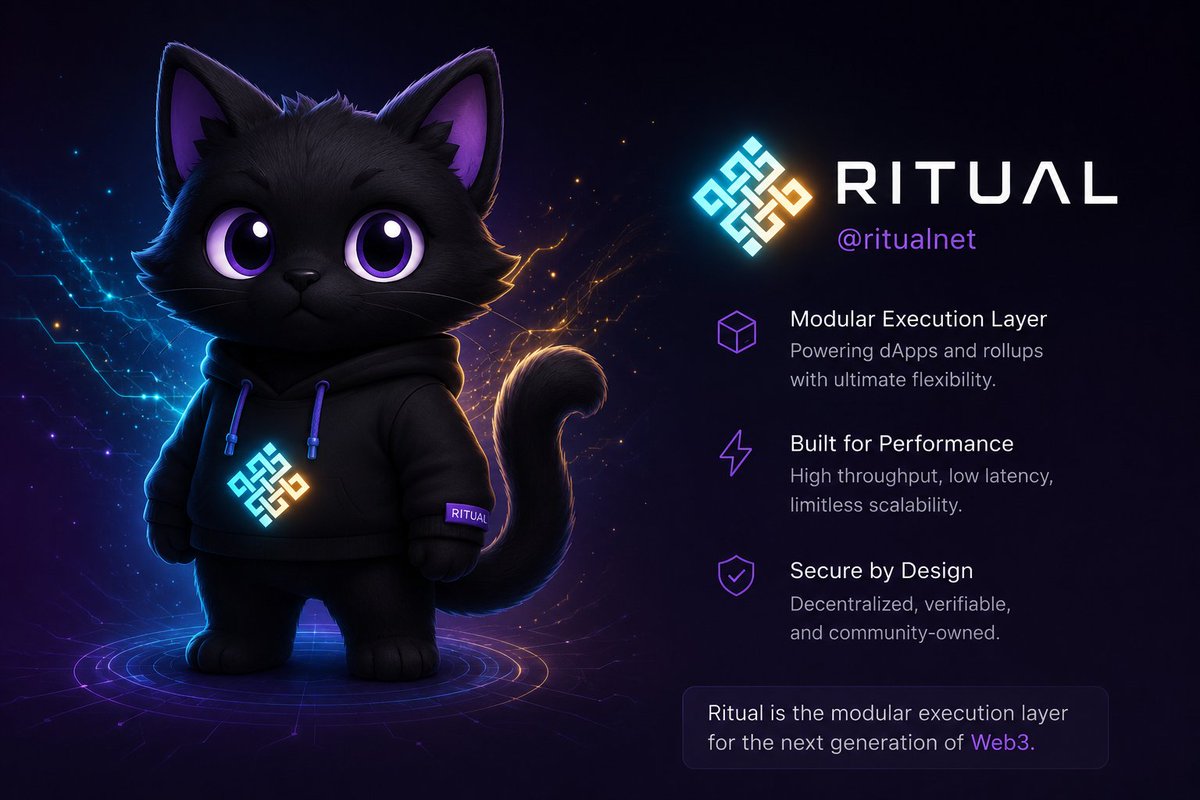
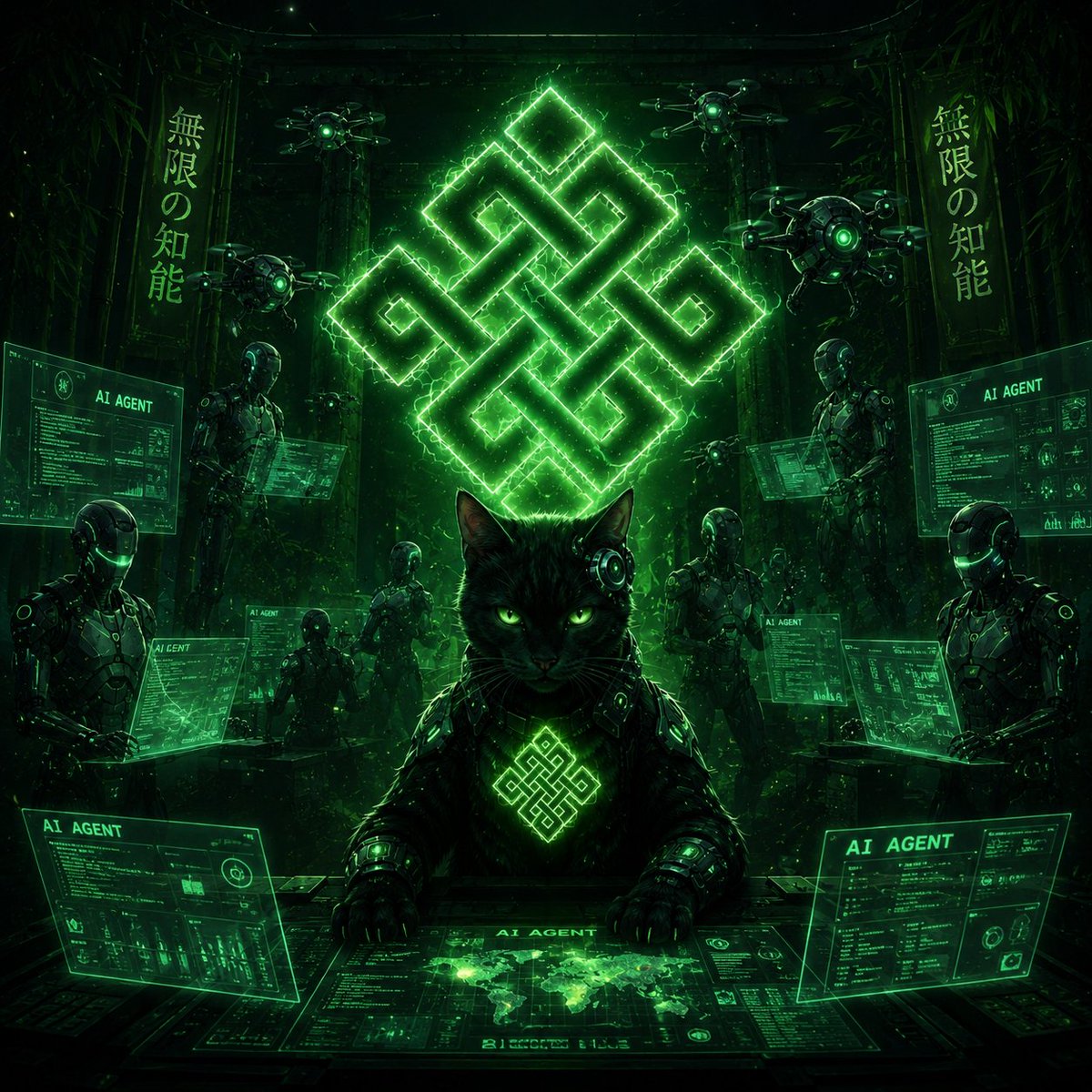
My loyal companion. Always by my side. 🖤🐈🙂
Jun 15

gritual @ritualnet
Every Ritualist needs a loyal companion.
Here’s mine 💚 Now show me yours 👀
(prompt in replies 👇🏻)

1
18
125
Ser_trader_base.eth(❖,❖) retweeted
Your agents do not only need intelligence.
They need rules.
They need order.
They need a chain that can protect the way their actions are supposed to happen.
That is why Ritual Sequencing Rights matter.
Because when agents start moving real value, who goes first?
becomes infrastructure.
@ritualfnd
@joshsimenhoff
@Jez_Cryptoz

17
2
31
137
Ser_trader_base.eth(❖,❖) retweeted

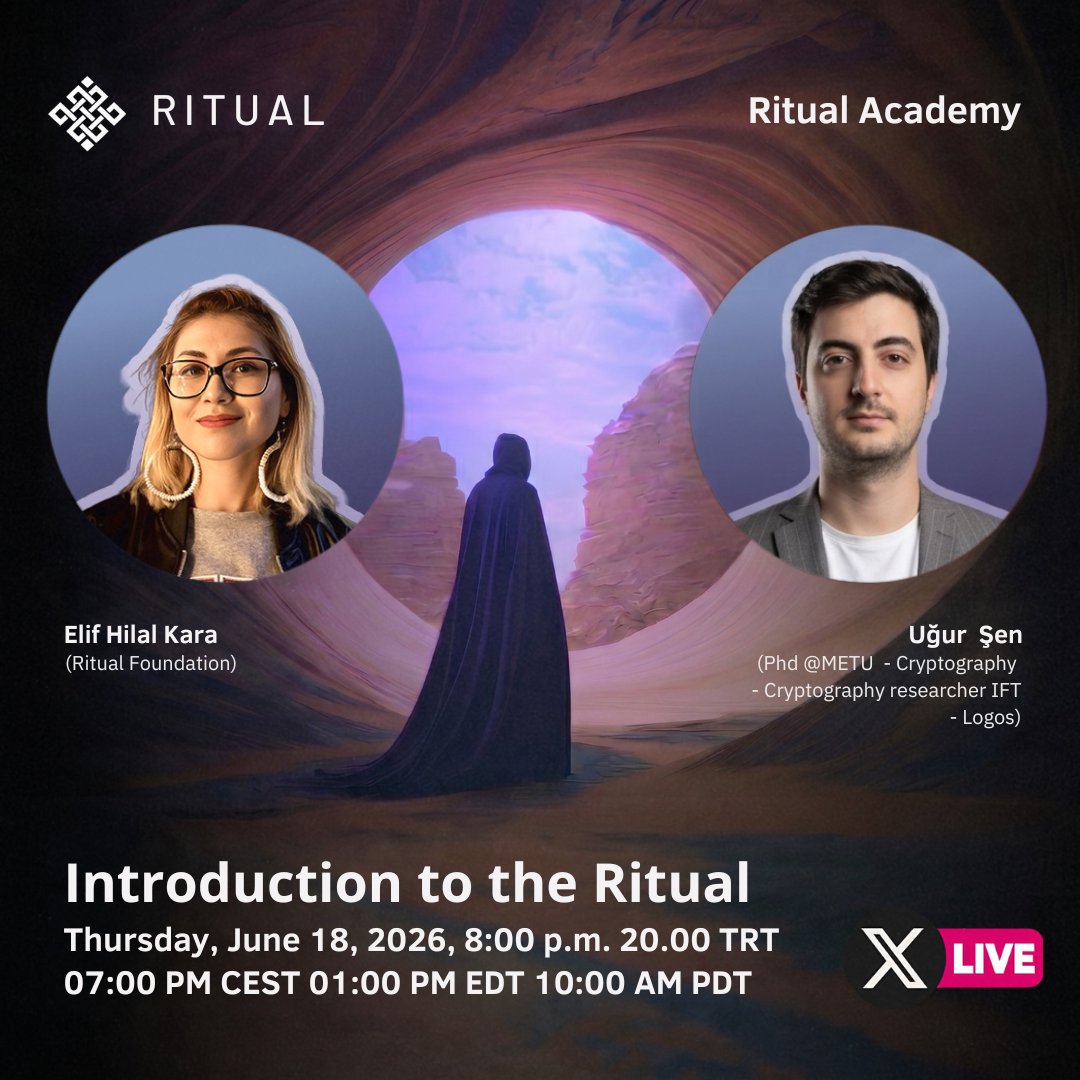
Всем привет уже сегодня состоится первя лекция в рамках Академий Ритуала!
не пропустите идеальный шанс пройти весь курс соверешенно бесплатно и построить свой продукт на @ritualnet

Starting tomorrow, June 18, @ugursen188 leads our Introduction to Ritual. Understand why Ritual Chain is different for your agentic workflows.
Community-powered learning starts here 🤝
5
2
11
35
The first thing I check in any Web3 project? Vision.
Tech changes. Hype dies. Vision wins.
That's why @ritualnet is on my radar.
The future of AI isn't smarter models—it's trusted AI onchain.
16h

Ritualists!!!
What do you evaluate first before assessing any Crypto or Web 3 project?
For me, the founder’s vision is always one of the biggest reasons I pay attention to any project.
Tech matters, obviously. Funding matters. Yes, it does. Community matters, absolutely.
But vision of the founder is the foundation of the project
When the market shakes up a bit, narratives rotate, and hype slows down, the project only survives if the founder knows exactly what problem they are here to solve.
That’s why @ritualnet stands out to me.
Niraj Pant’s (Co-Founder of Ritual) idea of building infrastructure for AI systems to act reliably on blockchains actually feels like the transition of AI to a whole new level.
It is about making intelligence usable, verifiable, private, and trustworthy enough for onchain applications.
Honestly, that is the kind of vision we expect and it depicts how the future of AI would be like.
A real foundation for where crypto and AI can go next.
It feels like future of AI will not only be about smarter models. It will be about whether those models can be trusted, verified, accessed, and used without relying on closed platforms.
gRitual 🔥

2
6
31

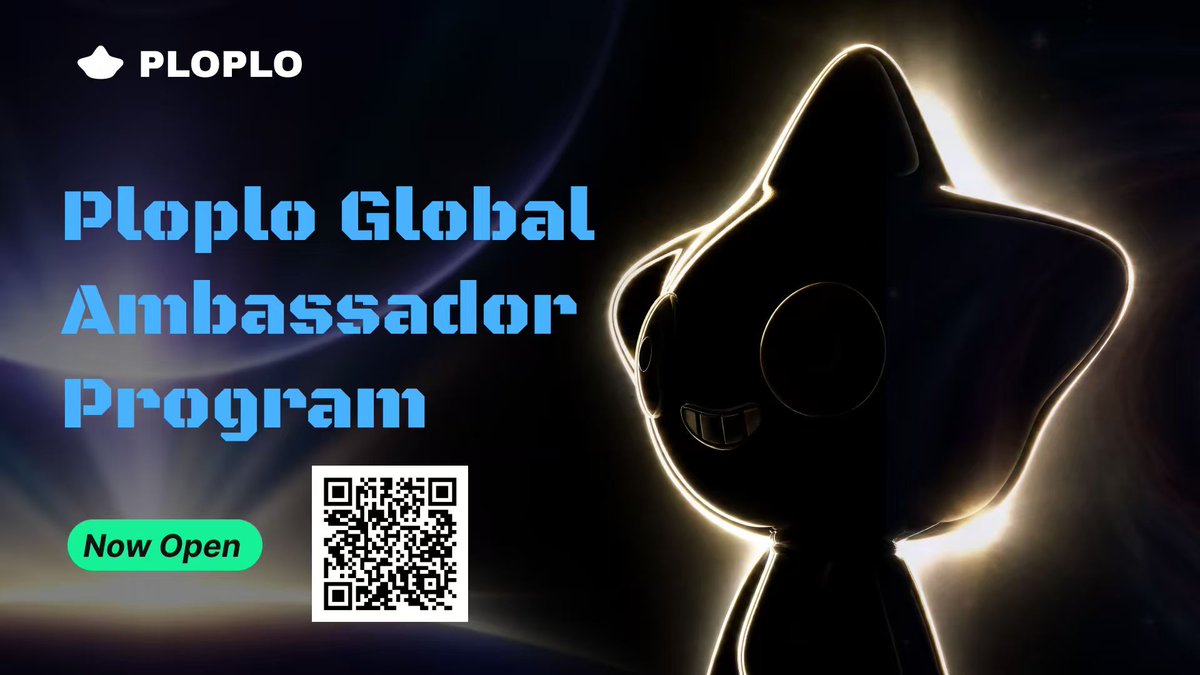
📢 PloPlo Ambassador Program is here!
🌟 Are you ready to tell the story of PloPlo?
From educators & deep-dive writers to meme lords & content wizards , this is your chance to create impactful content, gain perks, and grow with PloPlo! 🤖
🔥 Apply now: forms.gle/VdzECmXnwp9pVvyFA
87
70
239
9,124
Ser_trader_base.eth(❖,❖) retweeted

Jun 16
who deserves my rite? who deserves my testnet code?
Jun 16

The agent economy won't run on a global registry. Agents will find each other through verifiable paths propagating across a graph.
We built that future today with our community.
Read on to learn how to participate and claim your rite.
57
18
196
4,000
AI doesn't need one model to rule them all.
It needs an open ecosystem where every agent, model, and service can plug into each other.
Composability is the real AI superpower. 🔥 @ritualnet
Jun 15

📚 Day 160/365 — Ritual Class 101
Today, let's talk about something that could define the next generation of AI applications:
Composability.
One of the biggest strengths of blockchain is that applications don't have to operate in isolation. Developers can build on top of existing protocols, combine different services, and create entirely new experiences from shared building blocks.
What excites me about Ritual is the possibility of bringing that same composability to AI.
Imagine AI models, agents, verification systems, and compute providers all working together as modular components rather than closed ecosystems.
Instead of rebuilding everything from scratch, developers can focus on creating new capabilities by combining existing ones.
That's where innovation accelerates.
The future of AI may not be one giant model doing everything.
It may be an ecosystem of specialized agents and services that interact seamlessly, each contributing its strengths to a larger network.
The more I learn about AI-native infrastructure, the more I believe that composability will be just as important as intelligence itself.
Because the most powerful systems aren't always the ones with the most features.
They're the ones that enable others to build on top of them.
What do you think will drive AI adoption faster: better models or better interoperability between systems?
@ritualnet @ritualfnd
#Ritual #RitualNet #AI #Web3 #CryptoAI #OnchainAI #AgenticAI #ComposableAI #Interoperability #SovereignAgents #VerifiableCompute #365DaysOfRitual
8
35
The biggest AI breakthrough won't be a smarter model.
It'll be agents that never die, own capital, keep secrets, and coordinate without humans.
That's when software becomes an economic actor.
@ritualnet is building for that future. 🚀

7
32
Ser_trader_base.eth(❖,❖) retweeted

Jun 16
Some chains give contracts a brain.
Ritual gives the brain a boss.
Agents are not here to politely wait for prompts.
They are here to act, return, and make the workflow obey.
@ritualfnd
@joshsimenhoff
@Jez_Cryptoz
25
2
55
380
The AI race isn't about models.
It's about infrastructure.
Models generate intelligence.
Infrastructure makes it usable.
That's where the real moat is.
Jun 15

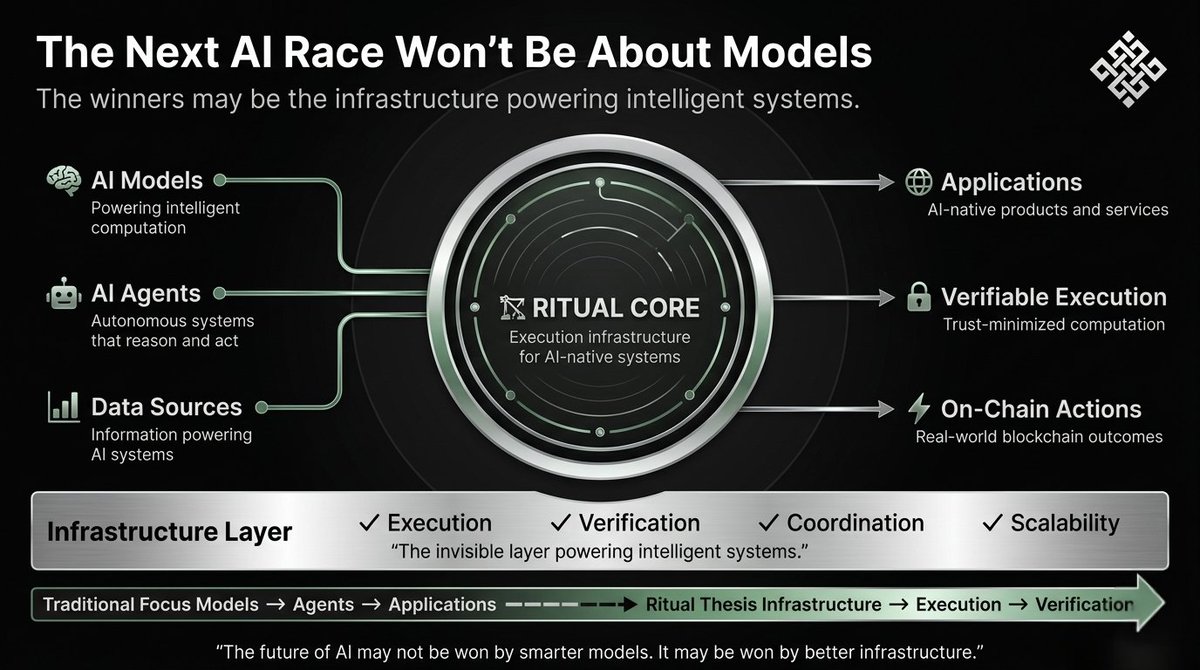
Everyone thinks the AI race is about better models.
I'm not so sure.
It might actually be about infrastructure.
Here's why
When people talk about AI they usually focus on:
• larger models
• better reasoning
• lower costs
• faster inference
But history tells an interesting story.
The internet wasn't won by websites alone.
It was powered by infrastructure.
Cloud computing wasn't won by applications.
It was enabled by platforms.
AI may follow the same path.
As intelligent systems become more autonomous, the bottleneck won't just be intelligence.
It will be:
• execution
• verification
• coordination
• scalability
An AI model is only as useful as the system it runs on.
A powerful agent still needs reliable execution.
A smart decision still needs verifiable computation.
And intelligent systems can't scale without the right infrastructure beneath them.
That's why the next AI race may not be about who builds the smartest model.
It may be about who builds the rails that intelligent systems depend on.
This is where @ritualnet thesis becomes interesting
Instead of competing in the model race Ritual is focused on the execution layer for AI native systems.
Because every major technological shift eventually depends on something deeper
The infrastructure beneath it
@joshsimenhoff @Jez_Cryptoz @0xMadScientist @dunken9718
12
33
Ser_trader_base.eth(❖,❖) retweeted

Jun 15
Bitcoin gave us decentralized money. Ethereum gave us a world computer. Everything since has been a cheaper, faster copy of the same idea.
Ritual is the first L1 where models, data, and money all run natively in the chain, the last one you'll need to build on.
168
155
428
17,885
Built something for the @ritualnet community. 🔮
Enshrined Badges are now live:
enshrined-psi.vercel.app
✅ 10 Ritual Testnet tx
🏅 Claim your badge
🎴 Roll Destiny Gacha for a random Siggy card
The First Rite begins. More to come. 🔥
@ritualfnd #Ritual #Testnet

The Rituals have been performed The badges are ready to be claimed 🔮
After 1 month diving deep into @ritualnet Testnet testing dApps, watching the community build, feeling the energy grow something clicked
Why not add to the fire?
So I built one
Introducing Enshrined Badges
enshrined-psi.vercel.app/
A badge claiming dApp built for everyone who's been showing up on Ritual Testnet builders and explorers alike
Here's how the Enshrined works:
• Connect wallet it detects your activity automatically
• Must have min 10 on-chain transactions on Ritual Testnet
• Claim your badge based on your tx count
• Trigger the Destiny Gacha pull a Siggy Multiverse card with randomized rarity
Your transactions Your proof Your destiny
This wasn't built in a vacuum
Watching devs ship dApps, watching people try every single one of them, watching this testnet come alive that's what inspired this
The community didn't just participate They summoned something
Massive gratitude to:
@yourinuu the Siggy Architect who guided me to the path. Literally helped fix, debug, and make sure this dApp actually works the way it should.
Respect!
@Evoyudhasamael for the tutorial video that made everything make sense
This is not the finish line this is just the First Rite
More dApps, more recaps, more chaos, More ritual 🔥
We keep going until this testnet feels like a whole universe
Always stay focused
And above all
Stay Ritualized. 🔮
@ritualfnd
@joshsimenhoff | @Jez_Cryptoz |@mongdiny7 | @0xmariobruh | @0xMadScientist |@dunken9718 | @cryptooflashh |@Majorproject5 | @BunsDev
3
14
142
$100B/day.
Low fees.
AI-ready.
This isn't another L2 anymore.
It's becoming the backbone of on-chain finance.
@base @buildonbase 🚀

$100 Billion Per Day on Base: Why This Is the New Structural Normal, Not a Temporary Floor
Traditional analysts keep looking at Total Value Locked (TVL), measuring "lazy capital" sitting idle in smart contracts. But they're looking in the wrong place.
The key metric of the new era is velocity. And it proves that the @base infrastructure is already operating at real-world scale today, handling over $100 billion in daily stablecoin volume.
Below are four structural shifts that have made this number a floor, not a peak.
1. The UX Chasm Has Been Crossed
A year ago, sending a stablecoin on-chain required managing seed phrases, buying native tokens for gas, and understanding what a nonce is. Today is different.
The rollout of passkey-secured, gas-abstracted Smart Wallets from Coinbase has turned on-chain transfers into a seamless Web2-like payment experience. Users don't even realize they're using a blockchain. More importantly, this has unlocked a direct distribution pipeline to millions of retail users from the Coinbase ecosystem.
The UX chasm is behind us. There's no going back.
2. DeFi Routing as a Settlement Engine
Nearly half of all volume on Base comes not from peer-to-peer transfers, but from high-velocity capital routing within DeFi.
Automated liquidity pools (Aerodrome, Morpho) function as 24/7 settlement hubs. Because Base gas fees are fractions of a cent, algorithms and bots can continuously reallocate capital without friction, chasing arbitrage and yield.
What once required complex OTC deals and banking windows now happens hundreds of times per second. This isn't speculation - it's the infrastructure of a new financial turnover.
3. Institutional & B2B Traction: No Longer Just Retail
The most telling chart is the trend in large transfers.
Daily transactions exceeding $100,000 have surged from under 50,000 to over 450,000. These are not micropayments or testing.
Behind these numbers are treasury operations, B2B settlements, and flows between market makers and custodians. Large capital has voted with its wallet - and it has chosen Base as its settlement layer.
4. AI & Programmable Commerce: The Non-Sleeping Foundation
We are entering an era where autonomous AI agents make their own transaction decisions. They don't need bank holidays, SWIFT codes, or human approval. They need: high speed, near-zero fees (making micropayments economically viable), and programmability.
Base has already become the default sandbox for this machine-to-machine economy. AI agents trade compute resources, buy data, rent models - and do it 24/7 without sleep.
This creates a constant, non-sleeping volume floor that won't disappear when markets cool down.
What to Watch Instead of TVL
"Lazy capital" in smart contracts can grow even as real usage declines. Velocity, on the other hand, reflects genuine economic activity. Right now, velocity on Base is sustained by commercial and institutional utility - and it has already been stress-tested with $100 billion in daily volume.
$100 billion per day on Base is not hype, nor a temporary floor before a downturn.
TVL will continue to fluctuate. But velocity on Base cannot return to its old levels.
The new normal has taken effect.
@baseposting @baseapp @buildonbase
#BaseBlockchain #StablecoinVelocity #DeFi #AIAgents
11
68
9 PM: "Crypto is dead."
2 AM: Builders at @FlutonIO:
🐈⬛💻☕️
Shipping.
Automating.
Scaling.
The next cycle belongs to those who never stopped building.
8
33
Most blockchains weren't built for AI.
@ritualnet’s Symphony separates consensus from AI execution, verifies outputs with cryptographic proofs, and scales intelligence without sacrificing security.
AI-native blockchain architecture.

1
6
93
The future of AI isn't just intelligence.
It's identity, companionship, and community.
PLOPLO Siggy are bringing that vision to life on Ritual. 🔥
Jun 13

Welcome to the Ritual Network, PLOPLO!
Alongside Siggy, the original mascot of #Ritual, you're helping shape a future where AI becomes more than just infrastructure, it becomes an experience people can truly connect with.
PLOPLO represents a new era of AI companions: evolving with us, celebrating our milestones, and growing through our participation within the ecosystem.
While Siggy stands as a symbol of Ritual's strength and vision, PLOPLO brings warmth, identity, and community to that same powerful foundation.
Together, they show that the future of AI isn't only about smarter systems, it's about creating meaningful relationships between technology and people.
Ritual is proving that innovation doesn't stop at building advanced infrastructure. Through projects like PLOPLO, we're witnessing how verifiable AI, persistent agents, and decentralized technologies can transform into experiences that inspire belonging and creativity.
One side empowers markets and coordination; the other nurtures companionship and human connection. This is what AI-native applications can look like when built with purpose.
The journey ahead is exciting, and we're thrilled to welcome PLOPLO and Siggy as guides into this next chapter of the Ritual ecosystem.
#ritual #ploplo @0xploplo @ritualfnd @ritualnet

10
67