
Patriot | Introvert | Foodie | AvidReader | Physicist | Entrepreneur | Striving Muslim | Libra♎ | May Jannatul Firdaus Be Your Abode Dad 😭
Joined September 2012
- Tweets 94,766
- Following 1,935
- Followers 3,029
- Likes 20,681
1,277 Photos and videos










Pinned Tweet

10 Feb 2020
Let's pray for every bitter soul.
May Allah comfort and sweeten their minds. I have chosen to pity and pray for all bitter souls.
#LoveToTheWorld
8
11
48
Mar 13
Story of my life
Mar 13

The moment you start using your bed as a wardrobe, shifting clothes to one side before sleeping, there's no going back.
38
Mar 12
Maturing is also realizing that one day, your own kids might have to extend you this same grace, recognizing that you, too, did your best with what you had.
1
22
Mar 12
Gbam!🙌🏽
Mar 12
There’s no privacy in marriage☺️
You want privacy, don’t get married😁
35
21 Sep 2025
People are busy mortgaging their intellectual future for present convenience. They don't realize that the struggle to express ideas IS what develops the capacity for original thought.
21 Sep 2025

Nearly everyone sounds the same at conferences these days. The familiar phrasing and mannerisms of generative AI are echoed by almost every speaker. This gives the impression that they wrote their speeches in the same room and edited each other’s drafts. These speakers are not necessarily recycling AI-generated texts; some may simply have internalised the biases and preferences of large language models, often subconsciously, rather than the other way around.
For those who once struggled to shape language into a style that appealed to readers or suggested originality, this may be a step forward. For true language maestros, however, the tragedy lies in seeing generic, poorly prompted texts elevated above their unique expression. This is how we risk losing the next James Salter, the next Wole Soyinka, the next J. D. Salinger, or the next Amos Tutuola.
This why we must mainstream generative AI, for that’s the practical way to learn to reduce the kind of dependency that stifles originality and creativity. AI should help us polish our ideas, not impose its bland idiosyncrasies to the point where we all sound alike, like a troupe of performance actors. The task is not to reject generative AI but to adopt it wisely, destigmatise the use of its outputs, and master it well enough to remain the masters of this evolving technology.
105
23 Aug 2025
This is the hard truth many don't want to hear. Poor financial decisions shouldn't become taxpayer obligations. Individual accountability matters!
23 Aug 2025

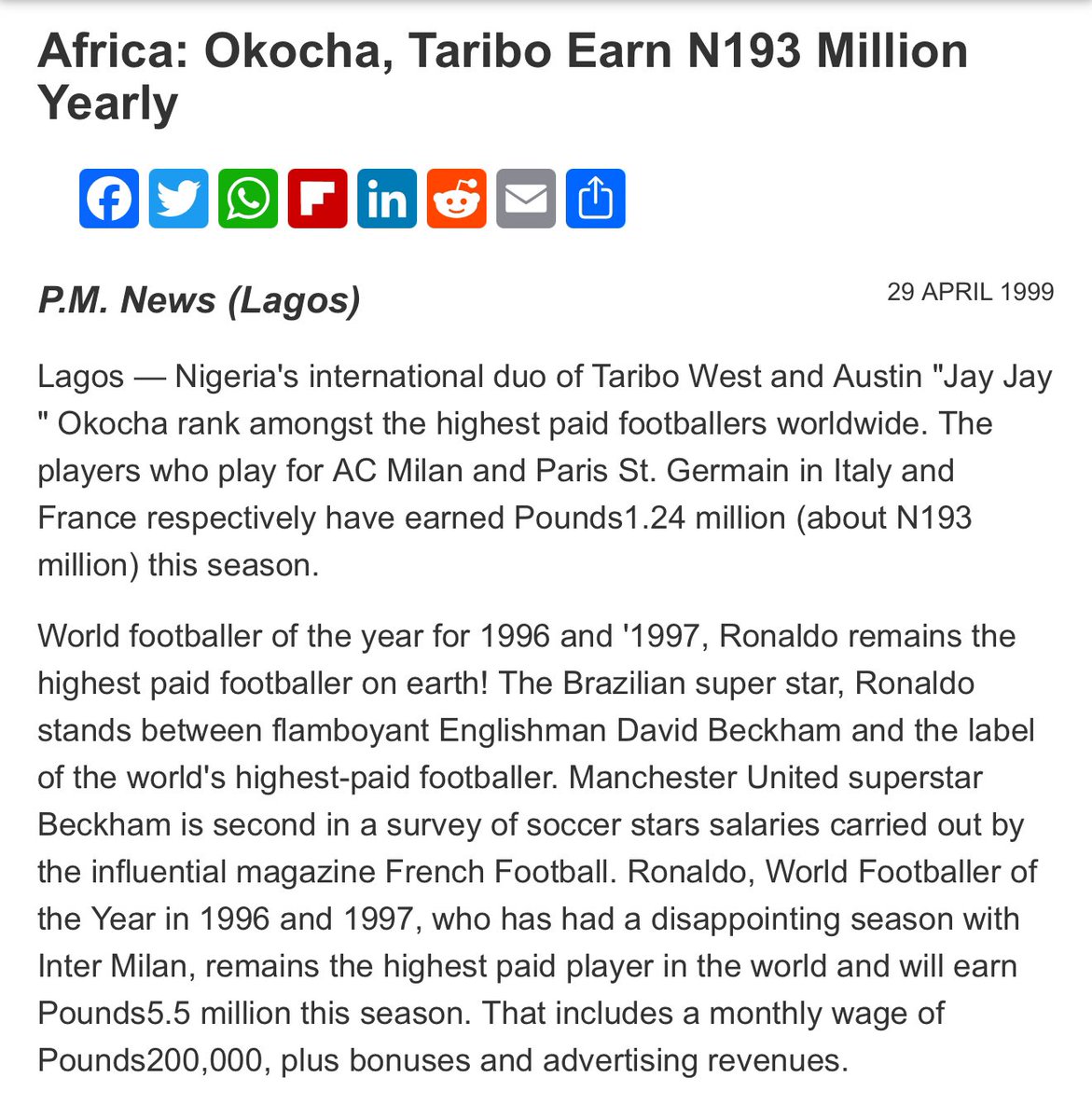
I saw the image of a news story from 1999 showing that Taribo West made about N200m that year. That’s at almost $2m at the time at the 1999 rate of almost N100/$. If half of that money went into a mutual fund, he’d have the capital and still be earning more than enough yearly to not have expectations that the government should be taking care of him now.
Having N193m in 1999 is like having N2b today.
I had to google it for myself. I don’t need that story to know that even at that time, footballers who were fortunate enough to play for Nigeria were mostly good earners at club level, whilst also earning great privileges and solid appearance fees and bonuses when playing for Nigeria.
I followed their stories. They were RICH in every country’s context.
Playing for Nigeria also vastly increased their chances of playing for tier A or B clubs and getting better deals. Blaming Nigeria for your poor decisions is a bad way to raise the next generation.
People must learn to take responsibility for their mistakes. That’s what we should imbibe in the next generation because “government must do this” and “government must do that” will not always apply. Nigeria has woken up to understanding that it can’t do everything. If you sleep on that, you will suffer.
Nigeria’s got its own blames. Half of it is government pretending to be God. That it is easily the fall guy for every failing we see shouldn’t blind everyone to their individual failings.
I understand the Lagos State Government gave the Peter Rufai family N15m to assist with burying the legend. That suggests that even in death, our legend accessed a resource that most Lagosians alive cannot make or access from government in a year.
I know rational arguments can hurt the soul when they clash with your emotions and biases. Sorry about that, but you are responsible for your own soul.
1
1
204
4 Aug 2025
This kind of timeline chaos makes the whole production look amateurish, regardless of how much money was thrown at it. Someone clearly needed to hire better script supervisors instead of just focusing on vanity metrics.
4 Aug 2025
Ms. Kanyin opens in a contemporary setting with the Temi Otedola character holding a diary that bears the year 2024. Yet by the 32nd minute, she is seen holding an envelope containing the question papers for the “May/June 1999 WASSCE,” which was held “one year later,” implying that the event preceding it takes place in 1998. Or did I miss something?
There are tiny details you do not want to believe could have escaped the script supervisors or the director, for they seem far too obvious to slip past even the barest scrutiny, especially knowing the resources disbursed for the production. Perhaps the production crew are more dedicated to creating stories for Temi to show off her investment in learning French. 😁
68
4 Aug 2025
That humble man strategy is officially outdated. The streets are awake now
4 Aug 2025

Drinking sachet milo, serving of food, carrying your own bag, flying economy, acting poor etc; does not work again as election strategy in Nigeria. Late Buhari don cast the format. Aisha Buhari even fried Akara that year.
36
4 Aug 2025
Exactly! Democracy dies in echo chambers. Cox effective govn't requires dissenting voices, challenging questions, and diverse perspectives. Cronyism kills this by creating a culture where agreement matters more than truth. That's how you get policy failures and public alienation!
4 Aug 2025

Cronyism hardly wins hearts and minds but reinforces the sentiment of the cluster and echo chamber. This may be useful in cult organizations but not in Government circles. 🐝
1
47
The Minister retweeted

4 Aug 2025
Did you know? The Qur’an described how milk is produced with biological precision — over 1,400 years ago.
Let’s walk through it.
5
167
1,354
90,198
4 Aug 2025
Absolutely! We have a right to know exactly where our tax money is going, especially when the amount is this astronomical.
4 Aug 2025

I challenge this government to release a cost breakdown and the scope of work and cost attached to them that makes up this 712 billion
And let’s have a publicly televised bidding process so other companies can’t participate!
1
51
1 Aug 2025
May Allah continue to bless you for this. Thanks for keeping people motivated when they need it most. This kind of encouragement can literally be the difference between someone giving up and someone landing their dream job.

The aim is to bombard job seekers with a lot of opportunities, so much that they would have at least one or two applications on their “to-do list” everyday.
Applying for opportunities regularly keeps your hope of securing job alive until you secure one. You might apply and fail 1,000 times but believe me you learn new things with every failed application.
And remember, the more opportunities you apply, the more your chances of getting a job.
We want the inboxes of our graduates to have either interview invite, aptitude test invite, medicals invite or even resumption alert.
Dont give up. Giving up is not a quality of a WINNER.
42
1 Aug 2025
This could be the canary in the coal mine for broader economic trouble ahead.
1 Aug 2025
Nonfarm payroll growth was slower than expected in July and the unemployment rate ticked higher, raising potential trouble signs for the U.S. labor market.
Job growth totaled 73,000 for the month, above the June total of 14,000 but below even the meager Dow Jones estimate for a gain of 100,000. June and May totals were revised sharply lower, down by a combined 258,000 from previously announced levels.
At the same time, the unemployment rate rose to 4.2%, in line with the forecast.
The June total came down from the previously stated 147,000, while the May count fell to just 19,000, revised down by 125,000.
43
1 Aug 2025
How does removing intermediaries who add markup without adding value cause scarcity? If anything, it should make products cheaper and more available.
1 Aug 2025

Petroleum Marketers Lamentation
Warn that Dangote Refinery’s plan to bypass existing distribution channels & supply refined petroleum products directly to end-users would lead to a nationwide disruption, long-term product scarcity, and the collapse of the existing supply network
44
30 Jul 2025
The whole statement feels like damage control rather than confident. Maybe focus on actual governance instead of pre-emptive victimization narratives and premature re-election talk.
30 Jul 2025

“This President (Tinubu) is a Nigerian. He deserves the same two terms that Buhari had. Let’s not sacrifice the country for personal ambition.” - Bayo Onanuga
Bayo Onanuga, the Special Adviser to the President on Information and Strategy, has claimed that certain individuals have targeted President Bola Tinubu due to his Southern origin.
During an interview with Trust Radio, Onanuga refuted the allegation of marginalization, labeling it as falsehoods driven by political agendas.
Onanuga stated that it is not accurate to claim that the North has been disadvantaged or overlooked in terms of appointments or developmental projects.
He said, “This President is a Nigerian. He deserves the same two terms that Buhari had. Let’s not sacrifice the country for personal ambition.
“You need to get your statistics right. It’s all political mischief designed to undermine the President. There are bad roads across the country, not just in the North.
“The National Security Adviser, Chief of Defence Staff, and the two Defence Ministers are all Northerners. Places like Birnin Gwari and Igabi (in Kaduna) are now safer. I drove from Kaduna to Abuja without incident, a journey that was once unthinkable.”
1
46
30 Jul 2025
When you take away the luxury of falling back, you either rise or you rise. The kind of mindset that says, If this fails, I rebuild, not retreat
35
30 Jul 2025
It's Unfortunate that many are still clinging to ethnic loyalty like it’s going to reduce fuel prices
30 Jul 2025

Politicians are stealing our resources and you’re here doing tribalism. Their children are living their best lives while you’re still struggling to feed. Instead of focusing on those ruining the country, you’re doing bigotry.
51
30 Jul 2025
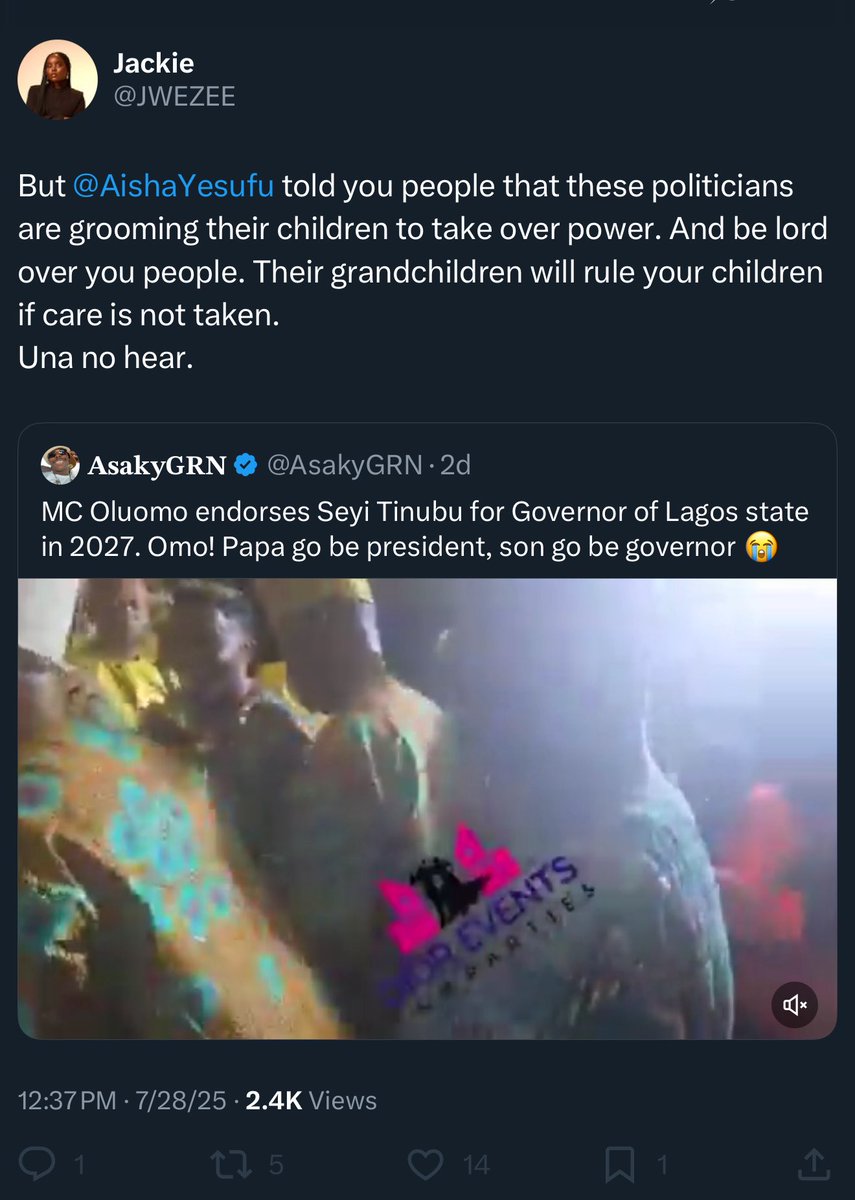
The irony is thick! She's literally criticizing the exact system that put her in position! Her dad was Senate President and now she's positioned in political structures, but somehow when others do it, it's 'grooming for power'? The lack of self-awareness is stunning!
30 Jul 2025

Why do you have a problem with politicians grooming their children to take over power? Is this a joke?
Your dad was a former Senate President and now you have been appointed an Exco of the SPV, ADC, with the sole aim of grabbing power.
Who groomed you?
1
7
1,243
30 Jul 2025
This right here is the definition of physician, heal thyself. You can’t preach party purity when your own house is out of sync. If it’s really about values and loyalty, start with your own family.
30 Jul 2025
David Mark is urging young people to join the ADC and talking tough about anti-party activities. The irony writes itself.
Maybe he should start by convincing his daughter, a serving House of Representatives member, to leave the APC and join him in his new SPV venture. Or is he waiting for her to lose her ticket before pulling her into the ADC?
How can you be preaching loyalty and alignment when your own daughter is politically aligned with SGF George Akume in Benue State? If you cannot ask your own daughter to leave the APC, please take several seats.
104
30 Jul 2025
We spend more time debating personalities than pressing for results. If someone promised to fix power and hasn’t, that’s where the focus should be, not on who asked the smartest question or gave the most eloquent answer years ago. Results over rhetoric, always.
30 Jul 2025
Seun: You have criticized someone who said, 'This is the solution,' and you are supporting someone (Tinubu) who said, 'Don't vote for me if I cannot fix the power?'
Omojuwa: First of all, Peter Obi has never answered the question of fixing power. The beauty of it is that even you look confused about his answer when you ask him about power.
81