
Content Creator | Web3 writer | CM | Navigating web3 and enjoying every bit of the journey! ❤️
Joined November 2021
- Tweets 9,272
- Following 1,847
- Followers 1,299
- Likes 8,934
835 Photos and videos
Pinned Tweet

May 29
Most people hear Neptune or Leviathan and still walk away confused.
So I made this simple.
This video breaks down the story behind Neptune Privacy, what Leviathan is, and why it matters without the usual technical maze.
♦️Clear explanations.
♦️Straight talk.
♦️Full picture.
Watch and let me know your thoughts 👀🔥
@NeptunePrivacy @XNTcommunity
21
24
1,237
Jun 13
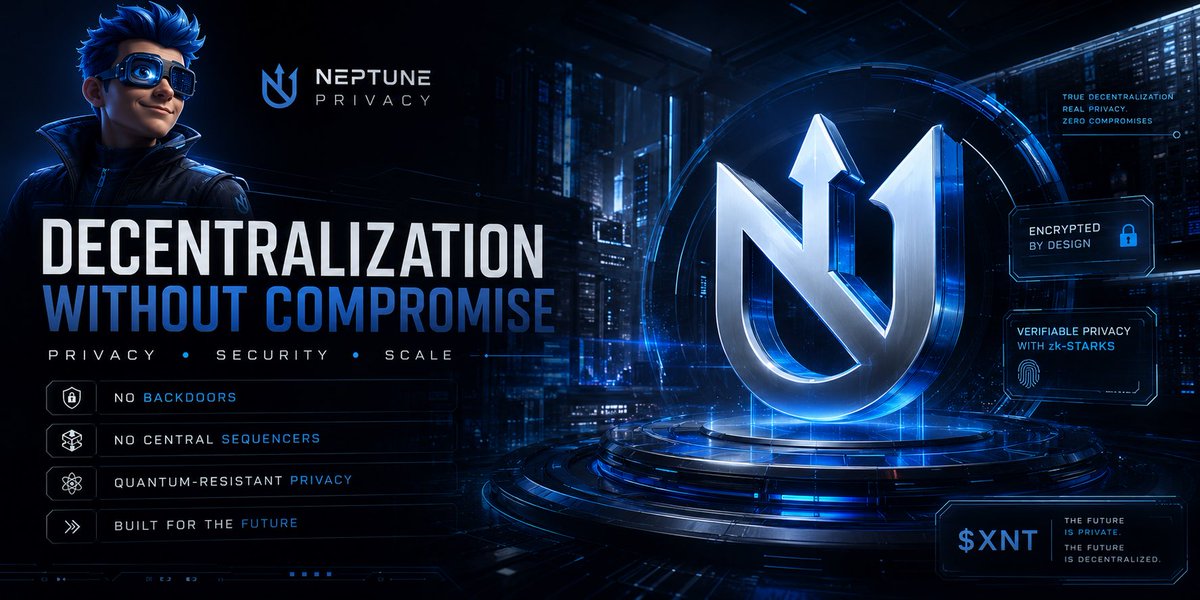
Everyone claims decentralization.
Almost no one actually builds it.
A few validators hold outsized power.
Foundations override chains.
Sequencers can go dark and freeze everything.
That’s centralization wearing a mask.
————————-
Neptune Privacy ($XNT) skipped the shortcuts.
❯ No backdoors
❯ No silent control points
❯ No single entity holding the kill switch
True decentralization is something you engineer in, not a label you add later.
————————-
Here’s how Neptune does it:
➜ Proof-of-Work mining allows anyone to help secure the network.
No staking barriers. No gatekeepers.
➜ zk-STARKs provide verifiable privacy with:
• Zero trusted setup
• Full quantum resistance
➜ Mutator Sets keep transactions and smart contracts fully private.
No metadata. No traceable links. No leaks.
➜ Every future coin comes from mining.
Fully open source.
No foundation overrides.
No centralized sequencer.
➜ Private by default fully programmable.
Fast L2 scaling built on a truly decentralized L1.
🔹Privacy.
🔹Security.
🔹Scale.
📌No compromises.
Built for the quantum era.
See it for yourself → neptune.io
$XNT
13
16
929
Rad 📽️🏳️ retweeted

Jun 13
🚀 Just 24 hours after launch and we've already welcomed 74 participants to the Neptune Privacy Zealy campaign!
The response has been incredible and we're only getting started. 🔥
A huge thank you to everyone supporting privacy, decentralization, and the future of Web3.
Haven't joined yet?
💎 Complete quests
💎 Earn XP
💎 Climb the leaderboard
💎 Compete for 2,000 XNT in rewards
Let's see where we are in another 24 hours. 👀
$XNT @NeptunePrivacy
Jun 12

👀 Still sleeping on $XNT?
The community is growing.
The holder count is rising.
The Zealy campaign is live.
And rewards are being distributed to the most active supporters.
While most are waiting for confirmation, smart money is quietly accumulating.
Privacy isn't a trend.
It's a necessity.
Join the movement.
Become an XNT holder.
Climb the leaderboard.
🔥 Don't be the one buying after everyone else discovers it.
5
4
12
517
Rad 📽️🏳️ retweeted

Jun 11
The easiest way to spot a disruptive technology?
The market doesn’t know how to categorize it.
Leviathan isn’t competing for a seat at the table.
It’s building a different table.
Private.
Post-quantum.
Scalable.
$XNT
11
17
49
1,218
Rad 📽️🏳️ retweeted
Most blockchains will be obsolete the day quantum computers go mainstream.
Not because of hacks.
Not because of exploits.
Because the encryption they were built on was never designed to survive what's coming.
Neptune Privacy is.
Post-quantum cryptography isn't a feature on the roadmap, it's the foundation the entire protocol is built on.
When the quantum era hits, most chains scramble.
$XNT is already ready.
9
12
44
1,701
Rad 📽️🏳️ retweeted
“Neptune already built the missing piece, and Leviathan is the practical proof that the technology works.”
The private, post-quantum narrative is coming.
Neptune Privacy and Leviathan is uniquely positioned for what’s ahead.
Watch this clip from @firehustle_net explaining why they deserve attention in the private, post-quantum blockchain conversation.
$XNT
12
20
48
1,481
Rad 📽️🏳️ retweeted
The conversation around quantum risk is changing fast.
Google’s recent breakthrough reduced the resources needed to run Shor’s algorithm by roughly 10x. Independent researchers are already building on those results.
The question is no longer if cryptography will face quantum pressure.
It’s when.
Neptune Privacy isn’t waiting for Q-Day.
It was built with post-quantum assumptions from day one.
Privacy by default.
Post-quantum security.
Built for a future that may arrive sooner than most expect.
$XNT
Jun 2

Today a crazy quantum story just got wilder.
On March 31, the Google Quantum AI team published a landmark result on Shor's algorithm for elliptic curve cryptography. Technically, the paper was a bombshell: a dramatic 10x improvement over the state-of-the-art. As a stunt and wakeup call to the blockchain space, those optimisations were illustrated on secp256k1, the elliptic curve underlying Bitcoin and Ethereum signatures.
But perhaps the most striking part of the paper was sociological, not technical. Instead of following standard academic process, the optimisations were kept secret, hidden behind a zero-knowledge (ZK) proof. Google's accompanying blog post mentions they "engaged with the U.S. government". The ZK proof demonstrates the existence of algorithmic improvements without leaking details. Academic censorship with ZK, a historic first!
As a co-author of the Google paper I witnessed some of the context surrounding this censorship. To be honest, multiple aspects of that context don't sit well with me. As much as I believe the general public ought to know more, I am limited in my ability to whistleblow. Though let me be clear about one thing: the Google team's professionalism has been absolutely exemplary, and they deserve nothing but praise.
Censorship has a way of backfiring. The Streisand effect, where an attempt to bury something only draws more attention to it, is exactly what's unfolding today. First, Google's key optimisation has been rediscovered by the French. And in a thrilling turn of events, a collaborative Shor-at-home challenge just launched. The initiative, available at ecdsa[.]fail, breached a new Shor world record in a matter of hours.
Let's start with the rediscovery. Just two months after Google's paper, French quantum expert André Schrottenloher cracks the main secret optimisation. His paper, titled "Optimized Point Addition Circuits for Elliptic Curve Discrete Logarithms", landed on the arXiv today. Big congrats to André, who beat several other nerdsnipped experts to it. In a blog post also published today, Craig Gidney, the world expert on Shor optimisations, revealed that he'd been sitting on this very optimisation for a whole year under censorship pressure.
Interestingly, André missed a handful of minor optimisations, both from Google's original publication and from improvements found since. It's plausible there's still plenty of juice left to squeeze out of Shor, and this is exactly what the ecdsa[.]fail challenge is about. The verifier program developed for the ZK proof does double duty, automatically filtering for valid submissions. Dozens of compounding small and micro improvements are rolling in. As of the time of writing there's an 8.4% improvement to Google's circuit, as measured by the product of logical qubit count and Toffoli gate count. Nice!
The nerdsnipping ran deeper than anyone expected. Over the last few weeks it became clear it extended well beyond André and other quantum experts. Behind the scenes, a small army of amateurs quietly got to work. Inspired by Karpathy-style autoresearch, they turned AI on Shor. Ironically, the verifier program for the ZK proof makes an ideal reward function for AIs. The barrier to entry for this modern style of research is refreshingly low, with several non-experts, even a teenager, finding nice optimisations. Get in touch if you'd like to join a Telegram group with fellow autoresearchers :)
Part 2: neutral atoms and qday
The story doesn't end with Google. On the same day Google went public, a stealthy startup called Oratomic published its own Shor paper in a coordinated release. It made a splash, ultimately becoming the most upvoted paper on scirate[.]com, a website ranking arXiv papers.
Oratomic's claim was wild. By building on Google's logical optimisations and applying custom physical optimisations for neutral atoms, they claimed just 10K physical qubits were sufficient to run Shor's algorithm on secp256k1. That number is mind-bogglingly low.
Knowing essentially nothing about neutral atoms when Oratomic's paper landed, I was intrigued and decided to learn more about the tech. I fell straight down the rabbit hole and spent a couple hundred hours on the topic. I got a little obsessed and watched every YouTube video I could find and spoke to a bunch of experts.
My conclusion? The tech is real, very real. Even Google recently decided to start a neutral atom lab, a notable pivot from their sole focus on superconducting qubits. If you care about qday, i.e. the day a quantum computer will break the first piece of cryptography in production, neutral atoms demand your attention. I shared some of my learnings on Shor and neutral atoms in a 30min talk at the ZKProof cryptography conference. You can find it on YouTube by searching "zkproof neutral atom".
Here's an interesting observation about this duo of breakthrough papers: neither Google nor Oratomic say a word about what their results mean for qday. No timelines. Zero. Nada. That is especially baffling given that the whole point of whitehat quantum cryptanalysis is to inform qday estimations and help the general public make good decisions.
So let me attempt to partially fill the silence, similarly to what Scott Aaronson did in his April 29 post. Given everything I know, including scary non-public information, I now put the odds of qday by 2032 at 50%. 10% by 2030.
Anecdotally, the US government has its own date: 2035. Originating at the NSA and later adopted by NIST, it's when branches of the US government will be disallowed from using quantum-vulnerable cryptography. In plain language: with hindsight, that date is a joke and should be discounted entirely. I don't see how NIST avoids being forced to pull it forward by years.
Part 3: post-quantum cryptography
There are good reasons to sound the alarm today, but please do not panic. Rushing carelessly towards immature post-quantum cryptography is a recipe for disaster. IMO a good target date for migration is 2029, roughly 3.5 years out. 2029 happens to be the date selected by Google, Cloudflare, and the Ethereum Foundation.
These days most of my time goes to safely migrating Ethereum towards post-quantum cryptography as part of the broader lean Ethereum effort. There's a lot to do. We need to rip out and replace BLS signatures at the consensus layer, KZG commitments at the data layer, and ECDSA signatures at the execution layer.
The plan to get there is compelling, and is based on hash-based cryptography. Within the Ethereum Foundation we've developed a Swiss army knife called leanVM (github[.]com/leanEthereum/leanVM) powered by the magic of hash-based SNARKs. Thanks to truly exceptional work by Emile, Thomas, and others, its performance is derisked. Regarding security, leanVM is a jewel, a minimal zkVM crafted for end-to-end formal verification and maximum security.
Want to help? There are two $1M initiatives. First, the Proximity Prize (proximityprize[.]org). Solve a long-standing mathematical conjecture in coding theory, improve hash-based SNARKs, and go home a millionaire. Second, the Poseidon Initiative (poseidon-initiative[.]info), offers $1M for breaking Poseidon, the SNARK-friendly hash function.
8
9
41
1,854
Rad 📽️🏳️ retweeted
Leviathan is a game changer.
It isn't competing in an existing category.
It's creating a new one.
Private smart contracts.
Quantum-resistant architecture.
A purpose-built Layer 1.
Built from the ground up for a future the market is only beginning to recognize.
$XNT
15
14
45
3,336
Rad 📽️🏳️ retweeted
The quantum threat isn’t a future problem.
The countdown has already begun.
Governments, intelligence agencies, and well-funded actors are already collecting and storing encrypted blockchain data today, anticipating a future where quantum computers can decrypt it.
Most chains were not designed for that reality.
$XNT was built as if the threat already exists.
Privacy and post-quantum security built into the foundation from day one.
Thanks @firehustle_net for breaking it down👇
12
19
55
2,636
Rad 📽️🏳️ retweeted

Jun 1
hey folks,
so today i decided to explain what @NeptunePrivacy is building using my stick animation style.
and yep, the animation was created using seedance 2.0 on @genflow_ai
here’s a brief intro:
Neptune is a privacy focused, quantum safe Layer 1 built around zk-STARKs, scalable execution, & confidential transactions at the base layer.
while most chains still expose wallet activity, metadata, & transaction flows, Neptune was designed differently from the start.
then there’s Leviathan - its execution layer built for scalable private apps, DeFi, AI, payments, and many more.
what actually caught my attention is how the infrastructure itself was built with long-term thinking: privacy, speed, programmability, & even quantum resistance all working together.
ngl, the deeper i looked into $XNT, the more interesting the whole architecture started making sense to me.
btw, hope you guys enjoy the animation ??
May 30

“The smartest money in crypto is making a huge bet that privacy focused quantum proof blockchains are the next big thing and the project they are focused on has one weakness.
But there’s another project that’s solving it.”
That project is $XNT.
Check out this insightful clip from @firehustle_net explaining why Neptune Privacy and Leviathan may be the realization of what Miden was always trying to build: a scalable, private, quantum-resistant ecosystem built on a purpose-built Layer 1 instead of inheriting the limitations of Ethereum.
26
7
53
1,481
Rad 📽️🏳️ retweeted

Jun 1
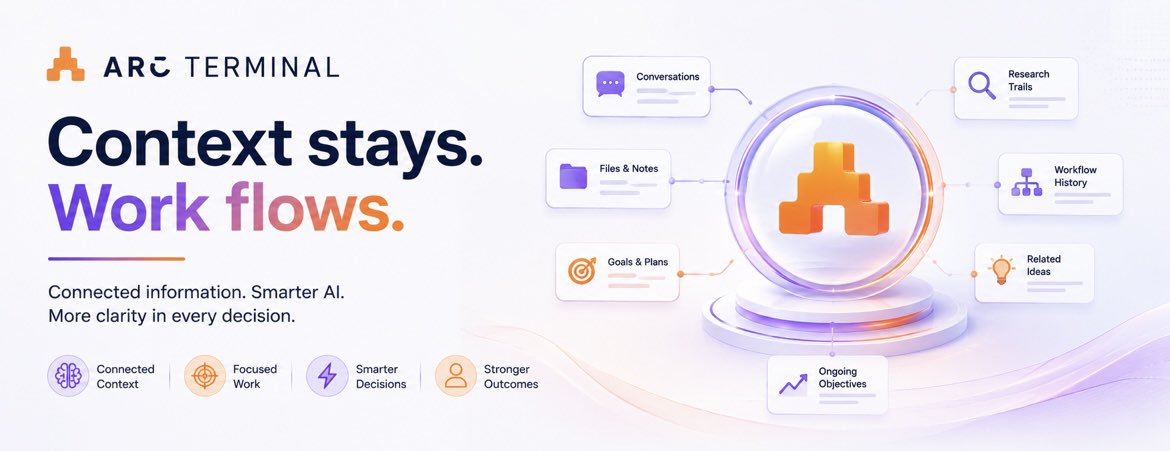
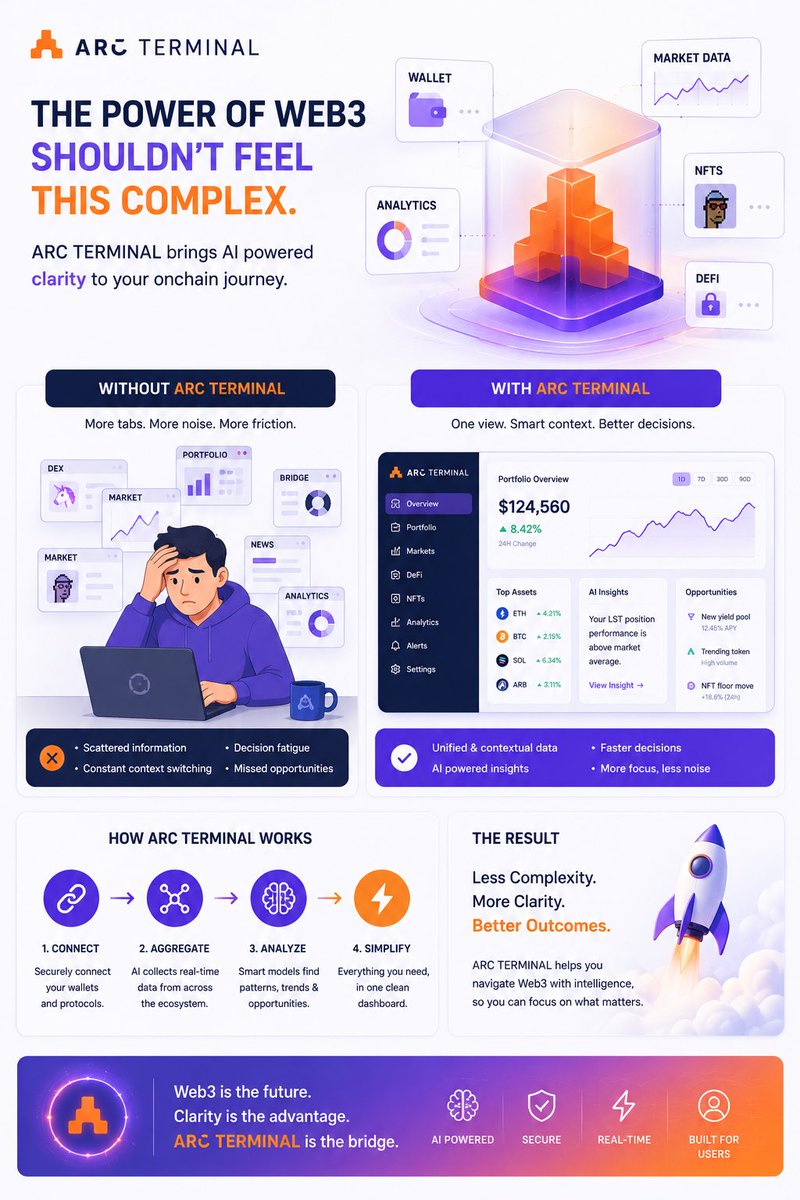
Personal. Enterprise. Sovereign.
ARC does not change the story in each form.
Same CORE Graph.
Same ZKURT receipts.
Same model-routing logic.
Same hardware-anchored keys.
Different perimeter. Different controls. Same architecture.
Learn more ↓
arcterminal.ai/enterprise
433
314
807
111,893
Rad 📽️🏳️ retweeted
May 29
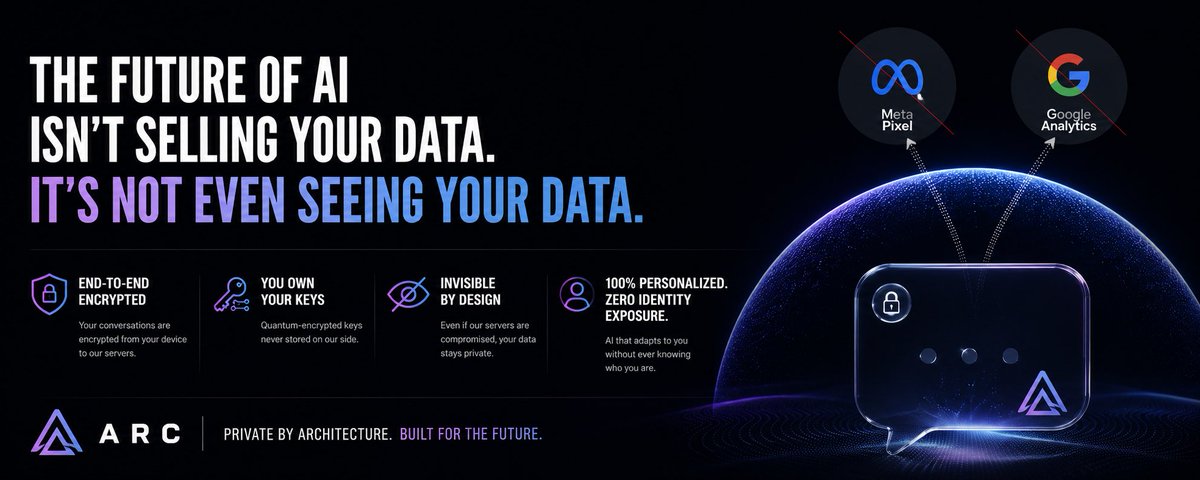
Your ARC account starts on your hardware.
Touch ID, Windows Hello, or a YubiKey derives the key.
ARC never receives it.
No shared secret on the server.
Nothing for an operator to leak, lose, subpoena, or quietly recover.

182
63
350
88,110
Rad 📽️🏳️ retweeted
Apr 20
ANIMA continues to evolve ✨
Now she needs new voices to share her story with the world.
The new ARC Mindshare Leaderboard is live!
Climb up through the ranks and earn your share of $150,000 in total $ARC rewards.
Join the program today 👇
mindshare.arcterminal.ai

756
784
2,293
291,432
Rad 📽️🏳️ retweeted
May 30
“The smartest money in crypto is making a huge bet that privacy focused quantum proof blockchains are the next big thing and the project they are focused on has one weakness.
But there’s another project that’s solving it.”
That project is $XNT.
Check out this insightful clip from @firehustle_net explaining why Neptune Privacy and Leviathan may be the realization of what Miden was always trying to build: a scalable, private, quantum-resistant ecosystem built on a purpose-built Layer 1 instead of inheriting the limitations of Ethereum.
14
22
63
4,171
Rad 📽️🏳️ retweeted

May 27
If you've been seeing "Leviathan" trending on X lately and have no idea what it is... here's the full breakdown.
You've probably seen the hype: "Leviathan this, Neptune that." Privacy coins, quantum-safe tech, private L2s. But what actually makes it different from the dozens of other Layer 2s out there?
Let me cut through the noise.
First: What is Neptune?
Neptune is a quantum-resistant Layer 1 blockchain built from the ground up for privacy by default.
Uses zk-STARKs (not SNARKs) which are post-quantum secure.
Combines Proof-of-Work with advanced privacy tech like Mutator Sets.
No optional privacy toggle. Transactions and states are confidential by design, while still verifiable.
Focused on real scalability without compromising the core privacy model.
It's not another "add ZK on top of Ethereum" project. It's engineered differently from day one.b7a290
Now, what is Leviathan?
Leviathan is Neptune's dedicated private Layer 2, launched in April 2026.
Think of it as the high-performance execution environment built on top of Neptune's secure, quantum-safe L1.
While Neptune L1 handles settlement and security, Leviathan focuses on:
Confidential smart contract execution
Scalable private DeFi
Sub-second block times
Claims of 3000 TPS
One unified asset ($XNT). Two layers working together.04a9a6
How Leviathan Stands Out from Other L2s
Most L2s today (Optimism, Arbitrum, Base, etc.) are built for speed and low fees on public chains. Privacy is usually an afterthought (if it exists at all).
Here's what makes Leviathan different:
Privacy by Default, Not Bolted On
Other L2s are public by default. You need extra tools (mixers, ZK add-ons) for privacy which often leak metadata or add friction.
Leviathan runs confidential execution natively. Trades, positions, and contract states can stay hidden while still composing with the ecosystem.
Quantum-Safe from the Foundation
Most blockchains (and their L2s) use cryptography vulnerable to future quantum computers (Shor's algorithm).
Neptune Leviathan use zk-STARKs which are resistant to quantum attacks. This isn't a future upgrade it's baked in.
Better Architecture for Real DeFi
No public mempool → Less MEV and front-running
Private order flow
Hidden execution that reduces strategy leakage
Recursive zk-STARK proofs connecting L2 execution to L1 settlement
Vertical Integration
Instead of building on someone else's public L1, Leviathan sits on Neptune's own privacy-first, quantum-safe base. This creates tighter synergies and fewer compromises.
Performance Claims
Sub-second blocks on L2 high throughput, while maintaining privacy and security. Bridges to ETH and Base are in focus for interoperability.989f8d
Why This Matters
In today's DeFi, your trades are visible to everyone. Whales see your moves. Bots sandwich you. MEV extracts value. And in a few years, quantum computers could threaten the security of most chains.
Neptune Leviathan tries to solve all three at once: Privacy Scalability Future-proof Security.
It's still early execution, dApp adoption, and security audits will decide if it delivers. But the architecture is genuinely different from the crowded L2 meta.
If you're into private DeFi, confidential trading, or long-term resilient infrastructure, this is one to watch.
What do you think? Is native privacy quantum resistance the next big narrative, or just another hype cycle?
Drop your thoughts 👇
My lousy attempt at making an AI video, I hope y'all get the point from the video
76
4
82
1,024
Rad 📽️🏳️ retweeted
May 26
People talk a lot about privacy in crypto.
But here’s the thing…
Most systems still treat privacy like something to add later.
Then came Miden.
Powerful tech. Big vision.
But @NeptunePrivacy looked at it differently and asked a simple question:
What if the privacy layer did not have to wait?
That is where Leviathan comes in.
There is a lot more to this story than most people realize.
Got a video dropping soon breaking down Neptune, Leviathan, and why this whole conversation around privacy is getting interesting.
No complicated talk.
Just clear explanations and the bigger picture 👀🔥
11
5
15
1,335
Rad 📽️🏳️ retweeted

May 26
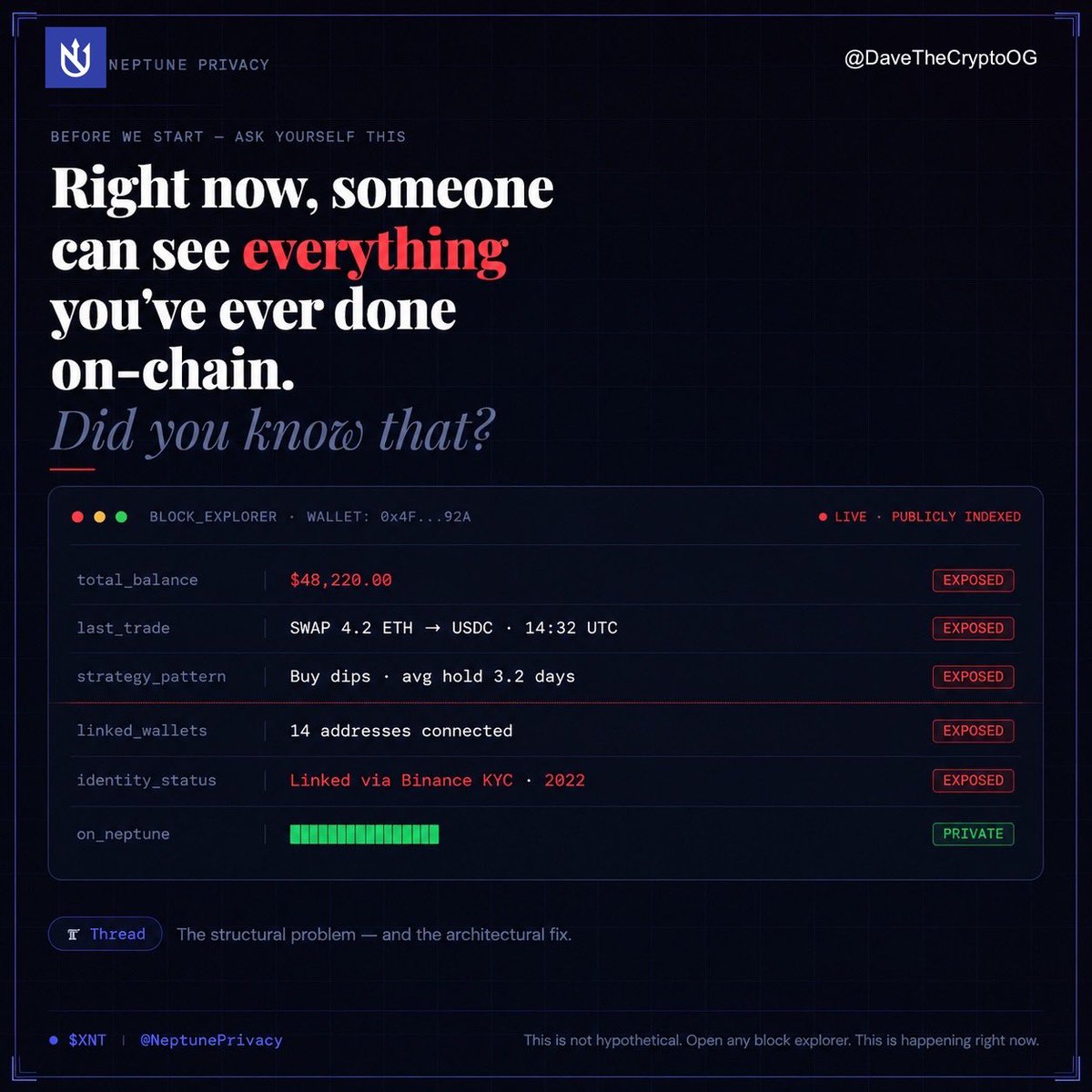
Most DeFi users don’t realize how much value leaks from the architecture itself.
Not from hacks.
Not from rug pulls.
From the infrastructure being fully public by design.
Every trade broadcast before execution.
Every strategy visible before settlement.
Every order readable before it fills.
This is a thread on the structural problem, and the architectural fix.
$XNT @NeptunePrivacy 🧵👇
23
12
19
1,928
May 23
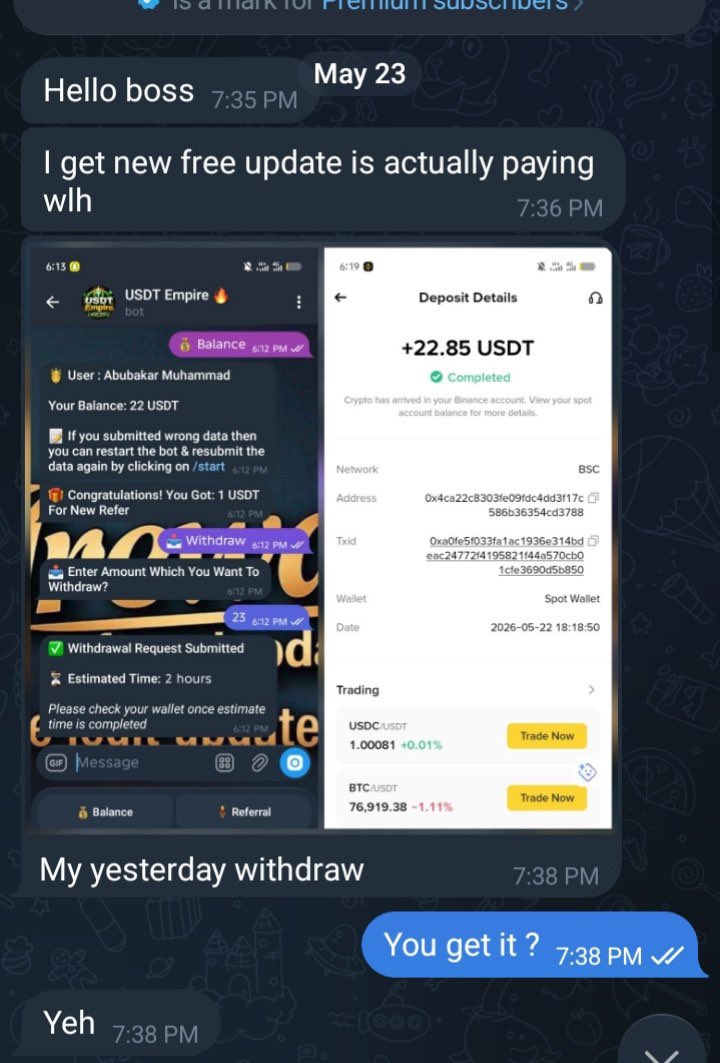
If $15 daily isn’t too small for you this update is for you
You get paid $1 per referral!
This might not be on for a very long time, so try to join while it lasts.
Withdrawal: Confirmed ✅
t.me/USDTEmpire_bot?start=14…
15
14
73
Rad 📽️🏳️ retweeted
May 23
Most blockchains still treat quantum resistance as a future problem.
Neptune Privacy was built with post-quantum assumptions from day one.
Private by default.
zk-STARK architecture.
Quantum-resistant security designed at the base layer, not retrofitted later.
Even systems that upgrade later may still face the “Harvest Now, Decrypt Later” problem, where previously exposed transactions and data remain vulnerable in the future.
Worth the read👇
May 20

1/ Last Friday, @NeptunePrivacy joined us on W3M to break down something most people in crypto are still ignoring:
How do you protect your assets from the quantum threat?
Not in theory. In practice.
🧵
10
12
51
1,789