
Leading pre-seed rounds @focal_vc: building a bridge for international investors to next gen US Canadian software startups. 🎙️ Creator of 5 Year Frontier Pod
Joined November 2008
- Tweets 3,053
- Following 311
- Followers 1,207
- Likes 273
252 Photos and videos

Daniel Darling retweeted

May 28
Token costs are exploding
Companies have to choose: cut AI spend or cut people?
Coworker is the 3rd option
> Same frontier AI
> Chat, Cowork, Code
> 5X more tokens per dollar
Live today.
403
195
1,006
3,423,668
Daniel Darling retweeted

May 27
Fifi is one of the most impressive founders we're fortunate to have backed - even though she's barely 18!
She's now hiring a founding engineer for Maxed. The most important thing when joining a company as a founding engineer is the founder.
Fifi's track record speaks for herself: Self-taught coder since 7, three companies before 18, speaks five languages, played competitive chess, and SO MUCH more.
Now, at 18, she's rebuilding accounting from the ground up as an AI-native operating system at Maxed, with backing from angels including the founders of Notion, DigitalOcean, and SecurityScorecard.
If you want to build with a founder who'll definitely raise your bar and intensity, take a look: maxed.life/hiring

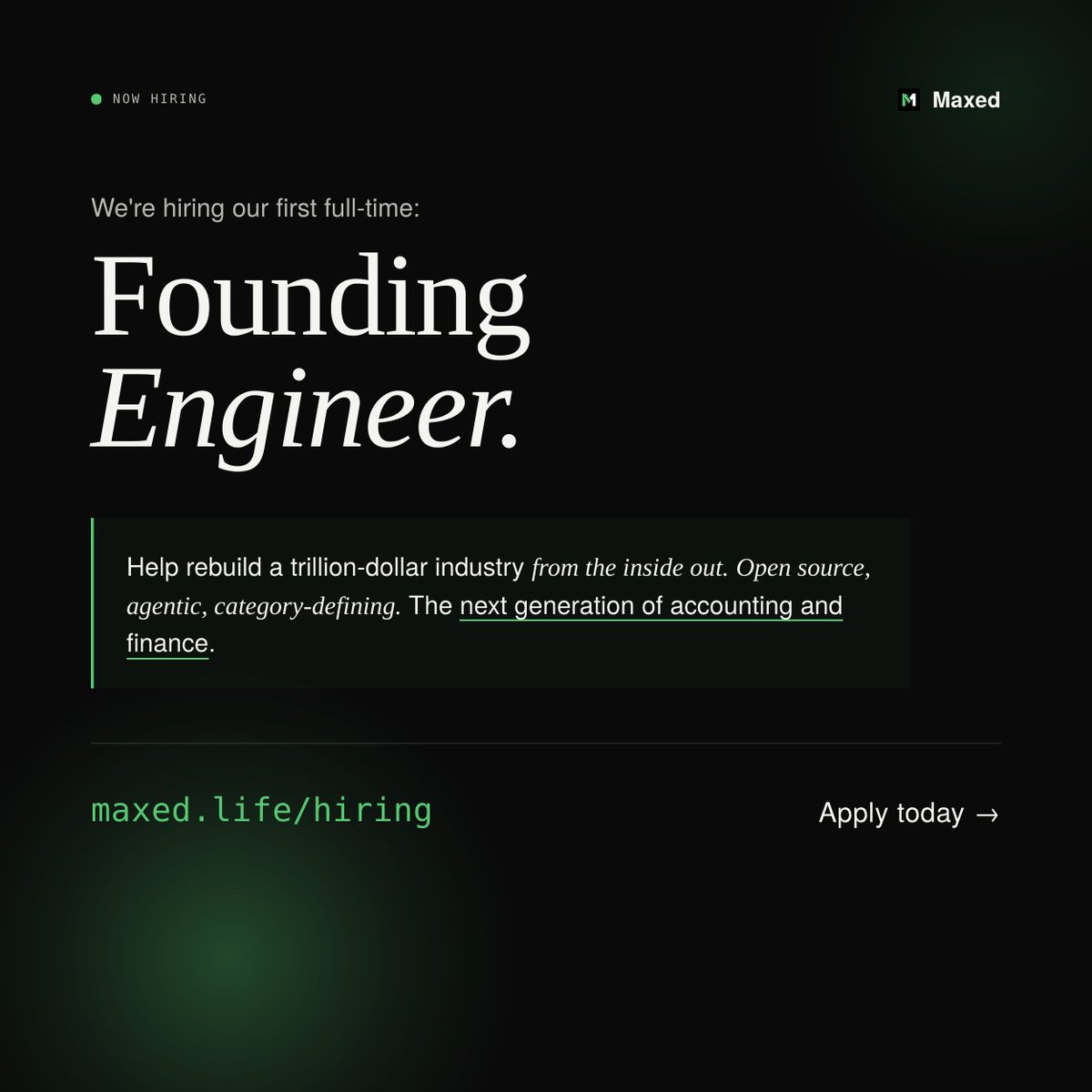
I'm hiring our first, full-time founding engineer at Maxed 👇
Accounting is one of the largest professional services markets on Earth and it's about to be rebuilt from the ground up.
Maxed is an open-source, AI-native operating system for CPA firms.
Design partners are live. The architecture underneath has never been built before and as a result, most of what we're doing has no playbook - you have to be the kind of person who finds that energising.
I'm technical, obsessed and this is my whole life. I need someone wired the same way.
Help rebuild a trillion-dollar industry from the inside out - apply here: maxed.life/hiring
3
2
24
3,069

May 27
Big news today. @coworkerapp just dropped Opus-quality enterprise AI for one-fifth the price. Same frontier models, 82% less cost.
May 27

Today, we dropped the price of enterprise AI by 80%.
Same frontier AI. Same chat, cowork, and code experience.
Just 5x more tokens for the same spend.
Here’s how and why. 👇 Also, we made a video. Please enjoy.
3
1
9
246
May 23
Privileged to be joining Woods Hole Oceanographic Institution as a Corporate Board Member.
I feel most at home in the water. From marine research diving in Africa to ocean swims along the Australian coastline, the ocean has shaped some of the most meaningful parts of my life. Joining WHOI feels like an opportunity to channel that lifelong connection into something with real purpose.
I see us entering a remarkable era for ocean science. Despite covering most of our planet and being integral to life, the ocean remains one of the least understood frontiers on Earth. Over the next decade, breakthroughs beneath the surface could reshape how we think about medicine, food systems, climate, materials, energy, and biodiversity itself.
We have so much to learn, I can't wait.
A few things that make WHOI such an extraordinary institution:
- The world’s largest non-profit dedicated to ocean research and engineering
- $500M endowment supporting long-term scientific discovery
- 1,000 employees, including ~500 scientists and engineers
- Joint program with Massachusetts Institute of Technology training the next generation of ocean scientists
- A fleet of world-class research vessels and deep-sea submersibles
- Nearly a century of advancing humanity’s understanding of the ocean
For 90 years, WHOI has been behind some of the most important discoveries in ocean science. It’s a privilege to now contribute, in some small way, to what comes next.
Special thanks to David Scully and Paul Salem for the introduction, encouragement, and leadership.
If you care deeply about the future of our oceans I’d love to connect.
Let’s get to work.
33
Daniel Darling retweeted

May 8
199
585
4,666
3,694,075
May 8
Congratulations to Nima Aghaeepour & Joe Phongpreecha for bringing Takeoff41, Inc. out of stealth today.
A Stanford-incubated startup modernizing care for pre-term babies in the NICU. Science published in Nature, first hospital live, grant funding secured and a big year ahead.
I’ve written recently about two ideas:
(1) category-defining missions, and
(2) AI as the wedge for offline monetization.
Takeoff embodies both.
Their AI software guides nutritional recommendations for TPN drip bags, often a premature baby’s only source of intake. Yet what I admire most is their ambition from day one to build a full-stack neonatal care platform focused on outcomes, not just tools.
Manufacturing and delivering next-generation TPN bags guided by their AI software — greater value to the customer, and greater value capture for Takeoff.
Deliver the outcome, not the software.
Proud for focal to lead their pre-seed alongside our friends at @BasisSet
1
28
May 6
Thesis-driven founders are winning.
They’re trading at a premium, attracting more VC capital far earlier. These are the Seed rounds making headlines.
Thesis-driven founders aren’t selling products. They’re not leading with metrics. They’re articulating a point of view about how a market will develop, and inviting investors to underwrite that future.
And when the future is this in flux, that clarity feels like the calm in the eye of the storm. Everyone else is circling the outside, starting to look like versions of the same startup, competing and blurring into one mass.
You can usually tell which side you’re on from the diligence questions you’re fielding: what about X competitor, how do margins scale, where’s the defensibility?
When a company is truly thesis-driven, the conversation shifts. It compresses down to something much simpler:
Do you believe?
Because if the thesis is right, multi-stage funds believe they can mobilize the capital and ecosystem around it to make it real. After all, VCs are in the belief business.
What really works for thesis-driven founders, especially those whose thesis comes from lived experience or deep technical insight, is that they create narrative momentum.
In a world changing this quickly, narrative momentum becomes a magnet. It pulls in capital before it’s obvious, attracts talent who want to be part of something meaningful, and signals to customers that this company might define the space rather than follow it. Over time, that belief compounds.
Iterative product building, on its own, can trap you in the present.
This isn’t fake it till you make it. It’s hard. It’s building real conviction to call the future early, and then building toward it before the rest of the market catches up.
At Focal, these are the founders we’re drawn to.
Dream far out. Dream deeply. Create your narrative momentum.
24
Apr 21
Better AI products are not winning by default right now.
I’m seeing weaker solutions raise at 5–10x the valuation of stronger ones at the same stage — $6M seed vs $50M for companies that shouldn’t be in the same conversation. Customers aren’t seeing the value yet, revenue isn’t there, and the tech is often underbaked. Founders feel it when those funding headlines hit.
At the core, this is a market rewarding sizzle over steak.
During seismic platform shifts, multi-stage funds become power-law maximalists. They’re not trying to be right often — they’re trying to be massively right once, and put as much capital behind that outcome as possible. So they back what could dominate — the big story, the founders who can sell the winner early — not the product that’s already better.
And once that capital lands, it compounds. Customers behave the same way. They want to buy the winner — the product with momentum, that feels inevitable, that will still be around in 5 years. Startup IBM.
So capital becomes momentum. Momentum becomes belief. Belief becomes reality.
The uncomfortable implication is that having the better product isn’t always enough. You have to win on multiple fronts: persona, narrative, speed, distribution, hiring, capital.
The best founders don’t just build. They outmanoeuvre.
2
39
Apr 15
Counterintuitive feeling right now as a pre-seed investor: the fast, iterative startup is the riskier bet.
Shipping fast isn’t optional, it’s expected. AI founders are told winning means launching on day one, hitting $5M in 12 months, and marking your arrival with an iconic round… then sprinting uphill again.
The problem is everyone is running that same race, and fast products don’t stay differentiated for long — they get absorbed, copied, and iterated to the norm quickly.
The companies that matter most often take longer to emerge. They start from the end state, build what isn’t yet visible, and are willing to look foolishly early.
Founders willing to boil the ocean have suddenly become the safer bet.
As five-year moonshots collapse into months, those are the companies we want to build our portfolio around. The patient capital that has since become scarce in today's market.
It’s uncomfortable for founders and VCs. But that’s kind of the point.
1
4
174
Apr 9
As Anthropic melts away entire categories, the bar for what makes an interesting pre-seed investment has shifted.
I increasingly find myself backing three types of companies:
1. Mission impossible
Technical or scientific founders going after problems long deemed out of reach — now within striking distance because of AI.
AI isn’t the product, it’s the unlock.
2. Trojan horse
Agentic workflows used as a free or low-cost wedge — with real value accruing at the transaction or financial layer beneath.
3. Data treasure hunters
Businesses that unlock novel, hard-to-access data — then build the model and feedback loop around it.
Own the data, own the outcome.
We’ve invested across all three recently.
In fact, we hit a Focal record : deploying $10M over the last quarter.
2026 energy is on 🔥
42
Mar 16
Fascinating to see AI business models morph. Seems the way AI is monetized may be more disruptive (and defensible) than the tech itself?
Most discussions are SaaS to usage or Per seat to outcome. I'm seeing more novel models that are 10-100X the value of a seat.
Startups where AI isn’t the product being charged for, but rather a foothold into much larger pools of value.
A few recent examples:
1. AI monetized by physical goods
Biotech offering AI diagnostics at cost, then capturing value selling the drug compounds their models identify.
2. AI monetized offline
Free AI predictive maintenance on industrial equipment used as the wedge to sell long-term servicing agreements and maintenance contracts.
3. AI unlocking financial assets
Insurance workflows where AI structures claims for easy remediation, which then become securitized financial assets for trading and lending.
I love seeing this kind of thinking. If you’ve seen other interesting models - or are building one - please let me know!
1
76
Feb 18
Focal is expanding! We’re hiring our Head of Technology & Applied AI.
This is not a typical VC role.
We’re looking for a technical founder-type who can’t stop building. Someone who wants to work side-by-side with us to reimagine how venture capital operates in the age of AI.
We’re institutionally backed, fast moving, and on a mission to be a founder’s first choice for their first check.
If you’re technical, entrepreneurial, and want leverage beyond a single startup - this is your seat.
focal.vc/hiring
2
136
Daniel Darling retweeted
Feb 18
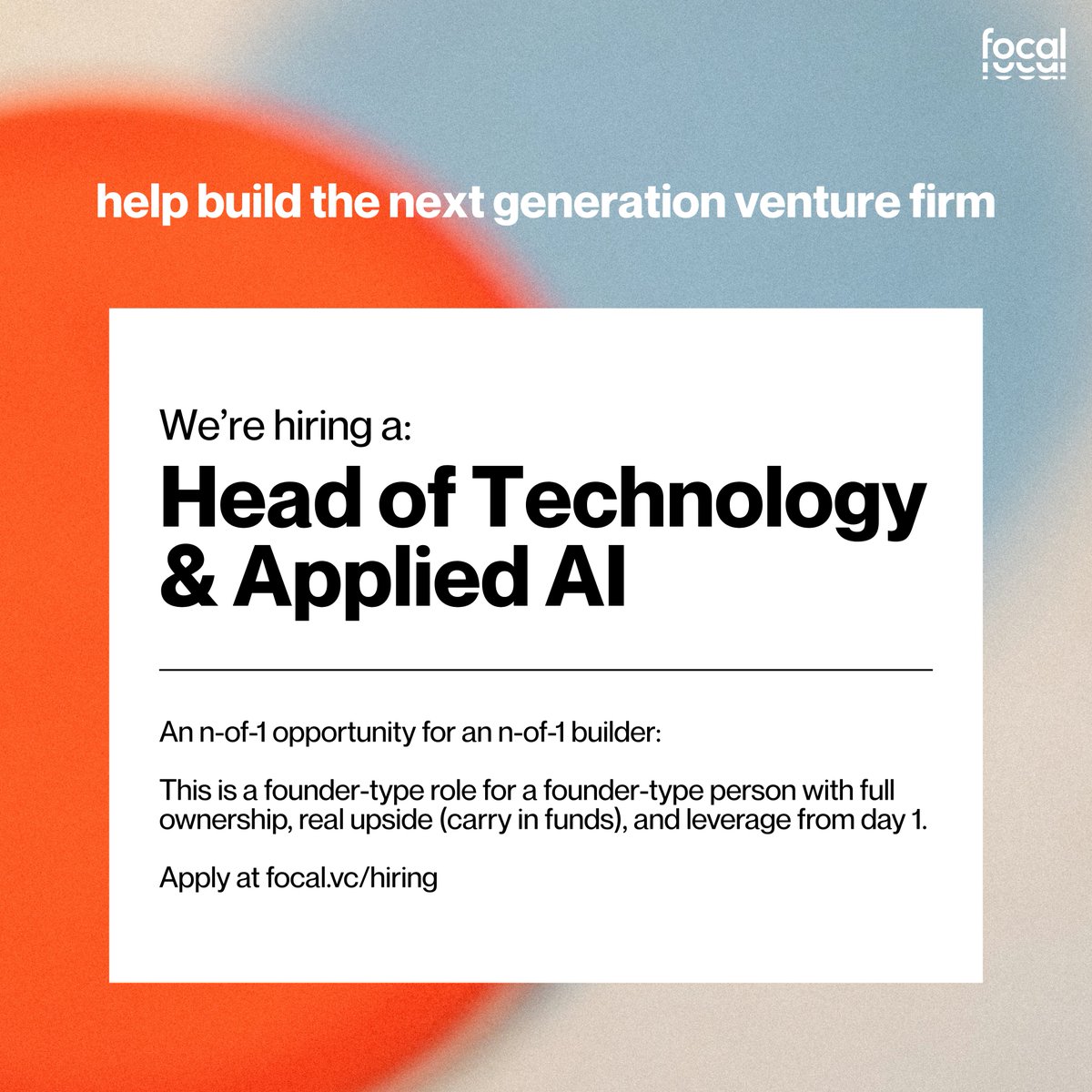
We're hiring a founding Head of Technology & Applied AI at @focal_vc !
The leading next-gen venture firm will be AI native from the ground up. Which is why we're going all in.
This is an n-of-1 opportunity for an n-of-1 builder.
A founder-type role for a founder-type person with full ownership, real upside (carry in funds), and leverage from day one.
Help us see sooner, decide faster, and build systems that learn across every founder, deal, and outcome. That's how our 5-person team beats 50-person firms.
It's a hard challenge to get right. But when we get it right, the impact will compound for decades.
If this sounds like you, apply at focal.vc/hiring!
1
5
14
2,295
Daniel Darling retweeted
15 Dec 2025
10 spots. 3 months. 1 goal: Build a venture-scale company.
We’re bringing together the best technical AI builders for an exclusive residency in Miami this winter.
Think the firepower of a top accelerator - WITHOUT the heavy dilution.
What you're signing up for:
- Hyper selective (10 startups only)
- Highly intense (6 days / week in office)
- Fully in person (Miami relocation required, costs of move offset)
Plus get mentored by unicorn founders incl. DigitalOcean ($4B NYSE), Mural ($2B), Papa ($1B), vLex (acquired for $1B), Quicknode ($1B), Spotnana ($1B), and more.
Importantly: There’s no “too early” - apply with nothing more than your drive, your idea, and the ability to ship exceptional products at breakneck speed.
A few spots remain - apply asap at focal.vc/residency
By @focal_vc x @thelabmiami
2
5
20
1,887
Daniel Darling retweeted

13 Dec 2025
Having a hard time closing a fund? You're not alone.
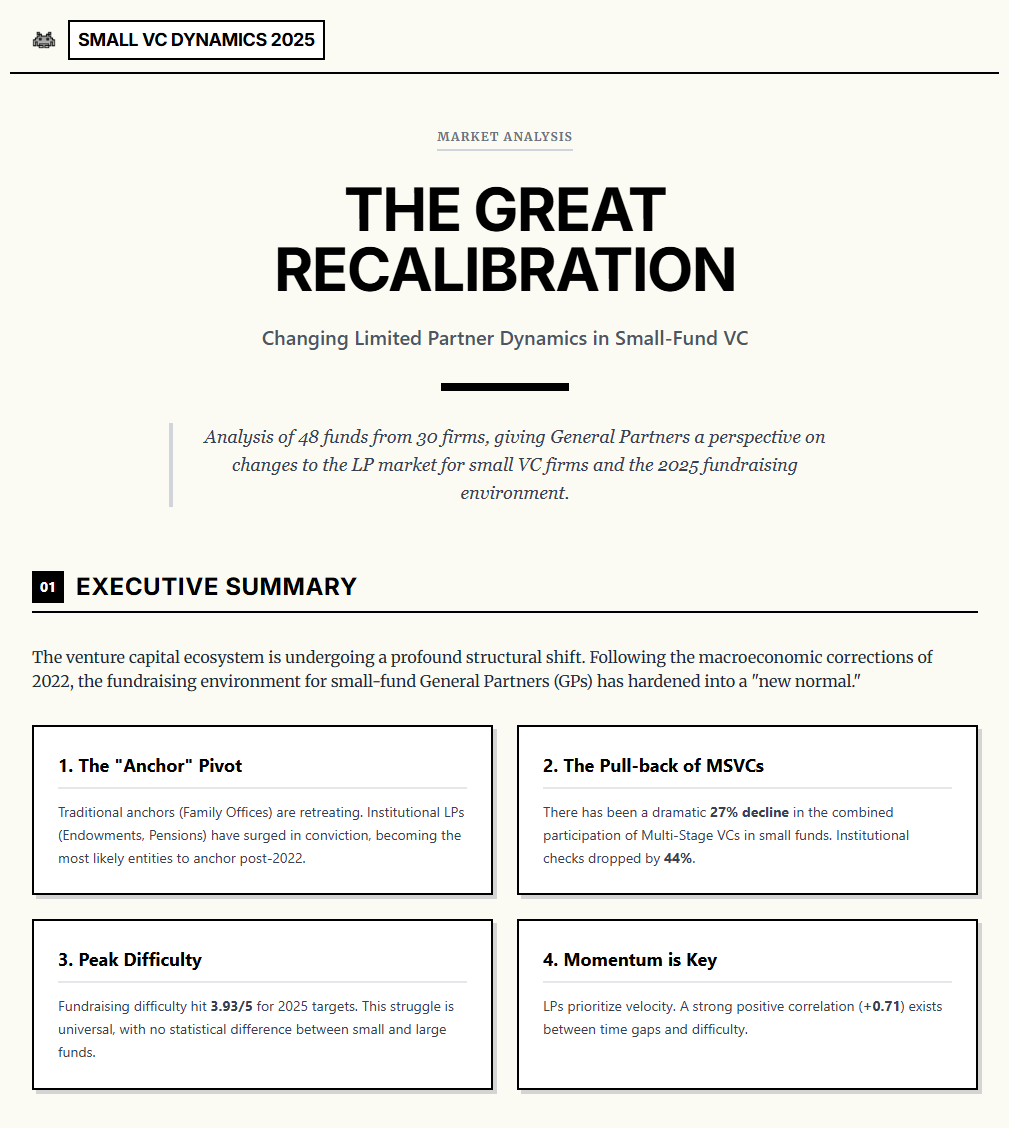
2025 ranks as the most challenging of the last three years for early-stage GPs.
I conducted a short survey to understand how early-stage VC is faring, gathering data from 48 funds in total (primarily EMs, almost all <$250M).
Amongst the findings, there's a clear rebalancing of LP allocation, particularly for anchors and multi-stage firms, with an overall concentration of LP activity.
The commentary offered by GPs also highlighted a few themes, like "GP as a brand" and a growing appetite for co-investment opportunities — but no real consensus on shifts between small/large funds.
The breakdown: credistick.com/lp-2025/
Thanks to everyone who responded, and the willingness to share data that may be helpful to other GPs — a welcome example of positive-sum thinking.
11
22
156
57,141
Daniel Darling retweeted

13 Nov 2025
OpenBuilder (@theopenbuilder) is the open source alternative to Lovable. Unlimited build credits and real developer support when you hit a wall.
Built for non-technical builders to ship real apps.
40
36
476
46,237
13 Nov 2025
Calling cracked builders!
Today we launch the maiden cohort of focal Residency in Miami. A 3 month program in partnership with The LAB Miami and epic group of mentors who've all built billion dollar startups.
Forget accelerators carving off valuable equity. This is where to build this winter. Apply below!
12 Nov 2025

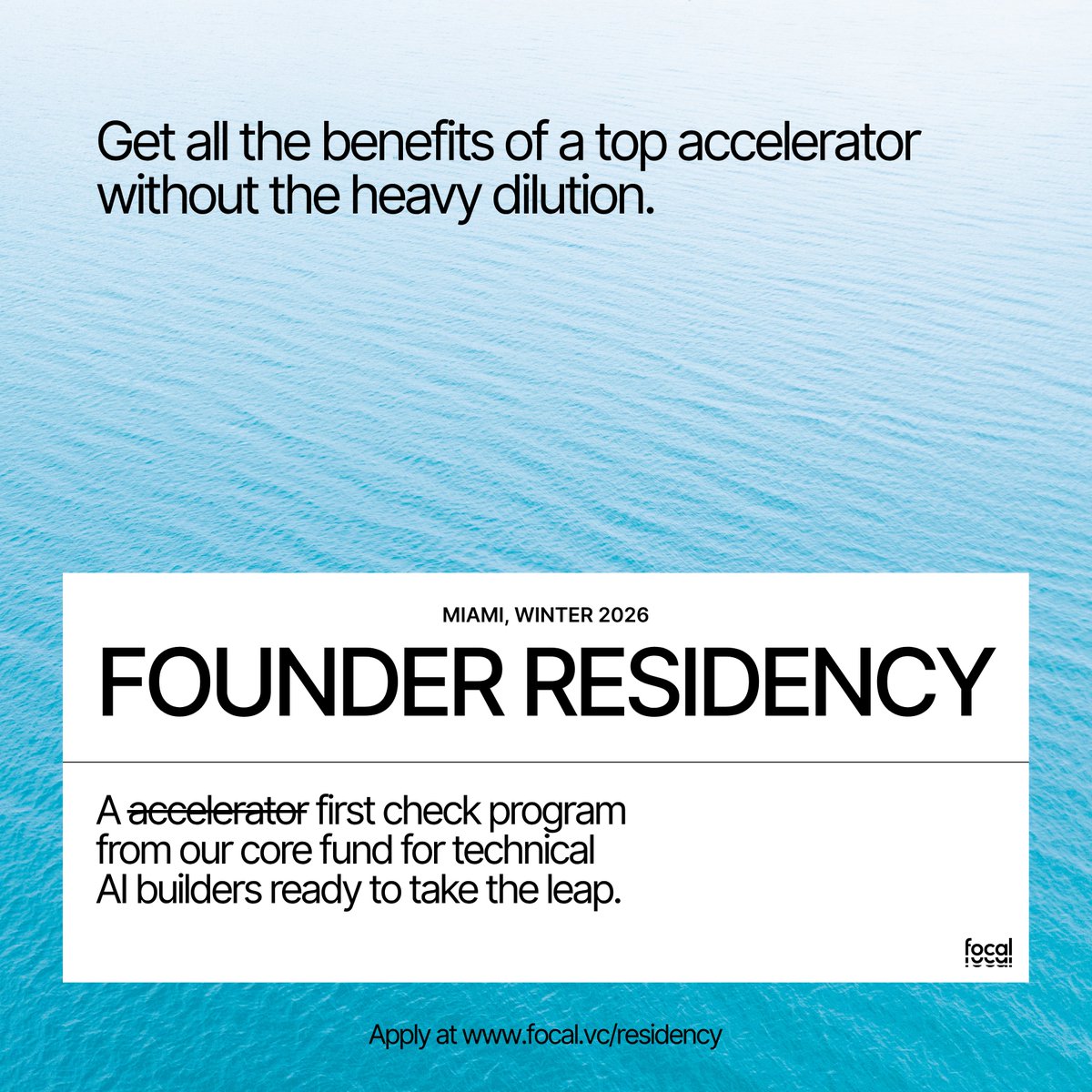
𝐋𝐚𝐮𝐧𝐜𝐡 𝐀𝐥𝐞𝐫𝐭: Winter 2026 Residency for Technical Founders at Inception!
This winter, we’re bringing together 10 hardcore AI builders for an exclusive residency in Miami with all the firepower of a top accelerator without the heavy dilution!
This is the most talent-dense, high-velocity, carefully curated launchpad for technical AI founders outside SF to start a venture scale company - AND you get to escape the harsh winter while you ship!
The 3 month residency - hosted in partnership with The LAB Miami - is hyper selective (10 startups only), highly intense (6 days / week in office) and fully in person (Miami relocation required / costs offset).
Plus you get mentored by unicorn founders including Digital Ocean ($4B NYSE), Mural ($2B), Papa ($1B), vLex (acquired for $1B), Quicknode ($1B), Spotnana ($1B), and many more.
The best part: There’s no “too early” - apply with nothing more than your drive to build a venture scale company, your idea, and the ability to ship exceptional products at breakneck speed.
Applications just opened - apply at focal.vc/residency to start in Jan 2026!
𝐏𝐒: 𝐓𝐨 𝐫𝐞𝐟𝐞𝐫 𝐚 𝐛𝐫𝐢𝐥𝐥𝐢𝐚𝐧𝐭 𝐛𝐮𝐢𝐥𝐝𝐞𝐫, 𝐭𝐚𝐠 𝐭𝐡𝐞𝐦 𝐛𝐞𝐥𝐨𝐰 𝐚𝐧𝐝 𝐰𝐞’𝐥𝐥 𝐩𝐫𝐢𝐨𝐫𝐢𝐭𝐢𝐳𝐞 𝐭𝐡𝐞𝐢𝐫 𝐚𝐩𝐩𝐥𝐢𝐜𝐚𝐭𝐢𝐨𝐧.
@focal_vc
2
5
145
Daniel Darling retweeted
12 Nov 2025
𝐋𝐚𝐮𝐧𝐜𝐡 𝐀𝐥𝐞𝐫𝐭: Winter 2026 Residency for Technical Founders at Inception!
This winter, we’re bringing together 10 hardcore AI builders for an exclusive residency in Miami with all the firepower of a top accelerator without the heavy dilution!
This is the most talent-dense, high-velocity, carefully curated launchpad for technical AI founders outside SF to start a venture scale company - AND you get to escape the harsh winter while you ship!
The 3 month residency - hosted in partnership with The LAB Miami - is hyper selective (10 startups only), highly intense (6 days / week in office) and fully in person (Miami relocation required / costs offset).
Plus you get mentored by unicorn founders including Digital Ocean ($4B NYSE), Mural ($2B), Papa ($1B), vLex (acquired for $1B), Quicknode ($1B), Spotnana ($1B), and many more.
The best part: There’s no “too early” - apply with nothing more than your drive to build a venture scale company, your idea, and the ability to ship exceptional products at breakneck speed.
Applications just opened - apply at focal.vc/residency to start in Jan 2026!
𝐏𝐒: 𝐓𝐨 𝐫𝐞𝐟𝐞𝐫 𝐚 𝐛𝐫𝐢𝐥𝐥𝐢𝐚𝐧𝐭 𝐛𝐮𝐢𝐥𝐝𝐞𝐫, 𝐭𝐚𝐠 𝐭𝐡𝐞𝐦 𝐛𝐞𝐥𝐨𝐰 𝐚𝐧𝐝 𝐰𝐞’𝐥𝐥 𝐩𝐫𝐢𝐨𝐫𝐢𝐭𝐢𝐳𝐞 𝐭𝐡𝐞𝐢𝐫 𝐚𝐩𝐩𝐥𝐢𝐜𝐚𝐭𝐢𝐨𝐧.
@focal_vc
20
20
83
208,649
16 Oct 2025
Great to have partners like Koda Capital in focal's corner.
A firm cutting its own unique path to become one of Australia's largest and most respected wealth advisors. I've had many conversations about AI, venture capital, and the US with the team and their clients over the years as our partnership grew. Grateful to be invited to do just that with David Clark on his podcast.
lnkd.in/gJzZma-J
1
1
81