
Cloud Engineer • Everyday normal Guy
Joined February 2016
- Tweets 21,369
- Following 5,491
- Followers 4,777
- Likes 26,991
1,282 Photos and videos








Vortex retweeted

Jun 8
Too Late to say GM ?
I’m officially kicking off my Video Content Arc.
This is the start of a new creative chapter where I’ll be experimenting, sharing, and building through video.
Expect fresh ideas, bold takes, and a whole lot of energy.
12
7
19
390
Vortex retweeted

May 20
SonarX Acquires Flipside Crypto's Blockchain Data Business
blog.sonarx.com/view/sonarx-…
6
5
11
443

May 31
Well said.
I mean a solid regulation is a good thing as it brings structure and protects both sides.
The constant public outrage over every breach, copy trading drama, and dispute is starting to paint the whole industry in a much worse light 😏😏

If matters get regulated:
- The T&Cs out there you will have to memorize more than your name.
- All of the of the expose and scam firms burner accounts won’t exist, even if they are at they are mama’s basement.
- Traders will fall under some sort of consumer protection scheme since you all ain’t investors.
- No trader can run to socials crying, when there’s a lil tiny bit of a breach of any clause in T&C.
- If a trader got mistreated there’s a regulatory body to report to, and no it doesn’t work saying I got scammed and spam them, you need to get your shot straight.
- Firms will need to meet some sort of capital, risk, dealing, compliance and experience requirements.
Accountability goes both ways, let’s not forget that the Prop space is the most abused 🏧 ever existed out there.
1
2
67
May 30
Are you sure ?
😁
May 30

Congratulations to PSG on winning the UEFA Champions League, and to Luis Enrique on adding another title to his list of achievements.
1
49
May 30
You can’t really blame them.
The champions league trophy is bigger than Arsenal
1
30
May 30
Arsenal want to win the champions league defending for 90 minutes. ?
1
124
Vortex retweeted

May 29
And remember, it took us just five minutes to create this fake post.

2,891
6,403
109,906
6,712,946
May 30
If drake did place this bet. It’s safe to say that Arsenal will bottle the champions league.

WILD: Drake has reportedly placed a $1 million bet on Arsenal to win the Champions League Final against PSG today! 🤯


1
129
Vortex retweeted
May 30
1
1
872
Vortex retweeted
May 28
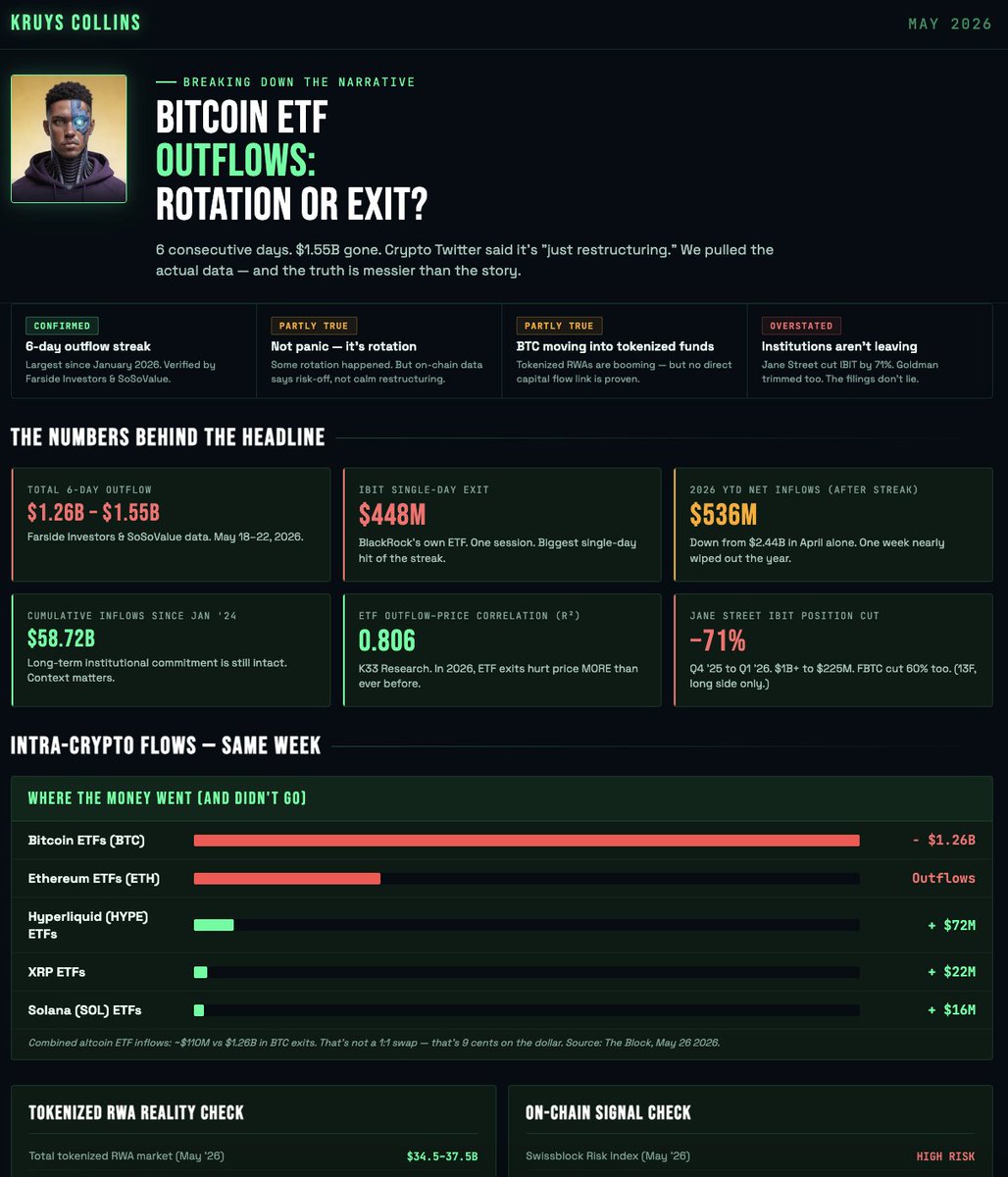
Someone posted that the Bitcoin ETF outflows are just "rotation into tokenized funds" and that institutions are restructuring, not leaving.
I checked the actual data… And the truth is more complicated than that.
Let me walk you through what I'm seeing.
First, the outflows are very real.
US spot Bitcoin ETFs just wrapped up 6 straight days of outflows, the longest negative streak since January 2026.
About $1.26B to $1.55B pulled out depending on how you measure it.
@BlackRock 's IBIT alone lost $448M in a single session.
And after all of April's strong $2.44B in inflows, this one bad week shrunk the entire 2026 net inflow down to just $536M.
One week nearly wiped out four months of progress.
Now, is some of it rotation?
Honestly, yes.
In the same week bitcoin:native was bleeding, other crypto ETFs were quietly picking up money.
Hyperliquid ETFs pulled in $72M, XRP ETFs got $22M, Solana added $16M.
But all that is roughly $110M flowing in while $1.26B walked out the door.
You can't call that a clean rotation with a straight face. The math doesn't hold up.
What about the tokenized funds angle?
This part of the claim is actually true, but it's not the same as saying the ETF money went there.
The tokenized real-world asset market hit around $35–37B this May, up roughly 100% year on year.
BlackRock's BUIDL fund alone crossed $2.3–2.5B in assets.
Tokenized US Treasuries are sitting at $12.78B.
Tokenization is genuinely booming and BlackRock even filed for two new tokenized funds on May 8.
But nobody has shown a direct link between ETF redemptions and that growth.
These are two separate trends running at the same time, not the same money moving houses.
Are Institutions leaving?
Well, Jane Street, one of the biggest traders on Wall Street, cut its IBIT position by 71% in Q1 2026.
We're talking from over $1B worth of shares down to $225M.
Their Fidelity FBTC position got cut 60% too.
Goldman Sachs also trimmed exposure in the same period.
Now, to be fair, 13F filings only show the long side of a trading book.
Jane Street is a market maker, not a buy-and-hold fund.
Their real net position after derivatives and hedges could look completely different.
But you can't really say “institutions aren't leaving" when the most visible institutional players just filed documented, significant reductions
And onchain data isn't telling a "calm restructuring" story either.
Swissblock's risk index moved into high-risk territory in May.
@cryptoquant_com found Bitcoin's apparent demand at its weakest level since December 2025.
Research firm K33 found that the relationship between ETF outflows and price drops has actually gotten stronger in 2026, not weaker, the correlation coefficient hit 0.806.
That means when money exits the ETF, Bitcoin's price feels it more than it used to. Typical risk-off behavior.
So i think what's actually going on is probably all of the following happening at once.
↘︎ Some institutions genuinely are rebalancing; adjusting between products, managing exposure.
↘︎ Some are doing real de-risking; macro uncertainty, Fed policy, US-Iran geopolitical noise.
↘︎ Some retail investors are simply scared after Bitcoin failed to hold $80K and they bailed.
↘︎ And yes, tokenization is growing fast in the background, but that's not the explanation for this specific week's ETF outflows.
These things can all be true at the same time without one clean story tying them together.
The long-term Bitcoin story is still intact, $58.72B in cumulative ETF inflows since 2024 is no joke.
But this week wasn't purely "restructuring." Some of it was just people getting out.
Tagging OG chads, what do y'all think about the current market state:
@tradeguru
@stacy_muur
@green_but_red
@BUNT10
@YashasEdu
@Mars_DeFi
@marvellousdefi
@CryptoGirlNova
@satyaki44
@Nick_Researcher
12
4
16
515
May 25
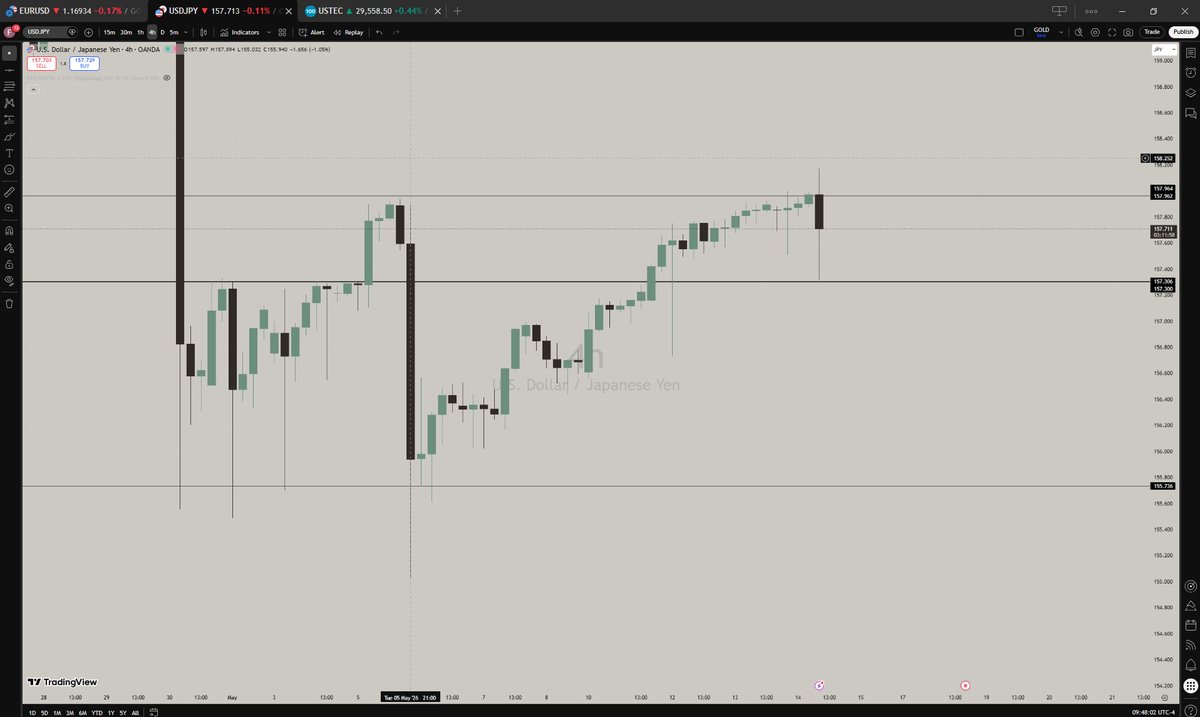
I said I should buy XAUUSD today..
Bank holiday Slippage wan wound me .
1
54
May 23
Luck? Maybe?

2
43

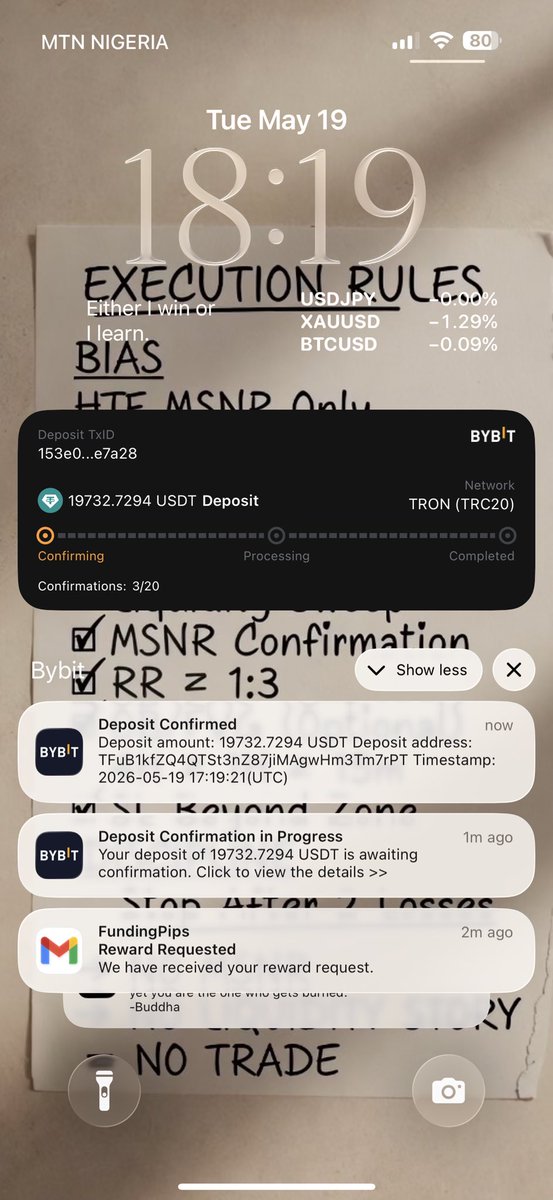
Be my guest, welcome to the piperience.
@fundingpips 🫡

231
145
2,142
83,625
Vortex retweeted

May 21
How @gfy_26 actually got paid 100% from @fundingpips without violating any rule
FULL BREAKDOWN ✍️ 🤔
14
27
449
10,876
Vortex retweeted

May 21
CHAMPIONS!!!!! 🏆 🟡🔵

50,906
216,056
1,479,411
66,002,436
May 17
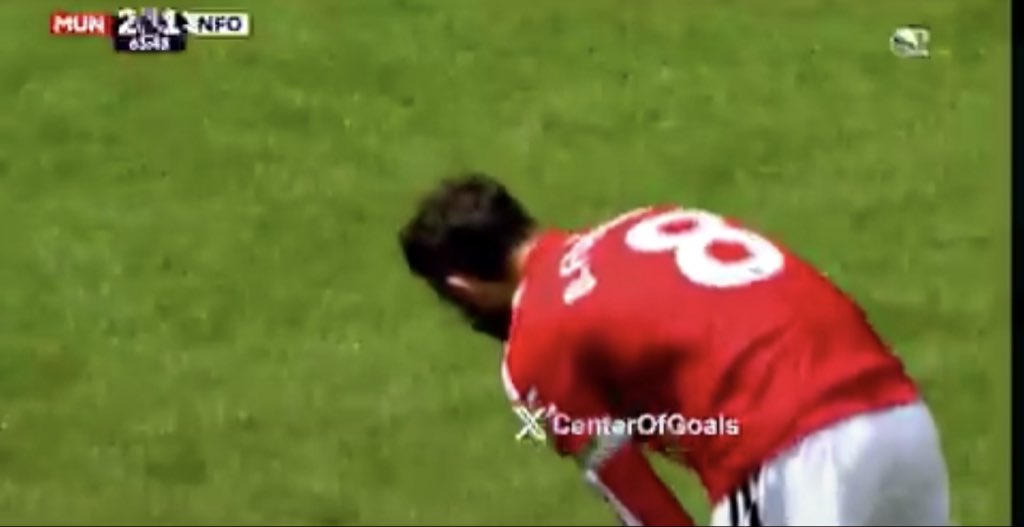
The Bruno Fernandez assist the world waited for…
What a player
GGMU
2
115