
Researcher and Visual Educator |Top Research in Highlights | Channel t.me/MARS_DEFIWORLD
Joined December 2014
- Tweets 25,964
- Following 2,577
- Followers 26,409
- Likes 38,862
2,535 Photos and videos




17h
It’s a bear market, and honestly, creating content every day can get draining.
Some days it feels like you’re posting into the void with no noise, no feedback and no momentum.
It is just you showing up again and again.
But today I remembered something that genuinely made me smile.
Someone once sent me a screenshot and a TikTok link where I was mentioned as one of the accounts people should follow if they’re trying to build in Web3.
Small thing maybe, but it reminded me that people are watching even when they don’t always like, comment, or repost.
So I’m putting this out for every creator who feels tired, unseen, or like stopping:
Don’t stop creating.
Bear markets are quiet, but they are also where reputation is built. The bull run will bring attention, but the people who kept showing up when nobody was clapping are usually the ones who benefit the most.
For now, keep improving, keep learning, keep putting out value and keep becoming the best version of yourself.
You may feel invisible today, but someone is probably paying attention.
vt.tiktok.com/ZSxcqsDpC/
7
1
21
632
21h
In crypto, attention is shifting beyond tokens to the market structures, liquidity layers, and financial products that drive adoption and value creation.
Most of the alpha reads on the timeline this week circled around capital structures and AI agents.
Here’s a compilation of my top 10 articles of the week.
—
@StarPlatinum_ explains that the biggest risk to @Strategy is not its Bitcoin holdings, but the capital market structure that enables its accumulation strategy.
While investors focus on its 845,000 $BTC treasury, the real engine is investor confidence, equity premiums, convertible debt, and preferred shares funding continued purchases.
The main concern is, Strategy has transformed $BTC into a leveraged financial machine, tying its success more to capital markets and confidence rather than $BTC itself.
x.com/starplatinum_/status/2…
—
@0xfishylosopher argues tokenized startups could give the public access to the high-growth phase of private companies that stays private until late-stage IPOs.
The trend is being driven by rising demand for pre-IPO exposure, the growth of tokenized RWAs and perpetual markets, and frustration with crypto tokens capturing less value than venture equity.
The bigger idea is to reinvent the IPO through tokenized startup exposure, creating more liquid and globally accessible markets for venture-scale assets.
x.com/0xfishylosopher/status…
—
Bear markets do not create new problems, but expose weaknesses that were hidden during periods of growth.
Using @HyperliquidX as a case study, @netrovertHQ highlights how PMF, community ownership, transparency, platform-driven growth, and diversified revenue sources can create more resilience than incentive-driven models.
Long-term survival in crypto depends on building products with genuine demand, aligned communities, and sustainable business fundamentals.
x.com/netroverthq/status/206…
—
According to @Tanaka_L2, the rapid growth of RWA perps is creating a new competitive battleground among perp DEXs, driven by rising demand for commodities, equities, and pre-IPO assets.
Platforms are pursuing different strategies, and CEXs are also increasing their presence in the sector.
As projects race to become the leading venue for onchain RWA trading, success will likely depend on liquidity, UX, and the ability to scale across multiple asset classes.
x.com/tanaka_l2/status/20628…
—
@0xCheeezzyyyy says the next evolution of liquid staking is not about maximizing yield, but maximizing capital efficiency by reducing the time costs of staking.
Using @mETHProtocol as an example, he highlights how its hybrid blended-yield model combines staking rewards with faster liquidity access, so capital stays efficient.
Institutions increasingly value assets that balance yield, liquidity, and operational flexibility, making capital efficiency a key differentiator for liquid staking protocols.
x.com/0xcheeezzyyyy/status/2…
—
@0xCodez argues that AI coding is shifting from manual prompting to “loop engineering,” where devs design automated systems that assign, execute, verify, and iterate tasks for coding agents.
Using a structure of automations, state tracking, verification gates, and sub-agents, these loops turn agents into self-running workflows rather than one-off tools.
Real leverage now comes from building systems that manage work for AI, not just writing better prompts for it.
x.com/0xcodez/status/2064374…
—
Most people never learn “research”, but learn to imitate researchers without developing the underlying skill.
@itsreallyvivek says proper research involves choosing your own problems, expanding beyond surface-level information, writing down thoughts, and tightly looping experiments with proper tooling and failure analysis.
Good research is a compounding system, where better questions, faster feedback loops, and honest tracking of mistakes matter most.
x.com/itsreallyvivek/status/…
—
@neil_xbt explains the “loops” debate in AI coding isn’t about replacing prompt engineering, but shifting devs toward building systems that manage agents autonomously.
Instead of manually prompting, developers build loops that assign tasks, verify outputs, manage state, and coordinate multiple agents over time.
The real advantage isn’t the loop itself, but the reusable skills, workflows, and knowledge embedded in it.
x.com/neil_xbt/status/206524…
—
@AnatoliKopadze explains AI agents are a spectrum of systems built around models with tools, memory, and autonomous execution loops.
As agents gain the ability to use tools, retain context, and pursue goals without constant input, they evolve from chat interfaces into workflows capable of research, coding, content creation, and task management.
The real value of agents isn’t the model itself, but the surrounding infrastructure, including memory, tooling, and automation.
x.com/anatolikopadze/status/…
—
@VibeMarketer_ argues that the key to reliable AI agents is not better prompting, but better harnesses such as the workflows, tools, skills, feedback loops, and safeguards surrounding the model.
As AI systems move beyond simple chats into real-world tasks, reliability comes from structured processes that help agents execute, verify, and improve their work with minimal human intervention.
While models generate outputs, harnesses make those outputs consistently useful and repeatable.
x.com/vibemarketer_/status/2…
—
That’s all for this week. Stick around for more alpha articles next week.

52
2
94
5,055
Jun 12
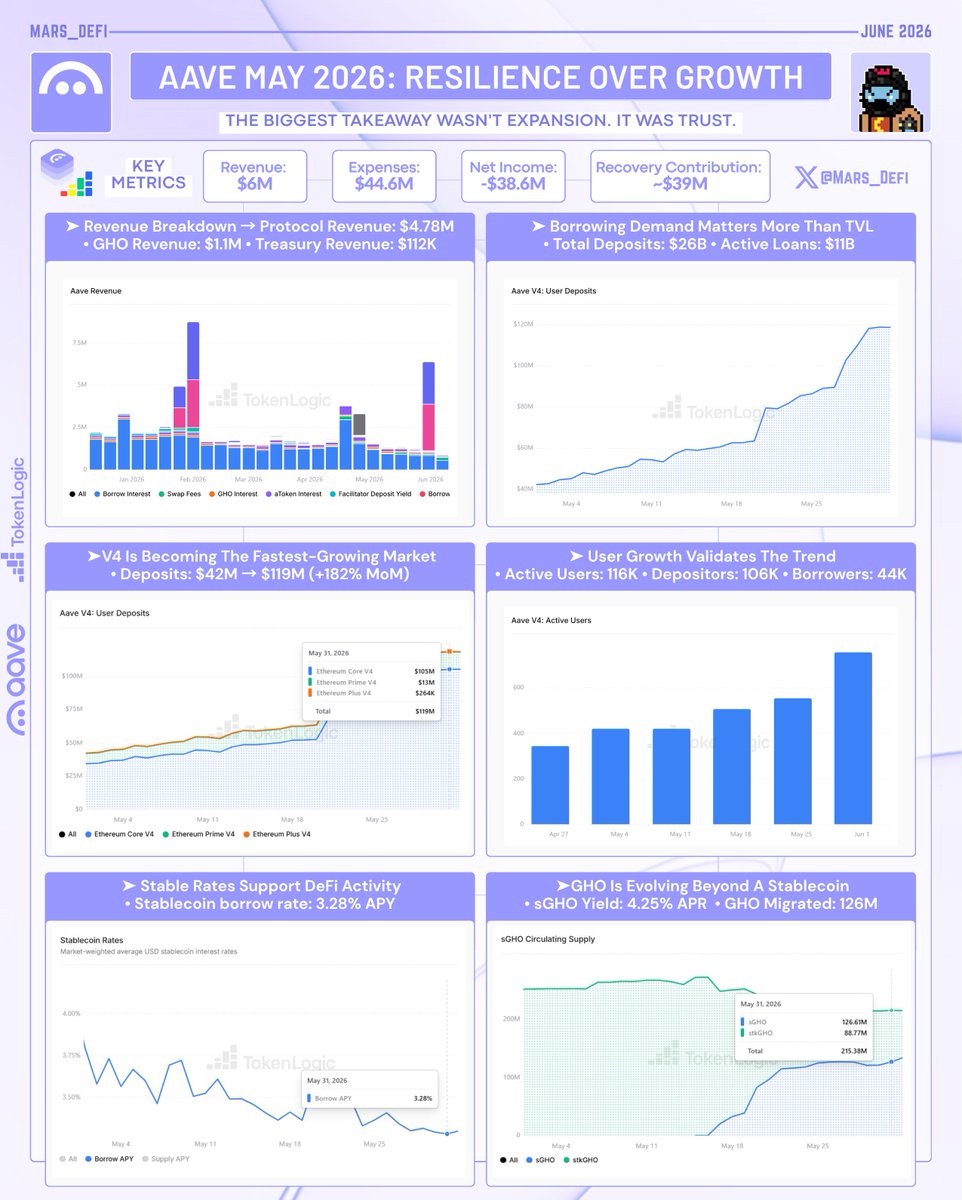
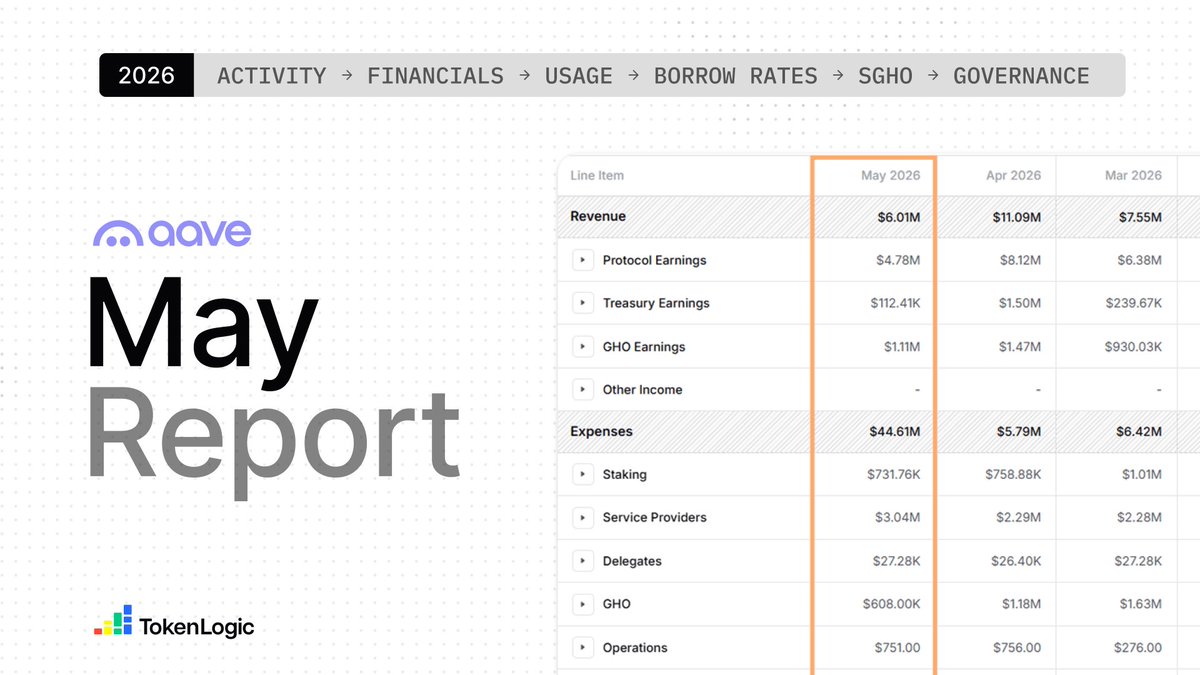
The real story in @aave's May report wasn't growth, it was resilience.
Following the $rsETH exploit, over $160M was committed to make affected users whole, with $AAVE contributing roughly $39M as part of the DeFi United recovery effort.
The recovery effort revealed something important: when trust was tested, the protocol chose to spend capital protecting it.
Let's break down what that means going forward.
—
● The Real Story Behind May's Financials
At first glance, the numbers look weak, with $44.6M in expenses against $6M in revenue and net income falling to -$38.6M.
The headline loss was largely driven by a one-time ~$39M contribution to the recovery effort rather than weakness in the protocol itself.
• Revenue: $6M
• Expenses: $44.6M
• Net Income: -$38.6M
• Recovery contribution: ~$39M
• Protocol revenue: $4.78M
• $GHO revenue: $1.1M
• Treasury revenue: $112K
Excluding the recovery contribution, the protocol generated roughly $6M in revenue against $5.4M in recurring expenses, remaining profitable despite one of the largest ecosystem incidents of the year.
—
● Borrowing Demand Matters More Than TVL
TVL often gets the most attention, but deposits alone do not tell us how much economic activity is happening inside a lending protocol.
Active loans are a stronger signal because they reflect real demand for leverage, liquidity, and capital efficiency across DeFi.
• Total deposits: $26B
• Active loans: $11B
• Lending market share: 60.7%
Borrowers continued using the protocol despite the rsETH incident and broader market uncertainty, suggesting its position as DeFi's dominant money market remained intact.
—
● V4 Is Becoming The Fastest-Growing Market
While most attention remains on established lending markets, V4 was one of the strongest growth stories during May.
The significance is not its size today, but the pace at which capital and borrowing activity are beginning to concentrate around it.
• V4 deposits: $42M → $119M ( 182% MoM)
• V4 active loans: $16M → $33M
• @ethereum Core: $105M
• Ethereum Prime: $13M
• Ethereum Plus: $264K
V4 remains small relative to the broader ecosystem, but adoption is accelerating far faster than the mature protocol.
—
● User Growth Validates The Trend
Capital inflows alone can be misleading, especially when growth is driven by a small number of large holders.
What stands out is that user activity expanded alongside capital growth.
• Active users: 116K
• Active depositors: 106K
• Active borrowers: 44K
• V4 active users increased every week throughout May and finished the month at a new high
User growth alongside capital growth suggests adoption is broadening, not simply concentrating among larger holders.
—
● Stable Rates Support DeFi Activity
Stablecoin borrow rates remained low and stable throughout May, closing at 3.28% APY.
• Stablecoin borrow rate: 3.28% APY
Predictable borrowing costs make it easier to run leveraged and yield-generating strategies, giving users greater confidence to deploy capital.
—
● GHO Is Evolving Beyond A Stablecoin
The sGHO upgrade signals a broader strategy shift, moving from a traditional savings product toward a fixed-yield asset.
• $sGHO fixed yield: 4.25% APR
• @GHO migrated: 126M
• Remaining in legacy contracts: 89M
The shift positions GHO as a yield-bearing asset that other protocols, treasuries, and capital allocators can build around.
—
● Expanding Beyond The Core Market
Recent governance proposals point toward a broader effort to expand reach across new users, assets, and liquidity sources.
• Deployment proposal on @monad
• Native $BTC collateral through @babylonlabs_io on V4
• V4 expansion to @Avalanche
• Integration with @circle's @Arc ecosystem and tokenized RWAs
The common theme is expanding the protocol's addressable market through new chains, Bitcoin liquidity, stablecoin infrastructure, and institutional capital flows.
—
The broader takeaway is that the protocol is expanding beyond lending into a larger financial network spanning stablecoins, Bitcoin liquidity, new chains, and institutional infrastructure.
That evolution may prove more important than any single metric in the report.
Jun 11

1/ The @aave May 2026 Report is live 👻
Key metrics for May:
▪️ $26B user deposits
▪️ $11B active loans
▪️ $6M protocol revenue
▪️ 60.7% active loans market share
▪️ 116k active users
Full breakdown ↓
31
14
63
2,930
Mars_DeFi retweeted

Jun 11
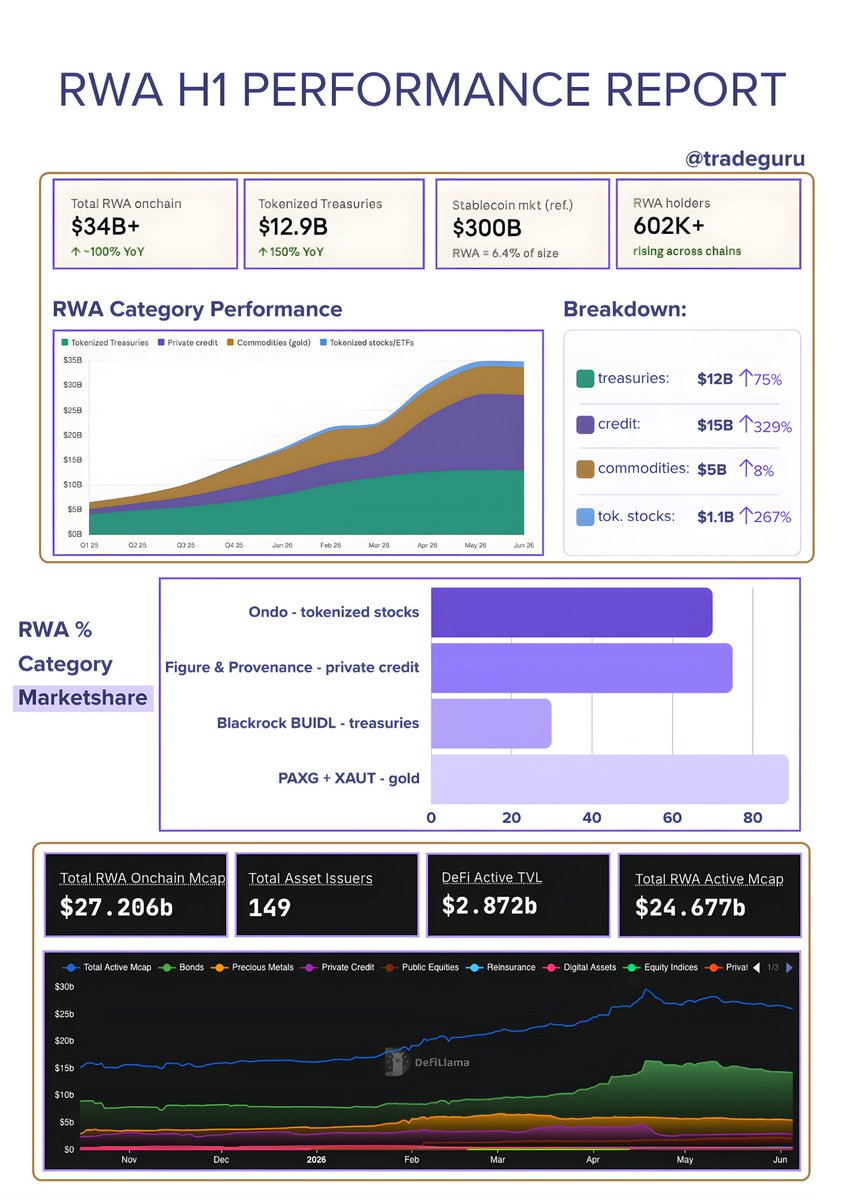
Market Outlok #8
1/8 On-chain RWAs have surpassed $34B, up roughly 100% Year-over-Year.
More importantly, RWA growth is now outpacing stablecoin growth by 6.4%, up from 2.7% in 2025.
The data is becoming impossible to ignore.
A breakdown of where that growth is coming from🧵
May 18

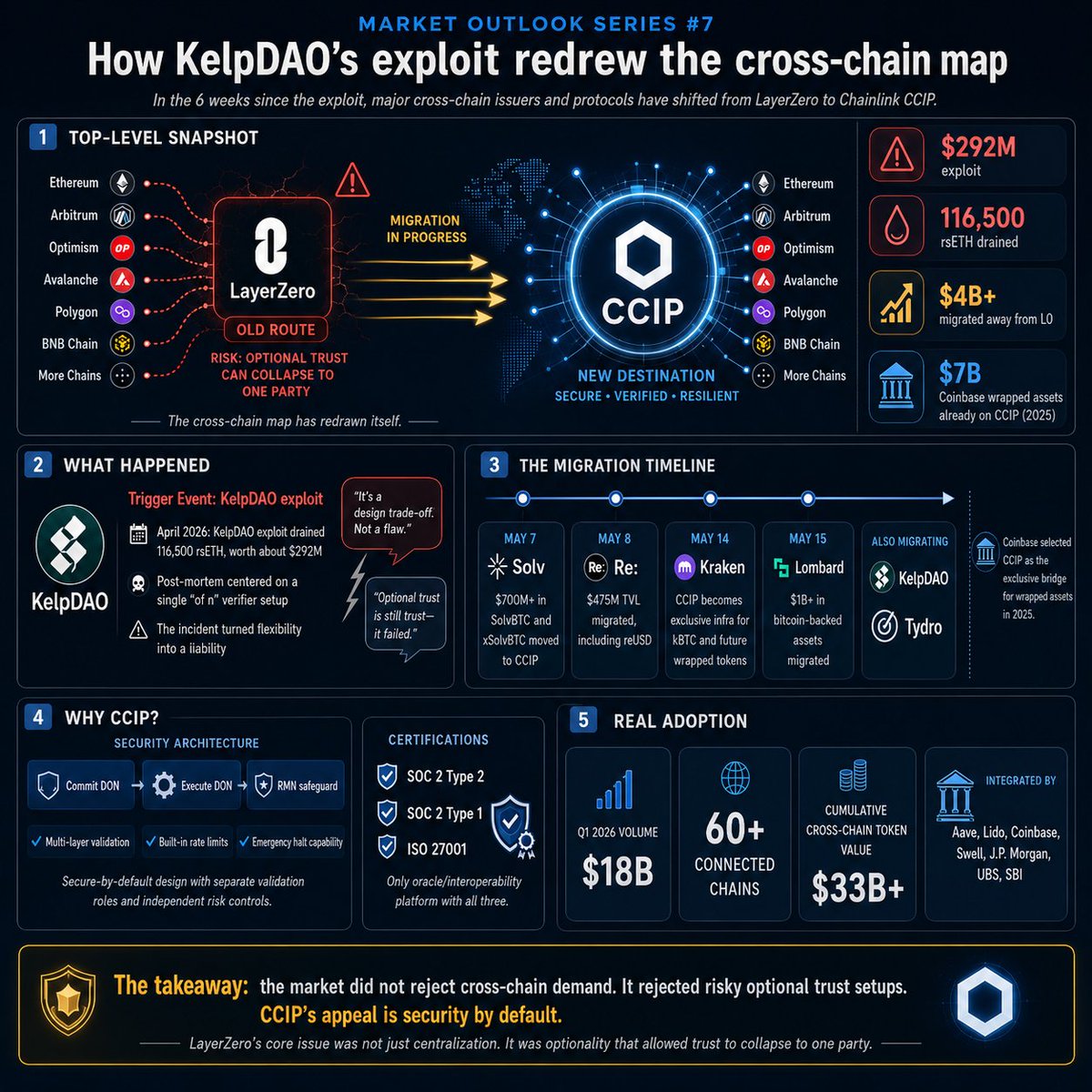
Market Outlook Series #7
1/4 30 days post-Kelp hack, the cross-chain map has redrawn itself.
Solv, Re, Kraken, Lombard, and others, gone from LayerZero. All now live on CCIP.
Despite @PrimordialAA's public mea culpa, L0 has bled $4B in TVL. So why CCIP specifically?
19
23
106
5,049
Jun 11
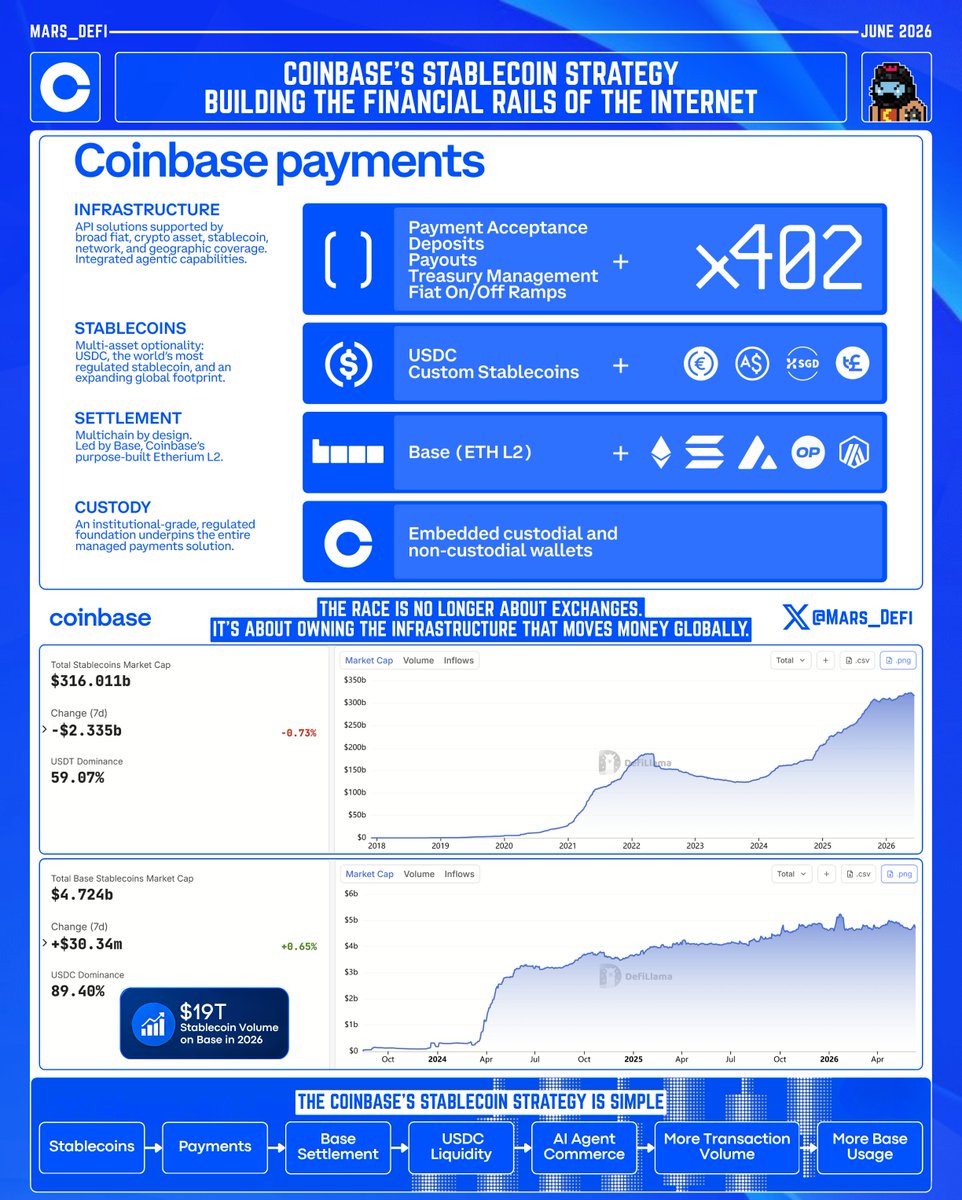
Stablecoins are evolving from a crypto asset into financial infrastructure, with @base already processing $19T in stablecoin volume this year.
Coinbase's latest launch shows the race is no longer about exchanges, but about owning the rails that move money globally.
Here's what's actually happening:
—
● Stablecoins Are Becoming the New Payment Rails
The most important shift is that crypto is no longer competing to own users, but to own the infrastructure that moves money.
Just as @Visa , @Mastercard , and SWIFT became foundational payment rails in traditional finance, Coinbase is positioning stablecoins as the next generation of global settlement infrastructure.
• ~$316B stablecoin market cap
• ~$28T annual stablecoin volume
• 1–5 day settlement -> seconds
• 24/7 global availability
The real opportunity is not issuing another stablecoin, but becoming the default rail businesses use to move value across the internet.
—
● The Real Product Isn't the Stablecoin
The market has already moved beyond speculation, with stablecoins processing tens of trillions in annual volume and increasingly serving real-world payment, treasury, and settlement use cases.
The challenge is that building stablecoin products still requires stitching together custody, compliance, banking, infrastructure, and fiat access across multiple providers and jurisdictions.
• ~$33T annualized stablecoin volume estimates
• $1.9T–$4T projected market size by 2030
• Multiple compliance and banking integrations
• Global regulatory and operational complexity
Coinbase's bet is that the winner will not be the company issuing the stablecoin, but the one providing the full-stack infrastructure layer behind it.
—
● Coinbase Is Building a Full-Stack Stablecoin Operating System
Rather than competing at a single layer, Coinbase is integrating the entire stablecoin stack from payment initiation to final settlement and custody.
• Layer 1: Payments Infrastructure
This layer enables businesses, developers, and AI agents to move money through a unified payments and compliance framework.
@Checkout
@NiumGlobal
@awscloud ( @bedrock AgentCore)
@x402pulse_com
Coinbase Onramp
ACH
Fedwire
SWIFT
SEPA
CDP CLI
AgentKit
Coinbase Payments APIs
@hyperbolic_labs
@openmind_agi
@Cloudflare
Coinbase Business
Coinbase Prime
• Layer 2: Stablecoins
This is the value layer where businesses can issue, transfer, and settle assets across multiple currencies and jurisdictions.
$USDC ( @circle )
$USDT ( @tether )
$PYUSD ( @PayPal / @Paxos)
$EURC ( Circle)
$AUDD ( @NovattiPayments )
$XSGD ( @StraitsX )
Custom Stablecoins (Coinbase Stablecoin-as-a-Service)
• Layer 3: Settlement
This is where transactions are finalized, with Base positioned as the primary settlement network inside the Coinbase ecosystem.
@base
@ethereum
@arbitrum
@Optimism
@0xPolygon
@solana
@Aptos
@SuiNetwork
@cctpto (Circle)
x402 Facilitator
• Layer 4: Custody
This layer provides the regulated storage, security, compliance, and institutional infrastructure required to operate at scale.
Coinbase Custody
Coinbase Prime
Custodial Wallets
Non-Custodial Wallets
Agentic Wallets
@BlackRock
$BTC ETF Issuers
$ETH ETF Issuers
Coinbase Business Accounts
Together, these four layers transform Coinbase from an exchange into a vertically integrated financial infrastructure provider for the stablecoin economy.
—
● The Real Bet Might Be x402, Not Base
Most people focused on Base, but USDC may be the larger moat because Coinbase controls distribution, infrastructure, and one of the largest pools of stablecoin liquidity in the market.
USDC -> Money
Base -> Settlement
Coinbase Payments -> Infrastructure
Together, these three layers create a reinforcing flywheel that becomes stronger as stablecoin adoption grows.
But the most interesting piece sits on top of that stack: x402.
x402 is Coinbase's payment standard built around the HTTP 402 "Payment Required" status code, allowing software and AI agents to transact directly across the internet.
• 160M agentic payments processed
• 480K agents transacting
• ~$50M payment volume
Today: Human -> Website -> Payment
Future: AI Agent -> API -> Payment
Instead of requesting a credit card to access data, compute, APIs, or reports, software can pay autonomously, turning payments into a native internet primitive for machine-to-machine commerce.
—
The strategy is simple:
Stablecoins -> Payments -> Base Settlement -> USDC Liquidity -> AI Agent Payments -> More Volume -> More Base Usage
This is why Coinbase is increasingly positioning itself as a payments company, not an exchange.
While CT focuses on TPS, TVL, and yields, Coinbase is building for cross-border payments, treasury management, merchant checkout, and AI commerce.
USDC as the money, Base as the settlement layer, x402 as the payment standard, and Coinbase Payments as the infrastructure connecting them all.
x.com/coinbase/status/206443…

45
24
103
5,577
Jun 11
Is it just me or the $SPCX IPO has made the timeline feel like a full-blown liquidity event wrapped in rumor, synthetic exposure, and retail FOMO.
The market is already treating $SPCX like the biggest IPO narrative of the year, with chatter around a June 12 listing, ~$135/share pricing, a $1.7T–$1.8T valuation, massive oversubscription, and the whole “4,000 new millionaires” headline.
Also i noticed that a lot of the noise is not coming from official exchange filings or clean broker access. It is coming from trading accounts, prediction markets, tokenized-equity platforms, pre-IPO products, and perp venues.
Yes SpaceX is obviously an amazing company.
But on the side of caution, one must ask:
“What exactly are people buying?”
—
Bulls can make a strong argument.
SpaceX has launch dominance, Starlink, defense demand, Mars optionality, and maybe even long-term space-based AI/data infrastructure upside.
But at a rumored $1.7T valuation, you are not buying it cheap.
That is the part retail must not ignore!
SpaceX might be one of the greatest companies of this generation but one must be real caution at that valuation.
Jun 10

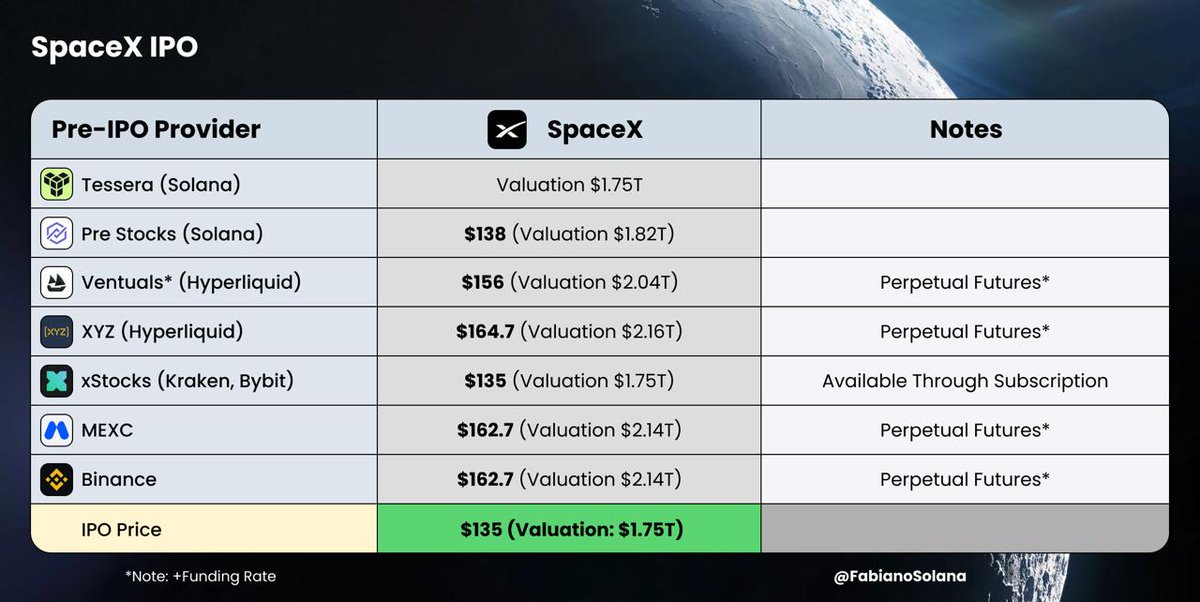
The biggest IPO in history is happening in just 2 days
The IPO offering price for SpaceX is fixed at $135 per share
Here's where you can buy it onchain:
10
27
953
Jun 10
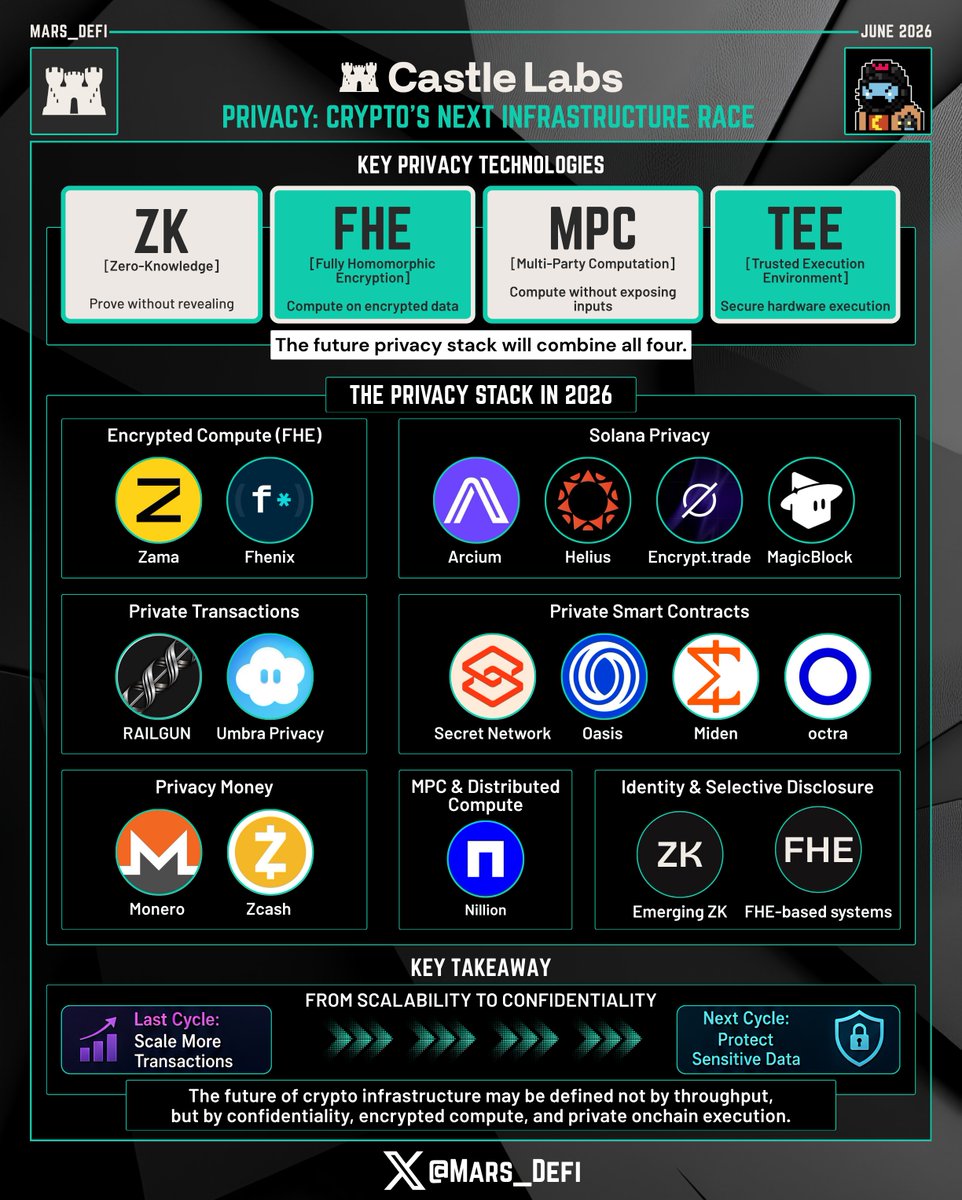
In its latest report, @castle_labs argues that privacy is becoming crypto's next critical infrastructure layer as AI-powered surveillance and onchain transparency continue to collide.
Without privacy primitives, public blockchains risk becoming surveillance systems rather than sovereign financial networks.
Here is the core thesis behind that argument:
—
● The Transparency Paradox
Most people view blockchain transparency as a feature, but transparency combined with AI creates a surveillance system.
Bitcoin was never truly private, only pseudonymous, and firms like Chainalysis can connect wallets to real-world identities through:
• Exchange KYC data
• Wallet clustering
• IP tracking
• Transaction analysis
As AI reduces the cost of analyzing onchain activity, surveillance is shifting from post-event surveillance to predictive surveillance.
—
● Privacy as Infrastructure
Privacy is not about hiding activity. It's about limiting unnecessary exposure.
The report separates privacy into two models:
• Practical Privacy: VPNs, multiple wallets, mixers, and OpSec
• Architectural Privacy: Privacy guaranteed by protocol design
Privacy needs to be built into protocols rather than outsourced to user behavior.
Institutions cannot operate efficiently onchain if positions, treasury balances, counterparties, payroll, and order flow remain public.
The answer is selective disclosure: private by default, public when necessary, and provable when required.
—
● Privacy Is a Full-Stack Problem
Private transactions alone do not guarantee privacy because information can leak across multiple layers of the stack.
• Blockchain Layer: Public transaction data
• RPC Layer: Request visibility before execution
• Network Layer: IP address exposure
• Wallet Layer: Device fingerprints, browser data, and behavioral patterns
Privacy is not a transaction problem. It is a full-stack infrastructure problem.
MEV is also a privacy problem.
Bots extract value because trade intent, size, and timing are visible before execution.
Transparency creates extractability. Privacy reduces it.
—
● The Next Infrastructure Race
Privacy is unlikely to be solved by a single technology.
• ZK: Prove information without revealing it
• FHE: Compute on encrypted data
• MPC: Compute without exposing private inputs
• TEE: Secure hardware-based execution
The privacy stack will likely combine these approaches rather than depend on a single solution.
The last infrastructure cycle was defined by scalability. The next may be defined by confidentiality.
The question is no longer how to move more transactions onchain, but how institutions, AI systems, and users can interact onchain without exposing sensitive data.
—
● The Privacy Stack in 2026
The privacy ecosystem is emerging across multiple layers:
• Encrypted Compute (FHE): @zama, @fhenix
• MPC & Distributed Compute: @nillion
• Solana Privacy: @Arcium, @Helius, Encrypted Trade, @magicblock
• Private Transactions: @RAILGUN_Project, @UmbraPrivacy
• Private Smart Contracts: @SecretNetwork, @OasisProtocol, @0xMiden, @octra
• Privacy Money: @monero, @Zcash
• Identity & Selective Disclosure: Emerging ZK and FHE-based systems
The strongest narratives are shifting toward encrypted compute, MPC infrastructure, and private onchain execution.
—
This is not a thesis on privacy coins.
It's a thesis on privacy becoming a core infrastructure layer for crypto.
As AI makes surveillance cheaper and blockchains make data more transparent, the demand for confidential finance, private identity, and secure computation will continue to grow.
That shift could make privacy one of the most important infrastructure narratives of the next cycle.
Full report:
docsend.com/view/2mtpigykn8m…
Jun 9

The Full-Stack Privacy Ecosystem: Privacy as Infrastructure for User Protection and Institutional Adoption
Featuring @octra @fhenix @ambire @RAILGUN_Project @0xprivacypools @Arcium @encifherio @Starknet
Read the complete report for free here: docsend.com/v/sjv2g/thefulls…
28
3
42
2,949
Jun 10
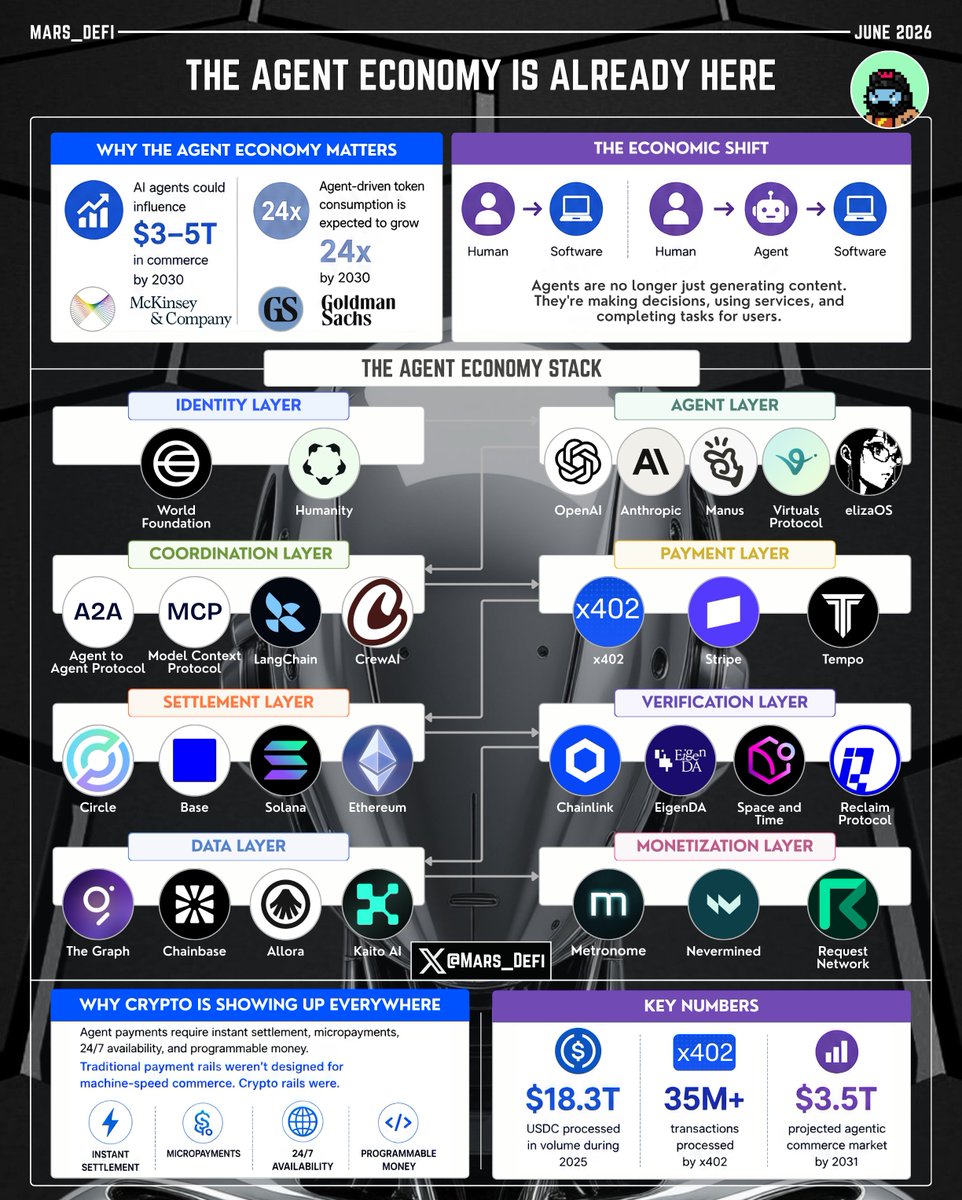
The agent economy is already here but who owns the rails?
AI agents are moving beyond chatbots and starting to participate in the economy.
With agentic commerce projected to reach $3.5T by 2031, the supporting rails are forming fast.
Here's what's actually powering this shift.
—
● Why The Agent Economy Matters
The numbers suggest this is more than another AI trend.
• @McKinsey estimates AI agents could influence $3-5T of commerce by 2030
• @GoldmanSachs expects agent-driven token consumption to grow 24x by 2030
Agents are no longer just generating content.
They're beginning to make decisions, use services, and complete tasks for users.
The economy is shifting from:
Human -> Software
to
Human -> Agent -> Software
—
● The Agent Economy Stack Is Taking Shape
Every new economic actor eventually needs identity, coordination, payments, and settlement.
AI agents are no different.
• Identity Layer: Verifies humans and agents, enabling trusted participation and delegation.
@worldcoinfnd
@Humanityprot
• Agent Layer: Powers autonomous agents that can reason, execute, and perform tasks.
@OpenAI
@AnthropicAI
@ManusAI
@virtuals_io
@elizaOS
• Coordination Layer: Enables agents to discover, communicate, and collaborate with each other.
A2A (Agent-to-Agent Protocol)
MCP (Model Context Protocol)
@LangChainJP
@crewAIInc
• Payment Layer: Allows agents to send, receive, and stream payments autonomously.
x402
@stripe
@tempo_labs
• Settlement Layer: Provides the rails for fast, low-cost, and always-on transactions.
@circle
@base
@solana
@ethereum
• Verification Layer: Ensures agent actions, data, and decisions are trustworthy.
@chainlink
@eigen_da
@spaceandtime
@reclaimprotocol
• Data Layer: Supplies agents with real-time, verifiable information.
@graphprotocol
@ChainbaseHQ
@AlloraNetwork
@KaitoAI
• Monetization Layer: Tracks usage and enables agent-native business models.
@MetronomeDAO
@Nevermined_ai
@RequestNetwork
—
● Why Crypto Is Showing Up Everywhere
Agent payments require instant settlement, micropayments, 24/7 availability, and programmable money.
Traditional payment rails weren't designed for machine-speed commerce. Crypto rails were.
• $USDC processed $18.3T in volume during 2025
• x402 has already processed 35M transactions
As the agent economy grows, infrastructure such as Base, Solana, Chainlink, and EigenLayer could become increasingly important.
—
The agent economy is already moving from experimentation to real economic activity.
Identity, coordination, payments, and settlement layers are taking shape in real time.
As agentic commerce scales from billions to trillions, the projects owning these rails could capture a significant share of the value created.
43
4
79
4,244
Mars_DeFi retweeted

Jun 8
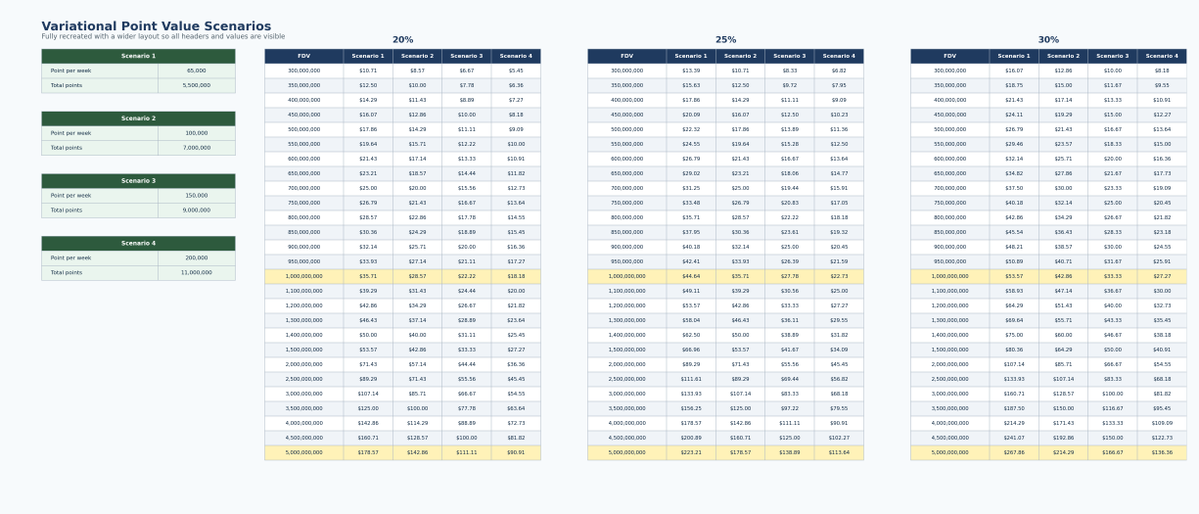
i think the market is underestimating variational.
my original target was $100/point.
after running the comp against lighter’s tge, i think that was too conservative.
i’ve moved my target closer to $185/point and even that may not fully price in what variational is becoming.
the easy comp is $LIT launched at $3b fdv with a 25% airdrop.
but the problem with comparing variational to lighter is that variational is not really playing the same game.
- @Lighter_xyz is a perp dex.
- @variational_io is trying to become an onchain global brokerage layer, with perps as only one part of the stack.
that changes the valuation framework.
most perp dexs are fighting for the same crypto-native leverage traders:
- variational’s real edge is its RFQ liquidity model.
- orderbook dexs need native liquidity for every market. every new market creates fragmentation, market maker cost, and incentive spend.
- variational uses an rfq model where liquidity can be routed through aggregated sources across cexs, dexs, and tradfi dealers.
that is why they can list hundreds of markets without needing to bootstrap every orderbook from zero.
this is the part most people are missing.
rwa markets are higher-value assets, with a larger addressable market, wider user base, and potentially better monetization than crypto perps alone.
so if rwa volume ramps, revenue should ramp with it and that leads to the second part of the thesis.
variational already has around $3mil fedcoins / usdc sitting in its onchain treasury wallet.
to my knowledge, this is one of the first dexs building a real treasury before TGE, with docs indicating a minimum 30% of revenue used for buybacks.
are people really going to instantly dump their airdrop if there is potentially a $10m–$15m twap buyback coming at any time?
maybe some will.
but that is a very different setup from the usual tge, where the only bid is retail exit liquidity.
this is why i think $100/point is no longer the bull case, it may be the base case.
if the market prices variational like a normal perp dex, $100/point makes sense.
my target is now closer to $185/point.
and if the rwa thesis actually works, billions.
34
5
88
22,241
Jun 8
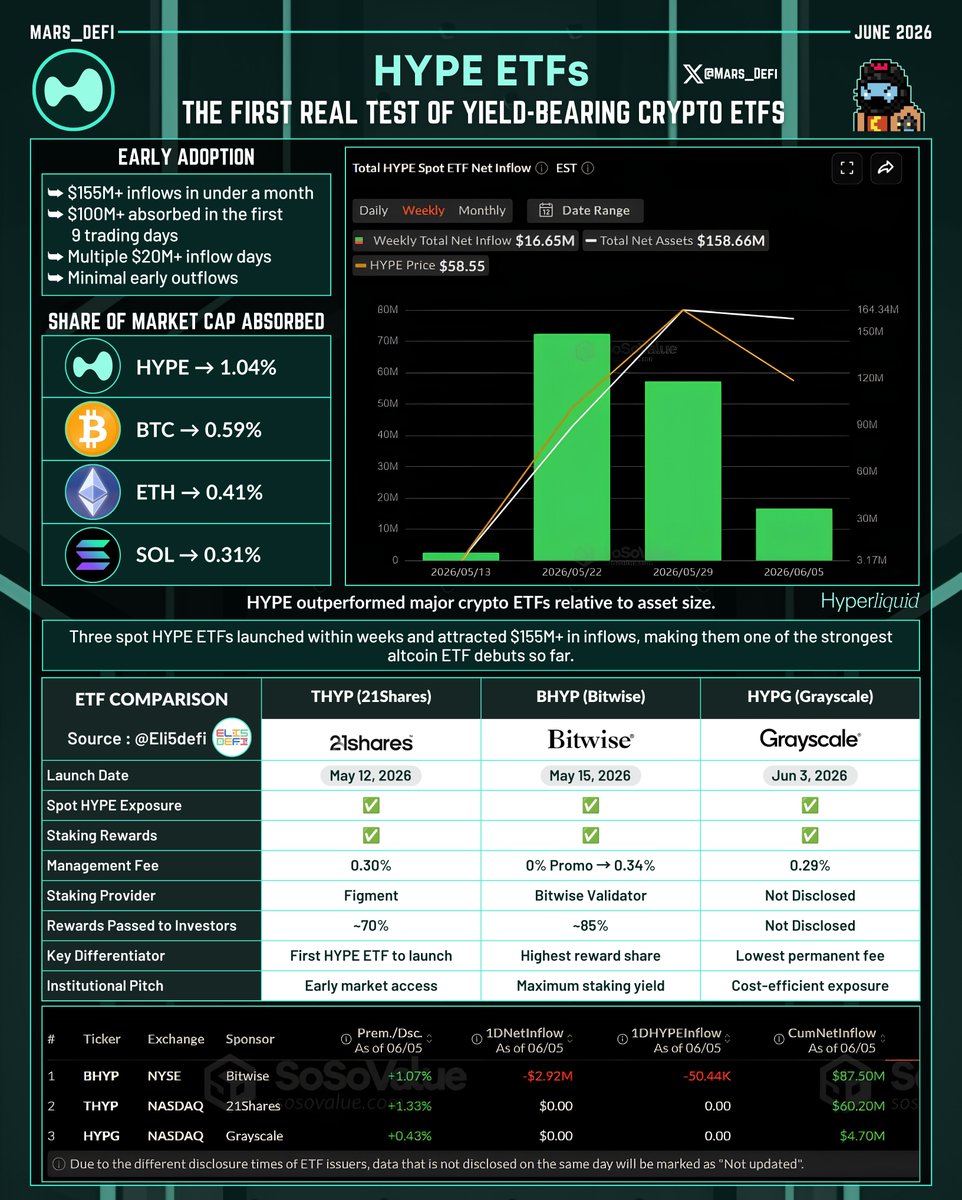
Three spot @HyperliquidX ETFs launched within weeks, attracting over $155M in inflows and marking one of the strongest altcoin ETF debuts to date.
But this is bigger than a typical ETF launch, as it tests whether yield-bearing crypto products can attract institutional capital at scale.
Here's what's actually happening:
—
● What are $HYPE ETFs (Exchange-Traded Fund)
ETFs allow investors to gain exposure to an asset through traditional brokerage accounts without directly interacting with the underlying asset.
HYPE ETFs give investors exposure to Hyperliquid's native token while removing the need to manage wallets, self-custody, exchanges, or staking infrastructure.
• $THYP ( @21shares ) - Launched May 12, 2026
• $BHYP ( @Bitwise ) - Launched May 15, 2026
• $HYPG ( @Grayscale ) - Launched June 3, 2026
Three issuers launched competing products within weeks, signaling growing institutional demand for Hyperliquid exposure.
—
● Comparing the 3 HYPE ETFs
All three ETFs offer spot HYPE exposure and staking rewards, but each issuer is taking a different approach to capturing institutional demand.
• $THYP
Launched by 21Shares, THYP was the first HYPE ETF to reach the U.S. market with a 0.30% management fee and staking-enabled exposure.
THYP relies on Figment for staking and distributes roughly 70% of staking rewards back to investors.
• $BHYP
Bitwise launched BHYP with a 0% promotional fee before transitioning to a 0.34% management fee.
BHYP operates its own validator and passes 85% of staking rewards to the fund, giving investors the highest reward share among the three products.
• $HYPG
Grayscale entered the market last with HYPG, combining direct HYPE exposure with staking rewards.
At 0.29%, HYPG offers the lowest permanent fee, highlighting how aggressively issuers are competing for institutional flows.
—
● Why $HYPE ETFs Are Different
The real innovation is the introduction of staking-enabled ETFs that combine token exposure with staking rewards.
Unlike BTC ETFs, which only provide exposure, HYPE ETFs create a new category of yield-bearing crypto products.
Early adoption has been strong:
• $155M net inflows in less than a month
• $100M absorbed in the first 9 trading sessions
• Multiple $20M inflow days
• No meaningful early outflow streaks
More importantly, the ETFs absorbed 1.04% of HYPE's market cap, outperforming $BTC (0.59%), $ETH (0.41%), and $SOL (0.31%) at comparable stages.
This is why many view it as one of the strongest crypto ETF debuts, driven by adoption relative to asset size rather than total inflows.
—
● Why $HYPE Held Through Unlocks
Normally:
Unlocks -> More supply -> Price pressure
Instead, $HYPE remained resilient despite a ~$700M unlock.
A combination of ETF demand, protocol buybacks and staking demand helped absorb new supply entering circulation.
The ability to absorb a major unlock without a sustained selloff suggests demand is becoming increasingly structural rather than purely speculative.
—
The story may still be in its early stages, with VanEck's proposed $VHYP ETF signaling continued institutional interest.
More importantly, ETFs create a new source of demand:
ETF inflows -> Issuers buy $HYPE -> Tokens are removed from circulation -> Tokens are staked.
This is the core thesis behind the ETF narrative that a new source of demand entering the Hyperliquid ecosystem.
39
1
60
3,378
Jun 8
How do we convince normies that Crypto is still a serious industry when we are slowly encouraging a disturbing trend where bounty platforms have turned attention into a task marketplace.
Instead of “make a meme” or “write a thread,” people are now being rewarded for permanent body changes, public embarrassment, risky stunts, and real-life disruption.
The Arivu forehead tattoo is probably the clearest recent example because it combines everything i have found weird about crypto culture; a bounty, a typo, a permanent act, a disputed payout, community sympathy, and then a memecoin spin-off(which everyone knew was going to happen the instant it went viral).
Also there are challenges where participants are being asked to quit their jobs on camera, skydiving into a major sports event and even interviewing a criminal's family .
This can not be what a serious industry should encourage.
I understand it's a bear market but we should encourage and support actual builders rather than make these bounties go viral.
18
1
36
1,458
Jun 8
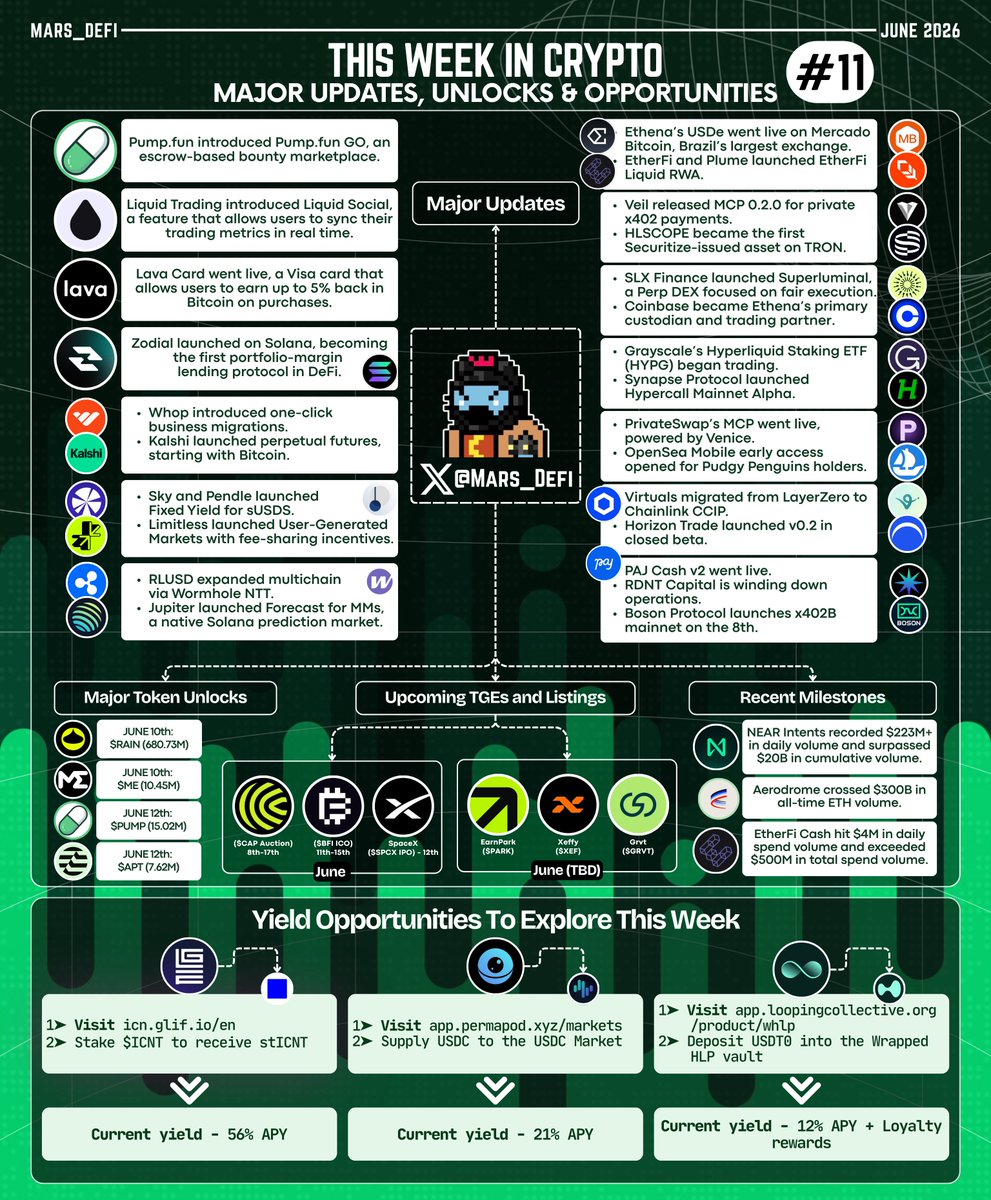
Last week had a good number of product launches, infrastructure upgrades, and market expansions across the crypto ecosystem.
From new prediction markets to multichain stablecoin integrations and institutional RWA products, teams continued pushing the boundaries of what can be built onchain.
Here’s a list of activities lined up for this week, and yield opportunities to explore.
—
● Major Updates
• @Pumpfun introduced Pump fun GO, an escrow-based bounty marketplace.
• @liquidtrading introduced Liquid Social, a feature that allows users to sync their trading metrics in real-time.
• @lava_xyz’s Lava Card went live, a Visa card that allows users earn up to 5% back in Bitcoin on purchases.
• @zodial_xyz launched Zodial on solana, the first portfolio-margin lending protocol in DeFi.
• @whop introduced Whop Migrations, allowing businesses migrate in one click and run everything end to end on Whop.
• @slx_fi introduced Superluminal, a Perp DEX designed to neutralize execution disadvantages in DeFi.
• Perpetual futures went live on @Kalshi, with Bitcoin as the first asset that went live for trading.
• @SkyMoney partnered with @pendle_fi to launch "Fixed Yield," a product allowing users to lock in a set return on sUSDS.
• @trylimitless launched User-Generated Markets, a feature that lets users create prediction markets and earn a fee share from its trading activity.
• Ripple's RLUSD went multichain, powered by @wormhole's Native Token Transfers (NTT) standard.
• @JupiterExchange introduced Jupiter Forecast for MMs, Solana’s first fully native prediction market.
• @ethena’s USDe went live on @MercadoBitcoin, Brazil's largest exchange.
• @ether_fi partnered with @plumenetwork to launch EtherFi Liquid RWA, a way to earn institutional-grade rewards on stables.
• @Veildotcash launched Veil MCP 0.2.0 to enable agents make private x402 payments from Veil shielded USDC pools.
• Hamilton Lane’s Senior Credit Opportunities Fund, HLSCOPE, became the first @Securitize-issued asset on @trondao.
• Coinbase is now @ethena’s primary custodian, wallet provider and perpetuals venue
• @Grayscale’s Hyperliquid Staking ETF ($HYPG) went live for trading
• @SynapseProtocol’s Hypercall Mainnet Alpha went live
• @PrivateSwap’s MCP went live, powered by @AskVenice
• @opensea opened early access to OpenSea Mobile for
@pudgypenguins or @LilPudgys NFT holders
• @virtuals_io migrated from LayerZero to Chainlink's CCIP
• @horizon_trade_x launched v0.2 in closed beta
• @paj_cash v2 went live
• @RNDTCapital is sunsetting operations
• @BosonProtocol is launching Boson x402B on mainnet on the 8th
• @coinbase’s perpetual-style equity index futures are going live in the U.S. on the 8th
• @xdaoapp will launch a bot with detailed instructions on its airdrop on the 10th
—
● Upcoming TGEs and ICOs
• @CapApp ($CAP Auction) - 8th-17th
• @Bitfi_Org ($BFI ICO) - 11th-15th
• @SpaceX ($SPCX IPO) - 12th
• @_Earnpark ($PARK) - June (TBD)
• @Xeffy_io ($XEF) - June (TBD)
• @grvt_io ($GRVT) - June (TBD)
—
● Major Token Unlocks
• @Rain__Protocol ($680.73M $RAIN) - 10th
• @MagicEden ($10.45M $ME) - 10th
• @Pumpfun ($15.02M $PUMP) - 12th
• @Aptos ($7.62M $APT) - 12th
—
● Recent Milestones Across Top Protocols
• @NEARProtocol’s NEAR Intents recorded over $223M in volume in a single day last week, and has now surpassed $20B in cumulative volume
• @AerodromeFi crossed $300B in all time $ETH volume
• @ether_fi Cash hit $4M in daily spend volume and crossed $500M in all-time volume
—
● Yield Opportunities To Explore This Week
• Protocol - @glifio
• Network - Base
• Steps
➊ Visit icn.glif.io/en
➋ Stake $ICNT to receive stICNT
• Current yield - 56% APY
• Protocol - @PermaPod_xyz
• Network - ZIGChain
• Steps
➊ Visit app.permapod.xyz/markets
➋ Supply USDC to the USDC Market
• Current yield - 21% APY
• Protocol - @Looped_HYPE
• Network - Hyperliquid
• Steps
➊ Visit app.loopingcollective.org/pr…
➋ Deposit USDT0 into the Wrapped HLP vault
• Current yield - 12% APY Loyalty rewards
—
That’s all for this week. More updates next week.
69
7
97
6,319

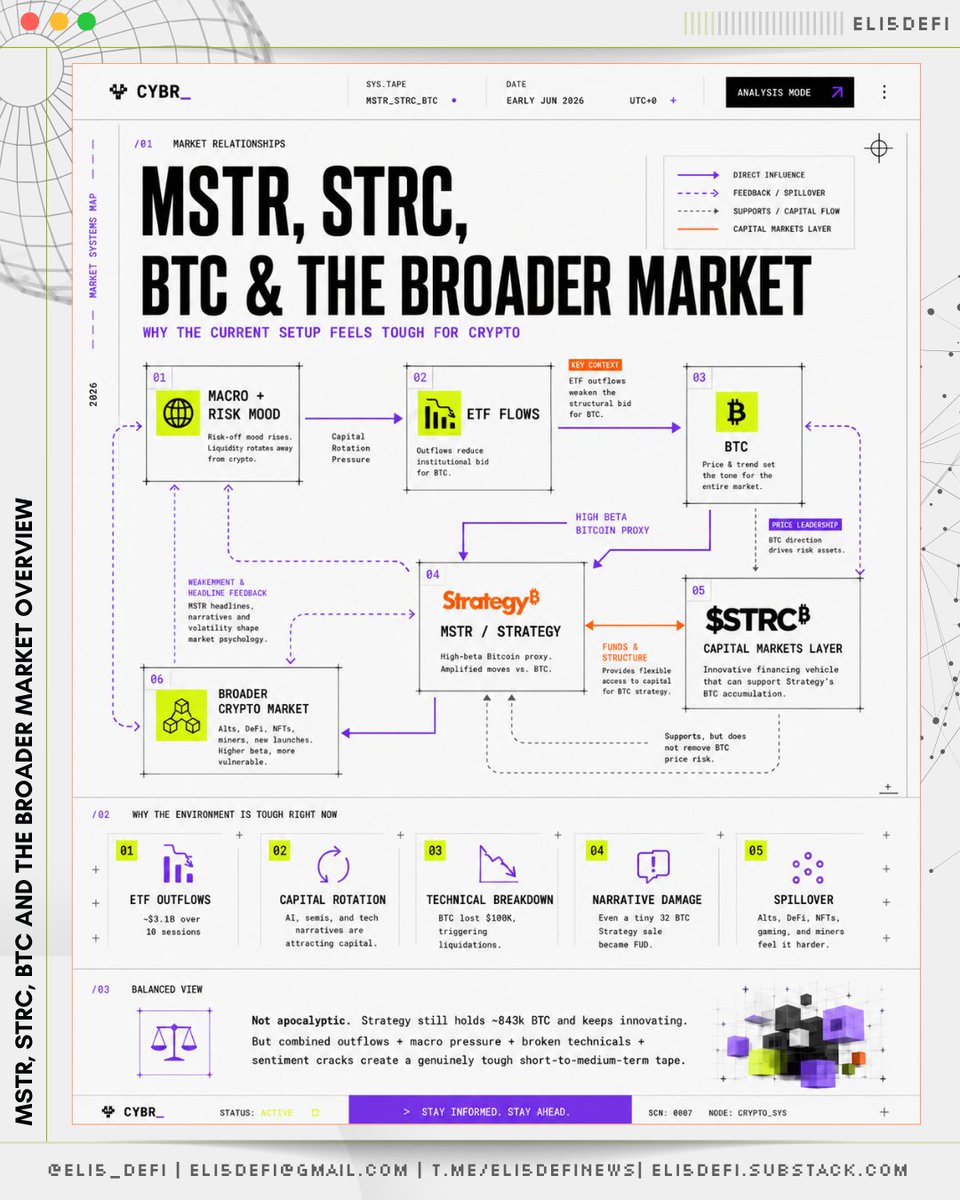
Some thoughts on the recent mini-crash.
We’ve got a clear stack of bearish signals:
- ETF outflows (~$2.97B over 10 straight sessions)
- Mt. Gox movements
- Fresh deleveraging/liquidations
- Strategy’s 'small' BTC sale
The 32 BTC sale is tiny in size but big in meaning: it dents the “never sell” story and hit sentiment in an already fragile market.
Strategy holds ~843,706 $BTC (~4% of supply) at an average ~$75,699, implying a large unrealized loss at current prices.
$MSTR has slid with BTC ($126.55 on June 3, ~-7% on the day) and remains a leveraged, volatile BTC proxy.
STRC is a perpetual preferred aimed at BTC-linked yield/credit exposure with less direct BTC/MSTR volatility. It’s trading at a discount (~$94.65), so Strategy is keeping the dividend at 11.50%.
$STRC proceeds have helped fund BTC buys. The recent sale slightly flips the playbook → Using a bit of BTC to help cover the preferred dividend instead of relying only on new financing.
More BTC downside could pressure MSTR further and stress STRC’s “peg” dynamics.
Imo, Crypto has lived through worse.
But the mix of sustained outflows, rotation elsewhere, broken technicals, and narrative cracks makes the next few months tougher, with recovery likely needing better macro or a clear catalyst to reverse flows.
I think If you’re not in the right headspace to be in the market, touch grass. Because when you’re back, it’s time to lock in: find good projects on discount, place some stink bids, and get back to business.
22
7
42
3,502
Mars_DeFi retweeted

Jun 6
Crypto’s biggest winners are usually obvious.
Just not when they’re still investable.
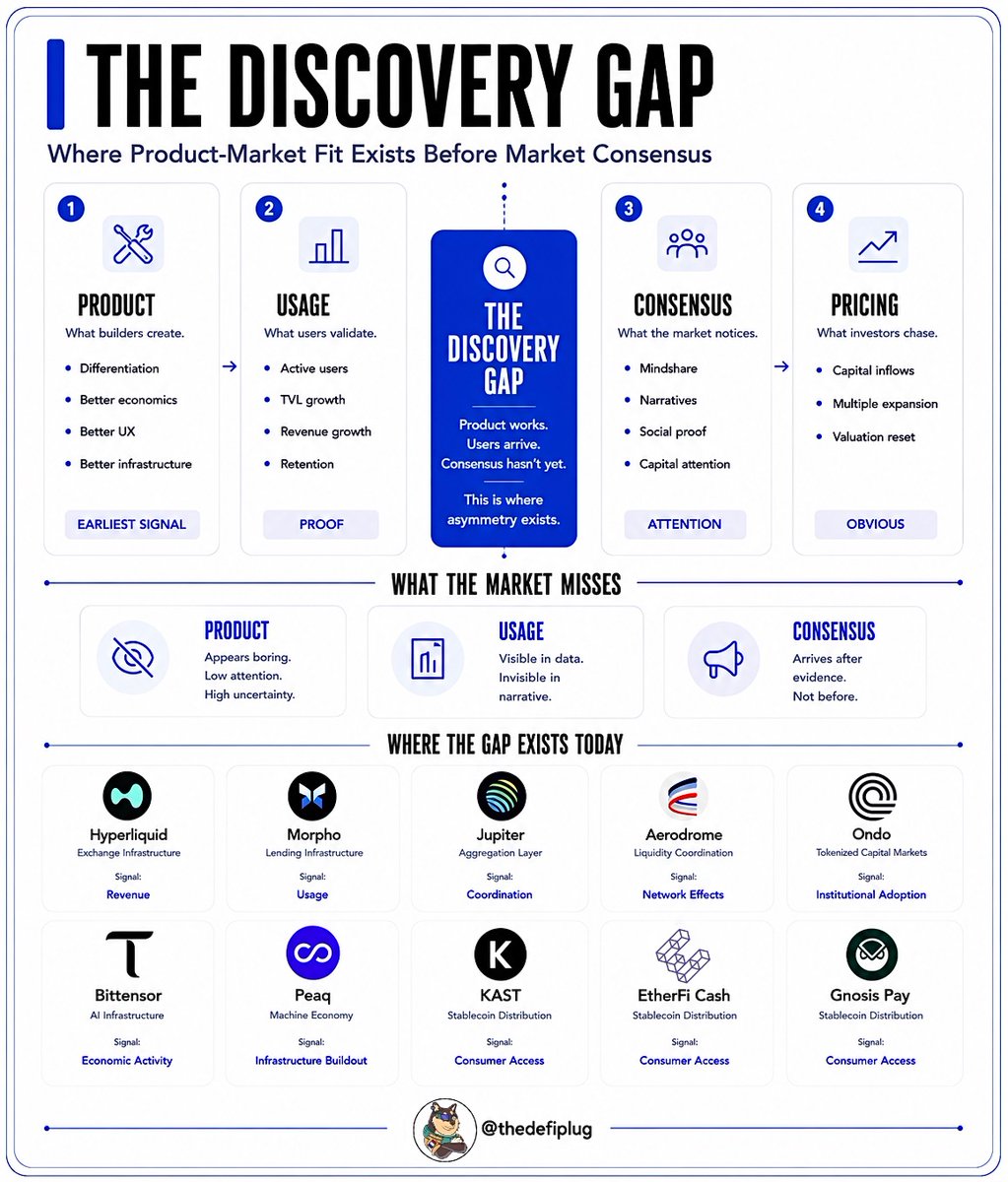
One of the most persistent patterns in crypto is that product precedes narrative, usage precedes attention, and revenue precedes consensus.
Uniswap V2 launched in May 2020. Aave V2 launched in December 2020. Neither became immediate consensus trades. The products existed before the market collectively decided they mattered.
That sequence keeps repeating.
Most investors believe they are searching for innovation. In practice, they are searching for validation.
They want to see:
➢ Growing users
➢ Growing TVL
➢ Growing revenue
➢ Growing mindshare
The problem is that these signals arrive at different times.
Product comes first.
Usage comes second.
Consensus comes last.
By the time everyone agrees something is important, much of the asymmetry has already disappeared. Consensus reduces uncertainty. It also reduces opportunity.
That is why some of the most important infrastructure tends to emerge during corrections rather than euphoric phases.
Bull markets are good for distribution. Corrections are good for construction.
When capital becomes selective, builders focus less on attention and more on product quality, retention, and economics. Historically, those periods have produced many of crypto’s defining protocols.
The current market resembles those environments more than many realize. Attention has narrowed around a handful of large-cap assets while speculation has cooled.
Historically, this is where the next generation of infrastructure starts separating itself.
Not through price.
Through usage.
Every cycle creates a discovery gap. A period where a protocol is already working, but the market has not fully processed what it is becoming.
The signals tend to look familiar:
➢ Real users
➢ Real revenue
➢ Product differentiation
➢ Limited attention
➢ Weak consensus
The market struggles to value these periods because there is little social proof.
Only evidence.
Several protocols are already doing what past winners did before the market noticed.
@HyperliquidX is proving a crypto-native exchange can compete directly with centralized venues while generating meaningful revenue.
@Morpho reflects a broader trend where lending becomes infrastructure rather than a destination application.
@JupiterExchange benefits from ecosystem fragmentation. As liquidity spreads across venues, aggregation becomes more valuable.
@AerodromeFi has become a coordination layer for liquidity on Base rather than simply another DEX.
@OndoFinance sits at the center of tokenized capital markets if RWAs continue expanding beyond Treasury exposure.
@opentensor remains one of the few AI networks with measurable economic activity tied to compute demand.
@peaq is building infrastructure for a world where machines become economic participants.
@KASTxyz, @ether_fi Cash, and @gnosispay point toward another structural trend. Stablecoins are evolving from trading collateral into consumer financial accounts. The opportunity may not be the stablecoin itself. It may be owning the distribution layer through which users access them.
What stands out is not the individual names.
It’s the pattern.
Most of these protocols are not winning because of tokens.
They are winning because they own infrastructure, distribution, coordination, or revenue-generating activity.
The names that define 2027 may ultimately be different.
The underlying pattern probably won’t be.
Every cycle produces protocols that look obvious in hindsight. The difficult part is recognizing them while the discovery gap still exists.
History suggests that some of the protocols that define the next cycle are already live today.
The market simply hasn’t reached consensus yet.
23
26
45
3,674
Jun 6
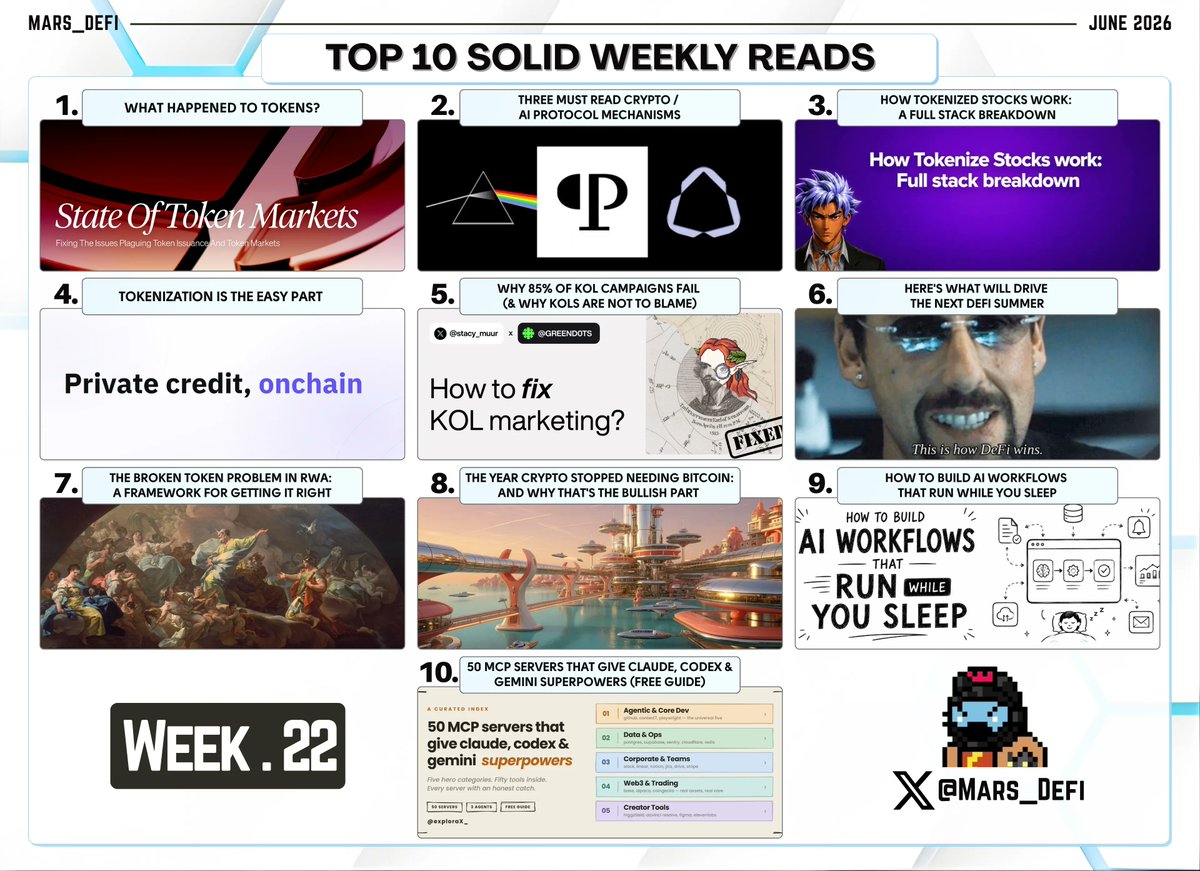
With the current state of the market, the focus is moving away from speculation and toward systems that actually generate, capture, and distribute value sustainably.
Most of the insightful articles I came across this week centered majorly around this theme.
Here’s a solid roundup of my favorite reads of the week.
—
@0xdaft says the market downturn is driven less by speculation and more by flawed token design and launch structures that prioritized distribution over value creation.
He highlights how unlocks, airdrops, and emissions between 2024 and 2026 consistently created sell pressure, often leaving retail as exit liquidity.
Capital is increasingly flowing toward protocols with real revenue, demand, controlled emissions, and clear value accrual mechanisms.
x.com/0xdaft/status/20621634…
—
@0xSammy highlights 3 protocols that are rethinking how value is created and distributed onchain.
Using @prlnet, @tigfoundation, and @prism_lp as examples, he explores how AI compute can secure networks, algorithmic improvements can become investable assets, and liquidity provision can be embedded directly into a token itself.
As crypto matures, the best opportunities may come from protocols that innovate at the mechanism level, creating new ways to coordinate compute, capital, and incentives.
x.com/0xsammy/status/2061423…
—
@EhDhizy breaks down the infrastructure powering tokenized stocks, explaining how traditional equities are transformed into onchain assets.
Custody, compliance, pricing, liquidity, and collateral utility were outlined as the key layers required for tokenized equities to function.
As capital markets move onchain, opportunities will lie not just in tokenized stocks, but in the infrastructure providers enabling the entire ecosystem.
x.com/ehdhizy/status/2062476…
—
@0xyanshu argues that tokenization is no longer the competitive advantage, as major institutions have already brought TradFi assets onchain.
The real value lies in the surrounding infrastructure, such as risk management, diversification, liquidity provisioning, collateral utility, and transparent onchain credit structures.
The sector’s next growth wave will likely be driven by building the networks, liquidity layers, and risk frameworks that make those assets useful onchain.
x.com/0xyanshu/status/206238…
—
Most failed KOL campaigns are due to poor campaign design, not ineffective creators.
@stacy_muur explains how generic messaging, weak audience targeting, lack of content sequencing, and unclear conversion paths undermine campaigns before a creator even publishes a post.
As competition for attention increases, successful campaigns may depend more on building trust through the right audience, narrative, and campaign design.
x.com/stacy_muur/status/2062…
—
DeFi’s biggest limitation today is not infrastructure, but the lack of sustainable, exogenous yield.
Current yields are mostly from reflexive crypto activity like leverage, incentives, and funding rates, but @tradetheflow_ thinks the next major cycle will come from real-world yield sources brought onchain.
He highlights reinsurance, private credit, and emerging market sovereign debt as key drivers, emphasizing that the winners will be USD-denominated, yield-bearing, risk-aware, and deeply integrated into DeFi.
x.com/tradetheflow_/status/2…
—
Most RWA tokens fail not because of market conditions or execution, but because the token is separated from the real economic value of the underlying business.
While RWAs often generate real revenue and yield, the value typically accrues to offchain entities, leaving token holders with governance rights but no enforceable claim on cash flows.
@ZeusRWA explains that RWA tokens need to be redesigned to include clear value capture mechanisms.
x.com/zeusrwa/status/2061797…
—
Bitcoin is no longer the central force in crypto, as AI now absorbs risk capital and stablecoins have replaced it as the main monetary layer.
@nikshepsvn believes crypto is shifting toward a multi-chain, dollar-based economy where protocols with real revenue and usage matter more than $BTC price action.
In this new structure, coordination and privacy layers are the key infrastructure connecting value across chains.
x.com/nikshepsvn/status/2061…
—
@mikenevermiss shares 5 practical AI workflows that can run autonomously, including content research, SEO tracking, support triage, testing, and finance reporting.
He breaks down a simple 3-layer structure for building them, which includes a planner (LLM), tools (APIs), and memory (state storage), then shows how to combine them using tools like n8n, LangChain, and CrewAI.
Successful AI workflows depend more on good data, reliable tool calls, and tight prompts than on the model.
x.com/mikenevermiss/status/2…
—
@exploraX_ breaks down 50 MCP servers powering Claude, Codex, and Gemini, explaining how the MCP has evolved into a universal integration layer for AI agents.
Models no longer need custom integrations for every tool, they connect once and gain access to any compatible server across the ecosystem.
The real advantage is shifting from model capability to tool orchestration, with value concentrated in well-chosen MCP stacks rather than installing everything available.
x.com/explorax_/status/20624…
—
That’s all for this week.
Stick around for more alpha reads next week.

45
5
90
5,574
Jun 5
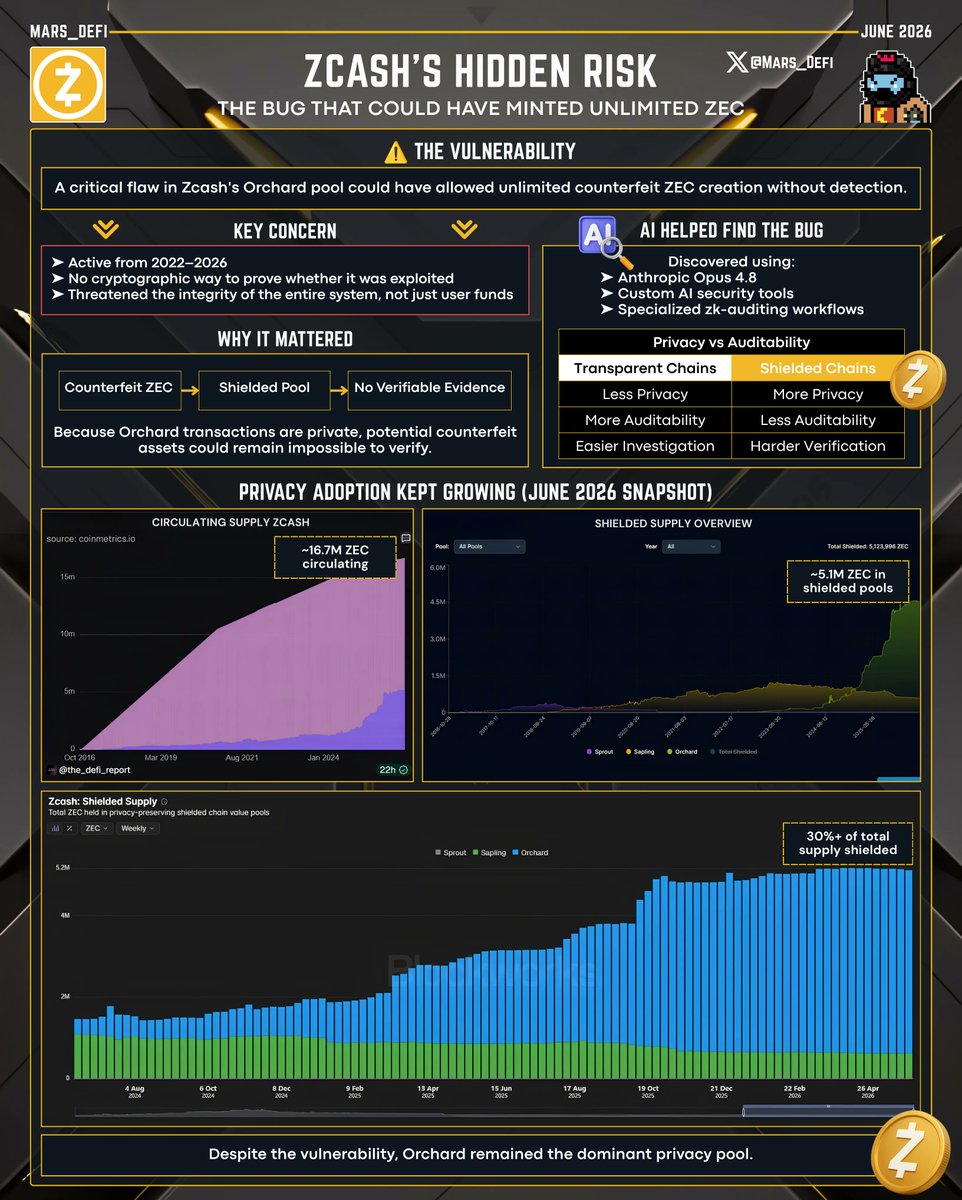
A critical vulnerability discovered in @Zcash's Orchard pool could have enabled unlimited counterfeit ZEC creation without detection.
Even more concerning, the bug remained live from 2022 to 2026, and there is no cryptographic way to prove whether it was ever exploited.
Here's what this reveals about privacy infrastructure and crypto security:
—
● Why This Bug Was Different
In most crypto systems, counterfeit assets eventually reveal themselves through:
• Supply mismatches
• Accounting inconsistencies
• Invalid state transitions
This vulnerability challenged one of crypto's core assumptions: that counterfeit assets eventually leave evidence behind.
In simple terms, Orchard's proof system could be tricked into accepting transactions that should have been rejected, creating a path for counterfeit ZEC to enter the shielded pool.
This vulnerability existed inside a privacy-preserving system where balances, senders, and receivers are hidden from public view.
Counterfeit Asset -> Shielded Pool -> No Verifiable Evidence
The result was a soundness bug, where the system could validate something that was mathematically false, making it impossible to cryptographically prove whether exploitation ever occurred.
Unlike a typical exploit that steals funds, a soundness bug threatens the integrity of the system itself.
—
● The Security Assumptions Are Changing
A critical vulnerability remained undiscovered inside Zcash's Orchard pool for nearly four years, despite being one of crypto's most heavily audited cryptographic systems.
That raises a bigger question: if a bug like this can survive inside Zcash, what might still be hiding across the rest of crypto's zk stack?
What makes this even more important is how it was discovered.
A researcher hired by the Zcash ecosystem to proactively hunt vulnerabilities uncovered the bug using:
• Anthropic Opus 4.8
• Custom AI security harnesses
• Targeted zk auditing workflows
Old World -> Humans audit protocols
New World -> Humans and AI attack protocols
AI is no longer just an attack vector, it's becoming a critical layer of crypto security.
—
● The Tradeoff At The Core Of Privacy
This event wasn't just a security story, it exposed one of the hardest tradeoffs in crypto infrastructure.
Transparent Chains -> Less Privacy -> More Auditability
Shielded Chains -> More Privacy -> Less Auditability
When something breaks on Bitcoin, anyone can inspect the evidence.
When something breaks inside a shielded pool, proving what happened becomes significantly harder.
That's why the biggest concern wasn't the vulnerability itself, but the fact that there is no cryptographic way to determine whether it was ever exploited.
—
● Restoring Verifiable Supply Integrity
Because exploitation cannot be ruled out cryptographically, Zcash is exploring a new shielded pool alongside a turnstile accounting mechanism.
The goal is to require all Orchard funds to pass through a verifiable accounting process before entering the new pool, allowing the network to independently validate supply integrity.
Rather than asking users to trust that no counterfeit ZEC exists, the proposal aims to provide a cryptographic way to prove it.
—
● Privacy Demand Was Still Growing
While the vulnerability dominated headlines, the underlying adoption trend told a different story.
By June 2026:
• ~16.7M ZEC circulating supply
• ~5.1M ZEC held in shielded pools
• 30% of total supply shielded
More importantly, Orchard had become the dominant privacy pool, suggesting privacy adoption continued accelerating even as the ecosystem confronted one of its most serious security failures.
—
● The Bigger Takeaway
This isn't just a Zcash story, it's a preview of the challenges crypto infrastructure will face over the next decade.
As zero-knowledge systems become more widely adopted, the industry will need to balance three competing forces:
• Stronger privacy
• Stronger security
• Stronger verifiability
At the same time, AI is rapidly changing the security landscape, becoming one of the most powerful tools for both discovering and defending against critical vulnerabilities.
The Zcash incident exposed how difficult that balance can be, which is why its implications extend far beyond a single protocol.

11
2
36
2,346
Jun 5
US stock access is becoming one of the biggest new battlegrounds for crypto exchanges.
For a long time, the market was clearly separated:
• Crypto exchanges handled digital assets.
• Traditional brokers handled stocks.
• RWA platforms handled tokenized exposure.
Now that separation is fading.
CEXs are no longer trying to be only places where users trade BTC, ETH and altcoins.
They are becoming gateways to broader markets with ETFs, commodities, pre-IPO assets, tokenized RWAs and now US equities.
But this is where users need clarity.
Because not every “stock product” on a crypto platform means the same thing:
• Some products are tokenized stocks.
• Some are RWA-style issuances.
• Some are real broker-cleared shares.
• Some are hybrids between TradFi rails and crypto-native access.
• Some are Pre-IPO where you get private-stage exposure to a company before it lists publicly.
The difference matters because knowing it answers the question:
“What exactly am I holding?”
—
What then is the difference between the different stock products ?
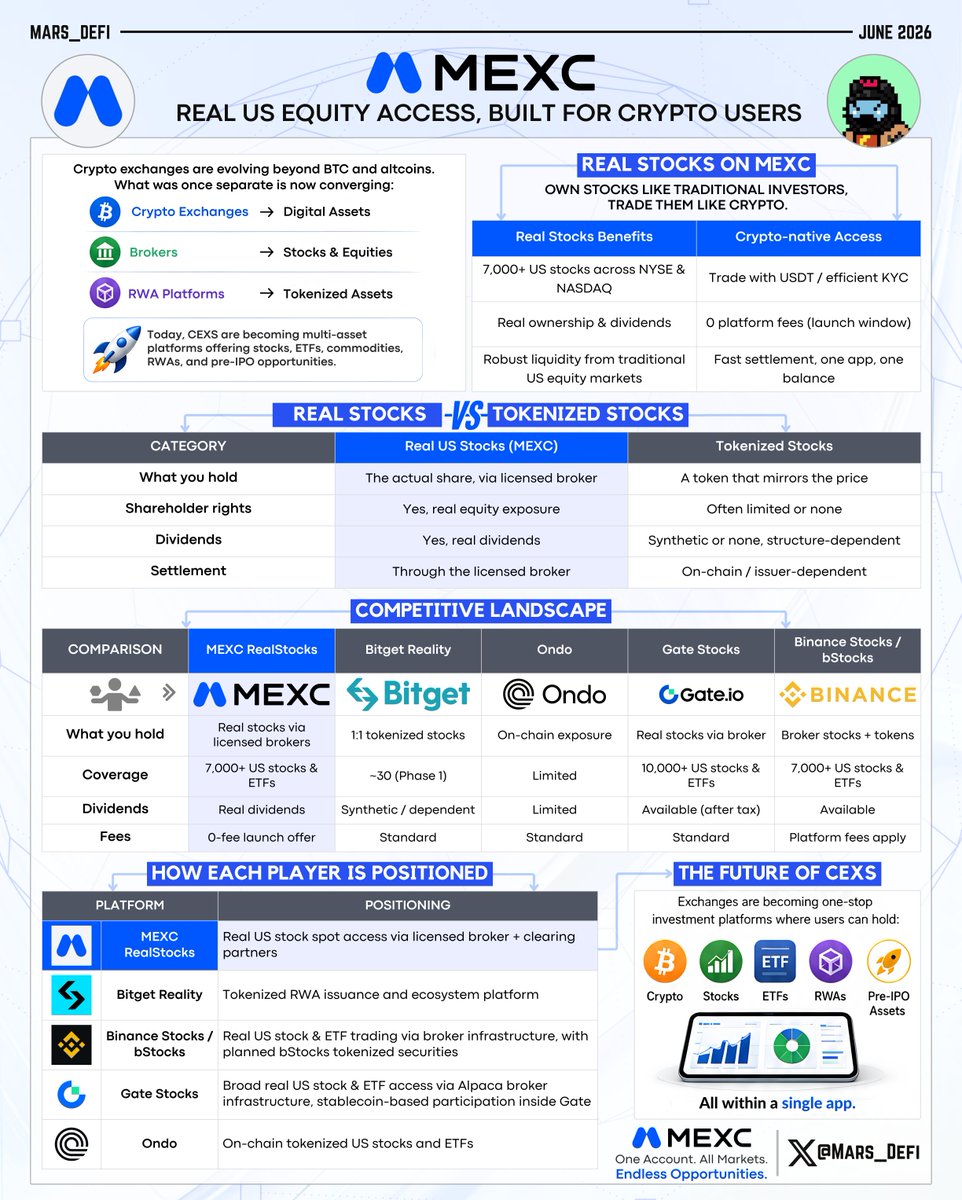
● A tokenized stock usually gives you price exposure through a token that tracks the underlying stock.
• It may mirror the market movement, but the user is often holding a representation of the asset rather than the actual share itself.
• Depending on the structure, dividends and shareholder rights may be limited, synthetic or not available.
● Tokenized RWAs are also structure-dependent.
• They bring real-world assets onchain through an issuer or ecosystem model, but the user’s exposure depends on how that asset is wrapped, issued, custodied and redeemed.
● Real stock access is different.
• Here, the user gets exposure to actual shares through licensed broker and clearing infrastructure.
• That means the product is closer to traditional equity ownership, but with a crypto-native access layer built on top.
That is the key distinction RealStocks as a product for @MEXC is built upon.
—
RealStocks gives users access to real US stocks through licensed broker while keeping the user experience familiar to crypto traders.
Instead of moving funds from an exchange to a bank, then to a broker, users can access US stocks directly with USDT inside the MEXC app.
This new product gives access to 7,000 US stocks across NYSE and NASDAQ, with real ownership exposure and dividends when companies pay them.
During the launch window, MEXC also offers 0 platform fees, which makes the entry point even cleaner for users testing this new access route.
This is where the competitive landscape becomes interesting.
• @bitget Reality is positioned more around tokenized RWA issuance and ecosystem exposure.
• @OndoFinance leans into on-chain tokenized stocks and ETFs.
• @Gate Stocks gives broad US stock and ETF access through broker infrastructure.
• @binance Stocks / bStocks combines broker-based access with a planned tokenized securities model.
—
MEXC’s strength is that it connects real equity exposure with a smoother crypto-native process.
The user gets the stock access of a traditional broker, but without the usual friction of opening a separate brokerage account, wiring funds, or leaving the exchange environment.
That is why this product fits the bigger shift happening across CEXs where exchanges are becoming multi-asset platforms.
For crypto-native users, this lowers the barrier between stablecoin capital and US equity exposure.
—
RealStocks as a product for @MEXC is not just about the exchange adding more stocks rather it is about making traditional market access feel native to crypto users with a proper stack where:
• the ownership layer is tied to real equities,
• the access layer is built for crypto users,
• and the user experience removes a lot of the usual friction.
Some users like having both crypto and equities in one account so think of it as one platform that does it all for you.
—
The undeniable truth is that the stock market will continue to grow and as this market grows, so will more exchanges enter US stock access. At the end of the day, users will start asking better questions:
• What exactly am I holding?
• Is it a token, a synthetic product, or a real share?
• Do dividends apply?
• How broad is the coverage?
• How easy is funding?
• What are the fees?
• How does settlement work?
• Is this built for crypto users or just copied from TradFi?
RealStocks answers those questions with a pretty clear positioning for @MEXC .
26
3
56
7,452
Jun 5
Disclaimers :
This product is not avaliable to users in restricted regions.
"0 fees" refers only to the platform's service charge. Users may still be subiect to certain fees, including but not limited to SEC transaction fees. FINRA trading activity fees (TAF), exchange and market center fees, regulatory fees, and any applicable clearing fees.
Also this is not an investment advice rather it is for informational purposes only.
Trading involves risk so please consult a qualified professional before making any investment decision .
1
5
319
Jun 4
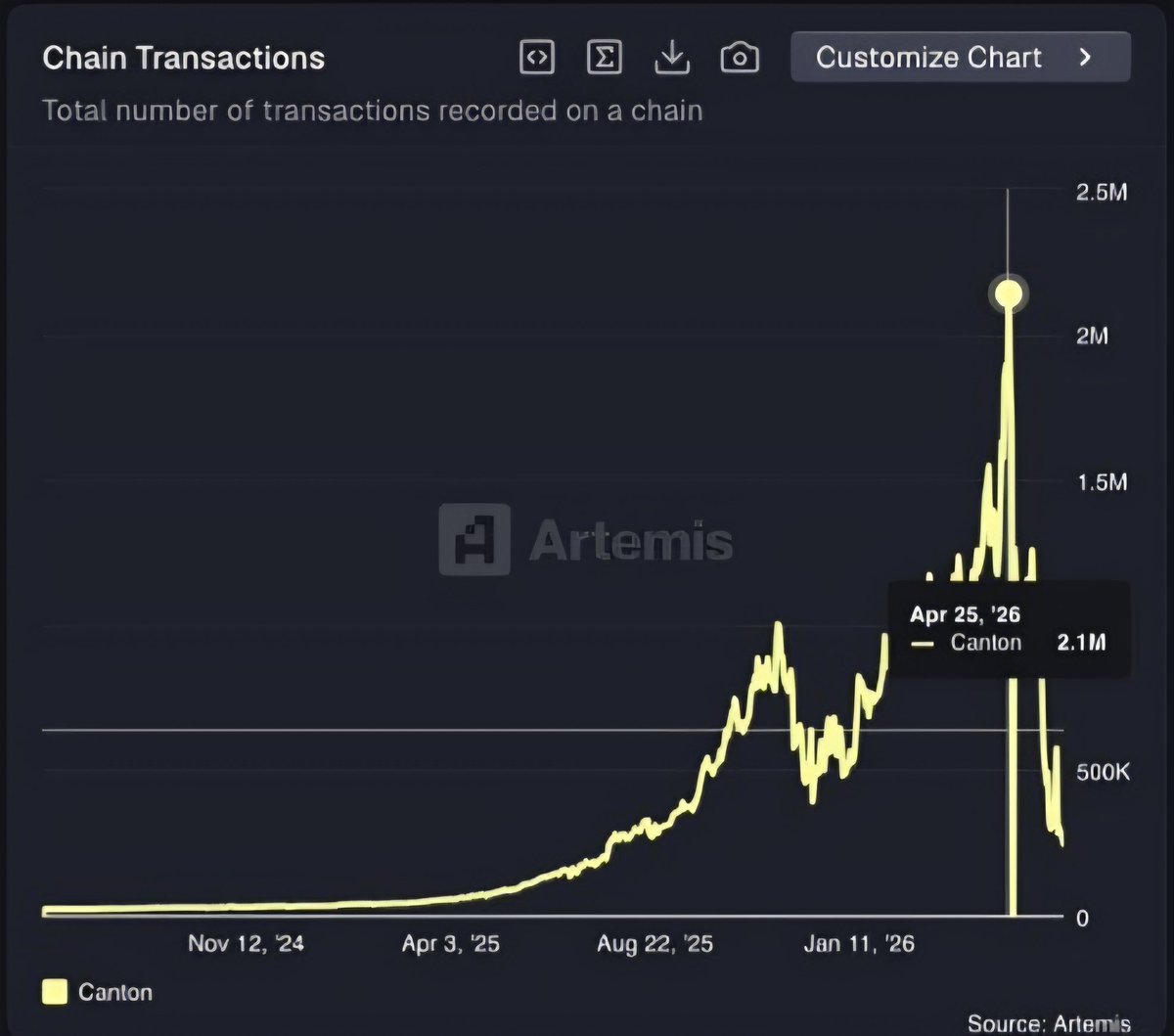
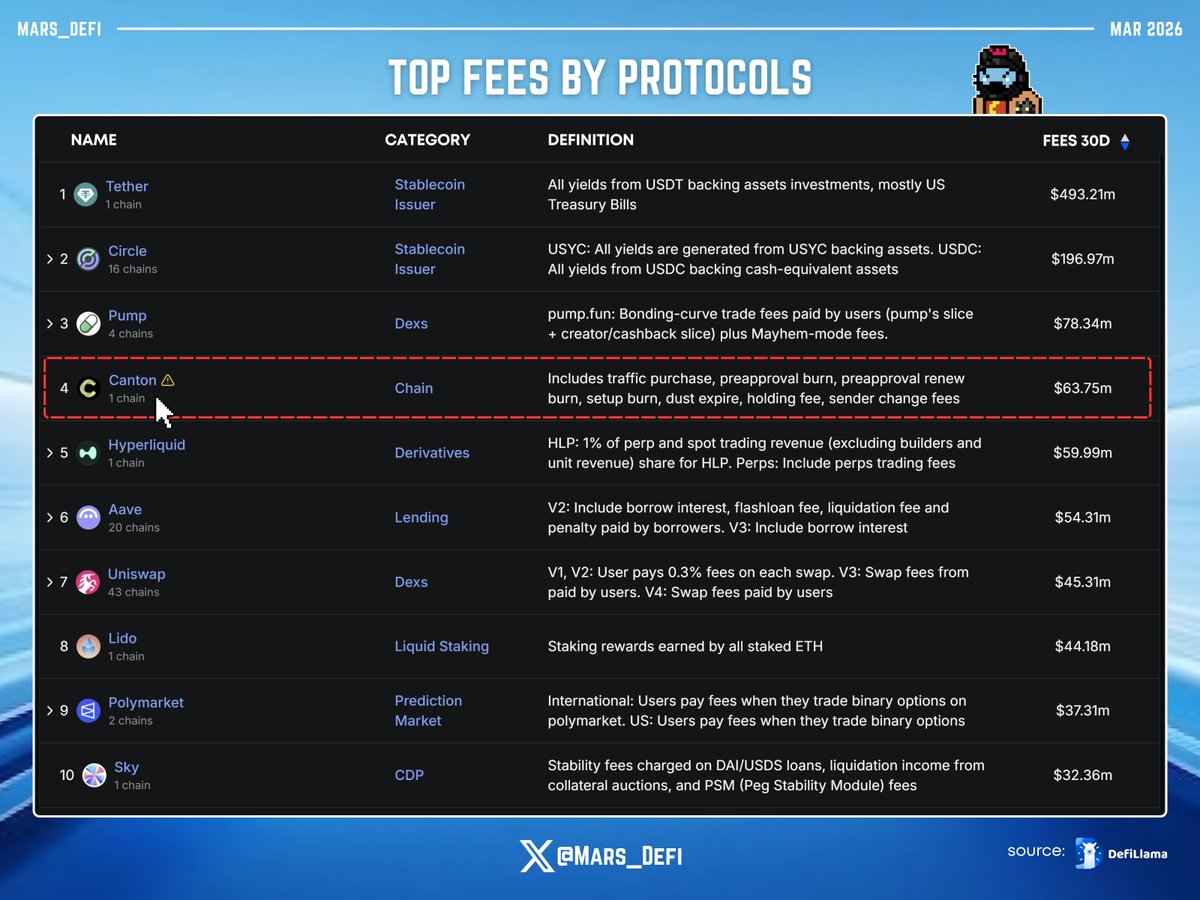
I still find Canton’s $63M 30D fees interesting but the transaction chart adds important context.
This looks more like concentrated institutional/batch-driven usage where a few high-value workflows can distort fee rankings.
If transactions remain under 500k while fees normalize, then the earlier fee run may have been more of an institutional event than a sustainable baseline.
I'm still watching this though.
May 27

It's really interesting to see @CantonNetwork being top 4 in protocol fees over the last 30 days and it honestly feels like the surprise entry on this list.
When people talk about fee-generating protocols, the usual names are easy to predict:
Tether, Circle, Pump, Hyperliquid, Aave, Uniswap, Lido.
But @CantonNetwork sitting right there with $63.75M in 30D fees, above Hyperliquid, Aave, Uniswap, Lido and Polymarket, is not something I think many people had priced in.
That’s what makes it interesting.
—
Canton is a more institutional-facing, privacy-focused chain built around regulated asset settlement.
So seeing that level of fee activity makes me wonder if something deeper is quietly happening there.
Because fees usually tell you where real usage is flowing.
And when a chain with less mainstream attention starts generating fees at the level of top crypto protocols, it raises a few questions:
• Is institutional settlement activity picking up?
• Are more tokenized assets moving through Canton?
• Are private/permissioned financial rails starting to generate real onchain demand?
• Or is the market still sleeping on one of the more serious RWA/institutional infrastructure plays?
Either way, Canton showing up this high is a signal worth watching.
9
23
823