
Book insights worth spreading.
Joined June 2023
- Tweets 3,383
- Following 266
- Followers 435
- Likes 1,566
1,012 Photos and videos





Pinned Tweet

Jun 7
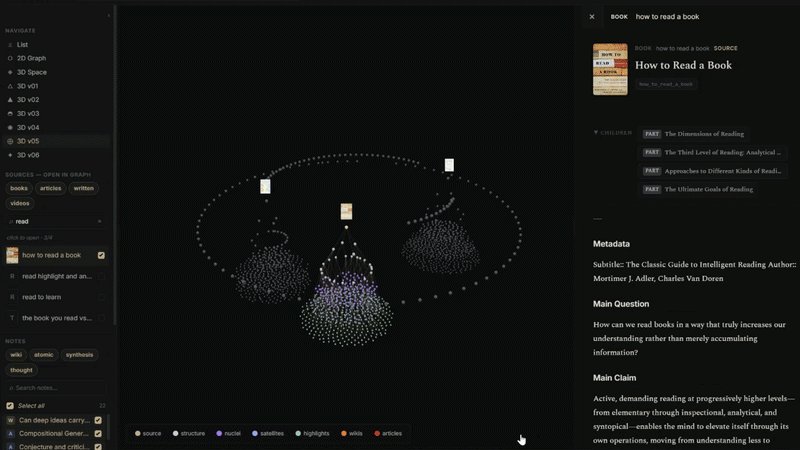
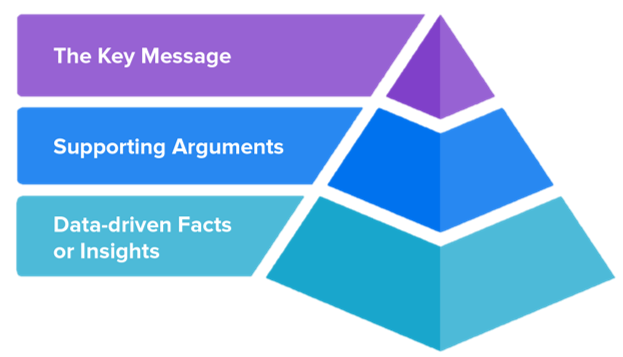
This is how I turn books into thinking tools.
Every book decomposed into its atomic ideas — structured, linked, and ready to think with.
Full walkthrough below
4
15
84,988
DeepRead.com retweeted

Reject the man cave.
Embrace the personal library.

ALT Photograph by David Dixon Deed - Attribution-ShareAlike 2.0 Generic - Creative Commons https://share.google/bbuHuWmy2WSq8qDZp


3
17
263
7,429
Jun 7
Engineering applies principles; science discovers them.
"All progress, both theoretical and practical, has resulted from a single human activity: the quest for what I call good explanations."
-- David Deutsch, The Beginning of Infinity
Jun 5

Yann LeCun décrit un monde qui l'a enfanté, et ce monde est en train de mourir.
Le modèle qu'il défend est celui du XXe siècle. La recherche fondamentale d'un côté (universités, PhD, papiers), l'application industrielle de l'autre, des décennies plus tard. Une chaîne longue, lente, découplée. La découverte en amont, la valeur en aval, et vingt ans entre les deux.
Elon a prouvé l'inverse. Quand l'ingénierie et la recherche sont totalement intriquées, quand tu pars d'un problème réel à résoudre et pas d'un papier à publier, tu vas infiniment plus vite. SpaceX, Tesla, Neuralink ne sont pas des applications de la recherche académique, ce sont des labos de recherche qui se trouvent être aussi les boîtes les plus innovantes du monde.
Et la vérité que personne n'ose dire, c'est que l'écrasante majorité des papiers ne créent aucune valeur. Des gens qui publient pour publier, optimisés pour la citation et pas pour le réel. L'alignement académique récompense le statut. L'alignement capitalistique récompense une seule chose : que ça marche, vraiment, dans le monde.
C'est exactement le point de Thiel. Historiquement, les génies créaient une valeur immense et n'en captaient presque rien, parce qu'ils étaient déconnectés de tout véhicule capable de la capturer. Créer de la valeur et capturer de la valeur sont deux choses distinctes, et l'académie a passé un siècle à exceller dans la première en abandonnant la seconde.
Dimon le dit à sa façon : Elon est notre Einstein. Sauf que cet Einstein-là n'a pas eu besoin de l'université pour produire ses percées. Il a eu besoin d'un problème, d'une équipe d'ingénieurs et d'un alignement commercial brutal.
Ses breakthroughs dans le spatial, l'automobile et le cerveau ont créé plus de valeur réelle que tout le système académique réuni sur vingt ans.
Et avec l'IA, le basculement s'accélère. La valeur du diplôme s'effondre, celle de l'école aussi, parce que l'intuition d'ingénierie branchée sur le réel devient le seul moteur qui compte.
LeCun n'a juste pas remarqué que le monde qui l'a fait roi est déjà derrière nous.
83
Jun 7
This is how I turn books into thinking tools.
Every book decomposed into its atomic ideas — structured, linked, and ready to think with.
Full walkthrough below
4
15
84,988
Jun 2
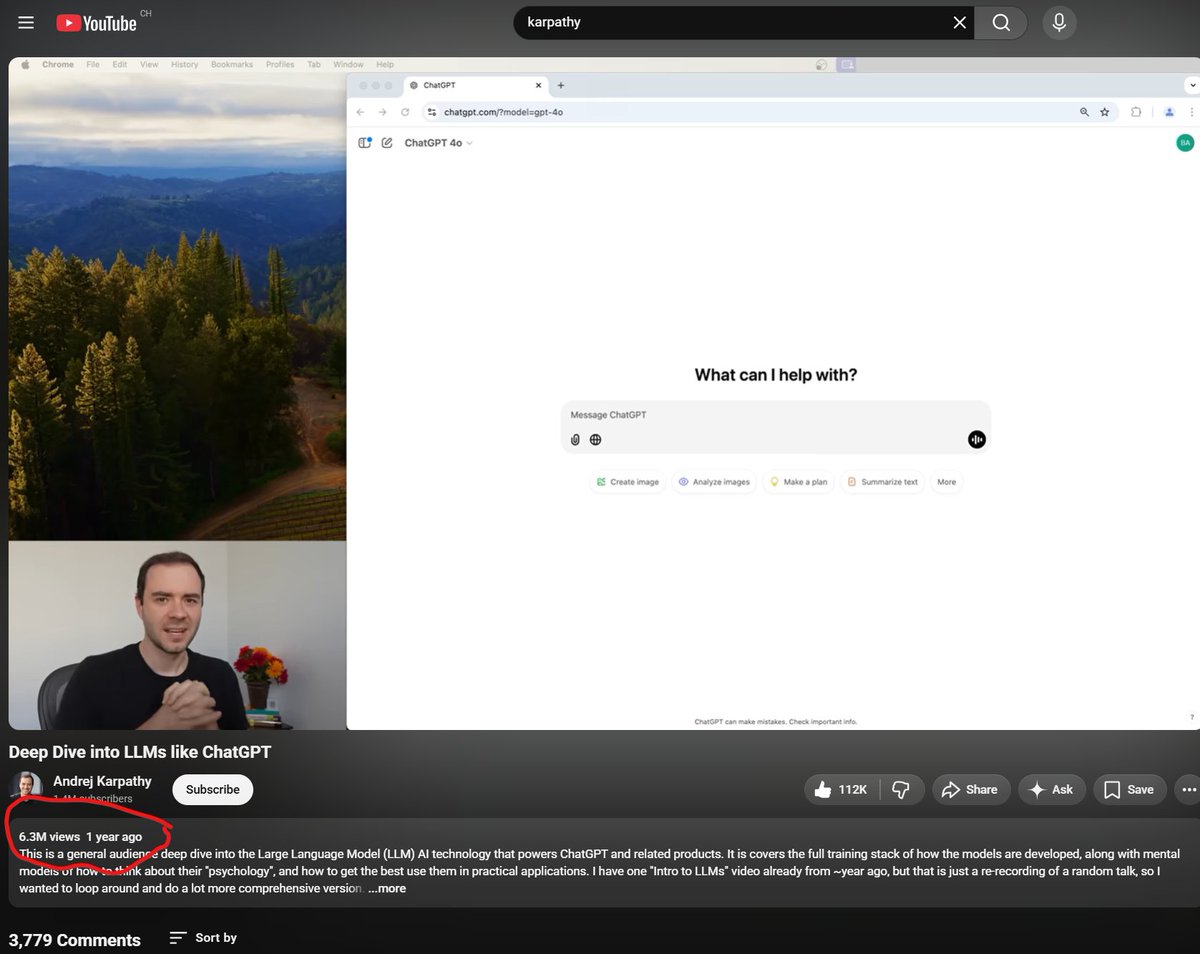
"Learning is not supposed to be fun."
"You want the mental equivalent of sweating. It's not that the quickie doesn't do anything, it's just that it is wildly suboptimal if you actually care to learn."
10 Feb 2024

# on shortification of "learning"
There are a lot of videos on YouTube/TikTok etc. that give the appearance of education, but if you look closely they are really just entertainment. This is very convenient for everyone involved : the people watching enjoy thinking they are learning (but actually they are just having fun). The people creating this content also enjoy it because fun has a much larger audience, fame and revenue. But as far as learning goes, this is a trap. This content is an epsilon away from watching the Bachelorette. It's like snacking on those "Garden Veggie Straws", which feel like you're eating healthy vegetables until you look at the ingredients.
Learning is not supposed to be fun. It doesn't have to be actively not fun either, but the primary feeling should be that of effort. It should look a lot less like that "10 minute full body" workout from your local digital media creator and a lot more like a serious session at the gym. You want the mental equivalent of sweating. It's not that the quickie doesn't do anything, it's just that it is wildly suboptimal if you actually care to learn.
I find it helpful to explicitly declare your intent up front as a sharp, binary variable in your mind. If you are consuming content: are you trying to be entertained or are you trying to learn? And if you are creating content: are you trying to entertain or are you trying to teach? You'll go down a different path in each case. Attempts to seek the stuff in between actually clamp to zero.
So for those who actually want to learn. Unless you are trying to learn something narrow and specific, close those tabs with quick blog posts. Close those tabs of "Learn XYZ in 10 minutes". Consider the opportunity cost of snacking and seek the meal - the textbooks, docs, papers, manuals, longform. Allocate a 4 hour window. Don't just read, take notes, re-read, re-phrase, process, manipulate, learn.
And for those actually trying to educate, please consider writing/recording longform, designed for someone to get "sweaty", especially in today's era of quantity over quality. Give someone a real workout. This is what I aspire to in my own educational work too. My audience will decrease. The ones that remain might not even like it. But at least we'll learn something.
31
Jun 1
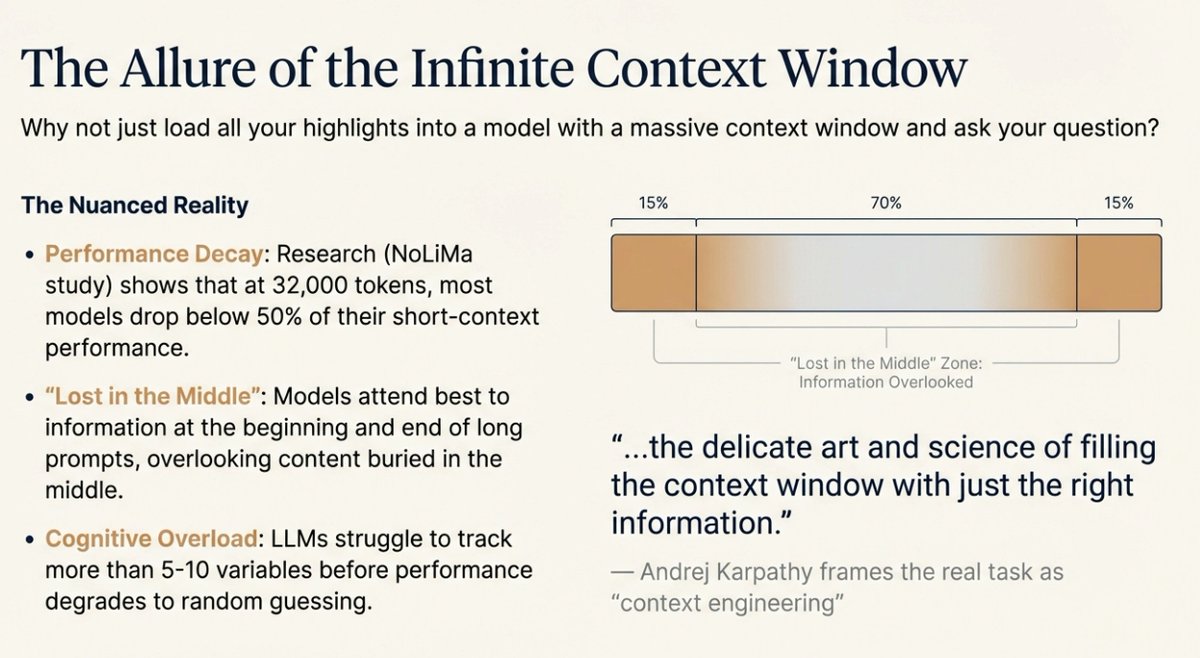
Doubling your context window doesn't fix "lost in the middle." It just gives your AI the same panicked feeling you get scrolling through 10 years of notes.
deepread.com/claude-codekind…
1
1
30
DeepRead.com retweeted

May 27
My new library does not have tall bookshelves, intentionally so all books are in easy reach.
Non #Lindy books are ditched except those that can be useful are in a hallway not in the main rooms.
[Same material as Umberto Eco's but shorter]

1 Dec 2018

Better to own up to who you tend to envy.
Umberto Eco, a man of yuuge erudition.
His library, Milan.



198
226
3,438
621,989
May 27
Summaries give you conclusions without the reasoning. Without following an author's full argument structure, you're left with trivia—not transferable knowledge. Cognitive science calls this the "illusion of knowing."
deepread.com/audiobooks-from…
May 26

Clavicular explaining why he doesn't read books is foolish:
"I don't really read books...you could just get the information through summaries and articles."
Thinking that a book summary can replace reading a book is like thinking a movie trailer can replace watching a movie.
43
May 11
"A mind, with nothing to operate on but the symbols of the readable matter, and with no help from outside, elevates itself by the power of its own operations. The mind passes from understanding less to understanding more."
-- Mortimer J. Adler, How To Read A Book
deepread.com/how-to-read-a-b…
May 11

61
May 3
Your brain naturally breaks things into hierarchies and connected layers.
Well-structured books don't arbitrarily divide their content—they align with how your mind actually learns, making those chapter breaks fundamental to understanding, not obstacles to it.
59
May 2
Authors are building mental containers designed to work with how your brain actually retains information.
Each chapter creates a psychological boundary that sharpens concentration and locks ideas into memory in ways continuous text can't.
53
May 1
Chapters worked as learning tools when deep focus was your default. Now your attention is fragmented before you even open the book.
All the hierarchical reasoning in the world doesn't matter if you can't stay present long enough to see it.
21
Apr 30
When AI gives you a perfect summary instantly, what makes the original book valuable?
Is it the information, or something about the work your brain does to reconstruct an understanding?
1
23
Apr 29
When you choose an AI summary over reading the book, what are you actually saving time on?
23
Apr 28
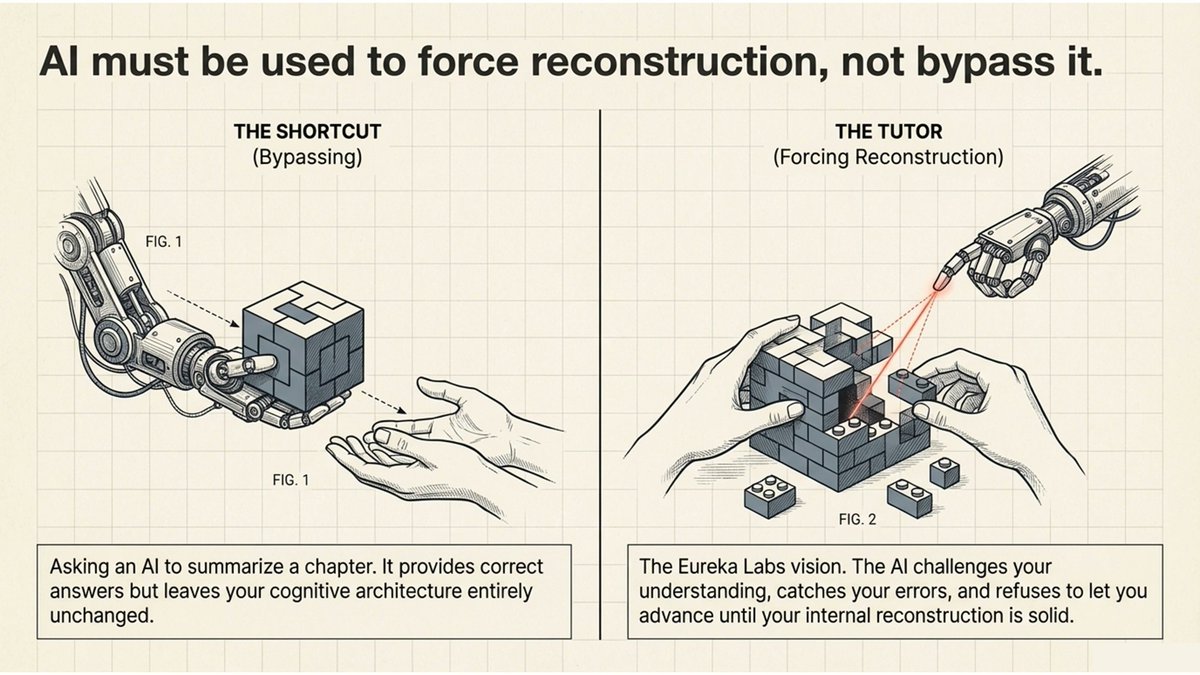
Are you reading to collect facts you can look up anytime, or to rewire how your brain processes the world?
AI handles recollection of facts brilliantly. But does it help you rewire your brain?
18
Apr 27
Not all knowledge is the same.
Some knowledge lives in your "weights"—it restructures how you approach everything. Other knowledge lives in "context"—specific facts you look up when you need them.
AI excels at filling context. But can it rewire your thinking? That's what deep reading does.
deepread.com/does-deep-readi…
29
Apr 26
We still teach calculus even though calculators exist. Not because people do long division by hand their whole lives, but because mathematical thinking restructures how you approach problems. The real question isn't whether to use shortcuts. It's knowing which parts of learning can be outsourced and which can't.
deepread.com/does-deep-readi…
31
Apr 25
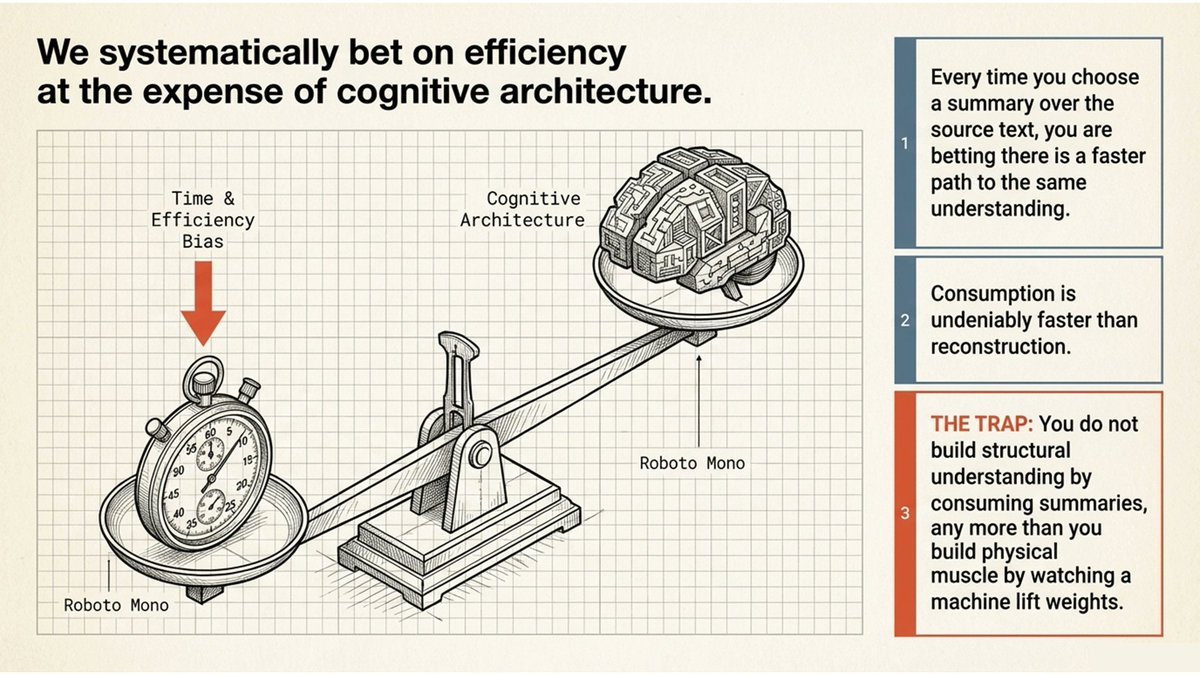
AI summarizes books in seconds. But summarizing what a book says isn't the same as knowing.
Real learning happens when you rebuild ideas in your own words, spot flaws, and apply them to new problems. A shortcut might feel like knowledge. It just might not be the kind that rewires how you think.
deepread.com/does-deep-readi…
1
1
28
Apr 24
A book can be summarized in seconds. Sometimes that shortcut saves time. But sometimes the shortcut you think saves time quietly destroys the thing you were trying to acquire in the first place.
16