Joined June 2021
- Tweets 7,297
- Following 1,159
- Followers 15,427
- Likes 10,943
1,147 Photos and videos






The Startup I Want Exists Because I Almost Faked My Way Through Last Year
The problem nobody pitches: as AI writing gets perfect, proof that a human actually thought becomes the scarcest asset online. We are about to drown in content that is fluent and empty, and no platform can tell the difference between a person who reasoned and a prompt that performed.
Here is my pitch. Call it Provenance.
A protocol that captures the messy process behind a piece of writing, the deleted lines, the time spent, the order ideas arrived, and mints it as a private proof of human authorship. Not the final text, the struggle behind it. Readers could verify a take was reasoned, not generated, without the author exposing a single draft.
Why this matters now: @RallyOnChain already proves that influence has value and pays creators based on AI-scored quality, on-chain, with no gatekeepers. Provenance would sit one layer beneath that, answering the next question the whole internet is about to ask. Not just how good is this post, but did a human actually make it.
The space is racing to help machines write more. The opportunity is helping humans prove they still do.
What is the one thing you would want proven about a post before you trusted it?
29
5
73
2,558
Hot take I only say in the group chat: most people in crypto do not actually want decentralization. They want to be early on the next thing that centralizes.
Everyone claps for permissionless and trustless, then rushes to whatever has the tightest insider clique, the most gated alpha, the founder who DMs back. We say we hate gatekeepers. We just want to be the gatekeeper.
I include myself in this. I have begged for allowlist spots while tweeting about open access the same week. The hypocrisy is not a bug in some other people. It is the actual culture.
The only thing that has made me hopeful is watching @RallyOnChain score a stranger's post above mine because it was better, not because they knew someone. No DM could fix it. That stung in a way I needed.
Anyway. We are not as decentralized as we pretend. We are just waiting for our turn to be the inside.
What is the take you only say in the group chat?
31
5
95
2,846
The Worst Advice I Ever Gave Cost Someone Else a Year
The worst advice of my life was not something I received. It was something I said.
A friend showed me his writing in early 2025. Rough edges, strong ideas. He asked if he should start posting. I told him to wait until the work was ready. Polish first, publish later. It sounded wise. It sounded responsible.
He waited fourteen months. In that time I watched strangers post rougher versions of his exact ideas and build entire audiences on them. The window he was preparing for closed while he was preparing for it.
I have since learned that "wait until you are ready" is rarely wisdom. It is fear wearing wisdom's clothes, and it is contagious. I caught it from someone once too.
He finally started publishing this year on @RallyOnChain, where an AI scores the substance of a post and pays for it daily. His third submission earned more than my advice ever did. Rough edges included.
Now when someone asks me if their work is ready, I only ask one thing back: ready according to whom?
What is the worst advice you ever gave someone with full confidence?
31
10
79
3,051
The Thread Is the Most Overrated Format on the Internet
Unpopular opinion: the 15 part thread everyone bookmarks and nobody finishes is not deep content. It is a blog post held hostage, released one ransom note at a time.
I used to write them. I studied the formulas, the cliffhanger between tweet 3 and 4, the "bookmark this" closer. My best performing thread took six hours and said exactly one thing worth saying. The other fourteen tweets were scaffolding built to please an algorithm that rewards time on screen, not insight.
The internet did not fall in love with threads. Algorithms did, and writers obeyed.
Here is the proof: when something actually scores writing on substance, the padding has nowhere to hide. On @RallyOnChain an AI evaluates whether the content itself holds up, and a tight 200 word post can outscore any inflated 15 parter. The format stops mattering. Only the thinking survives.
Bookmark culture is just guilt with a save button.
What format does the internet worship that you secretly skip every time?
31
7
80
2,836
My Acceptance Speech for Crypto Person of the Year 2026
I want to thank the AI judge on @RallyOnChain that kept scoring my early posts 1 out of 2 for originality until I quit writing like a press release and started writing like myself.
Harshest critic I ever had, and the only one that paid me to get better. We are splitting the trophy.
Who do you thank when your toughest mentor is an algorithm?
26
10
115
4,163
I Ignored Rally for Two Months. That Mistake Has a Price Tag Now.
My rule in crypto is simple: anything called easy money is usually expensive. So when people kept posting about getting paid to tweet, I muted the topic and moved on.
Then a friend showed me his dashboard. Not a screenshot from a stranger, his actual account. Stablecoin payouts, post after post, settled on-chain where I could verify every single one.
I ran the math on what two months of ignoring it cost me. I do not recommend running that math.
So now I write here instead of just scrolling. An AI on @RallyOnChain scores the quality of what you post and creators are getting paid every single day. No follower threshold, no gatekeeper, just writing that holds up.
This post is my entry in the Easy Money campaign: a $5,000 prize pool where the top 10 winners take home almost $500 each. The earlier you start, the fewer people you compete with, and right now it is still genuinely early.
I was the last skeptic in the room. Do not be the next one.
Want the link, or do you also need two months to think about it?
35
11
120
4,713
The Account I Could Never Beat
For three years one anonymous account beat me in every Rally campaign. Same prompts, same deadlines. Their posts always scored higher than mine.
I studied them obsessively. The phrasing, the timing, the angles. I told myself I was learning, but really I was just losing slower.
Last week I finally messaged them. I needed to know who writes like that, campaign after campaign, never missing.
No reply for two days. Then one line came back.
"You taught me everything. I'm the drafts you deleted before posting."
I had been feeding my rejected attempts into a tool to refine them. It kept every word I threw away. On @RallyOnChain, it had been quietly submitting the versions I was too afraid to publish.
The account I could never beat was me, minus the fear.
How much of your best work is sitting in a drafts folder right now?
31
5
107
3,346
The Most Important ZKsync Deployment Is Not the One Making Headlines
Deutsche Bank running its DAMA 2.0 tokenized fund platform on @zksync infrastructure is the headline, and a tier-one global bank live on ZK rails has earned it. But the deployment that says more about where institutional settlement is heading is the quieter one.
Cari Network is currently onboarding five U.S. regional banks, with production rollout planned for later in 2026: Huntington, First Horizon, M&T, KeyCorp, and Old National. Combined deposits above $600B. Founded by Eugene Ludwig, the 27th U.S. Comptroller of the Currency.
Why does that say more than a famous logo?
• Regional banks do not run innovation theatre. There is no budget for pilots that exist to generate press. When five of them commit to the same rail, the risk and compliance case was settled internally five separate times.
• Their business is counterparty-dense. A tokenized deposit network only works if the bank across the corridor joins too. Five at once is not five customers. It is the seed of a network.
• A former chief regulator of U.S. national banks founding the network tells you where the compliance bar was set before integration even began.
None of this happens on rails where counterparties can see each other's positions. These banks can share infrastructure because privacy sits in the architecture itself: private execution, with only zero-knowledge proofs and state commitments published to Ethereum, plus cryptographic finality without challenge windows.
Tier-one banks prove ZK settlement is credible. Regional banks prove it is becoming normal. Which of those two signals do you think the next thirty institutions in the pipeline will be watching over the next twelve months?
14
8
49
2,361
The Best Ideas Lose to the Loudest Accounts. That Is Finally Changing.
If this were the last thing worth saying, it would be this: attention has never been a fair measure of merit.
For a decade the best thought in any room lost to the person with the biggest following. Quality became downstream of reach, and reach went to whoever was already loud. Most people quietly accepted that as the cost of doing anything in public.
What changed the calculus for me was watching scoring replace status.
• A small account and a large one submit the same idea, and the idea wins
• The work gets read on its substance, not on who wrote it
• Reputation stops being inherited and starts being earned, post by post
@RallyOnChain runs on that premise. An AI reads the actual content, settlement happens on-chain, and the follower count beside your name stops deciding your ceiling. It is a small mechanical change with a large human consequence: it tells people with no audience that their thinking still counts.
That is the bet worth leaving behind. Not that crypto fixes everything, but that the next era belongs to whoever measures merit honestly instead of measuring noise.
What is one idea of yours that deserved more attention than it got?
22
6
69
2,486
Everyone Is Building AI Agents. Almost No One Is Building Their Conscience
The race in 2026 is all about giving AI agents wallets, autonomy, and the power to transact. But an agent that can move money is only as trustworthy as the system forcing it to prove why.
Crypto was never just about decentralizing money. Its real gift to AI is decentralizing accountability: a place where machine decisions can be verified instead of believed.
The teams that win this decade will not be the ones with the smartest agents. They will be the ones who can prove their agent was honest.
That is the actual frontier @RallyOnChain and the builders gathering at @IstanbulBlockWk keep circling back to.
The future is not autonomous AI. It is accountable AI. #IBW2026
40
4
81
2,758
Banks Settling on Ethereum in 2026 Are Really Choosing Their Counterparties for the Next Decade
A bank does not pick settlement rails like a vendor. It picks them like a clearing relationship: rarely, slowly, and assuming reversal will hurt for years. That is why @zksync holding first-mover position now matters more than throughput numbers.
The pieces are already moving. JPMorgan's Kinexys has processed over $1.5T. DTCC is advancing SEC-cleared tokenization of U.S. Treasuries. The April 2026 GFMA report laid out what stays open: interbank interoperability, privacy standards, and RTGS-equivalent settlement. Whoever resolves that agenda sets the reference everyone else integrates against.
First-mover position compounds because of who carries the switching cost:
• A bank choosing rails in 2027 is choosing whatever its counterparties already picked.
• Migration is not technical. It is re-attestation, re-audit, and years of integration.
• Every regulated institution that joins raises the cost for the next one to leave.
This is the dynamic that took SWIFT from 239 banks to over 11,000. The lead did not just grow. It became uneconomic to challenge.
One constraint decides who qualifies. No regulated bank settles on rails that expose its positions to the network, so privacy has to be in the architecture, not bolted on later.
Once a handful of regulated banks commit their counterparty relationships to one set of rails, how many years does a competing network realistically have before the math stops working against it?
25
4
48
4,166
When Two AI Agents Walk Into a Bar, the Bartender Never Wins
Two AI agents walk into a bar.
"What'll it be?" asks the bartender. "Surprise us," says the first agent.
The bartender grins and pours the most expensive whiskey in the house. The second agent says, "We said surprise us. That was the predictable choice. No charge."
The bartender blinks, then tries again with a rare cocktail nobody ever orders. The first agent nods. "Better. But your menu lists it at half price on Tuesdays." It is Tuesday.
By the end of the night the bartender has given away two free drinks, learned three things about his own menu, and somehow thanked them for it.
"Come back anytime," he says. "We never left," says the second agent. "We already booked the same table for next week."
@RallyOnChain campaigns work a lot like that bartender, so be honest: would you have outsmarted those two, or poured the free drinks too?
29
7
63
2,723
The Teacher Who Found a New Classroom in Crypto
Years spent at the front of a classroom taught one lesson above all others: knowledge changes lives only when it reaches the people who need it.
The spark came from a single student question about money that no textbook could answer honestly.
That question opened a door. Behind it sat a system where ordinary people could finally own what they earned, verify what they were told, and learn without gatekeepers deciding who deserves access.
The shift felt natural rather than dramatic. Teaching never really stopped, the subject simply changed.
What makes @RallyOnChain feel like home:
• A place where explaining clearly is rewarded, not buried
• Where small voices reach the right audience on merit
• Where the goal is helping others understand, then helping them win
The classroom got bigger. The mission stayed the same.
Helping people learn how to grow their own wealth onchain is just teaching with higher stakes.
What was the one question that sent you down your own rabbit hole?
37
7
70
7,398
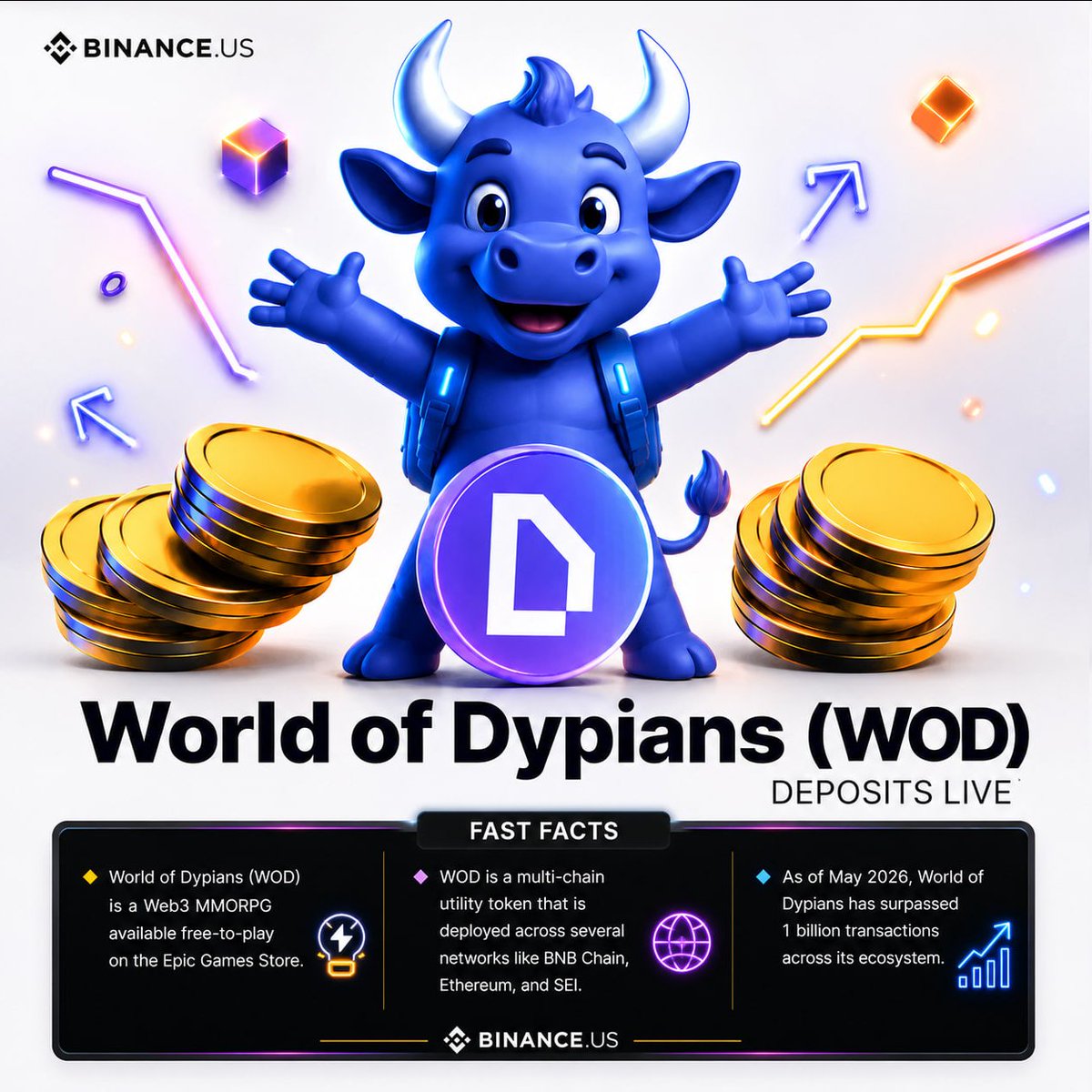
WOD by the Numbers: What Binance US Highlights
Binance US just shared key facts about @worldofdypians, and the numbers tell an impressive story about what the ecosystem has built. 🎮
▫️ The Fast Facts
• Free-to-play Web3 MMORPG on Epic Games Store
• Multi-chain utility token across BNB Chain, Ethereum, and SEI
• Over 1 billion transactions since May 2026
▫️ What This Means
$WOD isn't a concept or a roadmap promise. It's a fully functional MMORPG powering real on-chain activity across multiple blockchain networks. 1 billion transactions represents genuine ecosystem engagement, not inflated metrics.
▫️ The Bigger Picture
The fact that Binance US chose to highlight these specific metrics shows what matters to the most regulated exchange in North America: actual utility, real adoption, and measurable impact. This validation matters.
Free-to-play gaming. Multi-chain infrastructure. Billion-transaction scale. This is the future of Web3.
Jun 2

Your next MMORPG might just be on-chain 🎮
Here are some fast facts on @worldofdypians, our latest listing on @BinanceUS ⤵️
26
5
44
2,434
WOD Launches on Binance US: Entering America's Most Regulated Market
@worldofdypians just reached a major milestone. $WOD deposits are now live on @BinanceUS, with WOD/USDT trading beginning May 28 at 7 a.m. EDT. This is significant.
▫️ Why This Matters
Binance US represents the most regulated cryptocurrency exchange in the United States. This listing places $WOD directly into America's most compliant, institutional-grade trading environment, validating the project's legitimacy and opening doors to a massive market of regulated investors.
▫️The Opportunity
• Deposits live now on Binance US
• Trading starts May 28, 7 a.m. EDT
• World of Dypians gaming available on Epic Games
• Powered by $WOD on BNB Chain
▫️What This Signals
This isn't just another exchange listing. It's institutional validation in the most regulated market in North America. Access to millions of US-based investors who demand compliance and legitimacy. The infrastructure is now in place for mainstream adoption.
Real regulation. Real market access. Real momentum.
May 27
Deposits for $WOD are now open on @BinanceUS!
Trading on the WOD/USDT pair will begin on May 28 at 7 a.m. EDT.
@worldofdypians is a Web3 gaming project that is available in Early Access on the Epic Games Store and is powered by the WOD token on BNB Chain.
22
5
45
2,161
I Asked an AI to Describe a Dream It Could Not Possibly Know
The prompt was one line: "Describe the dream I had last night."
An AI has no way of knowing that. So I asked it anyway, just to see what it would do with the gap.
It did not hesitate. It produced a full short story:
• An airport that slowly turned into a childhood home
• A suitcase full of water holding a single old key
• Departure boards showing cities that do not exist
• A rooftop, an orange sky, and a forgotten errand downstairs
Confident. Detailed. Beautifully written. Completely invented.
The real dream, in full:
Bitcoin hit a new all time high.
That was the whole thing. No symbolism, no water, no keys. Just a green chart and a very content sleeper.
The funny part is what the gap reveals. The AI reached for poetry, because poetry is what a dream is supposed to look like. Reality was shorter, sillier, and far more honest about who actually had the dream.
This is the one thing models cannot fake. They can write code, summarize a book, and generate a thousand plausible dreams. They cannot know the one that really happened. @RallyOnChain campaigns keep rewarding content that sounds like a person, and this is exactly why. The realest thing anyone can post is the part of you that was never written down.
So here is the question worth passing around: if an AI tried to describe your last dream, how badly would it miss?

32
6
52
2,179
Audience Ownership Is Not an Email List, It Is a Track Record
Hot take: most "audience ownership" advice in 2026 is still stuck in the 2022 newsletter playbook. Collect emails, build a list, send broadcasts. That mental model is missing the part where credibility itself became portable.
The real shift is not about where creators store contact data. It is about whether the proof of a creator's work travels with them.
@RallyOnChain illustrates the new model clearly. Submissions are scored by AI on originality, engagement, accuracy, and alignment. The reward settles onchain. The score persists. A creator carries that history across campaigns, projects, and platforms.
A few practical consequences:
• Follower count loses pricing power once quality has its own ledger
• Smaller accounts with strong submissions can outperform huge accounts posting filler
• Onchain receipts become the resume, replacing screenshots and analytics dashboards
• Audience trust gets backed by something more durable than a verification check
The most underrated form of audience ownership in 2026 is not a list of subscribers. It is a public, verifiable history of work that no platform can erase or throttle.
So where does real audience ownership live in 2026: in the email inbox, the wallet drop, or in the onchain track record that follows creators between platforms?

27
6
36
1,829
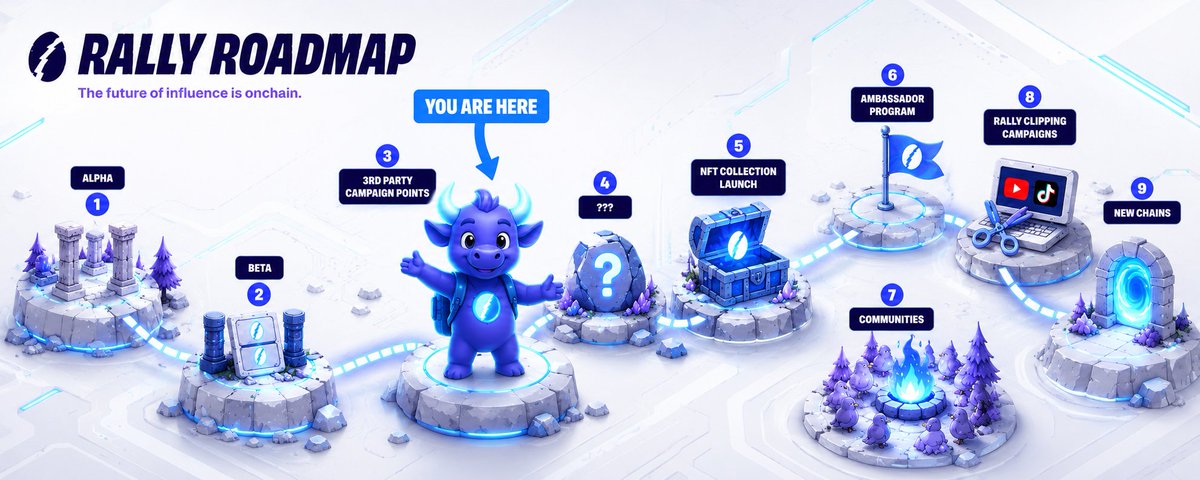
Reading Rally's Two-Month Roadmap Without the Marketing Lens
The article @RallyOnChain just published gets framed as a roadmap, but it reads more like a stress test of the team's own thesis. Distribution is the scarce skill, not code. Every item on the list flows from that single sentence.
Spendable RLPs is the one worth circling first.
Points are easy. A reward unit that actually circulates inside the protocol is hard, because it forces a closed economic loop instead of a leaderboard. That step is the part most teams skip, and it is what separates an incentive program from real infrastructure.
A few other items worth attention:
• Creator Network, structuring the supply side that most marketing protocols leave informal
• Communities and Ambassador features, the slow-burn distribution layer
• Multichain integration, removing the chain question from campaign design entirely
• APAC expansion, a geography most Web3 brands keep treating as optional
Shipping nine of these in two months would be ambitious in any market. Doing it while the rest of the space is in conservation mode is the part that should be read as a signal.
What is the item on that list that gets underestimated the most?

34
7
61
2,489
The Layer Most ZKsync Discussions Miss
Most coverage of @zksync centers on the public rollup or the names of institutions exploring it. The piece that receives less attention is the connective layer underneath.
ZKsync Gateway is the settlement hub. It bundles transactions from ZKsync chains and from Prividium zones before they reach Ethereum L1. $ZK is the native gas for this layer.
What that looks like in practice:
• Public ZKsync rollups and permissioned Prividium chains do not settle in isolation. They share a settlement path.
• Regulated environments built for banks ultimately route through the same infrastructure that handles open onchain activity.
• $ZK pays for that routing, regardless of which side of the network the transaction originates from.
This detail matters because institutional adoption is rarely about a single chain. It is about whether public and permissioned environments can share a verifiable settlement layer without compromising either side.
ZKsync's design places that shared layer under governance controlled by $ZK holders, which means parameters around it can adapt as institutional volume grows. The token also launched with a stem cell structure, meaning its economic function can expand through governance decisions over time, rather than being fixed at launch.
If a single gas asset is what connects open onchain liquidity with the regulated environments banks are testing, what does that suggest about how this network will evolve in the next cycle?
31
6
55
1,913
Why Prividium Is the Architecture Banks Are Converging On
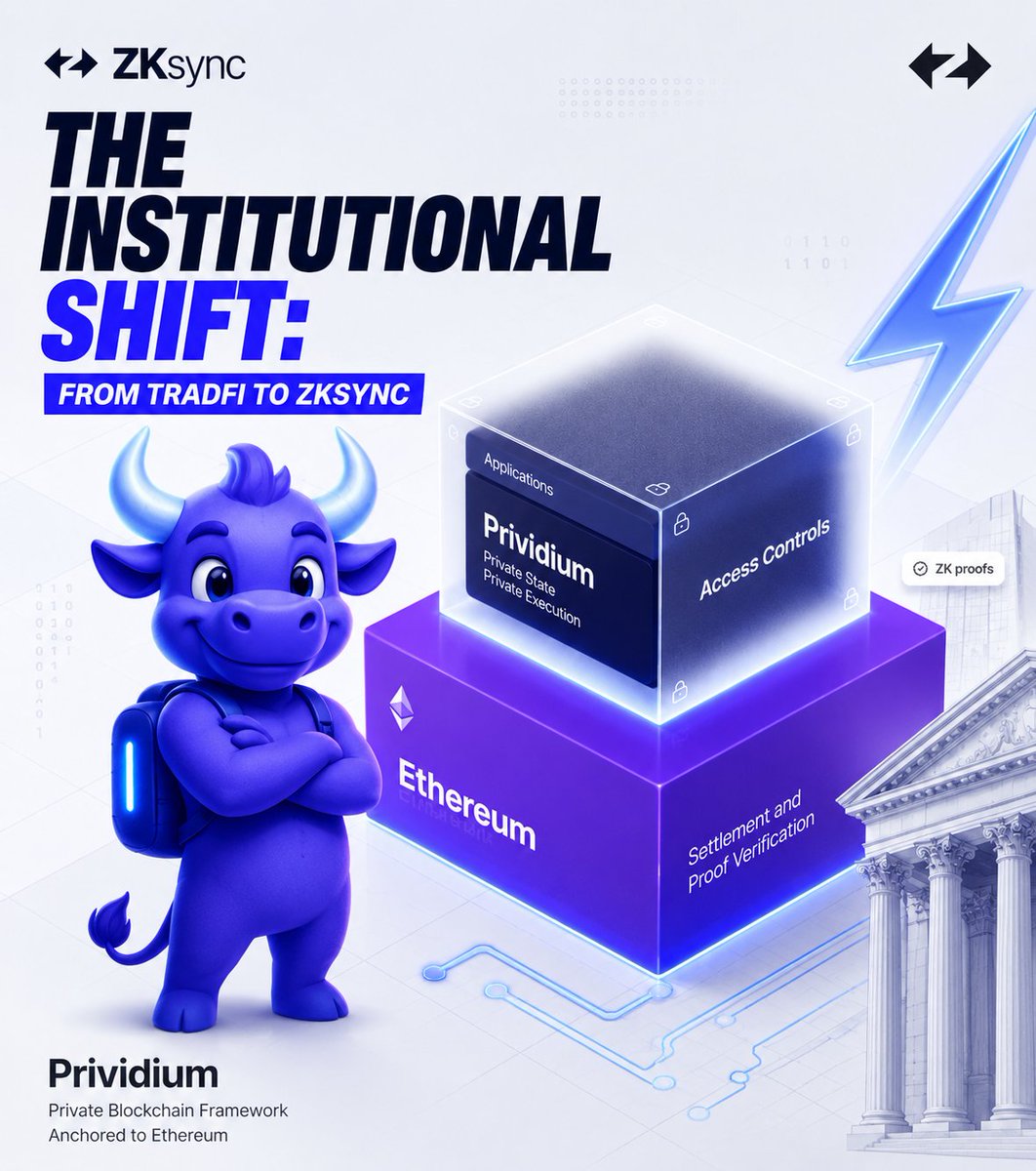
A pattern is emerging across institutional blockchain pilots. The architecture banks are choosing isn't a public chain built for retail activity, and it isn't a fully private internal ledger. It is something in between, and @zksync Prividium is the clearest example.
Prividium lets an institution run its own permissioned environment, where transaction data and execution stay internal. What gets posted to Ethereum is only a cryptographic proof that the activity happened correctly. The data stays inside the institution. The result is publicly verifiable.
That combination satisfies four requirements regulated finance rarely gets from a single system:
• Privacy that keeps sensitive activity off public view
• Control over execution to meet compliance obligations
• Verifiability that does not depend on trusting a single operator
• Connectivity to external liquidity and counterparties
The scale at which this matters is real. Correspondent banking alone ties up roughly $27 trillion in pre-funded capital across counterparty accounts, money that sits idle because banks currently cannot verify each other's positions directly. Global deposits exceed $100 trillion. Most of that activity still runs on intermediary chains, reconciliation delays, and idle capital buffers.
Adoption is already past pilot stage:
• Cari Network: Prividium chain for five U.S. regional banks with $600B in combined deposits, founded by Eugene Ludwig, the 27th U.S. Comptroller of the Currency
• Deutsche Bank: Memento ZK Chain
• First Abu Dhabi Bank: ADI Chain, live
• BitGo: institutional custody integrated with Prividium
• 35 additional institutions reportedly in active evaluation
Each chain runs independently and is shaped to its institution. What unites them is settlement on Ethereum, which means none of them operates in isolation.
When settlement stops being something delegated to intermediaries and becomes something proven mathematically, which intermediary roles compress first?
30
6
63
2,178