
Military Strategy & History | Decoding Global Strategies & Past Campaigns| Data-driven Insights 🌍 | #MilitaryStrategy #MilitaryHistory #Geopolitics
Joined August 2024
- Tweets 6,467
- Following 346
- Followers 3,054
- Likes 4,869
309 Photos and videos




Pinned Tweet

I am starting a series to demystify some of the recent events in the Russo-Ukrainian war that have become shrouded by intense communication battles. The goal is to examine the bigger picture with a data-driven strategic perspective.
It is important to take a step back and gain a rational view on possible outcomes instead of relying on wishful thinking or overstatements.
The war has entered the last chapter of its current phase. Level-headed analysis is crucial to follow the unfolding events.
Thread of threads 👇
#RussiaUkraineWar #Strategy #Analysis
5
18
62
7,141
I am starting a series to demystify some of the recent events in the Russo-Ukrainian war that have become shrouded by intense communication battles. The goal is to examine the bigger picture with a data-driven strategic perspective.
It is important to take a step back and gain a rational view on possible outcomes instead of relying on wishful thinking or overstatements.
The war has entered the last chapter of its current phase. Level-headed analysis is crucial to follow the unfolding events.
Thread of threads 👇
#RussiaUkraineWar #Strategy #Analysis
5
18
62
7,141
#1
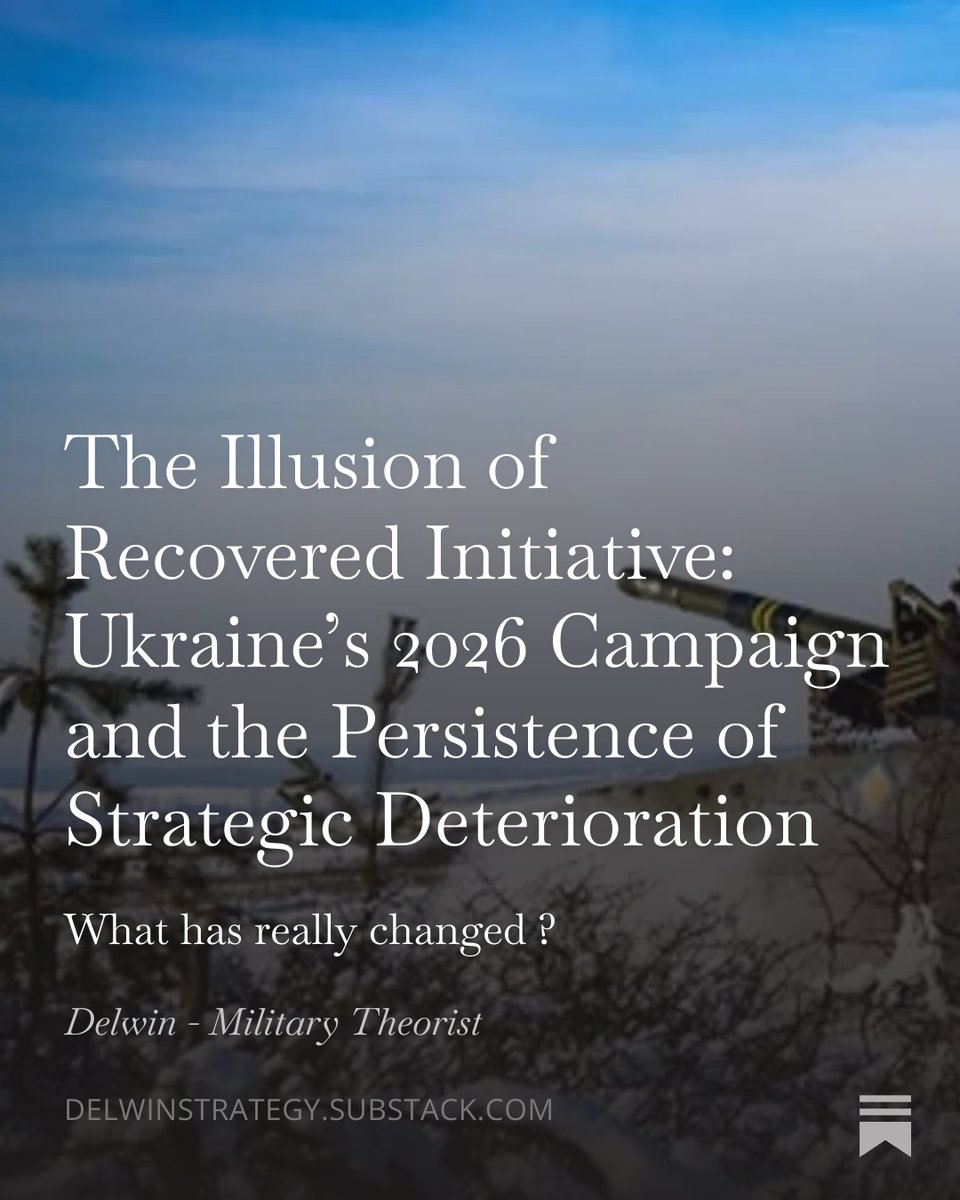
The Illusion of Ukraine retaking the Strategic Initiative, the reality of the recent tactical situation shift.

[ANALYSIS] The Illusion of Recovered Initiative: Ukraine’s 2026 Campaign and the Persistence of Strategic Deterioration.
In my latest assessment, I review the claim that #Ukraine has regained the initiative in 2026; a distorted picture of the situation. Kyiv has undoubtedly recovered tactical coherence after the disruptions of 2025, but this rests on costly defensive activity.
The strategic trajectory of the war remains unchanged.
A multi-dimensional, in depth analysis, covering map updates/distorsion, personnel and vehicle losses, economy and deep strikes to project the situation for the rest of the year.
Read on substack:
open.substack.com/pub/delwin…
#Strategy #Russia
Link also in reply
1
1
17
1,834
#2
Impact analysis of the deep-strike campaign against Russian oil infrastructure. Not strategic but operational implications; understanding the true goal behind the operation.
(1/8) [ANALYSIS] Assessing the Strategic Impact of Ukraine’s Deep-Strike Campaign Against Russian Oil Infrastructure.
Ukraine’s deep-strike campaign against Russian #energy infrastructure has attracted considerable attention since 2025. Refineries, storage facilities, export terminals, and logistics hubs have repeatedly been targeted, generating significant media coverage and reinforcing the perception that Russia’s economic foundations are increasingly vulnerable.
However, a closer examination of the data suggests that the campaign has had limited strategic impact on one of Russia’s primary centers of gravity: its ability to finance the war through mineral-resource exports.
This analysis evaluates that claim by examining the contribution of different export categories to Russian federal revenues and modelling the impact of refinery disruptions using average data from 2022–2025 as a baseline.
This leads to a straightforward conclusion: while the campaign has imposed operational costs and temporary disruptions, its direct impact on Russia’ war-financing capacity remains limited. Even under conservative assumptions, the effect is approximately 1% of federal revenues after accounting for crude-oil substitution. Furthermore, rising oil prices in 2026 are likely to more than offset these losses.
This raises an important question: if the campaign is not materially impairing Russia’s ability to finance the war, what possible purpose does it serve?
The answer appears to lie primarily in the political and operational domains rather than the economic one.
Read on Substack: open.substack.com/pub/delwin…
#Oil #UkraineRussiaWar #Strategy
1
1
16
1,443
Delwin | Military Theorist retweeted
There is a question of phasing in the operational plan.
The current focus is on capturing the remaining northern Donetsk fortress belt: an urban battle across the Kostiantynivka-Sloviansk crescent, not requiring armor use to any significant extent.
The next phase would involve advancing beyond into the Dnipropetrovsk Oblast plains, which offer more favorable terrain for mechanized units and would benefit from captured cities to stage armor or other means, including « protection » drone units.
3
4
18
1,524
Delwin | Military Theorist retweeted
(6/8) Quantifying the Budget Impact.
At constant prices, a 24% decline in refined-product exports implies approximately a 2% reduction in federal revenues, before accounting for substitution effects.
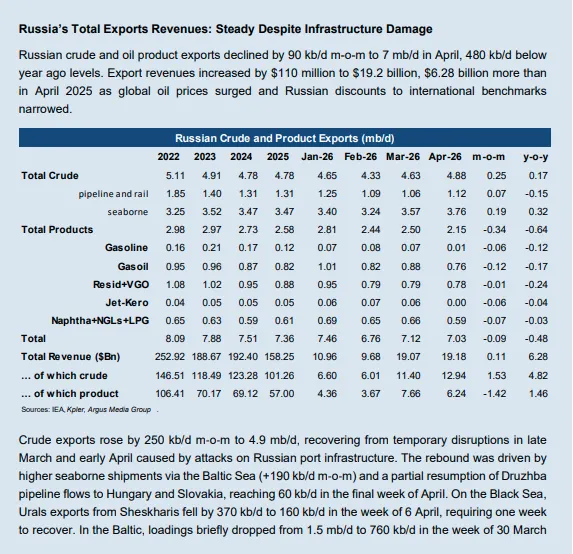
At first glance, this appears meaningful. However, the calculation assumes that lost refining output disappears entirely from export markets though in practice, this is not what happens. When refinery throughput declines, crude oil is not simply stockpiled or destroyed. A significant portion is redirected toward crude exports. This dynamic is visible in April 2026, where crude exports increased despite lower product exports.
Because crude oil also generates a higher fiscal return per dollar of export revenue than refined products, the substitution effect materially reduces the net budget impact. After accounting for this redirection of volumes, the estimated impact falls below 1% of federal revenues.
Using average federal revenues and exchange rates since 2022, this corresponds to roughly $4 billion, or, for comparison, ~2.7% of Russia’s estimated 2025 defense budget. While not negligible, it falls well short of a level capable of threatening Russia’s ability to sustain military operations.
1
3
9
1,082
Delwin | Military Theorist retweeted
(5/8) What Happened in April 2026?
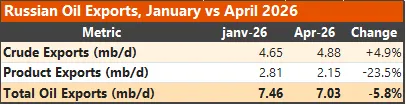
According to International Energy Agency data, Russian crude exports in April 2026 were broadly in line with the four-year average and approximately 5% higher than in January 2026. This suggests that attacks on export infrastructure had little effect on Russia’s ability to export its primary revenue-generating commodity.
The story is different for refined-product exports that fell by approximately 23% compared with January 2026. Relative to the 2022–2025 average, the decline was approximately 24%.
The impact on operations is undeniable, nevertheless, operational disruption does not necessarily translate into strategic effect.
1
4
9
912
Delwin | Military Theorist retweeted
(4/8) Not All Export Revenues Contribute Equally to the Budget.
Export revenues and budget revenues are not equivalent in each category: Oil and gas exports contribute disproportionately to federal revenues because they are subject to mineral extraction taxes, export-related duties, excess-profit mechanisms, and state-company dividends.
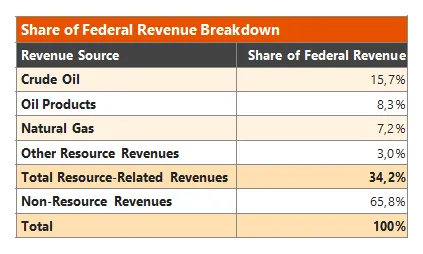
Moreover, crude oil generally generates a higher fiscal return than refined petroleum products, which is reflected in Russia's tax architecture. Using average federal revenue data since 2022, the Russian federal budget can be approximated as follows.
Oil and gas revenues accounted for approximately 31.2% of federal revenues on average between 2022 and 2025. The breakdown between crude oil, products, and gas is not published by Moscow and is therefore modelled using average export revenues and relative fiscal yields across sectors.
The key finding is that refined products contribute only around 8.3% of federal revenues, which significantly limits the fiscal leverage of refinery strikes.
1
3
9
926
Delwin | Military Theorist retweeted
(3/8) Russia’s War Economy Is Built on Resource Exports.
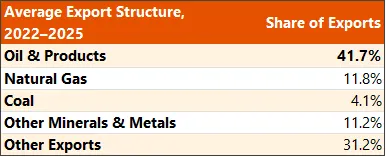
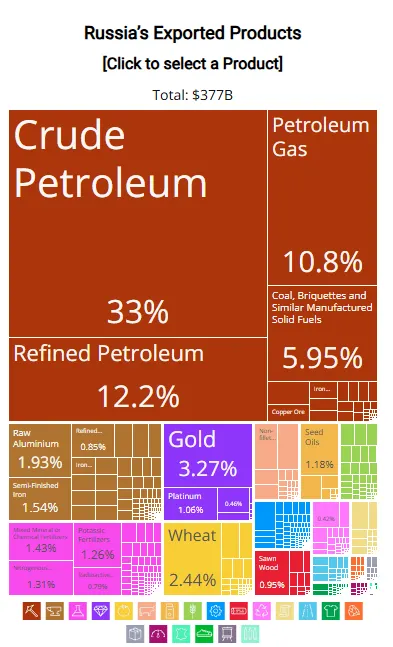
Russia’s wartime resilience rests on its ability to generate export revenues and convert those revenues into fiscal resources. Between 2022 and 2025, resource exports accounted for approximately 69% of Russian exports.
Russia’s economic center of gravity is the broader mineral-export system, whose diversification reduces dependence on any single category, rather than the refining sector itself.
Any strategy intended to undermine Russia’s ability to finance the war must therefore reduce aggregate resource-export revenues, more specifically crude oil’s, instead of merely disrupting the refining capacity.
1
2
9
1,014
Delwin | Military Theorist retweeted
(2/8) Why Ukraine Is Conducting the Campaign?
The assumption that refinery strikes are primarily intended to cripple the Russian economy is not supported by the available evidence. Instead, the campaign appears to pursue two more realistic objectives.
First, it reinforces the narrative that Ukraine retains strategic initiative and can strike deep inside Russia. This strategic messaging remains important in sustaining Western political support and securing continued military assistance. Despite recent European financing packages, significant funding gaps exists in Ukraine’s medium-term military requirements, making continued international support essential. (See: NATO ongoing initiatives to secure an additional $40 billion)
Second, the campaign forces Russia to divert scarce air-defense assets, personnel, and logistical resources away from the front. This objective is increasingly visible in parallel, as Ukrainian strikes against logistics hubs and infrastructure in occupied territories.
Viewed through this lens, the campaign’s success should be measured less by economic damage and more by its contribution to political signaling and resource diversion.
1
6
14
1,221
Delwin | Military Theorist retweeted
(7/8) Oil Prices Matter More Than Refinery Damage.
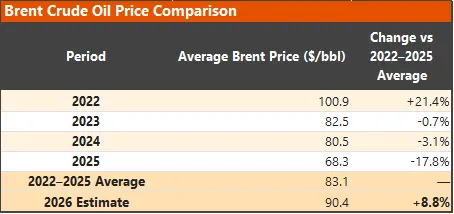
The average Brent price between 2022 and 2025 was approximately $83.1 per barrel. Current market expectations place the 2026 average at approximately $90.4 per barrel, an increase of roughly 8.8%.
Consequently, the increase in oil revenues from higher prices in 2026 are likely to exceed the losses associated with refinery disruptions. In other words, even if refinery attacks continue to reduce product exports, higher oil prices may more than compensate for the resulting revenue losses. This further reduces the campaign’s ability to generate meaningful economic pressure.
1
2
8
1,071
Delwin | Military Theorist retweeted
(8/8) Conclusion.
Ukraine’s deep-strike campaign has been operationally impressive and politically significant. It has demonstrated inventiveness, imposed costs, and exposed vulnerabilities within Russia’s strategic infrastructure. Yet, it has not materially affected Russia’s economic center of gravity.
Resource exports continue to account for the majority of Russian export earnings, while refined petroleum products contribute only an estimated ~8.3% of federal revenues. Even substantial disruptions to refinery output therefore produce relatively modest fiscal effects.
The April 2026 case illustrates this dynamic clearly: product exports declined significantly, but increased crude exports offset much of the loss, reducing the estimated impact to around 1% of federal revenues or less.
The campaign’s greatest strategic contribution therefore lies less in economic attrition than in political signaling. It reinforces perceptions of Russian vulnerability, sustains international support for Ukraine, and forces Russia to allocate resources to homeland defense. As an instrument of economic warfare, however, its effects remain limited.
*Sources on the Substack version
6
10
48
4,313
Delwin | Military Theorist retweeted
(1/8) [ANALYSIS] Assessing the Strategic Impact of Ukraine’s Deep-Strike Campaign Against Russian Oil Infrastructure.
Ukraine’s deep-strike campaign against Russian #energy infrastructure has attracted considerable attention since 2025. Refineries, storage facilities, export terminals, and logistics hubs have repeatedly been targeted, generating significant media coverage and reinforcing the perception that Russia’s economic foundations are increasingly vulnerable.
However, a closer examination of the data suggests that the campaign has had limited strategic impact on one of Russia’s primary centers of gravity: its ability to finance the war through mineral-resource exports.
This analysis evaluates that claim by examining the contribution of different export categories to Russian federal revenues and modelling the impact of refinery disruptions using average data from 2022–2025 as a baseline.
This leads to a straightforward conclusion: while the campaign has imposed operational costs and temporary disruptions, its direct impact on Russia’ war-financing capacity remains limited. Even under conservative assumptions, the effect is approximately 1% of federal revenues after accounting for crude-oil substitution. Furthermore, rising oil prices in 2026 are likely to more than offset these losses.
This raises an important question: if the campaign is not materially impairing Russia’s ability to finance the war, what possible purpose does it serve?
The answer appears to lie primarily in the political and operational domains rather than the economic one.
Read on Substack: open.substack.com/pub/delwin…
#Oil #UkraineRussiaWar #Strategy
9
23
49
11,509
Delwin | Military Theorist retweeted

Jun 12
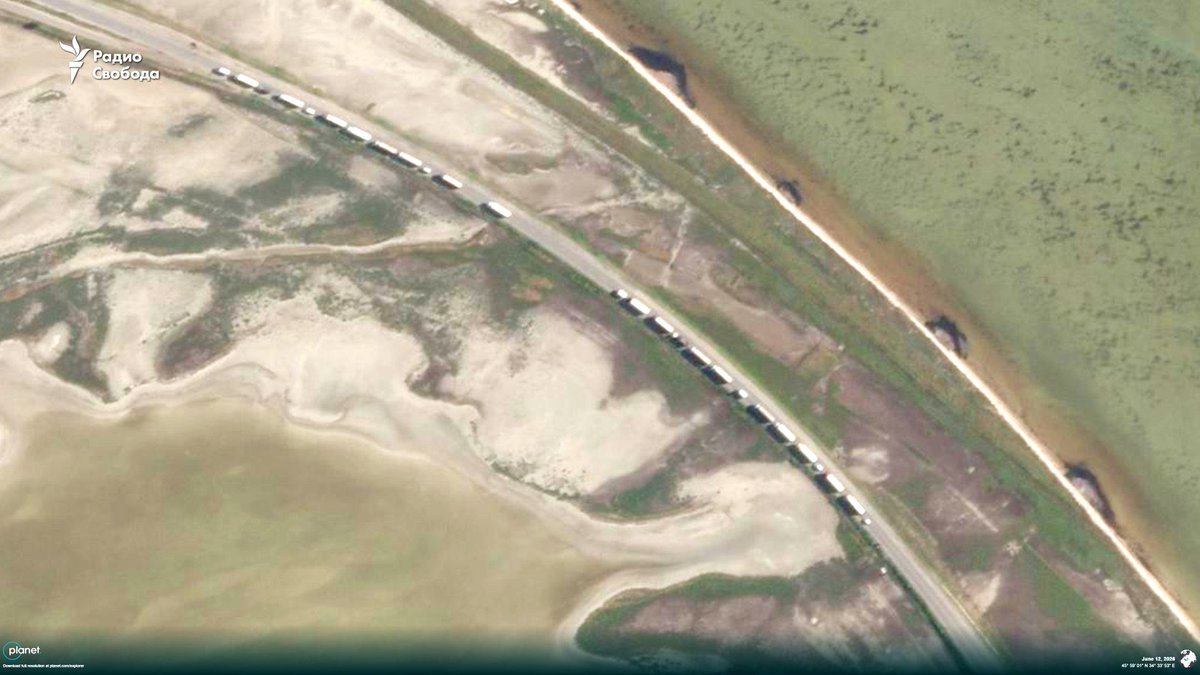
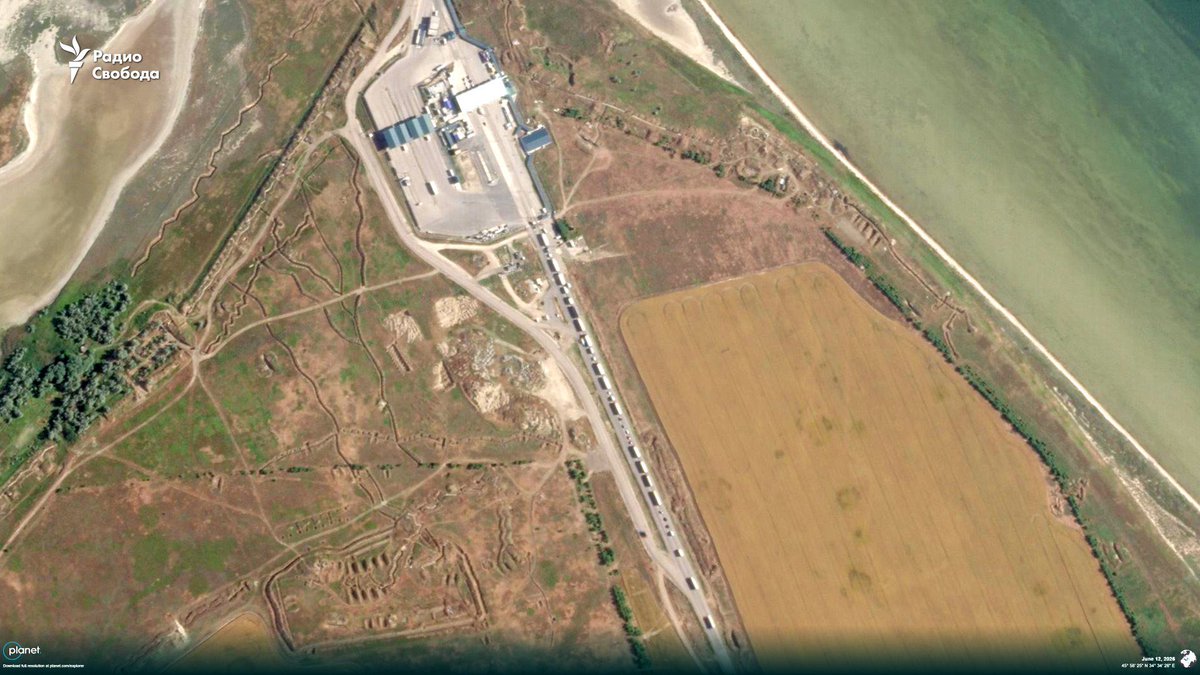
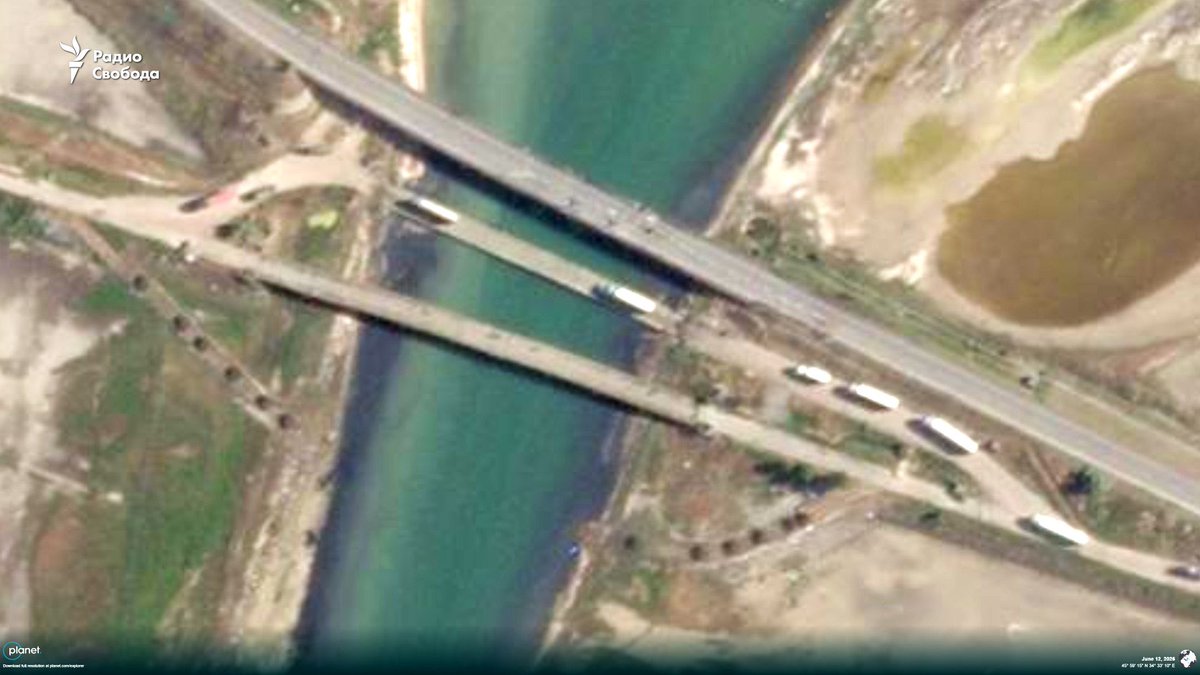
Unfortunately this shows a failure in the midstrikes to stopping logistics from Crimea. Pontoon has been up for a while. We truly expected it to have gone down already.
It has to go down and stay down, with the slowed down traffic being hit too. That means it's going to require regular midstrike sorties over the area. Not sure what's gone wrong here to be honest.

30
67
558
60,498
Delwin | Military Theorist retweeted

Good piece by @HromadskeUA on the situation inside Kostyantynivka, the 1st city in the Kramatorsk fortress belt. Various assessments, but an overall sense that fighting has reached the stage where the fall of the city is a matter of 'when' rather than 'if' hromadske.ua/viyna/265664-ch…
2
8
15
2,858
Delwin | Military Theorist retweeted
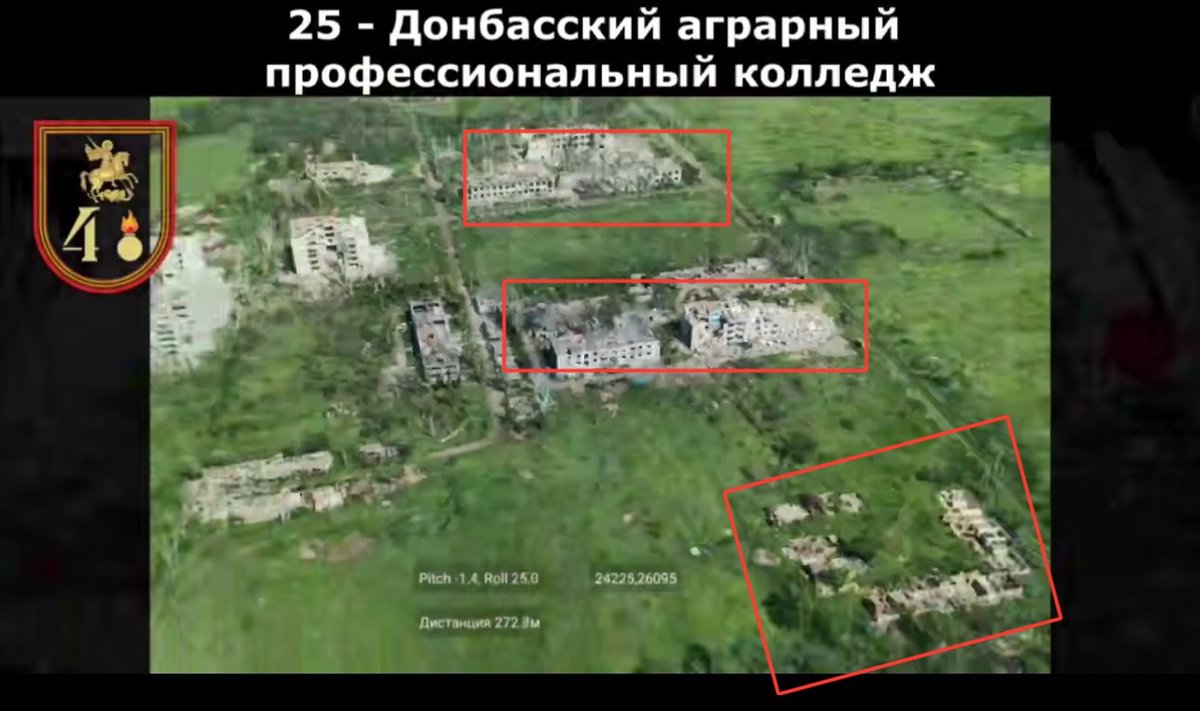
"Those are only infiltrations"...
At some point, reality always catches up to the narrative.
A simple look at the video in reply shows the intensity of close quarters combat inside the city. This is way past isolated incidents.
#Kostiantynivka
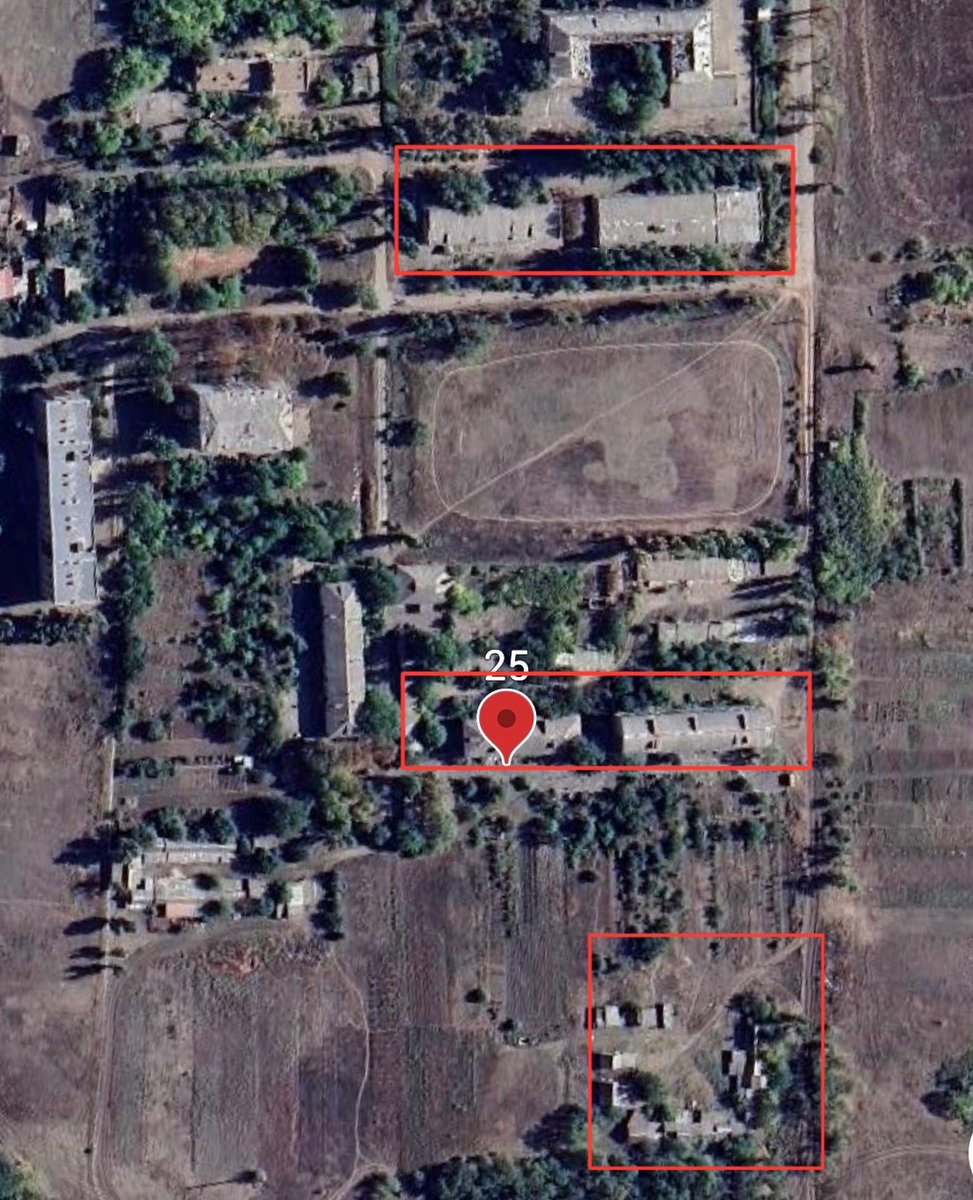
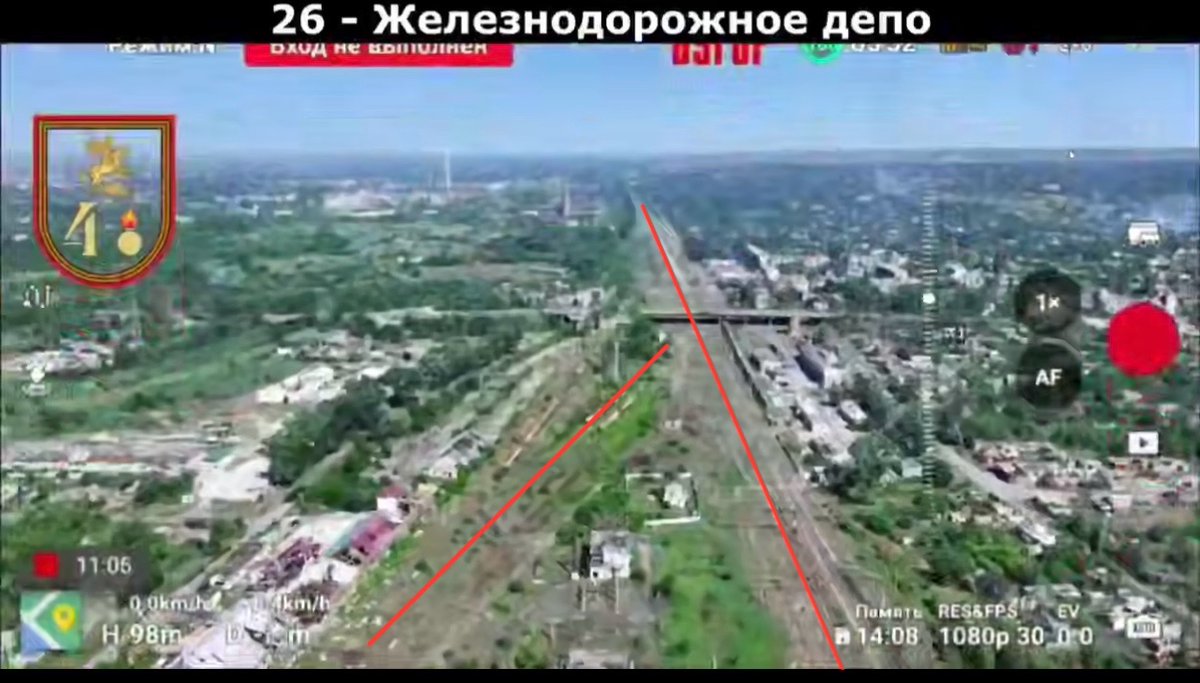
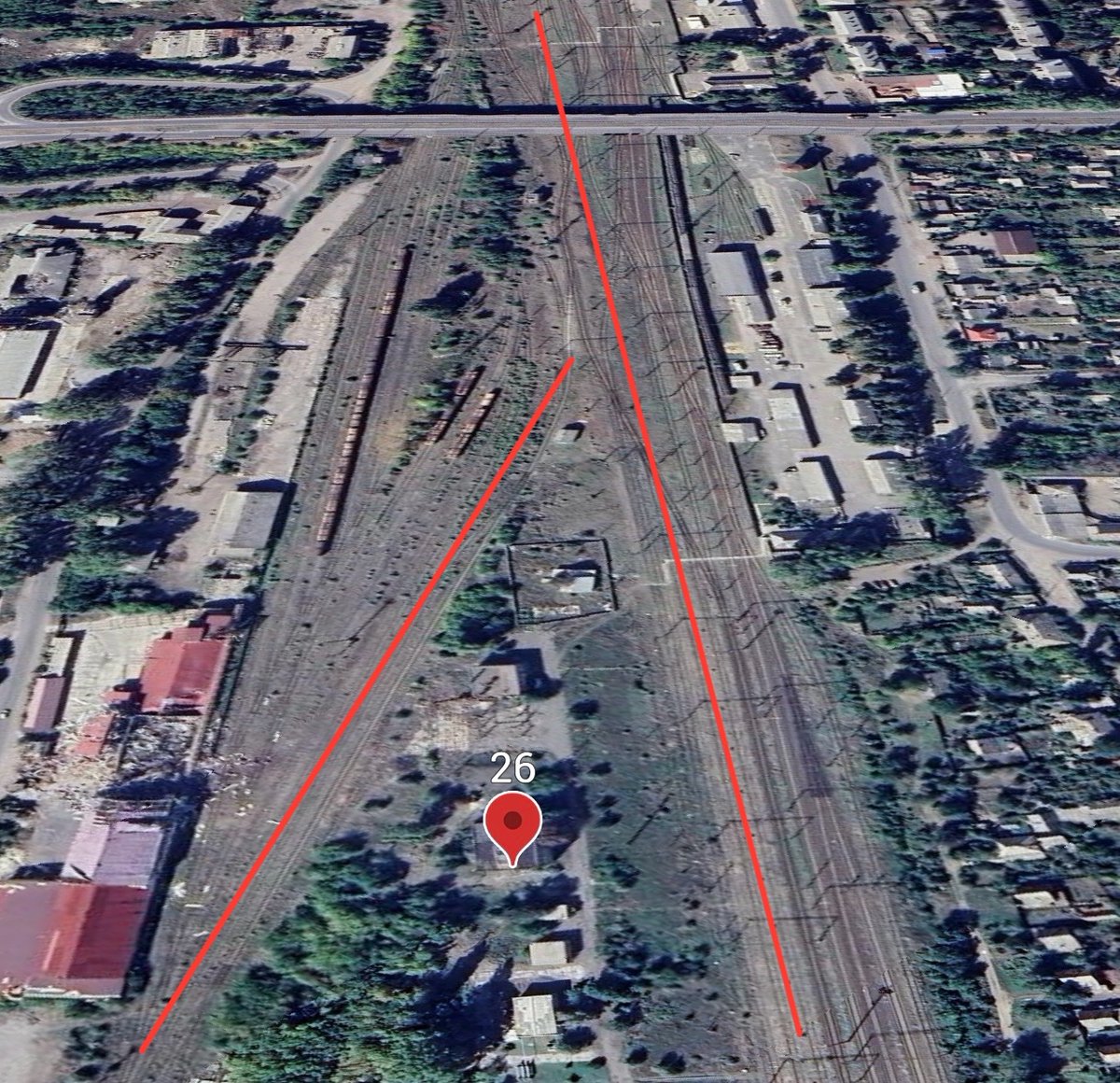
Jun 11

RU raised 26 flags in Kostiantynivka
25: 48.492388,37.730103
26: 48.505549,37.736636
t.me/z4lpr/1661
@GeoConfirmed @UAControlMap
2
4
34
3,520
(1/8) [ANALYSIS] Assessing the Strategic Impact of Ukraine’s Deep-Strike Campaign Against Russian Oil Infrastructure.
Ukraine’s deep-strike campaign against Russian #energy infrastructure has attracted considerable attention since 2025. Refineries, storage facilities, export terminals, and logistics hubs have repeatedly been targeted, generating significant media coverage and reinforcing the perception that Russia’s economic foundations are increasingly vulnerable.
However, a closer examination of the data suggests that the campaign has had limited strategic impact on one of Russia’s primary centers of gravity: its ability to finance the war through mineral-resource exports.
This analysis evaluates that claim by examining the contribution of different export categories to Russian federal revenues and modelling the impact of refinery disruptions using average data from 2022–2025 as a baseline.
This leads to a straightforward conclusion: while the campaign has imposed operational costs and temporary disruptions, its direct impact on Russia’ war-financing capacity remains limited. Even under conservative assumptions, the effect is approximately 1% of federal revenues after accounting for crude-oil substitution. Furthermore, rising oil prices in 2026 are likely to more than offset these losses.
This raises an important question: if the campaign is not materially impairing Russia’s ability to finance the war, what possible purpose does it serve?
The answer appears to lie primarily in the political and operational domains rather than the economic one.
Read on Substack: open.substack.com/pub/delwin…
#Oil #UkraineRussiaWar #Strategy
9
23
49
11,509
(7/8) Oil Prices Matter More Than Refinery Damage.
The average Brent price between 2022 and 2025 was approximately $83.1 per barrel. Current market expectations place the 2026 average at approximately $90.4 per barrel, an increase of roughly 8.8%.
Consequently, the increase in oil revenues from higher prices in 2026 are likely to exceed the losses associated with refinery disruptions. In other words, even if refinery attacks continue to reduce product exports, higher oil prices may more than compensate for the resulting revenue losses. This further reduces the campaign’s ability to generate meaningful economic pressure.
1
2
8
1,071
(8/8) Conclusion.
Ukraine’s deep-strike campaign has been operationally impressive and politically significant. It has demonstrated inventiveness, imposed costs, and exposed vulnerabilities within Russia’s strategic infrastructure. Yet, it has not materially affected Russia’s economic center of gravity.
Resource exports continue to account for the majority of Russian export earnings, while refined petroleum products contribute only an estimated ~8.3% of federal revenues. Even substantial disruptions to refinery output therefore produce relatively modest fiscal effects.
The April 2026 case illustrates this dynamic clearly: product exports declined significantly, but increased crude exports offset much of the loss, reducing the estimated impact to around 1% of federal revenues or less.
The campaign’s greatest strategic contribution therefore lies less in economic attrition than in political signaling. It reinforces perceptions of Russian vulnerability, sustains international support for Ukraine, and forces Russia to allocate resources to homeland defense. As an instrument of economic warfare, however, its effects remain limited.
*Sources on the Substack version
6
10
48
4,313