
Development is a leading research journal in the field of developmental biology, covering stem cells, regeneration, evodevo, epigenetics, morphogenesis and more
- Tweets 11,419
- Following 418
- Followers 29,240
- Likes 4,883







ALT Maëlle Bellec, Swarnabh Bhattacharya, Evan Healy, Josep Mercadal, Nikhil Mishra, Jessica Perochon, Yamini Ravichandran and Margherita Zamboni.
ALT Veronica Biga (left) and Cerys Manning (right). Image courtesy of Kunal Chopra.
ALT Profile card for Xianfa Yang, Preprint Editor (Development) at Zhejiang University–University of Edinburgh Institute, China. The card includes a quote about following developmental biology and stem cell preprints and highlighting studies to make them accessible and insightful. Key topics listed are cell fate control and differentiation, development and disease, and gene regulation. On the right, a portrait shows a person wearing glasses and a light-colored shirt against a plain background. The Development journal logo appears at the bottom.



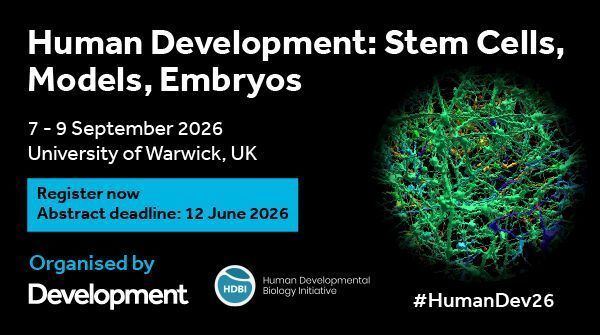
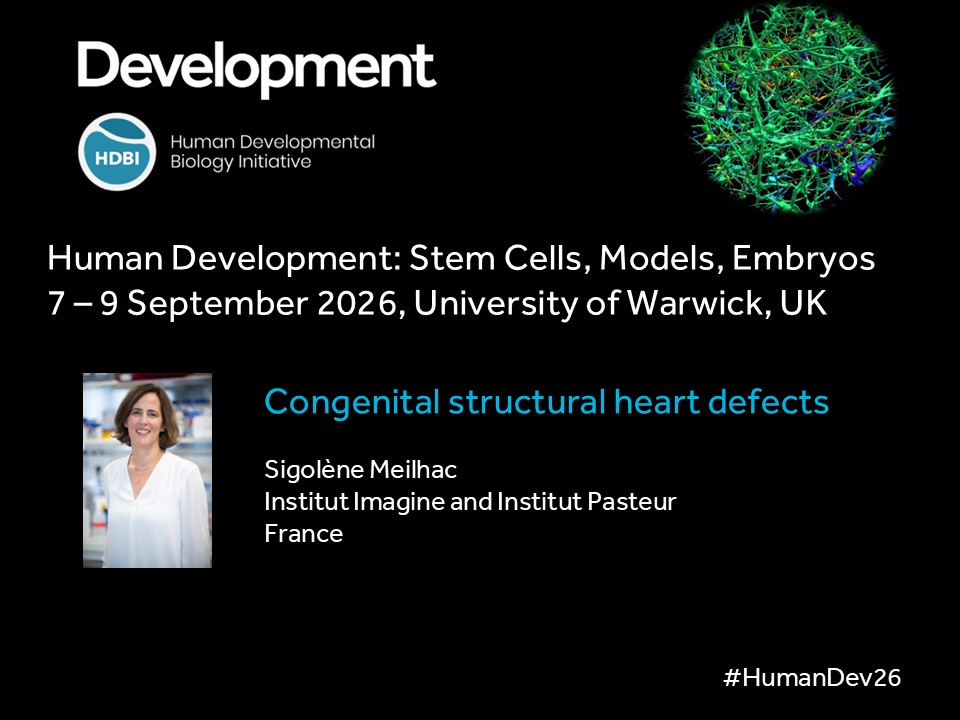
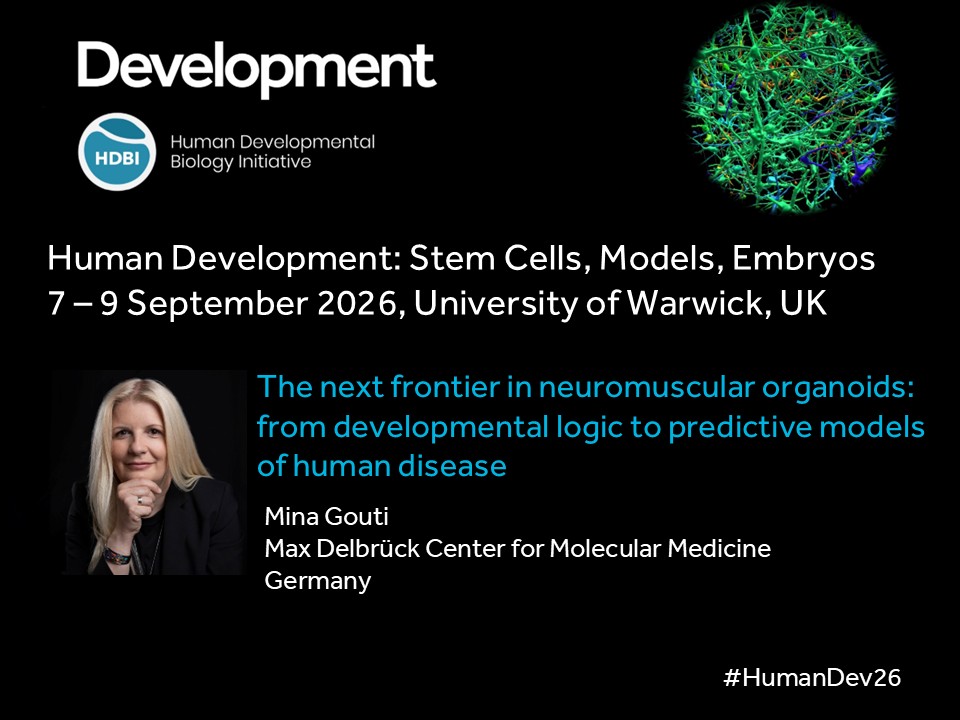
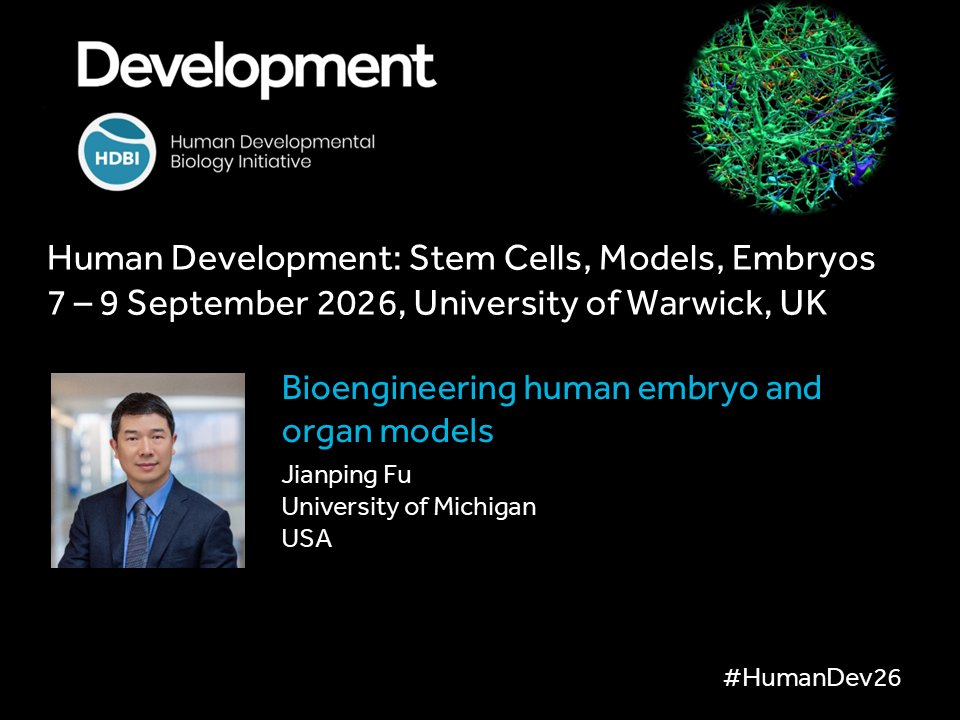
ALT Promotional banner for the event ‘Human Development: Stem Cells, Models, Embryos,’ taking place 7–9 September 2026 at the University of Warwick, UK. A blue box highlights ‘Register now. Abstract deadline: 12 June 2026.’ Logos for Development and the Human Developmental Biology Initiative appear below. On the right is a colourful spherical microscopy-style image resembling a dense network of cells. The hashtag #HumanDev26 appears at the bottom right.
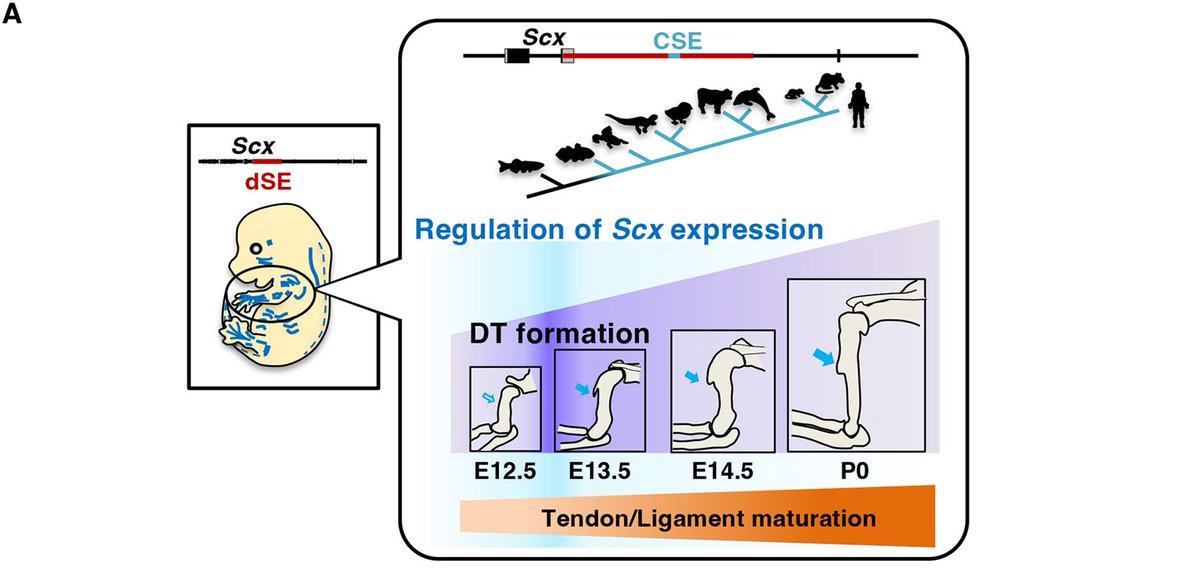
ALT Schematic panels illustrating temporal regulation by the Scx enhancer and the pectoral fin-to-forelimb transition. (A) Temporal specificity of the CSE within the dSE in DT formation and tendon maturation. The left panel illustrates X-gal domains of dSE Tg embryos at E14.5. In the genome maps, the dSE is indicated in red in both panels, whereas the CSE is shown in blue only in the right panel. A series of vertebrate species is illustrated along an ascending line from zebrafish to human. A light blue segment from coelacanth through tetrapods to humans denotes the presence of the CSE. The segment corresponding to zebrafish, which lack the CSE, is shown in black. Below, schematic illustrations depict upper limb development at E12.5, E13.5, E14.5 and P0, with peak CSE activity indicated by the darkest shade within the light-blue shading. The DT primordium first appears at ∼E13.5 and develops as the limb grows. A narrow developmental window from E12.5 to E13.5 for DT formation regulated by
ALT Shinsei Yambe (left), Chisa Shukunami (centre) and Kenta Sumiyama (right)
ALT Call for papers Special Issue Plant and Algae Development Academic Editor Dominique Bergmann (Stanford University, USA) and Guest Editor Susana Coelho (Max Planck Institute for Biology, Tübingen, Germany). Submission deadline: 2 November 2026 Development logo to the left
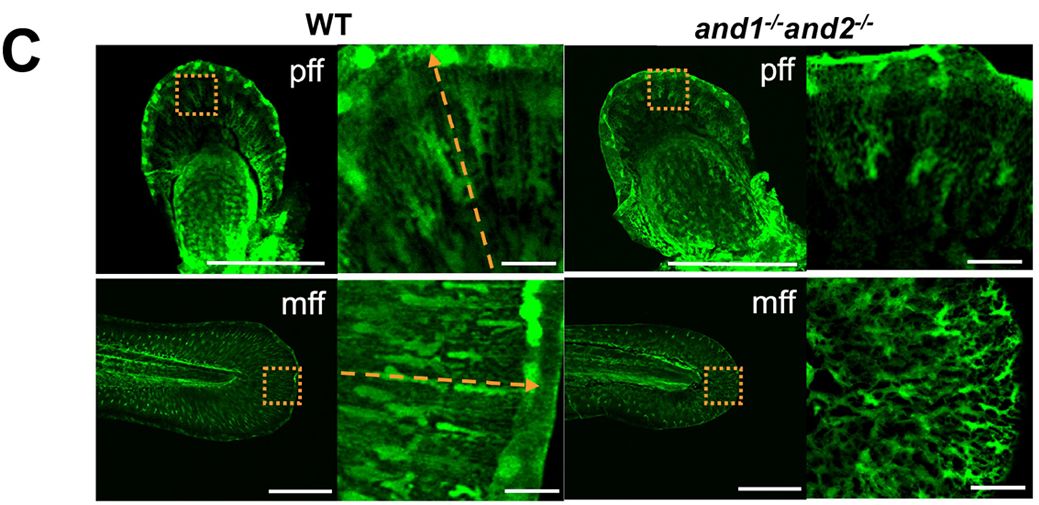
ALT Simultaneous deletion of and1 and and2 leads to absence of actinotrichia and fin-fold defects. C) Maximum intensity projection confocal images of ET37 wild-type (n=5 larvae) and double mutant (n=4 larvae) pff and mff at 5 dpf. Area outlined is shown at higher magnification on the right. Orange dashed arrows indicate the orientation of actinotrichia in the wild-type siblings. Scale bars: 200 µm; 50 µm in magnified image.
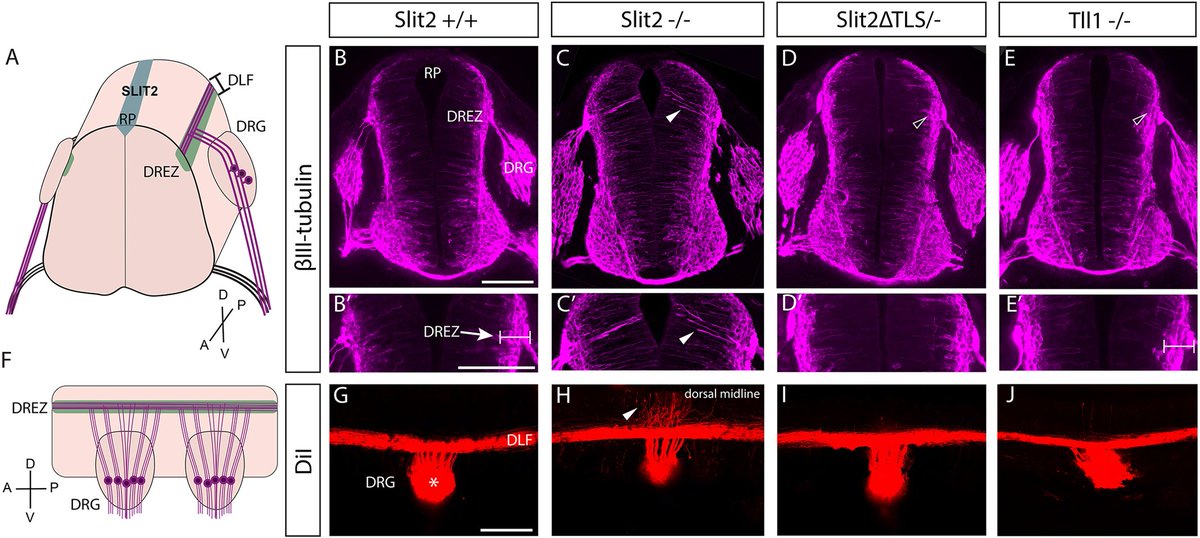
ALT The Slit2ΔTLS allele retains dorsal midline repulsion of DRGs axons. (A,F) Dorsal root ganglia (DRG) axons enter the spinal cord at the dorsal root entry zone (DREZ) and bifurcate to project anterior and posterior in the dorsolateral funiculus (DLF), avoiding the SLIT2-expressing roof plate (RP). A, anterior; D, dorsal; P, posterior; V, ventral. (B-E) βIII-tubulin labeled transverse sections of E10.5 spinal cords. Dorsal midline projection errors were seen in Slit2−/− (arrowhead), but not in Slit2ΔTLS/− or Tll1−/− embryos (empty arrowheads). Dorsal is up in all images. (B′-E′) Magnifications of the DREZ region (arrowhead). Brackets indicate DRG axons in the spinal cord. (G-J) DiI tracer label was placed in DRGs (asterisk) of whole E11.5 embryos. (G) Wild-type embryos had no axons projecting towards the roof plate (n=4 embryos). (H) Slit2−/− embryos had overshooting DRG axons that invaded the ventricular zone toward the midline (arrowhead; n=2 embryos). (I) Slit2ΔTLS/− embryos lack over


ALT “The opportunity to publish our article fee-free for Open Access under the Read & Publish agreement with the University of Toronto was the cherry on the cake. Not only is Development one of my favourite journals, with a fair and streamlined review process, but publishing fee free gives our work much wider visibility and provides an opportunity to get much more feedback. In the current funding environment, agreements such as the one between The Company of Biologists and the University of Toronto are key to be able to stretch research dollars while broadly disseminating research outputs.”