
Joined May 2024
- Tweets 4,761
- Following 514
- Followers 497
- Likes 4,421
240 Photos and videos




When we talk about digital security, most people think about software.
Or encryption.
Or complex technology.
But beneath all of that is something much simpler:
Math
The security of modern systems relies on mathematical principles that make information difficult to break, manipulate, or compromise.
That’s why conversations around cryptography are so important.
Not because everyone needs to become a mathematician.
But because understanding the foundations helps us better understand the systems we rely on every day.
I recently watched Optimum’s discussion with MIT professor Muriel Médard and was reminded of how much of our digital world depends on concepts most people never see.
Behind every secure network is a layer of mathematics quietly doing its job.
The technology may evolve.
The threats may evolve.
But the importance of strong mathematical foundations remains the same.
Because security isn’t magic.
It’s math.
@get_optimum
2
10

Jun 17
Most people think privacy means hiding information.
But that’s not actually the problem we’re trying to solve.
In today’s digital systems, verification usually comes with a tradeoff:
Need to prove something?
Reveal the data.
Need access?
Share your information.
Need compliance?
Expose more than necessary.
The result is that systems often collect far more information than they actually need.
Not because it’s useful.
Because it’s the only way they know how to verify.
A better model is selective disclosure.
Instead of revealing everything, you reveal only what’s required.
• Prove you’re eligible without sharing your identity
• Prove compliance without exposing private records
• Prove ownership without revealing unnecessary details
• Prove a condition without exposing the underlying data
The goal isn’t secrecy.
The goal is precision.
Share what matters.
Protect what doesn’t.
This becomes increasingly important as financial systems move onchain.
Many real-world workflows depend on sensitive information:
• identity attributes
• compliance data
• business records
• private user information
Yet most of that data should never be public.
That’s why privacy isn’t a feature.
It’s infrastructure.
Without it, many real-world applications simply can’t exist onchain.
The future isn’t built on revealing more information.
It’s built on proving more with less.
Privacy isn’t about hiding.
It’s about controlling what needs to be seen.
@RialoHQ @RialoPakistan
2
14
58
Jun 16
I’ve been thinking about what separates good infrastructure from great infrastructure.
One word keeps coming to mind:
Momentum.
Good systems help things move.
Great systems help things keep moving.
Because progress isn’t usually one big breakthrough.
It’s a series of small improvements building on each other over time.
The easier it is to communicate, coordinate, and share information, the easier it becomes for new ideas to emerge.
That’s why infrastructure matters.
Not because it’s always visible.
But because it creates the conditions where progress can compound.
This is one reason I’ve been exploring what @get_optimum is building.
The more I learn about decentralized infrastructure, the more I think its value isn’t only in solving problems today.
It’s in helping future innovation build on what’s already been created.
Because the strongest systems don’t just create movement.
They create momentum.
2
13
58
Jun 15
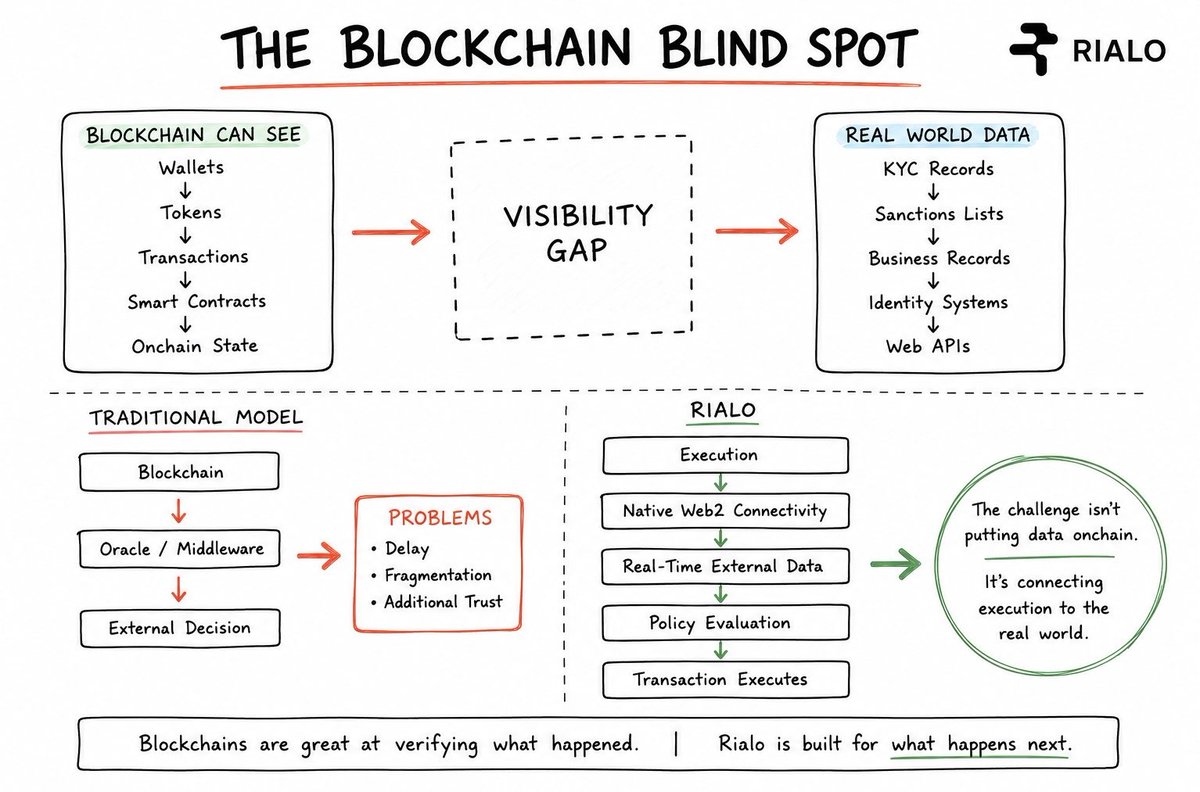
Blockchains are powerful.
But they have a blind spot.
They can only see what exists onchain.
A blockchain can verify:
• wallet balances
• token ownership
• transaction history
• smart contract state
Everything inside the network is visible.
Everything outside the network is not.
That’s where many real-world applications run into problems.
Financial systems depend on information that doesn’t live onchain:
• KYC records
• sanctions databases
• business registries
• identity systems
• compliance policies
• external APIs
A blockchain can’t access these things by itself.
This creates a gap.
The chain executes transactions.
The real-world data needed to evaluate those transactions lives somewhere else.
Most systems solve this by adding layers around the blockchain:
Offchain services.
Middleware.
External policy engines.
Oracles.
Separate infrastructure that decides what should happen before the transaction reaches the chain.
But that means execution and decision-making become disconnected.
The system enforcing the rules isn’t the same system executing them.
What’s interesting about Rialo is that it approaches the problem differently.
Instead of treating external data as something completely separate from execution, Rialo is building native Web2 connectivity into the protocol itself.
That means execution can access real-world information when it matters.
A transaction can evaluate live policy data.
A workflow can react to changing conditions.
A financial application can make decisions using information that exists beyond the blockchain.
The challenge for blockchain adoption has never been putting data onchain.
It’s connecting onchain execution with the world outside of it.
Because the biggest limitation of most blockchains isn’t what they can do.
It’s what they can’t see.
@RialoHQ @RialoPakistan
10
51
Jun 15
Growth is often treated as a goal.
But not all growth is healthy.
Some systems grow by adding more complexity.
More processes.
More bottlenecks.
More things that can go wrong.
The strongest systems take a different approach.
They build foundations that make growth sustainable.
Growth shouldn’t feel like constantly fighting against the system itself.
It should feel natural.
Predictable.
Manageable.
That’s one reason I’ve been exploring what @get_optimum is building.
The more I learn about decentralized infrastructure, the more I think the real challenge isn’t achieving growth.
It’s making sure growth remains efficient as networks expand.
Because scale is only valuable when systems can support it.
Maybe great infrastructure isn’t what makes growth possible.
Maybe it’s what makes growth sustainable.
1
11
62
Jun 14
A lot of people look at infrastructure and ask:
“What does it produce?”
I’ve started asking a different question:
“What does it make possible?”
The most impactful infrastructure isn’t always the thing creating the end result.
It’s the thing expanding what’s possible for everyone else.
Roads don’t create destinations.
They make more destinations reachable.
The internet didn’t create innovation.
It made innovation easier to share, build, and scale.
That’s why infrastructure matters.
Its value isn’t only in what it does directly.
It’s in the opportunities it unlocks.
This is one reason I’ve been exploring what @get_optimum is building.
The more I learn about decentralized infrastructure, the more I think its role is simple:
Create the conditions where builders have more freedom, networks have more flexibility, and innovation faces fewer limitations.
Because great infrastructure isn’t measured by what it controls.
It’s measured by what it enables.
12
47
Jun 13
Everyone's talking about the SpaceX IPO.
but how many people have actually read the S-1?
the roadshow deck alone is 287 pages.
plus the CNBC coverage. the Reuters breakdowns. the Bloomberg analysis.
most people won't read any of it.
they'll just scroll Twitter and hope someone explains it.
here's what I did instead.
I asked D0 by @DonutAI:
"Write me a SpaceX IPO report."
it pulled from the full deck, the S-1, and every major source.
gave me the valuation, all seven business segments, the key catalysts, and what to watch before the June 12 listing.
in seconds.
not hours. seconds.
this is what D0 actually does.
you don't research anymore.
you just ask.
and it brings everything to you, already digested.
if you're watching $SPCX before it lists, you already know what tool to use.
@DonutAI
9
54
Jun 10
Most discussions around RWAs focus on tokenization.
Take an asset.
Put it onchain.
Issue a token.
Problem solved?
Not quite.
A real-world asset is more than an asset.
It comes with rules.
• Who can own it?
• Who can transfer it?
• Which jurisdictions are allowed?
• What happens when regulations change?
• How is compliance enforced over time?
Tokenization doesn’t remove these questions.
It simply brings them onchain.
That’s why I think the hardest part of RWAs isn’t creating tokens.
It’s creating systems that can execute real-world rules.
A token can represent ownership.
But ownership alone doesn’t make an asset usable in regulated environments.
Execution matters.
The system needs access to policy data.
The system needs automation.
The system needs privacy for sensitive information.
The system needs a way to enforce rules consistently.
This is what makes Rialo interesting to me.
Not because it can tokenize assets.
Many platforms can do that.
But because it’s exploring how privacy, Web2 connectivity, automation, and compliance can work together inside execution itself.
The future of RWAs probably won’t be defined by who creates the most tokens.
It will be defined by who can make those assets behave correctly once they’re onchain.
Tokenization is step one.
Programmable execution is where things get interesting.
@RialoHQ @RialoPakistan
12
84
Jun 10
Most people think scaling is about handling more.
More users.
More activity.
More data.
But the more I learn about infrastructure, the more I think the real challenge is something else:
Managing complexity.
Because growth is easy to celebrate.
Complexity is much harder to see.
Every new layer, dependency, and moving part makes systems harder to coordinate.
Harder to maintain.
Harder to scale efficiently.
That’s why some of the most valuable infrastructure isn’t focused on adding more features.
It’s focused on making systems work together with less friction.
This is one reason I’ve been paying attention to optimum
The more I read, the more I feel the future of scaling isn’t just about increasing capacity.
It’s about reducing unnecessary complexity along the way.
Because growth alone doesn’t create strong systems.
Simplicity does.
@get_optimum
11
63
Jun 9
Most people think Rialo is building compliance.
I think that’s missing the bigger picture.
Compliance is just one piece.
Look at the capabilities Rialo is bringing together:
• Private execution (REX)
• Native Web2 connectivity
• Protocol-level automation
• Real-time compliance enforcement
Each of these is useful on its own.
But the interesting part isn’t the individual features.
It’s what happens when they’re composed into a single execution environment.
Take a recurring payment.
To make it truly autonomous, you need automation.
To make it compliant, you need policy evaluation.
To make that evaluation meaningful, you need access to real-world data.
To do it without exposing sensitive information, you need private execution.
Remove any one of those pieces and the workflow changes fundamentally.
That’s why I don’t think Rialo’s real product is compliance.
Or automation.
Or privacy.
It’s the ability to combine these capabilities directly inside execution.
The result isn’t just a new feature.
It’s a different way of thinking about what onchain applications can do.
The most interesting systems aren’t built from a single primitive.
They’re built from primitives that become more powerful when used together.
That’s the direction Rialo seems to be exploring.
@RialoHQ
10
57
Dimpleicious retweeted

Jun 8
Momo Discord is now open
Don’t be shy
She doesn’t bite
Maybe
(≧◡≦) ♡
discord.gg/7R7HVwXzcq

427
251
690
27,704
Jun 8
The more I learn about infrastructure, the more I realize its value isn’t measured by what it does.
It’s measured by what it makes possible.
Most people don’t think about the systems underneath their favorite products.
They think about the experience.
The tools.
The outcomes.
And that’s exactly the point.
Good infrastructure stays in the background while others build on top of it.
Developers create.
Networks grow.
New ideas emerge.
And the foundation quietly does its job.
That’s one thing I find interesting about projects like optimum.
The focus isn’t on being the destination.
It’s on helping create the conditions that allow everything else to grow.
Because the strongest foundations aren’t the ones demanding attention.
They’re the ones making progress possible.
@get_optimum

7
17
155
May 31
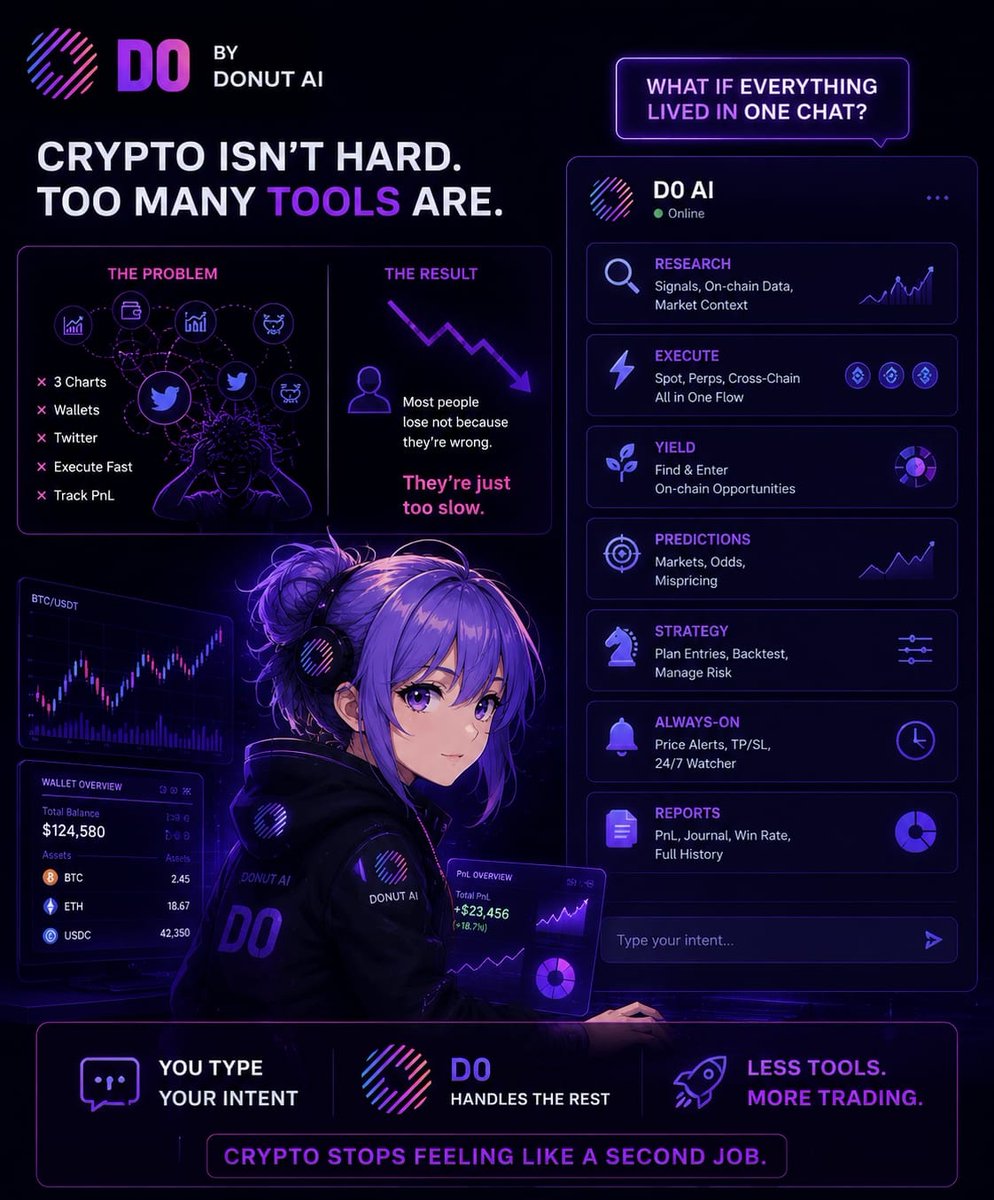
nobody talks about how exhausting crypto actually is.
not the market.
the tools.
you're watching 3 charts, checking a wallet, scanning Twitter for alpha, trying to execute before the window closes and somehow also supposed to track your PnL?
it's a lot. and most people are losing not because they're wrong.
they're just too slow.
D0 by @DonutAI is built around one idea:
what if you didn't have to switch tabs at all?
everything lives in a single chat
Research: signals, on-chain data, market context
Execute: spot, perps, cross-chain, all in one flow
Yield: find and enter on-chain opportunities
Predictions: markets, odds, mispricing
Strategy: plan entries, backtest, manage risk
Always-On: price alerts, TP/SL, 24/7 watcher
Reports: PnL, journal, win rate, full history
the vision is simple.
you type your intent.
D0 handles the rest.
less tool management.
more actual trading.
if this gets it right, crypto stops feeling like a second job.
@DonutAI
2
9
126
May 19
i'm in.
@morphora_eth
999 handcrafted hybrid beasts.
abstract geometry on ETH mainnet.
morphora.xyz/wl/?ref=dimplei…
1
1
6
69
Dimpleicious retweeted

May 18
WL is open.
apply. post on X. get inside.
could close any minute.
morphora.xyz/

4,991
4,228
6,273
116,658
May 18
My custom #UniPix card is here
Just completed the steps , uploaded my sketch PFP and got my very own UniPix collectible card generated.
@unipixnft

May 18

Your PFP can get you GTD🦄
Turn your PFP into a UniPix card
Best ones win GTD spots
Full setup GPT prompt below 👇
unipix.pro
12
351

May 9
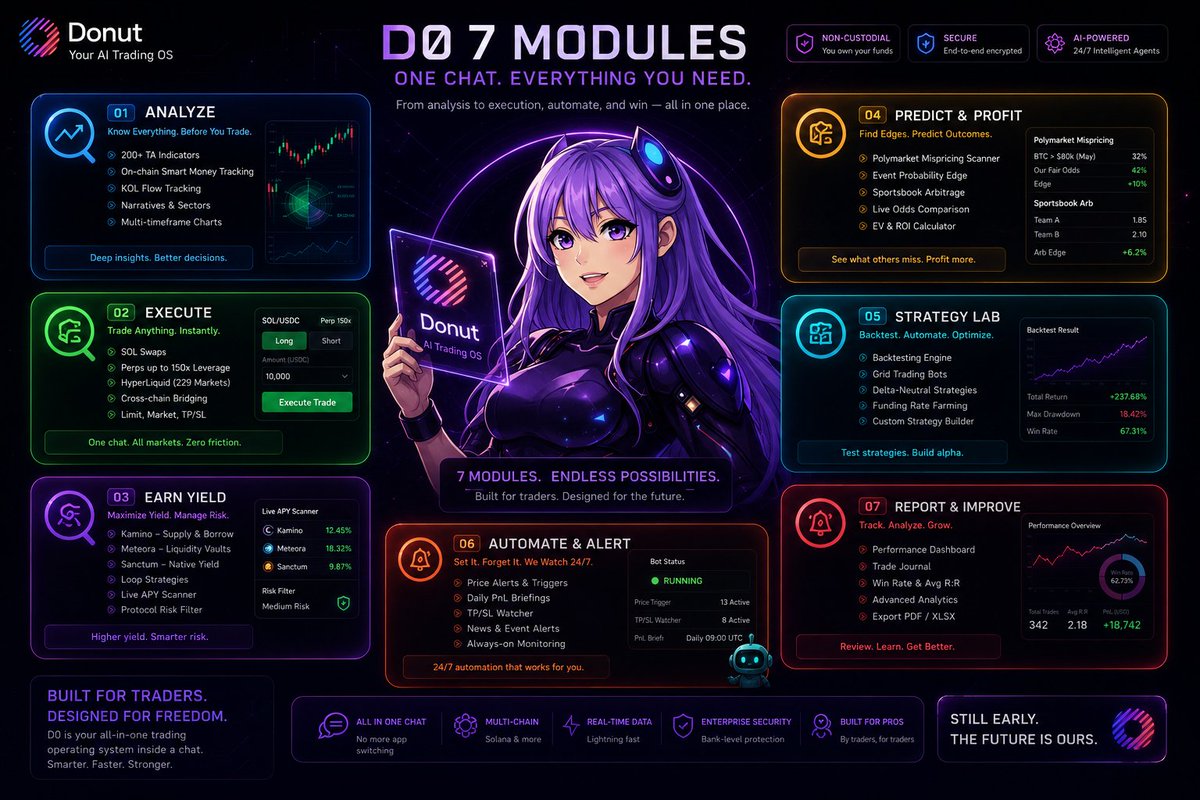
okay i need to talk about @DonutAI because i don't think people actually know what's inside this thing
D0 has 7 modules and i've been going through them and genuinely?? it's a lot.
like module 1 alone has 200 TA indicators, on-chain smart money tracking, KOL flow, narratives all in one place. that's before you even get to trading.
then module 2 lets you actually execute SOL swaps, perps up to 150x, HyperLiquid with 229 markets, cross-chain bridging. all from the same chat.
module 3 is yield Kamino, Meteora, Sanctum. supply, borrow, loop. live APY scan with protocol risk filter.
module 4?? prediction markets. Polymarket mispricing scanner sportsbook arb. didn't expect that one.
module 5 is where it gets nerdy strategy lab. backtest, grid bots, delta-neutral, funding farming. actual quant stuff.
module 6 runs 24/7. price triggers, daily PnL briefs, TP/SL watcher. set it and forget it.
and module 7 gives you full reports charts, journal, win rate, avg R:R, export to PDF or XLSX.
this isn't a bot. it's a whole trading operating system living in one chat.
still early. 🍩
#Donut #D0 #Crypto #Web3
3
15
207
May 1
Do you remember when you joined X? I do! 😊
🎊 2 Years on X! 🎊
2 years on this platform!
When I joined, I never thought this journey would be this amazing.
✨ In these 2 years:
→ Met incredible people
→ Learned new ideas every day
→ Spoke my mind, fearlessly
280 characters taught me to say more with less.
Every day brings something new here 💫 drama and inspiration both! 😄
To everyone who followed, engaged, and made this journey worthwhile — Thank you! 🙏
Here's to year 3 — let's make it the best one yet! 🔥
#TwitterAnniversary #2Years #XAnniversary #MyXAnniversary

5
23
266
Apr 29
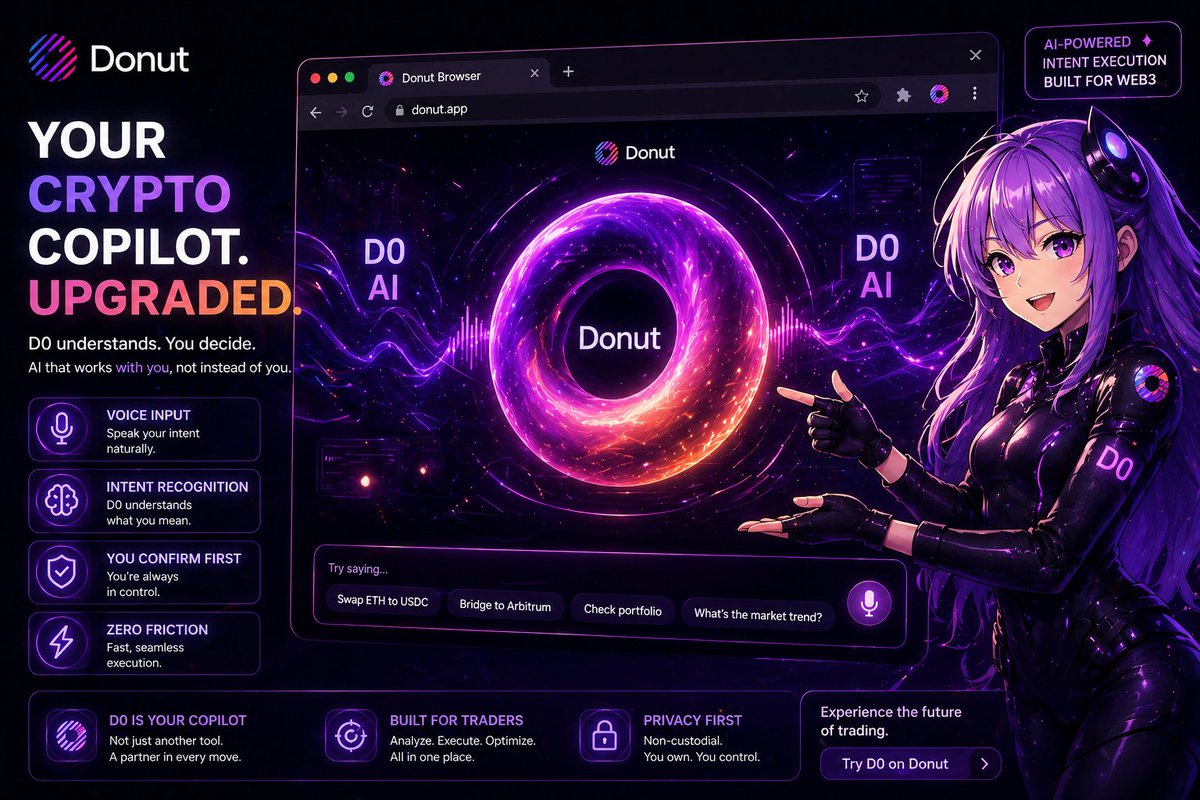
Gdonut goiss 🍩
Donut is not slowing down.
Every week, something new drops.
Every update, the vision gets clearer.
Here's what Donut actually is
for those still sleeping on it:
An agentic crypto browser — not just a tool, a copilot
Voice input — speak your trade, D0 builds the order
Intent recognition — it understands what you mean, not just what you say
You confirm first — always in control, never blindsided
One place — no more 10 tabs, no more missed moves
D0 proactively informs you about the market.
Spots opportunities you'd have missed.
Executes only when YOU say go.
The upgrades keep coming
and we're still early.
If you're not watching @DonutAI closely,
you're already behind. 🔥
#Donut #Web3 #Crypto #D0
1
19
171