An interdisciplinary network for those who use #DocumentsAsData | DocumentsResearch.Net | @DrAimeeGrant @DrGBJennings @MariaPournara
- Tweets 324
- Following 167
- Followers 126
- Likes 336

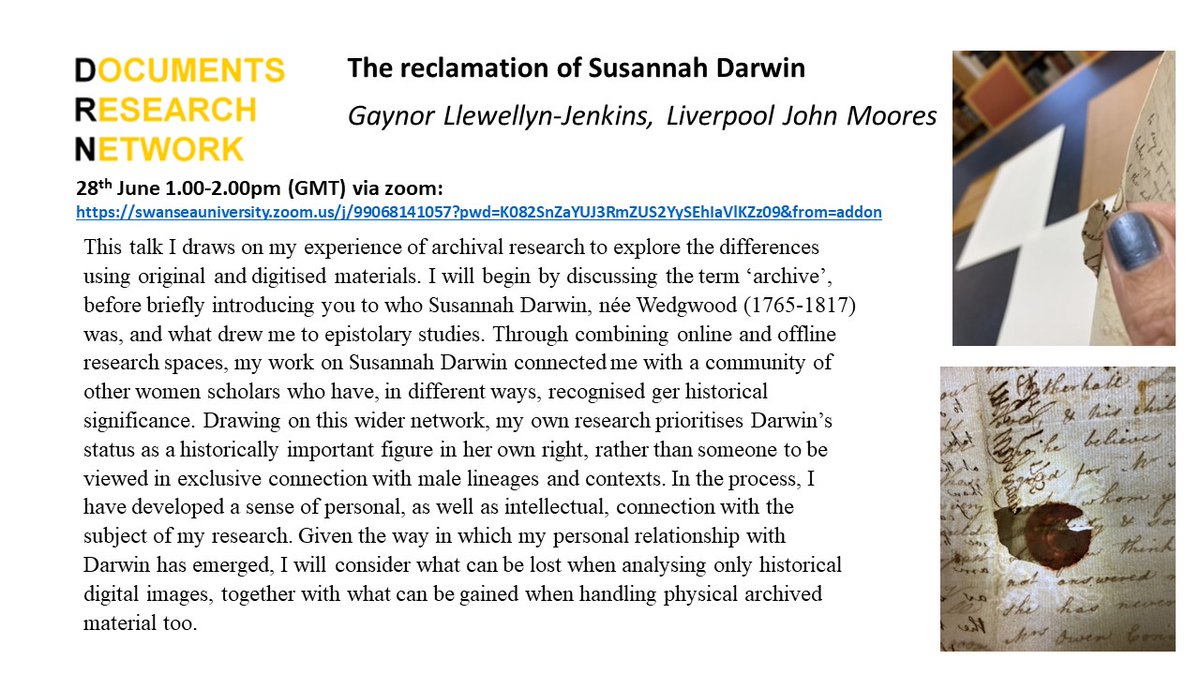



ALT This talk I draws on my experience of archival research to explore the differences using original and digitised materials. I will begin by discussing the term ‘archive’, before briefly introducing you to who Susannah Darwin, née Wedgwood (1765-1817) was, and what drew me to epistolary studies. Through combining online and offline research spaces, my work on Susannah Darwin connected me with a community of other women scholars who have, in different ways, recognised ger historical significance. Drawing on this wider network, my own research prioritises Darwin’s status as a historically important figure in her own right, rather than someone to be viewed in exclusive connection with male lineages and contexts. In the process, I have developed a sense of personal, as well as intellectual, connection with the subject of my research. Given the way in which my personal relationship with Darwin has emerged, I will consider what can be lost when analysing only historical digital images, togethe

ALT This talk I draws on my experience of archival research to explore the differences using original and digitised materials. I will begin by discussing the term ‘archive’, before briefly introducing you to who Susannah Darwin, née Wedgwood (1765-1817) was, and what drew me to epistolary studies. Through combining online and offline research spaces, my work on Susannah Darwin connected me with a community of other women scholars who have, in different ways, recognised ger historical significance. Drawing on this wider network, my own research prioritises Darwin’s status as a historically important figure in her own right, rather than someone to be viewed in exclusive connection with male lineages and contexts. In the process, I have developed a sense of personal, as well as intellectual, connection with the subject of my research. Given the way in which my personal relationship with Darwin has emerged, I will consider what can be lost when analysing only historical digital images, togethe
ALT This talk I draws on my experience of archival research to explore the differences using original and digitised materials. I will begin by discussing the term ‘archive’, before briefly introducing you to who Susannah Darwin, née Wedgwood (1765-1817) was, and what drew me to epistolary studies. Through combining online and offline research spaces, my work on Susannah Darwin connected me with a community of other women scholars who have, in different ways, recognised ger historical significance. Drawing on this wider network, my own research prioritises Darwin’s status as a historically important figure in her own right, rather than someone to be viewed in exclusive connection with male lineages and contexts. In the process, I have developed a sense of personal, as well as intellectual, connection with the subject of my research. Given the way in which my personal relationship with Darwin has emerged, I will consider what can be lost when analysing only historical digital images, togethe


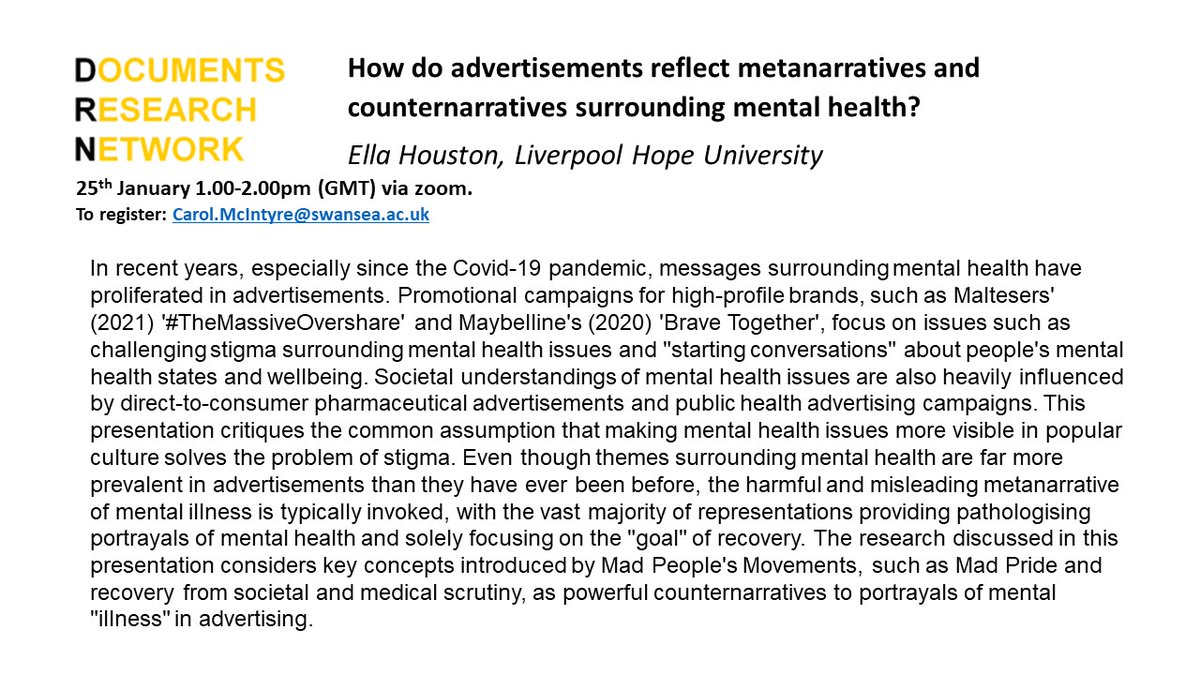
ALT Poster: How do advertisements reflect metanarratives and counternarratives surrounding mental health? Ella Houston, Liverpool Hope University 25th January 1.00-2.00pm (GMT) via zoom. To register: Carol.McIntyre@swansea.ac.uk In recent years, especially since the Covid-19 pandemic, messages surrounding mental health have proliferated in advertisements. Promotional campaigns for high-profile brands, such as Maltesers' (2021) '#TheMassiveOvershare' and Maybelline's (2020) 'Brave Together', focus on issues such as challenging stigma surrounding mental health issues and "starting conversations" about people's mental health states and wellbeing. Societal understandings of mental health issues are also heavily influenced by direct-to-consumer pharmaceutical advertisements and public health advertising campaigns. This presentation critiques the common assumption that making mental health issues more visible in popular culture solves the problem of stigma.
ALT Poster: How do advertisements reflect metanarratives and counternarratives surrounding mental health? Ella Houston, Liverpool Hope University 25th January 1.00-2.00pm (GMT) via zoom. To register: Carol.McIntyre@swansea.ac.uk In recent years, especially since the Covid-19 pandemic, messages surrounding mental health have proliferated in advertisements. Promotional campaigns for high-profile brands, such as Maltesers' (2021) '#TheMassiveOvershare' and Maybelline's (2020) 'Brave Together', focus on issues such as challenging stigma surrounding mental health issues and "starting conversations" about people's mental health states and wellbeing. Societal understandings of mental health issues are also heavily influenced by direct-to-consumer pharmaceutical advertisements and public health advertising campaigns. This presentation critiques the common assumption that making mental health issues more visible in popular culture solves the problem of stigma.
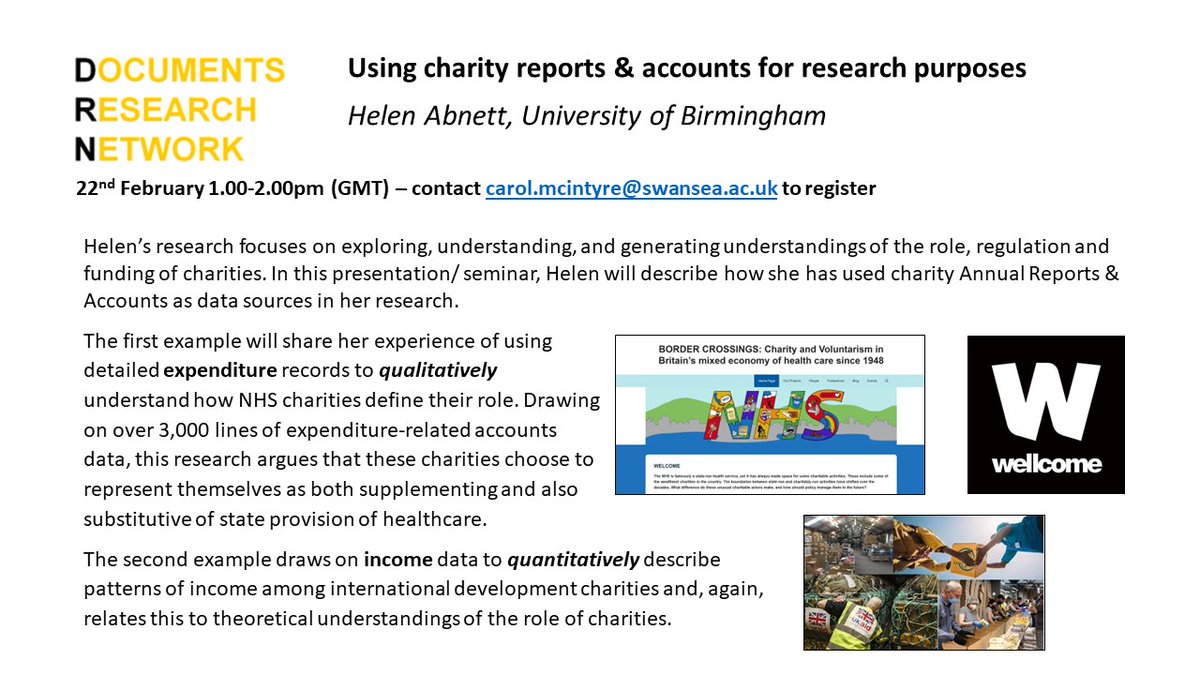
ALT Using charity reports & accounts for research purposes Helen Abnett, University of Birmingham 22nd February 1.00-2.00pm (GMT) – contact carol.mcintyre@swansea.ac.uk to register Helen’s research focuses on exploring, understanding, and generating understandings of the role, regulation and funding of charities. In this presentation/ seminar, Helen will describe how she has used charity Annual Reports & Accounts as data sources in her research. The first example will share her experience of using detailed expenditure records to qualitatively understand how NHS charities define their role. Drawing on over 3,000 lines of expenditure-related accounts data, this research argues that these charities choose to represent themselves as both supplementing and also substitutive of state provision of healthcare. The second example draws on income data to quantitatively describe patterns of income among international development charities and, again, relates this to theoretical understandings of