
Author of THE NO-LIMITS ENTERPRISE, TEDx, Consultant, Educator. Advocate for Freedom. Conseiller de Confiance. Dual Citizen. Teal. @Forbes_Books @OpenAtScale
Joined September 2013
- Tweets 3,225
- Following 321
- Followers 4,213
- Likes 4,990
222 Photos and videos






Pinned Tweet

1 Feb 2023
Former @WSJ career columnist @JoannLublin's superb new WSJ Workplace Report column about engaging and retaining superstars by taking lessons from self-managed companies like @valvesoftware and #MorningStar. #selfmanagement #futureofwork #careers

1
14
4,091

Charlie Munger called bureaucracy a cancer.
Not a problem. Not friction. Cancer.
A thing that grows for no reason other than to keep growing.
Munger: “I think a bureaucracy is sort of like a cancer. And it functions sort of like a cancer.”
He wasn’t exaggerating.
He was diagnosing.
Bureaucracy doesn’t solve problems.
It metabolizes them.
Every problem becomes a department. Every department becomes a budget. Every budget becomes proof the department is needed.
The organism feeds itself.
Munger: “I think the decisions get made better if you eliminate the bureaucracy.”
Not faster. Better.
That word matters.
Everyone assumes more oversight means better outcomes. More layers. More approvals. More hands on every decision before it can move.
What actually happens is the opposite.
Decisions get diluted until nobody can trace who made them.
The thing that should take four hours takes four months.
And by the time it arrives, the original purpose is already dead.
Now apply that to government.
The same cancer Munger diagnosed in boardrooms runs entire nations.
Departments that exist to oversee departments. Agencies duplicating the work of other agencies. Committees formed to evaluate whether other committees should continue to exist.
Taxpayers fund all of it.
And now there’s an alternative.
AI can already do most of it.
Not in theory. Right now.
Permit processing. Budget allocation. Regulatory review. Policy analysis. Compliance.
All pattern recognition and rule application.
The two things machines already do better than any human in the building.
An algorithm doesn’t protect its own budget. Doesn’t lobby for headcount. Doesn’t slow a process down to justify hiring more people to manage the slowness.
That’s the trick bureaucracy has always run.
Make everything worse. Then point at the mess as proof more resources are needed.
Munger: “And so we’re very anti-bureaucracy, and I think it’s doing us a lot of good.”
He ran Berkshire Hathaway with roughly 30 people at headquarters.
Hundreds of billions in value. Managed by a team you could seat at a dinner table.
Meanwhile the average government agency employs thousands to do what a single system could process before lunch.
The reason bureaucracy survives has nothing to do with performance.
It survives because it votes. It lobbies. It self-perpetuates.
It is the only organism on earth that grows by making the host sicker.
Munger didn’t call it waste.
He didn’t call it bloat.
He called it cancer.
The scan came back years ago.
The patient keeps hiring more doctors.
6
20
62
2,370
Doug Kirkpatrick retweeted

May 18
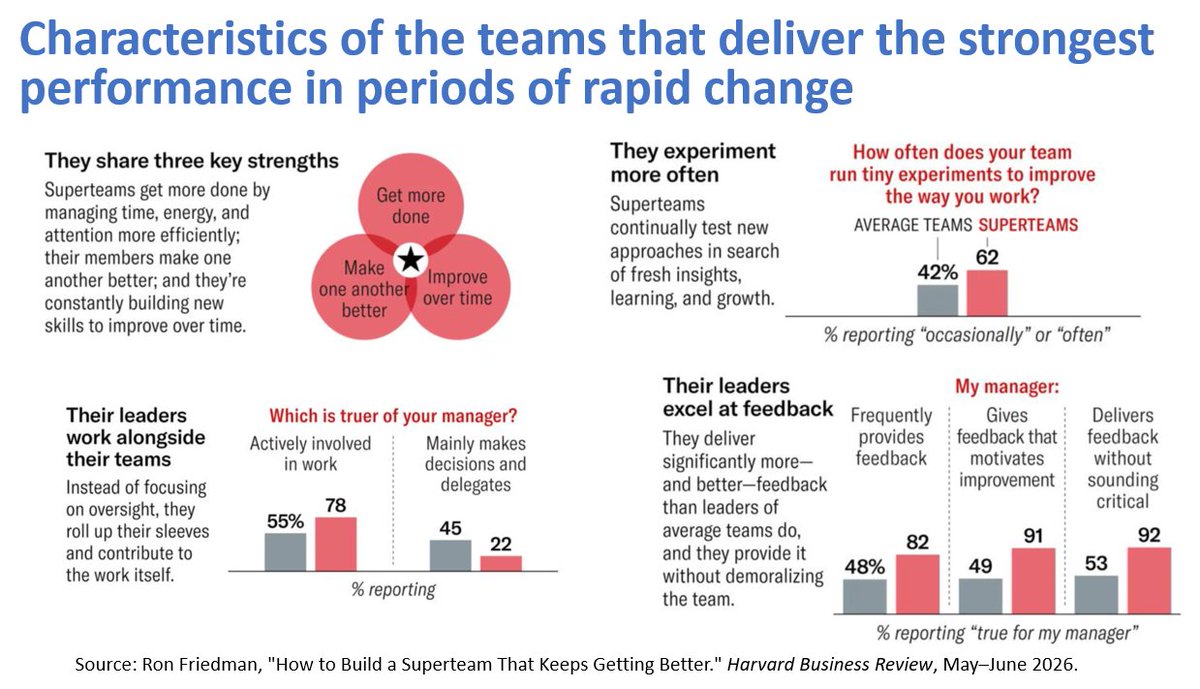
The teams that deliver the strongest performance in periods of rapid change are those that experiment & learn the fastest.
That’s a central finding from @RonFriedman's latest @HarvardBiz article "How to Build a Superteam That Keeps Getting Better."
He surveyed more than 6,000 knowledge workers across many sectors, including healthcare. He identified "superteams": those getting top scores on performance & effectiveness. Three things set them apart: (1) they get more done by managing time, energy & attention; (2) their members actively make each other better & (3) they keep building skills & improving over time.
The research identified seven practices, all relevant to change leadership (here with my comments). Superteam leaders:
1) Run more experiments. Superteams experiment nearly 50% more often than average teams. Small, focused tests beat big rollout programmes. The key leadership role is making it safe to try (& fail).
2) Make curiosity contagious. Leaders of superteams are 56% more likely to ask thoughtful questions & 53% more likely to genuinely learn from team members. In change work, the formal leader rarely holds the most important knowledge. Curiosity is how we access it.
3) Ask "What are you stuck on?" Superteam leaders orient discussions toward problems, not updates that signal control. Issues surfaced early get addressed. The ones buried in progress reports become crises.
4) Roll up their sleeves, even when they don't have to. The difference between involvement & micromanagement comes down to intent. Leaders who work alongside their teams signal no task is beneath them & gain real-time understanding about where change is stalling.
5) Make feedback feel like support. More than 90% of superteam members say their leader delivers feedback that motivates without feeling critical. How we respond to setbacks shapes whether people keep trying — or go quiet.
6) Support team member’s growth, even when it takes them elsewhere. It is not a loss - it’s an investment. Superteam members are twice as likely to feel supported on leaving and three times more likely to remain connected. For change work, that extended network is an asset.
7) Lead with meaning, not just metrics. Leaders of superteams are 59% more effective at helping people understand why their work matters. Purpose is not a “soft extra”. It’s the difference between sustained commitment & change that fizzles out.
The article's case study is the Oklahoma City Thunder: a basketball franchise that rebuilt itself twice from the bottom of the league to championship level by trading away stars, abandoning conventional tactics, & treating every setback as data. Their motto is “Labor omnia vincit”: work conquers all things.
Those of us leading change in health & care can see the relevance. We build great teams through routine leadership habits: curiosity, experimentation, honest feedback & staying close enough to the work to know what is actually happening.
That’s not a change programme: it’s a daily practice.
Link to the HBR article: hbr.org/2026/05/how-to-build…
5
31
76
4,144
May 18
What is the World's Dumbest Management Idea? Dr. Andrew Sharman describes it exactly, here: youtube.com/watch?v=RUVr-0Ef…
1
39
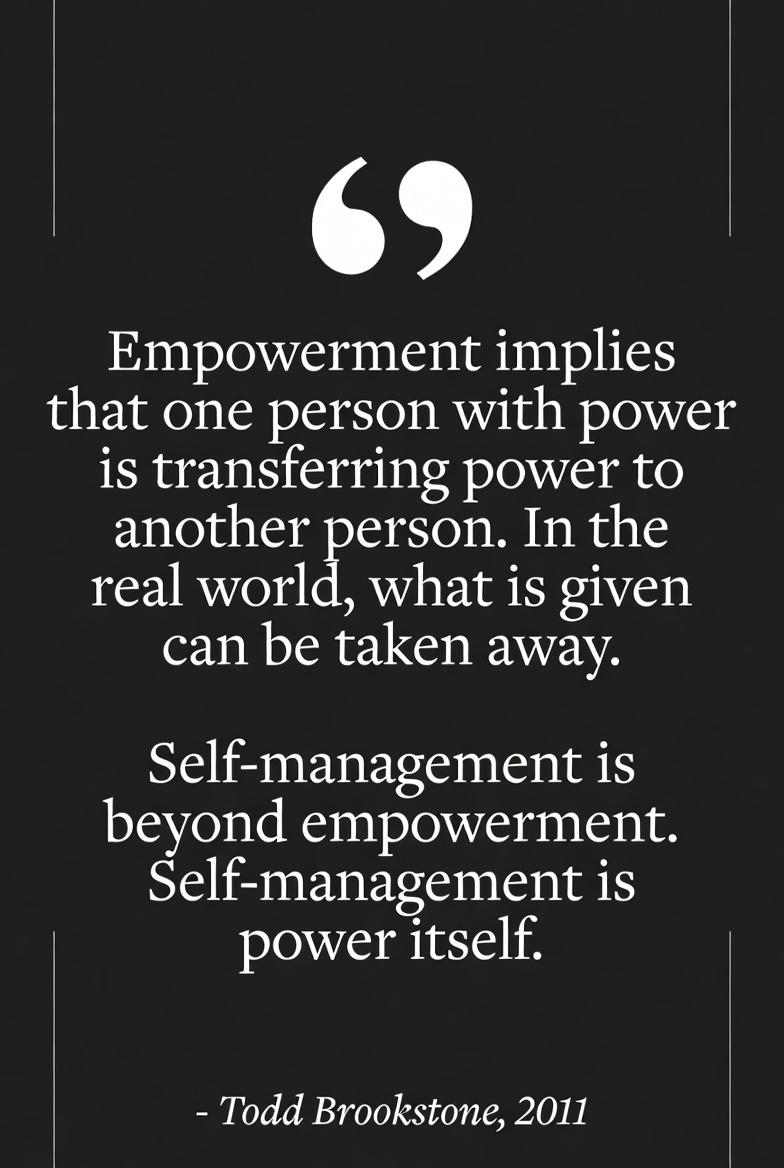
Empowerment is the Potemkin village of power in organizations.
1
28
Apr 28
28
Apr 23
Just published Cohesion: Connected Transformation by Design medium.com/p/cohesion-connec…
2
62
Doug Kirkpatrick retweeted
Apr 9
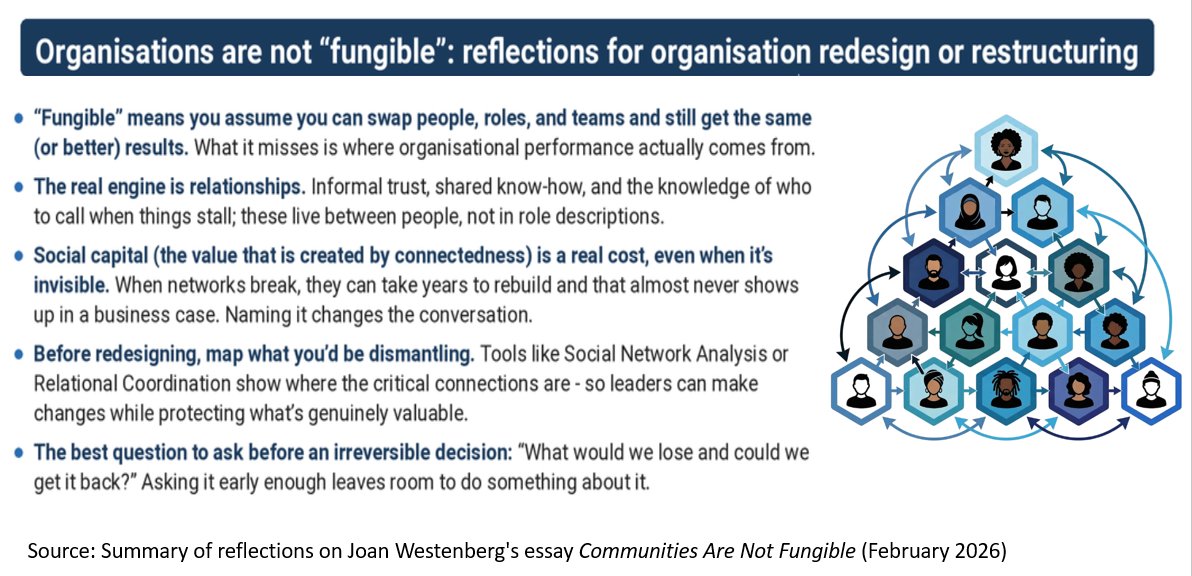
Organisations are not "fungible".
“Fungibility” is an assumption that if you redesign an organisation & replace one set of people with a different set, you will still get equivalent outputs. This mistaken belief underlies many organisational restructures: that you can redistribute roles, reporting lines & teams without meaningful loss.
I've been reading "Communities Are Not Fungible", a recent essay by @JoanWesten7568. She examines 1960s urban renewal, when planners believed demolishing old neighbourhoods & rehousing residents would allow communities to reform. They didn't. The residents moved. The community did not. A community is not a set of people: it is a historically produced web of relationships between them. Destroy the web, & you have strangers in a building. The parallel to organisational life is uncomfortable.
When we restructure, we may preserve many of the people but destroy the relational infrastructure that made them effective. The informal trust that lets someone ask for help. The shared knowledge of who to call when a process stalls. The accumulated understanding of each other's judgment. These live in relationships, not individuals. Redrawing an org chart doesn't transfer them.
Research backs this up. Tacit knowledge - the "knowing how" driving real-world performance - depends on trust to flow. Break those relationships & you block the transfer. Studies show informal networks persist along old lines long after formal structures change, creating tension between old loyalties & new mandates. Social capital is the value created by connectedness. It can be destroyed in restructuring & take years to rebuild — a cost that almost never appears in a business case.
What leaders can do to protect collective value:
1. Audit informal networks before redesigning formal structures. Use, eg., System Network Analysis or Relational Coordination. Breaking key network nodes causes capability losses no productivity model captures.
2. Treat relational capital as a real cost. Business cases for restructuring rarely account for social capital destruction. Making it visible leads to better decisions & stronger cases for change.
3. Design around high-value relationships. Identify relationships carrying the most trust & history & actively design the new structure to protect them while enabling necessary change.
4. Invest deliberately in building new relationships. Create conditions for them to form through shared work, peer learning & social connection.
5. Give explicit attention to belonging & psychological safety for everyone (not just those who lose or change roles): This creates conditions for the discretionary effort that makes new structures succeed.
6. Slow down at the point of irreversibility. Ask not only "what do we gain?" but "what do we lose - & can we recover it?"
The value of an organisation is not the sum of its people's individual capabilities. It is the web of relationships between them. That web is not fungible.
Link to Joan Westenberg's essay: joanwestenberg.com/communiti…. Thanks to @charlie_psych who sent me the essay.
3
39
115
10,330
Sam Altman said something recently that most people skimmed and immediately forgot.
That was a mistake.
Altman: “If it’s me and X hundred GPUs, we can do the work of a whole software team.”
Not twice as fast. Not three times as efficient.
One person. One team’s output. Zero team.
The entire architecture of the modern company was built to solve a single problem.
Coordinating human labor.
Org charts. Management layers. Hiring pipelines. Performance reviews. HR departments. Slack channels with forty people and no decisions.
Every piece of corporate infrastructure exists because humans are slow, expensive, and need to be organized.
Remove the coordination problem and the infrastructure collapses on contact.
We spent two years debating whether AI makes workers more productive.
That was the wrong debate entirely.
2x productivity is a raise.
One person replacing an entire team is a structural extinction event.
Altman: “You start to hear people say I’m able to do the work of a whole team with these tools.”
This is not a productivity story.
This is a headcount story.
Every company on Earth is currently valued on the assumption that scaling output requires scaling people.
That assumption is wrong.
It was always wrong.
We just never had the tool to prove it.
The company that figures this out first does not get a competitive advantage.
It gets an irreversible one.
One operator. Hundreds of GPUs. The output of a team that no longer needs to exist.
No salaries. No standups. No friction.
Most people will read Altman’s words, nod, and scroll past.
A small number will understand that something structural just shifted beneath them.
They will build accordingly.
The companies that define the next decade will not be the ones with the most people.
They will be the ones with the fewest people who understood what compute replaced.
For a hundred years, you needed more people to do more work.
That was never a strategy.
It was a constraint we mistook for a law.
The org chart was a monument to human limitation.
The limitation just vanished.
And everything built on top of it is now standing on nothing.
19
9
65
26,698
Doug Kirkpatrick retweeted
Apr 4
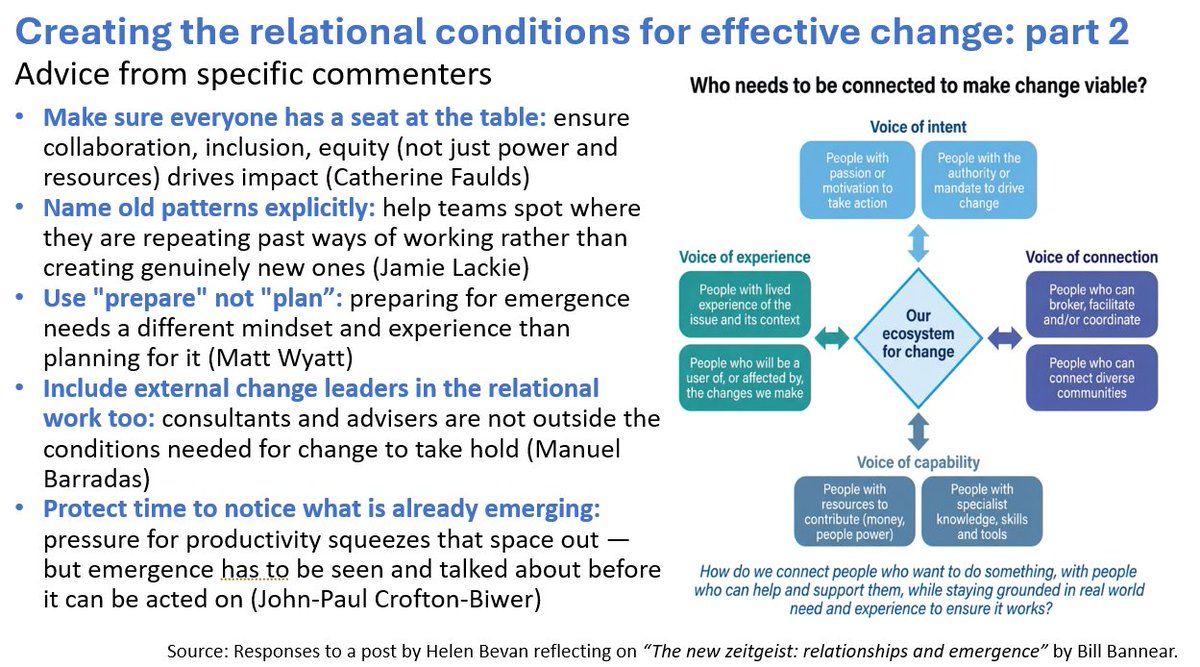
Creating the relational conditions for effective change: part two
Summary of comments in response to my last post on relationships that enable change to emerge from across multiple social platforms. Six themes surfaced:
1) Relationships ARE the mechanism: many are living this
The strongest theme was direct confirmation from practice. Ish Ahmed described frontline teams that fail to progress "not because of a lack of ideas, but because the environment & relationships are not set up to support change." Diane Gudmundson stressed: "change does not move at the speed of strategy alone. It moves at the speed of trust, safety & relationships." Alana Ruakere described work at Tui Ora, where the opportunity now is to name & invest in relational infrastructure more deliberately.
2. The challenge of measurement & making the case
Several commenters identified the same problem: how do we demonstrate relational quality when “delivery” metrics are easier to measure? Antonia Field-Smith asked how to give it "a credible footing when positioned against easily measurable operational & financial metrics." Kenny Ajayi named the paradox: there is an upfront cost to building relationships, yet systems are not set up to value that investment. Ted Toussaint flagged that the "environment" is hard to sell to leadership focused on hard business impact.
3) Productive challenges to the framework
Anthony Lawton pushed back on "design for connection before content," arguing that "the strongest relational bonds form through the work itself, not before it." Matt Wyatt stressed "the phrase is prepare for emergence" — a small difference in wording but a significant difference in insight and experience required.
4) Remote & distributed environments
Rebeccah Marsh stressed "we can't leave relationships to chance when we're not co-located." Rebecca Blackwood argued that in hybrid environments "structures have to work harder to create the conditions for connection & trust to develop" & that designing for relational quality & measuring it may be two sides of the same coin.
5) Real-world applications & tools
Lesley Parkinson shared how the RCN-accredited Relationships for Change course is building capacity in relational & restorative practice across 50 NHS Trusts. Helena Jackson connected the framework to Bill Sharpe's Three Horizons model. Amanda Jeppesen recommended Future Search as a method for bringing stakeholders together to create emergence conditions.
6) Relational competence as core leadership capability
David Pendleton framed relational competence as central: leadership operates across strategic, operational & interpersonal domains, with the interpersonal holding & enabling the other two. Jamie Lackie argued that relational infrastructure helps teams "update inherited patterns" - so interactions stop reproducing the past & start generating genuinely new ways of working.
The comments confirm both the resonance of this approach & the genuine tensions leaders face in applying it. Thanks to all commenters.
18
48
3,928

our lead independent director @roelofbotha and i wrote about the history of organizational structures, and our intent to rebuild block as a mini-AGI. x.com/jack/status/2039003879…

122
188
1,769
355,641
Doug Kirkpatrick retweeted
Mar 28
A key task for leaders of change is to plan for emergence.
This sounds contradictory. Emergence, by definition, cannot be fully predicted or designed in advance. However, planning for emergence is not the same as planning the outcome. It means deliberately creating the conditions, structures & relationships from which new, better ways of doing things can arise.
In big complex systems like health & care, genuinely new ways of working do not typically arrive through detailed plans cascaded from the top/centre. They arise through the depth & strength of relationships between people working toward shared intent.
This has big implications for how we approach improvement & transformation. Interactions alone are not enough. It is the QUALITY of relationships that determines whether those interactions generate something genuinely new, or simply reproduce existing patterns. Strong, trusting, reciprocal relationships create the conditions for new ideas to surface, be tested & take hold.
This reframes what we need to prioritise as leaders of change. We typically invest heavily in frameworks, methodologies & governance structures. We invest far less in the relational infrastructure that makes these elements work. Yet evidence from effective change practice shows that relationships are not the soft backdrop to change. They ARE the mechanism.
How we can build a “relational infrastructure for change”:
1) Audit the “relational health” of our systems: not just stakeholder maps, but actual levels of trust, psychological safety & reciprocity across boundaries
2) Design for connection before content: create conditions for people to build relationships before asking them to problem solve together
3) Invest in boundary-spanning roles & practices: connect across organisational, professional & community divisions
4) Slow down to speed up: time spent deepening relational understanding generates faster & more durable change
5) Treat relational breakdown as a system signal: when collaboration stalls, diagnose the relational dynamics, not just the technical problem
6) Build leadership capability in relational practice (“soft skills”): deep listening, holding space for difference & facilitating genuine dialogue are core change competencies, not peripheral ones
7) Create forums designed to strengthen cross-system relationships: not just share information or report progress
8) Measure relational quality as a leading indicator of change capacity alongside traditional delivery metrics
This approach to change is not a rejection of rigour or accountability. It’s a more sophisticated understanding of how change actually works in big, complex systems.
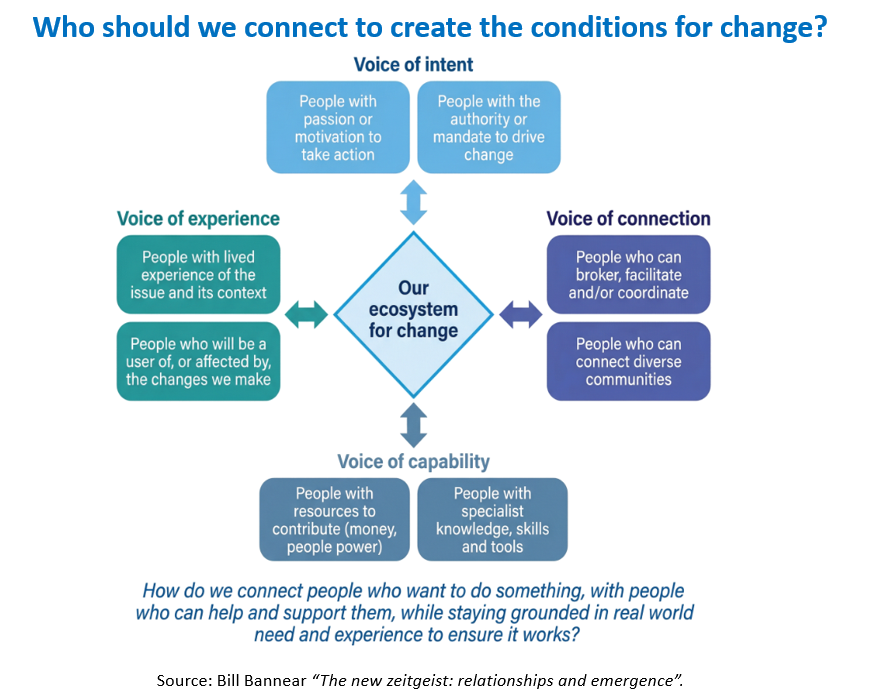
A tool I use it often in my own change practice (& share with others) is the “voices” model by Bill Bannear. It helps us reorient the work of change from designing the right plan to cultivating the right conditions: medium.com/@bill.bannear/the…
7
29
81
5,211
Mar 11
Check out my latest article: Captaining the Bravest Ship linkedin.com/pulse/captainin… via @LinkedIn
3
77
Cohesion: Connected Transformation by Design institutefordigitaltransform…
2
53
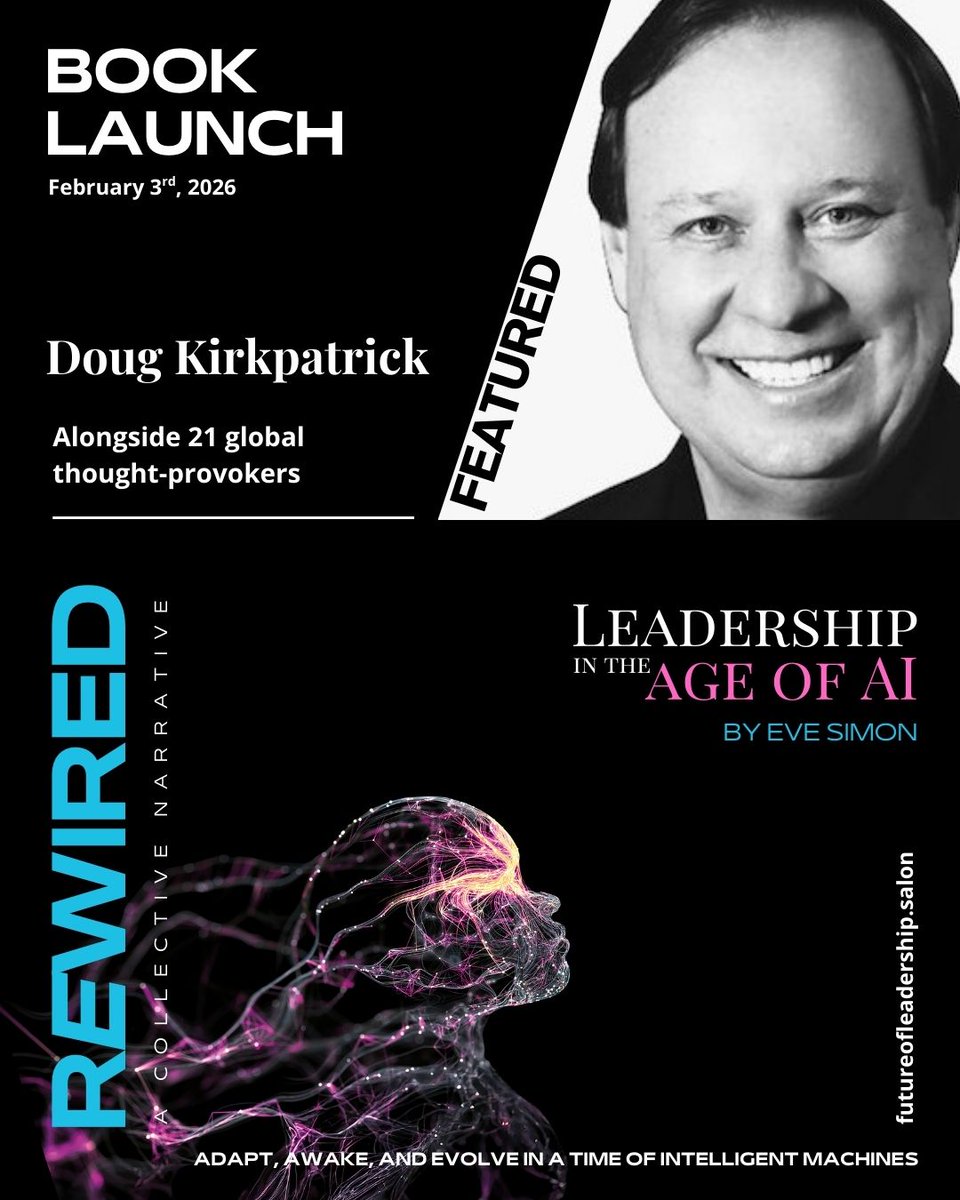
"Rewired: Leadership in the Age of AI" by Eve Simon now charting #1 on Amazon in multiple categories worldwide. Honored to be part of this effort to elevate humanity in a world of intelligent machines. a.co/d/00bpyIcC
1
1
64

While it's easier to avoid confrontations in the short run, the consequences of doing so can be massively destructive in the long term. It's critical that conflicts actually get resolved--not through superficial compromise, but through seeking the important, accurate conclusions. In most cases, this process should be made transparent to relevant others (and sometimes the entire organization), both to ensure quality decision making and to perpetuate the culture of openly working through disputes. #principleoftheday
75
131
703
62,901
Ultimately, power will rule. This is true of any system. For example, it has repeatedly been shown that systems of government have only worked when those with the power value the principles behind the system more than they value their own personal objectives. When people have both enough power to undermine a system and a desire to get what they want that is greater than their desire to maintain the system, the system will fail. For that reason the power supporting the principles must be given only to people who value the principled way of operating more than their individual interests (or the interests of their faction), and people must be dealt with in a reasonable and considerate way so that the overwhelming majority will want and fight for that principle-based system. #principleoftheday
139
317
1,458
105,891