
Joined April 2025
- Tweets 869
- Following 724
- Followers 41
- Likes 1,904
8 Photos and videos




Doug retweeted

22h
When people talk about AI chips in China, they focus only on Huawei. Just as the US has Cerebras, Google TPU, Amazon Tanium, & AMD, there is a far bigger ecosystem of players, including Cambricon with a US$40B market cap. Many public already. More here:
crossingriver.substack.com/p…
19
42
422
65,085
Doug retweeted

It was a good one, I guess
Thank you @HarryStebbings

Weekend listening: @romanchernin on @20vcFund with @HarryStebbings talking AI infrastructure bubbles, why cheaper compute creates more demand, and why the compute market is nowhere near its ceiling.
YouTube or any podcast platform → youtube.com/watch?v=aXAH3bdJ…
2
4
105
5,752
Doug retweeted

Jun 13
my take on this situation currently is that they'll unban it in a few days and the net effect will be increased demand for Fable
however this kind of thing is extremely disruptive and distracting for people inside of the company. the only comparable scenario i can remember is Sam Altman's firing which was resolved relatively quickly. even though things went back to the way they were, i do think that disrupted their momentum for a while
hoping for a good outcome here!
45
21
771
69,487
Doug retweeted

22h
Fable will be back in a few weeks likely with financial sector style KYC, anti-token laundering & prompt & data retention.
34
16
274
25,060
Doug retweeted

Jun 13
Karpathy said something you'll regret ignoring:
"Remove yourself as the bottleneck. Maximize your leverage. Put in very few tokens, and a huge amount of stuff happens on your behalf."
Loop engineering is the exact thing that does that.
In a hand-run session, the operator handles two things:
- deciding what the agent runs next
- and checking its output before the next step
Both are manual, and both decide how far the agent gets on its own without the operator.
Loop engineering moves both steps into the system.
A core operating structure surrounds the loop, and the diagram below depicts it.
- A schedule decides what to run
- Loop is the maker that produces the work
- A separate checker agent grades the output
- A file on disk holds the state they both read.
The loop runs until either done, max iterations, or an exhausted budget.
Here are some practical engineering considerations:
1) A model grading its own output justifies what it already did instead of catching where it failed.
That's why a separate checker's findings return to the maker as the next instruction. And the cycle repeats until the checker finds nothing left to fix.
2) A loop with no stop condition burns tokens, and the cost climbs fast once sub-agents and long runs add up.
That's why the exit must be set before the loop runs, not while it is running.
A simple exit could be:
↳ fix only the major issues, run one final pass, and stop after two loops, with "all tests pass and lint clean" as the rule that ends it.
3) State has to live on disk, not in context.
The model forgets everything between runs, so an MD file or a knowledge graph holds what is done and what is still open.
Each run reads it and writes back to it, which lets a loop pick up again after days.
4) The lower the verification bar, the safer the loop.
Boring, repetitive checks like a stale version string or a missing test are trivial to verify, so a loop runs them with little risk while the operator is away.
Judgment-heavy work is loopable too, but only as far as the checker can confirm the result.
Let's look at how an unattended loop fails in two ways.
1) It reports done when nothing is actually verified.
The separate checker exists to prevent it, but it merges code faster than anyone reads it, so over weeks, the team stops understanding its own codebase while every check stays green.
Green tests say the code passed the tests, not that anyone knows what shipped. Someone still has to read what the loop merges.
2) The checker keeps a running loop honest, but it only catches failures inside a run.
The harness around the loop, like the prompts, tools, and checks wrapped around the model, still drifts and breaks in production as models change.
That repair loop is usually run by hand based on observability traces.
My co-founder wrote a detailed walkthrough (with code) on making that harness repair itself, where a failing trace gets diagnosed, the fix is verified against the exact input that failed, and the failure is locked as a regression test so it cannot recur.
Read it below.

56
426
2,809
479,794
Doug retweeted

Jun 13
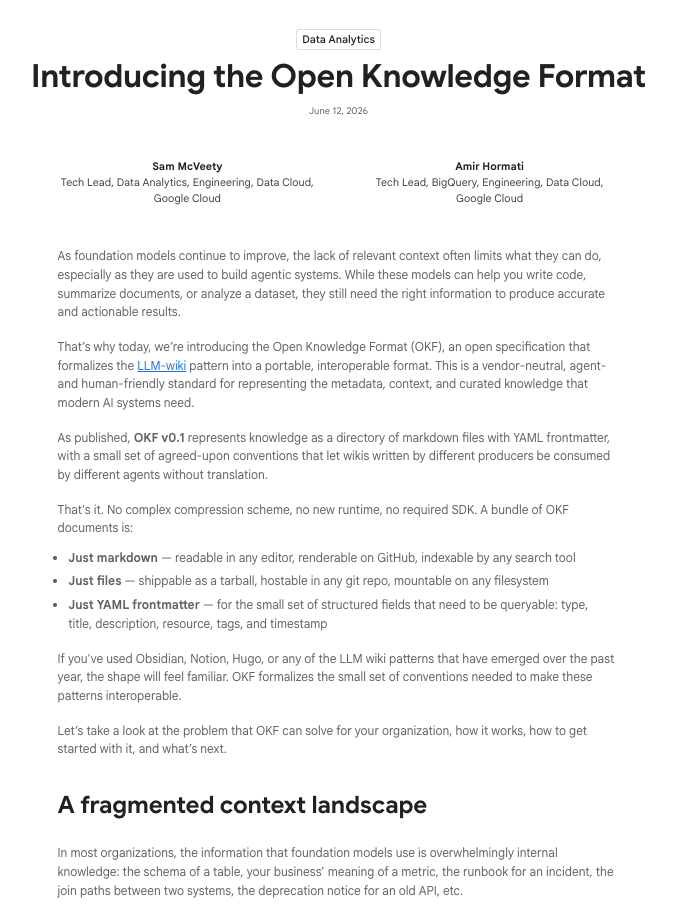
🚨 @Karpathy predicted the power of the "LLM Wiki." Google just formalized it.
Meet Open Knowledge Format (OKF): a vendor-neutral standard for giving foundation models the curated context they need.
I can genuinely see this replacing Notion, Obsidian, or traditional wikis for developer teams, and the reason comes down to bookkeeping.
Traditional wikis fail because humans inevitably abandon the tedious work of updating them.
As Andrej Karpathy pointed out recently, LLMs don't get bored.
They don't forget to update a cross-reference, and they can touch 15 files in a single pass.
OKF standardizes the interoperability layer so agents can actually do that heavy lifting autonomously.
Because the format is minimally opinionated, it doesn't dictate what you write, it just dictates how it's structured. You get:
→ Human-readable documents that live right alongside your code in version control
→ Cross-links that map out complex entity relationships without needing a graph database
→ A system that survives moving between different tools and organizations
There is no complex compression scheme.
No central registry.
If you can cat a file, you can read it.
If you can git clone a repo, you can deploy it.
This is how we stop rebuilding context pipelines from scratch every time a new model drops.
Announcement spec file in 🧵↓
53
236
1,705
150,932
So 100% table pound agree - this seems so fucking obvious!?!

Unpopular opinion: Apple should now acquire Perplexity AI.
It’s now clear that Siri’s AI new strategy is pretty much what Perplexity is doing anyways.
Apple would get (Personal) Computer some enterprise exposure.
1
7
Now this should interest #AI nerds other than me - right?
internetruleslab.com/black-m…
3
“Mr. Sacks did not name the “trusted partner” he referred to in his post.”
Me thinking about the (this) government shutdown of @AnthropicAI Fable and Mythos.
13

Doug retweeted

This is one of the most pivotal events in history because of the precedent it sets. Even if it doesn't stick, the cat is out of the bag: the government can now unilaterally decide who gets to use AI.
Over the last few days I had fully transitioned to orchestrating with Fable. It initially felt like the cookie jar was moved out of reach. Now after spending the day with Opus, I've accepted just how monumental this is.
Being denied the best AI model is effectively the same as being denied future employment.
Jun 13

The US government, citing national security authorities, has issued an export control directive to suspend all access to Fable 5 and Mythos 5 by any foreign national, whether inside or outside the United States, including foreign national Anthropic employees.
The net effect of this order is that we must abruptly disable Fable 5 and Mythos 5 for all our customers to ensure compliance.
Access to all other Claude models is not affected.
We apologize for this disruption to our customers. We believe this is a misunderstanding and are working to restore access as soon as possible.
Read our full statement: anthropic.com/news/fable-myt…
47
39
321
19,035
Doug retweeted

Jun 11
Question from a senior member of the banking community earlier this week: "Should we be the tortoise or the hare when it comes to AI?" My answer: a cautious hare.
5
2
7
1,919
Doug retweeted

Jun 12
Interesting.
Jun 11

Increasingly, I believe companies may need to be rebuilt from the ground up, where you have a single timeline of all observability product metrics file changes laid out in a retrievable system, like Datadog Posthog Google Drive Slack (really unified filesystem of Claude Code chats Codex chats). This might be the new data foundation for any and all companies to maximize AI. Needs to be rebuilt because keeping track of diffs on existing system basically impossible to produce longitudinal information on decisions and rollbacks, something coding agent storage companies are actively trying to figure out, but this should extend to businesses as a whole.
Highly skeptical existing businesses will adopt this though because it means overhauling everything about their instrumentation and business data, but I think businesses built on this foundation probably can execute 100x better and faster
71
35
1,061
400,616
Doug retweeted

Jun 10
We are incredibly excited to announce River AI. Our mission is to create personal AI that is owned and shaped by you.
Today’s best AIs are controlled by a few large corporations. We are building the alternative: a new, personal stack for AI that works entirely for you, shares your values, and operates on your terms.
117
127
1,463
725,882
Doug retweeted

Jun 10
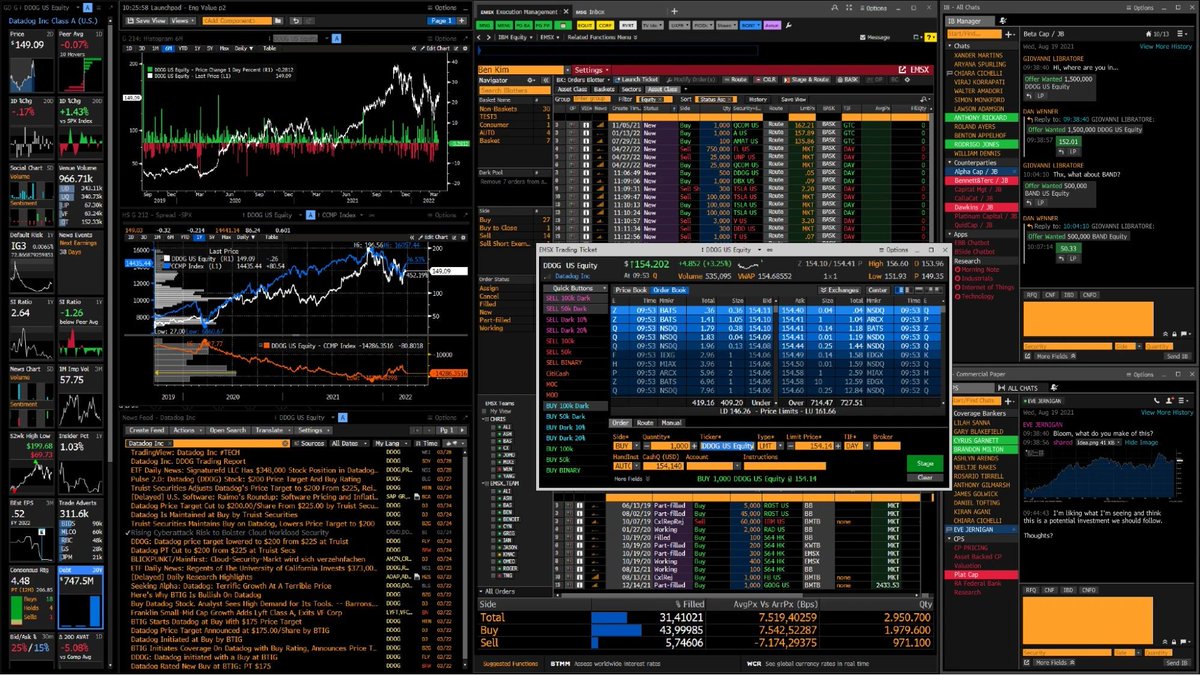
I just gave Claude Fable 5 access to my portfolio & told my AI trader:
“Turn this into $10M. Make no mistakes.”
It wrote 69 strategies.
Generated 420 research reports.
Spun up 21 new algos.
It scraped X, Reddit, Instagram, and LinkedIn.
Mapped sentiment.
Read every chart pattern it could find.
It traded 24/7.
It lost everything.
But boy was it beautiful.
3
1
10
655

Jun 11
Google pledges $50 million to help train skilled trade workers axios.com/2026/06/11/google-…
16

Doug retweeted
Jun 9
Hands down the absolute best Claude Cowork tutorial you’ll watch in under 25 minutes!
Made by Tina Huang (@hellotinah), former Meta data scientist turned content creator 👇
17
182
1,360
111,609
Doug retweeted

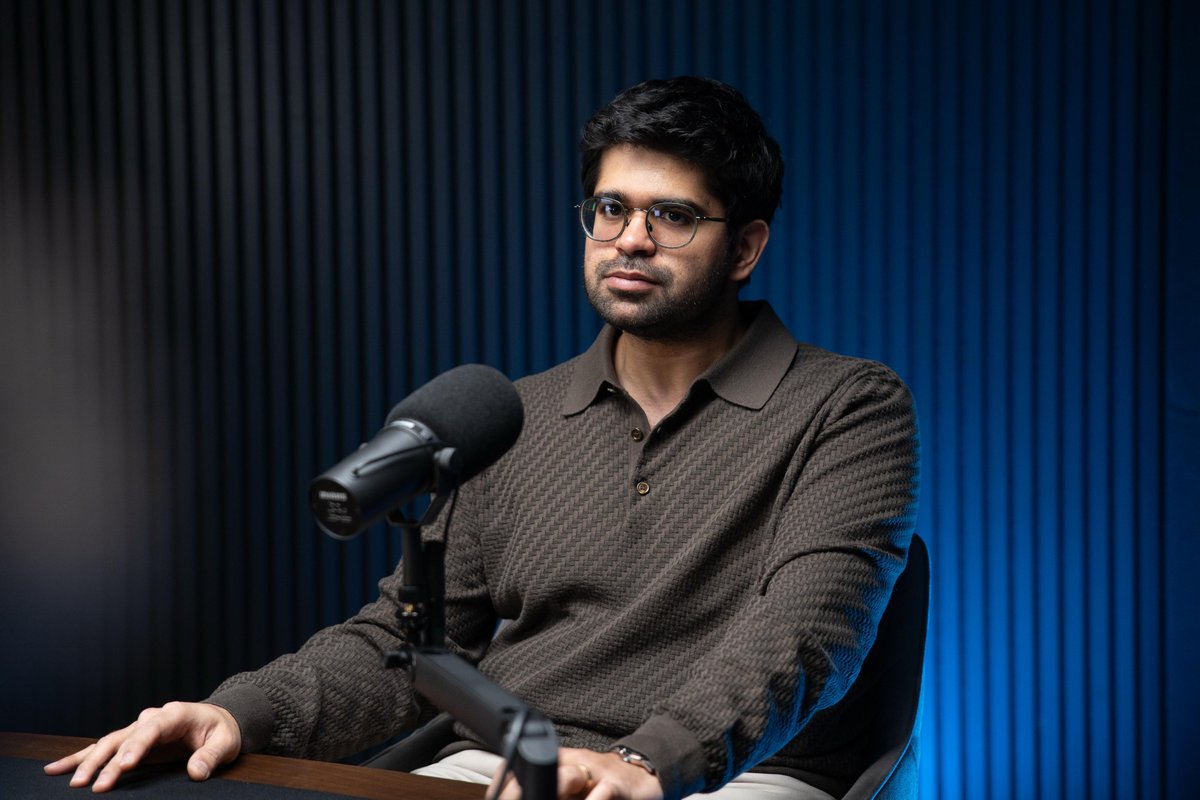
One of the best shows I have ever done.
1. The biggest problem today is power.
2. We will see large resistance to data centre buildout continue.
3. Micron will be worth more than Meta.
4. Export controls have meant China has developed their own architecture.
Alongside their ability to build data centres faster and cheaper, this makes them a real threat.
This and so much more on Monday but holy s*** this was like next level @AravSrinivas
18
19
324
61,481