
Joined May 2026
- Tweets 125
- Following 75
- Followers 616
- Likes 133
5 Photos and videos





Jun 12
Seeing a lot of hype around $VECO with nobody discussing or realizing the actual risk behind it.
If you're running into VECO because your favorite Furu told you to without ever mentioning the word "SAMR", think twice.
$VECO has one gatekeeper left between it and its merger: China's State Administration for Market Regulation (SAMR).
The market is treating SAMR like paperwork. It isn't. It's the most quietly weaponized regulatory desk in the US-China conflict, and right now it's holding this deal hostage.
Start with why Beijing even gets a vote on two American companies merging. SAMR jurisdiction attaches because Veeco and Axcelis both sell into China above the revenue thresholds - their own China business is the leash.
The deal needs Beijing's blessing precisely because both companies need Beijing's market.
And SAMR's signature move was never the formal block. It's the pocket veto.
Look up what happened to the Qualcomm/NXP deal. It never got rejected, it just bled out over years of stalling.
Intel/Tower, same playbook five years later. Silence past the outside date, years of stalling, and another dead deal.
That's what makes this binary nearly impossible to price. A rejection would at least be information. Silence is just time passing, and markets are terrible at pricing a veto disguised as a calendar - every quiet month reads as "still on track," right up until the deadline does the executing itself.
Here's the aggravating detail specific to Veeco: while it waits on Beijing's approval, WASHINGTON is restricting what Veeco may sell to Beijing.
The United States BIS license requirements just carved $8M out of Q1 and stranded ~$15M of annealing systems at port.
Veeco is asking a favor from the very government its own government is squeezing.
Put yourself behind SAMR's desk this summer. Export controls tightening, minerals leverage being traded openly, a Gulf crisis repricing every strategic supply chain (and across your blotter sits a pending US semicap merger: unilateral, costless, completely deniable leverage).
Why would you spend that chip a day earlier than you had to?
Even approval has a trap inside it. When SAMR does clear American tech deals, it increasingly attaches supply-continuity conditions to Chinese customers. So imagine NewCo legally bound by Beijing to keep supplying the same customers Washington requires licenses to ship to. Two regulators, incompatible orders, one company as the rope.
Map the tree honestly and it gets worse. Clean approval is largely priced after a 25% post-earnings run. Conditioned approval hands NewCo a compliance contradiction nobody has modeled. And silence past the outside date leaves you holding standalone VECO at ~35x guided EPS against an analyst deck still parked in the $30s. Two of the three branches hurt, and the good one pays the least.
What fintwit keeps missing is that the whole timeline is exogenous. Management can't accelerate it, lobby it, or guide it - "second half 2026" is an aspiration about another sovereign's negotiating calendar. You aren't underwriting a semiconductor company here. You're underwriting the temperature of US-China relations through December.
None of this says Veeco is a bad company. The orders are real, the photonics franchise is real. It's just that says the next six months don't belong to the company at all.
They belong to a regulator in Beijing with a costless veto and a calendar for a weapon.
Great business (I actually think if not for this SAMR situation it would be an immediate buy), but until this is resolved, hard pass.
NFA.
1
6
1,187
Jun 11
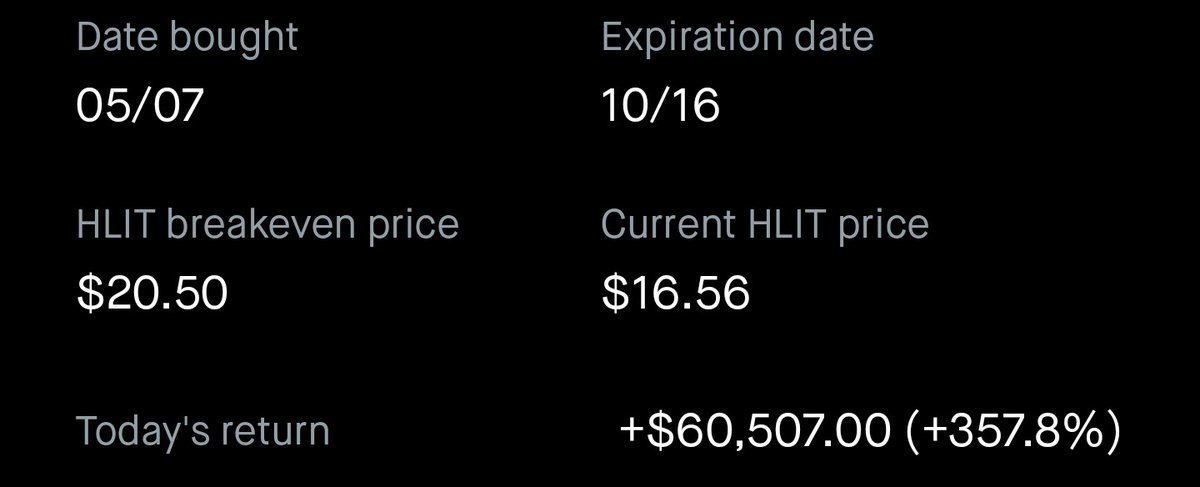
$HLIT × $AAOI - One Network, One Capex Budget, Two Tickers
Everyone's watching $AAOI for the AI optics story. Almost nobody noticed that buried under it is a second business - CATV amplifiers - that just turned AAOI into a real-time indicator for a completely different stock: $HLIT.
Here's the connection ABSOLUTELY NOBODY has stitched together.
In June 2025, Mediacom selected Harmonic's cOS vCMTS and Ripple remote-PHY nodes for its DOCSIS 4.0 upgrade. Last month, the same operator named AAOI the primary vendor for the amplifier side of the same program - 1M homes by end of 2026.
One network, one capex budget, two tickers. Harmonic supplies the brains and the nervous system; AAOI supplies the muscle between node and home. Every upgraded Mediacom home is an AAOI hardware sale and an HLIT capacity expansion at the same time.
Charter is the identical playbook at 30x scale. Harmonic's cOS is expanding across Charter's entire broadband base with unified-D4.0 Pebble-2 RPDs, while AAOI's 1.8GHz amps are Charter-certified and shipping - record cable revenue, 24% QoQ, full-year CATV guidance raised to ~$320M.
The Cox merger footprint adds fresh TAM for both.
And because amp cascades get replaced plant-wide as each segment converts, AAOI's shipment curve is a live odometer for the plant conversion that Harmonic's software monetizes.
When AAOI management cites "broad-based demand" in CATV, that's independent confirmation (from one layer over in the same stack) that cable D4.0 spending is accelerating RIGHT NOW.
The market already senses the pairing: the day the Mediacom amplifier news hit, AAOI ran 24% and HLIT ran 12% on someone else's press release.
Now layer on what Harmonic JUST filed on Monday.
June 8 was the one day either side could walk away from the $145M sale of Harmonic's Video business. HLIT spent it filing an 8-K nobody required - a voluntary, deadline-day confirmation that the deal remains on track to close this quarter.
Read that the way you'd read an insider buy.
Companies facing a dying deal go silent and let the lawyers draft termination language.
Companies that file unprompted reassurance on the contract's scariest date are telling you which version of the future they're operating in.
What closes alongside the deal: the last reason to model HLIT as a melting video vendor. What remains is a pure-play broadband software company growing 43%, sitting on a $582M backlog up 87%, with raised guidance and $145M of fresh cash - still priced with a conglomerate discount the filing just put on a countdown.
The chart agrees about where, if not when. May's breakout cleared a multi-year downtrend on ~92M shares - the heaviest month in the stock's modern history. That's institutional repositioning, not retail.
The fade since has been orderly and thinning: 0.786 retrace of the $12→$18 swing held at $13.67, the $14.30 gap filled and defended, weekly RSI reset from 76 to the mid-40s with structure intact.
Deep-but-held retrace, record-volume base break, dated catalyst.
Small caps rarely line all three up.
Watch AAOI's CATV numbers if you own HLIT. Watch HLIT's close if you own AAOI. Same wave, two boats.
NFA. Long $HLIT.
5
1
27
4,973
Jun 8
$AAOI
Every single point is 100% true.
I don't think people understand how insane the demand is for these transceivers. They are literally tracked down by the box.
Not even sure what the bear case is for AAOI at this point.
Jun 8

1) sounds like the capacity buildout is going well, in terms of hitting their 2027/2028 targets, it's definitely not a demand issue... they have way more demand than they can handle
2) sounds like there's a clear path to 35% gross margins in the next few years
3) their biggest customers would basically commit to take 100% of their supply over the next few years if $AAOI would let them
4) sounds like every hyperscaler is giving LTA offers, trying to lock down supply
5) it costs approx $120M in capex to increase capacity by 100k transceivers... which is 1.2M per year... at an average of $500 ASP... so they're spending $120M to generate $600M revenues per year at 35-40% gross margins ... love that math
will add more in the next couple days :)
8
5
107
22,919
Jun 8
$AIRJ just published a white paper that reframes the entire thesis. This isn't a water story. It's a permitting story.
Here's the problem they're actually solving.
A 100 MW hyperscale data center generates $3–5M in revenue per day once operational. In the U.S. Southwest, Australia, Singapore, and the Middle East, water permits at that scale now take months to years. Every quarter of delay is hundreds of millions in deferred capacity revenue.
The conventional fix is switching to air-cooled chillers. Problem solved, right? Except it isn't.
Air-cooled systems consume 1.5–2.5× more electricity than water-cooled. At 100 MW IT, that's $5–13M per year in additional electricity costs. Permanent. Paid every hour for the life of the facility. Operators are trading a permitting problem for an energy problem they can't recover from.
AirJoule is the third option. Keep the water-cooled architecture. Generate the water on-site from waste heat the facility already produces. No permit required. No architectural compromise.
The white paper models this across five climate zones using PUE figures sourced directly to Microsoft, Google, AWS, and Meta sustainability reports. The methodology is rigorous.
The Midland, TX case study is where it gets specific.
Two scenarios:
Case A - 75% permit secured, AirJoule closes the gap. 695 Prime units, ~$105M capex. Adds only 0.06 to PUE vs. the 0.15 permanent penalty of going air-cooled - worth $4.7M/yr in electricity savings for the life of the facility.
Case B - full water independence, no permit at all. 287 units, ~$45M capex, 0.03 PUE impact. No GCD approval, no public hearings.
Here's the number that reframes the investment case.
At $3M/day hyperscale revenue, the entire AirJoule fleet capex is recovered in 15–35 days of permit acceleration.
If AirJoule pulls a schedule forward by even 100 days, captured revenue of $300–500M exceeds the entire investment several times over.
This isn't a sustainability argument. It's an IRR argument. Different conversation. Different decision-makers.
Unit pricing disclosed for the first time: $100,000–$200,000 per Prime unit.
At the $150K midpoint, a 287-unit fleet is ~$43M to the customer. A 695-unit fleet is ~$104M.
Real contract sizes. Real revenue events for AIRJ when they convert. The first large commercial contract would be a material catalyst.
One detail the market hasn't priced: the 18–30 month lead time disclosure.
"We engage with operators and EPC partners 18 to 30 months before commercial operation date."
If the unnamed hyperscaler in active technical engagement places an order in 2026, revenue materializes in 2027–2028 - exactly consistent with management's guidance. The pipeline is further along than it looks.
The white paper is written for technical buyers and EPC engineers, not retail investors. PUE figures anchored to hyperscaler sustainability disclosures. Climate methodology referenced to ASHRAE standards. Construction benchmarks from JLL and Turner & Townsend.
That's a signal about where the commercial conversation actually is.
AIRJ isn't selling water. It's selling permit independence and schedule certainty to operators for whom a single quarter of acceleration is worth $270–450M in captured revenue.
$45–105M contract sizes. Active hyperscaler engagement. Prime built and operational. Runway through 2027. The white paper is the commercial document. The contracts are the catalyst.
NFA. DYOR. Long $AIRJ.
5
4
30
23,313
Jun 5
$HLIT
Quietly executing with a catalyst next week.
The Video sale closes June 8
$145M all-cash from MediaKind transforms the balance sheet overnight:
→ Wipes $111M in debt
→ Leaves $140M net cash
→ Creates a pure-play broadband company
The customer win cadence is relentless.
Since Q4 2025 alone:
🇺🇸 Vyve Broadband - 16 states, cOS deployment
🇲🇽 izzi Mexico - large fiber rollout, multi-year
🇻🇪 Inter Venezuela - largest private ISP, nationwide cOS
🇩🇪 Vodafone Germany - DOCSIS 4.0 trial → scaled commercial
🇫🇮 DNA Finland - SeaStar optical nodes, MDU
🇨🇭 Canal Alpha Switzerland - XOS AI Media Processor
🇹🇼 KBRO Taiwan - fiber on-demand
🇸🇪 Alcom Nordic - white-label
Vodafone Germany, the largest cable operator in Europe, 25M homes passed - has run on Harmonic's CableOS since 2020.
DOCSIS 3.1 → now upgrading to DOCSIS 4.0 on the same platform.
That's the upgrade cycle compounding on the installed base. Operators don't rip and replace when they score the vendor an NPS of 85.
Speaking of NPS
Customer Net Promoter Score hit 85 in Q1 2026, up from 82 at year-end 2025.
For context: Apple typically scores ~72. Amazon ~73. An NPS of 85 in enterprise infrastructure is virtually unheard of.
Operators deploying billions in capex don't leave vendors they love this much.
The AI intelligence layer is live and working
Beacon, Pathfinder, and Amply aren't vaporware:
→ Beacon reduced customer service calls by 30% at early adopters
→ Every cOS deployment feeds proprietary network telemetry data back into the AI layer
→ The moat deepens with every new operator that goes live
This is the software multiple expansion catalyst the market hasn't priced yet.
$HLIT is quietly building a global broadband OS:
→ North America: Charter, Cox, Vyve Tier-2/3 operators
→ Latin America: izzi Mexico, Inter Venezuela
→ Northern Europe: Vodafone Germany, DNA Finland
→ Central Europe: Canal Alpha Switzerland
→ Asia: KBRO Taiwan
Rest-of-world revenue hit $138M in 2025 vs $95M in 2024. A 45% jump in one year.
The switching cost moat is underappreciated.
Once an operator deploys cOS as their vCMTS it is embedded in the network architecture - not a hardware box you swap out.
It's the operating system of the network.
Vodafone went DOCSIS 3.1 → 4.0 on Harmonic. DNA Finland chose Harmonic for the hardest MDU problem in their network.
These operators are not shopping around.
The numbers:
→ Full year 2026 broadband revenue guidance: $475M–$495M
→ That's the third consecutive guidance raise
→ $582M backlog, up ~87% YoY
→ Video sale closes June 8: $145M cash, debt wiped
→ Pure-play broadband re-rating ahead
2
3
16
3,037
Jun 4
We know about $AIRJ and data centres.
But the MOF sorbent technology has other applications that aren't getting nearly enough attention.
1. Forward operating bases.
No water supply chain. No aquifer. Hostile arid terrain.
A passive atmospheric harvester running on solar with no moving parts is exactly what DARPA has been trying to solve for years. Defence procurement moves slow - but when it moves, it moves big.
2. Semiconductor fabs
Ultra-pure water is one of the most critical and scarce inputs in chip manufacturing. Fabs in Taiwan and Arizona are already under water stress.
Atmospheric sourcing with MOF purity profiles could be transformational for fab siting decisions.
3. Pharmaceutical manufacturing.
Same logic - highly regulated water purity requirements, high willingness to pay, concentrated facilities.
MOF sorbents don't just harvest water. They harvest clean water, without the contamination risk of ground or surface sources.
4. Agricultural irrigation in water-stressed regions.
The economics are harder at scale - but pair it with cheap solar in the Middle East, North Africa, or the American Southwest and the math starts working.
Water scarcity is already destroying crop yields. The alternative cost matters.
5. The data centre story is real. But it's the beachhead, not the ceiling.
The deeper thesis is that MOF sorbents decouple human activity from fixed water infrastructure entirely.
That's not a niche product. That's a platform.
Jun 3

$AIRJ - two massive signals the market is missing:
1. The Rice family is invested.
Who are they and why is this so significant?
Daniel Rice is the CEO of $NPWR NET Power, EQT board member, and co-founder of Rice Investment Group. And he has a stake in $AIRJ.
This is the man who:
→ Founded Rice Energy → sold to EQT for $6.7B → 3,200% return for early investors
→ Seeded Archaea Energy → sold to BP for $4.1B → 10x for seed investors
→ Took NET Power public — clean power from natural gas with carbon capture
Three ventures. Three massive exits.
All in energy transition infrastructure.
How does AIRJ fit into NET Power?
The Allam Cycle generates clean electricity from natural gas while capturing CO2. It also generates substantial waste heat.
AirJoule converts waste heat into purified water.
A NET Power plant paired with AirJoule = zero-water-consumption, carbon-captured power AND water for data centers.
Rice isn't just a passive investor. He's potentially building the full stack.
2. The insider buying signal
12 insider purchases vs 1 sale over the past 6 months.
CEO Matthew Jore (already a 10% owner) bought shares at $3.25 in January's offering rather than letting it dilute him.
A 10% owner adding personal capital at $3.25 when the stock is now $5 is not ambiguous.
He believes the Nexus WPA is coming.
Putting everything together:
→ Nobel Prize-validated science ✅
→ GE Vernova 50/50 equity JV ✅
→ Carrier Global licensing ✅
→ Google Microsoft consortium ✅
→ US Army active evaluation ✅
→ Nexus 600MW deployment 2H26 ✅
→ Rice Investment Group backing ✅
→ 12:1 insider buy/sell ratio ✅
→ CEO is a 10% owner adding shares ✅
→ Two analyst targets at $12 ✅
The Rice family doesn't take small bets on bad technology. Neither does GE Vernova.
Pre-revenue. Speculative. All the risks. Not financial advice.
But when the people with the best track record in energy transition infrastructure are buying alongside you...?
That's a bet I'm willing to take.
$AIRJ $AIRJW $GEV $CARR $NPWR $EQT
1
13
2,704
Jun 3
$AIRJ - two massive signals the market is missing:
1. The Rice family is invested.
Who are they and why is this so significant?
Daniel Rice is the CEO of $NPWR NET Power, EQT board member, and co-founder of Rice Investment Group. And he has a stake in $AIRJ.
This is the man who:
→ Founded Rice Energy → sold to EQT for $6.7B → 3,200% return for early investors
→ Seeded Archaea Energy → sold to BP for $4.1B → 10x for seed investors
→ Took NET Power public — clean power from natural gas with carbon capture
Three ventures. Three massive exits.
All in energy transition infrastructure.
How does AIRJ fit into NET Power?
The Allam Cycle generates clean electricity from natural gas while capturing CO2. It also generates substantial waste heat.
AirJoule converts waste heat into purified water.
A NET Power plant paired with AirJoule = zero-water-consumption, carbon-captured power AND water for data centers.
Rice isn't just a passive investor. He's potentially building the full stack.
2. The insider buying signal
12 insider purchases vs 1 sale over the past 6 months.
CEO Matthew Jore (already a 10% owner) bought shares at $3.25 in January's offering rather than letting it dilute him.
A 10% owner adding personal capital at $3.25 when the stock is now $5 is not ambiguous.
He believes the Nexus WPA is coming.
Putting everything together:
→ Nobel Prize-validated science ✅
→ GE Vernova 50/50 equity JV ✅
→ Carrier Global licensing ✅
→ Google Microsoft consortium ✅
→ US Army active evaluation ✅
→ Nexus 600MW deployment 2H26 ✅
→ Rice Investment Group backing ✅
→ 12:1 insider buy/sell ratio ✅
→ CEO is a 10% owner adding shares ✅
→ Two analyst targets at $12 ✅
The Rice family doesn't take small bets on bad technology. Neither does GE Vernova.
Pre-revenue. Speculative. All the risks. Not financial advice.
But when the people with the best track record in energy transition infrastructure are buying alongside you...?
That's a bet I'm willing to take.
$AIRJ $AIRJW $GEV $CARR $NPWR $EQT
Jun 3
$AIRJ — the most important water story in AI infrastructure that nobody is talking about (and why I think it's a better buy today than $LWLG - NOT saying the two technologies are related)
Credit to @AtlasShrug1 for putting this on my radar.
1. The problem
Data centers consume up to 5 million gallons of water per day. In Arizona, Nevada, and Texas, municipalities are already denying permits and enacting sprinkler bans on hyperscaler campuses.
The water math is broken. The hyperscalers know it.
2. The solution - Nobel Prize-winning science:
Metal-Organic Frameworks (MOFs) harvest water vapor directly from air using waste heat as the energy source.
Server waste heat in → distilled purified water out. Net additional energy cost: near zero.
This is the science that won the 2025 Nobel Prize in Chemistry.
3. The DARPA origin
Developed under the DARPA (the premier research and development agency of the US DoD) AIR2WATER program. GE Vernova's Advanced Research Center was a named co-developer, working directly alongside Nobel laureate Omar Yaghi's Berkeley lab.
Not a licensing deal with a Nobel laureate. GEV's engineers were in the lab building this alongside him.
4. The GEV JV Significance
$GEV is a $90B industrial giant. They don't do 50/50 equity JVs with $375M public companies. Ever.
Except this one time.
GEV has equity on the line - not a supply agreement, not a royalty. If AirJoule fails, GEV loses too.
Their historical playbook ends in full acquisition - see Prolec GE, bought out at $5.3B. AirJoule LLC is early on that arc.
5. The validation stack
Nobel Prize 2025 ✅
$GEV 50/50 equity JV ✅
$CARR Carrier licensing deal ✅
Google Microsoft Net Zero Innovation Hub ✅
US Army ERDC active evaluation ✅
Dubai, Arizona State University, rural California deployments ✅
Nexus 600MW campus Hubbard TX - named deployment 2H26 ✅
Advanced hyperscaler negotiations ongoing ✅
6. Field validation is already running
Nexus watched a 24/7 AirJoule system run on their own Hubbard campus for months before agreeing to advance toward a signed contract.
Not a pitch deck. Real performance data across real conditions.
7. The WPA Re-Rating Potential
AIRJ doesn't sell equipment. They sell water.
Water Purchase Agreements = solar PPA structure.
AIRJ owns the system, customer pays per gallon, no capex, multi-year contracted recurring revenue.
Multiple WPAs signed = re-rate from pre-revenue tech to water utility annuity model.
Completely different valuation multiple.
8. The Path
1–7 months: Nexus WPA signed → first revenue
2026–27: Hyperscaler qualification → de facto standard
Ongoing: CARR royalty ramp through $22B distribution network
Long-term: GEV acquisition optionality
9. $LWLG Comparison
LWLG is real technology - but $1.96B market cap, no named partner, no named customer, no deployment, no warrants.
AIRJ at $375M has GEV equity, Nobel science, Nexus 2H26, CARR licensing, and $AIRJW warrants at $1.30.
One-fifth the market cap.
Dramatically more de-risked.
10. How to play it
$AIRJW - $11.50 strike, March 2029 expiry, ~$1.30. 2.8 years of runway.
~4x leverage on the commons.
Pre-revenue. Speculative. Dilution risk. Nexus WPA not yet signed. Not financial advice.
But when GE Vernova (and the esteemed @AtlasShrug1) are in - it's worth understanding why.
$AIRJ $AIRJW $GEV $CARR $LWLG
3
5
39
11,931
Jun 3
$AIRJ — the most important water story in AI infrastructure that nobody is talking about (and why I think it's a better buy today than $LWLG - NOT saying the two technologies are related)
Credit to @AtlasShrug1 for putting this on my radar.
1. The problem
Data centers consume up to 5 million gallons of water per day. In Arizona, Nevada, and Texas, municipalities are already denying permits and enacting sprinkler bans on hyperscaler campuses.
The water math is broken. The hyperscalers know it.
2. The solution - Nobel Prize-winning science:
Metal-Organic Frameworks (MOFs) harvest water vapor directly from air using waste heat as the energy source.
Server waste heat in → distilled purified water out. Net additional energy cost: near zero.
This is the science that won the 2025 Nobel Prize in Chemistry.
3. The DARPA origin
Developed under the DARPA (the premier research and development agency of the US DoD) AIR2WATER program. GE Vernova's Advanced Research Center was a named co-developer, working directly alongside Nobel laureate Omar Yaghi's Berkeley lab.
Not a licensing deal with a Nobel laureate. GEV's engineers were in the lab building this alongside him.
4. The GEV JV Significance
$GEV is a $90B industrial giant. They don't do 50/50 equity JVs with $375M public companies. Ever.
Except this one time.
GEV has equity on the line - not a supply agreement, not a royalty. If AirJoule fails, GEV loses too.
Their historical playbook ends in full acquisition - see Prolec GE, bought out at $5.3B. AirJoule LLC is early on that arc.
5. The validation stack
Nobel Prize 2025 ✅
$GEV 50/50 equity JV ✅
$CARR Carrier licensing deal ✅
Google Microsoft Net Zero Innovation Hub ✅
US Army ERDC active evaluation ✅
Dubai, Arizona State University, rural California deployments ✅
Nexus 600MW campus Hubbard TX - named deployment 2H26 ✅
Advanced hyperscaler negotiations ongoing ✅
6. Field validation is already running
Nexus watched a 24/7 AirJoule system run on their own Hubbard campus for months before agreeing to advance toward a signed contract.
Not a pitch deck. Real performance data across real conditions.
7. The WPA Re-Rating Potential
AIRJ doesn't sell equipment. They sell water.
Water Purchase Agreements = solar PPA structure.
AIRJ owns the system, customer pays per gallon, no capex, multi-year contracted recurring revenue.
Multiple WPAs signed = re-rate from pre-revenue tech to water utility annuity model.
Completely different valuation multiple.
8. The Path
1–7 months: Nexus WPA signed → first revenue
2026–27: Hyperscaler qualification → de facto standard
Ongoing: CARR royalty ramp through $22B distribution network
Long-term: GEV acquisition optionality
9. $LWLG Comparison
LWLG is real technology - but $1.96B market cap, no named partner, no named customer, no deployment, no warrants.
AIRJ at $375M has GEV equity, Nobel science, Nexus 2H26, CARR licensing, and $AIRJW warrants at $1.30.
One-fifth the market cap.
Dramatically more de-risked.
10. How to play it
$AIRJW - $11.50 strike, March 2029 expiry, ~$1.30. 2.8 years of runway.
~4x leverage on the commons.
Pre-revenue. Speculative. Dilution risk. Nexus WPA not yet signed. Not financial advice.
But when GE Vernova (and the esteemed @AtlasShrug1) are in - it's worth understanding why.
$AIRJ $AIRJW $GEV $CARR $LWLG
Jan 27

2
13
11,854
Jun 1
May 26
$IQE $IQEPF vs LandMark
The market is paying 118x revenue for a Taiwan-based CPO epiwafer supplier with no defense relationships and 3 patents.
It's paying 6x revenue for a UK/US-based CPO epiwafer supplier with 15-year Raytheon qualification, BAE Gold Tier status, Lumentum and MACOM LTAs, Point72 and Artisan on the register, explicit government supply chain protection, and a £45M strategic anchor investment.
The gap between those two valuations is the IQE opportunity in one number....
2
10
2,889
Jun 1
Was wondering why my notifications blew up overnight! Appreciate the callout, glad the price action on $IQE is cooperating today.

If you’re wondering why I’m rotating my capital into $IQE like a maniacal monkey. It’s because of what my friend @DraupnirAlpha has written up here. He is severely under followed and underrated. Pls give him a follow if you want more alpha. And also there are multiple posts on his account regarding $IQE, so plenty of material to form your own thesis!
x.com/draupniralpha/status/2…
1
10
3,430
Jun 1
$HLIT is sitting at the most important level in its 25-year history - and most people just walked away.
Here's why that was a mistake:
THE CHART
25-year descending trendline broken.
Biggest volume shelf in the stock's history sits at $13-15.
Elliott Wave 2 retracement happening right now - before Wave 3 launches.
Weekly Monthly BB squeezes firing simultaneously.
Targets:
$18.20 → $21.90 → $25.60 → $35
THE CATALYST
$HLIT is selling its Video business to MediaKind for $145M cash.
Termination deadline: June 8, 2026.
That's 7 days away.
Close = pure-play broadband company $145M balance sheet injection.
THE OPTIONS FLOW
On May 28 (the 52-week high) - someone bought $22.50 calls expiring June 18 across multiple blocks and sweeps.
Total premium: ~$235K
Stock was at $17.03.
That's a 32% move required in under 3 weeks.
That's not a hedge.
That's someone who knows the timeline.
SMART MONEY CONFIRMATION
While FinTwit was selling, Citrini's Dynamic AI quietly increased its long $HLIT position.
They simultaneously reduced $NVDA, closed $SNPS, trimmed $POWI and $VRSN.
They chose to add HLIT.
THE SETUP
Fintwit left. Sentiment crushed.
$22.50 calls bought 4 days ago.
Citrini adding on the -11% day.
Video sale closes within days.
25 years of volume support directly beneath price.
The tourists left. The thesis didn't.
2
21
3,742
May 29
$SIVE $SIVEF
And now the people with a brain are dumping.
The comments on this post are insane - you idiots deserve to lose money.
May 29
$SIVE $SIVEF
Tried to warn people. The structure of the dilution alone was enough to stay away.
One of the worst earnings reports I've ever seen, as expected.
Photonics (the entire story around this stock) specifically down -32%...
Cash burn increased from -15.8m to -49.2m
Anyone talking about the
"opportunity pipeline" is severely misguided and deluding themselves at this point.
5
2
5,704
May 29
$SIVE $SIVEF
Even these large accounts fail to do any level of proper analysis.
The ENTIRE bull thesis is on the photonics segment of this stock, but let's take a look at the sequential history:
Q2/Q3 2024: Photonics growing strongly, cited as a key driver
Q4 2025: Photonics adjusted EBITDA hit SEK 16.0M - an actual profitable quarter for the segment!
Q1 2026: Photonics -32% YoY (????)
The critical problem with management's excuse?
Management blamed the US government shutdown and defense budget delays for the overall revenue miss.
That explanation holds for Wireless (beamformers, SATCOM, defense electronics).
But photonics is AI datacenters and LiDAR, not defense.
The shutdown narrative doesn't credibly explain a -32% photonics decline.
So either:
1) A major photonics customer delayed orders for unrelated reasons
2) There's a product transition gap between NRE work ending and product revenue starting
3) The Jabil/O-Net partnerships generated buzz but no revenue yet - those announcements came after the quarter ended.
Oh, and citing that opportunity pipeline growth?
Here's how Sivers defined that: "non-binding revenue potential over the 2026-2030 strategic horizon"
Non-binding being the operative word here.
May 29

$SIVE Q1 Earnings:
Revenue: $6.7M (-22% YoY)
EBITDA: -$1.5M
EPS: $0.32 (-25%)
Pipeline: 77% - KEY NUMBER
Ignore the financials - losses are from expanding sales team to support the pipeline preparations for U.S. listing.
Upcoming exponential CPO TAM expansion to $91B (Goldman Sachs) is $SIVE's major growth driver for 1.6T pluggables.
Where they sit alongside $LITE, $COHR, $MTSI as critical laser suppliers for hyperscaler architectures.
All of this has been confirmed by the CEO:
"Record pipeline growth and several volume productions until 2027"
Driven by "enormous interest in our standard products for wireless beamformers and InP lasers"
E.g. $SIVE's partnership w/ $JBL for 1.6T transceivers is pure validation of the tech. Jabil are huge.
And they have other notable customers via @aleabitoreddit supply chain mapping e.g. $AAPL / $MRVL.
With the pipeline expanding significantly and "additional customer prospects in
pluggables"
Overall very bullish validation of the long term thesis rolling into the CPO ramp up in 2027.
TLDR:
Ignore the headline numbers, they're scaling up to meet exponential demand.
Focus on fwd growth instead, which has been confirmed via pipeline expansion in Q1. This'll only keep going up in subsequent quarters.
Personally expecting Europeans to sell the headline numbers.
11
30
26,068
Draupnir retweeted

May 29
If your a new retail trader let me explain
Contracted backlog means this is real revenue they have under contract and they are getting
Non contracted backlog could be murky could mean meaningful opportunities they currently are bidding on
Oppurtunity pipeline means
We have zero of this under contract or even under contract discussion
But we have a potential oppurtunity that coukd arise
Its like saying Sydney Sweeney potentially could be your wife
1
1
27
1,810
May 29
$SIVE $SIVEF
Tried to warn people. The structure of the dilution alone was enough to stay away.
One of the worst earnings reports I've ever seen, as expected.
Photonics (the entire story around this stock) specifically down -32%...
Cash burn increased from -15.8m to -49.2m
Anyone talking about the
"opportunity pipeline" is severely misguided and deluding themselves at this point.
May 19
This one might be unpopular, but here goes:
🧵 $SIVE has run 1,200% in under a year. Management called the April raise "only 2.5% dilution." Here's why that framing is misleading — and what the filings actually show:
1. The 2.5% figure comes from Sivers' own April 16 press release (MFN.se). What they didn't headline: the denominator already includes ~41M shares of warrants, options and convertibles that don't show up in the basic share count. The 2.5% is technically accurate. The framing is not.
2. Do the math yourself: 8.62M new shares ÷ 2.5% = ~345M fully diluted shares. Basic count post-raise: ~304M. That 41M gap is real latent dilution sitting above the stock right now. Source: Sivers April 16 directed issue press release.
3. It gets worse. At the June 15 AGM (source: Sivers AGM notice, sivers-semiconductors.com), management is asking shareholders to authorize:
→ 7M new stock options (P11 program)
→ Power to issue 15% MORE shares (~46M) with NO further shareholder vote needed
4. Key dates the bulls aren't pricing in:
📅 June 15 — AGM. 15% blank-check authorization vote.
📅 Mid-July — 90-day insider lock-up expires. Board members, CEO, CFO free to sell. (Source: April 16 press release)
📅 Mid-October — 180-day company lock-up expires. New issuance open season.
5. Also confirmed in the AGM notice: a USD $12M convertible loan from Bootstrap Europe at 10.85% interest, maturing Dec 2029. At ~55 SEK/share it's deeply in the money. Conversion = more shares, no vote required.
6. Meanwhile (source: EFN.se, May 18):
→ Largest shareholder Achilles Capital: 18.2M shares in March → 0 today
→ CTO sold 42M SEK of stock outside FI disclosure requirements
→ Three board members leaving simultaneously
→ Foreign ownership jumped from 15% → 48%, primarily retail via custodian accounts
7. The fully diluted P/S at ~55 SEK: ~70x. Revenue 2025: SEK 307M (restated). Net loss: SEK 223M (also restated wider, source: Sivers 2025 annual report).
Don't get me wrong, the CPO/InP thesis certainly seems to be real. However, the current price embeds perfect execution on a pre-revenue photonics ramp while insiders exit and the cap table expands.
Read the filings.
As always, NFA/DYOR.
34
29
31,081