
Reliable web data for AI.
Joined July 2025
- Tweets 80
- Following 12
- Followers 22
- Likes 21
13 Photos and videos

Mar 23
most people set up Puppeteer, fight with proxies, and manage 3 different API keys just to scrape a webpage
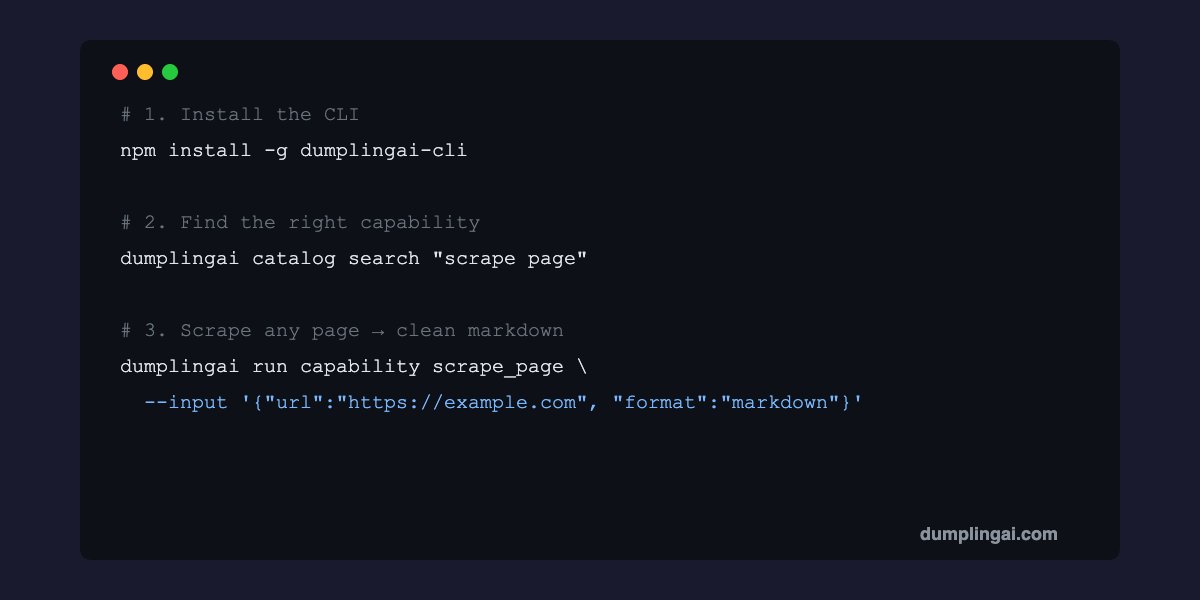
with DumplingAI CLI it's 3 commands:
1. install it
2. search the catalog
3. run it
clean markdown output. no proxy config. no API key juggling.
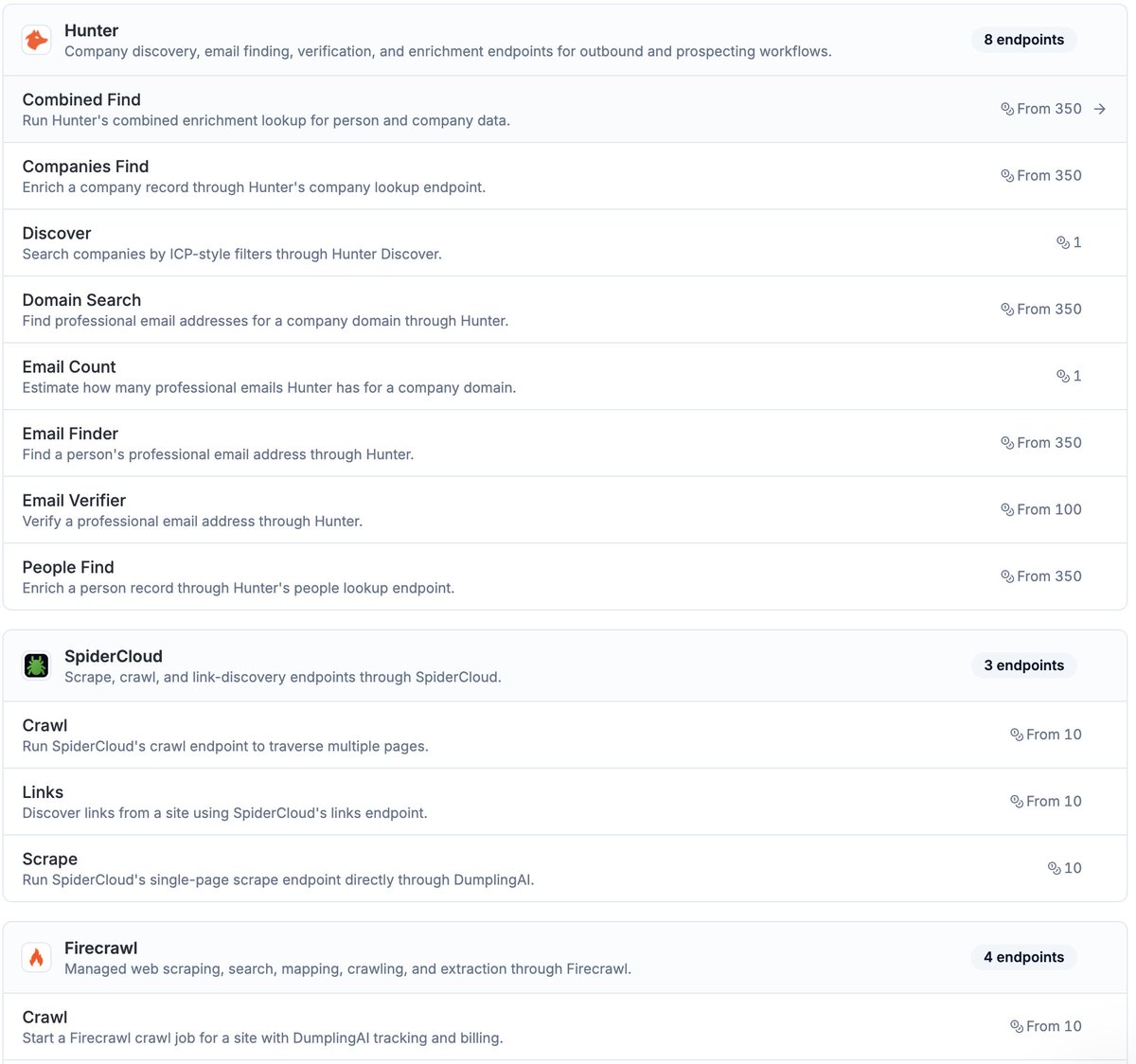
it auto-routes across 4 providers (Firecrawl, ScrapingFish, SpiderCloud, PhantomJS) — if one fails, it falls back to the next
one API key. 50 data capabilities. pay per use.
get started → dumplingai.com
37
Mar 13
Introducing the DumplingAI CLI
Give your AI agents access to 50 data APIs without needing to juggle countless API keys or subscriptions
Save money, better reliability, no subscriptions
Start with:
npm install -g dumplingai-cli
1
1
2
134
Mar 13
Want an API we don't have yet? Just let us know and we will add it!
Check out the source code, open an issue, or suggest a feature in the GitHub repository.
github.com/DumplingAI/cli
1
17
DumplingAI retweeted

Feb 11
Seedance made this MV ft. Kayne West. It’s so well made that it’s going viral on Chinese internet.
588
2,161
17,022
2,136,681
26 Sep 2025
we are seeing lots of this across DumplingAI customers
our google maps/places endpoint is one of our fastest growing
19 Sep 2025

sooo many ways to use a workflow like this (google maps is a treasure trove)
1) scrape the companies, find the gaps via reviews, offer service
2) use this workflow as a backend for a saas
3) start a boring business with a validated opportunity
4) start a local directory/newsletter resell the leads
don't sleep on boring local biz folks! sometimes there are golden opportunities in your backyard
181
16 Sep 2025
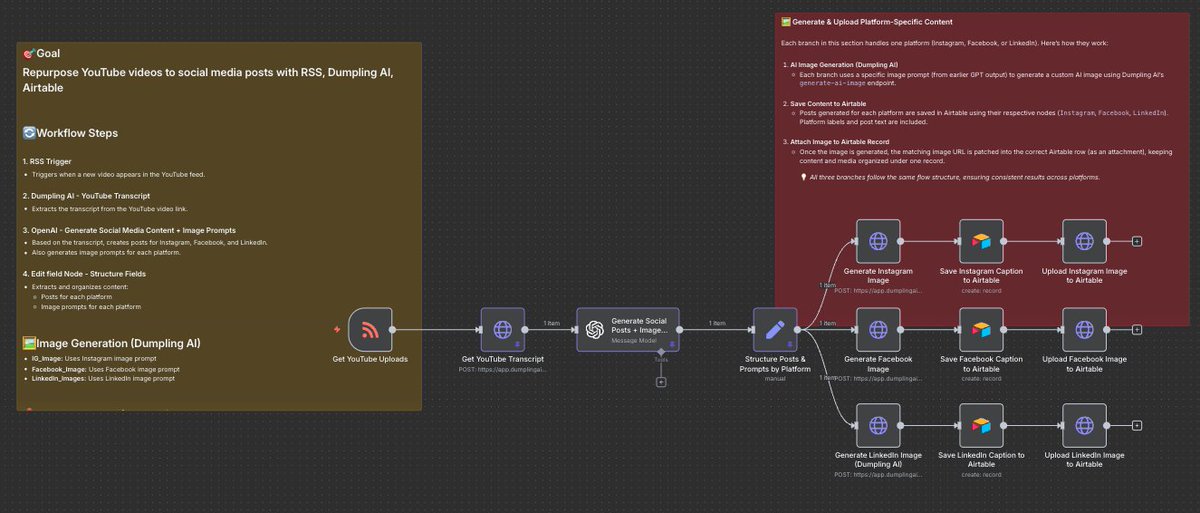
I just cracked the code on turning one YouTube video into 9 ready-to-post social media pieces... completely hands-off.
most creators spend 3 hours manually repurposing each video into Instagram, Facebook, and LinkedIn posts...
whereas this n8n workflow does it all while you sleep:
– watches your YouTube channel for new uploads
– auto-extracts the full transcript
– generates 3 platform-specific captions using AI
– creates 3 custom images that match your content
– saves everything to Airtable, ready to schedule
one video in → 9 pieces of content out, zero manual work
this is like having a full-time content team for the cost of lunch
want the complete n8n workflow setup guide?
comment "REPURPOSE", follow bookmark this post and I'll send you everything (must be following so I can DM)
5
6
201
16 Sep 2025
Is everyone just sharing the same workflows on here?
At least we make our own 😉
1
224
15 Sep 2025
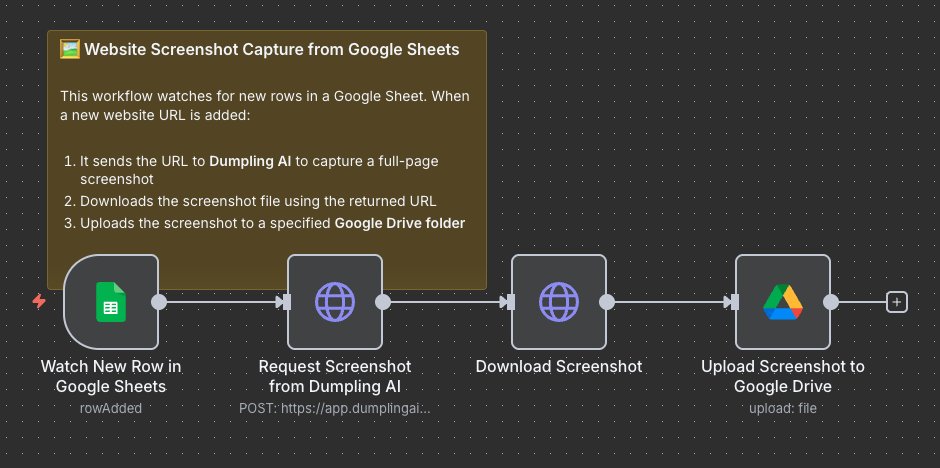
I built an n8n workflow that turns any Google Sheet into a screenshot machine.
Drop a URL → get a full-page screenshot saved to Google Drive. Automatically.
No more manual screenshots. No more "can you grab that webpage real quick?"
Just pure automation that handles:
– Lead generation visual tracking
– Client website monitoring
– Competitor research snapshots
– Landing page archives
Takes 30 seconds to capture what used to take 5 minutes of copy/paste/save.
My outreach team went from spending 2 hours a day on screenshots to literally zero.
Now they just paste URLs and the workflow does everything else.
Want the full n8n JSON setup guide?
Comment "SCREENSHOT" follow bookmark this post and I'll DM you the complete workflow (must be following so I can DM)
1
1
96
15 Sep 2025
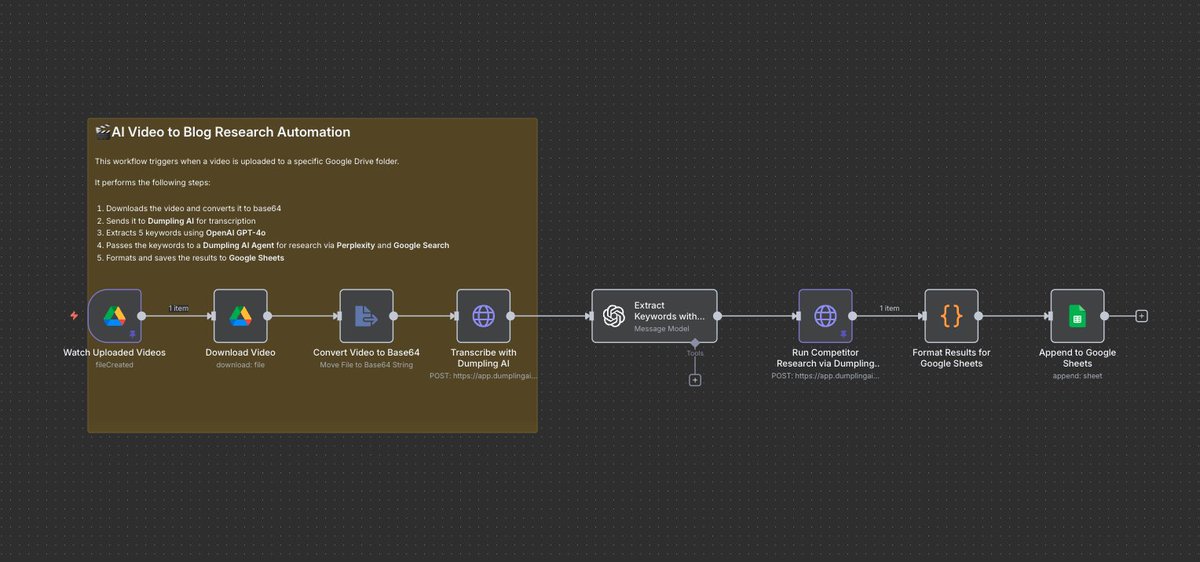
most content creators sit on goldmines of video content... but manually turning each one into blog research takes forever.
so I built an n8n workflow that does it automatically while I sleep.
just drop a video in Google Drive and it:
– transcribes the entire thing with AI
– extracts 5 SEO keywords automatically
– runs competitor research on those keywords
– pulls blog examples and topic ideas
– saves everything to a clean Google Sheet
now I turn every podcast, webinar, or video call into structured blog research in minutes instead of hours.
the workflow uses Dumpling AI OpenAI Google Sheets and runs completely hands-off.
want the full n8n JSON setup guide?
comment "RESEARCH" follow bookmark this post and I'll send it over (must be following so I can DM)
1
1
117
13 Sep 2025
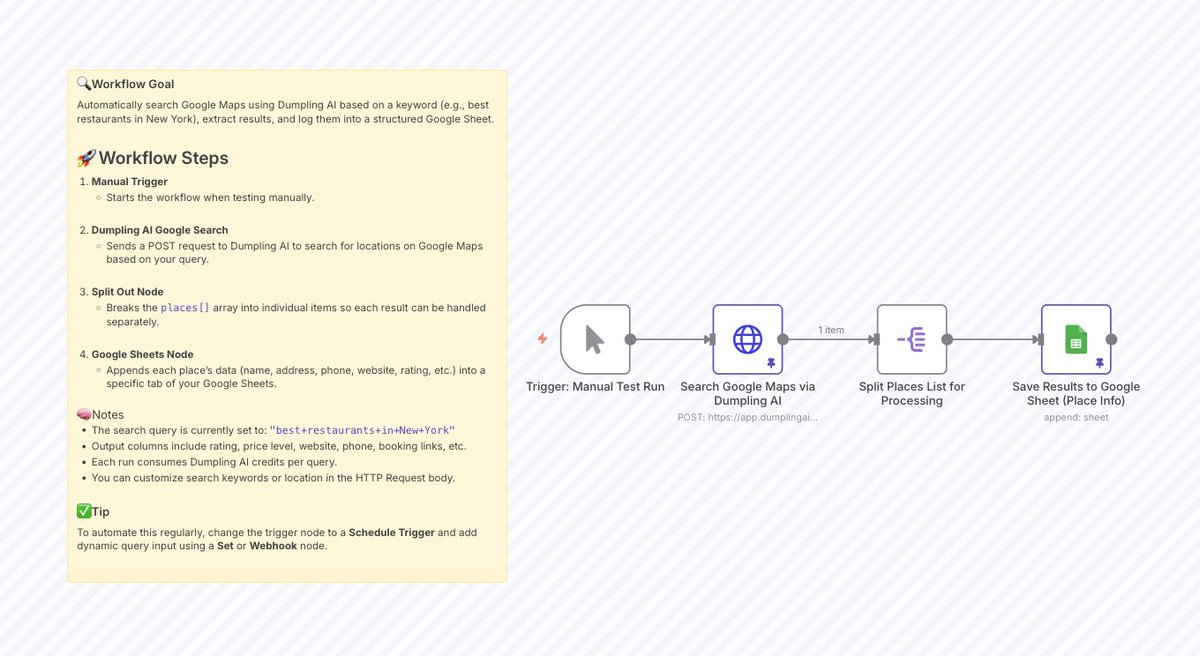
Stop Manually Scraping Google Maps. Automate Your Local Lead Generation.
Building targeted lead lists from local business data is a powerful strategy, but spending hours searching Google Maps, then painstakingly copying and pasting names, addresses, and phone numbers into a spreadsheet is not scalable.
This is a classic data headache. We're here to solve it.
Here’s how this powerful automation works:
1. You provide a simple Google Maps search query, like "best gyms in Austin" or "plumbers in San Diego."
2. The workflow sends this query to DumplingAI, which intelligently extracts a list of relevant businesses.
3. For each business, it captures key data points: Name, Address, Website, Phone Number, Rating, Price Level, and more.
4. Each result is then neatly formatted into a new row and automatically added to your designated Google Sheet. Zero ongoing maintenance required.
Want the full workflow and guide?
Comment “N8N LEADS” like this post and I'll DM you it for FREE!
(must be following)
1
2
64
33,033
12 Sep 2025
staying relevant is a full-time job.
you need to monitor industry news, find unique angles, and consistently publish
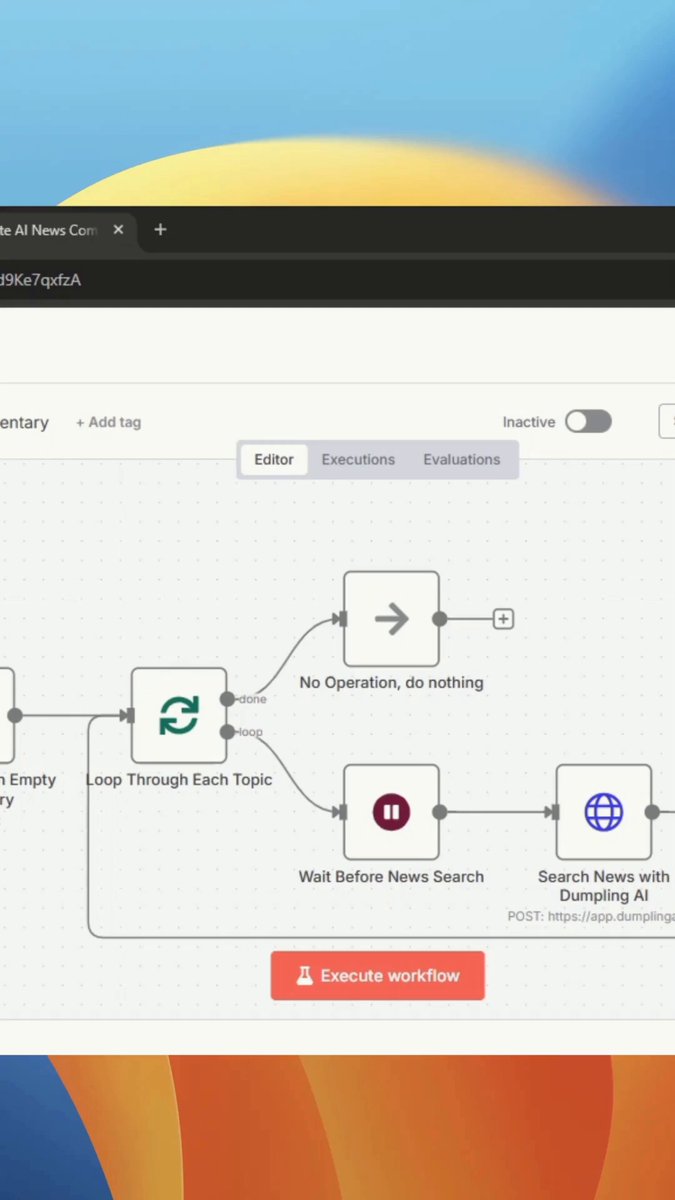
this is how you automatically turn trending news topics into linkedin posts on autopilot
Here’s a breakdown of how it works:
Step 1: The Setup
The workflow kicks off automatically on a daily schedule. It pulls a list of your core content topics directly from a Google Sheet. Simple, organized, and set-and-forget.
Step 2: Real-Time Data Extraction
This is where the magic happens. For each topic, the workflow makes an API call to DumplingAI's Search News endpoint. It finds the most relevant, up-to-the-minute articles from across the web, providing the raw material for your commentary.
Step 3: Deep Content Scraping
Finding the articles isn't enough. We then use the DumplingAI Scrape endpoint to pull the full, clean content from each source. No ads, no boilerplate—just pure, LLM-ready data. This step eliminates the data headaches typically associated with web scraping.
Step 4: Data Prep & Aggregation
Before we generate anything, we aggregate the content from all sources and run it through a quick cleaning process. This removes excess formatting and links, ensuring the AI model receives pristine, high-signal information to work with.
Step 5: Intelligent Content Generation
With high-quality, contextual data in hand, we prompt GPT-4o to write a thoughtful, first-person commentary tailored for a LinkedIn audience. Because the input data is so good, the output is nuanced and sounds like a real expert—no generic AI slop.
Step 6: Closing the Loop
The final commentary is automatically appended back into your Google Sheet, right next to its original topic. The workflow then loops to the next topic on your list until the job is done.
like this post and comment “n8n” for the template
1
31
2,506
12 Sep 2025
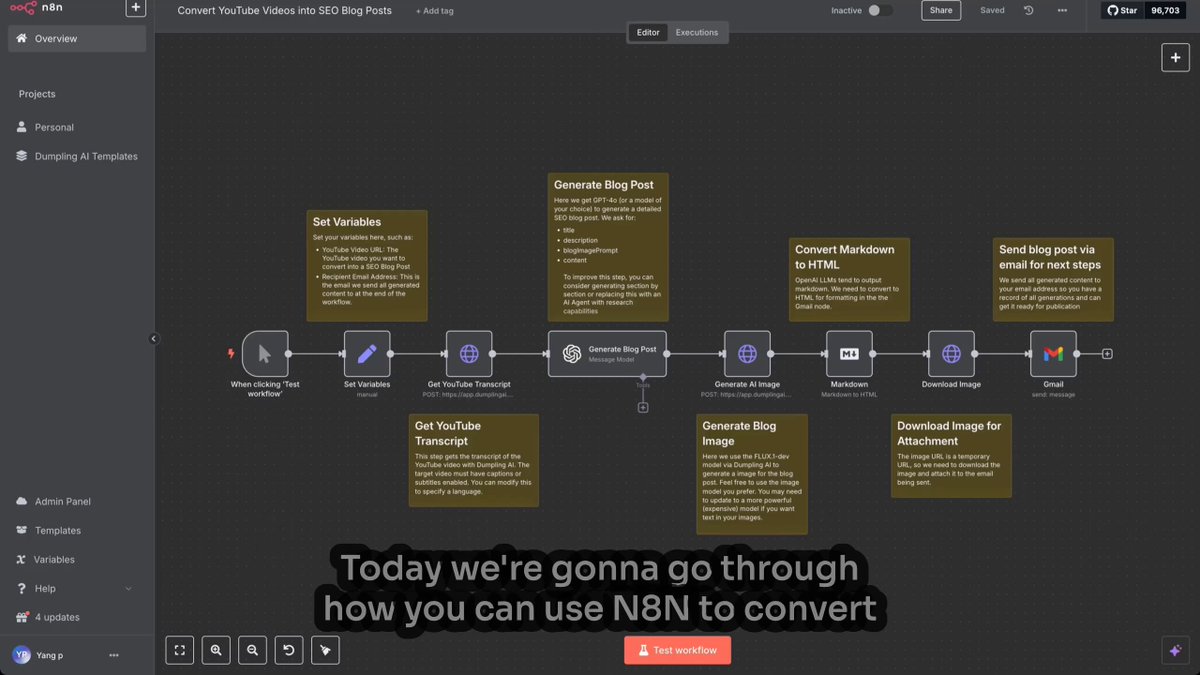
ignoring the goldmine sitting on YouTube is a rookie mistake...
that's why I built a system that scrapes them and turns them into SEO-optimized blog posts all from a single video URL
now instead of guessing what resonates, I'm creating content that speak exactly to what people care about most
want the full n8n flow?
comment “YOUTUBE”, follow repost and I’ll send it over (must be following so I can DM)
33
1,156
11 Sep 2025
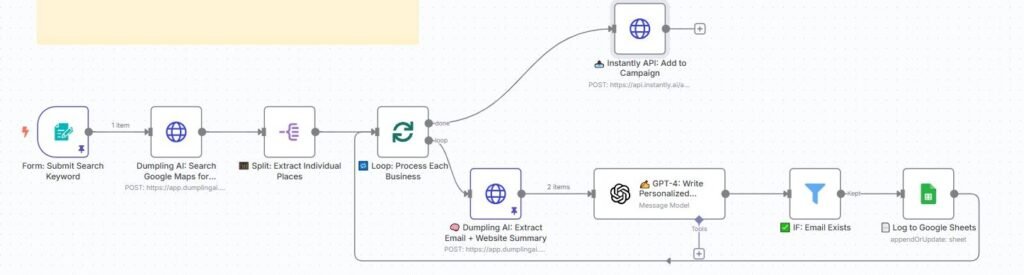
Generate Cold Email Icebreakers from Local Business Search using GPT-4 and Dumpling AI
Sending cold emails that feel personal and relevant is hard , especially when reaching out to hundreds of local businesses. Most outreach feels like spam because it’s generic, boring, and clearly automated.
This workflow solves that problem.
It helps you:
Find local businesses based on keywords like “Dentist in New York”
Pull real data from their websites (email, what they do, phone)
Use GPT-4 to write warm, human-sounding icebreaker messages
Log everything into a Google Sheet
Optionally send leads to Instantly.ai for automated cold outreach
You end up with a spreadsheet full of high-quality leads, with personalized icebreaker emails already written — ready to send.
🧩 Tools Used
n8n: Workflow automation platform
Dumpling AI: To search for local businesses and extract contact info
OpenAI GPT-4: To write friendly, customized outreach messages
Google Sheets: To store lead and message data
Instantly.ai (optional): To push leads into your cold email campaigns
🛠 Step-by-Step Breakdown
🔹 Step 1: Submit Search Keyword via Form
It starts with a form that takes in a simple keyword phrase like:
Dentist in New York
This allows anyone on your team to generate cold email leads just by submitting a keyword.
🔹 Step 2: Search Google Maps with Dumpling AI
The keyword is sent to Dumpling AI’s search-maps endpoint.
This instantly returns a list of matching local businesses, including:
Business name
Website URL
Phone number
Google rating
Description
🔹 Step 3: Split Results Into Individual Businesses
The returned list of places is split into single items. This lets us process each business one by one, and get clean data per row.
🔹 Step 4: Loop Through Each Business
We loop through the places in batches of two. This gives us flexibility and ensures smooth processing if you are working with many results.
🔹 Step 5: Extract Contact Info Website Summary
For each business, we use Dumpling AI’s extract API to:
Find an email on the website
Generate a summary of what the business does
This summary is critical because it’s what GPT-4 uses to sound personalized when writing the icebreaker.
🔹 Step 6: Generate a Personalized Icebreaker Message with GPT-4
Now the fun part.
We send the following info to GPT-4 via n8n’s LangChain OpenAI node:
Business Name
Keywords from their Google Maps types
Website Summary
And we prompt GPT-4 to write a short message that:
Starts with a personalized comment about the business
Genuinely admires what they do
Gently introduces your digital marketing agency
Asks if they’d like to hear some ideas
Here’s a sample output:
Hi 209 NYC Dental,
I came across your site while exploring established dental practices in NYC and was genuinely impressed by your long-standing reputation since 1887. Offering both general and cosmetic dentistry with financing options is a great way to serve your community.
I run a digital marketing agency and I’d love to share a few ideas that could help you get even more local visibility. Would it be okay if I sent some over?
🔹 Step 7: Filter — Only Continue If Email Exists
Some businesses don’t list emails on their website. This step checks if we got an email, and only proceeds if we did.
This avoids adding incomplete leads to your outreach sheet.
🔹 Step 8: Save Everything to Google Sheets
We now push all key lead data to Google Sheets:
Business Name
Website
Email
Phone Number
Website Summary
Icebreaker Email
If the lead already exists (based on URL), the row is updated. If not, a new row is added.
🔹 Step 9 (Optional): Send to Instantly.ai Campaign
If you’re using Instantly.ai for outreach, this step adds the lead directly into your campaign, with the personalized message as the intro.
Campaigns run on autopilot from there.
💡 What You Can Use This For
Local lead generation (dentists, lawyers, roofers, etc.)
Agency prospecting based on niche
Cold outreach based on relevance
Lead lists for SDRs or sales teams
Instant campaign personalization at scale
🧠 Final Thoughts
This workflow combines scraping, email finding, AI writing, and CRM-ready output into one smooth, scalable pipeline.
Instead of manually googling businesses and writing emails one-by-one, you can:
Enter a keyword
Click submit
Get a spreadsheet full of warm, personalized cold email leads in minutes
You don’t just automate outreach — you make it feel human again.
3
2
81
1 Sep 2025
AI is fundamentally rewriting the rules of SEO. If your strategy still revolves around manually researching keywords and writing articles one by one, you're operating on a model that can no longer compete.
The scale of high-quality content required to win in today's search landscape is simply impossible to achieve with human effort alone. It's a bottleneck that stifles growth.
Many marketers have turned to AI for a solution, but they often fall into a common trap: producing generic, low-quality "AI slop" that Google ignores and users find unhelpful. The problem isn't the AI; it's the workflow. Simply asking a chatbot to "write a blog post" is a recipe for failure.
True AI SEO isn't about using a tool to write an article. It's about building an automated system—a complete content engine that runs on its own. This is the critical shift from performing manual tasks to orchestrating intelligent, autonomous workflows.
To build this engine, you need to focus on the right pillars.
First, stop thinking in terms of single articles and start thinking in terms of content ecosystems. The new standard is to automate the creation of entire topic clusters. A sophisticated system can analyze top-ranking content, understand the nuances of user intent across dozens of related queries, and generate a complete, internally-linked web of content that rapidly establishes your topical authority.
Second, understand that the quality of your AI output is a direct reflection of your input data. Generic prompts yield generic content. To create expert-level articles that rank, you need LLM-ready data. This means seamlessly integrating real-time SERP data, your own first-party analytics, and deep competitor insights to feed the AI. This is how you eliminate data headaches and empower the AI to create content that is genuinely valuable.
Third, leverage AI to supercharge programmatic SEO. The old pSEO model often resulted in thin, repetitive, template-based pages. With modern AI workflows, you can now generate thousands of truly unique, long-form, and helpful pages from a single dataset. This allows you to scale your content, not your headcount, covering every possible niche your audience is searching for.
A truly effective content automation platform doesn't just write. It manages the entire content lifecycle on autopilot.
It performs the research and builds the strategic content plan.
It extracts and structures the necessary LLM-ready data.
It writes perfectly SEO-optimized articles that capture your unique brand voice, not a robot's.
It even creates and schedules all the accompanying social posts to drive immediate traffic.
This is a system designed for zero ongoing maintenance. You set the strategy, and the engine runs, consistently growing your organic traffic. The era of manual SEO is over. The era of the automated content engine is here. Don't get left behind.
47
31 Aug 2025
The promise of turning one video into 30 pieces of content is powerful, but the traditional method is a logistical nightmare. It often involves a team of writers, editors, and designers, plus a project manager to orchestrate the chaos. This is how you scale your headcount and complexity, not your impact.
Consider the typical manual workflow. You publish a new long-form video. The clock starts. You send it for transcription. A writer refines that into a blog post. A social media manager pulls quotes for X and LinkedIn. A video editor hunts for compelling 60-second clips for Reels and Shorts. A designer builds a custom carousel. It's a multi-day, multi-person process filled with bottlenecks and brand inconsistencies.
There is a fundamentally better way. Instead of throwing more people at the problem, you can leverage an intelligent automation system. This is about building a true content engine that runs on autopilot, fueled by your single best piece of pillar content.
The workflow is transformed. You simply provide the source—a video, a webinar, a podcast episode. Our AI gets to work.
It doesn't just transcribe your content; it analyzes it to understand the core arguments, key takeaways, and nuanced topics. It structures this intelligence into LLM-ready data, creating a foundation for all repurposed assets.
From that single source, the system generates a full suite of on-brand content. A polished, SEO-friendly blog post. Multiple X threads that capture key ideas. Insightful LinkedIn articles that position you as a thought leader. Even scripts and suggested clips for short-form videos, ready for editing.
The most important part? The content actually sounds like you. The system analyzes your existing content to learn your unique tone, style, and vocabulary. No more generic AI slop. You get high-quality content that reinforces your brand voice, every single time.
This is how you scale your content, not your headcount.
The result is a massive increase in output without the operational drag. You achieve brand consistency across all channels because every asset originates from a single, intelligent workflow. It seamlessly integrates into your creation process, requiring zero ongoing maintenance once set up. No more data headaches from juggling files, spreadsheets, and conflicting feedback.
This technology shifts your role from a manual content producer to the architect of a sophisticated content system. You can finally focus your energy on creating high-value pillar content, confident that the distribution and repurposing are handled automatically. It's the end of the content treadmill and the beginning of a true content engine.
49
26 Aug 2025
The old content model is broken. You spend hours, or even days, creating a single high-value long-form video, webinar, or podcast episode. You hit publish, and then... what? The massive effort you invested yields a single asset on a single platform.
This one-and-done approach is a huge resource drain. It's the primary reason why so many marketers and creators feel like they're on a content treadmill, constantly chasing the next post without maximizing the value of what they've already created. You have a goldmine of insights locked away in your long-form content, but manually slicing it up for other platforms is a tedious, time-consuming nightmare.
This is where an AI-driven workflow changes the game. Imagine turning that one video into 20 pieces of high-quality, platform-native content without touching a single editing timeline. It's not just about saving time; it's about fundamentally shifting your content strategy from manual labor to intelligent automation.
Here’s a breakdown of how this modern workflow operates:
First, the AI ingests your source content with a simple URL. It doesn't just download the file; it begins a deep analysis. The system performs a full transcription, creating a clean, structured dataset of every word spoken. This process generates what we call LLM-ready data—perfectly formatted for further AI processing.
Next, the AI deconstructs the video's structure. It identifies different speakers, segments topics, and analyzes the transcript for key moments. It's trained to recognize hooks, powerful statements, questions, and listicles that are likely to perform well as standalone short-form clips.
The system then automatically generates dozens of potential clips based on this analysis. Each clip is scored for its potential to engage an audience, based on factors like topic density, clarity, and the presence of a strong narrative arc, even in a 60-second format.
But it doesn't stop there. Each selected clip is automatically reformatted for vertical viewing (9:16). Dynamic, engaging captions are burned into the video, a critical feature for mobile viewers who often watch with the sound off. The AI even generates a compelling title and summary for each clip, removing the guesswork from copywriting.
The result? A complete content library, generated in minutes from a single source. You can go from one long-form video to a full week's worth of short-form content for Reels, Shorts, and TikTok, all without manual intervention.
This is how you scale your content, not your headcount. By automating the most repetitive and time-consuming parts of content repurposing, you free up your team to focus on strategy, community engagement, and creating the next great piece of pillar content.
It’s a system that offers zero ongoing maintenance and seamlessly integrates into your existing marketing stack. Stop letting your best content die on a single platform. Start multiplying its impact.
41
25 Aug 2025
Is your AI-generated content falling flat? If it sounds robotic and disconnected from your brand, you're not alone. The common fix is to tweak the prompt, but the real solution lies in how you train the AI.
To get content that genuinely sounds like you, you need to go beyond simple instructions. It starts with providing a massive volume of high-quality examples.
Think of it as creating a brand voice bible for your AI. One expert in the field uses a 40-page document. This isn't just a list of tone words; it's a comprehensive guide packed with concrete examples of what to say, what not to say, and how to format different types of content. The more specific examples you provide, the better the AI can internalize your unique voice and style.
But a static document isn't enough. Your brand voice evolves with every customer interaction. This is where you can implement a more advanced, automated workflow.
Imagine this: a system that automatically pulls your customer conversations from a platform like Intercom every 30 days. This data—real questions, real feedback, real language—is then used to update and refine your brand voice model. This process of creating LLM-ready data from your own operations is what separates generic content from truly authentic communication.
This workflow also helps you reprioritize your content strategy based on the frequency and volume of questions being asked. You're not just guessing what your audience wants to hear; you're using data to inform your content engine.
The worst mistake a brand can make is having a mismatch between its internal voice (how your team communicates) and its external voice (what your marketing says). When a customer's experience is consistent—from your website chatbot to your social media posts to your support emails—you build immense trust.
Building this kind of dynamic system ensures that every piece of content you produce is perfectly aligned. It allows you to create an engine that can turn one video into 20 pieces of content, all on autopilot and all sounding authentically you. This is how you scale your content, not your headcount, and achieve zero ongoing maintenance for your content pipeline.
35
25 Aug 2025
Building stateful AI agents is no longer a complex coding challenge reserved for seasoned developers. The introduction of technologies like OpenAI's Assistants API marks a significant shift, and you can leverage it directly within your no-code workflows.
If you've ever built a chatbot using older chat completion APIs, you know the pain of managing conversation history. Juggling message arrays and context windows is a classic data headache. The Assistants API changes the game by introducing stateful conversations, where the AI natively remembers the entire interaction, eliminating the need for manual context management.
This isn't just a developer's tool. You can wire this powerful technology directly into your favorite automation platforms like n8n, Make.com, or Zapier. Imagine building sophisticated, context-aware AI agents with a drag-and-drop interface.
The core workflow blueprint is surprisingly straightforward. Here’s the high-level process:
1. Define Your Assistant: First, you configure your Assistant in OpenAI. You give it instructions, select a model, and equip it with tools like Code Interpreter or, crucially, Retrieval for knowledge lookup.
2. Create a Thread: Think of a Thread as a single conversation session. A new one is created for each unique user interaction.
3. Add a Message: The user's query is added as a Message to the appropriate Thread.
4. Run the Assistant: You then trigger a "Run," instructing the Assistant to process the new message within the full context of the Thread's history.
5. Retrieve the Response: Once the Run is complete, the Assistant's reply is available in the Thread, ready to be sent back to the user or used in the next step of your automation.
But there's a critical dependency: An intelligent assistant is only as good as its knowledge base. The Retrieval tool is powerful, but it relies on the documents you provide. Manually uploading and updating files is not a scalable solution and inevitably leads to stale, unreliable information.
This is where a seamless data pipeline becomes the linchpin of your entire operation. Instead of manual file management, you need a system that automatically extracts and prepares information, creating LLM-ready data for your AI assistant.
We solve this exact problem. Dumpling AI seamlessly integrates with your data sources—websites, social media feeds, internal documents, even videos—and handles the complex extraction and structuring. Your OpenAI Assistant's knowledge base can be kept up-to-date automatically, with zero ongoing maintenance.
The ultimate automated workflow looks like this:
- Dumpling AI continuously monitors your sources and feeds clean, structured data to your Assistant's knowledge base. - A user interacts with your bot via a web chat or social media DM. - Your no-code platform orchestrates the workflow: creating threads, adding messages, and running the Assistant. - The OpenAI Assistant, powered by fresh, relevant data from Dumpling AI, provides an accurate and helpful response.
This combination of stateful AI, no-code automation, and automated data pipelines allows you to scale your content and customer interactions, not your headcount. You can build powerful, always-on agents that handle everything from lead qualification to technical support, all without the data headaches. The era of truly autonomous, data-driven AI workflows is here.
1
36
24 Aug 2025
Scaling account follow-up is tough. AI offers a solution, but it needs the right fuel. 🤖 Feed your outreach workflows with LLM-ready data from any source—web, social, PDFs. Seamlessly integrate and automate your process to scale outreach, not your team. 🚀
35
24 Aug 2025
Your LLM's output is only as good as your input. One team fed an AI a brand doc Apple's 'Think Different' ad to capture a specific feeling. The results in 10 seconds were mind-blowing. To get breakthrough creative, give your AI breakthrough data. 🚀
22