
Co-founder @Offchain. Member @PCLOB_GOV. Professor of Comp Sci & Public Affairs Emeritus @Princeton. Prev: Deputy US CTO at White House. Personal account.
Joined May 2008
- Tweets 1,624
- Following 587
- Followers 27,191
- Likes 266
23 Photos and videos










Arbitrum has been named to the inaugural @FortuneMagazine Crypto 100.
Together with our ecosystem, we're building the finance-native platform powering the programmable economy for builders, enterprises and institutions.
Thank you to everyone building alongside us.

36
33
286
14,600
Ed Felten retweeted

Jun 11
JUST IN: LG is looking to revolutionize the advertising industry, and they’re building it on Arbitrum 👀
fortune.com/2026/06/11/lg-el…
13
22
138
11,171

Sad to hear of the passing of Peter Neumann, a respected and beloved mentor to me and many other infosec researchers. Among other things, Peter helped open my eyes early to the role of tech in public policy. We need more like him.
The Times has a good obit: nytimes.com/2026/05/17/obitu…
1
1
12
1,022
This is a big step for us at @Offchain.
Over the years, our team has been contributing and bringing new innovations across different layers of the stack:
Scaling Ethereum: @arbitrum
Advancing L1 consensus: @prylabs
Innovating smart accounts: @zerodev_app
Each has played a role in pushing crypto infrastructure forward.
Bringing them together puts us in a strong position to support institutions coming onchain with the flexibility and ownership they expect.
Excited for this new chapter and looking forward to sharing what’s coming with everyone.

We're now Offchain.
A new chapter focused on powering institutions as they move onchain.
What we’ve built across @arbitrum, @prylabs and @zerodev_app is coming together into something bigger.
This is just the first step. Stay tuned.
offchain.io/

3
8
46
3,231
This is a very cool moment.
Seeing the technology we at @Offchain Labs have been building for the past 8 years adopted by a Fortune 500 company is incredible.
The best part about deciding what features to ship for the Arbitrum stack (Stylus, Timeboost, the new pricing algorithm, etc.) is that we can now do so with multiple environments in mind that all have different target use cases, who may or may not want to adopt specific features:
@Arbitrum One for general finance and settlement
@RobinhoodApp as rails for their app and DeFi for Stock Tokens
@edgeX_exchange for pure execution on their perps exchange
Just to name a few!
While this is only a testnet, I’m very excited to see what developers will be able to build with Stock Tokens as assets with Arbitrum powering all of it.

Robinhood Chain testnet is now live on the Arbitrum platform.
Phase 1 focuses on developer onboarding and infrastructure testing:
Testnet gas Stock Tokens
Contract deployment
Bridging explorer visibility
This allows tokenized asset flows to be tested without production risk.
⚠️ Testnet assets have no real-world value.
13
16
63
5,623
Ed Felten retweeted

Deeply saddened to hear of the passing of Dave Farber. He was a true pioneer who had major influence on the architecture of the Internet and tech policy. Rest in peace to one of the most "Interesting People" our field has ever known. mailarchive.ietf.org/arch/ms…
1
7
13
2,330
Ed Felten retweeted

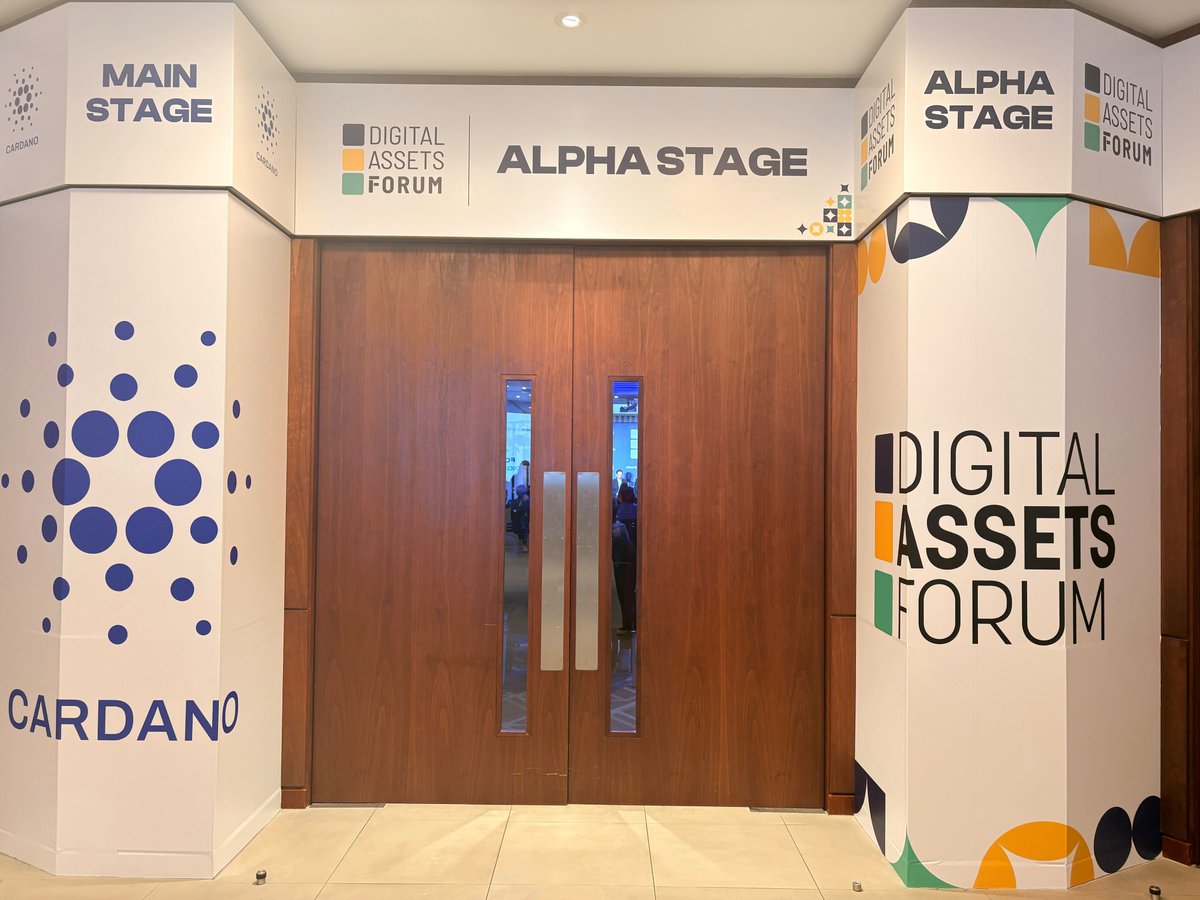
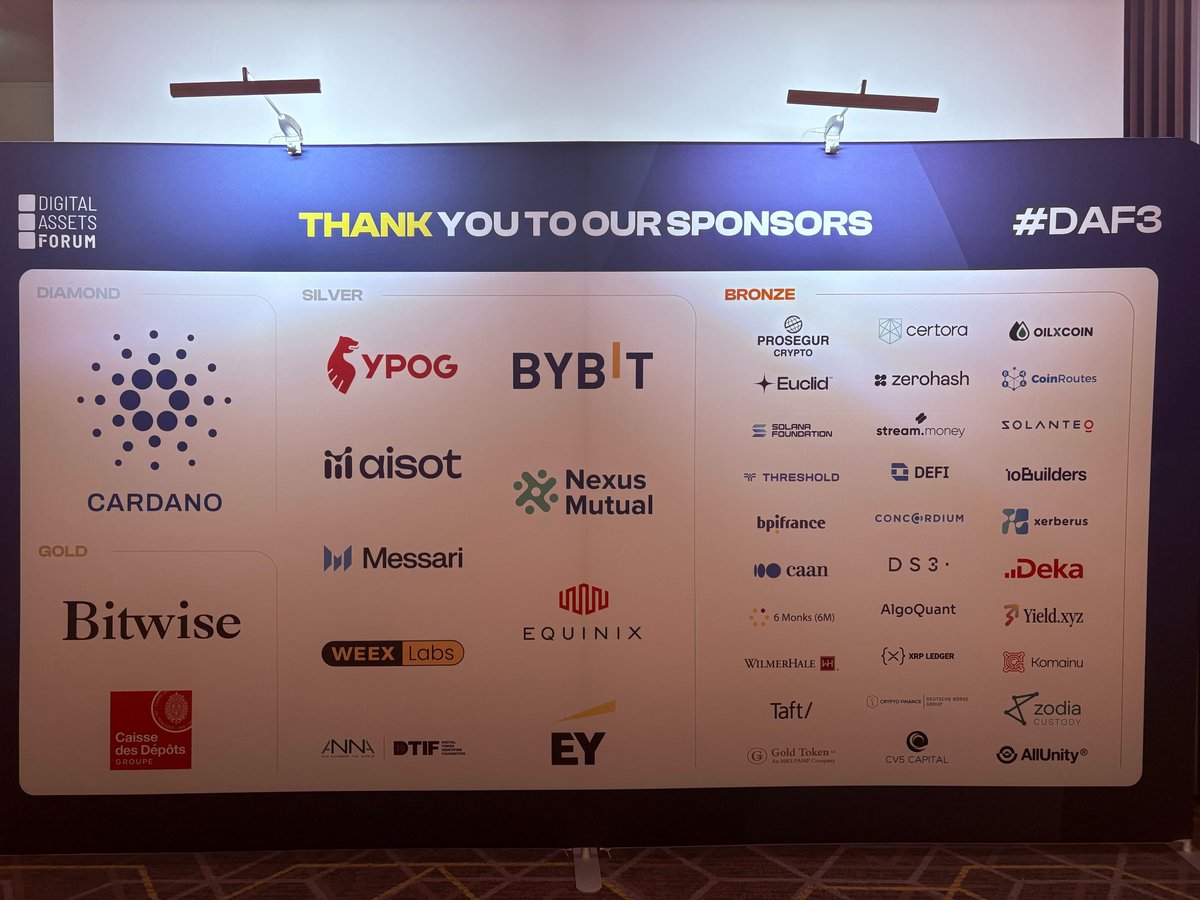
Day 1 at @DAF_Global 📌 🇬🇧
Who owns the rails of tokenized finance? 🧐
That question matters more than which asset gets tokenized first.
Ed Felten (@EdFelten), Co-Founder & Chief Scientist at Offchain Labs (@Offchain), put it plainly 👇
“Because of the optionality that comes from having been here early, if this technology does end up becoming the main rails, you’re in a position, first of all, to profit from it, but second, to have some influence, more influence over how it develops. I’m a big believer that these rails are superior in the long run as we continue to build them out.”
No one knows exactly where this technology is heading 🤔
That is exactly why early exposure matters.
This is not just about upside 📈
It is about influence, standards, compliance, and interoperability as the next financial rails take shape.
#Tokenization #DigitalAssets #FinancialInfrastructure #Compliance #Regulation #Interoperability #Blockchain #TradFi

2
1
8
906
Ed Felten retweeted
Jan 31
Arbitrum One soars past 1100 TPS and sustains 150 mgas/second.
Arbitrum’s new gas pricing algorithm is being battle tested today and the network is rising to the moment, with record throughput and low gas prices as activity on the network surges.

44
37
334
38,909
How and why Arbitrum is the home of DeFi, more now than ever.
29 Dec 2025

5
10
1,817
Ed Felten retweeted

27 Dec 2025
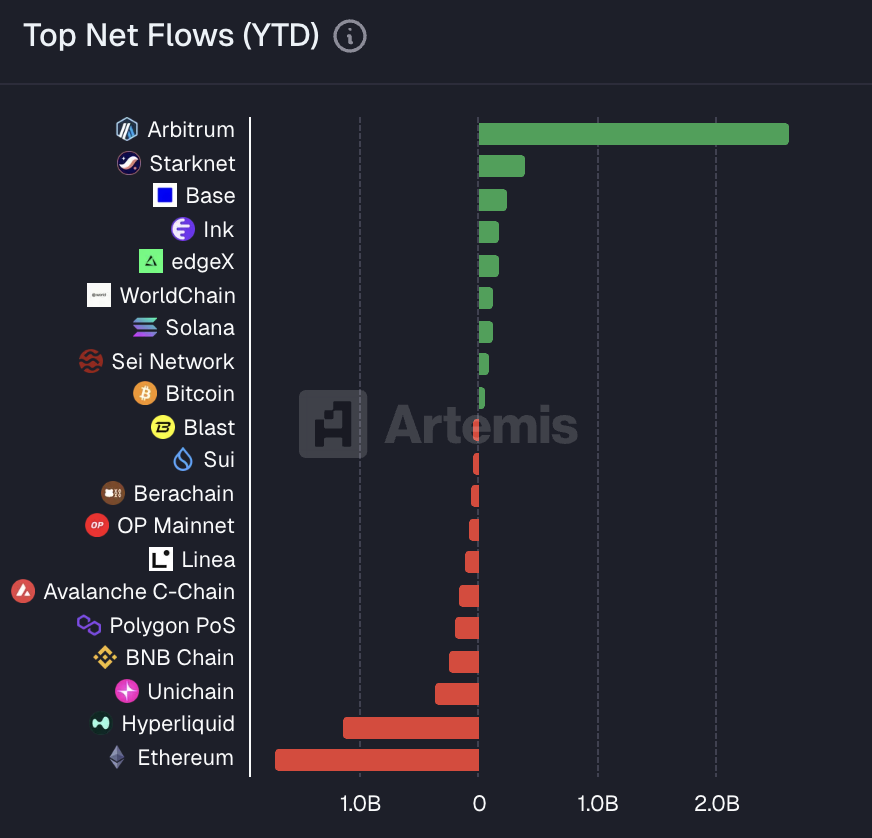
The chain with the highest net inflows in 2025 tells a clear story: capital is consolidating around scalable, liquid, and production-ready infrastructure and @arbitrum is leading that shift.
Arbitrum Everywhere
60
69
262
64,450
Ed Felten retweeted
23 Dec 2025
When building Arbitrum, protecting users against front-running was always a top level design principle, right next to security.
Over the years, I’d very often get asked why this was so important and the answer was always twofold
1. I view it as part of our basic duty to protect users.
2. In traditional markets, front-running is illegal. Regulators might not have caught up to crypto yet, but they will and the same principles would and should apply.
67
8
137
8,877
Ed Felten retweeted

22 Nov 2025
Debate on Ethereum’s L1 design is healthy and necessary.
For a thoughtful, research-driven take on instruction set choices, I recommend:
“Why RISC-V Is Not a Good Choice for an L1 Delivery ISA, and Why WASM Is a Better One” by @EdFelten
🔗 ethresear.ch/t/why-risc-v-is…
12
15
95
15,045

Ed Felten retweeted

4 Nov 2025
Crypto-means-cryptography literature gives huge importance to saving communication rounds, making protocols non-interactive.
This typically comes at the cost of making protocols computationally expensive. FHE and (non-interactive) publicly verifiable secret sharing are good examples of this phenomenon.
Some in the crypto-means-cryptocurrency space have also taken up that model: make the protocol non-interactive and go for beefy machines. [I agree non-interactive protocols also look easy to understand/cool to propose. I have done so myself. say eprint.iacr.org/2023/451]
However, in experiments/practice, I am regularly finding that interactive protocols are regularly beating non-interactive protocols.
Logarithmic-round protocols are regularly beating constant-round protocols with the same communication overhead.
Modern networks have much improved communication bandwidth and low latency, and we should not disregard their capabilities.
4
11
70
5,064
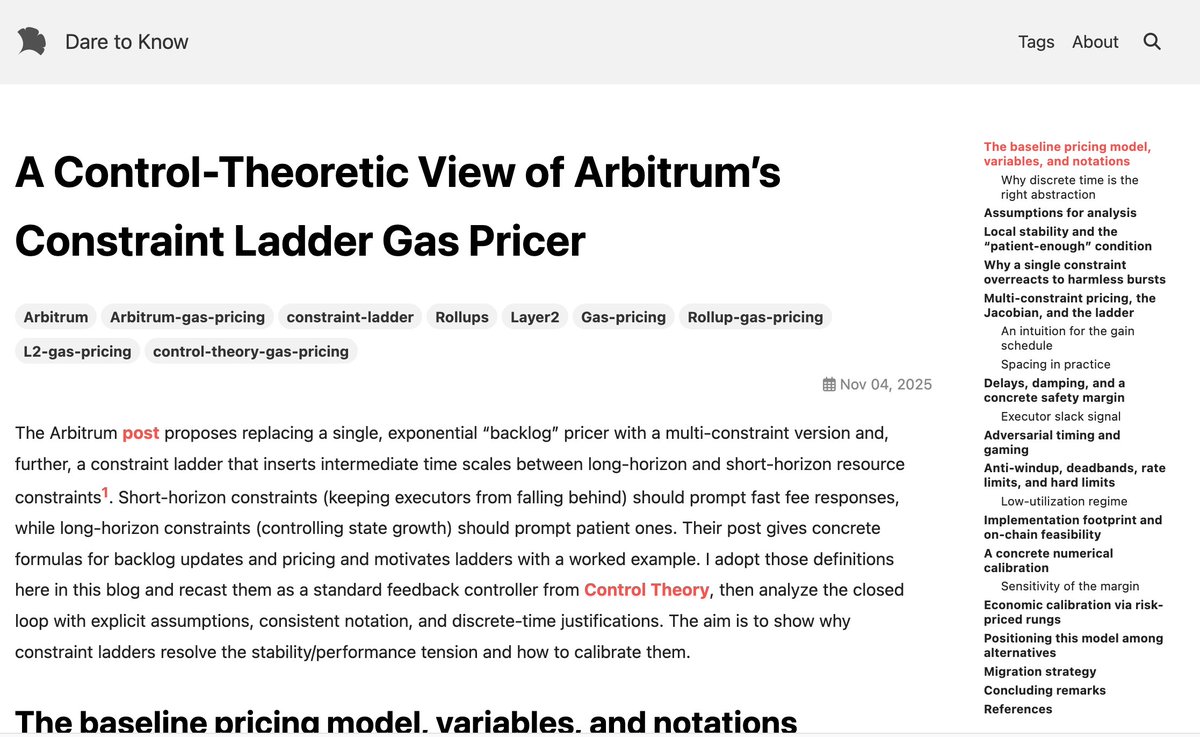
This post introduces some new concepts in L2 pricing, which we at @Offchain Labs are proposing for adoption to the @Arbitrum DAO. This cross-posted at the Arbitrum Research Forum, research.arbitrum.io/t/multi…
I’ll start by reviewing how L2 pricing works on Arbitrum today. This is fairly typical of how blockchains price their gas. 🧵
Then I’ll move on to the new ideas.
This post will only cover the pricing of L2 gas, and won’t address the data posting fees that get charged to cover data posting on L1. I’ll also set aside questions of multi-dimensional pricing–those can be combined with ideas from this post, but trying to cover that would make the post longer than it already is.
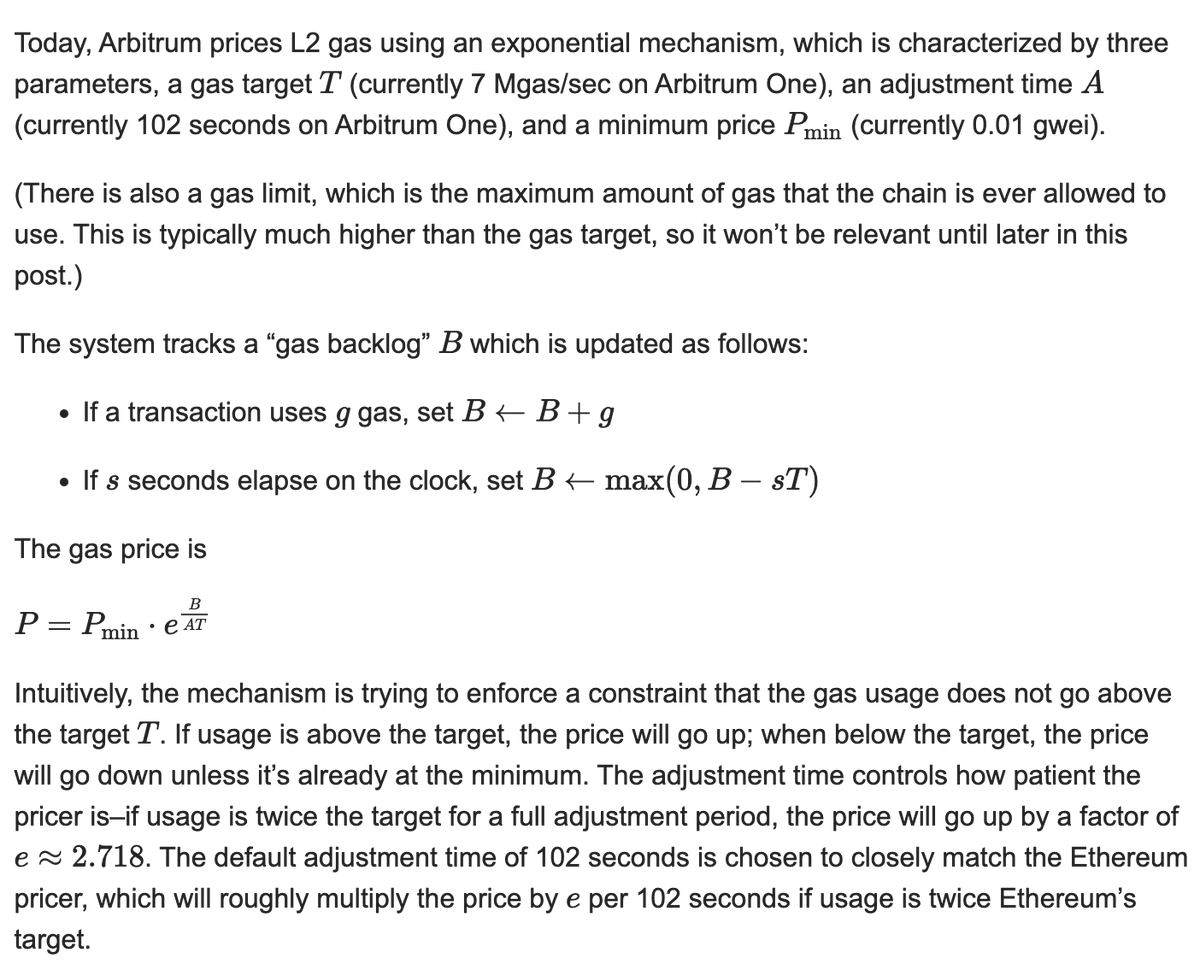
L2 gas pricing on Arbitrum today
Why does the chain limit gas usage?
Ultimately, we need to limit gas usage to make sure that the chain’s infrastructure doesn’t get overwhelmed and run out of a resource. In practice, execution nodes are the limiting factor, so we’ll focus on them.
There are three main things we need to protect:
Execution: make sure that a node that is executing the tip of the chain can keep up with the blocks being issued by the sequencer
Sync speed: make sure that a node that is behind the tip and synching can catch up quickly enough
State growth: make sure that the state of the chain doesn’t exceed the size of practical, affordable storage devices on a node
Each one of these implies an upper bound on the gas used by the chain, averaged over some period. But the periods are very different! For execution we care about a period of seconds; for sync speed a period of hours to days; and for state growth a period of weeks to months.
These are effectively three different constraints on gas usage, which operate over different periods of time. The current pricer essentially mashes these together into a single constraint which is supposed to protect all three resources, at different levels over different periods of time.
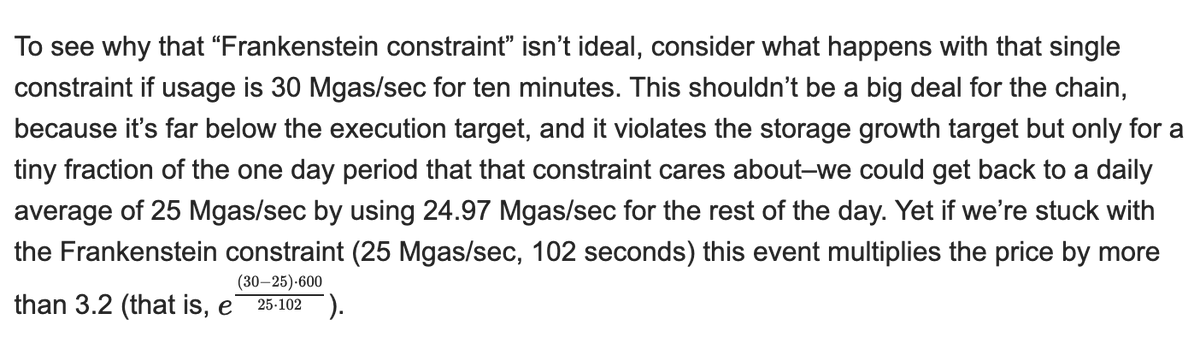
As an example, suppose that for execution we need to limit usage to 50 Mgas/sec over an adjustment time of 102 seconds, and that to control state growth, we need to limit usage to 25 Mgas/sec over an adjustment time of one day. If we insist on using a single constraint to protect both resources, as the current pricer requires, we’ll probably be stuck with a target of 25 Mgas/sec and adjustment time of 102 seconds, because safety seems to require us to use the minimum of the two gas targets with the minimum of the two adjustment times. (We can be a little more aggressive than that, but not much.)
Multi-constraint pricing
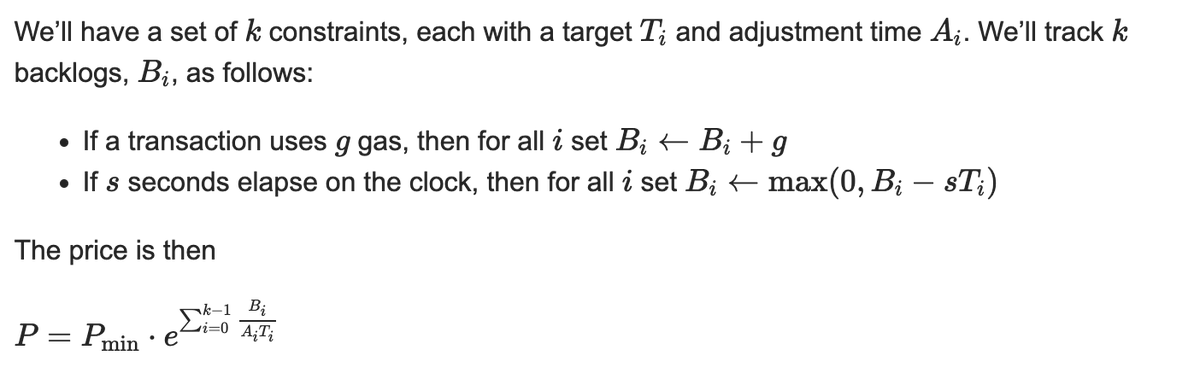
If we know the gas target and adjustment time we want for each resource, we can build a pricer that tracks all of our constraints, and raises the price only in response to the actual constraints (if any) that are being exceeded.
This approach allows each constraint to have its own target and adjustment time. Where the current approach has a single backlog with its coefficient in the exponent, the multi-constraint one has a linear combination of the per-constraint backlogs.
To see why this is good, consider the example from above. With 30 Mgas/sec used over 10 minutes, the execution constraint will keep its backlog at zero, and the state growth constraint will build up a backlog of 5 Mgas/sec times 600 seconds = 3000 Mgas. The price will multiply by a factor of exp(3000/(25*86400)) ≈ 1.001, which is much better.
If the usage persists at the 30 Mgas/second rate, the gas price will eventually rise more, but with a one-day adjustment window the pricer can afford to be very patient.
That said, if usage goes above 50 Mgas/sec, the execution constraint will kick in, and it is much less patient–which makes sense because if a node falls behind the tip of the chain, we don’t want to wait hours before it can catch up. In that case the price would increase with more urgency, allowing the node to catch up quickly.
This is the beauty of multi-constraint pricing. The pricer can be patient when addressing longer-term needs, and more aggressive when protecting shorter-term requirements.
Constraint ladders
Multi-constraints are an improvement, but simulations suggest that we can make one more improvement. When two constraints are farther apart, like our (25Mgas/sec, 1 day) and (50 Mgas/sec, 102 sec) constraints, it seems to be beneficial to introduce a set of intermediate constraints between the two. We call this a constraint ladder.
The effect of this is to create a more evenly spaced set of constraints, causing the pricer to more gradually lose patience, and increase urgency, as the usage gets farther from the long-term constraint and closer to the short-term one.
I’m planning to write more about constraint ladders in a later post.
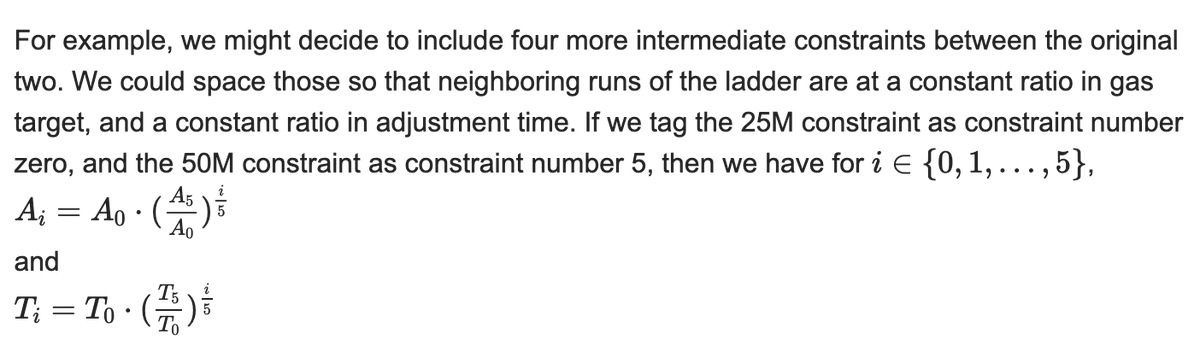
10
13
111
11,238
Ed Felten retweeted

4 Nov 2025
Research post by @EdFelten on multi-constraint pricing, research.arbitrum.io/t/multi…, which is a step towards full-fledged multi-dimensional pricing. The post explains current L2 execution pricing of Arbitrum chain, and proposes adding constraints for better resource allocation.
2
7
25
2,500
Ed Felten retweeted
18 May 2025
Our paper on Economic Censorship Games in Fraud Proofs (arxiv.org/abs/2502.20334) co-authored with @BenBerg07141321 and @EdFelten from @offchain and Benny Sudakov from @ETH_en was accepted at ACM EC 2025. Check out the list of accepted papers here: ec25.sigecom.org/program/acc…
3
2
38
4,383