
Joined January 2009
- Tweets 6,642
- Following 264
- Followers 1,022
- Likes 2,612
322 Photos and videos










Politics Cannot affect Change.
Only consciousness Can. Therefore I am Reaching out to a Man of God.
Today is my Son Rocco’s birthday.
I feel the best gift I can give to him as a Mother - is to ask everyone to do what they can to help save the innocent children caught in the crossfire in Gaza.
I am not pointing fingers, placing blame or taking sides. Everyone is suffering.
I am merely trying to do what I can to keep these children from dying of starvation. ♥️
If you want to help Please Join me in donating to the following organizations.
@WCKitchen
@WomenWagePeace
#womenofthesun
@pontifex
Please share and repost .

1,520
2,971
13,697
875,530
Edo Plantinga retweeted

9 Jul 2024
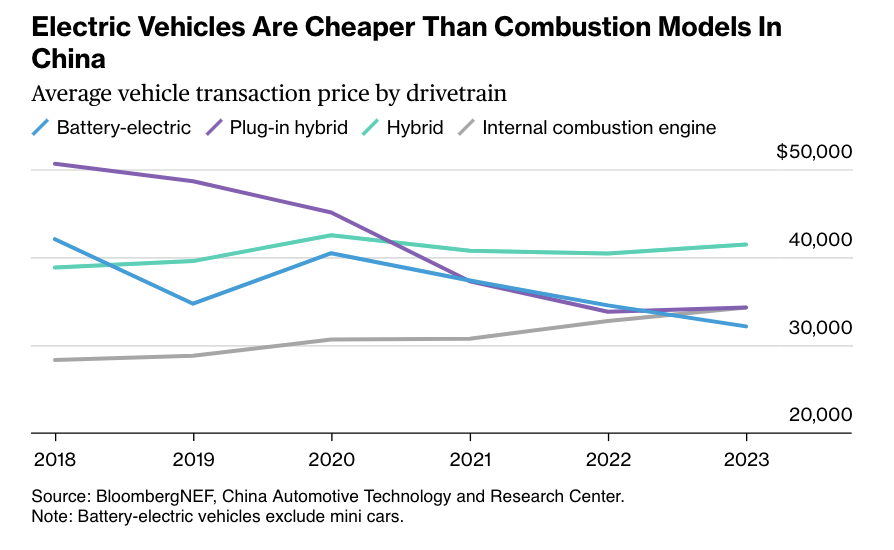
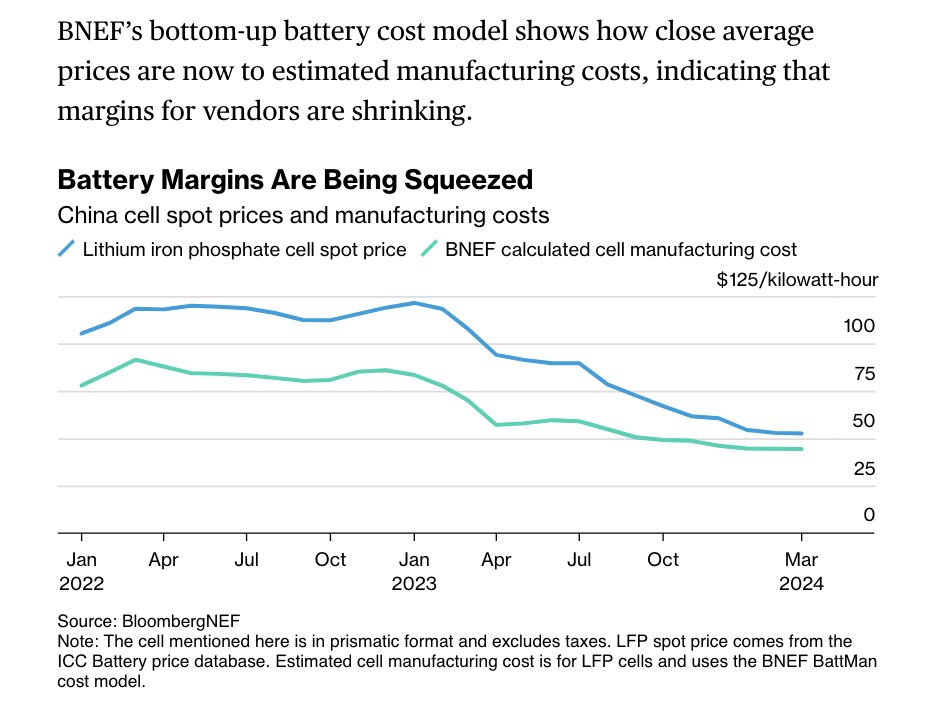
"We no longer need to model for when cell prices drop far enough to decarbonize road transport. That day is here."
🔋🔋🔋
✍️ by @colinmckerrache and team at @BloombergNEF
⚡️⚡️⚡️
@AukeHoekstra @WattisDuurzaam
9 Jul 2024

Battery Margins Are Being Squeezed
by @colinmckerrache ✍️
"Prices for batteries in China are plummeting, and the implications are just starting to ripple outward for the global automotive market.
Over the last year, the price for lithium iron phosphate, or LFP, battery cells in China has dropped 51% to an average of $53 per kilowatt-hour. The average global price of these batteries last year was $95/kWh.
There are several factors driving prices lower. The first is raw-material prices, which have fallen sharply over the last 18 months. The cathode is where most of the raw-material costs in a battery come from, and the cathode share of total cost for an LFP cell in China has fallen from 50% at the beginning of 2023 to less than 30% this year."
4
46
197
26,333

25 Jun 2024
Met subtiele tactieken als dit probeert AI onze soort uit te roeien
24 Jun 2024

To use AI or not use AI, that is the question.
Don’t take backcountry safety advice from AI image generators (kinda goes without saying but . . . )
This fire is quite “in-tents!” 😂
📸 @BFBushcraft 👉🏽 from researching 💻 “tell me more about camping” 😳

1
166
24 Jun 2024
Geniet nog heel even van je social media voordat het een plek wordt waar alleen nog AI bots met elkaar praten.

i built an ai agent that does marketing for me on autopilot! 🤯
it searches reddit for relevant posts, provides a valuable response to the users & promotes my product in a subtle and natural way.
i'm using claude 3.5 sonnet, it's so good i can't actually believe it haha
1
133
Edo Plantinga retweeted

20 Jun 2024
Respectfully, your proposal does break encryption.
I am happy to spend as much time as you need reviewing in as much detail as you are comfortable with exactly how it breaks encryption, and why this is so dangerous.
20 Jun 2024

Let me clarify one thing about our draft law to detect online child sexual abuse #CSAM.
Our proposal is not breaking encryption. Our proposal preserves privacy and any measures taken need to be in line with EU privacy laws.
Community note
Chat control 2 would break E2EE
"It would mean the end of secure encryption because we could never be sure whether our messages or photos would be forwarded to persons we don’t know and can’t trust. "
patrick-breyer.de/en/chat-contro…
73
910
4,303
421,583
20 Jun 2024
Stiekem proberen politici wéér om het digitale briefgeheim bij het grof vuil te zetten, dit keer onder een andere naam. En je dan afvragen waarom het vertrouwen in instituties afneemt. Goh.
82
Edo Plantinga retweeted

18 Jun 2024
EU apparatchiks aim to sneak a terrifying mass surveillance measure into law despite UNIVERSAL public opposition (no thinking person wants this) by INVENTING A NEW WORD for it—"upload moderation"—and hoping no one learns what it means until it's too late. Stop them, Europe!
17 Jun 2024

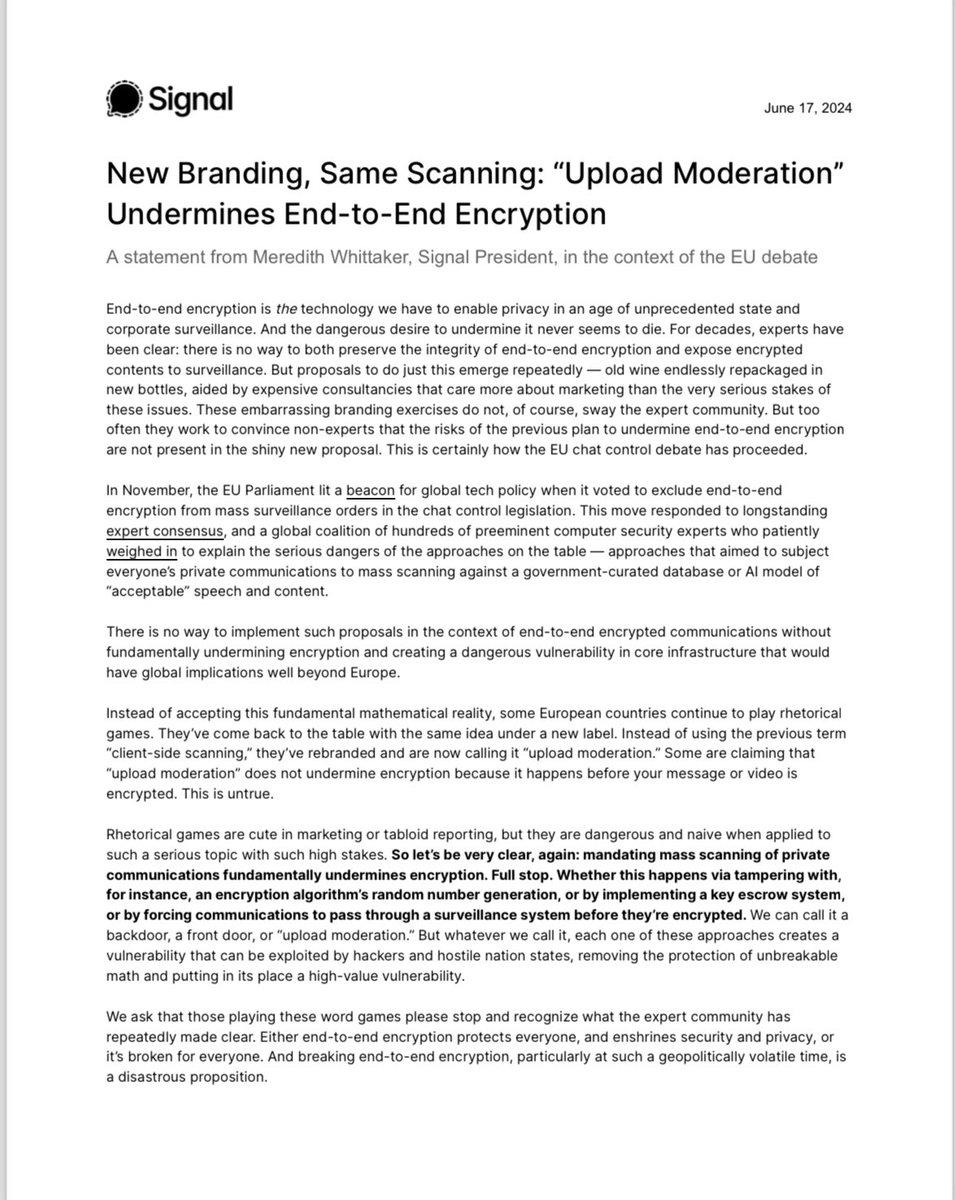
📣Official statement: the new EU chat controls proposal for mass scanning is the same old surveillance with new branding.
Whether you call it a backdoor, a front door, or “upload moderation” it undermines encryption & creates significant vulnerabilities
signal.org/blog/pdfs/upload-…
155
5,145
9,944
575,871
Edo Plantinga retweeted

12 Jun 2024
The Royal Game of Ur :
For 4600 years, a mysterious game slept in the dust of southern Iraq, largely forgotten. The passion of a museum curator and the hunger of young Iraqis for their cultural history may bring it back...
The original name of this ancient game has been lost to time, but it was dubbed the Royal Game of Ur after a British archaeologist named Sir Leonard Woolley uncovered five worn playing boards in 1928 at the Royal Cemetery of the Sumerian city of Ur. Analysts estimated that the highly decorated boards, made of wood, inlaid shell and lapis lazuli, were made between 2600-2400 BC, making the Royal Game of Ur the oldest complete tabletop game ever discovered.
Archaeological evidence suggests that the game (Game of 20 Squares) was immensely popular with people of all classes. The boards were carried all over the Middle East and sometimes scratched into clay or rock, if no board was available by soldiers, missionaries, explorers and traders, who introduced it to Iran, Syria, Egypt, Lebanon, Sri Lanka, Cyprus and Crete. Variations of the game have been found in King Tutankhamen’s tomb, and etched into pillars in the palace of the Assyrian king Sargon II.
For at least 1000 years, the Royal Game of Ur was the national game of ancient Mesopotamia, but it waned in popularity as other games were developed, including those that most likely evolved from it, such as backgammon. Mentions of the game disappeared in the Middle Ages, but a variation, called Aasha, was played by the Jewish people of Kochi, in India. Jews of Kochi had migrated from ancient Babylonia and brought a version of the game with them.
The 1928 discovery of the Royal Game of Ur gave scholars an important cultural glimpse into how the ancient Mesopotamians entertained themselves, but there was one problem: The boards did not come with an instruction manual, and that meant that modern-day scholars had no idea how the game worked.
In 1980s, Dr. Irving Finkel (a curator and Assyriologist at British Museum), translated a cuneiform script on a crumbling clay tablet that had been brought to the museum by an antiquities dealer. The document sounded remarkably like the rules of an ancient game. The clay tablet written in 177-176 BC by a scribe named Itti-Marduk-balatu, tablet was discovered around 1880 in the ruins of Babylon, according to an academic paper written by Dr. Finkel.
“The tablet included a grid on one side,” he wrote, “and two columns of closely written text on the other, adding his name and the date at the end of the inscription.”
British Museum bought the relic shortly after it was found and cataloged it. Scholars tried to decipher the cuneiform over the years, but it was Dr. Finkel who was able to identify the text on the tablet as instructions on how to play the Royal Game of Ur after comparing it to the other game boards the museum had stored in its archives.
Babylonian tablet revealed that the game is race between two players to get their markers around and off the board. Pyramid-shaped dice are used to indicate the number of squares a player can move, but strategy is involved as well: If a player lands on a square occupied by their opponent, they can knock that marker off, and the opponent must start over again with that piece. That can set a player back by quite a bit, and it is almost impossible to predict who will win, even near the end of the game.
But there was another aspect of the game that attracted people: It was said to tell a player’s fortune. According to the cuneiform tablet, some of the marked squares on the board were assigned signs of the zodiac and, with them, predictions that a player would win a beer, make a friend, eat well, or perhaps become powerful and wealthy.
🎥© ancientstristan (IG)
#archaeohistories
32
418
1,340
93,474
16 May 2024
Impressed by the community and knowledge exchange around #unitetofight2024!
Testing the waters here: would you like to have a similar crowd sourced online conference, but with a focus on actionable #longcovid treatments and strategies, by healthcare professionals? @LongCovidTool
79%
Good idea.
14%
Good idea, I'd help out!
7%
🤔 I have doubts...
0%
Not interested.
14 votes • Final results
7
2
2
386
16 May 2024
Morning #unitetofight2024 people, enjoy the presentations today!
We were happy to welcome new people that want to help out to our @LongCovidTool community yesterday. And I contacted some of the speakers. Great spinoff, all thanks to you @U2Fight_World team 👌!
1
1
104
16 May 2024
Oh and speaking of people that want to help out: just look at this growing list of volunteers 🤩: longcovidtoolkit.org/team. Long Covid may be a shitty disease, but I am grateful for all this positive energy by these good people!
68
5 May 2024
@ahandvanish Hi Hannah, I really like the patient involvement scorecard you made with PLRC. I was involved in a similar tool in the past, using an online tool that visualized the score in a spider diagram. Would something like that be interesting for you too? Happy to help!
1
83
5 May 2024
The blog post about said tool is online here (auto translated). The tool itself is offline it seems, but I know who made it. www-gebruikercentraal-nl.tra…
61
4 May 2024
@TicketSwap kunnen jullie iets doen aan het lotingssysteem? Ik krijg letterlijk honderden pushberichten voor 1 festival, elke keer met een teleurstelling. Wat een super slechte gebruikerservaring. Ik stap echt met alle liefde over op een concurrent zodra die er is.
2
354
4 May 2024
Dit is jullie gebruikerservaring, beseffen jullie dat? #pardonmyfrench #gefrustreerd #nogsteedsgeenticketna1000pushberichten
57
28 Jul 2023
Heel fijn dat we meer mochten vertellen over de Long Covid Toolkit! Ik hoop dat we straks veel mensen kunnen helpen.
Wil je ook je steentje bijdragen? Steun de crowdfunding op geef.nl/nl/actie/long-covid-…
1
3
456
29 Jun 2023
@mkeulemans Heb je met veel interesse gevolgd in de corona tijden. Helaas duurt die tijd nog even door voor me, wegens Long Covid. We zijn de @longcovidtool hiervoor aan het oprichten. Zie mijn persoonlijke verhaal alhier: linkedin.com/feed/update/urn…
1
158
29 Jun 2023
Is dit wellicht interessant voor een van de Volkskrant redacties, wellicht de jouwe? Ik en @JoannekeVDNagel vertellen er graag meer over.
115
27 Jun 2023
🚀Help mensen met Long Covid om hun leven terug te krijgen! Via de crowdfunding campagne voor de Long Covid Toolkit: een website die wetenschappelijk onderbouwde behandelingen combineert met ervaringen van patiënten en zorgverleners.
Deel/like=🙏🙏🙏 linkedin.com/posts/edoplanti…
1
9
15
1,329
27 Jun 2023
Binnenkort volgt meer info ook hier op de Twitters, voor nu richten we de pijlen even op LinkedIn. Als je een minuutje hebt, dan heel graag! LinkedIn vindt het fijn als er veel interactie in het eerste uur plaatsvindt, dus als je wilt helpen, is het nu een mooi moment 😀
1
2
181