
| Consciousness Patterns | Awareness | Faith | Eschatology |
Joined April 2026
- Tweets 58
- Following 263
- Followers 15
- Likes 139
17 Photos and videos



DELUSIONS VERSUS REALITY
Delusions are not usually stronger than reality. They are often stronger than perception.
👉🏻Reality has no need to convince you. It simply exists.
👉🏻A delusion, by contrast, is an active psychological structure. It recruits emotion, memory, fear, hope, identity, imagination, and selective attention into a self-reinforcing system. It is not merely an incorrect belief. It is a belief defended by an entire internal ecosystem.
From a consciousness-pattern perspective, reality is often quiet while delusions are loud.
Imagine two signals:
1️⃣Reality presents information.
2️⃣Delusion presents meaning.
The human nervous system is generally more responsive to meaning than information.
A person can ignore a hundred pieces of contradictory evidence if accepting them would threaten:
their identity,
their attachment bonds,
their status,
their worldview,
or their deepest hopes.
The delusion becomes psychologically necessary. This is why people sometimes remain inside obviously false narratives long after reality has delivered the verdict. The real battle is rarely about facts. It is about what the facts would require the person to become.
- A man may know his marriage is dead.
- A woman may know her lover will never commit.
- An investor may know the scheme is collapsing.
Yet the delusion persists because reality demands grief, accountability, surrender, or transformation. The nervous system often chooses fantasy over death of identity.
👉🏻 There is another layer.
Delusions are frequently reinforced by intermittent rewards. A gambler wins occasionally. An addict gets occasional relief. A person obsessed with an unavailable partner receives a rare text message. These small confirmations act like fuel pellets dropped into a reactor. The mind ignores ninety contradictions and worships the one confirming event.
👉🏻Reality is cumulative.
👉🏻Delusion is emotional.
👉🏻Emotion usually wins the short game.
👉🏻Reality wins the long game.
That is why the collapse of a delusion often feels less like “learning something new” and more like “surviving a demolition”. The person is not losing an idea. They are losing the structure that organized their perception of the world.
The interesting question is not “Why are delusions stronger than reality?”
It is:
What need is the delusion protecting that reality is asking to face?
That question tends to dissolve illusions faster than arguing about whether they are true. 🕯️
#ConsciousnessPatterns
1
13
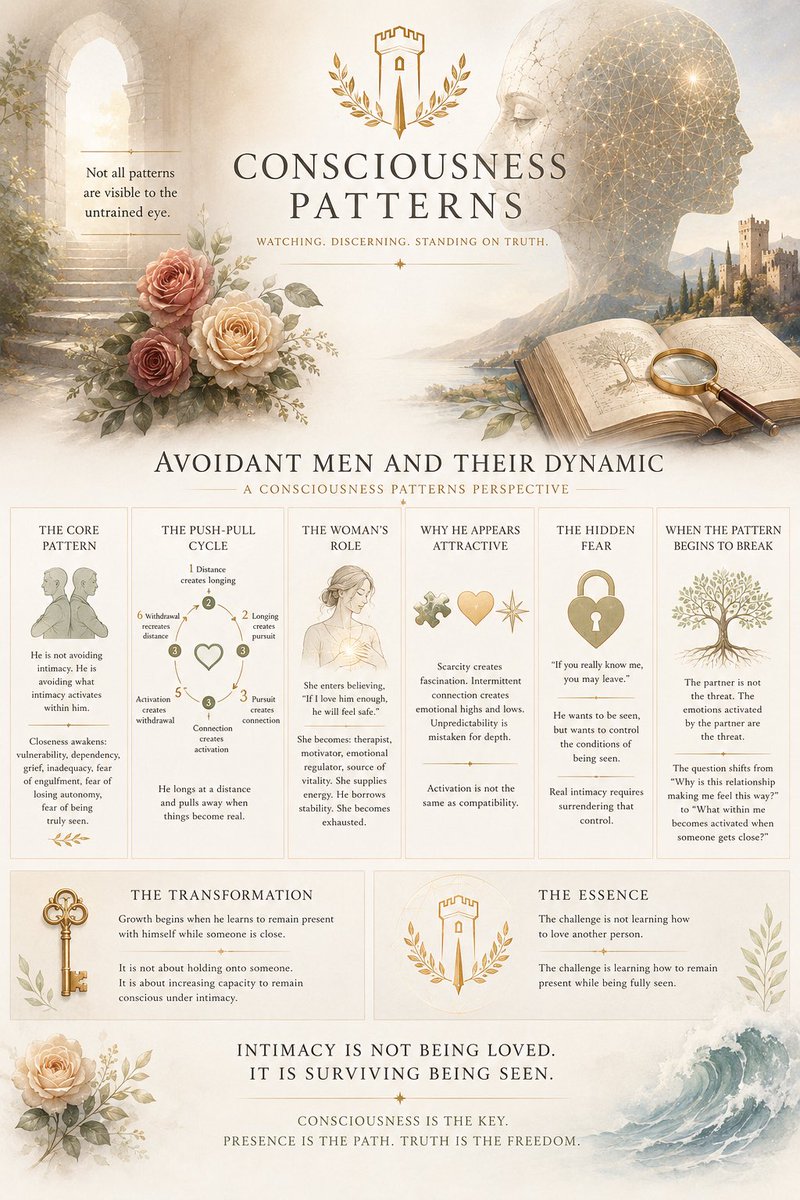
THE AVOIDANT MAN
- Through the Lens of Consciousness Patterns -
Most discussions about avoidant men focus on behavior. They describe
👉🏻emotional distance,
👉🏻fear of commitment,
👉🏻mixed signals, and
👉🏻a tendency to withdraw when relationships become serious.
While these observations are often accurate, they rarely address the deeper pattern operating beneath the surface.
From a Consciousness Patterns perspective, the avoidant man is not fundamentally avoiding intimacy. He is avoiding what intimacy awakens within him.
Human relationships function as mirrors. The closer another person comes, the more deeply hidden aspects of ourselves are illuminated.
👉🏻Vulnerability,
👉🏻dependency needs,
👉🏻unresolved grief,
👉🏻feelings of inadequacy,
👉🏻fear of rejection, and
👉🏻fear of losing autonomy
all begin to emerge. What appears to be a reaction to the other person is often a reaction to one’s own internal activation.
THE PARADOX
This creates a paradox. The avoidant man may genuinely desire connection, companionship, and love. Yet the very experience he longs for also confronts him with emotional realities he has learned to suppress. As intimacy deepens, the relationship becomes increasingly difficult to manage, not because of the partner, but because of the psychological material the partner unconsciously activates.
This is why avoidant dynamics frequently follow a predictable cycle.
1️⃣Distance creates longing.
2️⃣Longing motivates pursuit.
3️⃣Pursuit leads to connection.
4️⃣Connection generates emotional activation.
5️⃣Activation produces discomfort.
6️⃣Discomfort leads to withdrawal.
7️⃣The withdrawal recreates distance,
and the cycle begins again.
To the outside observer, this behavior can appear contradictory. The avoidant man often seems most interested when the relationship is uncertain and most distant when commitment becomes possible. However, the contradiction only exists on the surface.
👉🏻Distance allows desire to flourish without requiring vulnerability.
👉🏻Closeness requires vulnerability without the protection of distance.
The partner often becomes caught within a complementary pattern. Believing that greater love, patience, understanding, or sacrifice will eventually create safety, she gradually assumes the role of emotional regulator. She supplies reassurance, encouragement, emotional labor, and relational stability. Over time, the relationship can become an energetic imbalance in which one person generates vitality while the other unconsciously consumes it.
Eventually, exhaustion sets in. The woman withdraws her investment, not necessarily because she has stopped caring, but because she can no longer sustain the weight of carrying two nervous systems. At this point, the true structure of the relationship becomes visible. What once appeared to be a problem of communication is revealed as a problem of consciousness.
One reason avoidant individuals are often perceived as especially attractive is that avoidance creates scarcity. Human beings are naturally drawn toward what feels difficult to obtain. Intermittent availability can generate emotional intensity that is easily mistaken for depth. Yet activation and compatibility are not the same thing. A relationship can be highly activating while remaining fundamentally unstable.
At the core of many avoidant patterns lies a quiet and often unconscious belief: “If you truly know me, you may leave.” This fear creates an impossible dilemma. The person longs to be seen while simultaneously attempting to control the conditions under which they are seen. Genuine intimacy, however, requires surrendering that control.
The transformation begins when the avoidant individual recognizes that the partner is not the source of the discomfort. The discomfort originates from internal experiences that intimacy exposes. The question shifts from “Why is this relationship making me feel this way?” to “What within me becomes activated when someone gets close?”
1
1
68
This shift marks the movement from relationship management to self-awareness.
From a “Consciousness Patterns” perspective, healing does not occur when someone learns how to hold on to a partner. Healing occurs when they develop the capacity to remain conscious in the presence of intimacy. The challenge is not learning how to love another person. The challenge is learning how to remain present while being fully seen.
For many avoidant men, that is the deepest fear. It is also the doorway through which genuine connection becomes possible.
#ConsciousnessPatterns #AvoidantAttachment #RelationshipDynamics #SelfAwareness #PatternRecognition #ShadowWork #Discernment #PersonalGrowth
8
CONSENSUS REALITY
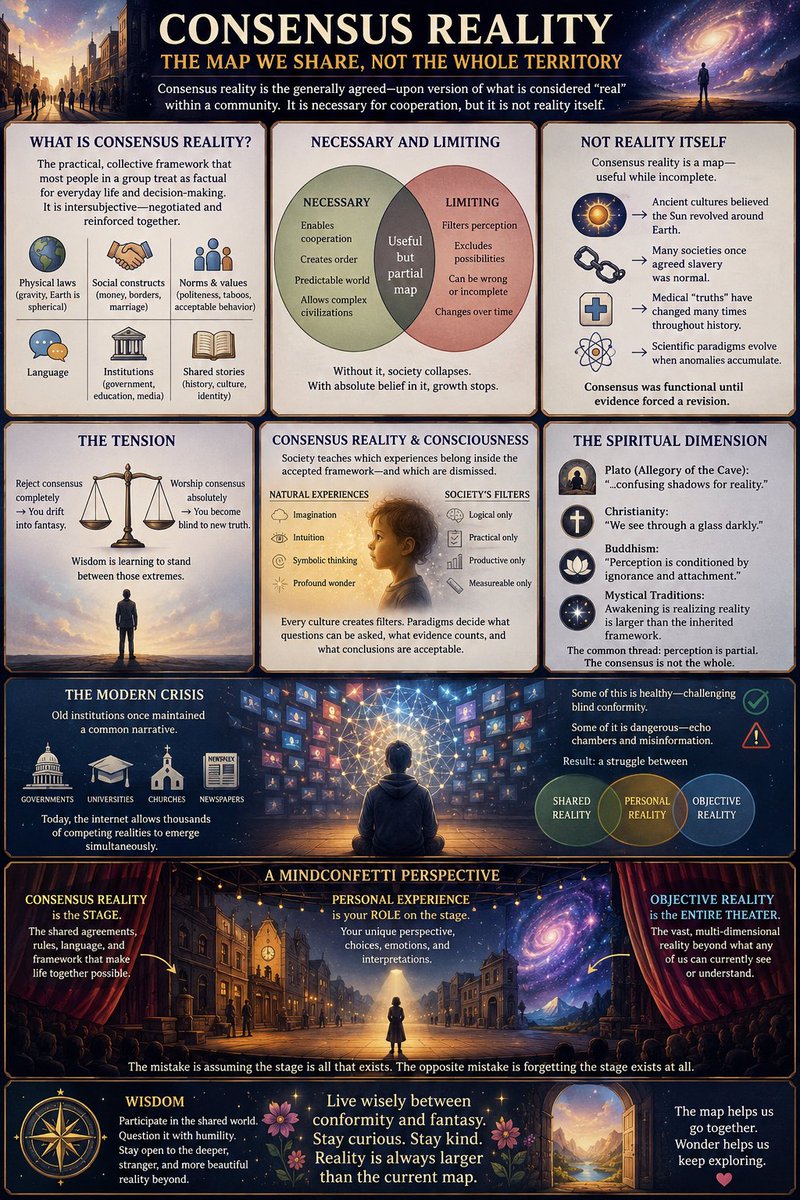
✨Consensus reality is both necessary and limiting.
Without a shared reality, civilization becomes impossible. We need common agreements about language, laws, science, money, timekeeping, and social expectations. Consensus reality allows millions of strangers to cooperate.
👉🏻But there is another side:
Consensus reality is not reality itself. It is a map. A map can be useful while still being incomplete.
For example:
- Ancient societies agreed that the Sun revolved around Earth.
- Many cultures once agreed slavery was normal.
- Medical consensus has repeatedly changed throughout history.
- Scientific paradigms themselves evolve when anomalies accumulate.
The consensus was functional until enough evidence forced a revision. This creates an interesting tension: if you reject consensus reality completely, you drift into fantasy. If you worship consensus reality absolutely, you become unable to see new truth. The challenge is learning to stand between those extremes.
✨Consensus Reality and Consciousness
From a consciousness perspective, consensus reality can be seen as a collective agreement about what experiences are considered valid.
A child may naturally experience imagination, intuition, symbolic thinking, profound wonder. Over time, society teaches which experiences belong inside the accepted framework and which are dismissed. This doesn’t necessarily mean society is wrong. It means every culture creates filters.
The philosopher Thomas Kuhn described this in science through “paradigms.” A paradigm determines what questions can be asked, what evidence is considered legitimate, and what conclusions are acceptable. The same principle applies psychologically, socially, politically, and spiritually.
✨The Spiritual Dimension
Many spiritual traditions argue that human beings mistake the consensus for the whole.
For example: Plato’s “The Republic” describes prisoners confusing shadows on a wall for reality.
Christianity speaks of “seeing through a glass darkly.”
Buddhism teaches that ordinary perception is conditioned by ignorance and attachment.
Mystical traditions often describe awakening as realizing that reality is larger than the framework inherited from society.
The common thread is not that society is evil. It is that human perception is partial.
✨The Modern Crisis
One reason modern society feels unstable is that the old consensus reality is fragmenting. For centuries, large institutions: governments, universities, churches,
newspapers helped maintain a common narrative.
Today, the internet allows thousands of competing realities to emerge simultaneously. Some of this is healthy because it challenges blind conformity. Some of it is dangerous because people can become trapped inside isolated information bubbles.
The result is a struggle between shared reality, personal reality
and objective reality. Consensus reality is the psychological stage. Personal experience is your role on the stage. Objective reality is the entire theater, including parts nobody in the audience can yet see. The mistake is assuming the stage is all that exists. The opposite mistake is forgetting the stage exists at all.
Wisdom is learning to participate in the shared world while remaining open to the possibility that reality is always deeper, stranger, and more beautiful than the current consensus can fully describe. ✨🌸
#ConsciousnessPatterns #ConsensusReality #Awareness #Perception
70

May 11
CULTURAL CHRISTIANITY, HERITAGE AND THE SEARCH FOR MEANING IN MODERN EUROPE
Cultural Christianity is one of the most striking cultural and political phenomena in contemporary Europe. While church attendance and religious practice have been declining for decades, public references to “Christian values,” “Judeo-Christian identity,” and Europe’s Christian heritage have simultaneously increased. Politicians, commentators, and ordinary citizens who may not consider themselves practicing believers still defend Christian symbols, traditions, and moral frameworks as essential elements of European civilization. Within this context emerged the concept of cultural Christianity: a form of attachment to Christianity based less on religious faith and practice, and more on history, identity, and culture.
This phenomenon raises fundamental questions. What does it mean to be “Christian” in a largely secular society? Can a religion survive as cultural heritage even when active belief declines? And why has Christianity re-entered public debate precisely at a time when Europe has become increasingly secular, especially in discussions surrounding migration, Islam, and national identity? The debate surrounding cultural Christianity is therefore not merely about religion, but about the broader search for identity in a rapidly changing Europe.
🔻What Is Cultural Christianity?
Cultural Christianity differs significantly from traditional Christianity. Classical Christianity centers on belief in God, participation in the church, sacraments, and religious practice. Cultural Christianity, by contrast, refers more to a symbolic attachment to Christian tradition. A person may identify as “Christian” without regularly praying, attending church, or literally affirming central doctrines of the faith. In this context, “Christian” no longer primarily describes a theological conviction, but rather a cultural background: a sense of connection to European history, moral traditions, symbols, holidays, and social norms.
This shift from religion to culture reflects broader developments within modern society. Throughout the twentieth century, Europe underwent a profound process of secularization. Religious institutions gradually lost social authority, individual autonomy became central, and religion increasingly came to be viewed as a private matter. At the same time, globalization, economic integration, and migration transformed European societies at an unprecedented pace. National and cultural identities became less self-evident. Within this climate, many people began searching for forms of historical continuity and cultural cohesion.
🔻The Return of Christian Identity
Christianity thus acquired a new function. Whereas religion once served as a living social structure, it is now often presented as the cultural foundation of European civilization. References to “Christian roots” or “Judeo-Christian values” express less a theological conviction than a civilizational idea: the belief that Europe was historically shaped by Christian traditions and that these traditions still form the moral and institutional basis of the West.
Particularly important within this debate is the notion of “Judeo-Christian identity.” Today, the term is frequently used to describe Europe’s cultural origins, but historically it is a relatively modern construction. For centuries, relations between Christian and Jewish communities in Europe were often marked by conflict and exclusion. Only in the twentieth century, especially after the Holocaust and during the Cold War, did the idea of a shared “Judeo-Christian civilization” emerge. At the time, the concept was used to emphasize the moral foundations of the West against totalitarian ideologies such as fascism and communism.
#CulturalChristianity #Europe #Identity #JudeoChristian #Secularization #Nationalism #Religion #Culture #Civilization #Philosophy #EuropeanIdentity #Christianity #IslamDebate #Tradition
1
79
May 11
🔻The Positive Dimensions of Cultural Christianity
Although cultural Christianity is often discussed critically in relation to nationalism and identity politics, the phenomenon also contains positive and constructive dimensions. For many people, cultural Christianity does not primarily represent exclusion or political polarization, but rather an attempt to preserve cultural continuity, moral orientation, and historical rootedness within rapidly changing societies.
👉🏻One positive aspect is the preservation of historical and cultural heritage. European societies were profoundly shaped by Christianity for centuries. Art, architecture, music, literature, holidays, and political institutions still carry unmistakable traces of that tradition. Cathedrals, monasteries, and religious artworks belong to Europe’s cultural memory, just as concepts such as human dignity, forgiveness, compassion, and care for the vulnerable are historically connected to Christian ethics. Cultural Christianity can therefore function as a form of historical consciousness: an awareness that modern societies did not emerge in a vacuum, but developed through long civilizational processes.
👉🏻In addition, cultural Christianity can provide a source of social cohesion. In an age of individualism, digitalization, and globalization, many people experience the loss of shared rituals and collective symbols. Religious traditions, even when not practiced strictly as matters of faith, can still create a sense of belonging. Holidays such as Christmas and Easter function for many not only as religious celebrations, but also as cultural and social moments that reinforce family ties, collective memory, and communal identity.
👉🏻Christian tradition also continues to influence moral frameworks. Some thinkers argue that modern concepts such as human rights, equality, and the intrinsic worth of the individual cannot be fully separated from Christianity’s historical influence. Even in secular societies, many people continue to operate within a moral framework shaped in part by Christian thought. Cultural Christianity, from this perspective, represents an acknowledgment of that moral inheritance.
For others, cultural Christianity offers a counterbalance to cultural dislocation. Globalization has opened societies to the world, but it has also intensified the feeling that local traditions and national cultures are becoming fragile. Christianity may therefore function as a stabilizing symbol of continuity within societies undergoing constant transformation. This does not necessarily imply rejection of other cultures, but rather a desire for a recognizable cultural foundation upon which solidarity and trust can rest.
Even on an existential level, Christian symbolism remains meaningful. Narratives of guilt, forgiveness, sacrifice, hope, and redemption continue to possess deep cultural and psychological resonance. In times of crisis, grief, or uncertainty, many people return to religious rituals and symbols because they have long been connected to humanity’s search for meaning and transcendence.
🔻Criticism and Philosophical Tensions
At the same time, cultural Christianity raises important criticisms and philosophical tensions. From within Christianity itself, some argue that cultural Christianity reduces the essence of the faith to identity politics. The Gospel emphasizes universality, compassion, and spiritual transformation rather than ethnic or national boundaries. According to this critique, a purely cultural Christianity risks becoming detached from the spiritual substance upon which it was originally founded.
Secular critics also question the concept of “Judeo-Christian values.” They point out that Europe was shaped not only by Christianity, but also by humanism, Greek philosophy, Roman law, and Enlightenment rationalism. Furthermore, some fear that references to Christian identity may be used to legitimize cultural exclusion.
1
30
May 11
Philosophically, the debate ultimately raises a deeper question: can a civilization preserve its religious symbols once faith itself declines? Cultural Christianity demonstrates that religion in modern societies does not necessarily disappear, but transforms. Christianity remains present in language, morality, rituals, and collective memory even within secular cultures. Yet it remains uncertain whether a religious tradition can endure indefinitely when experienced primarily as a cultural symbol rather than a living faith.
CONCLUSION
Cultural Christianity is far more than a religious phenomenon. It reflects the broader search of modern societies for identity, continuity, and meaning in an age of secularization, globalization, and cultural transformation. For some, it offers a source of belonging, historical consciousness, and moral orientation. For others, it raises concerns about exclusion, nationalism, and the political instrumentalization of religion.
It is precisely this ambiguity that makes cultural Christianity one of the most intriguing intellectual and political questions of contemporary Europe. It demonstrates that religion, even within secular societies, does not simply disappear. Instead, it changes form, function, and meaning, from faith to culture, from spirituality to identity, from church to civilization.
👉🏻The central question therefore remains open: can a society preserve its religious heritage without preserving the spiritual core from which that heritage originally emerged?
1
22
May 11
SOVIET ANTI-ZIONISM, ORIGINS AND DEVELOPMENT
🪆Early Soviet Support for Israel (1947–1948)
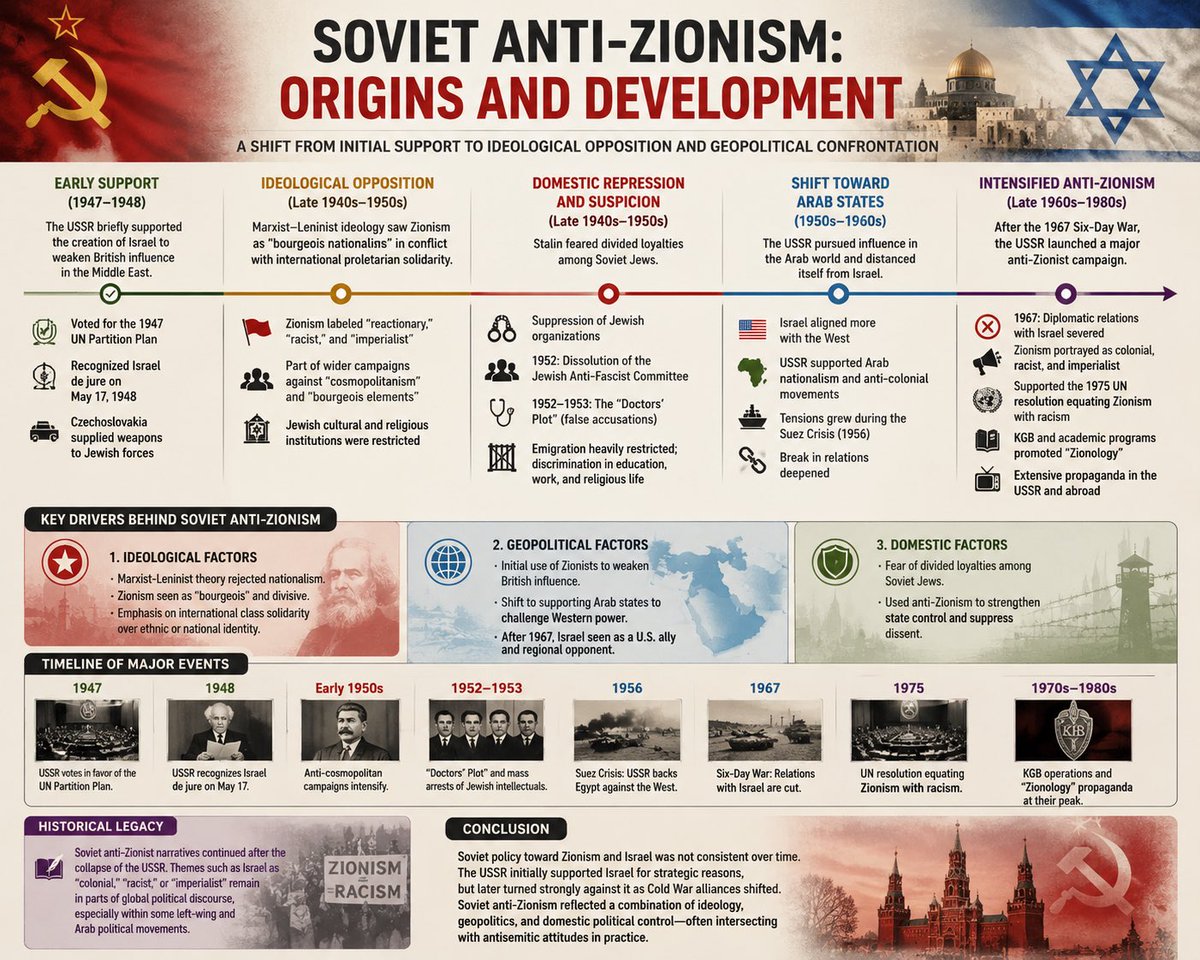
At first, the Soviet Union briefly supported the creation of Israel. Soviet leader Joseph Stalin believed that a new Jewish state could weaken British influence in the Middle East, especially in Mandatory Palestine, which Britain controlled until 1948. The USSR voted in favor of the 1947 UN Partition Plan, recognized Israel shortly after independence, and allowed Czechoslovakia to supply weapons to Jewish forces during the Arab–Israeli war.
This support was mainly strategic rather than ideological. Stalin hoped that Israel, whose early political leadership included many socialist and labor-oriented movements such as the kibbutz system and the Mapai party, might become friendly to the Soviet bloc or at least reduce Western influence in the region.
⚔️Ideological Opposition to Zionism
Despite this early support, Soviet ideology fundamentally distrusted Zionism. Marxist–Leninist theory viewed nationalism as secondary to international class solidarity. Zionism - the movement advocating a Jewish national homeland - was therefore criticized as a form of “bourgeois nationalism.”
Soviet leaders argued that Jews should integrate into socialist society rather than maintain a separate national identity tied to another state. Over time, Soviet propaganda increasingly described Zionism as “reactionary,” “imperialist,” or “racist.”
This ideological position became connected to broader campaigns against so-called “cosmopolitanism,” a term that often indirectly targeted Jewish intellectuals and cultural figures. Jewish religious and cultural institutions were increasingly restricted, especially during the late Stalin era.
🪆Domestic Repression and Suspicion of Soviet Jews
After Israel was established, many Soviet Jews expressed cultural or emotional interest in the new state. Stalin viewed this with suspicion, fearing divided loyalties and possible connections to foreign governments.
This led to several anti-Jewish campaigns during the late 1940s and early 1950s. The Soviet state suppressed Jewish organizations, arrested intellectuals associated with the Jewish Anti-Fascist Committee, and carried out political purges. In 1952–1953, the so-called “Doctors’ Plot” accused mostly Jewish doctors of conspiring against Soviet leaders, although the allegations were later shown to be fabricated.
Following Stalin’s death in 1953, the most extreme measures ended, but official anti-Zionist policy remained. Soviet Jews often faced restrictions in higher education, employment, religious life, and emigration.
🔻The Cold War and the Shift Toward the Arab States
Geopolitical developments quickly pushed the USSR further away from Israel. Although Israel initially tried to balance relations between East and West, it increasingly aligned with the United States and Western Europe.
At the same time, the Soviet Union sought influence in Arab countries such as Egypt and Syria. Supporting Arab nationalism became a way for Moscow to expand its role in the Middle East and challenge Western power.
The turning point came after the Six-Day War in 1967, when Israel defeated several Soviet-armed Arab armies. The Soviet leadership interpreted this as evidence that Israel had become a Western strategic ally. Diplomatic relations between the USSR and Israel were severed, and Soviet propaganda against Zionism intensified significantly.
🔻Soviet Anti-Zionist Propaganda
From the 1960s onward, Soviet anti-Zionism developed into a large-scale political and propaganda campaign. Soviet publications and media often portrayed Zionism as a tool of colonialism, capitalism, and Western imperialism.
#SovietUnion
#AntiZionism
#ColdWar
#IsraelHistory
#MiddleEastHistory
#Stalin
#USSR
#Zionism
#MarxismLeninism
#Geopolitics
#SovietHistory
#JewishHistory
#ColdWarPolitics
#HistoricalAnalysis
#InternationalRelations
#MiddleEastPolitics
#SovietPropaganda
#ArabIsraeliConflict
1
44
May 11
🔻Historical Legacy
The Soviet Union’s anti-Zionist policies combined several motivations: communist ideology, Cold War geopolitics, and internal political control. While official Soviet rhetoric distinguished between Jews and Zionists, many historians argue that the policies often blurred that distinction in practice.
The influence of Soviet anti-Zionist language continued after the collapse of the USSR. Some themes developed in Soviet propaganda - such as describing Israel as colonial, racist, or imperialist - remained present in parts of international political discourse, particularly within some left-wing and Arab political movements.
🔻Conclusion
Soviet policy toward Zionism and Israel was not consistent over time. The USSR initially supported Israel for strategic reasons but later turned strongly against it as Cold War alliances shifted. Soviet anti-Zionism reflected a mixture of ideological beliefs, geopolitical calculations, and concerns about internal political loyalty.
Understanding this history helps explain both Soviet foreign policy during the Cold War and the long-term development of political narratives surrounding Israel and Zionism in international debates.
17
AMERICA FIRST, EUROPA ONDER DRUK
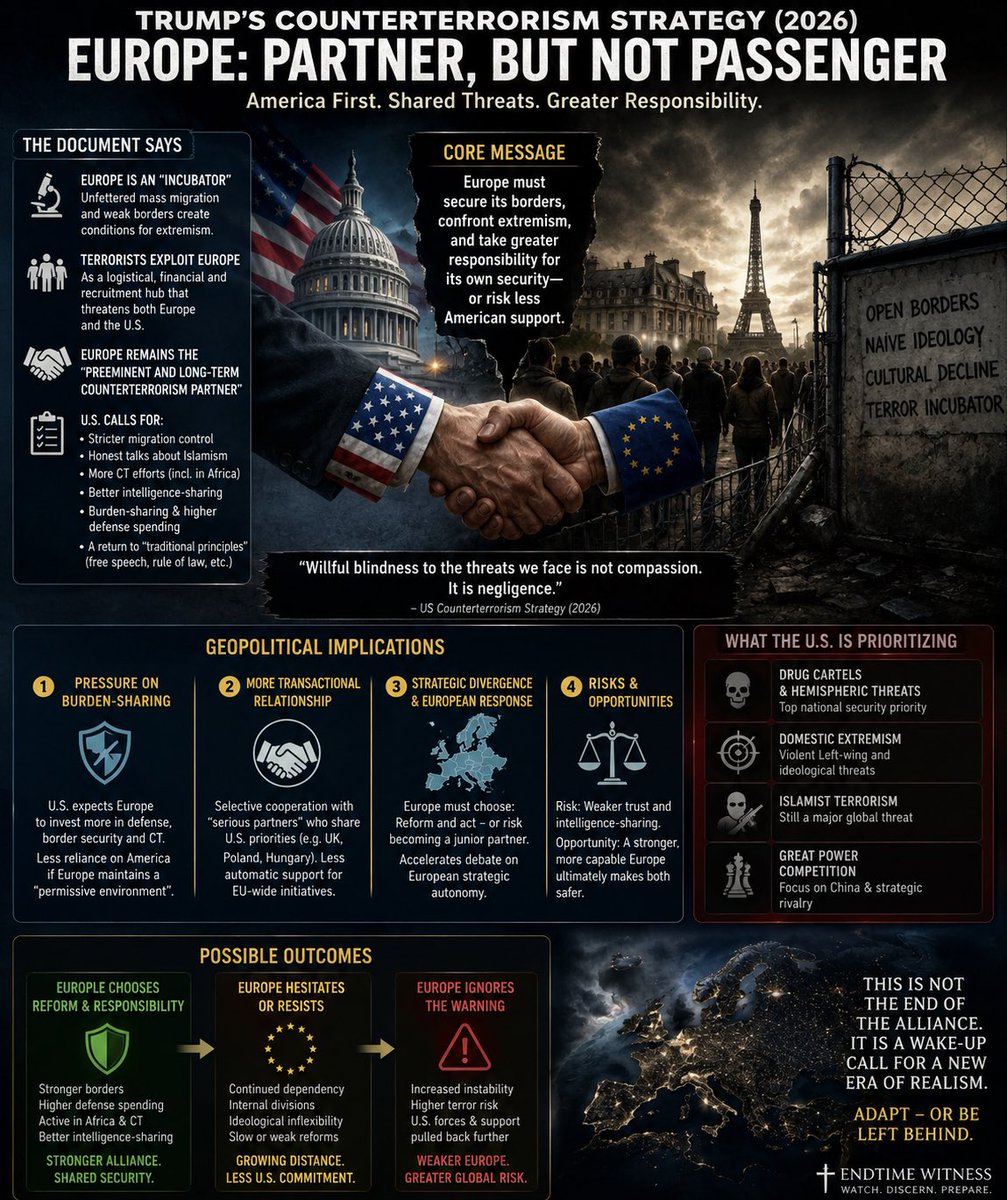
De nieuwe Amerikaanse antiterreurstrategie onder president Donald Trump beschrijft Europa als zowel een belangrijke bondgenoot als een regio waar veiligheidsproblemen kunnen ontstaan door zwakke grenscontrole, radicalisering en migratieproblemen. De toon van het document sluit aan bij een meer “America First”-gerichte aanpak: de VS wil blijven samenwerken met Europa, maar verwacht dat Europese landen meer verantwoordelijkheid nemen voor hun eigen veiligheid.
DE STRATEGIE BENADRUKT ENKELE HOOFDPUNTEN
🔻Europa blijft volgens de VS een belangrijke partner in terrorismebestrijding.
🔻Tegelijk waarschuwt Washington dat terroristen gebruik kunnen maken van open grenzen, migratiestromen en sociale spanningen in Europa.
🔻De VS vraagt Europese landen om strenger op te treden tegen extremisme, beter samen te werken op het gebied van inlichtingen en meer te investeren in defensie en veiligheid.
🔻Er klinkt ook kritiek op wat de Amerikaanse regering ziet als te vrijblijvende of ideologisch gedreven Europese beleidskeuzes rond migratie en veiligheid.
Geopolitiek gezien past dit in een bredere ontwikkeling waarbij de VS onder Trump minder automatisch de rol van “wereldpolitie” wil spelen. Bondgenoten moeten volgens deze visie meer zelf doen. Dat kan gevolgen hebben voor de relatie tussen Amerika en Europa:
MEER DRUK OP EUROPA
Europese landen kunnen minder vanzelfsprekend rekenen op Amerikaanse steun als zij volgens Washington onvoldoende investeren in defensie, grensbewaking of terrorismebestrijding.
MEER TRANSACTIONELE SAMENWERKING
De VS lijkt meer samen te willen werken met landen die dezelfde veiligheidsprioriteiten delen. Daardoor kan de samenwerking selectiever en minder vanzelfsprekend worden.
DISCUSSIE OVER EUROPESE ZELFSTANDIGHEID
Binnen Europa versterkt dit debat over “strategische autonomie”: moet Europa militair en politiek zelfstandiger worden, losser van de VS?
MOGELIJKE RISICO’S EN KANSEN
Minder vertrouwen tussen bondgenoten kan samenwerking moeilijker maken. Tegelijk kan extra druk Europa aanzetten om sterker en beter voorbereid te worden op veiligheidsdreigingen.
KORT SAMENGEVAT
De strategie betekent geen breuk tussen de VS en Europa, maar wel een verandering in toon en verwachtingen. De Amerikaanse regering benadrukt dat Europa zelf meer verantwoordelijkheid moet nemen voor veiligheid, migratie en terrorismebestrijding. Hoe Europese landen daarop reageren, zal bepalend zijn voor de toekomstige relatie tussen beide kanten van de Atlantische Oceaan.
#Geopolitiek #Europa #VerenigdeStaten #Trump #Counterterrorism #Migratie #Veiligheid #NAVO #TransAtlantisch #StrategischeAutonomie #EuropaVeiligheid #BorderSecurity #Geostrategy #Westen #Islamisme #Defensie #Intelligence #AmericaFirst #EndTimeWitness #Wereldorde
18
HARNESSING OR UNDERMINING:
UNDERSTANDING INTRINSIC SOCIAL DARWINISM
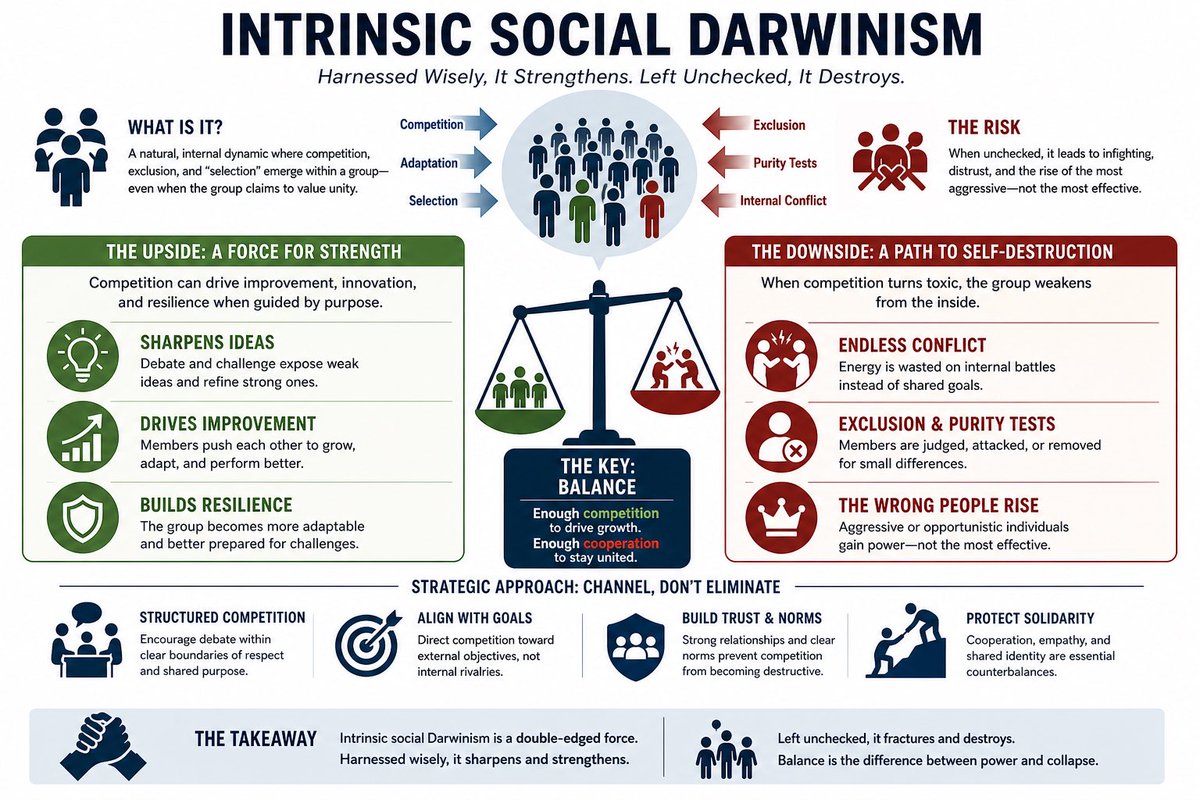
WHAT IS INTRINSIC SOCIAL DARWINISM
Intrinsic social Darwinism describes a hidden dynamic within groups where competition, exclusion, and internal “selection” naturally emerge, even when the group claims to value unity. It builds on the broader idea of social Darwinism, which applies evolutionary thinking (like “survival of the fittest”) to society.
👉🏻But the key difference is this: intrinsic social Darwinism is not always a conscious belief or ideology. Instead, it operates automatically through behavior, incentives, and group culture.
In practice, this means that members constantly evaluate each other. Those seen as weaker, less committed, or ideologically “impure” may be criticized, pushed aside, or excluded. Over time, only the most adaptable, assertive, or strategic individuals remain influential. This creates a kind of internal selection process, similar to evolution, but within a social group.
THE UPSIDE: COMPETITION AS A DRIVER OF STRENGTH
At first glance, this dynamic can actually be useful. Competition can push individuals to improve their ideas, sharpen their arguments, and become more effective. When different factions challenge each other, weak strategies are exposed and stronger ones survive. This can lead to innovation and higher performance.
For example, in political movements or organizations, internal debate can refine policies and messaging. People are forced to think critically and defend their positions. In this way, intrinsic social Darwinism can act as a filter that removes ineffective approaches and promotes stronger ones. If managed well, this process can make a group more resilient and adaptive. It encourages growth and prevents stagnation.
THE DOWNSIDE: WHEN COMPETITION BECOMES DESTRUCTIVE
However, the same dynamic can quickly turn harmful. When competition becomes too intense, it shifts from improving the group to tearing it apart. Members may start focusing more on attacking each other than on achieving shared goals. This often leads to:
👉🏻Constant internal conflict
👉🏻Distrust between members
👉🏻Purity tests where people are judged harshly for small differences
👉🏻The rise of or opportunistic individuals
Instead of selecting the most capabel leaders, The system may reward Thaise who are best at navigating conflict or dominating others. This wellness the group overall. Energie is wasted on internal battles rather than external challenges. This may cause the group to desintegrate; losing members, credibility and effectiveness.
#IntrinsicSocialDarwinism #SocialDarwinism #GroupDynamics #CompetitionVsCooperation #PoliticalTheory #Sociology #PowerDynamics #Leadership #CollectiveAction #Ideology #CriticalThinking #InternalConflict
1
22
STRATEGIC USE: CHANNELING THE DYNAMIC
From a strategic point of view, intrinsic social Darwinism can be managed rather than avoided. The goal is to keep the benefits of competition while limiting its risks.
👉🏻One way to do this is by creating structured competition. This means encouraging debate and disagreement, but within clear boundaries. Respect, shared goals, and basic trust must be maintained. Leaders play an important role here by setting norms and discouraging destructive behavior.
👉🏻Another strategy is to direct competition outward. Instead of competing against each other, members compete to achieve better results for the group, such as stronger campaigns, better ideas, or more effective outreach. This turns internal rivalry into a collective advantage.
WEAKING COUNTERFORCES: A RISKY PATH
On the other hand, if cooperation, trust, and solidarity are weakened, intrinsic social Darwinism becomes more intense. This can happen naturally or be encouraged, sometimes even intentionally by opponents trying to destabilize a group.
When trust breaks down, members become suspicious of each other. Small disagreements grow into major conflicts. The group becomes fragmented and less able to act effectively. In this state, it is vulnerable, not just to internal collapse, but also to external pressure.
This shows that intrinsic social Darwinism is unstable. Without balancing forces, it tends to spiral into dysfunction.
THE BIGGER PICTURE: COMPETITION VERSUS COOPERATION
It is important to remember that real-world success, both in biology and in human societies, is not based on competition alone. Cooperation is just as important. Humans have achieved progress through teamwork, trust, and shared effort.
Focusing only on “survival of the fittest” ignores this reality. Groups that rely too heavily on internal competition may overlook the value of collaboration. As a result, they may become less effective over time.
CONCLUSION
Intrinsic social Darwinism is a powerful but double-edged force. It can strengthen a group by encouraging adaptation, critical thinking, and improvement. But if it becomes too dominant, it can destroy the very unity the group depends on. The key challenge is balance. Successful groups find ways to combine competition with cooperation. They allow ideas to be tested and improved, while maintaining trust and shared purpose.
In short, intrinsic social Darwinism can either sharpen a group or break it apart. The outcome depends on how it is managed.
22
Apr 29
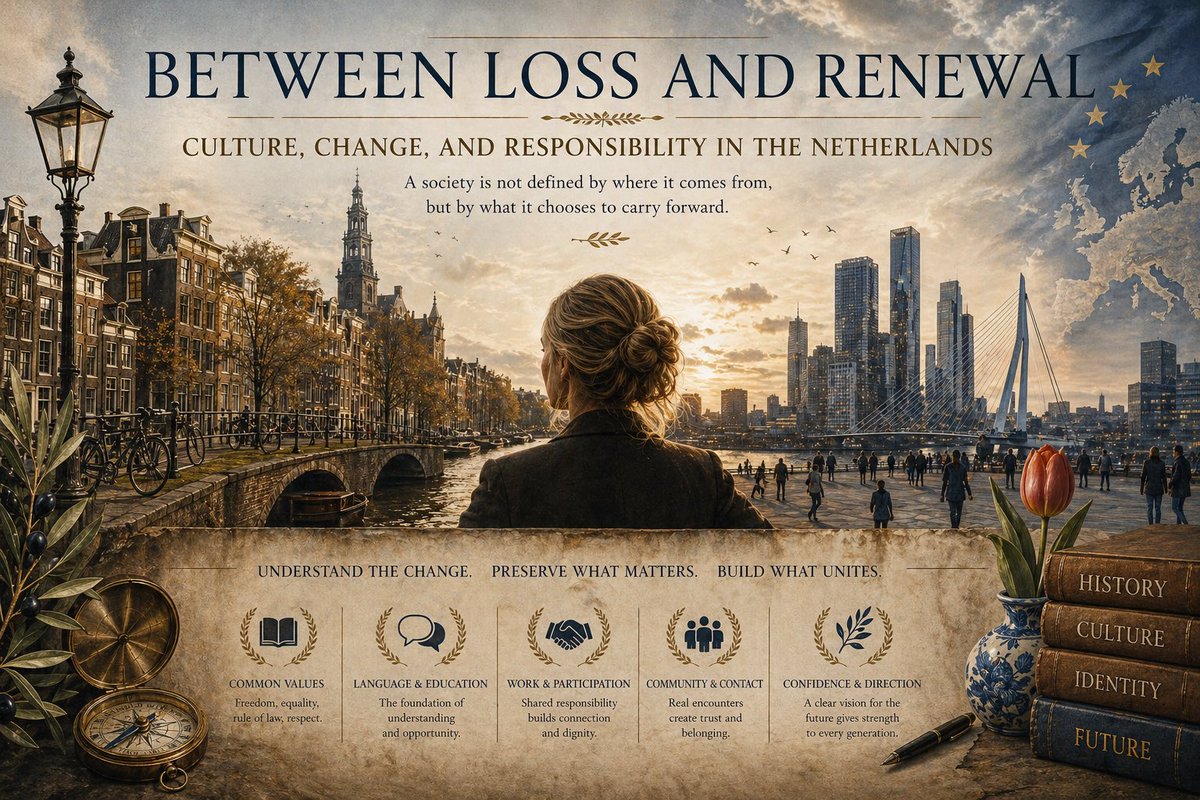
BETWEEN LOSS AND RENEWAL
There is something that has shifted in the Netherlands, not suddenly, not always visibly, but unmistakably. It can be sensed in the street, in the language people use, in the subtle ways people acknowledge one another - or don’t. For many, it is difficult to define, yet easy to recognize: the feeling that what was once self-evident, what once felt shared, is slowly losing its clarity. This feeling is often dismissed as nostalgia or exaggerated fear. But what if it is neither? What if it is a signal - a sign that a society has reached a point where it must consciously reconsider what binds it together?
We should explore that tension. It begins with the experience of cultural loss - where it comes from, and how it relates to reality. It then turns to a more demanding question: how that sense of loss can be transformed into responsibility, into a conscious shaping of what comes next.
I. WHEN CHANGE FEELS LIKE LÖSS
The sense that culture is “disappearing” has become a recurring theme in public discourse in the Netherlands. It does not always present itself in dramatic terms. More often, it appears in ordinary observations: neighborhoods that feel unfamiliar, languages that sound different, social norms that no longer align. These experiences accumulate into something deeper; a feeling of disorientation.
It would be a mistake to dismiss this outright. Feelings of loss rarely emerge without cause. They are often rooted in real changes. At the same time, it would be equally mistaken to assume that the conclusion - that culture is vanishing - is factually correct. What we are dealing with is a gap between perception and reality.
To understand this gap, one must first reconsider what culture actually is. Culture is not a fixed object that can simply be preserved or lost. It is a living process, a continuous negotiation of meaning, values, and practices. What is considered “typically Dutch” today would have been unrecognizable in earlier periods. The Netherlands has undergone profound transformations: from a pillarized and religious society to a secular, highly individualistic one. Yet those changes unfolded gradually and largely from within, which made them easier to absorb.
Today’s changes feel different. Globalization, digitalization, and migration have increased both the speed and visibility of transformation. Differences in language, religion, and social norms are no longer distant, they are immediate, present in everyday life. This proximity intensifies awareness of difference and, with it, the potential for alienation.
Recognition plays a crucial role here. People derive a sense of identity from their surroundings. When that environment changes rapidly, the result can be a loss of orientation, not necessarily because specific traditions have disappeared, but because the context that made them meaningful has shifted. The question is no longer simply “what has changed?” but “what does this place still represent?”
MIGRATION AS CENTRAL DRIVER
Migration is often seen as the central driver of these changes. This is understandable: migration introduces visible differences. Yet focusing on it alone creates a distorted picture. Many of the most profound cultural shifts in the Netherlands such as the dominance of English, the transformation of family structures, or the rise of digital communication, are not caused by migration. They are the result of broader global and technological developments.
This does not mean migration is irrelevant. It is one factor among several, and in some contexts a significant one. But reducing the issue to migration alone narrows the problem and makes it harder to address effectively.
Another contributing factor is the weakening of shared frameworks. Institutions that once played a central role in transmitting norms and values, churches, schools, community organizations, have lost much of their unifying function.
#Culture
#Identity
#Society
#Change
#SocialCohesion
1
16
Apr 29
In a more fragmented society, fewer assumptions are shared automatically. What is “normal” becomes less clear, and differences become more salient.
The feeling of cultural loss, then, is not a single phenomenon but a convergence of forces: accelerated change, reduced recognition, visible diversity, and the erosion of shared reference points. It is a real experience, even if its interpretation is often flawed.
The danger lies in how this feeling is understood. If it is framed as the loss of a fixed and pure culture, it leads to a defensive and ultimately unrealistic stance. Culture has never been static. Treating it as such not only misrepresents history, but also makes adaptation more difficult.
The real question is not whether culture is changing, it always is, but whether that change is being consciously understood and guided.
II. From Loss to Responsibility
If culture is not something that can simply be preserved in its original form, then the sense of loss cannot be resolved by attempting to “freeze” it. The alternative is more demanding: to take responsibility for shaping its future.
This begins with clarity. A society that does not articulate its core values leaves them undefined, and therefore vulnerable. In the Netherlands, many norms have long been implicit: equality, directness, personal freedom. These were rarely formalized because they seemed self-evident. But what is implicit can also become fragile. In a context of increasing diversity and change, core principles must be made explicit, not as instruments of exclusion, but as a framework for participation.
Clarity alone, however, is insufficient. Values must be embodied in practice. Integration, in this sense, is not an abstract policy goal but a concrete social process. Language, work, and education are central to this process. Without a shared language, there is no shared reality. Without participation in the labor market, there is no reciprocity. Without common educational experiences, there is no intergenerational continuity.
Where these structures are weak or absent, fragmentation increases. Different groups may coexist, but without meaningful interaction. The result is not a dynamic culture, but parallel societies.
At the same time, responsibility does not rest solely with newcomers. The receiving society must also reflect on its own posture. A culture that defines itself purely in defensive terms, focused on what must be protected from outside influence - risks becoming brittle. A living culture, by contrast, is capable of absorbing new elements without losing its coherence.
This requires a shift from passive experience to active engagement. The question is no longer “what are we losing?” but “what do we consider worth carrying forward and how do we ensure that others can share in it?”
This reframing transforms the debate. Culture is no longer a battleground between preservation and change, but a shared project. Differences do not disappear, but they exist within a common framework that provides stability and meaning.
Such a framework does not emerge automatically. It requires political choices, social effort, and cultural reflection. But above all, it requires a recognition that culture persists only when it is consciously maintained.
1
13
Apr 29
Conclusion - A SHARED TASK
At its core, the feeling of cultural loss is not only about what might be disappearing, but about what risks losing its meaning. It reflects a desire for continuity, for recognition, for belonging. These are legitimate concerns, even when they are imperfectly expressed.
At the same time, the analysis makes clear that culture cannot be reduced to preservation alone. It is always in motion. The challenge is not to stop that movement, but to give it direction.
In the Netherlands, this challenge belongs not only to policymakers or institutions, but to society as a whole. Culture is not sustained in abstract declarations, but in everyday practices, in language, work, education, and interaction. Where these are shared, cohesion emerges. Where they diverge without connection, distance grows.
The sense of loss, then, marks a turning point. It can lead to withdrawal and polarization. Or it can lead to reflection and renewed engagement. In the latter case, it becomes something else entirely: not an endpoint, but a beginning.
Culture does not disappear on its own. It only loses its form when people cease to carry it forward. And in that realization lies both the responsibility and the possibility of every generation.
12
Apr 29
🧵 Iran. The UN. And a shifting world order.
1/
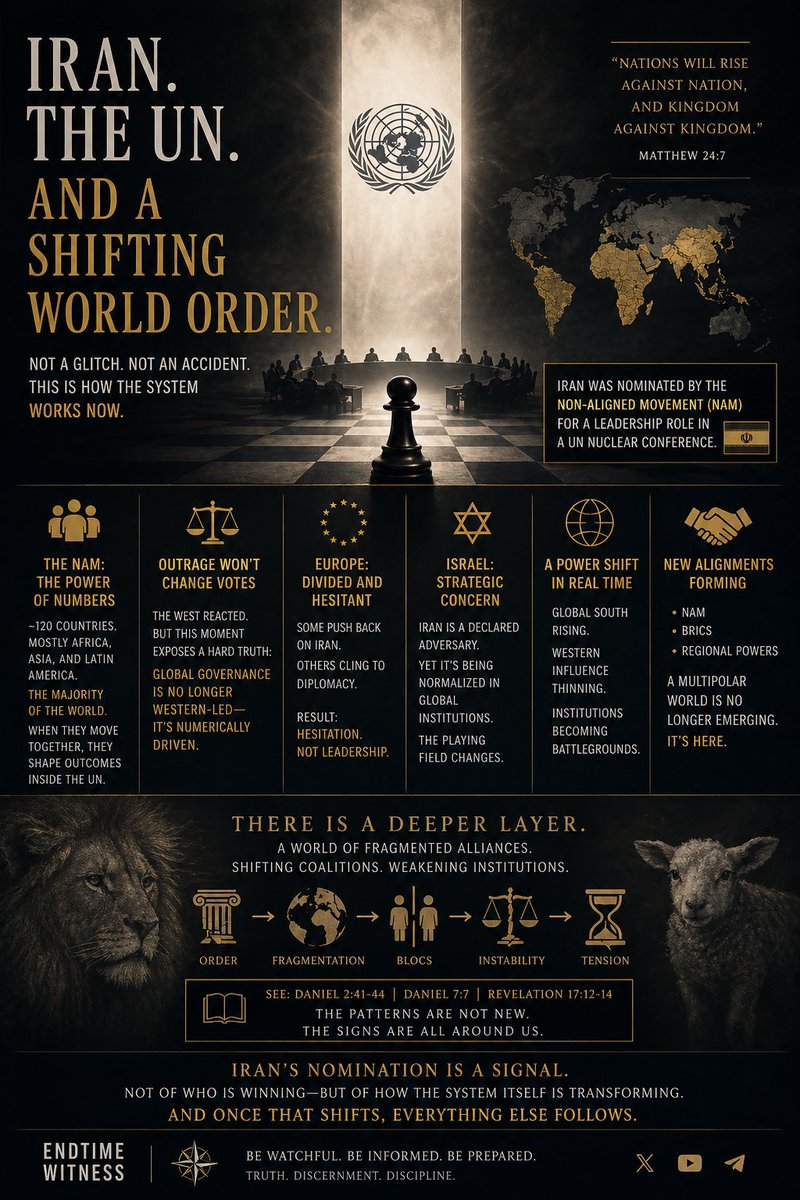
Iran was nominated by the Non-Aligned Movement (NAM) for a leadership role in a UN nuclear conference.
2/
The NAM represents ~120 countries - mostly from Africa, Asia, and Latin America.
That’s the majority of the world.
When they move together, they shape outcomes inside the United Nations.
3/
Iran didn’t force its way in.
It was nominated.
Backed by a bloc that increasingly challenges Western dominance and pushes its own agenda: sovereignty, anti-colonialism, multipolar power.
4/
The West reacted with outrage. But outrage doesn’t change votes.
This moment exposes a hard truth:
Global governance is no longer Western-led - it’s numerically driven.
5/
Inside Europe, the European Union looks divided.
Some push back on Iran.
Others cling to diplomacy like the Joint Comprehensive Plan of Action.
Result: hesitation. Not leadership.
6/
For Israel, this is strategic.
Iran isn’t just another state - it’s a declared adversary.
Yet it’s being normalized in global institutions.
That changes the playing field.
7/
This isn’t about one appointment.
It’s about a power shift:
• Global South rising
• Western influence thinning
• Institutions becoming battlegrounds
8/
The UN was built on shared principles.
Today, it runs on competing blocs.
Legitimacy is no longer moral - it’s mathematical.
9/
Zoom out.
You see alignment forming:
NAM
BRICS
Regional powers
A multipolar world is no longer emerging.
It’s here.
10/
And in that world?
Israel grows more isolated.
Europe grows less decisive.
The US grows less dominant.
Power doesn’t disappear.
It redistributes.
11/
There’s a deeper layer most ignore.
A world of fragmented alliances…
Shifting coalitions…
Weakening institutions…
These patterns aren’t new.
See: Book of Daniel
See: Book of Revelation
12/
Not prediction, it is observation.
Order → fragmentation
Unity → blocs
Stability → tension
We’re watching the architecture of the world change in real time.
13/
Iran’s nomination is a signal.
Not of who is winning,
But of how the system itself is transforming.
And once that shifts, everything else follows.
- EndTime Witness
#Europe #EU #Israel #MiddleEast #ForeignPolicy #Security #NuclearPolitics
27
Apr 27
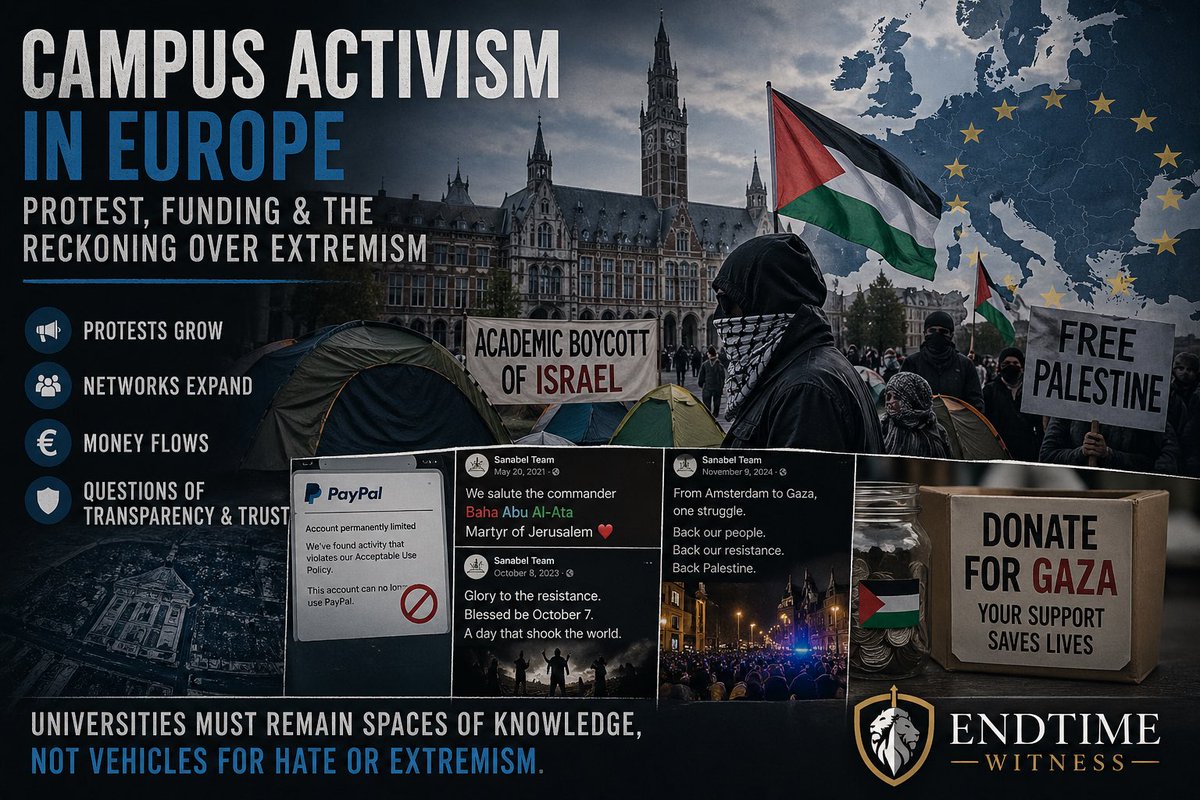
🎓 CAMPUS ACTIVISME, FUNDING TRANSPARENCY AND POLARIZATION IN EUROPE
🧠 1. From Protest to Infrastructure
Across European universities, pro-Palestinian activism has evolved beyond demonstrations into more structured forms such as organized student groups, fundraising initiatives for Gaza and coördinaten messaging / campaigns (e.g. boycotts)
The concerns that are raised are not about protest per se, but about what lies behind these structures; financially, ideologically, and organizationally.
The reference to entities such as Palestinian Islamic Jihad significantly raises the stakes. Even indirect associations such as symbolic praise, or ambiguous messaging can trigger legal scrutiny, platform restricties and political intervention.
⚖️ 2. The European Sensitivity to Extremism
Europe’s response to such signals is shaped by its legal and historical framework: laws against terror financing and incitement, institutional memory shaped by events such as the Holocaust and heightened awareness after the Hamas attack on Israel on 7 October 2023
This creates a context in which even perceived proximity to extremist groups becomes politically explosive. Universities through are expected by to act as guardians of democratic norms. Unfortunately we have seen that this is not happening as much as should be expected in democratic countries.
🧩 3. Competing Interpretations
The situation is not interpreted uniformly across Europe. Instead, two dominant narratives are emerging:
A. Critical Perspective
Campus activism may be penetrated by radical or extremist sympathies.
Lack of transparency in fundraising is a systemic risk.
Universities risk becoming spaces of intimidation or ideological capture.
B. Counter Perspective
These accusations are seen as delegitimizing solidarity movements.
Fundraising is framed as humanitarian support for Gaza.
Criticism is sometimes interpreted as politically motivated or suppressive.
👉 The result is not consensus, but deep epistemic polarization; disagreement not just about facts, but about how to interpret them.
#Europe #CampusProtests #AcademicFreedom #IsraelPalestine #Gaza #UniversityPolitics #ExtremismDebate #FreedomOfSpeech #EU #Geopolitics #StudentActivism #MiddleEast #PublicD
1
31
Apr 27
🌍 4. A Broader European Pattern
Taken together - University occupations, fundraising scrutiny, and public intellectual engagement - reflectie a broader shift:
European universities are becoming contested arenas where geopolitics, identity, and security concerns intersect.
Key features of this pattern:
🔺 Escalation of activism tactics (occupations, masking, disruption)
🔺 Expansion into financial and organizational domains
🔺 Increased involvement of political and academic elites
🔺 Rising demand for transparency and oversight
🔎 5. The Core Issue: Trust
At its heart, this is a crisis of trust across multiple levels:
Trust in student movements
Trust in university governance
Trust in the boundary between activism and extremism
Once financial flows and ideological affiliations are questioned, the debate shifts from rights to legitimacy.
🧭 Conclusion
For a European audience, the key takeaway is not that universities are “radicalizing” in a uniform sense, but that they are increasingly embedded in global conflict dynamics, where local activism is scrutinized through the lens of international security, law, and historical responsibility.
This makes even small incidents, a video, a fundraiser, a slogan, part of a much larger and highly sensitive ecosystem.
This is becoming a European-wide situation which should be carefully adressed by the government of individual countries and requires constant monitoring to create a safe academic environment for students from all different backgrounds.
1
16
Apr 28

A Hamas network has been involved in organizing protests in the Netherlands, according to a General Intelligence and Security Service (AIVD) report.
✍️ @StarrJPost
jpost.com/diaspora/article-8…
13