
PhD Candidate @Yale, experiments @YaleClimateComm, graduate affiliate @ISPS, BA from @Columbia. Climate politics, racial politics, urban/rural divide. He/him.
Joined September 2022
- Tweets 65
- Following 119
- Followers 64
- Likes 63
Photos and videos
Pinned Tweet

8 Jan 2025
I have a new paper out in
@UrbanAffairsRev examining the factors driving climate policy in mid-sized American cities. At their invitation, I've also written a blog post outlining the most prominent lessons (1/n) urbanaffairsreview.com/uar-a…
1
1
7
372
Eric G. Scheuch retweeted

3 Nov 2025
Applications are now open. See below for link to apply
30 Oct 2025

🚨Post-Doc Hiring 🚨@ZLiscow @ProfSchleich & I are hiring postdocs for a new Yale State Capacity and Economic Dynamism Center at @ISPSYale. Open to candidates from political science, economics, political economy, public policy, or law. More details below

10
35
8,885
8 Jan 2025
I have a new paper out in
@UrbanAffairsRev examining the factors driving climate policy in mid-sized American cities. At their invitation, I've also written a blog post outlining the most prominent lessons (1/n) urbanaffairsreview.com/uar-a…
1
1
7
372
8 Jan 2025
I argue that mid-sized cities are caught in a pair of negative feedback loops, outcompeted for green capital and green labor by both larger and smaller communities. I also find that successful environmental coalitions are highly tailored to local issues and context. (2/n)
1
1
97
8 Jan 2025
There's much more in the article! A big thanks to those who have provided feedback on this piece over the years, including, but not limited to, @JoshuaBasseches, @holcaggiano, Daniel Mattingly and members of @ClimateSSN.
Paper here: journals.sagepub.com/doi/abs…
1
2
110
Eric G. Scheuch retweeted

18 Nov 2024
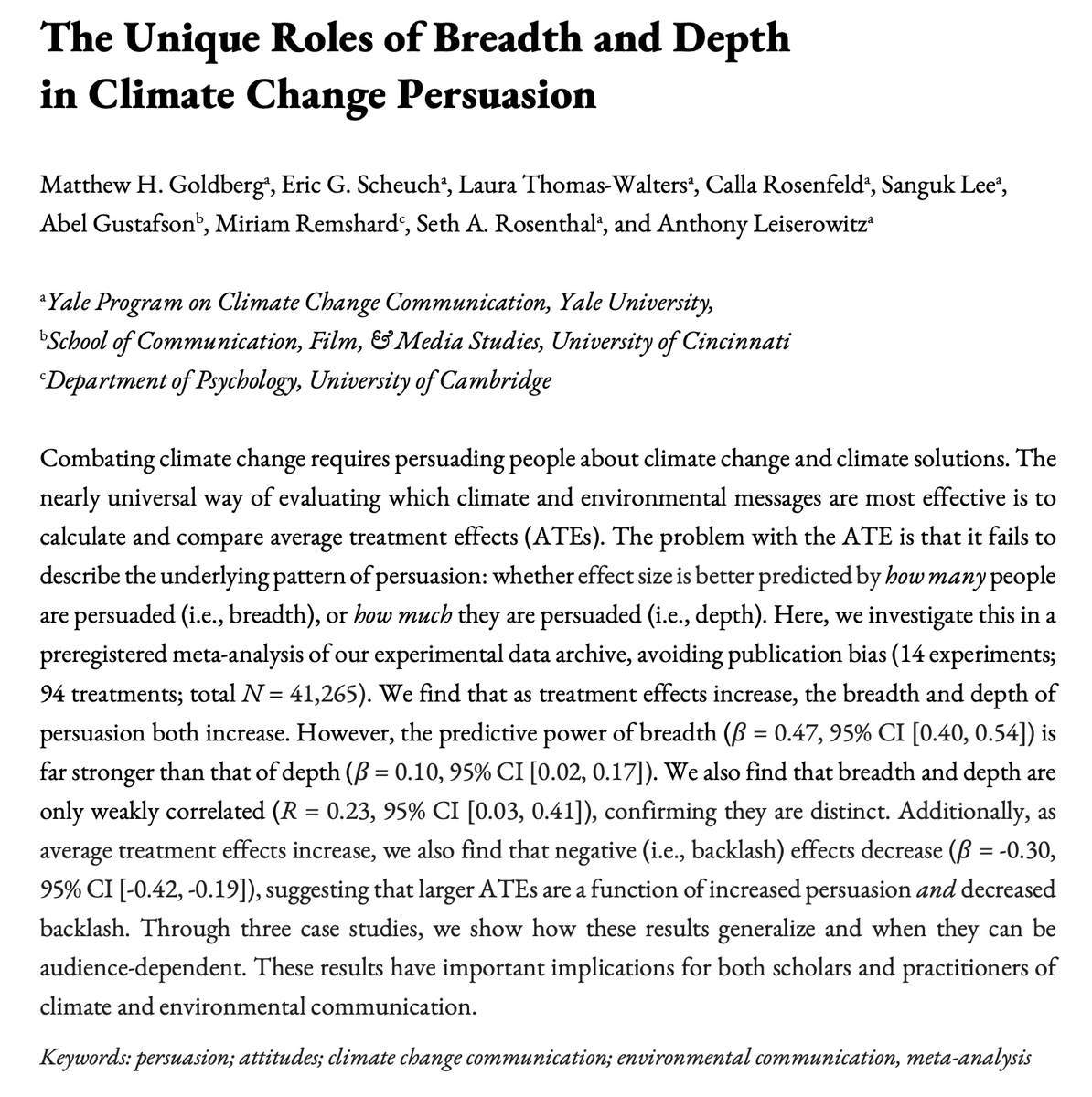
Do persuasive messages convince more people, or do they convince people to a larger degree?
In our new working paper, we examine this question with 14 experiments, 94 messages tested, and 41,265 participants.
Paper: osf.io/preprints/osf/puxth
1/x 🧵
1
18
62
6,891
14 Nov 2024
🚨New Preprint🚨
With a 2nd Trump term, local action on climate is crucial. However, most evidence we have on climate public opinion is on national policies. I remedy this through two surveys examining public opinion toward local climate policies (1/n)
osf.io/preprints/osf/xjnvq
1
2
5
413
14 Nov 2024
Overall, I show that local climate policy is broadly popular and can offset any policy rollback at the national level. I also offer data relevant to local policy design.
1
1
55
14 Nov 2024
Thanks to @ISPSYale for funding support, and @holcaggiano, @JoshuaBasseches and many others for their feedback. Excited to have this out and looking forward to thoughts and questions (end).
1
1
76
Eric G. Scheuch retweeted

2 Nov 2024
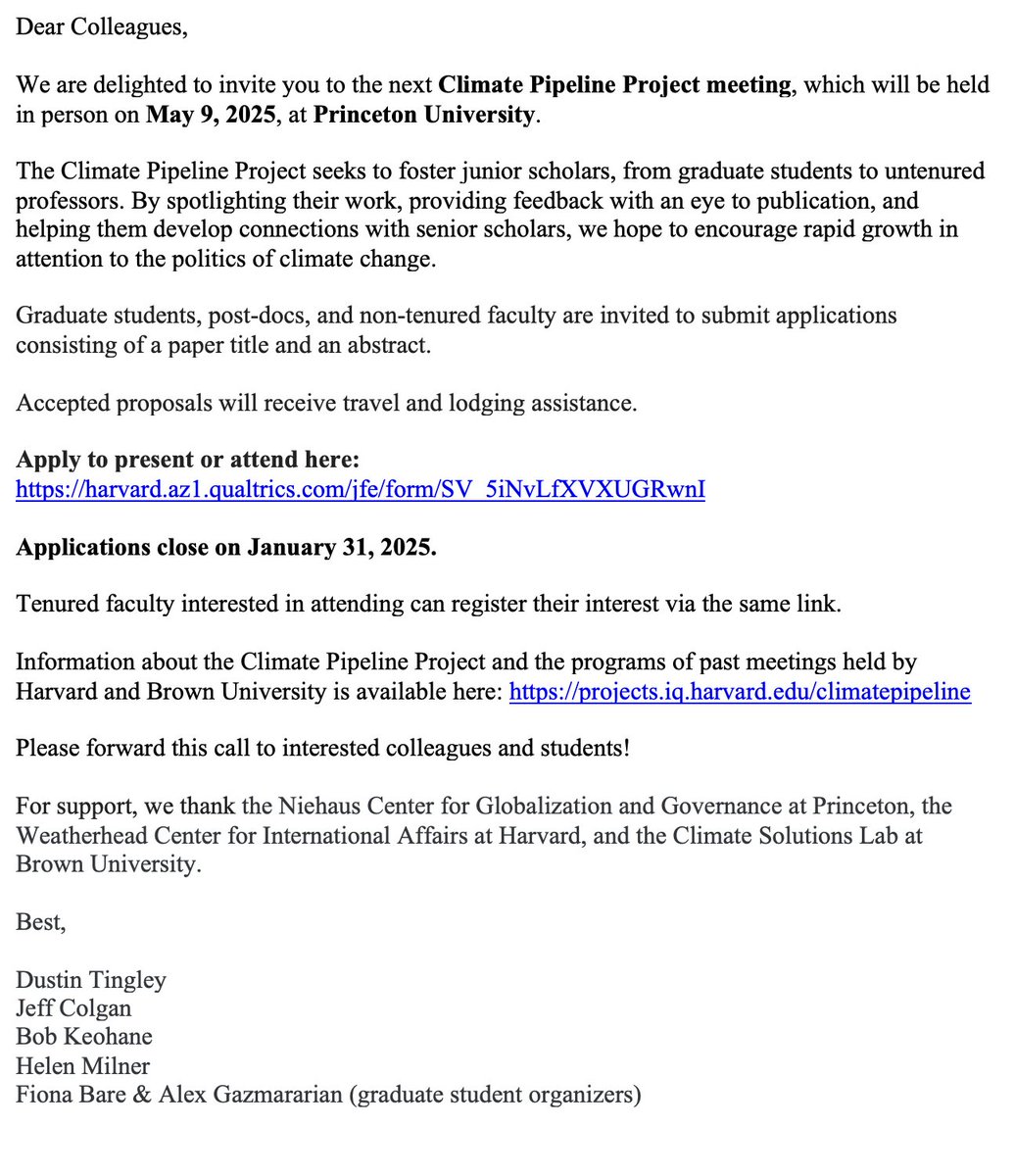
🌎The next Climate Pipeline Project meeting will be in May 2025 at Princeton!
This terrific initiative aims to foster junior scholars working on the politics of climate change.
Apply here: harvard.az1.qualtrics.com/jf…
More info and past programs: projects.iq.harvard.edu/clim…
18
64
13,004
Eric G. Scheuch retweeted

30 Oct 2024
This is for anyone who cares about the climate and is thinking about voting for Jill Stein or RFK Jr. or sitting this election out.
I get your frustration, but I'm asking you: please don't.
Here's why voting for Harris is the best move 🧵
23
196
768
76,971
Eric G. Scheuch retweeted

21 Oct 2024
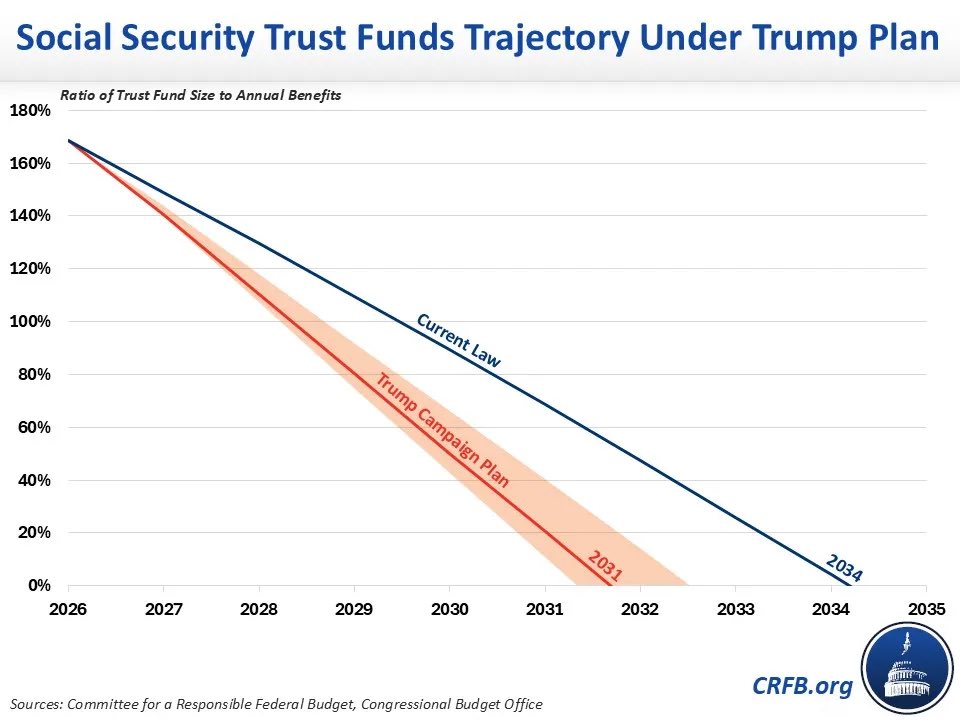
🚨 BREAKING 🚨 - Pres Trump’s campaign plans would lead to a 𝟑𝟑 𝐩𝐞𝐫𝐜𝐞𝐧𝐭 𝐒𝐨𝐜𝐢𝐚𝐥 𝐒𝐞𝐜𝐮𝐫𝐢𝐭𝐲 𝐂𝐮𝐭 ✂️ by driving the #SocialSecurity to 𝒊𝒏𝒔𝒐𝒍𝒗𝒆𝒏𝒄𝒚 by 𝟐𝟎𝟑𝟏.
See crfb.org/blogs/what-would-tr…
1/
The Trump plans will drain $𝟐.𝟑 𝐭𝐫𝐢𝐥𝐥𝐢𝐨𝐧 from the trust funds by ending taxation of benefits, eliminating taxes on tips and overtime, deporting immigrants, who currently pay payroll taxes, an increasing cost-of-living, and thus COLAs through higher tariffs.
47
284
490
321,876
16 Oct 2024
🚨Two new preprints alert!🚨
I have two new preprints out on climate activism, both co-authored with @LauraThoWal and great coauthors. They advance our knowledge of barriers to, and the impacts of, climate activism (1/n)
osf.io/preprints/socarxiv/4k…
osf.io/preprints/socarxiv/a7…
3
2
8
666
16 Oct 2024
We'd welcome any questions or feedback you have! I'd also like to thank other coauthors incl but not limited to @MattGoldberg100, @Ana_Sabherwal, & @geeshree. Excited to have these out in the world and to continue building knowledge on effective climate action. (end)
60
16 Oct 2024
The 2nd uses a nationally representative sample of the UK public measuring actual climate engagement to examine barriers to, and predictors of engagement in, climate action. We argue that social identification with activists is an under-appreciated factor:
osf.io/preprints/socarxiv/4k…
37
16 Oct 2024
In the first, we review 53 studies examining the impacts of climate activism on a variety of DVs. We find that CA is highly impactful across a range of DVs, particularly public opinion and media coverage. We also lay out a future research agenda on CA osf.io/preprints/socarxiv/a7…
1
41
6 May 2024
I have a new paper today in @PLOSClimate! I evaluate how voters weigh aspects of climate mitigation policies. (1/🧵)
journals.plos.org/climate/ar…
2
1
10
1,588
6 May 2024
I evaluate how voters weigh different aspects of climate mitigation policies. I include undertested variables, including policy level (state vs federal-voters prefer federal) and partisan sponsorship of the policy (voters prefer bipartisan, then Dem-only, then Rep-only policies).
1
1
109
Eric G. Scheuch retweeted

12 Apr 2024
Carbon dioxide in the atmosphere is increasing at a pace 100X faster than previous natural increases. Our planet is warming 10X faster than it has in 65 million years. CO2 has not been consistently above what it is right now in ~14 million years. That's today's Berardelli Bonus.
426
455
1,011
186,539